


In order to show how blockchain platforms are converting conventional fixed-income assets into on-chain, yield-generating opportunities with transparency, liquidity, and worldwide accessibility for both retail and institutional investors, I will go over the Top DeFi Protocols with Real Yield from Tokenized Bonds.
Why Use DeFi Protocols with Real Yield from Tokenized Bonds
Real-World Backed Returns – income streams which are predictable and profitable can be sustainably earned from U.S. Treasuries and regulated bond instruments, as opposed to inflationary token rewards.
24/7 Global Liquidity – With bond-backed tokens, trading and rebalancing can be done any time to increase the overall flexibility of the portfolio, and to be more efficient with the capital.
Lower Counterparty Risk – Transparency of the chain, with the audits reserves and the regulated custodians, lowers the reliance on centralized institutions and opaque middlemen.
DeFi Composability – tokenized bonds can be used as collateral for liquidity pools and other yield strategies which can add several income layers from one tokenized bond.
Institutional-Grade Access – Providing a global access to fixed income investing, it is democratizing the bond markets.
Key Point & Best DeFi Protocols with Real Yield from Tokenized Bonds
| DeFi Protocol | Key Point |
|---|---|
| Ondo Finance | Tokenizes U.S. Treasury and bond products, offering compliant, on-chain real yield with institutional-grade risk management and transparent NAV tracking. |
| Matrixdock (STBT) | Provides tokenized short-term Treasury exposure through STBT, enabling stable, low-volatility yield backed by regulated custodians and real-world bond reserves. |
| Superstate | Bridges traditional asset management and DeFi by offering tokenized government bond funds with daily liquidity, compliance layers, and investor-grade reporting. |
| Backed Finance | Issues fully collateralized tokenized bonds and ETFs, ensuring transparent proof-of-reserves, cross-chain compatibility, and secure real-yield access for DeFi users. |
| Maple Finance | Delivers institutional lending and yield strategies using tokenized debt instruments, combining on-chain transparency with professional credit underwriting. |
| Centrifuge | Connects real-world assets and bond cash flows to DeFi liquidity pools, allowing investors to earn yield from tokenized invoices and structured debt. |
| Clearpool | Enables decentralized credit markets where institutions borrow against on-chain liquidity, generating real yield through transparent, risk-rated bond-like pools. |
| Credix | Focuses on emerging market private credit, tokenizing fixed-income opportunities to deliver stable, real-world yield backed by off-chain legal agreements. |
| TrueFi | Provides uncollateralized and bond-style lending pools with DAO governance, offering yield derived from verified institutional borrowers and on-chain credit scoring. |
| Securitize | Specializes in compliant tokenization of bonds and securities, enabling regulated DeFi access to real-yield assets with KYC, custody, and investor protections. |
1. Ondo Finance
Best DeFi Protocols with Real Yield from Tokenized Bonds Ondo Finance is an exceptional DeFi service that combines traditional finance and decentralized finance by using on-chain assets that are tokenized. These assets range from U.S.

Treasury and corporate debt, to money market instruments. For instance, Ondo’s OUSG and USDY products offer stable cash flow by real yield for less than U.S.
Treasury and corporate debt, all while utilizing the blockchain technology. Ondo is the first platform that integrates compliance and institutional-grade risk control, which allows regulated and DeFi users to invest in bond-like products. The governance token ONDO grants holders the right to participate in decision-making for the protocol.
Ondo Finance Features, Advantages & Disadvantages
Features
- He tokenizes U.S. Treasuries and other fixed-income assets on the blockchain.
- He offers liquid tokenized bond funds (e.g., tokens of short-term government bonds).
- He has a partnership with several DeFi liquidity pools and yield aggregators.
- There is continuous yield accrual with a transparent net asset value (NAV).
- It is possible to bridge to and from different blockchains.
Advantages
- There is a real yield from U.S. government bonds.
- Traditional bonds are no longer as tradeable.
- There is a bond token with limited circulation to buy.
- 公司 high transparency and audited holdings.
- This is a simple and transparent way for DeFi users to buy bonds with a low risk.
Disadvantages
- There are regulatory obligations.
- There may be a lack of on-chain liquidity.
- A DeFi user may have to upload their on-chain account to a regulated financial institution.
- There is still the risk of Smart Contracts.
- Outcomes sometimes yield less than other, riskier DeFi people strategies.
2. Matrixdock (STBT)
Best DeFi Protocols with Real Yield from Tokenized Bonds Matrixdock (STBT) includes tokenized short-term U.S. Treasury Bills (STBT), which are considered to be one of the safest assets in the traditional fixed-income sector.
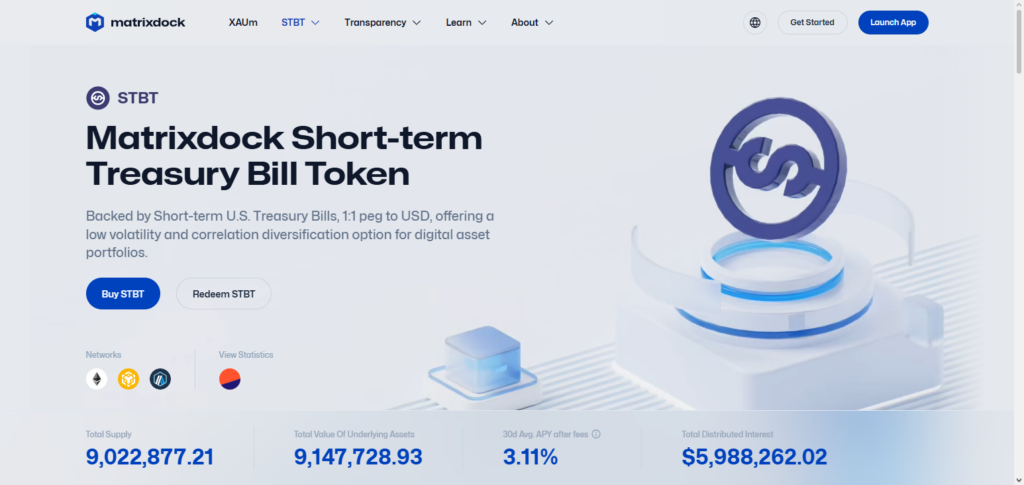
Each STBT token, which is short for U.S. Treasury Bills, is 1:1 fully backed by a U.S. Treasury bill, pegged to the USD, and distributes yield using a daily rebasing mechanism. This mechanism reflects the interest earned in users’ token balances, in the real-world.
While primarily accessible by accredited investors, STBT improves portfolio diversification in DeFi by generating steady returns from low-volatility government securities. Using transparency through Proof-of-Reserve and blockchain, Matrixdock is a great option for obtaining traditional Treasury yields in decentralized markets.
Matrixdock (STBT) Features, Advantages & Disadvantages
Features
- STBT offers vehicle of tokenized short-term Treasury bills.
- Securitized with U.S. Treasury T-bills through an SPV.
- A static interest accrual feature, called Rebase.
- On the ERC-1400 standard for security tokens.
- Tailored for accredited and institutional market participants.
Advantages
- Real yield from government T-bills.
- Preservation of principal due to short durations.
- Increased flexibility due to on-chain tradability.
- Priority claim on underlying assets due to the SPV structure.
- Bridging of institutional and DeFi liquidity.
Disadvantages
- Frequent limitation to accredited investors.
- Legal complexities and varying degrees of compliance.
- Tooling limitations due to less familiar token standard.
- Limited integrations that are friendly to retail participants.
- Possible fragmentation of liquidity.
3. Superstate
Best DeFi Protocols with Real Yield from Tokenized Bonds Superstate is an asset tokenization platform that aims to get traditional financial products like short-duration U.S. government securities on-chain as digital tokens. Funds tokenized by Superstate, like USTB short-duration government securities fund, provide yield from Treasury bills and government bonds, and also utilize blockchain technology for added efficiency.
These ERC-20/SPL tokens are legal shares of the regulated fund and feature near-instant settlement and real-time updates to net asset value. Superstate places significant emphasis on regulatory adherence and the protection of investors; as such, the firm combines traditional institutional asset management with the rapidity and programmability of DeFi for qualified purchasers.
Superstate Features, Advantages & Disadvantages
Features
- Tokenized short-duration government securities.
- Compliancy with U.S. securities laws
- Continuous NAV Pricing
- Blockchain-native issuance
- Capability to integrate with DeFi protocols
Advantages
- Government yield On-chain.
- Safety of regulatory compliance.
- Continuous settlement and pricing
- Inclusion of institutional support
- Fixed-income exposure in DeFi
Disadvantages
- Regulatory compliance is inhibiting to scaling.
- Limited to accredited investors.
- Lack of support on DeFi rails.
- Decreased secondary liquidity compared to TradFi.
- Residual smart contract and custody risks.
4. Backed Finance
Best DeFi Protocols with Real Yield from Tokenized Bonds Backed Finance also tokenizes traditional financial instruments such as stocks and bond ETFs and enables them to be used on-chain as fully backed bTokens.
While Backed may not solely concentrate on sovereign debt and other bonds, the tokenized bonds and fixed-income assets, which are tradeable and may be utilized in DeFi strategies, are held by regulated custodians.
Backed offers the tokenized instruments in the case of the tokenized instrument offerings the yield is real, that is, the cash flow is positive, and this is obtained through financial products which underlie them. Backed Finance is innovative in offering Proof of reserves and employs blockchain tokenization to offer traditionally illiquid and inaccessible asset classes.
Backed Finance Features, Advantages & Disadvantages
Features
- Tokenization of real-world assets like government bonds.
- Collaborates with regulated entities.
- Provides the issuance and management of security tokens.
- Merges with DeFi protocols.
- Emphasis on legal compliance and custody.
Advantages
- Access to real yields that have low risk.
- Institutional reporting & custody.
- Integration of DeFi and TradFi.
- On-chain collateralization.
- Ownership via blockchain (transparent).
Disadvantages
- Complexity of regulation.
- Investment KYC/AML.
- Potential for innovation cycles.
- Liquidity based on asset class.
- DeFi’s high risk vs lower yield.
5. Maple Finance
Best DeFi Protocols with Real Yield from Tokenized Bonds Maple Finance is not strictly a bonds protocol, it is a decentralized credit market. Here, institutional and qualified investors lend to corporate or institutional borrowers through structured pools.
Yield from Maple’s tokenized debt instruments is from the borrower’s side, and is funded through the interest that these borrowers pay, which, in most cases, is higher than the average yield in the DeFi space.
With products like Syrup, other DeFi participants are able to enjoy the credit yield that was previously institutional grade, and is now made available for small accredited investors. Maple’s credit strategies have been complemented by blockchain transparency to deliver strong net returns on certain pools.
Maple Finance Features, Advantages & Disadvantages
Features
- Offers a decentralized credit ecosystem.
- Pooled funding to lend to large scale institutional borrowers.
- Offers both over-collateralized and uncollateralized lending options.
- Allows lenders to earn interest on their investments.
- Decentralized oracles and ecosystem participants conduct credit assessments.
Advantages
- Yield from institutional credit.
- Ability to see all the variables and terms of a loan.
- More diversified yield sources compared to holding DeFi native tokens.
- Higher access to institutional grade borrowers.
- More decentralized institutional credit.
Disadvantages
- Possibility of default on loans.
- Less certainty with the yield compared to holding government bonds.
- Risks may be a little harder to gauge for average to retail investors.
- Less liquidity depending on the pool.
- Risk of smart contracts.
6. Centrifuge
Best DeFi Protocols with Real Yield from Tokenized Bonds Centrifuge makes it possible to finance and tokenized real-world assets like invoices, loans, and private credit on-chain across pools.
Tranche-like instruments from structured finance allow investors to receive payment streams from actual borrowers that are distributed to token holders. Centrifuge’s Tinlake protocol integrates DeFi with traditionally non-liquid assets, creating a diversified yield generating source that is uncorrelated with the crypto market.
It has developed a notable size for tokenized assets and in conjunction with other DeFi protocols, it is improving asset liquidity and providing real yields with actual cash flows.
Centrifuge Features, Advantages & Disadvantages
Features
- Ability to tokenize invoices, receivables, and other real world assets (RWAs).
- Employs the use of Tinlake pools for investor participation.
- Acceptance of major stablecoins as collateral.
- Connections with larger DeFi ecosystems, such as MakerDAO.
- Cash flows from the asset back yield to the investors.
Advantages
- Real yield with real commercial use assets.
- More diversified sources of yield from DeFi.
- Can fuel SME financing.
- On-chain collateral and automation.
- Integration expands utility of tokens.
Disadvantages
- Underwriting risk of real companies.
- Market depth depends on asset demand.
- Complexity for retail participants.
- Receivables cash flow unpredictability.
- Smart contract/custody risk.
7. Clearpool
Best DeFi Protocols with Real Yield from Tokenized Bonds Clearpool operates a decentralized credit market where liquidity providers lend to institutions and earn interest from those loans.
While more like corporate credit than traditional bonds, Clearpool’s pools resemble tokenized debt instruments, with yields based on the borrowers’ risk and loans’ terms.
The protocol supports lender and borrower pairs through a marketplace model with unambiguous fee and risk assessment structures. The liquidity providers’ returns are from the real paying credit market as opposed to the synthetic yield farming prevalent in DeFi.
Clearpool Features, Advantages & Disadvantages
Features
- Decentralized credit markets for institutions.
- Lenders provide capital via pools.
- Smart contract underwriting guardrails.
- Borrowers pay real interest.
- Multiple market integrations (e.g., Optimistic chains).
Advantages
- Earns real yield from institutional borrowers.
- On-chain transparency of loans.
- Permissionless or semi-permissionless lending.
- Diversifies yield sources in DeFi.
- Flexible pool incentives.
Disadvantages
- Borrower default risk.
- Pool yields tied to credit quality.
- Not as simple for novice users.
- Liquidity may vary.
- Smart contract risk.
8. Credix
Best DeFi Protocols with Real Yield from Tokenized Bonds Credix focuses on private credit in emerging markets by tokenizing the fixed income instruments and disseminating them through the blockchain.

Investors receive returns from the interest earned on loans from approved borrowers, with the tokenized debts being tradeable on the applicable networks. The method employed by Credix introduces diversified real-world credit returns into the DeFi framework with yield profiles resembling structured debt instruments.
While these are not government bonds, the focus on fixed income and real yield from actual borrowers stretches DeFi’s boundaries to include something beyond crypto-native assets.
Credix Features, Advantages & Disadvantages
Features
- Connects DeFi capital with FinTech and business borrowers.
- Tokenized credit pools.
- Earn yield from real loan interest.
- Focus on emerging markets.
- Allows diversified credit exposure.
Advantages
- Real economic activity underpins yield.
- Diversifies beyond crypto yield.
- Broad access to frontier credit markets.
- Structured risk pools for investors.
- Can integrate with DeFi liquidity.
Negative Aspects
- Compared to government bonds, there is greater credit risk.
- Greater exposure to emerging markets yields greater volatility.
- Risk assessment becomes more difficult.
- Certain areas have greater regulatory risk.
- The liquidity can be shallow.
9. TrueFi
Best DeFi Protocols with Real Yield from Tokenized Bonds TrueFi offers uncollateralized lending with bonds style lending pools where investors lend to selected borrowers and receive interest commensurate with the credit risk.
TrueFi’s lending instruments are pooled and yield the loans based on the performance of the underlying loan, providing fixed income like returns in DeFi. The TRU token governance Robs risk and borrower acceptance. TrueFi’s pool yields are the actual payments from institutional borrowers, providing a means to generate yield similar to tokenized bonds without the typical collateral.
TrueFi Features, Advantages & Disadvantages
Features
- Unsecured, on-chain lending is possible.
- Lenders can receive interest on their stablecoins.
- There is a credit committee and voting among the token holders.
- The performance of each borrower is available to the public.
- There can be several lending pools for each lending credit.
Advantages
- The interest from lending is a real yield.
- The voting and approval processes are transparent.
- Removing the over-collateralization requirement increases yield.
- Lenders have a stable income.
- The community can vote on credit.
Disadvantages
- There is a risk of default, and the possible decline in the quality of credit.
- The system requires active governance.
- The system is not suitable for capital preservation.
- The liquidity is dependent on the participation of that pool.
- There is a risk with the smart contracts.
10. Securitize
Best DeFi Protocols with Real Yield from Tokenized Bonds Securitize (through its tokenization platform) enables compliant tokenized securities, such as fixed income and money market funds, including significant institutional products like BlackRock’s tokenized fund, BUIDL.

These tokenized financial assets produce yield from traditional fixed income sources like U.S. government and corporate bonds and operate on the blockchain.
Securitize focuses on compliance and integrating KYC/AML with real-time NAV monitoring and liquidity on the secondary market. His services are tailored for institutions to facilitate the issuance and management of tokenized bonds and securities, the integration of genuine yield to DeFi.
Securitize Features, Advantages & Disadvantages
Features
- There is issuance and management of security tokens within the regulations.
- Tokenization of bonds, funds, and other real world assets.
- Provision of compliance and transfer agent services.
- Secondary trading and on-chain settlement.
- Integrated with custodians for institutions.
Advantages
- The real yields can be linked to real, registered securities.
- There is more safety due to the legal compliance.
- There is a greater variety of assets.
- The real assets can now be used in DeFi.
- There is support for institutions.
Disadvantages
- There are strict compliance regulations.
- There are strict onboarding requirements (KYC/AML).
- The level of liquidity varies based on the types of investors involved.
- Some tokens do not have continuous trading.
- May need accredited investor status.
Conclusion
DeFi is changing as a result of the emergence of tokenized bonds, which provide steady, transparent, and real-world yield from conventional fixed-income markets. Institutional-grade assets like corporate debt and U.S.
Treasuries are being connected with on-chain accessibility and programmability through platforms like Ondo Finance, Matrixdock, Superstate, and Securitize. Meanwhile, through tokenized private debt and structured lending, credit-focused protocols like Maple Finance, Centrifuge, Clearpool, Credix, and TrueFi increase yield prospects.
When combined, these platforms lessen the need for speculative token incentives and advance DeFi toward income-driven, sustainable, and compliance-friendly growth supported by actual financial instruments.
FAQ
What are tokenized bonds in DeFi?
Tokenized bonds are digital representations of traditional fixed-income securities—such as government or corporate bonds—on a blockchain. They enable investors to earn real yield from interest payments while benefiting from on-chain settlement, transparency, and fractional ownership.
How do tokenized bonds generate real yield?
Real yield comes from the actual interest earned by the underlying bond or debt instrument. When these assets are tokenized on DeFi platforms, the yield is passed through to token holders, often in the form of periodic rewards or price appreciation.
Do I need KYC/AML to invest in these protocols?
Some protocols (like Ondo Finance or Superstate) require KYC/AML verification due to regulatory compliance, while others (like TrueFi or Centrifuge) may allow broader participation. Always check each platform’s requirements before investing.
Are tokenized bonds safer than typical DeFi yield farming?
Generally yes. Because tokenized bonds are backed by real-world financial assets, they tend to have lower volatility and more predictable returns than high-risk yield farming strategies that rely on volatile crypto tokens or complex incentives.