


In this article, I will cover the most effective Open Banking Protocols for Instant Bank Verification that assist fintech companies, trading platforms, and financial institutions with the speedy and secure verification of bank accounts.
The usage of these Open Banking Solutions leads to rapid data access and the streamlining of the customer verification process. They also strengthen compliance procedures while decreasing fraud risks. For these reasons, they help meet the demands and requirements of contemporary digital banking services.
Why Open Banking Protocols for Instant Bank Verification
Faster Customer Onboarding – Verifies bank accounts and minimizes onboarding time by performing account checks in real-time.
Better Security – Protects financial information through the use of secure APIs and encryption.
Lower Fraud Probability – Verifies account ownership directly through financial institutions.
Better User Experience – Manual uploading of documents is eliminated, and time-consuming verification procedures are shortened.
Adherence to Regulations – Assists businesses in following KYC, AML, and other financial regulations.
Instant Data Access – Offers immediate access to current account balances and recent transactions.
Enhanced Verification Accuracy – Eliminates manual data entry and verification mistakes.
Reduced Costs – Lowers the cost of operations by automating verification procedures.
Connects to Global Banking Systems – Accessibility to numerous banks and financial institutions throughout the world.
Designed for Growth – Performance and security are not negatively impacted through the increase in the number of customers that the software is meant to serve.
Key Point & Best Open Banking Protocols for Instant Bank Verification
- Plaid – Provides instant bank account verification and financial data connectivity across thousands of institutions.
- TrueLayer – Enables secure open banking APIs for real-time account verification and payments across Europe and beyond.
- Yodlee – Offers comprehensive financial data aggregation and account verification for fintech and trading platforms.
- Yapily – Delivers open banking infrastructure with direct bank connectivity for fast customer onboarding.
- Finicity – Specializes in real-time financial data access and bank account verification for lending and investment apps.
- Tink – Supports account aggregation, identity verification, and payment initiation through a single API.
- Salt Edge – Provides PSD2-compliant open banking solutions with extensive global bank coverage.
- OpenWrks – Focuses on secure UK open banking connectivity for account verification and financial data sharing.
- Codat – Connects financial software and banking data to streamline business verification and financial analysis.
- BusinessScreen – Offers digital onboarding, AML checks, and bank account verification tools for regulated financial services.
10 Best Open Banking Protocols for Instant Bank Verification
1. Plaid
Plaid is an effective open-banking application. It connects fintech applications to many financial institutions across North America and Europe. Banks provide APIs to allow verification and authentication of financial information, transaction histories, and account balances.

They also allow verification of users’ identities. Plaid expedites the onboarding process of trading applications by reducing the need for manual verifications and improves the overall tedious compliance process.
Plaid is one of the the Best Open Banking Protocols for Instant Bank Verification due to its superior cybersecurity efforts, ease of integration, and dependable service. Its vast network of financial institutions provides the ideal banking solution for trading applications and other fintech solutions across the globe.
Plaid Features, Pros & Cons
Features
- Fast verification of bank accounts
- Aggregation of financial data
- Tools for verifying identity
- Access to transactions and balances
- API for developers
Pros
- Covers numerous banks
- Simple to implement
- Strong fintech relations
- API is dependable
- Great documentation for developers
Cons
- Mainly covers North America
- Higher costs for advanced features
- Coverage of other regions is lacking
- Relies on other banks
- Expensive enterprise plans
2. TrueLayer
TrueLayer is an open banking solution with direct access to numerous financial institutions across Europe and other countries and provides real-time financial data.
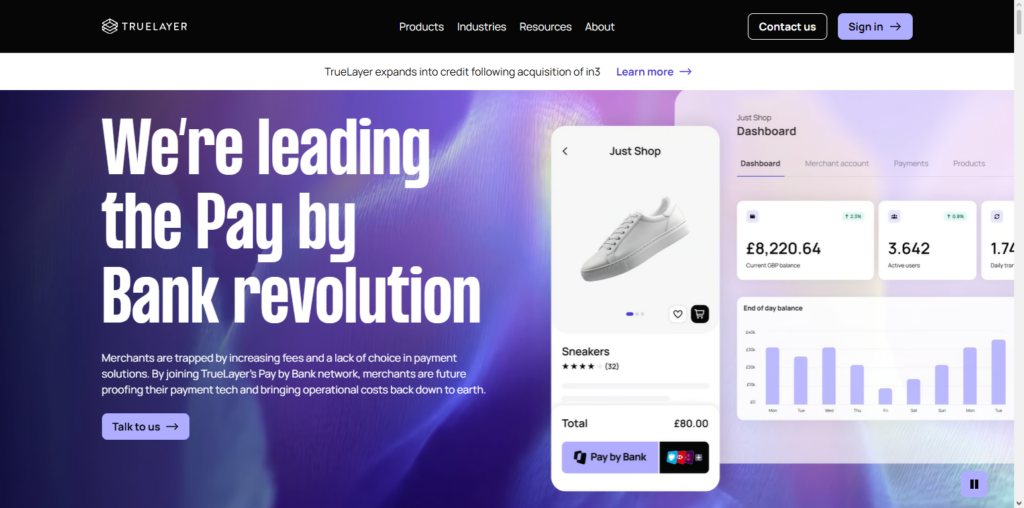
It allows instant account verification and secure payments through a single API. Trading applications use TrueLayer to onboarding customers quickly and easily within the requirements of compliance frameworks.
TrueLayer is one of the Best Open Banking Protocols for Instant Bank Verification due to its reliability in banking integrations and support for the PSD2 framework.
TrueLayer’s ability to provide real-time data is vital for the reduction of fraudulent activities and the improvement of users’ confidence and the overall performance of trading applications.
TrueLayer Features, Pros & Cons
Features
- Real-time verification of bank accounts
- Open banking with initiations of payments
- Verified bank connections
- Checks for ownership of bank accounts
- APIs that are compliant with PSD2
Pros
- Strong coverage of Europe
- Fast to setup
- Secure authentication
- Reliable APIs
- Direct bank payments
Cons
- Only covers certain areas
- Cost can depend on usage
- Can be difficult to integrate for some
- Varies by bank for country coverage
- Higher costs for advanced features
3. Yodlee
For a long time, Yodlee has been at the forefront of financial data aggregation and open banking. Using APIs, the platform provides access to financial data, transaction data, account balances, and even identity data. Banking apps utilize Yodlee for its speed, accuracy, and compliance.
Rated as one of the Best Open Banking Protocols for Instant Bank Verification, Yodlee’s global footprint and data coverage from numerous financial institutions allows ease in data access.
Its strong analytical tools allow firms to derive deeper behavioral insights on customers’ finances while enabling secure and fast verification.
Yodlee Features, Pros & Cons
Features
- Aggregation of financial accounts
- Verified accounts
- Classification of transactions
- Financial analytics
- Enriching data
Pros
- Well established in the industry
- Strong relations with banks
- Large amounts of financial data
- Strong analytics
- Good for enterprise users
Cons
- Complex to integrate
- High costs for startups
- Less appealing UI
- Setup requires deep knowledge
- Difficult to customize
4. Yapily
Yapily is a game-changing Open Banking infrastructure developer that makes it possible for businesses to have direct bank access via standardized APIs. The platform aims to make financial data and payment access easy without the need for the intrusive process of screen scraping.
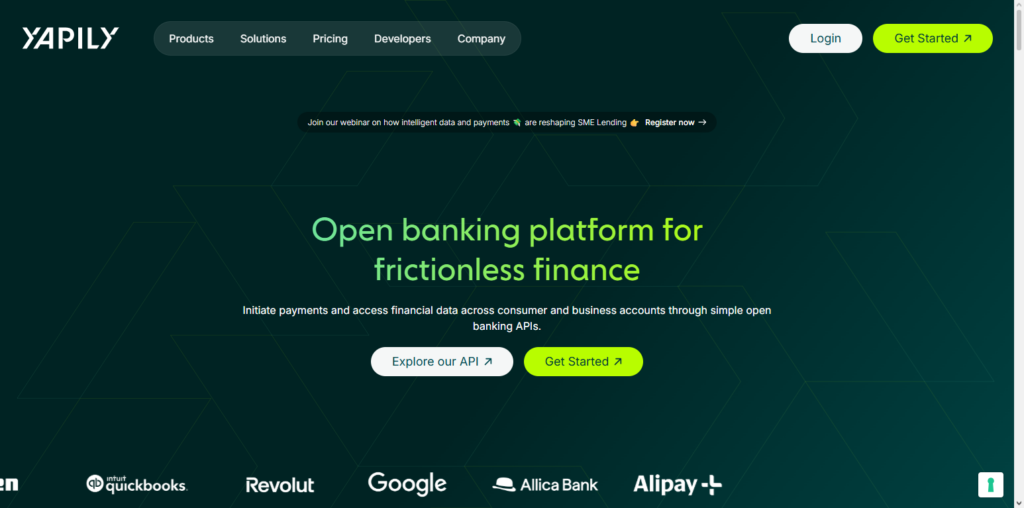
Financial apps rely on Yapily for secure account verification, customer authentication, and data access. Rated as one of the Best Open Banking Protocols for Instant Bank Verification, Yapily has a strong compliance framework, reliable bank connectivity, and its infrastructure is built to scale.
With its developer tools, Yapily allows firms secure and compliant data access to multiple jurisdictions allowing them to design seamless onboarding experiences.
Yapily Features, Pros & Cons
Features
- Open banking API platform
- Account information services
- Payment initiation support
- Secure bank connectivity
- Multi-country banking access
Pros
- Developer-focused platform
- Strong compliance support
- No screen scraping approach
- Scalable infrastructure
- Reliable API performance
Cons
- Limited global coverage compared to larger providers
- Some markets have fewer bank connections
- Advanced features may increase costs
- Requires technical implementation
- Smaller ecosystem than competitors
5. Finicity
Finicity, a Mastercard subsidiary, provides the fintech, lending, and investment sectors with real-time financial data and account verification services. Its services help businesses verify bank accounts instantaneously and access financial data directly from partner institutions.
Trading apps utilize Finicity’s secure API ecosystem. The system lessens user onboarding and friction and increases the reliability of customer verification. Finicity ranks among the Best Open Banking Protocols for Instant Bank Verification for the additional financial insights, transaction tracking, and income verification services it provides.
Its reputation and financial institution partnerships help companies needing secure financial services and regulatory compliance.
Finicity Features, Pros & Cons
Features
- Instant account verification
- Data aggregation
- Income verification
- Transaction monitoring
- Account insights
Pros
- Mastercard backing
- Great security
- Reliable data
- Great verification
- Trusted FIs
Cons
- Focused on N. America
- Pricing high for small biz
- Limited international coverage
- Enterprise onboarding takes time
- Features need more integrations
6. Tink
Tink is a leading provider of open banking services, and offers a consolidated API for account aggregation, payment initiation, and financial data services. Its platform facilitates connections to thousands of banks and provides businesses with the ability to perform instant account verification and secure customer authentication.
Trading apps use Tink to improve user experience, speed up the onboarding process, and aid compliance of regulatory requirements.
Tink is also recognized among the Best Open Banking Protocols for Instant Bank Verification for its extensive security, coverage across Europe, and flexibility in integration. Its real-time financial data services allow organizations to make quicker, low-risk business decisions and help prevent fraudulent activities.
Tink Features, Pros & Cons
Features
- Account aggregation
- Payment initiation
- Data access
- Identity verification
- Unified API
Pros
- Most European bank coverage
- Great dev tools
- Great data
- Easy integrations
Cons
- Coverage outside Europe is poor
- Some features country specific
- Premium features costly
- Regulatory requirements vary
- Advanced onboarding needs dev resources
7. Salt Edge
Salt Edge is a global, open banking provider. They offer extensive bank coverage and have a great PSD2 infrastructure. They offer APIs for account information, payment initiation, and real-time bank account verification.
They focus on banks, fintechs, and even trading applications, to improve the customer onboarding experience and compliance.
They are known as one of the Best Open Banking Protocols for Instant Bank Verification, as they cover connections to thousands of banks. They have great security and frameworks which protects data and meets regulations, making them a great partner wherever you do business globally.
Salt Edge Features, Pros & Cons
Features
- Global bank connectivity
- PSD2-compliant APIs
- Account information services
- Payment initiation
- Secure authentication
Pros
- Broad international reach
- Strong compliance skills
- Secure data
- Flexible solutions
- Extensive bank network
Cons
- May require technology skills for integration
- Varies by market
- Cost structures are based on usage
- May incur higher costs for advanced features
- Limited brand recognition relative to major competitors
8. OpenWrks
OpenWrks is another open banking provider based in the U.K. They offer a way to access bank data in a secure manner, through regulated APIs. They offer account verification, transaction analysis, affordability, and customer authentication as services.
Trading platforms can use OpenWrks to meet regulations and minimize fraud by quickly verifying user accounts.
They are ranked as one of the Best Open Banking Protocols for Instant Bank Verification because they offer great connectivity in the U.K. banking industry. Their service and compliance focus makes them especially useful to regulated fintech and financial service providers.
OpenWrks Features, Pros & Cons
Features
- Open banking services
- Account Verification
- Transaction Assessments
- Affordability Tests
- Secure customer verification
Pros
- Fast services for UK banking
- Good compliance assistance
- Strong Verifications
- Simple solutions
- Improvements in Financial Health
Cons
- UK centric
- Limited International Services
- Small banking network compared with global providers
- Customized Enterprise solutions are complex
- Suboptimal for Multinational Enterprises
9. Codat
Codat links various financial applications, accounting software, and even banking systems via a single API. Codat is primarily known for their accounting integrations, but they also offer financial data and business verification solutions to improve workflow and customer onboarding.
Codat is a great option for trading and fintech companies that need to access valid financial data and automate verification business and financial flows.
Codat is known for being one of the Best Open Banking Protocols for Instant Bank Verification because it easily allows companies to access a variety of standardized financial data. Because of the automated systems that Codat has in place, companies are able to validate financial flows with a great degree of confidence and in a very short timeframe.
Codat Features, Pros & Cons
Features
- Financial software integrations
- Business data connectivity
- Accounting platform synchronization
- Automated data collection
- Financial reporting support
Pros
- Excellent accounting integrations
- Simplifies business verification
- Strong automation capabilities
- Reduces manual data entry
- Flexible API architecture
Cons
- Not purely focused on banking verification
- Some integrations require additional setup
- Pricing may increase with usage
- Advanced features have learning curve
- Limited consumer banking focus
10. BusinessScreen
BusinessScreen assists companies in heavily regulated industries with customer verification workflow and automated compliance checks for digital onboarding services. The combination of open banking and compliance services allows BusinessScreen customers to verify their clients with ease and confidence.
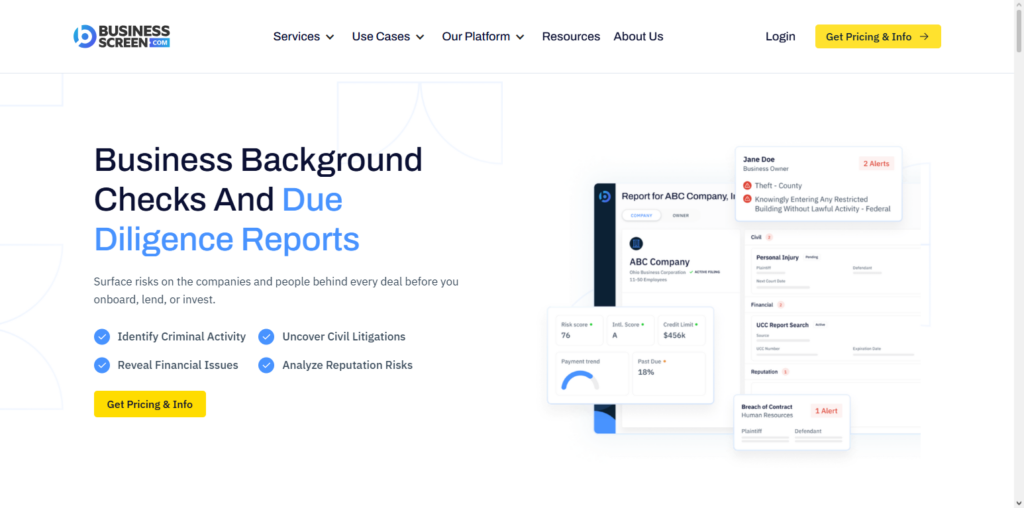
BusinessScreen is popular among trading applications to bolster the Know Your Customer (KYC) requirements and to help streamline the digital customer onboarding workflow. Recognized as one of the Best Open Banking Protocols for Instant Bank Verification,
BusinessScreen has the ability to conduct secure financial data assessments, automation, and compliance check services. The unique services of BusinessScreen allows financial service companies to limit the risk of fraud, and serve their customers verification requests in a more efficient manner.
BusinessScreen Features, Pros & Cons
Features
- Digital onboarding
- KYC verification
- AML compliance
- Bank verification
- Risk assessment
Pros
- Full compliance coverage
- Great fraud prevention
- Fast onboarding
- Good for regulated fields
Cons
- Generally more compliance-focused than banking-focused
- Complex implementation for small businesses
- Higher premium for power-users
- Greater Need for Regulatory Understanding Compared to Other Tools
- May Offer More Complexity than Some Small Businesses Require
Conclusion
As more and more global trading apps hit the market, fast and secure bank verification for seamless user onboarding, fraud diminishment, and compliance with the latest regulations will become critical.
The Best Open Banking Protocols for Instant Bank Verification includes Plaid, TrueLayer, Yodlee, Yapily, Finicity, Tink, Salt Edge, OpenWrks, Codat, and BusinessScreen. These offer valuable bank data via secure API and allow businesses to easily validate user bank accounts and bolster regulatory compliance and user trust.
Choosing a good open banking tool, trading apps have the chance to optimize their operations and approve users more swiftly and securely as a financial system.
FAQ
What is open banking and how does it support instant bank verification?
Open banking allows authorized third-party applications to securely access banking data through APIs. It supports instant bank verification by enabling real-time confirmation of account ownership, balances, and financial information without requiring manual document uploads.
Why is instant bank verification important for trading apps?
Instant bank verification helps trading apps onboard users faster, reduce fraud risks, improve compliance with financial regulations, and provide a smoother customer experience by eliminating lengthy verification procedures.
Which are the Best Open Banking Protocols for Instant Bank Verification?
Some of the leading solutions include Plaid, TrueLayer, Yodlee, Yapily, Finicity, Tink, Salt Edge, OpenWrks, Codat, and BusinessScreen. These platforms offer secure bank connectivity, real-time verification, and regulatory compliance features.
Are open banking protocols secure?
Yes. Most open banking providers use bank-grade encryption, secure APIs, multi-factor authentication, and regulatory frameworks such as PSD2 to protect customer data and prevent unauthorized access.
How do open banking APIs reduce fraud?
Open banking APIs connect directly with financial institutions to verify account ownership and banking information in real time, making it more difficult for fraudsters to submit fake or manipulated account details.