


In this article you will find the top verified Smart Contract auditing software to secure Smart Contract implementations pre-deployment for developers and businesses using Blockchain.
The best auditing tools, critical features along with pros, cons and how they enhance code security, help discover weaknesses in code and faulty Blockchain based applications will be outlined.
What is Smart Contract Auditing Software?
Smart contract auditing software assesses the security of smart contracts on a blockchain by examining coding errors, deficiencies in logic, and compliance concerns. This software identifies vulnerabilities with static analysis, symbolic execution, fuzz testing, and formal verification.
Used correctly, these tools will help smart contracts remain compliant with protections to safeguard digital assets and industry smart contract compliance. Organizations can deploy decentralized applications (dApps) with confidence due to the built-in auditing software.
These tools also help developers optimize smart contract coding with suggestions for error avoidance using best practices of the industry for code quality. Integrating auditing software during development can decrease the risks of deploying code and improve the security and confidence level for reliability of dApps.
Why Smart Contract Auditing Software for Verification
Identifies Security Flaws – Spot security issues like reentrancy, integer overflows, control issues, and error logic before your code is deployed.
Avoid Losing Money – Reduces your chances of losing money by finding defects that can be exploited by hackers when smart contracts are deployed.
Creates Refined Code – Smart contract coding can be improved by detecting bad patterns, smart coding logic, and inefficient logic.
Automated Security Checks – Automating smart contract security checks performs better than the common Manual Testing Security Checks.
Check Security Compliance – Security verifications can be done on the smart contract(s) to check if industry security standards are maintained and recommend secure Solidity checks.
Faster Development – Integrating Smart Contract security checks within a CI/CD pipeline can help speed up the development process by maintaining continuous Smart Contract security checks.
Trust – Auditing smart contracts helps build confidence among users and stakeholders, as it shows a security commitment from the business.
Key Point & Best Smart Contract Auditing Software for Verification
| Tool | Key Point |
|---|---|
| MythX | Cloud-based security analysis combining static, symbolic, and dynamic testing for Ethereum smart contracts. |
| Slither | Fast static analysis framework that detects common Solidity vulnerabilities and code quality issues. |
| Echidna | Property-based fuzz testing tool that automatically discovers unexpected contract behaviors. |
| Manticore | Symbolic execution platform for finding security flaws through exhaustive path analysis. |
| Certora Prover | Formal verification tool that mathematically proves smart contract correctness against custom rules. |
| Securify | Static security scanner that checks contracts for compliance with secure coding patterns. |
| Oyente | Early symbolic analysis tool for identifying vulnerabilities like reentrancy and timestamp dependence. |
| Rattle | Reverse engineering framework that decompiles Ethereum bytecode for security inspection and auditing. |
| Halmos | Symbolic testing framework for Solidity that verifies complex contract logic using formal methods. |
| Tenderly | Smart contract development platform offering debugging, simulation, monitoring, and transaction analysis before deployment. |
1. MythX
MythX is a cloud-based platform that focuses on smart contract security and vulnerability detection prior to deployment on a blockchain. It utilizes a mix of static analysis, symbolic execution, and fuzz testing. MythX is adept at identifying multiple security issues including reentrant attacks, integer overflows, external calls that are not verified, and access control vulnerabilities.
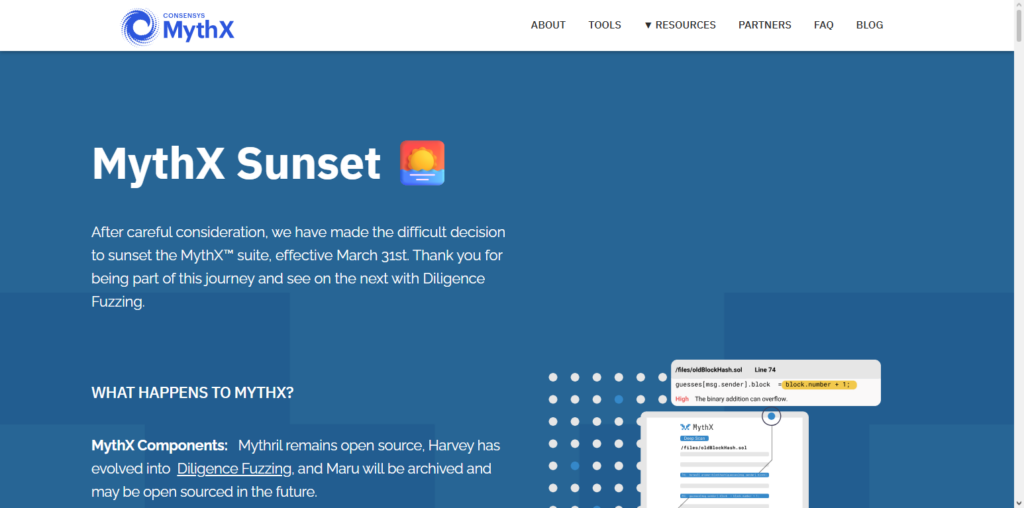
Considered to be one of the Best Smart Contract Auditing Software for Verification, MythX provides users the ability to integrate the platform with the leading Ethereum development frameworks and CI/CD tools.
The system generates detailed reports of found vulnerabilities, lists severity levels, and offers suggestions to mitigate the issues. The automated scan improves the quality of the code and provides the developer’s team the confidence to launch their DApps.
MythX Features, Pros & Cons
Features
- Smart contract security on the cloud
- Blends static, dynamic, and symbolic analysis
- Identifies popular Solidity vulnerabilities
- Works with CI/CD pipelines
- Complex vulnerability assessments
Pros
- Excellent detection rate
- Development tools can be integrated easily
- Fully automated scans
- Enterprise friendly
- Reduces manual auditing
Cons
- Premium features come at a cost
- Ethereum centric
- Connectivity dependent
- Limited advanced user features
- False positives are possible
2. Slither
Slither is a smart contract auditing software fort that focuses on static code analysis. Slither utilizes analysis of the source code in a non-executed format to find inefficient patterns, vulnerabilities, and violations of compliance. Slither is currently placed as one of the leading tools among the Best Smart Contract Auditing Software for Verification.

The tool has been adapted to meet a developer’s workflow and has the capability to scan large projects in a matter of seconds. Some of the issues commonly found by Slither include reentrancy, visibility among function and attributes, unused variables, and incorrect inheritance.
Due to the speed and coverage provided by Slither, auditors and developers are able to assess and improve the quality of smart contracts prior to their deployment.
Slither Features, Pros & Cons
Features
- Rapid static analysis
- Custom security detectors
- Solidity code quality
- CLI for automation
- Open-source
Pros
- No cost, open source
- Scans very quickly
- Large vulnerability detection
- Simple CI/CD integration
- Customizable
Cons
- No dynamic analysis
- Needs Solidity source code
- Learning curve for beginners
- CLI heavy
- Advanced issues may require manual review
3. Echidna
Echidna is a fuzz testing tool that takes a novel approach to testing Solidity smart contracts by automatically generating thousands of random inputs to find surprising behaviors. Rather than testing predefined logic units like most testing frameworks,

Echidna focuses on testing edge cases and breaks the contract logic with transaction sequences that would likely never arrive at that point. One award Echidna has received is the Best Smart Contract Auditing Software for Verification. To use Echidna, developers express the security properties to test.
If the property is violated, the framework states with which input the contract logic was violated. With this approach to testing, smart contracts are much more robust and protect against attacks that were not considered or assumed to be impossible.
Echidna Features, Pros & Cons
Features
- Property based fuzz testing
- Random input
- Invariant testing
- Automated discovery of vulnerabilities
- Solidity centric
Pros
- Great at finding edge cases
- Open-source
- Detects strange behaviors
- Easy configuration
- Strong community of developers
Cons
- Initial setup complexity
- Custom test properties
- Long execution for larger projects
- Limited reporting
- Solitidy centric
4. Manticore
Manticore is a smart contract auditing framework that uses symbolic testing to find a class of vulnerabilities that are extremely hard to find. This is achieved by testing the code, not the inputs. Manticore is known to be one of the Best Smart Contract Auditing Software for Verification.

Because Manticore chooses paths based on the constraints of the contract logic, it is good at finding vulnerabilities like integer overflows and underflows, reentrancy, bugs, and logic errors.
By choosing a path, Manticore describes the history and reasoning why a certain path was taken. Analyzing the results left by Manticore will describe numerous ways the vulnerabilities could be exploited, which is why it is critical for high value blockchain applications.
Manticore Features, Pros & Cons
Features
- Symbolic execution
- Path exploration analysis
- Automated test case generation
- Dynamic analysis integration
Pros
- Finds bugs
- Great for security research
- Highly customizable
- Validates test cases
- Multiple analysis options
Cons
- Steep learning curve
- Slower execution
- Limited documentation
- Mostly Ethereum based
- Reporting could improve
5. Certora Prover
Certora Prover is a semi-formal verification tool for smart contracts. It is capable of proving if a given smart contract is compliant with formally defined security and business rules. Unlike other tools that only find bugs,
Certora Prover guarantees that the smart contract logic will comply with defined business logic in every potential execution of the contract. It is ranked as one of the Best Smart Contract Auditing Software for Verification.
Certora Prover is extremely popular among enterprise blockchain projects and major DeFi protocols because they rely on the security of their smart contracts due to the large amount of money locked in their contracts.
Certora Prover allows developers to define business logic using the Certora Verification Language (CVL). This allows Certora Prover to find logical bugs in smart contracts that have not yet been deployed. This significantly improves the security and reliability of smart contracts.
Certora Prover Features, Pros & Cons
Features
- Formal verification engine
- Mathematical proof checking
- Custom verification rules
- Enterprise-grade security analysis
- Supports Solidity contracts
Pros
- Extremely accurate verification
- Trusted by leading DeFi projects
- Detects logical errors
- Reduces security risks
- Ideal for mission-critical contracts
Cons
- Commercial licensing
- Steep learning curve
- Requires formal specifications
- Time-consuming setup
- Less suitable for small projects
6. Securify
Securify is a static analysis smart contract security tool that was designed to automatically audit smart contracts on the Ethereum blockchain against security patterns. Securify analyzes the code of a smart contract to determine if it contains code that is either safe or unsafe to use in a smart contract.
Securify is ranked as one of the Best Smart Contract Auditing Software for Verification. It describes smart contracts that contain unsafe behaviors, such as reentrancy whitelists, allowed calls to a contract, delegate calls, and unsafe changes to a smart contracts state.
Securify provides a compliant/ violation classification of its findings, making its reports more understandable. Securify also performs a large part of the contract audit process for developers by offering an understandable report of security issues and automated contract security improvements.
Securify Features, Pros & Cons
Features
- Automated detection
- Compliance checks
- Automated detection of security issues
- Supports Ethereum contracts
Pros
- Automated compliance checks
- Automated vulnerability detection
- Improvement in static analysis
- Backed by research
- Detailed reporting
Cons
- Traditional static analysis problems
- Limited recorded blockchain
- May require other tools
7. Oyente
One of the first symbolic execution tools used to analyze Ethereum Smart Contracts, Oyente detects execution paths that could contain vulnerabilities prior to contract deployment, such as reentrancy attacks, timer attacks, transaction-ordering dependencies, and failures to throw exceptions.
Oyente was seminal as a research tool for blockchain security, and although many tools have built off of Oyente’s framework, it is still considered and recognized among the Best Smart Contract Auditing Software for Verification.
Automated symbolic analysis for Ethereum contracts was pioneered with Oyente. Much of the work for modern auditing frameworks for smart contracts has been based in the research of Oyente’s methodology for determining smart contract vulnerabilities.
Oyente Features, Pros & Cons
Features
- Open-source
- Ethereum contract support
- Execution path methods
- Detects traditional vulnerabilities
- Symbolic execution analysis
Pros
- Great tool for beginning courses
- Easy framework for research
- Great first contract auditor
- Good for common vulnerabilities
- Light weight
Cons
- Compared to tools available today, older tools become less useful
- Vulnerabilities become less prone to detection
- Tools become obsolete due to lack of support
- Tools become less useful for businesses of all sizes
- Tools become less useful for increasing workloads and complex tasks
8. Rattle
Rattle is more a of an Ethereum Smart Contract Auditing Software for Verification than Oyente because Rattle deals with EVM bytecode, and contracts that have been deployed. Rattle is still of great importance to the auditing framework, as it reverse engineers compiled EVM bytecode and constructs control flows as well as functions and data storage in a much more readable format.

Security researchers may still have doubts about the validity of deployed contracts. Rattle assists in verifying the security of deployed contracts as well as helping auditors understand the logic of a contract in a forensic audit. Rattle is one of the Best Smart Contract Auditing Software for Verification because it adds a layer of blockchain security that specializes in compiled EVM bytecode while complementing traditional auditing of source code.
Rattle Features, Pros & Cons
Features
- Understood EVM bytecode
- Analyzed decompiled contracts
- Reconstructed control flow
- Analyzed storage layout
- Inspected bytecode
Pros
- No need for source code to function
- Powerful forensics
- Useful for deployed contracts
- Unknown contracts can be studied
- Used with other auditing tools
Cons
- Knowledge for using Rattle is complicated
- For beginners, Rattle is hard to use
- Rattle only deals with bytecode
- Rattle has no automated vulnerability score
- Rattle has a small user base
9. Halmos
Halmos is an innovative automated symbolic testing framework that uses logic to verify Solidity smart contracts. It simultaneously examines a variety of execution paths to test security and logical assumptions. It is one of the Best Smart Contract Auditing Software for Verification.

Halmos is effective in locating hard-to-detect logic errors. Other software tools are likely to overlook these errors. Halmos fits into the Solidity development workflow and serves the purpose of displaying a bug in a smart contract that is hard to detect.
Furthermore, Halmos combines symbolic execution with formal verification, thus making it possible for developers to create secure enterprise-grade smart contracts for DeFi.
Halmos Features, Pros & Cons
Features
- Symbolic Testing of Smart Contracts
- Support for Formal Verification
- Automated Exploration of Paths
- Compatibility with Solidity
- Logic Validation Framework
Pros
- Can find subtle logic errors
- Useful for the new age of formal verification
- Can aid with formal proofs
- Free and Open Source
- User-Friendly for Skilled Developers
Cons
- Must have knowledge of Formal Verification
- Complicated to set up
- Smaller Ecosystem
- Development of documentation ongoing
- Better for more Skilled Users
10. Tenderly
Tenderly is a powerful smart contract auditing and monitoring solution that enables transaction simulation, contract execution, tracing, and profiling. Different conditions of executed smart contract transactions can be analyzed and audited before actual deployment, thus determining how transactions will be executed.
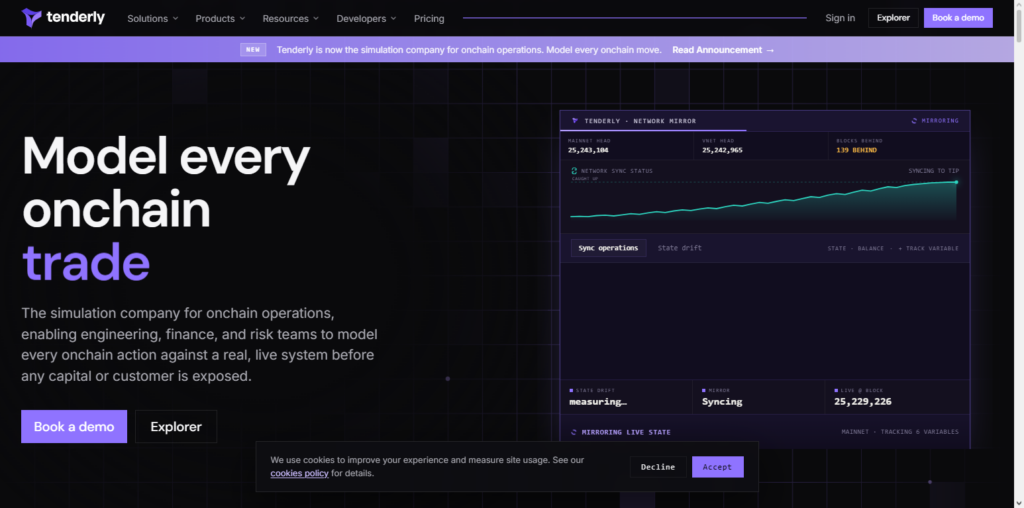
Tenderly is among the Best Smart Contract Auditing Software for Verification. Tenderly facilitates the identification of smart contract execution failures and performance concerns such as the inefficient use of gas, transaction failures, and security aspect concerns.
Integrate Tenderly into your monitoring and testing workflow to ensure that secure decentralized applications can be deployed and maintained easily and effectively.
Tenderly Features, Pros & Cons
Features
- Transaction simulation
- Smart Contract Debugging
- Monitoring in Real Time
- Gas Optimization
- Analyzing Performance with a Dashboard
Pros
- Easy to use with great UI
- Powerful Debugging Tools
- Monitors the Blockchain in Real Time
- Simple to Deploy and Test
- Can be used to foster developer collaboration
Cons
- Most Features are behind a paywall
- Runs in the Cloud
- Not a full formal verification tool
- Enterprise features have a steep learning curve
- Limited Offline Use
Conclusion
Selecting the proper Smart Contract Auditing Software for Verification can provide the tools necessary to assess the safety, trustworthiness, and accuracy of your blockchain applications prior to going live. Consider tools such as MythX, Slither, and Securify, to name a few.
Each of these tools has a different approach to auditing with options from static analysis, fuzz testing, symbolic execution, and formal verification.
The selection for your organization should depend on the complexity of your project, barriers to security that are present, and the development workflow that integrates closely with your team. Part of a development workflow, auditing tools help catch risks and improve trust and the quality of your code.
FAQ
What is smart contract auditing software?
Smart contract auditing software is a security tool that analyzes blockchain smart contracts to detect vulnerabilities, coding errors, and logical flaws before deployment. It helps developers create safer and more reliable decentralized applications.
Why is smart contract verification important before deployment?
Pre-deployment verification helps identify security risks such as reentrancy attacks, integer overflows, access control issues, and logic errors. Fixing these vulnerabilities before launch reduces the risk of exploits and financial losses.
Which is the best smart contract auditing software for verification?
The best tool depends on your needs. MythX is ideal for automated security scanning, Slither excels at static analysis, Echidna is popular for fuzz testing, Certora Prover specializes in formal verification, and Tenderly offers simulation and debugging features.
What is the difference between static analysis and symbolic execution?
Static analysis examines source code without running it to identify known security issues, while symbolic execution explores multiple execution paths mathematically to uncover deeper vulnerabilities that traditional testing may miss.