


In this article, I will discuss the Best Crypto Tokens For Micropayments while elaborating on their distinct attributes that facilitate faster and more cost-effective small-value transactions.
Аs a form of payment, cryptocurrency offers new opportunities for Dash, IOTA, TRON, and many others to implement microtransactions with greater ease. So let’s see how these tokens are changing the world of micropayments.
Key Point & Best Crypto Tokens For Micropayments List
| Cryptocurrency | Key Point |
|---|---|
| Dash (DASH) | Focuses on fast, low-cost transactions with PrivateSend & InstantSend. |
| IOTA (MIOTA) | Uses Tangle technology for feeless microtransactions in IoT. |
| TRON (TRX) | Aims to decentralize content sharing & entertainment industry. |
| EOS (EOS) | Designed for scalable dApp development with zero transaction fees. |
| Bitcoin (BTC) | The first & most valuable cryptocurrency, known as digital gold. |
| Ripple (XRP) | Facilitates fast & cheap cross-border payments for banks & institutions. |
| Litecoin (LTC) | A Bitcoin alternative with faster transactions & lower fees. |
| Nano (NANO) | Uses block-lattice tech for instant, feeless transactions. |
| Ethereum (ETH) | The leading smart contract platform powering dApps & DeFi. |
| Stellar (XLM) | Focused on cross-border payments & financial inclusion. |
1.Dash (DASH)
Dash (DASH) has made a reputation for itself as one of the best cryptocurrencies for making micropayments due to its low-fee near-instant transaction feature, InstantSend.
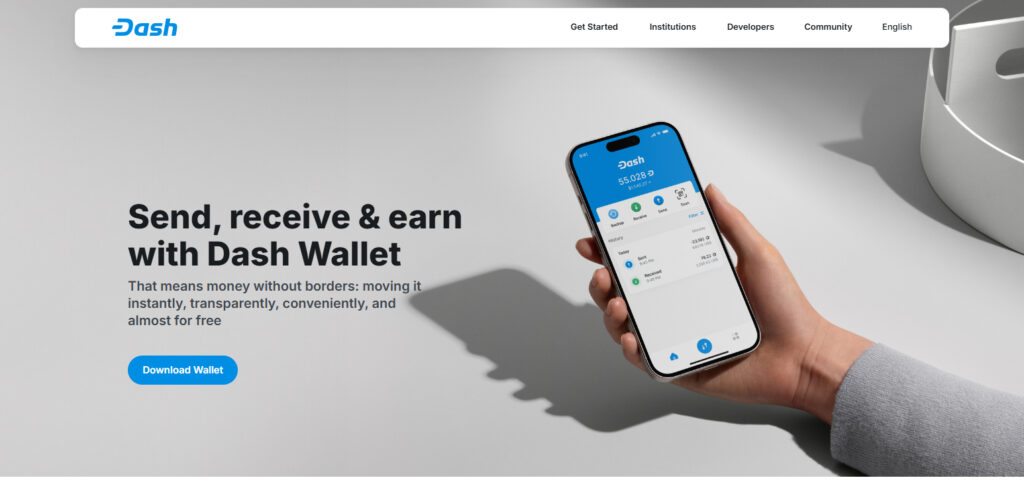
Transactions on Dash are settled in seconds as opposed to the minutes it takes Bitcoin confirmations, making it ideal for everyday purchases. Its Masternode network augments efficiency, security, and decentralization.”
With regard to practicality, Dash is accepted by numerous merchants around the world. This unfettered access, coupled with the speed, affordability, and reliability that it provides, has made it a go-to option for micropayments.
| Feature | Details |
|---|---|
| Token Type | Cryptocurrency focused on fast and secure transactions |
| Transaction Speed | InstantSend technology ensures transactions are completed in seconds |
| Privacy Features | Optional PrivateSend feature for enhanced privacy |
| Fees | Extremely low transaction fees, ideal for micropayments |
| KYC Requirements | Minimal KYC required for wallet setup and usage |
| Global Acceptance | Widely accepted by merchants and payment platforms worldwide |
| Scalability | Designed to handle high transaction volumes efficiently |
| Ease of Use | User-friendly wallets available for desktop and mobile |
| Security Features | Decentralized network with masternodes ensuring robust security |
| Additional Perks | Supports decentralized governance and funding for community projects |
2.IOTA (MIOTA)
IOTA (MIOTA) has established itself as one of the best cryptocurrency projects for micrompayments because of its feeless transactions and scalable Tangle technology.
Unlike conventional blockchains, IOTA’s Tangle employs a directed acyclic graph (DAG) structure where transactions are self-confirmable without the need for miners, rendering costs to zero.
This also makes IOTA suitable for IoT-based machine-to-machine payments as frequent small-value transactions are required.
Its light structure guarantees high operational efficiency which makes it much easier to achieve seamless micropayments for automated systems, smart cities, and supply chains compared to conventional cryptocurrencies.
| Feature | Details |
|---|---|
| Token Type | Cryptocurrency based on Directed Acyclic Graph (DAG) technology (Tangle) |
| Transaction Speed | Near-instant transactions due to parallel processing on the Tangle network |
| Transaction Fees | Zero transaction fees, making it ideal for micropayments |
| KYC Requirements | Minimal KYC required for wallet setup and usage |
| Scalability | Highly scalable, capable of handling high transaction volumes |
| Energy Efficiency | Low energy consumption compared to traditional blockchain networks |
| Global Acceptance | Increasing adoption in IoT and real-world applications |
| Security Features | Decentralized and secure through the Tangle network |
| Ease of Use | User-friendly wallets available for desktop and mobile |
| Additional Perks | Supports data integrity and IoT device integration |
3.TRON (TRX)
TRON (TRX) ranks as one of the best crypto tokens for micropayments due to its high-speed blockchain, which enables seamless transactions, as well as its low transaction fees.
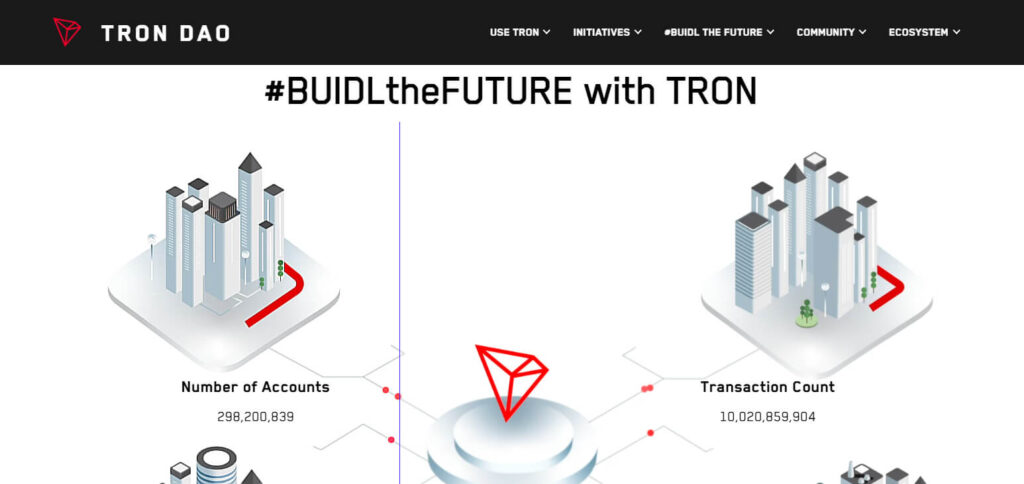
Blockchains designed for content sharing enable creators to receive direct payments without the need for intermediaries. As such, TRON is ideal for tipping, streaming, and in-app purchases.
Its Delegated Proof-of-Stake (DPoS) framework guarantees lower operational costs while providing fast confirmation times. With minimal restrictions between users and content creators, the TRON blockchain simplifies micropayments in digital entertainment, social platforms, and gaming, which in turn creates a more inclusive economy.
| Feature | Details |
|---|---|
| Token Type | Cryptocurrency designed for decentralized applications and micropayments |
| Transaction Speed | High-speed transactions with low latency |
| Transaction Fees | Extremely low fees, ideal for micropayments |
| KYC Requirements | Minimal KYC required for wallet setup and usage |
| Scalability | Highly scalable, capable of handling large transaction volumes |
| Global Acceptance | Widely used in payment platforms and decentralized applications |
| Energy Efficiency | Operates on an energy-efficient consensus mechanism |
| Ease of Use | User-friendly wallets and integration with various dApps |
| Security Features | Robust security through decentralized governance |
| Additional Perks | Supports smart contracts and token creation |
4.EOS (EOS)
EOS (EOS) presents a great opportunity for micropayment services because of its zero-fee transactions and high volume of transaction scalability.
Unlike other payment systems that operate on a fee-per-use basis, EOS uses a resource-based model where customers pay and stake thier tokens to receive network bandwidth which is economically viable.
Its delegated proof of stake (DPoS) consensus allows for quick and smooth processes, which optimizes EOS for use in mobile applications, gaming, and dApps.
EOS advances the digital ecosystem by eliminating fee barriers and enabling instant payments which increases accessibility to cost-efficient transactions in digital systems.
| Feature | Details |
|---|---|
| Token Type | Cryptocurrency designed for decentralized applications and micropayments |
| Transaction Speed | Near-instant transactions with low latency |
| Transaction Fees | Almost zero transaction fees, ideal for micropayments |
| KYC Requirements | Minimal KYC required for wallet setup and usage |
| Scalability | Highly scalable, capable of handling large transaction volumes |
| Global Acceptance | Increasing adoption in decentralized applications and payment platforms |
| Energy Efficiency | Operates on an energy-efficient Delegated Proof-of-Stake (DPoS) mechanism |
| Ease of Use | User-friendly wallets and integration with various dApps |
| Security Features | Robust security through decentralized governance |
| Additional Perks | Supports smart contracts and token creation |
5.Bitcoin (BTC)
Bitcoin (BTC) is a feasible cryptocurrency for performing micropayments because of the Lightning Network, which allows instantaneous and affordable transactions to be executed off the blockchain.
Although Bitcoin’s primary network has expensive transaction fees and slower confirmation times, the Lightning Network permits the opening of payment channels, enabling swift micropayment transactions with minimal costs.
This feature makes BTC ideal for use in tipping, pay-per-use services, and microtransactions in virtual economies. Bitcoin leverages this second layer solution and maintains its security and decentralization while enabling practical spending on everyday small-value transactions.
| Feature | Details |
|---|---|
| Token Type | Cryptocurrency designed for peer-to-peer transactions |
| Transaction Speed | Average transaction time is around 10 minutes |
| Transaction Fees | Variable fees; can be optimized for lower costs |
| KYC Requirements | Minimal KYC required for wallet setup and usage |
| Global Acceptance | Widely accepted by merchants and payment platforms worldwide |
| Scalability | Limited scalability; Layer 2 solutions like Lightning Network improve micropayment efficiency |
| Security Features | Highly secure through decentralized blockchain technology |
| Ease of Use | Supported by numerous wallets and exchanges globally |
| Additional Perks | Recognized as the first cryptocurrency; offers high liquidity |
6.Ripple (XRP)
Ripple’s (XRP) ultra-rapid payment processing and minimal transaction fees, it stands out as an exceptional cryptocurrency token for micropayments.
XRP’s network, unlike traditional banking systems which charge exorbitant fees for microtransactions, processes payments in mere seconds with fees that are only cents.
The consensus protocol of XRP eliminates mining delays, which is ideal for high-volume low-value transactions like remittances, digital services, and cross-border payments. XRP allows seamless micropayments all over the globe because of its high efficiency and liquidity.
| Feature | Details |
|---|---|
| Token Type | Cryptocurrency designed for fast and cost-effective transactions |
| Transaction Speed | Settles transactions in 3-5 seconds |
| Transaction Fees | Extremely low fees, ideal for micropayments |
| KYC Requirements | Minimal KYC required for wallet setup and usage |
| Global Acceptance | Widely accepted by financial institutions and payment platforms worldwide |
| Scalability | Handles up to 1,500 transactions per second |
| Energy Efficiency | Carbon-neutral and energy-efficient |
| Ease of Use | Supported by user-friendly wallets and exchanges globally |
| Security Features | Decentralized and secure through the XRP Ledger |
| Additional Perks | Facilitates cross-border payments and bridges fiat currencies |
7.Litecoin (LTC)
Litecoin (LTC) is one of the most popular crypto tokens used for micropayments because of its reduced fees compared to Bitcoin, as well as its faster block generation time.
With a mere block time of 2.5 minutes, Litecoin provides faster transaction confirmations which makes more sophisticated payments simple.
The low-cost transactions also facilitate efficient peer-to-peer transfers, and thus, Litecoin is ideal for everyday purchases and tipping. Moreover, Litecoin’s high level of adoption and security make it a dependable solution for businesses and users seeking a scalable micropayment system.
| Feature | Details |
|---|---|
| Token Type | Cryptocurrency designed for fast and low-cost transactions |
| Transaction Speed | Average block time of 2.5 minutes, ensuring quick transactions |
| Transaction Fees | Extremely low fees, ideal for micropayments |
| KYC Requirements | Minimal KYC required for wallet setup and usage |
| Global Acceptance | Widely accepted by merchants and payment platforms worldwide |
| Scalability | Capable of handling high transaction volumes efficiently |
| Energy Efficiency | Operates on a Proof-of-Work (PoW) consensus mechanism |
| Ease of Use | Supported by numerous wallets and exchanges globally |
| Security Features | Highly secure through decentralized blockchain technology |
| Additional Perks | Recognized as one of the earliest altcoins with strong community support |
8.Nano (NANO)
Nano(NANO) provides the best cryptocurrency solution for processing micropayments thanks to its unique block-lattice design that allows for instantaneous and charge-less transactions.
Unlike traditional blockchains, each user is assigned an independent blockchain by Nano, which reduces energy consumption due to the absence of congestion.
This capability to instantly process payments allows Nano to serve as a currency for real-time micropayments in retail, online tipping, and digital services.
Its lightweight governance framework devoid of miners guarantees scalability, resulting in a truly decentralized infrastructure that is cost-effective for transactions of low monetary value.
| Feature | Details |
|---|---|
| Token Type | Cryptocurrency based on Directed Acyclic Graph (DAG) technology |
| Transaction Speed | Near-instant transactions due to blockless architecture |
| Transaction Fees | Zero transaction fees, ideal for micropayments |
| KYC Requirements | Minimal KYC required for wallet setup and usage |
| Scalability | Highly scalable, capable of handling high transaction volumes |
| Energy Efficiency | Extremely energy-efficient, suitable for eco-friendly applications |
| Global Acceptance | Increasing adoption in payment platforms and IoT applications |
| Security Features | Decentralized and secure through the Open Representative Voting (ORV) system |
| Ease of Use | User-friendly wallets available for desktop and mobile |
| Additional Perks | Designed for seamless peer-to-peer transactions |
9.Ethereum (ETH)
Ethereum (ETH) serves well as a crypto token for micropayments because of its Layer 2 scaling solutions such as Optimistic Rollups and zk-Rollups, which improve the speed of processing transactions and decrease the cost associated with them.
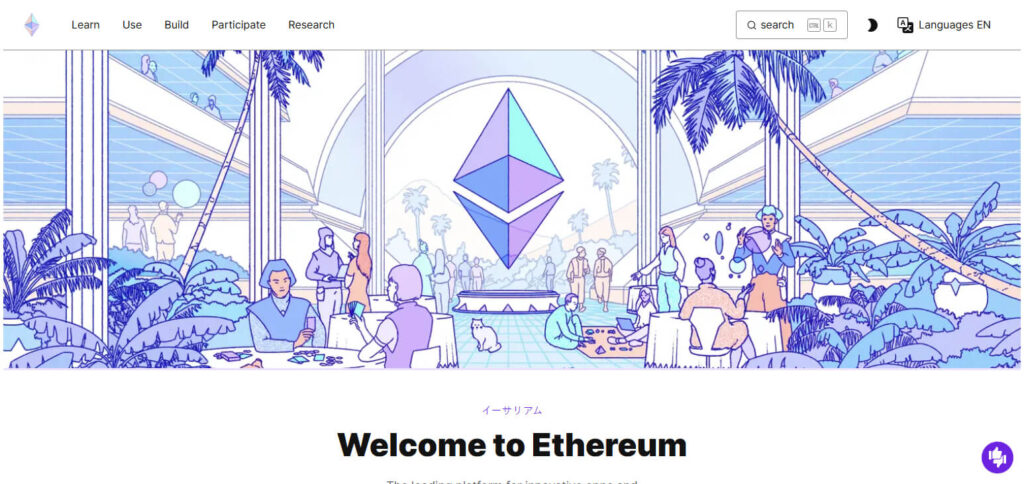
Although Ethereum’s base layer is expensive, Layer 2 networks facilitate transactions at virtually no cost, with delays of a few seconds, which makes ETH appropriate for microtransactions in gaming, content tipping, and DeFi applications.
With developed smart contract capabilities, Ethereum also enables programmable micropayments which facilitate automated, trustless transactions for digital services and decentralized economies.
| Feature | Details |
|---|---|
| Token Type | Cryptocurrency and smart contract platform |
| Transaction Speed | Average transaction time of 10-15 seconds (may vary due to network congestion) |
| Transaction Fees | Variable fees based on network activity; optimized using Layer 2 solutions like Optimism and Arbitrum |
| KYC Requirements | Minimal KYC required for wallet setup and usage |
| Global Acceptance | Widely accepted in DeFi, payment platforms, and dApps |
| Scalability | Enhanced scalability with Ethereum 2.0 and Layer 2 solutions |
| Security Features | Decentralized and secure through Proof-of-Stake (PoS) consensus mechanism |
| Ease of Use | Supported by numerous wallets and exchanges globally |
| Additional Perks | Facilitates smart contracts, token creation, and NFT payments |
10.Stellar (XLM)
Stellar (XLM) is one of the most effective crypto tokens regarding micropayments because it has incredibly low costs for transactions and quick settlement times.
Built for cross-border payments and financial inclusion, Stellar’s network can execute transactions in seconds at fees that are mere cents. Its distinctive consensus protocol eliminates mining, making efficiency and scalability easy.
As a result, XLM is ideal for all small-value transfers, remittances, and digital payments, facilitating seamless micropayments across borders without reliance on traditional banks.
| Feature | Details |
|---|---|
| Token Type | Cryptocurrency designed for fast and low-cost cross-border transactions |
| Transaction Speed | Settles transactions in 3-5 seconds |
| Transaction Fees | Extremely low fees, ideal for micropayments |
| KYC Requirements | Minimal KYC required for wallet setup and usage |
| Global Acceptance | Widely accepted by financial institutions and payment platforms worldwide |
| Scalability | Handles up to 1,500 transactions per second |
| Energy Efficiency | Highly energy-efficient and eco-friendly |
| Ease of Use | Supported by user-friendly wallets and exchanges globally |
| Security Features | Decentralized and secure through the Stellar Consensus Protocol |
Conclusion
In the developing context of the digital economy, micropayments enable effortless and low cost transactions. Cryptocurrencies such as Dash, IOTA,
TRON, EOS, and Bitcoin (via the Lightning Network), Ripple, Litecoin, Nano, and Ethereum (through Layer2) as well as Stellar provide small-value payment solutions.
These tokens facilitate advanced payment methods using feeless transctions, instant payment, or scalable networks as opposed to conventional payment systems. With increasing adoption, these tokens will improve accessibility, cost, and speed of micropayment systems world wide.