


In this article, I will explore the best Artificial Intelligence Crypto, focusing on how projects incorporating AI into blockchain technology are revolutionizing the digital space.
These cutting-edge cryptocurrencies integrate machine learning with predictive analytics and decentralized blockchain technology to build networks that are more intelligent, quicker, and significantly efficient.
They will range from AI-powered automated data evaluation to advanced cognitive smart contracts. These are the most innovative projects in the AI future of crypto.
What is Artificial Intelligence Crypto?
AI crypto refers to cryptocurrencies and blockchain implementations designed to leverage artificial intelligence for increased automation, efficiency, and improved decision-making within the crypto ecosystem.
Utilizing artificial intelligence and machine learning technology, these automated systems perform tasks such as forecasting, automated trading, managing risks, and detecting fraudulent activities.
Most AI crypto initiatives focus on building decentralized ecosystems where participants can securely share, access, and monetize AI algorithms or data sets on blockchain.
Powered by AI innovations, the Fetch.ai (FET), SingularityNET (AGIX), and Ocean Protocol (OCEAN) tokens exemplify the melding of blockchain technology with artificial intelligence to deliver advanced, transparent, and data-driven solutions within the digital economy.
How To Choose Artificial Intelligence Crypto
Project Utility & Use Case – Understand if the project has a solution for a real-world problem with the use of AI such as data automation, analytics, and decentralized AI services.
Team & Partnerships – Understand the pedigree of the team behind the project, their AI and blockchain experience, and the partnerships that have been set up.
Technology & Innovation – Review the AI integration and blockchain foundations of the project and determine if it is leveraging transformative technology such as machine learning, deep learning as well as closed data sharing ecosystems.
Tokenomics – Appreciate the distribution, supply of the tokens, staking rewards, and ecosystem utility to understand the potential for value creation.
Community & Adoption – Evaluate the community, their activity, presence on various platforms as well as partnerships which symbolize trust and adoption of the project.
Transparency & Security – Determine if the project has comprehensive documentation, publicly accessible code, and a user data and asset security focus.
Market Performance – Assess the trading patterns, liquidity, and volume of the tokens to determine the potential for growth and stability.
Future Roadmap – For sustainability and innovation assessment, check the projects development plan, new updates, and long-term goals.
Key Point & Best Artificial Intelligence Crypto List
| AI Crypto Project | Key Points |
|---|---|
| Bittensor (TAO) | Decentralized AI network allowing users to train and share machine learning models; rewards contributors with TAO tokens. |
| The Graph (GRT) | Provides decentralized indexing for blockchain data, enabling efficient AI-driven data querying for dApps. |
| NEAR Protocol (NEAR) | Scalable blockchain supporting AI integrations and smart contract automation with developer-friendly tools. |
| Qubetics (QUB) | Focuses on quantum and AI-based blockchain analytics for predictive modeling and data security. |
| Sei Network (SEI) | Optimized for high-speed AI-driven trading and data processing with low latency and strong scalability. |
| Numeraire (NMR) | Built by Numerai, it uses AI models from global data scientists to predict stock markets via decentralized data science. |
| Cortex (CTXC) | Integrates AI models directly into smart contracts, enabling on-chain AI inference and autonomous decision-making. |
| Oraichain (ORAI) | The first AI oracle and data platform bridging AI APIs with blockchain smart contracts for enhanced functionality. |
| Matrix AI Network (MAN) | Combines AI and blockchain for intelligent smart contracts, self-optimizing networks, and automated governance. |
| Render Network (RNDR) | Decentralized GPU rendering platform using AI to power 3D graphics, metaverse, and visual effects processing. |
1. Bittensor (TAO)
Bittensor (TAO) is revered as one of the top Artificial Intelligence cryptocurrencies because it established a genuinely decentralized network for machine learning, where users work together to build AI models and share them in a free and open network.
Bittensor’s ecosystem is unique in that it is incentive-driven; it compensates users in value to network AI models in the form of TAO tokens.

The open and permissionless construction enables Bittensor to be scalable and diverse in the datasets it acquires, both necessary in improving AI.
In contrast to traditional, centralized AI systems, Bittensor enables the global marketplace to participate in building AI, allowing them to train, assess, and monetize models, while boasting blockchain security, transparency, and ease of access.
Pros & Cons Bittensor (TAO)
Pros:
- Decentralized AI Network: Allows machine learning models to be trained and rewarded on a blockchain.
- Incentive System: TAO token rewards contributions to AI development.
- Community Driven: Open-source ecosystem fosters collaboration.
Cons:
- Complex Setup: Requires technical knowledge to participate in the network.
- Early Stage: Limited adoption and smaller community compared to larger projects.
- Market Volatility: Token value highly dependent on speculative interest.
2. The Graph (GRT)
The Graph (GRT) distinguishes itself among the leading Artificial Intelligence cryptocurrencies for allowing AI-powered indexing and querying of data for decentralized applications. Its subgraph technology sets it apart.
Subgraph technology structures blockchain data, allowing AI to analyze and examine large volumes of data almost instantaneously. The Graph removes data centralization and intermediaries, promoting a higher level of transparency as well as quicker, more accurate assessments for developers and AI systems.
Its decentralized network facilitates integration across many blockchains, positioning The Graph as fundamental to intelligent data within Web3, as well as the highly adaptable, AI-focused blockchain innovation.
Pros & Cons The Graph (GRT)
Pros:
- Efficient Data Indexing: Simplifies querying blockchain data for developers.
- Interoperable: Works across multiple blockchains like Ethereum and Polygon.
- Strong Developer Community: Well-established with growing adoption.
Cons:
- Competition: Faces competition from similar indexing protocols.
- Reliance on Ethereum: Performance tied to Ethereum network congestion.
- Token Volatility: GRT price can fluctuate widely with market trends.
3. NEAR Protocol (NEAR)
NEAR Protocol (NEAR) merges cutting-edge blockchain infrastructure with AI ushering it into the realm of the best Artificial Intelligence cryptocurrencies. Its unique sharding technology streamlines efficiencies and reduces operational costs which is optimal for AI that processes data at scale and in real time.
NEAR’s ecosystem is designed for developers wanting to infuse AI models with dApps for automated AI predictive analytics and augmented decision frameworks.
NEAR’s user-driven and interoperable attention ensure tools powered by AI and blockchain smart contracts communicate and collaborate harmoniously, opening new pathways to innovation and ease of use within the decentralized AI framework.
Pros & Cons NEAR Protocol (NEAR)
Pros:
- Scalable Blockchain: The usage of sharding allows for quick transactions.
- Developer Friendly: The smart contract development documentation is user-friendly.
- Low Fees: Users and DApps will find it affordable.
Cons:
- Limited Development Time: Fewer mature blockchains compared to Solana and Ethereum.
- Not Predominately AI: Main focus is not AI related.
- Market Saturation: Competing with a host of Layer-1 blockchains.
4. Qubetics (QUB)
As one of the best Artificial Intelligence cryptos, Qubetics (QUB) combines quantum computing and AI-powered blockchain analytics.
Predictive modeling and data streamlining are other advanced predictive analytics functionalities data Qubetics aims to provide. A remarkable feature of this project is its quantum-inspired algorithmic engine, which improves the precision and velocity of computation.
Qubetics focuses on intelligent and secure data architectures to transform data for enhanced decision-making across finance, cybersecurity, and the decentralized web. Qubetics uniquely combines the AI continuum and quantum technology, and is advancing intelligent blockchain as one of the strongest innovators in the space.
Pros & Cons Qubetics (QUB)
Pros:
- AI Evaluation: Use of AI in predictive modeling is a key focus.
- Rewarding Participation: Token rewards for completing AI tasks.
- AI and Blockchain Combined: New integration of AI focused on real-world blockchain problems.
Cons:
- Limited Market Exposure: Not a well-known low liquidity project.
- Slow to Gain Adoption: Usage may be slow to widespread.
- Fluctuating Value: Token is likely a cash grab with no real-world applications.
5. Sei Network (SEI)
Sei Network (SEI) stands out as the top Artificial Intelligence crypto developing the best-in-class trading infrastructure for High Frequency trading that Automates with AI.

As focused Layer-1 blockchains, Sei Network attain the exceptional speed, low latency, and fast transaction finality that AI financial systems, data models, and other AI applications require. Most notably, the intelligent parallelization engine that executes the advanced transaction processing makes Sei Network the only crypto that scales and responds in real-time to market changes.
The AI automated trading, Sei’s predictive AI algorithms for liquidity, and the automated market maker in Sei’s decentralized exchange derive the next-gen performance for intelligent digital economy blockchains.
Pros & Cons Sei Network (SEI)
Pros:
- DeFi and AI Focus: Optimized for and fast execution of smart contracts.
- High Capacity Network: Well designed and high throughput network.
- Cross-Chain Transactions: Works with other blockchain technologies.
Cons:
- Ecosystem Maturity: New player with evolving ecosystem.
- AI is an Add-On: Not a pure AI application.
- High Volatility: Price of SEI will be very volatile.
6. Numeraire (NMR)
Numeraire (NMR) is one of the leading Artificial Intelligence crypto because it innovates financial prediction using decentralized data science and AI models.
Developed by Numerai, it enables data scientists around the world to submit forecasting algorithms and compete in predicting stock market trends.
One of its distinguishing features is the staking mechanism, where players stake NMR tokens on the AI models, securing incentives for top-tier-quality predictions.
This system garners precision, transparency, and cooperative effort in accuracy without centralized control. Through the combination of AI and blockchain technologies, Numeraire is decentralized, data-driven, and trustless in transforming finance. Numeraire is a collective intelligence and trustless investing ecosystem.
Pros & Cons Numeraire (NMR)
Pros:
- AI Hedge Fund: Predictive financial modeling done through AI.
- Model Contribution Pays: Data scientists get paid in NMR for valuable contributions.
- Established Model: Proven and working fine, with a calculated community since the start.
Cons:
- Participation Difficulty: Must have knowledge of AI and Data Science.
- Limited Scope: Mainly focused on financial predictions.
- Fluctuating Demand: NMR faces price volatility.
7. Cortex (CTXC)
Cortex (CTXC) is one of the best Artificial Intelligence cryptos because it integrates AI functionality onto the blockchain, allowing smart contracts to execute machine learning models on-chain.
Its distinct feature enables developers to upload and integrate AI models into dApps, facilitating self-contained autonomous decision-making without reliance on external systems.
Cortex’s AI inference and automation of analytic data predictive processes encapsulates computation as verifiable, transparent and proof of no manipulation.
Cortex provides decentralized applications with the intelligent automation of advanced, predictive AI, advanced as AI is with blockchain technology in an authentically decentralized framework.
Pros & Cons Cortex (CTXC)
Pros:
- AI Tools on Blockchain: Empowers AI contracts to function on the blockchain.
- AI DApp Development: Support for DApp development.
- Innovative Decentralized AI: Promotes decentralized AI.
Cons:
- Adoption and Development: Smaller ecosystem and developer base.
- Niche Understanding Required: Need to understand AI and blockchain.
- Speculation: Token price determined by speculation.
8. Oraichain (ORAI)
Oraichain (ORAI) stands out among artificial intelligence cryptocurrencies as the first oracle with artificial intelligence capabilities. It joins smart contracts with advanced AI, opening new possibilities.
It is the first oracle to offer machine learning predictive, automation, and analytical capabilities directly embedded as AI APIs in blockchain applications. Other advanced AI computations in automation embedded in smart contracts or applications almost always elude users.
Oraichain documents AI automation and decision-making in a way that is transparent, secure, and verifiable.
Using AI with blockchain technology, ORAI offers developers the ability to build advanced, decentralized applications, innovative solutions, proof of automation AI predictive analysis and decision-making in decision contracts, and smart applications. The project captured the fin in artificial intelligence and decentralized finance.
Pros & Cons Oraichain (ORAI)
Pros:
- AI Oracle: Provides AI smart contracts with real-time data feed.
- Platform Interoperability: Connect with several blockchains.
- Partnerships: Strong partnerships in the AI and blockchain space.
Cons:
- Focus Area: Primarily important for AI smart contracts.
- Implementing Barriers: Requires developer expertise to implement.
- ORAI Token Speculation: ORAI token price can be predictable.
9. Matrix AI Network (MAN)
Matrix AI Network (MAN) is one of the top Artificial Intelligence cryptocurrencies on the market. It incorporates AI technology into blockchain architecture. It improves speed, security, and the smart contract’s functionality. What sets it apart from the competitors is its self-optimizing network.
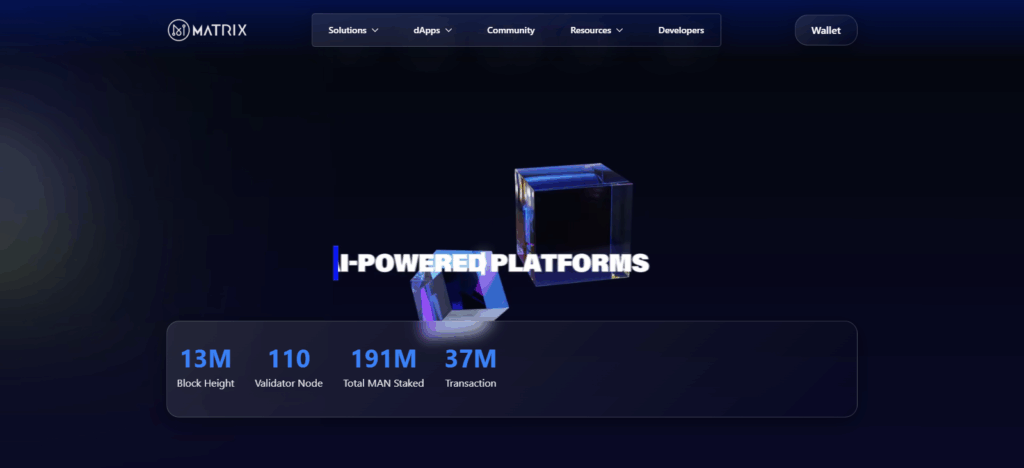
AI algorithms improve the consensus mechanism, validate transactions, and enhance the network’s efficiency. MAN also facilitates intelligent smart contracts, that permit automatic reasoning, and adaptive decision-making with little to no human interference.
Integrating AI with the scalability and decentralization of blockchain Matrix AI Network decentralizes apps with superior speed, intelligence, and security. The combination of AI-driven technology and crypto blockchain optimization sets MAN apart as the leader for the future of decentralized intelligence.
Pros & Cons Matrix AI Network (MAN)
Pros:
- Blockchain Performance: Uses AI to enhance blockchain functionalities.
- Smart Contracts: AI tools help automate and optimize contracts.
- AI Focus: Strong focus on AI innovation.
Cons:
- Adoption and Activity: Network growth and adoption is primary focus.
- Complex Integration: Requires specialized knowledge.
- Market Volatility: Dramatic fluctuations in price.
10. Render Network (RNDR)
Render Network (RNDR) is one of the finest examples of an AI-integrated cryptos as it uses AI to power a decentralized GPU rendering platform service which assists users in the rendering of 3D graphics, VFX and metaverse assets.
Its unparalleled capability is in the linking of users wanting to process a render and a true mesh of GPU renderers, forming a marketplace of safely and openly distributable computational resources.

Most of the advanced computational visualations and productions can be rendered and produced in less time, higher quality, and lower cost to the user because of AI powered GPU resource optimization.
The AI powered decentralization, productivity and empowerment to users of advanced computational visualation technology makes RNDR one of a kind in the blockchain and AI realm.
Pros & Cons Render Network (RNDR)
Pros:
- Decentralized GPU Rendering: AI and GPU cloud services combine for task rendering.
- Broad Use Cases: Engages in rendering for projects involving virtual and augmented reality, as well as AI.
- Strong Market Presence: Designers, animators, and other professionals in the creative industries have adopted it.
Cons:
- Dependence on Hardware: GPU providers are network performance weak links.
- Technical Barrier: Users must be technically savvy to enjoy rendering to the fullest.
- Speculative Token Volatility: RNDR price fluctuations are due to speculation and adoption.
Pros & Cons
| Pros | Cons |
|---|---|
| Enhanced Efficiency: AI integration automates tasks, optimizes processes, and improves decision-making in blockchain networks. | Complexity: Understanding AI crypto projects requires technical knowledge, which can be challenging for beginners. |
| Predictive Analytics: AI-driven data analysis helps forecast market trends and improve trading strategies. | High Development Costs: Building AI-powered blockchain solutions can be resource-intensive. |
| Decentralization & Transparency: Combines AI with blockchain to ensure secure, verifiable, and tamper-proof computations. | Regulatory Uncertainty: AI crypto projects may face unclear legal frameworks in different countries. |
| Innovation Potential: Encourages new applications like AI oracles, smart contracts, and autonomous decentralized networks. | Market Volatility: Token prices can fluctuate heavily, affecting investment stability. |
| Incentive Systems: Many AI crypto platforms reward contributors for data, models, or computational resources. | Data Privacy Risks: Handling sensitive data on decentralized AI networks may raise privacy concerns. |
| Interoperability: AI crypto can integrate across multiple blockchain platforms for wider adoption. | Adoption Barriers: Widespread use depends on developers and users understanding both AI and blockchain technology. |
Conclusion
AI crypto combines artificial Intelligence with blockchain technology and provides new means for automated decision-making, innovative approaches to data analytics, and new forms of automation and decentralized decision-making.
Notably Bittensor (TAO), The Graph (GRT), NEAR Protocol (NEAR), and Render Network (RNDR) derive everyone’s attention for various reasons. Some focus on decentralized AI model construction, data indexing, smart contract’s scaling, and transformative rendering powered by artificial intelligence.
It boils down to technology, tangible and attainable usefulness, the demographic and the scope of the environment of the AI crypto as to which one should one aim for. These are the pioneering activities as Artificial Intelligence and blockchain are intertwined.
FAQ
What are some top AI crypto projects?
Notable AI cryptos include Bittensor (TAO), The Graph (GRT), NEAR Protocol (NEAR), Qubetics (QUB), Cortex (CTXC), Oraichain (ORAI), Matrix AI Network (MAN), Numeraire (NMR), Sei Network (SEI), and Render Network (RNDR).
How to choose the best AI crypto?
Evaluate the project’s use case, team, technology, tokenomics, community, transparency, market performance, and roadmap before investing.
Are AI cryptos risky?
Yes, they carry risks like market volatility, regulatory uncertainty, and technical complexity, so careful research and risk management are essential.
Can AI cryptos be used in real-world applications?
Absolutely. They are applied in financial predictions, decentralized data analysis, AI oracles, automated smart contracts, and creative rendering solutions.