


The Best Crypto On-Chain Compliance Engines, which assist companies and financial institutions in keeping an eye on blockchain transactions, identifying questionable activity, and upholding regulatory compliance, will be covered in this post.
These cutting-edge technologies enable safe and transparent operations in the quickly expanding bitcoin ecosystem by offering real-time analytics, AML/KYC integration, risk assessment, and audit-ready reporting.
What is a Crypto On-Chain Compliance Engine?
A specialized software platform called a crypto on-chain compliance engine is made to track and evaluate blockchain transactions in real time, guaranteeing compliance with legal requirements like KYC (Know Your Customer) and AML (Anti-Money Laundering).
It assists financial institutions, exchanges, and wallets in identifying high-risk wallets across several blockchains, tracking money, and spotting suspicious activity. Automated transaction monitoring, risk scoring, audit-ready reporting, and configurable rule engines to identify illegal activity are just a few of the services offered by these engines.
Crypto on-chain compliance engines help companies stay transparent, stop fraud, and effectively fulfill international regulatory requirements by utilizing sophisticated analytics and automation.
Key Features of the Best Crypto On-Chain Compliance Engines
Transaction Surveillance in Real Time – Monitors blockchain transactions in real time to identify and stop transfer of fraudulent activities.
Risk of Wallets and Transactions – Calculates risk based on activities, histories, and addresses tied to the wallets.
AML and KYC – Incorporates workflows to satisfy compliance with the regulations.
Reports with Compliance and Audit in Mind – Prepares compliance and audit reports in detail, along with reports to the internal teams.
Support for Many Chains – Supports the monitoring of various cryptocurrencies and blockchains.
Alerts and Rules Setting – Gives organizations the chance to self-define the rules with alerts on transactions high in risk.
Analytics on Behavior – Fraud, scams, and other illegal activity.
Compliance and Regulations in Automated Fashion – Decreases manual work and override in the process stream.
System of Integration – Networks with wallets, DeFi systems, and exchange throughout enterprise.
Growth and Defense – High efficiency and growing volume of transactions in a safe manner while keeping security and integrity.
Key Point & Best Crypto On-Chain Compliance Engines List
| Platform | Key Point |
|---|---|
| CipherTrace (Mastercard) | Offers real-time transaction monitoring, wallet risk scoring, and AML compliance tools for crypto businesses. |
| Scorechain Compliance Engine | Provides blockchain analytics, transaction risk assessment, and regulatory reporting for enterprises. |
| Crystal Blockchain (Bitfury) | Focuses on visualizing blockchain flows, detecting suspicious activity, and supporting investigations. |
| Elementus Compliance Engine | Delivers on-chain analytics with comprehensive reporting, token tracking, and compliance automation. |
| Merkle Science Behavioral Rule Engine | Uses behavioral monitoring and custom rule engines to detect illicit transactions in crypto networks. |
| ComplyAdvantage Crypto Suite | Provides AML screening, transaction monitoring, and risk scoring integrated with KYC/AML workflows. |
| Notabene Travel Rule Engine | Ensures compliance with the Travel Rule for cross-border crypto transfers and automates reporting. |
| Shyft Network Compliance Infrastructure | Provides identity verification, transaction monitoring, and regulatory compliance for blockchain ecosystems. |
| Bitwave Compliance Cloud | Offers enterprise-level compliance reporting, automated audit trails, and blockchain transaction monitoring. |
| TRES Finance Compliance Engine | Provides real-time risk scoring, transaction monitoring, and AML/KYC compliance automation for exchanges and wallets. |
1. CipherTrace (Mastercard)
The top cryptocurrency on-chain compliance company is CipherTrace (Mastercard), which can detect money laundering risk, track cryptocurrency transactions, and score wallet risk. Banks, exchanges, and cryptocurrency companies can monitor money transfers, identify questionable activity, and create the required compliance reports with CipherTrace.
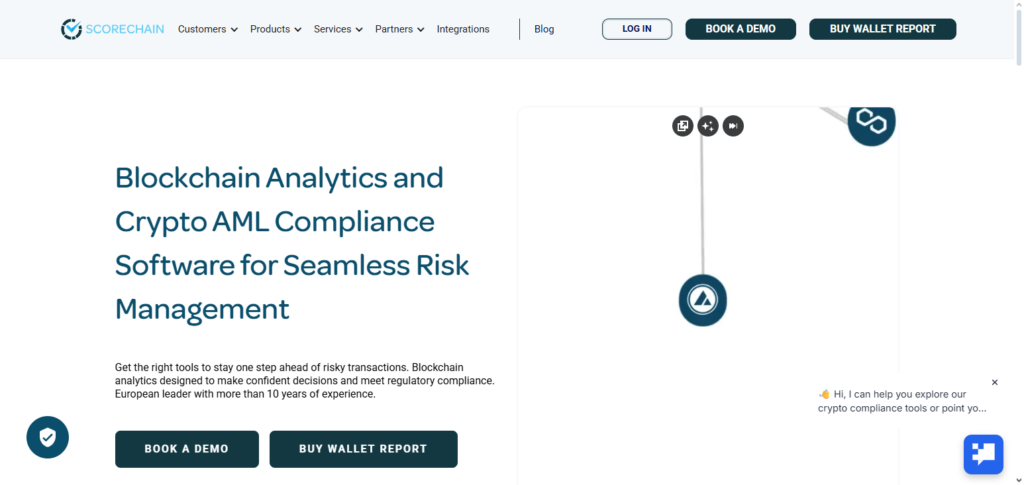
CipherTrace offers compliance monitoring and covers a wide range of cryptocurrency exchanges, allowing companies to concentrate on other operational facets. CipherTrace offers crucial tools for businesses to evaluate compliance risk and optimize operations. As a result, CipherTrace’s work and dedication to providing regulated and compliant cryptocurrency services were widely acknowledged.
CipherTrace (Mastercard) Features
| Feature | Explanation |
|---|---|
| Real‑Time Transaction Monitoring | Tracks crypto transactions across multiple blockchains instantly to flag suspicious activity. |
| Wallet Risk Scoring | Assigns risk levels to wallets based on behavior and history to identify high‑risk entities. |
| AML Compliance Tools | Provides Anti‑Money Laundering tools that help meet global regulatory requirements. |
| Regulatory Reporting | Generates audit‑ready reports for compliance teams and regulators. |
| Multi‑Chain Support | Supports major blockchains to deliver comprehensive visibility. |
CipherTrace (Mastercard) Pros & Cons
Pros:
- Great global compliance coverage for the compliance of regulators.
- Monitoring documentations of every single transactions.
- Risk and scroing of wallets across multiple chains.
- With trust comes a greater partnerships, and we get a trusted infrastructure as a part of Mastercard.
- Better forensic analysis and audits reportings.
Cons:
- High cost for small businesses.
- Complexity for the non-technical avenger of the setup.
- A diminuitive customization base for every small niche rule.
- On holidays the support tends to be sending low-priority support tickets.
- The coverage on the new and tokens still waiting to be launched are still emerging.
2. Scorechain Compliance Engine
Because it provides blockchain analytics, transaction risk scoring, and regulatory reporting to its clients, companies, and financial institutions, Scorechain Compliance Engine is the best crypto on-chain compliance engine. The technology automates the monitoring of suspicious activity and can service numerous cryptocurrencies.
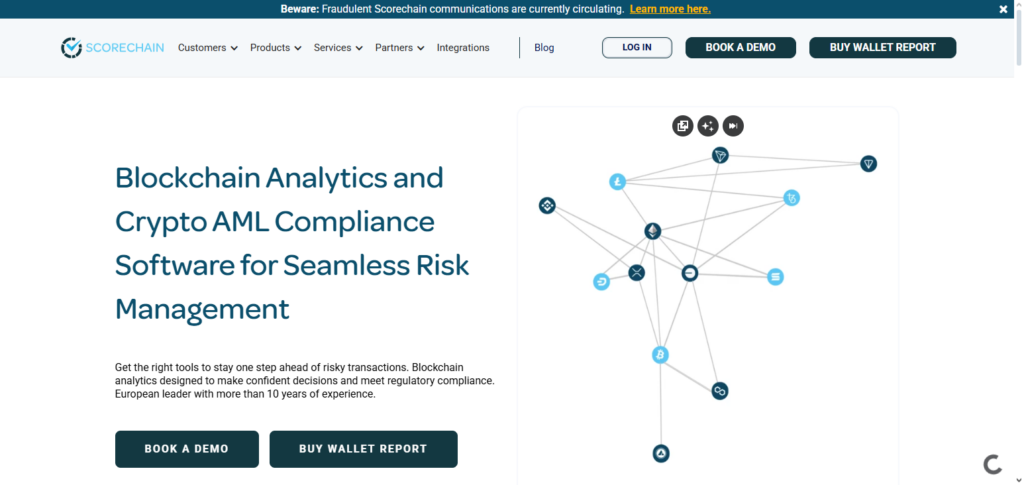
Compliance teams can use Scorechain to identify high-risk wallets, visualize transaction flows, and produce reports that can be sent straight to regulatory bodies.
The risk of serious compliance violations is reduced by Scorechain’s adaptable risk settings and real-time alerts. Scorechain enables full compliance with little effort and a deep comprehension of blockchain operations by streamlining compliance analytics with user-centered solutions.
Scorechain Compliance Engine Features
| Feature | Explanation |
|---|---|
| Blockchain Analytics | Visualizes transactional flows to detect irregular or risky patterns. |
| Risk Scoring | Assesses transactions and wallets to assign risk levels automatically. |
| Alert System | Sends alerts for suspicious activity to help compliance teams act quickly. |
| Multi‑Asset Support | Monitors transactions across multiple cryptocurrencies. |
| Custom Reports | Creates tailored reports for regulators and internal audits. |
Scorechain Compliance Engine Pros & Cons
Pros:
- Good tools for documenting the compliance of a blockchain.
- Risk tooling for other assets are configurable in the layer of the blockchain.
- More support for multiple assets and layer 2 chains.
- Regulatory documents in reportings are ready for completion.
- Compliance teams get a higher self-managed interface.
Cons:
- The advanced features may need a advanced training.
- On rsa a lesser training features are implemented.
- A smaller ecosystem of other services we are used to provided compared to other counterparts.
- The alerts are perfect but a manual tweaking is needed.
- Pricing may come in at the top tier in a ecosystem of itslike.
3. Crystal Blockchain (Bitfury)
Offering compliance and investigative insights on blockchain transactions, Crystal Blockchain is the top cryptocurrency on-chain compliance engine. Clients can monitor high-risk wallets across numerous chains, identify and flag suspicious transactions, and see the movement of assets thanks to its sophisticated, user-friendly design.

These features are especially important for cryptocurrency companies and law enforcement organizations that must spot fraudulent transactions and activities linked to money laundering and terrorism funding.
Additionally, Crystal Blockchain provides KYC/AML compliance by automating reporting and document preparation, allowing clients to meet all regulatory standards. Crystal Blockchain is a favored partner for companies and authorities looking to protect blockchain technologies because of its real-time warnings, advanced analytics, and investigative tools.
Crystal Blockchain (Bitfury) Features
| Feature | Explanation |
|---|---|
| Link Analysis | Maps how funds move across wallets to spot relationships among risky entities. |
| Investigative Tools | Enables deep investigations into suspicious chains of transactions. |
| Real‑Time Alerts | Notifies compliance teams of high‑risk activities immediately. |
| Case Management | Helps teams track and manage compliance cases from start to resolution. |
| Cross‑Chain Coverage | Supports multiple blockchain networks for broad oversight. |
Crystal Blockchain (Bitfury) Pros & Cons
Pros:
- Good at analyzing the flow of, and links between, particular transactions.
- Tools for investigations are of a good quality.
- There is a good partnership with law enforcement.
- Good features for managing cases.
- Supports the most popular cryptocurrencies.
Cons:
- There is a lot to learn.2. Inconvenient for small providers with basic functions.
- Certain functionalities are locked to higher plans.
- UI can be cluttered.
- Limited automation of the Travel Rule.
4. Elementus Compliance Engine
With its extensive blockchain analytics and regulatory reporting tools, Elementus Compliance Engine is considered the best crypto on-chain compliance engine. It enables businesses to keep an eye on transactions, manage token flows, and spot potentially dangerous on-chain activity.

The platform offers regulators audit-ready data and actionable insights by easily integrating with current compliance operations. Additionally, Elementus facilitates token tracking, which makes it possible to identify illegal activities on several blockchains.
Its automation features ensure high accuracy while minimizing manual compliance work. Businesses may guarantee complete regulatory compliance, reduce the risk of financial crime, and effectively obtain a comprehensive view of all on-chain activities by utilizing Elementus.
Elementus Compliance Engine Features
| Feature | Explanation |
|---|---|
| On‑Chain Analytics | Tracks token flows and on‑chain behavior with high precision. |
| API Integration | Connects with internal compliance systems for seamless workflows. |
| Audit‑Ready Reporting | Automates generation of regulator‑compliant reports. |
| Token Tracking | Allows deep tracing of specific tokens across chains. |
| Scalable Architecture | Supports growing demand and large datasets with performance. |
Elementus Compliance Engine Pros & Cons
Pros:
- Excellent on-chain data analytics.
- Excellent granular tracking of addresses and tokens.
- Solid automated generation of reports.
- Multiple API integrations.
- Supports advanced forensic queries.
Cons:
- Designed for Enterprises → an overkill for smaller companies.
- Can be expensive.
- For the best use, training is necessary.
- Less known compared to older competitors.
- Basic support for the Travel Rule.
5. Merkle Science Behavioral Rule Engine
Behavioral Rule Engine is one of the best crypto on-chain compliance engine geared towards detecting rare on-chain transactions using advanced behavioral analytics. The system is not like the standard monitoring systems. Here, custom rules, and machine learning is deployed for pattern recognition for fraud or money laundering detection.
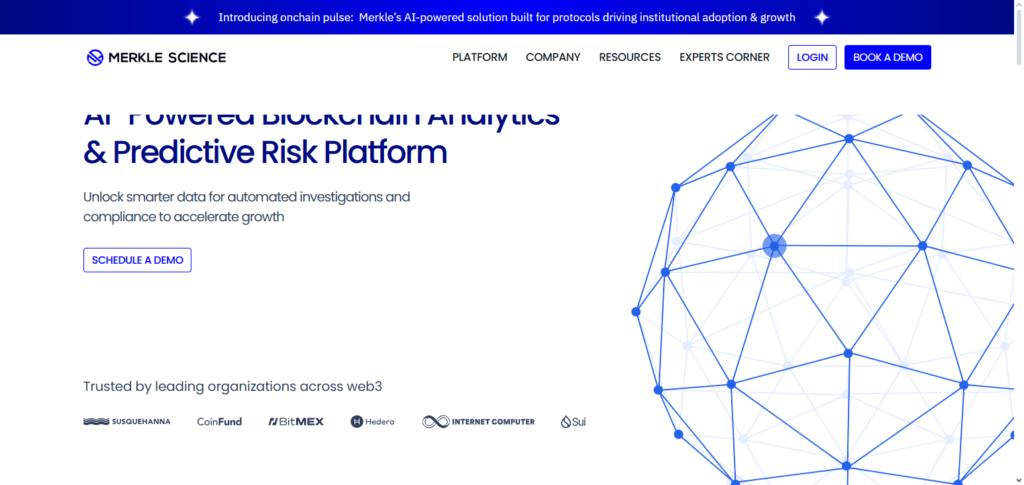
The service supports a variety of crypto, and crypto wallets and offers risk analytics, real time alerts, and real time risk monitoring of transactions. Merkle Science also offers seamless integration to AML and KYC workflows, allowing organizations to manage compliance requirements.
With its analytics, Merkle Science helps businesses, exchanges and financial institutions to identify and respond to threats in a timely manner, and also helps in operating transparency in crypto.
Merkle Science Behavioral Rule Engine Features
| Feature | Explanation |
|---|---|
| Behavioral Monitoring | Detects anomalies by analyzing transaction behaviors over time. |
| Custom Rule Engine | Lets teams build tailored compliance rules based on risk strategies. |
| Real‑Time Alerts | Issues quick warnings for transactions that breach rules. |
| Multi‑Token Detection | Supports behavioral detection across different crypto tokens. |
| Integration with AML | Works with AML/KYC tools to enrich compliance signals. |
Merkle Science Behavioral Rule Engine Pros & Cons
Pros:
- Behavioral analytics → identifies more sophisticated tactics.
- Can customize rule building for Risk teams.
- Contextual real-time alerts.
- Supports numerous token standards.
- Good compatibility with the AML/KYC stack.
Cons:
- Expertise is required to set up the rules.
- Initial false positives can be higher.
- Additional pricing for advanced functionalities.
- Does not include a full compliance suite.
- More technical documentation.
6. ComplyAdvantage Crypto Suite
ComplyAdvantage Crypto Suite is praised as the best crypto on-chain compliance engine offering AML screening, transaction monitoring, and risk scoring on the digital asset domain.
Businesses are enabled to meet the required compliance through real-time alerting, automated reporting, risk evaluation dashboards, and automated compliance reporting. The defence suite combines KYC, AML, and sanctions screening to produce an integrated compliance coverage.
With the advanced analytics financial institutions and crypto businesses are able to detect suspicious activities, mitigate fraud, and lower financial crime exposure. The userbase on ComplyAdvantage rapidly expanding cloud infrastructure is able to maintain equal light-touch compliance as they traverse challenging crypto regulatory settings.
ComplyAdvantage Crypto Suite Features
| Feature | Explanation |
|---|---|
| AML Screening | Automatically checks transactions against AML and sanctions lists. |
| Risk Scoring Dashboard | Centralized view of risk scores to prioritize reviews. |
| Real‑Time Alerts | Sends immediate alerts for high‑risk behaviors. |
| KYC Integration | Works with identity verification systems to improve compliance checks. |
| Cloud Deployment | Easy to deploy and scale across organizations. |
ComplyAdvantage Crypto Suite Pros & Cons
Pros:
- Provided strong measures for AML compliance alongside sanctions checks.
- Offered risk dashboards for unified and organized risk scoring.
- Provided improved risk alerts.
- Can be integrated with KYC workflows.
- Provided a relatively easy solution via being cloud-based.
Cons
- Does not have Travel Rule features built natively.
- Smaller blockchains have restrictions.
- High-volume transactions are expensive.
- Some tools need additional licensing.
- Non-experts may struggle with setups.
7. Notabene Travel Rule Engine
The top cryptocurrency on-chain compliance engine, Notabene Travel Rule Engine, is designed to automate Travel Rule compliance for international cryptocurrency transactions. In accordance with FATF standards, it guarantees the safe exchange of essential customer and transaction data between virtual asset service providers (VASPs).
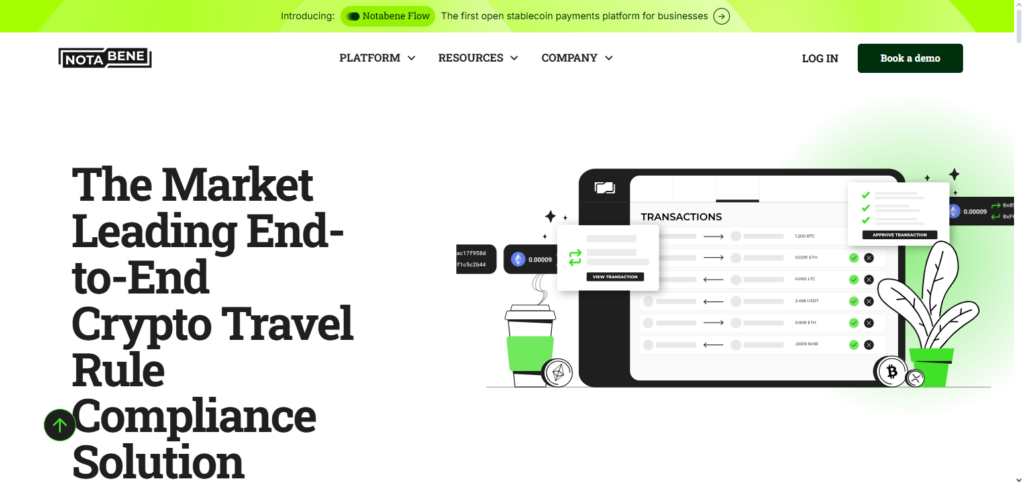
The technology facilitates encrypted messaging between institutions, automated reporting, and real-time transaction monitoring. Notabene lessens the operational load for financial institutions and exchanges by streamlining compliance with international rules.
While maintaining client privacy and data security, its strong infrastructure and workflow automation make it simpler to stop regulatory infractions, identify suspicious transfers, and preserve transparency in international cryptocurrency transfers.
Notabene Travel Rule Engine Features
| Feature | Explanation |
|---|---|
| Travel Rule Automation | Ensures compliance with FATF Travel Rule requirements for transfers. |
| Secure Messaging | Exchanges compliance data securely between VASPs. |
| Real‑Time Transaction Matching | Matches sender and receiver data for regulatory compliance. |
| Regulatory Alignment | Supports global Travel Rule standards across jurisdictions. |
| Integration APIs | Connects with existing compliance systems for seamless data flow. |
Notabene Travel Rule Engine Pros & Cons
Pros:
- Best‑in‑class Travel Rule automation.
- Secure data exchange between VASPs.
- Strong global regulatory alignment.
- Real‑time transaction matching.
- Reduces manual compliance burden.
Cons:
- Limited to Travel Rule — not full AML suite.
- Requires integration with existing compliance engines.
- May need partner services for KYC/AML.
- Cost adds up with message volume.
- Less suitable alone for full risk monitoring.
8. Shyft Network Compliance Infrastructure
Shyft Network Compliance Infrastructure is the best crypto on-chain compliance engine offering identity verification, transaction monitoring, and regulatory compliance tools for the blockchain ecosystem.
It helps users verify, monitor, and keep on-chain transactions for compliance with industry audit and reporting regulations. Shyft Network incorporates KYC/AML and ensures compliance with FATF and local laws.
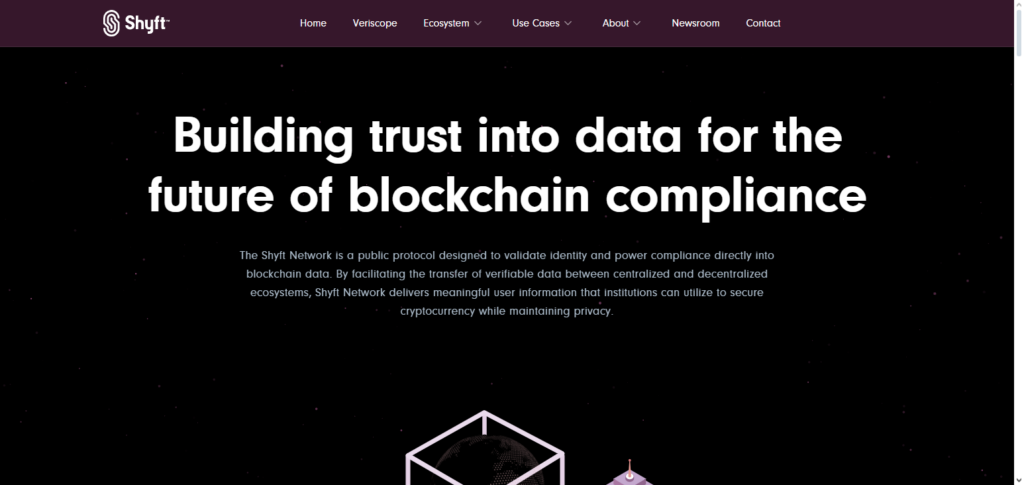
Its modular infrastructure serves numerous blockchains, offering adaptable and scalable services for exchanges, DeFi, and financial institutions.
With on-chain analytics and identity verification, Shyft Network safely and compliantly processes crypto transactions, protecting organizations from the risks of financial crime and helping them meet regulatory expectations.
Shyft Network Compliance Infrastructure Features
| Feature | Explanation |
|---|---|
| Decentralized Identity | Provides blockchain‑based identity verification for users. |
| Transaction Monitoring | Tracks on‑chain transfers for compliance analysis. |
| KYC/AML Support | Supports identity and risk verification for regulatory compliance. |
| Modular Architecture | Flexible setup that fits different business needs. |
| Audit Trails | Records transparent, immutable compliance logs. |
Shyft Network Compliance Infrastructure Pros & Cons
Pros:
- Decentralized identity verification.
- Built‑in transaction monitoring.
- Supports regulatory KYC/AML needs.
- Flexible modular architecture.
- Good for blockchain networks and ecosystems.
Cons:
- Adoption smaller than top rivals.
- Identity features can be complex to deploy.
- Less established reporting templates.
- Needs customization for enterprise needs.
- Documentation not always comprehensive.
9. Bitwave Compliance Cloud
Bitwave Compliance Cloud is regarded as one of the best crypto on-chain compliance engines of its kind and is geared for complete enterprise-level blockchain compliance and reporting.
Automation of regulatory compliance is achieved through the engine’s continual transaction monitoring and real-time risk reporting, accompanied by audit-proof reporting.

Bitwave’s support for several digital currencies enables seamless integration with organization workflows for accounting and compliance, fostering precise organization reporting. Bitwave provides transaction analytics and exposes high-risk address analytics for enterprise risk portfolio management.
With its services, companies can eliminate manual compliance workloads and provide reporting that mitigates the risks of fraud and money laundering. Cloud-based frameworks mitigates risks of crypto firms and provides optimum security and infinite scalability.
Bitwave Compliance Cloud Features
| Feature | Explanation |
|---|---|
| Enterprise Reporting | Produces compliance reports ready for regulators and auditors. |
| Real‑Time Alerts | Monitors transactions and flags risks as they occur. |
| Workflow Integration | Works with accounting and compliance tools for smooth operations. |
| Portfolio Analytics | Provides visibility into crypto holdings and risk exposure. |
| Cloud Scalability | Built for enterprise scale with secure cloud infrastructure. |
Bitwave Compliance Cloud Pros & Cons
Pros:
- Enterprise‑grade compliance and reporting.
- Real‑time risk alerts.
- Integrates with accounting + exchange workflows.
- Portfolio insights and risk scoring.
- Cloud‑based and scalable.
Cons:
- Some modules provide support for smaller tokens only.
- There may be a need for external AML suppliers.
- Some modules provide support for these features that are more oriented toward accounting.
- Client support may depend on the chosen service package.
10. TRES Finance Compliance Engine
The TRES Finance Compliance Engine is the best crypto on-chain compliance engine that provides AML and KYC automation, real-time transaction monitoring, and risk assessment related to digital asset holdings.
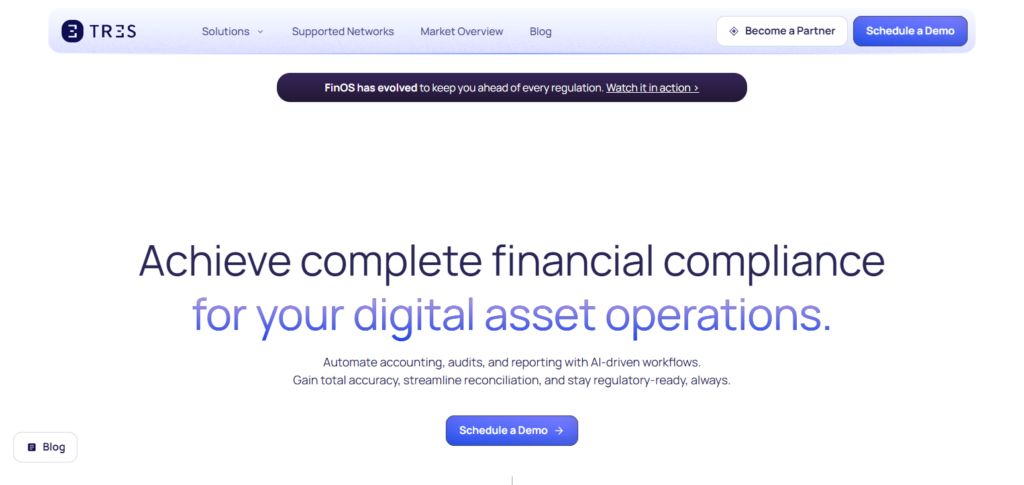
It provides audit trails, tools for regulatory reporting, and automation of alerts related to sensitive transaction monitoring. It is multi-chain, allowing entities to trace token movements and identify illegal activities seamlessly.
TRES Finance is easily adjustable to compliance workflows. It reduces operational effort in workflows while improving accuracy and transparency. It protects the operation of analytics and monitoring fully integrated compliance to financial cybercrime and geo-jurisdictional complexity of the crypto ecosystem for regulated entities.
TRES Finance Compliance Engine Features
| Feature | Explanation |
|---|---|
| AML Automation | Automatically identifies and flags potential money‑laundering. |
| KYC Integration | Supports identity verification checks within compliance workflows. |
| Multi‑Chain Monitoring | Tracks transactions across multiple blockchain networks. |
| Audit Reporting | Produces detailed reports for compliance and legal review. |
| Real‑Time Alerts | Issues risk alerts quickly to minimize exposure to illicit transactions. |
TRES Finance Compliance Engine Pros & Cons
Pros:
- Built-in automation for AML and KYC.
- Provides alerts and monitoring in real time.
- Optimized to support a multiple of blockchain technologies.
- Positive features for regulatory compliance reporting.
- Tailored for digital currency exchange and wallet services.
Cons:
- Less established and smaller user base.
- Limited documentation.
- Some volume alerts may need adjustments.
- Limited to basic offerings related to the Travel Rule.
- Additional costs may be incurred for features designed to meet specific.
Conclusion
Businesses and financial institutions must ensure regulatory compliance and stop illegal activity in the quickly changing bitcoin ecosystem of today.
Advanced capabilities for transaction monitoring, AML screening, risk scoring, and regulatory reporting are offered by the top cryptocurrency on-chain compliance engines, including CipherTrace, Scorechain, Crystal Blockchain, Elementus, Merkle Science, ComplyAdvantage, Notabene, Shyft Network, Bitwave, and TRES Finance.
Organizations can detect suspicious activity, maintain strong compliance frameworks, and increase transparency across blockchain networks by utilizing these technologies.
Investing in a dependable compliance engine promotes safe and sustainable growth in the cryptocurrency sector by reducing the risk of financial crime and fostering customer and regulatory confidence.
FAQ
A crypto on-chain compliance engine is a software platform designed to monitor blockchain transactions, detect suspicious activity, enforce AML/KYC regulations, and generate regulatory reports. These engines help exchanges, wallets, and financial institutions maintain compliance while preventing fraud and money laundering on blockchain networks.
They provide transparency and risk management in cryptocurrency transactions, ensuring businesses comply with local and international regulations. They reduce exposure to financial crime, enable real-time monitoring, and help maintain trust with regulators and customers.
Key features include real-time transaction monitoring, wallet risk scoring, AML/KYC integration, customizable risk rules, audit-ready reporting, multi-chain support, and automation to reduce manual compliance efforts.
Yes. Most top crypto on-chain compliance engines are designed to integrate seamlessly with exchanges, wallets, DeFi platforms, and enterprise systems, enabling automated compliance workflows without disrupting operations.
They generate detailed audit trails, risk reports, and regulatory filings, making it easier to comply with local and international laws such as FATF Travel Rule, AML regulations, and other financial reporting requirements.