


I’ll go over the Top Crypto Transaction Policy Engines in this post, which are crucial resources for keeping an eye on and controlling cryptocurrency transactions.
These engines assist companies in ensuring regulatory compliance, detecting suspicious behavior, and enforcing AML/KYC regulations.
The finest crypto transaction policy engines successfully guard exchanges, wallets, and financial institutions against fraud, money laundering, and other threats by utilizing sophisticated analytics and real-time monitoring.
What Is a Crypto Transaction Policy Engine?
In order to guarantee regulatory compliance, a crypto transaction policy engine is a compliance system that keeps an eye on, evaluates, and enforces regulations on cryptocurrency transactions.
By evaluating transaction behavior and risk levels, it assists exchanges, wallets, and financial institutions in implementing AML, KYC, and sanctions rules in real time. To identify suspect activities like fraud, money laundering, or authorized transfers, these engines use blockchain analytics, risk grading, and automatic warnings.
A crypto transaction policy engine improves transaction transparency across different blockchains, boosts regulatory compliance, and minimizes manual labor by automating compliance checks and producing audit-ready reports.
Why Crypto Businesses Need Transaction Policy Engines
Regulatory Compliance
These businesses now have the means to automate compliance rules across all transactions and thus are able to comply with the world`s AML, KYC, and sanctions regulations.
Fraud and Money Laundering Prevention
They lose the risk of being exposed to other financial crimes as they have the ability to detect, monitor, and analyze suspicious transaction flows, high-risk wallets, and other patterns in real time.
Real-Time Transaction Monitoring
These engines have the ability to monitor these transactions in real time and therefore businesses have the option to mitigate these issues instantaneously, rather than post settlement.
Automated Risk Scoring
These solutions set risk scores for certain transactions and/or addresses, which streamlines the compliance process and enables more efficient risk-based decision making.
Reduced Manual Compliance Workload
Compliance teams have more time on their hands as automation allows for fewer manual reviews of transactions, which in turn saves operational costs and time.
Audit-Ready Reporting
These systems create reports with the preferred level of detail within a simple and streamlined process, which allows companies to prep and submit documents to the regulators with ease.
Multi-Blockchain Coverage
These engines are able to comply with regulations in a consistent i all the cryptocurrencies and blockchains they support.
Protection of Business Reputation
These systems are able to prevent activities that would otherwise risk the reputation of the brand, and thus would cause a loss in customers.
Scalability for Growth
As the volume of transactions increase, businesses also have the ability to scale without the risk of losing compliance. These engines are built to handle transaction volume.
Key Point & Best Crypto Transaction Policy Engines List
| Platform | Key Point |
|---|---|
| Chainalysis KYT Policy Engine | Monitors crypto transactions in real-time to enforce AML/KYC policies. |
| Elliptic Policy Framework | Provides customizable compliance rules to detect and prevent illicit activity. |
| TRM Labs Policy Engine | Automates risk scoring and transaction monitoring for regulatory compliance. |
| ComplyAdvantage Crypto Policy Suite | Offers policy automation with real-time screening and alerts. |
| Scorechain Policy Manager | Manages transaction risk policies across multiple blockchains and wallets. |
| Notabene Transaction Policy Engine | Ensures compliance with travel rule and cross-border crypto regulations. |
| Shyft Network Policy Infrastructure | Centralized policy framework for identity verification and AML enforcement. |
| Lukka Enterprise Policy Suite | Enterprise-grade policy management with audit-ready compliance reporting. |
| Bitwave Compliance Policy Engine | Enables configurable rules for transaction monitoring and risk management. |
| TRES Finance Policy Engine | Streamlines policy enforcement for crypto transactions and regulatory reporting. |
1. Chainalysis KYT Policy Engine
Chainalysis KYT Policy Engine is a premier solution for monitoring crypto transactions in real-time. It helps financial institutions and crypto exchanges apply and manage AML and KYT policies. It automatically tracks transactions, flags suspicious activity, scores risks, and compiles reports for regulatory compliance.
It has an improved alert system for compliance officers to manage potential fraud and transaction monitoring. It seamlessly fits your workflows to ensure cross-chain monitoring. It is widely known to be one of the most outstanding policy engines for crypto transactions in the industry.
Chainalysis KYT Policy Engine Features, Pros & Cons
Key Features
- Continuous tracking of transactions in real-time
- Sophisticated risk scoring engine
- Support for multiple blockchains
- Automatic alerting and case management
- Support for compliance and regulatory reporting
Pros
- Best-in-class blockchain intelligence
- Accurate detection of illegal activities in transactions
- Recognized and trusted by regulators and financial institutions
- High scalability for large volumes of transactions
- Outstanding API integration capabilities
Cons
- Expensive for large enterprises.
- Complicated for smaller businesses to implement.
- Needs compliance and audit teams.
- Less flexibility for smaller customers.
- Primary focus on AML use cases.
2. Elliptic Policy Framework
Elliptic Policy Framework provides an adaptable model for achieving compliance of blockchain transaction activity. This lets organizations establish policies of differing levels of risk and compliance.
It provides real-time monitoring of blockchain activity for illicit transactions and violations of sanctions due to high-risk wallets. Actionable insights risk scoring and reporting for audits are also provided by the Framework.
Policy compliance monitoring and real-time rule adjustments by the compliance team are done using the user-friendly Elliptic dashboard.
Proactive detection and accuracy have earned Elliptic Policy Framework the ability to support both small and large organizations with regulatory compliance, and policy monitoring and management, and earned it the title of most effective crypto transaction policy engine.
Elliptic Policy Framework Features, Pros & Cons
Key Features
- Personalized compliance policies
- Portfolio and transactions risk scoring
- Detection of sanctions and exposure
- Live view monitoring dashboard
- Audit-ready reporting of tools
Pros
- Flexible policy design
- Good quality analytics
- Good balance in blockchain ecosystem coverage
- Comprehensible compliance information
- Good fit for Financial Institutions and Exchanges
Cons
- Additional fees apply for advanced functionality.
- New customers need training.
- Accounting integration is limited.
- Designed for large enterprises.
- Customization for advanced features is necessary.
3. TRM Labs Policy Engine
Businesses in cryptocurrency have to manage risks and monitor transactions, for which TRM Labs Policy Engine automates the process. TRM Labs employs advanced analytical techniques to monitor transactional fraud, money laundering, and more.
The policy engine and compliance center work together to manage multi-layered risk scores and comply with global regulations, reducing the complexity of audits.
With TRM Labs, policy enforcement is proactive, meaning companies adjust policies to address enforcement gaps in the ever-evolving cryptocurrency.
Because of its unparalleled performance on risk mitigation while managing and monitoring policies, TRM Labs Policy Engine is more than likely the most effective cryptocurrency transactions policy engine.
TRM Labs Policy Engine Features, Pros & Cons
Key Features
- Analysis of transactions that focus on the behavior
- Risk scoring on multiple levels
- Monitoring of transactions through different blockchains
- Alerts for compliance that are automated
- Assistance with regulatory reporting
Pros
- High-quality threat intelligence
- Strongest fraud detection abilities
- Worldwide regulatory range
- Adjustable framework
- Easy to use compliance dashboards
Cons
- Premium costs
- Lacks SME-centered tools
- Difficult onboarding procedure
- Strong need for data analysis
- Not focused on accounting
4. ComplyAdvantage Crypto Policy Suite
ComplyAdvantage Crypto Policy Suite is fully automated policy monitoring and policy execution in real-time for digital assets. It automates risk scoring, transaction monitoring, and suspicious activity case generation to streamline regulatory compliance.

The suite integrates with third party wallets and exchanges for transaction surveillance, while providing custom compliance workflows via APIs. It also supports travel rule compliance, sanctions screening, and KYC tiering.
ComplyAdvantage provides audit and regulatory reports for compliance to inform regulators. Due to the automated risk-mitigating compliance policies, ComplyAdvantage Crypto Policy Suite are recognized as among the top crypto transaction policy engines for compliance risk mitigation.
ComplyAdvantage Crypto Policy Suite Features, Pros & Cons
Key Features
- Real-time transaction monitoring for AML
- Monitoring of sanctions and PEP
- Policy automation features
- Integration using API
- Features for audit and reporting
Pros
- Strong regulatory data coverage
- Quick generation of alerts
- Integration flexibility
- Good for compliance teams
- Focus on AML worldwide
Cons
- Lacks depth in blockchain analytics
- Initially not crypto-native
- Extra charge for advanced features
- Less focus on DeFi
- Needs configuration tuning
5. Scorechain Policy Manager
Policy Manager is a first-of-its-kind policy management solution that allows users to track transactions across numerous blockchains and wallets and evaluate them for compliance with policy-based rules.
Users can set up and integrate automated rules for policy-based compliance, automatic transaction blocking, monitoring of alerts, and compliance with global standards like the 4th EU AML Directive.
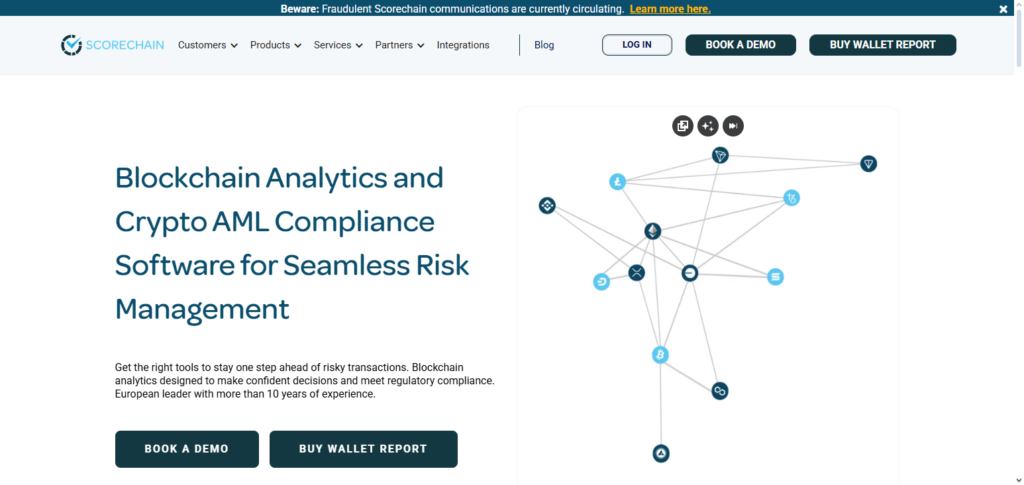
Policy Manager also provides advanced Active Monitoring functions for the identification of suspicious blockchain transactions. With a fully customizable dashboard policy compliance managers, control notification filters and alerts to take a policy-based investigation.
Policy Manager also performs Digital Asset Audits, making it the best DiFi Policy Manager for Exchanges and Financial Institutions. Policy Manager is simply the most advanced blockchain monitoring solution available today and the most comprehensive crypto transaction policy engine.
Scorechain Policy Manager Features, Pros & Cons
Key Features
- Monitoring of transactions across multiple blockchains
- AML/KYC tools
- Risk scoring tool
- Unique creation of policy rules
- Dashboard for compliance reporting
Pros
- Strong alignment to regulations in Europe
- Supports many blockchains
- Policy management flexibility
- Good for VASPs
- Risk scoring transparency
Cons
- UI can feel complex
- Lacks accounting features
- Smaller ecosystem integrations
- Not well known outside Europe
- More advanced setup needed
6. Notabene Transaction Policy Engine
Notabene Transaction Policy Engine covers cross-border compliance and travel rule enforcement. It provides automated monitoring of transactions, allowing for the automated regulation of cryptocurrency transfers.
It covers the integration of identity verification, sanctions screening, and risk scoring to identify and mitigate fraudulent activities. Their policy engine allows businesses to define and customize their rule sets to monitor transactions, providing alerts and detailed reports for audits.
Notabene boasts seamless interoperability with wallets, exchanges, and financial institutions. Notabene Transaction Policy Engine has received awards for travel rule compliance and alignment with regulations in multiple jurisdictions, earning the reputation of being one of the the best crypto transaction policy engines for cross border crypto activities.
Notabene Transaction Policy Engine Features, Pros & Cons
Key Features
- Travel Rule compliance automation
- Cross border transaction supervision
- Identity data transfer
- Risk-based policy execution
- Easily verifiable reporting
Pros
- Leading Travel Rule resolution
- Solid global regulatory alignment
- Smooth VASP collaboration
- Automated compliance
- Flexible infrastructure
Cons
- Limited blockchain data analysis
- Travel Rule-focused
- Unsuitable for complete AML suites
- Partner adoption required
- Limited fraud detection
7. Shyft Network Policy Infrastructure
Shyft Network Policy Infrastructure is a blockchain compliance solution focusing particularly on identity verification and AML enforcement. It offers a unified policy structure, allowing businesses to set, track, and implement rules on transactions at different tiers.
Shyft’s policy engine automates the processes of risk score generation, sanctions screening, and alerting on potential violations, leading to a more effective identification of suspicious transactions.
It also offers the ability to KYC and share documents with regulatory authorities for seamless compliance. It is tailor-made for both vendors and for moving large volumes like exchanges. Because Shyft Network Policy Infrastructure provides real-time identity compliance and monitoring, it is arguably one of the top tier crypto transaction policy engines.
Shyft Network Policy Infrastructure Features, Pros & Cons
Key Features
- Identity-based transaction policies
- AML and KYC data-sharing
- Distributed compliance system
- Policy execution in real-time
- Secure data transfer
Pros
- Excellent loss verification layer
- Unique distributed method
- Aligns with compliance worldwide
- Focused on user privacy
- Flexible infrastructure
Cons
- Adoption still maturing
- Fewer accounting functionalities
- Implementation complexity
- Lesser presence among large enterprises
- Ecosystem participation required
8. Lukka Enterprise Policy Suite
Lukka Enterprise Policy Suite is facilitated to meet the industry’s compliance and transaction oversight for digital assets. Fully automated policy compliance facilities, customized risk assessments and reports, and workshops on regulation policies to meet the compliance requirements of the firm.

The company combines blockchain transaction monitoring to identify potential fraudulent transactions, and sanctions evasion, and responsive monitoring for high transaction volume clients. Lukka’s policy engine comes with an industry-defining level of configurability, allowing clients to tailor the policy rules to their particular jurisdictional and operational needs.
It is for this reason that Lukka Enterprise Policy Suite is generally acknowledged as one of the most comprehensive and highly scalable solutions in the industry for the provision of policy engines for crypto transactions.
Lukka Enterprise Policy Suite Features, Pros & Cons
Key Features
- Enterprise-level policy framework
- Transaction risk management
- Compliance reporting
- Data normalization
- Financial system integration
Pros
- Significant focus on enterprise compliance
- Ready for audits
- Trusted by many institutions
- Data precision
- Good scalability
Cons
- High costs for new firms
- Limited DeFi coverage
- Onboarding is complicated
- Fewer real-time alerts
- Only orientation to enterprises
9. Bitwave Compliance Policy Engine
Bitwave Compliance Policy Engine assists businesses in automation compliance during crypto transactions. Uses configurable policy rules for transaction monitoring and compliance, automated in generating reports for various compliance regulations.

Featuring an integration with multiple wallets, exchanges, and blockchain infrastructure, facilitates real-time supervision. Services also include sanctions screening and KYC/AML compliance. Bitwave user-friendly dashboards allow compliance officers to modify policies and limit scope of alerts.
Bitwave Compliance Policy Engine has been an industry leader and recognized for its extensive automation solutions as one of the most popular policy engines for transaction compliance for contemporary crypto businesses.
Bitwave Compliance Policy Engine Features, Pros & Cons
Features
- Compliance rules are configurable
- Monitoring of risk associated with transactions
- Enforcement of AML/KYC
- Integration with accounting system
- Tools for compliance reporting
Pros
- Merged compliance and accounting
- Interface is user-friendly
- Customization of policy is flexible
- Recommended for medium-sized companies
- Designed with automation in mind
Cons
- Depth of blockchain analytics is limited
- Smaller ecosystem for compliance
- Less coverage of global regulation
- Not suited for larger exchanges
- Advanced tools for investigations are fewer
10. TRES Finance Policy Engine
TRES Finance Policy Engine assists in monitoring and automating compliance in the crypto transactions for businesses and exchanges.
Provides automation in risk detection, compliance policy application, and generation of alerts for real-time reporting of regulated suspicious actions. Provides various reports in compliance with the regulations for audits, sanctioning, KYC, and AML compliance.
Policy flexibility allows for tailored compliance to specific risk profiles and policies jurisdiction. TRES Finance highlights integration with existing financial systems and prioritizing minimal operational disruption.
With comprehensive monitoring and regulatory compliance, TRES Finance Policy Engine has been recognized as one of the most popular policies for transaction compliance in the crypto space.
TRES Finance Policy Engine Features, Pros & Cons
Features
- Monitoring of transactions in an automated manner
- Policy enforcement is based on risk
- Screening of AML and sanctions
- Assistance with regulatory reporting
- Integration with financial systems
Pros
- Compliance in the crypto space is strong
- There are detailed audit trails
- Configuration of policies is flexible
- Multiple jurisdictions can be supported
- Tailored for finance teams
Cons
- Public documentation is limited
- Market presence is smaller
- Less tools for intelligence on blockchain
- More advanced features require configuration
- Less suited for high-volume exchanges
Key Features of the Best Crypto Transaction Policy Engines
Real-Time Transaction Monitoring: Watches crypto transactions moving between wallets and blockchains in real-time until abnormal activity is detected.
Advanced Risk Scoring: Risk scores are assigned and modified to transactions and addresses based off on behavior, history, and threat signals.
Customizable Policy Rules: Compliance teams are empowered to define and modify policy rules based on the jurisdiction or business needs.
Automated Alerts and Case Management: Alerts are created in real-time when a potential violation occurs, and tools are given to manage and resolve a case efficiently.
Multi-Blockchain Support: Transaction supervision is guaranteed by the support of a variety of cryptocurrencies and blockchain protocols.
Sanctions and PEP Screening: Sanctions and PEP (Politically Exposed Persons) databases, as well as other high-risk entity lists, are screen against.
Travel Rule Compliance: Requirements of the travel rule are satisfied by obtaining and holding onto the required sender and receiver information.
Audit-Ready Reporting: Compliance documentation, as well as reports required for audits and regulatory filing, are automatically created.
API & System Integration: Compliance systems, wallets, and existing exchanges are integrated with various APIs without any problems.
Conclusion
Due to the rapidly growing cryptocurrency market, it is vital to have effective policy engines like Cahinlysis KYT, Elliptic, and TRM Labs to improve compliance, mitigate risk, and stop bad actors and activities. These services are great for enterprises and exchanges due to real-time monitoring, as well as risk scoring and policy automation.
CmplyAdvantage’s Crypto Policy Suite, Scorechain Policy Manager, Notabene Transaction Policy Engine, Shyft Network Policy Infrastructure, Lukka Enterprise Policy Suite, Bitwave Compliance Policy Engine, and TRES Finance Policy Engine also provide tools needed for effective and comprehensive AML/KYC, sanctions screening , and reporting tools for ready audits.
While all of these policy engines are the besting class for cryptocurrency and blockchain transactions, the ultimate choice will come down to the size of your business, your compliance policy and regulatory needs, and the blockchain your business operates on.
FAQ
A crypto transaction policy engine is a software platform that monitors cryptocurrency transactions to ensure compliance with regulatory requirements such as AML (Anti-Money Laundering), KYC (Know Your Customer), and sanctions screening. It automates risk detection, generates alerts for suspicious activity, and provides audit-ready reports for regulatory authorities.
These engines are critical for exchanges, wallets, and financial institutions dealing with digital assets. They help prevent fraud, money laundering, and regulatory violations, ensuring secure and compliant operations while reducing manual compliance efforts.
Key features include real-time transaction monitoring, risk scoring, automated alerts, AML/KYC compliance, sanctions screening, blockchain analytics, policy customization, and audit-ready reporting. Scalability and integration with existing systems are also important.
They automate the enforcement of compliance policies, flag suspicious transactions, and maintain detailed logs for audits. This ensures adherence to global regulations such as FATF Travel Rule, sanctions lists, and local AML/KYC laws, minimizing legal and financial risks.