


I’ll go over the top cryptocurrency wallets for US-compliant organizations in this post. For operational effectiveness, asset protection, and regulatory compliance, selecting the appropriate wallet is essential.
BitGo, Fireblocks, Coinbase Custody, and Gemini Custody are examples of US-compliant wallets that help businesses manage digital assets securely while adhering to US regulations. These wallets offer institutional-grade features like multi-signature security, insurance coverage, and audit-ready reporting.
How To Select Crypto Wallets for US-Compliant Institutions
Regulatory Compliance
- Confirm that the wallet is licensed and controlled in USA (e.g. NYDFS, SEC, FINRA).
- Confirm compliance with AML, KYC, and the reporting requirements.
Wallet Security
- Assess cold storage and hot wallet security, encryption, and access controls.
- Look for multi-signature wallets or MPC (Multi-Party Computation) for key splitting.
Insurance Policy
- Confirm if the wallet provides insurance for digital assets (e.g. theft or hacking).
- Analyze the coverage limits and the terms and conditions for claims.
Versatility and Asset Support
- Confirm support for a diverse set of cryptocurrencies your institution has.
- If necessary, check for support of tokenized assets or cross-chain features.
Enterprise Integrations.
- Assess the presence of API access for integrating with trading, treasury, and reporting platforms.
- Look for dashboards and reporting features to streamline audit and compliance work.
Operational Efficiency
- Look for transaction speed and assess approval workflows and features of super user control.
- Consider the simplicity of onboarding and collaboration features.
Benefits of Using US-Compliant Institutional Wallets
Regulatory Compliance
- US Regulations such as NYDFS, SEC and FINRA are followed.
- Institutional operations make auditing and reporting a breeze.
Enhanced Security
- Protection against hacks and loss of assets with multi signature and MPC key management.
- Cold storage services and options ensure that assets are safe.
Insurance Coverage
- In some cases, custodianship assets also incur insurance for theft or loss.
- More layers of protection means more layers of trust for stakeholders.
Enterprise-Level Control
- Advanced user roles allow for team, cross team, and multi team approver workflows.
- More complex structures are governance and operational oversight.
Audit and Reporting Tools
- Compliance reporting, dashboards, and reporting in real time are a few of the many tools and services offered.
- Regulatory filings and audits are a walk in the park.
Operational Efficiency
- Quick and safe movement of assets is offered.
- Workflows with treasury, trading, and investment platforms are more integrated.
Risk Mitigation
- More low than ever the chances of fraud, mismanagement, or regulatory fines.
- With US-compliant institutional wallets, all crypto transactions are clear and accountable.
Confidence and Credibility
- With digital asset management, institutions are seen as safe, compliant, and professional. Trust is sensed with clients, investors, and regulators.
Key Point & Best Crypto Wallets for US-Compliant Institutions List
| Crypto Custody Platform | Key Points |
|---|---|
| BitGo Trust Company | Institutional-grade security, multi-signature wallets, insurance coverage, supports multiple cryptocurrencies, regulated in the US. |
| Fireblocks | Secure transfer network, MPC-based wallets, fast transaction approvals, real-time monitoring, API integrations for enterprises. |
| Paxos Custody | Fully regulated, insured, real-time settlement, supports tokenized assets, compliance-focused solution. |
| Bakkt Custody | Regulated by NYDFS, enterprise security, supports digital assets and futures, insurance coverage, scalable platform. |
| Fortress Trust | Independent trust company, insurance-backed custody, multi-layer security, compliance-first approach, supports institutional clients. |
| Zengo Business | Keyless crypto security using MPC, user-friendly interface, enterprise wallet management, insurance for stored assets, fast onboarding. |
| Qredo | Decentralized custody with MPC, cross-chain interoperability, instant settlement, compliance support, built for institutional trading. |
| Ledger Enterprise | Hardware-backed security, offline storage options, multi-asset support, enterprise dashboard, regulatory compliance features. |
| Coinbase Custody | US-regulated, insured cold storage, supports multiple cryptocurrencies, API access for trading platforms, enterprise-ready. |
| Gemini Custody | Fully insured, regulated in the US, segregated cold storage, compliance-first, enterprise-grade reporting and audit tools. |
1. BitGo Trust Company
BitGo Trust Company is at the forefront with US-compliant institutional custody solutions. Offering multi-signature wallets, BitGo ensures no individual can access funds alone, which bolsters institutional security. Also, BitGo boasts a wide array of cryptocurrencies and provides custody insurance for digital assets.
The fully regulated platform in the United States makes it a reliable option for compliance-focused organizations. Thanks to its robust enterprise-grade APIs and real-time reporting, customers can secure assets, monitor transactions, and manage compliance. BitGo is one of the most acknowledged institutions for the Best Crypto Wallets for US-Compliant Institutions due to the hot and cold wallet integrations.
BitGo Trust Company Features, Pros & Cons
Features
- Regulated US Trust Company – Licenses custody services under US law.
- Multi-Signature Wallets – Requires multiple signers for transactions.
- Supports a Wide Variety of Crypto – Support for multiple tokens and digital assets.
- Institutional APIs and Reporting – Enterprise level dashboards and integrations.
- Insurance – Protection against theft and hacking.
Pros
- Strongens institutions’ compliance and regulation.
- Multi-sig custody adds an extra security layer.
- Multi-asset coverage strengthens institutional portfolio.
- APIs provides custom integrations to enterprise systems.
- Insured crypto assets provide safety.
Cons
- More expensive than a regular retailer custodians.
- Set up can be difficult for small organizations.
- A few recent crypto assets might not be available.
- More suitable to institutional rather than retail investors.
- Insurance coverage is limited.
2. Fireblocks
Fireblocks is a platform for digital asset management that provides secure institutional infrastructure. Fireblocks utilizes Multi-Party Computation (MPC) technology so that private keys are never fully disclosed, lowering the likelihood of hacks.
Users can access quick and secure transaction approvals, real-time monitoring, and a broad network for asset transfers. Fireblocks supports a broad range of digital currencies and integrates with numerous trading platforms, wallets, and exchanges.
With its compliance features meeting the standards of US regulations, it is considered a “go-to” platform for regulated institutions. Fireblocks is noted for having the “Best Crypto Wallets for US-Compliant Institutions” because of its operational efficiency and cutting-edge technology.
Fireblocks Features, Pros & Cons
Features
- MPC Key Management – Private keys are never fully revealed.
- Fireblocks Network – Rapid transactions between counterparties.
- Wide Token Support – Supports a large number of digital assets.
- Real-Time Monitoring & Alerts – Round the clock custody monitoring.
- API & Integrations – Works with wallets, apps, and exchanges.
Pros
- Cutting-edge MPC security minimizes risks.
- Fast transfers across different institutions.
- Extensive token coverage.
- Audit and risk central visibility.
- Integrations and workflows are simple.
Cons
- More intricate than standard custodians.
- Possible network fees.
- Learning curve with dashboard.
- Whitelisting some tokens is required.
- Developer assistance may be needed.
3. Paxos Custody
Paxos Custody provides institutional investors in the U.S. with a custodial solution that is fully regulated and insured. Paxos being a trust company offers custodial solutions along with compliance of U.S. financial regulations and covers a wide range of digital assets, including the likes of tokenized securities.

The platform features real time settlement and easy audit traceability for enterprise transaction reporting. With operational controls and custodial assets being insured Paxos designs to alleviate the crypto custody risks for institutions.
Paxos is highly rated in the Best Crypto Wallets for US-Compliant Institutions and combines regulatory compliance, security, and operational efficiency for enterprises managing large volumes of digital assets.
Paxos Custody Features, Pros & Cons
Features
- Regulated US Trust – Custody is licensed with Paxos.
- Real-time settlement – Provides instant transaction clearance.
- Asset protection insurance – Coverage against losses.
- Support for tokenized securities – Provides a bridge between regulated tokens and digital assets.
- Compliance Reporting – Documentation ready for audit.
Pros
- Great industry focus on compliance and transparency.
- Fast and straightforward settlement.
- Insurance increases institutional confidence.
- Support for tokenization of assets.
- Audit reminders for regulators are useful.
Cons
- Compared to its peers, a smaller portfolio of assets.
- Less suited for high-frequency trading.
- Limited third-party partnerships.
- Onboarding is a documentation-heavy process.
- Few advanced offerings.
4. Bakkt Custody
Bakkt Custody is an institutional wallet custody service regulated by the New York Department of Financial Services (NYDFS). Bakkt features corporate customer cold storage and custody protection by cryptocurrency insurance. Customers get seamless workflows integrated with Bakkt’s other services, including digital asset trading and futures.
The Bakkt Custody wallet service is adaptable for enterprise customers who need audit-ready custody services and warranties. For fully regulated, fully insured, and safe cryptocurrency custody, Bakkt is recognized as one of the Best Crypto Wallets for US-Compliant Institutions because of its reputation and operational adaptability.
Bakkt Custody Features, Pros & Cons
Features
- NYDFS Regulation – Licenced by the new york financial regulators.
- Cold Storage Security – Extensive offline security.
- Insurance Coverage – further safeguard for assets.
- Bakkt Ecosystem Integration – Compatible with Bakkt trading products.
- Enterprise Support Services – Institutional support tailored.
Pros
- High regulatory trust in the US.
- Excellent protection for offline assets.
- Insurance coverage.
- Direct integration with Bakkt platform services.
- Tailored support for institutions.
Cons
- Self-service interfaces are less sophisticated.
- DeFi or cross-chain offerings are limited.
- Not as large as other custodians in the ecosystem.
- Licensing is mainly US-focused.
- Full value may require additional Bakkt services.
5. Fortress Trust
Fortress Trust is an insured and secure crypto custody company which offers services to institutional clients. Fortress is equipped with multi-layer security and compliance, which are the pillars of the Fortress Trust’s platform.
Fortress provides security compliance support for frictionless institutional client – Fortress provides support that considers the US trust laws. Fortress provides insured, audit-ready documentation and transparent reporting, and compliance to help institutions secure and manage their digital assets.
Fortress Trust is distinguished to be one of the Best Crypto Wallets for US-Compliant Institutions. Fortress Trust is reliable, secure, and provides the institutional clients the crypto regulatory peace of mind.
Fortress Trust Features, Pros & Cons
Features
- Independent US Trust Custodian – Trust company that’s fully regulated.
- Multi-Layer Security – Use of encryption to safeguard digital assets.
- Institutional APIs & Reporting – Tools and dashboards for enterprise.
- Insurance Backed Custody – Coverage in the case of loss.
- Broad Asset Support – Supports various digital currencies.
Pros
- Enhanced regulatory framework and clarity.
- Robust multi-layered protection.
- Adequate for audit reporting and compliance.
- Insurance coverage provides reassurance.
- Meets the needs of institutions.
Cons
- Limited market presence.
- Less advanced interfaces.
- Reduced integration compared to larger competitors.
- Not suitable for sophisticated trading workflows.
- Pricing tends to be on the higher side.
6. Zengo Business
Zengo Business provides crypto management for institutions with zero-knowledge security and advanced Multi-Party Computation (MPC) technology. This keeps private keys safe from theft while simplifying transaction processes for business customers.
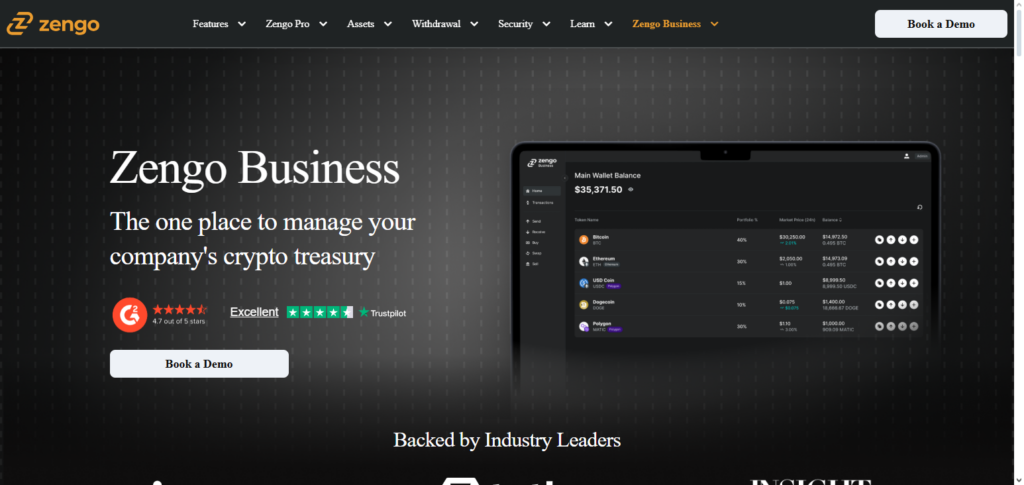
Zengo wastes no time facilitating the active management of multiple wallets and the safe insurance of the digital currencies stored on them. His compliance in Zengo’s management of digital currencies in the U.S. provides the needed regulatory compliance for institutions unwilling to compromise on security and efficiency.
For the Best Crypto Wallets for US-Compliant Institutions, Zengo Business is great for firms looking for a contemporary, safe, and simple crypto business wallet.
Zengo Business Features, Pros & Cons
Features
- Keyless MPC Security — no traditional private key. Safer key management.
- User Friendly Platform — intuitive for teams.
- Multi-Wallet Management — consolidate wallet control.
- Insurance on Assets — theft coverage.
- Compliance Infrastructure — institutional grade.
Pros
- Simple setup and use.
- Strong security due to MPC keyless architecture.
- Good for teams with multiple wallet management.
- Insurance provides peace of mind.
- Compliance is streamlined.
Cons
- Less mature and smaller ecosystem.
- Not as many advanced integrations.
- Analytics are less advanced.
- Not ideal for very high volume institutional use.
- Insurance coverage can be limited.
7. Qredo
Qredo provides business-size clients with digital assets decentralized custody and custodial services. The platform provides cross border services for instant settlement and asset transfer, while private keys remain distributed to several parties for protection from compromise.
Qredo services for institutions meet the regulatory compliance requirements of the US, including the necessary reports and audits. The platform is customizable for business grade needs with the ability to add trading, borrowing, and investing services.
For security, cross platform services, and regulatory compliance, Qredo is among the Best Crypto Wallets for US-Compliant Institutions, creating a space for the technology of today in the management of tomorrow’s digital assets for institutions.
Qredo Features, Pros & Cons
Features
- Decentralized MPC Vaults — no central private key exposure.
- Cross-Chain Settlement — instant on-chain asset transfers.
- Institutional Portal — enterprise dashboards and controls.
- Secure Transfer Protocols — transfers secured by MPC.
- Compliance Tools & Reporting — governance and audit solutions.
Pros
- Decentralized MPC is secure.
- Interoperability across chains.
- consolidated enterprise control dashboard.
- Quicker settlement processes.
- Compliance is built in.
Cons
- Complicated integrations.
- Smaller ecosystem compared to the big players.
- New users can find the UI difficult to navigate.
- Less market recognition.* Unsuitable for basic custody alone.
8. Ledger Enterprise
As part of the Ledger family, Ledger Enterprise caters exclusively to institutions by providing digital assets with hardware-backed custody solutions. Their services combine the offline safe storage of digital assets with an enterprise dashboard, customizable multi-user access, and operationally tailored audit reporting.
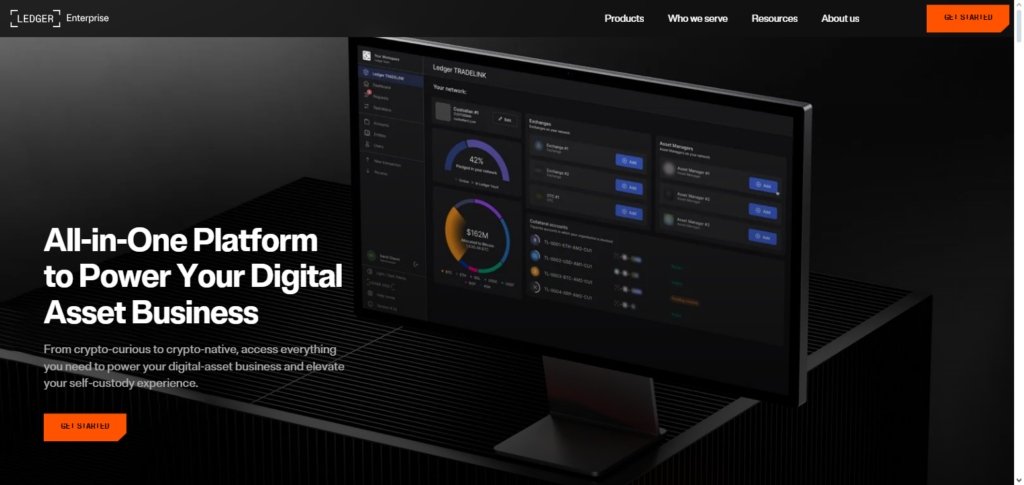
For treasury, trading, and risk management, Ledger Enterprise employs workflow integrations for several digital currencies. Compliance with US standards and the use of cold storage provide institutions with the assurance necessary to meet the operational and regulatory security needs.
Offering top-tier hardware protection for enterprise digital asset portfolios, Ledger Enterprise ranks among the Best Crypto Wallets for US-Compliant Institutions.
Ledger Enterprise Features, Pros & Cons
Features
- Hardware‑Backed Cold Storage – Cold storage for offline private keys.
- Multi‑User Governance – Adjustable roles for teams.
- Comprehensive Audit Trails – Track records, on and off the chain.
- Multi‑Asset Support – Support for multiple cryptocurrencies.
- Enterprise Dashboard – Dashboard for custodianship.
Pros
- Highest level of security offline.
- Defined roles for teams.
- Audit and compliance friendly.
- Extensive token support.
- Enterprise system compatible.
Cons
- Needs hardware.
- Custody mechanism is manual.
- Does not support DeFi or cross‑chain.
- Complex for team setups.
- Not completely software driven.
9. Coinbase Custody
Coinbase Custody provides institutions with cold storage crypto custody solutions under US regulations with the added benefit of insurance. Their services include segregated wallets for added security and access to numerous digital currencies, providing an API for enterprise applications in trading, treasury, and management.
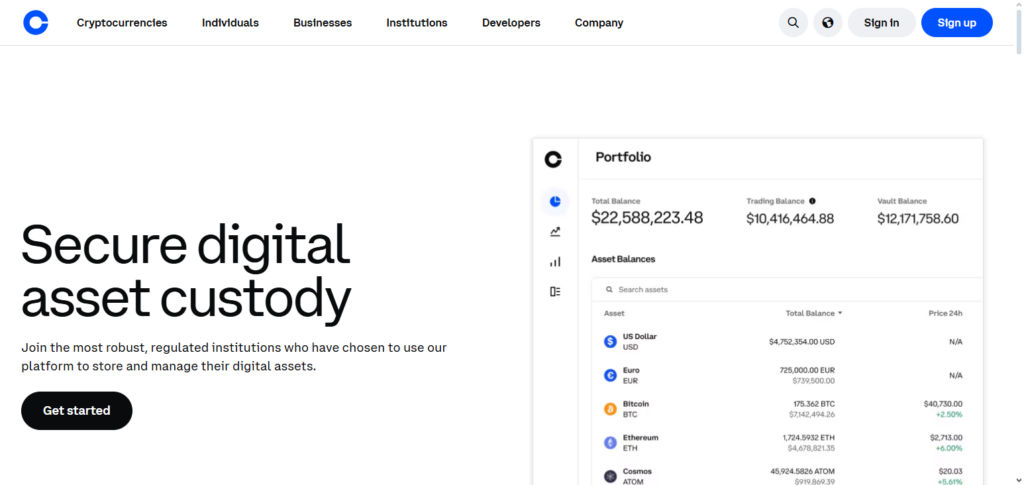
Coinbase Custody provides digital asset custody solutions under US regulations with added insurance for the assets in custody with the assurance of regulatory and operational reporting, and audit compliance.
Financial institutions trust Coinbase Custody and rate them as one of the Best Crypto Wallets for US-Compliant Institutions, providing the best combination of regulatory compliance, operational flexibility, and high-end security.
Coinbase Custody Features, Pros & Cons
Features
- US Regulated Custodian – Holds to US regulations.
- Segregated Cold Storage – Patient offline storage.
- Insurance Coverage – Coverage for theft and breach.
- API for Integrations – Integrate with trade & treasury.
- Wide Asset Support – Extensive token support.
Pros
- Reliable institutional name.
- Solid regulation and oversight.
- Extensive token support.
- API support.
- Great custody security.
Cons
- Onboarding for institution has minimums.
- Coverage is not all inclusive on insurance.
- Slow addition of new tokens.
- Focused on custody only (limited trading options).
- Evaluation might be necessary for the setup.
10. Gemini Custody
The Gemini Custody by Gemini provides fully insured crypto custody for institutional clients. With US regulations, segregated cold storage, and multi-user permissions, Gemini balances security and compliance.
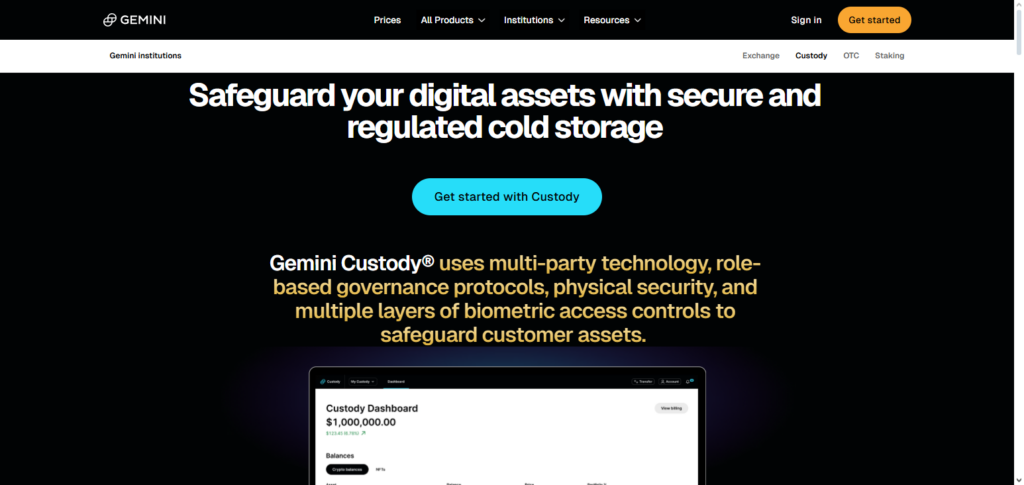
Detailed audit trails and compliance to US regulations and NYDFS standards make Gemini secure and reliable. Gemini provides custody for more digital assets compared to many crypto wallets for US-compliant institutions.
Additionally, Gemini Custody provides medium to enterprise level treasury and investment operation controls (including transparent reporting and API integrations). Due to the factors above, Gemini Custody ranked high for enterprise security and crypto operational flexibility for institutions with large crypto operational volumes.
Gemini Custody Features, Pros & Cons
Features
- NYDFS Licensed Custodian – Processed with the US regulations.
- Fully Insured Storage – Covers all protections both offline and online.
- Segregated Wallets – Greater separation of assets.
- Reporting and API Tools – Dashboards and reports in real-time.
- Enterprise Controls – Security policies and user roles.
Pros
- Assurance in regulation is high.
- Position of the insurance and security is strong.
- Assets stored are segregated.
- Reporting is of enterprise quality.
- Integration is straightforward.
Cons
- Limiting use of NYDFS on a global scale.
- Exposure to the DeFi ecosystem is less.
- There are limits on the insurance terms.
- Some enterprise features are on a need for onboarding.
- Speed to token listing is less compared to the rest.
Conclusion
For US-compliant organizations, selecting the best cryptocurrency wallet is essential to guaranteeing security, operational effectiveness, and regulatory compliance.
Enterprise-grade solutions that integrate multi-layered security, insurance coverage, and compliance with US legislation are offered by platforms like as BitGo Trust Company, Fireblocks, Paxos Custody, Bakkt Custody, Fortress Trust, Zengo Business, Qredo, Ledger Enterprise, Coinbase Custody, and Gemini Custody.
Each platform has special advantages that make it appropriate for certain institutional requirements, such as hardware-backed cold storage, MPC-based keyless security, and smooth API connections.
All things considered, these wallets are the greatest choices for US-compliant organizations looking for completely regulated, insured, and safe custody solutions.
FAQ
A US-compliant institutional wallet must adhere to US regulations, including SEC, FINRA, or NYDFS standards. It should offer enterprise-grade security, insured custody, multi-user governance, and audit-ready reporting to ensure compliance and operational safety.
Some of the leading wallets include BitGo Trust Company, Fireblocks, Paxos Custody, Bakkt Custody, Fortress Trust, Zengo Business, Qredo, Ledger Enterprise, Coinbase Custody, and Gemini Custody. These platforms combine regulatory compliance, security, and operational efficiency.
They employ advanced security measures such as Multi-Party Computation (MPC), multi-signature wallets, cold storage, hardware-backed security, and insurance coverage to protect digital assets against hacks, theft, or operational risks.
Yes. Most US-compliant institutional wallets provide APIs, dashboards, and integrations to connect with exchanges, trading platforms, and enterprise treasury systems for seamless operations.
Yes. Platforms like BitGo, Coinbase Custody, Gemini Custody, and others offer insurance coverage for digital assets held under custody, protecting against theft or loss due to security breaches.