

I’ll go over the Crypto Prop Firm Profit Split Explained in this post. To maximize profits and control risk, it is crucial to comprehend how traders and businesses split profits.
In order to assist traders in making wise choices while dealing with cryptocurrency prop firms, we will examine several profit split models, variables influencing payouts, and useful advice.
What is a Crypto Prop Firm?
A crypto prop firm, or proprietary trading firm, is a business that hires traders and provides them with the funds to trade cryptocurrencies for them, making a profit while the traders don’t have to put any of their own dollars at risk to lose.
While prop firms themselves are not new, the crypto prop firm model is a relatively new concept that applies to digital currencies like Bitcoin, Ethereum, and altcoins. Generally, traders need to prove that they’re able to trade profitably through some kind of evaluation or trading challenge, and then they get access to the company’s capital.

The firm and the trader then have a profit-sharing agreement for the profits to be split based on different criteria like the trader’s level of experience, the size of their trading account, and their trading performance. Most crypto prop firms are very conservative with their own risk management, meaning they put rules in place to protect the firm’s capital like max drawdowns, position size limits, and more.
Using prop firms, traders are able to increase their financial upside on their trading while the prop firm is able to profit off the trader’s strategy and the profits generated. All in all, crypto prop firms are a way to level up the trading playing field for smart traders while maintaining a solid level of risk management.
Understanding Profit Splits
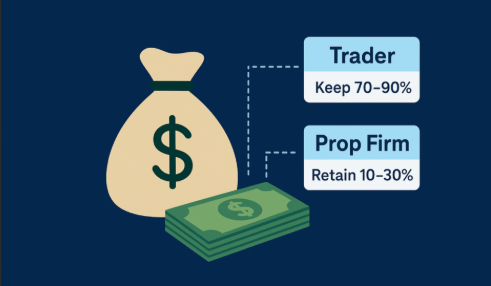
Crypto proprietary companies have certain policies on how profits made on trading will be divided between the trader and the company. Once a trader makes a profit using the company’s capital, the company keeps a certain percentage and the remainder is sent to the trader.
These profit splits tend to vary and might be fixed, tiered, performance based, or even a hybrid of any of these. Each of these models tend to reward the trader’s skill and consistency differently.
Typically, profit splits include fees to be paid on a platform or exchange as well as penalties for any given risk rule violations. Profit splits are extremely vital for any trader as they would guide the trader on how to make the most money, devise strategies, and pick a firm that best matches their objectives.
Crypto Prop Firm Profit Split Explained
Step 1: Trader Evaluation
- Traders take on an evaluation or challenge before they receive any capital.
- This evaluation assesses their skill, risk management, and consistency.
- If they pass this step, they are qualified for a funded account.
Step 2: Funded Account Allocation
- The firm then gives the trader a trading account that is funded with the firm’s capital.
- The size of the account can fluctuate based on the trader’s experience and performance.
Step 3: Trading and Profit Generation
- Traders then make the trades with the firm’s capital.
- Profits and losses are monitored in real time.
- Traders must adhere to the firm’s risk guidelines such as max drawdowns.
Step 4: Profit Calculation
- After a trading period, there is a total profit calculated.
- This profit includes fees, exchange costs, or penalties that must be taken from to get to the total.
Step 5: Profit Split Model
- The profit split that is agreed upon is then taken into account.
- For example, if the split is 70/30, then the trader gets to keep 70% of the profits and the firm keeps 30% of the profits.
- Other firms offer something called tiered splits where the trader gets to keep a higher percentage of the profits.
Step 6: Profit Payout
- Profits are paid according to the firm’s schedule — daily, weekly, or monthly.
- According to firm policy, these payouts may be in crypto or fiat.
Step 7: Reinvestment or Scaling Up
- Often, traders are allowed to reinvest their profits or scale to larger, funded accounts.
- More consistent performance often results in increased profit splits or more capital from the firm.
Step 8: Continuous Monitoring and Compliance
- The firm monitors risk and performance.
- If traders want to avoid penalties, and potentially losing access to their accounts, they need to follow the rules.
Why profit splits matter to traders
Maximizes Earnings: Higher splits mean traders earn a greater percentage of the profits which translates into more take home pay.
Incentivizes Performance: More splits inspire traders to be more successful and to be more active so that they earn a greater payout.
Aligns Risk and Reward: Traders can better assess the potential reward of a split vs the risk of losing the company’s money.
Informs Firm Selection: Traders can select firms that have a better split which will be better for the firm’s profitability in the long run.
Encourages Strategic Planning: Profit splits provide context to the development of trading strategies that achieve a balance of profit and performance.
Factors Affecting Profit Splits
Trader Experience and Skill Level: More splits in trading profits can be achieved if the traders are more experienced and have proven to be consistently profitable.
Account Size or Capital Provided: Different split ratios are assigned on bigger capital accounts to mitigate risk and maximize reward.
Firm Policies: Every prop firm has its own set of rules when it comes to profit split, some prop firms have policies that are more on the performance basis.
Trading Performance: Higher splits or profit bonus might be given to traders that achieve the set target consistently.
Risk Management Compliance: Ignoring the set risk parameters like drawdown limits might incur negative splits or profit reduction penalties.
Profit Payout Frequency: Some prop firms have daily, weekly, or monthly profit split intervals and this can change the ratios.
Market Conditions: At times the split ratios and risk assigned by the firm can change due to prevailing conditions of the crypto market.
Advantages of Understanding Profit Splits
Earnings Maximization
Traders can devise plans to earn the most from their profit shares.
Improved Judgement
Assists in selection of a specific prop firm(s) to work with and account type.
Expectation Management
Traders understand better the reward vs the risk and the effort that goes in.
Motivated Performance
Understanding splits fosters stick-to-it-ness in trading and obtaining results.
Fewer Unpleasant Surprises
Knowing fees, deductions, and rules/laws about payouts sharpens loss prediction.
Enhanced Risk Control
Traders can set the loss and reward points based on the risk profile of the firm.
Sustained Growth
Understanding splits allows traders to scale accounts and negotiate better.
Tips to Maximize Your Profit in Crypto Prop Firms
Choose the Best Profit Split Model
Select firms with profit splits that best match your trading style – fixed, tiered, or performance-based.
Stick to the Risk Management Rules
You should avoid drawdowns and position size limits to avoid fines or a profit reduction.
Consistency is Key
You can benefit tiered or performance splits by making profitable trades consistently.
Start Small, Scale Up Gradually
Start with the smallest accounts, prove your performance, and get access to bigger capital and higher splits.
Reduce Fees
Using the right exchange and platforms can help keep your profit higher by avoiding high fees.
Watch Your Performance
Always keep track of your trades, strategy, and performance to optimize profit potential.
Maximize Bonuses and Incentives
Some firms provide additional benefits on reaching certain targets.
Common Mistakes Traders Make

Ignoring Profit Split Details
If you do not clearly understand the split and the fees and what they deduct, you may earn a lot less.
Overtrading
You may get penalized or even lose your account because of overtrading, which is a pursuit of profit over the rules.
Neglecting Risk Management
You may lose the company’s money if you ignore the firm’s capital by breaking the drawdown limits or the rules of position size.
Choosing the Wrong Firm
Selecting a prop firm with a bad split or bad policies will hurt your potential earnings over time.
Failing to Track Performance
If you do not review your trades, you will lose the ability to improve and to understand what went wrong.
Overlooking Payout Frequency
If you do not take into consideration the payout frequency, you may be poorly prepared for your cash flow.
Underestimating Market Volatility
Failure to account for the steep rises and falls in the crypto market will surely take a hefty dent in the profit share.
Conclusion
For traders who want to maximize profits while controlling risk, it is essential to comprehend crypto prop firm profit splits. When selecting a firm, traders can make well-informed choices by understanding how profits are determined, the various split models, and the elements that affect payouts.
A thorough understanding of profit splits also promotes long-term growth by scaling accounts, disciplined trading, and compliance with risk regulations.
Traders can keep the largest portion of their income by avoiding typical blunders like overtrading or neglecting fees. In the end, understanding profit splits enables traders to maximize performance, successfully develop tactics, and thrive in the cutthroat realm of cryptocurrency prop trading.
FAQ
It’s the way profits from trading the firm’s capital are divided between the trader and the firm, typically as a percentage.
Profits are calculated after deducting fees, exchange costs, and penalties, then divided according to the firm’s agreed split model.
Common models include fixed percentage splits, tiered splits (higher share for better performance), performance-based splits, and hybrid models.
Some firms allow negotiation, especially for experienced traders or those with proven track records.
Payouts vary—daily, weekly, or monthly—depending on the firm’s policies.