


I will talk about the safest non-custodial wallet providers for long-term storing, more non-custodial long-term storage solutions where users retain sole command over their private keys, long-term security, and peace of mind.
Such digital wallets provide robust and long-term protection in the form of offline stored backups, safe of third-party custodial access to the digital assets.
What is Non-Custodial Wallet?
A non-custodial wallet allows you to maintain full control of your digital assets since you manage your own private keys. No exchange, bank, or company can hold or have access to your funds. This results in you having full autonomy of your funds, providing maximum ownership and security.
These wallets can come in the form of hardware, software, or mobile apps, and compared to custodial wallets, they offer more privacy and freedom. That said, they do come with more responsibility, as losing your private key or recovery phrase can lead to permanently losing access to your crypto.
Key Point & Safest Non-Custodial Wallet Providers for Long-Term Holding List
| Wallet | Key Points |
|---|---|
| Ledger Nano X | • Hardware wallet with strong security (Secure Element chip) • Supports 5,500+ cryptocurrencies • Ledger Live app for portfolio management |
| Trezor Model T | • Open-source hardware wallet • Passphrase, Shamir Backup & advanced security • Supports a wide range of coins via Trezor Suite |
| BitBox02 | • Swiss-made hardware wallet with open-source firmware • Easy backup through microSD card • Focus on Bitcoin and Litecoin security |
| Keystone Pro | • Air-gapped hardware wallet (no USB/Bluetooth) • Multi-sig compatible for advanced security • Biometric fingerprint authentication |
| Ellipal Titan | • Fully air-gapped metal hardware wallet • QR code scanning for all transactions • Tamper-proof and drop-resistant build |
| Exodus Wallet | • Multi-asset software wallet with sleek UI • Built-in exchange and staking options • Supports desktop and mobile |
| Trust Wallet | • Mobile-first wallet owned by Binance • Supports thousands of crypto assets + DApps • Built-in staking and Web3 browser |
| Zengo | • Keyless, MPC-based wallet (no private key) • High-level security with 3-factor authentication • Easy to restore account without seed phrase |
| MetaMask | • Popular Ethereum & EVM wallet • Supports DeFi, NFTs, DApps via browser extension • Custom networks and hardware-wallet integration |
| Wasabi Wallet | • Privacy-focused Bitcoin wallet • Advanced CoinJoin for anonymity • Open-source and designed for privacy enthusiasts |
1. Ledger Nano X
Ledger Nano X is regarded as one of the best non-custodial wallet providers for long-term holders because he joined a certified Secure Element chip with fully offline key storage, meaning sensitive data will never face online threats.
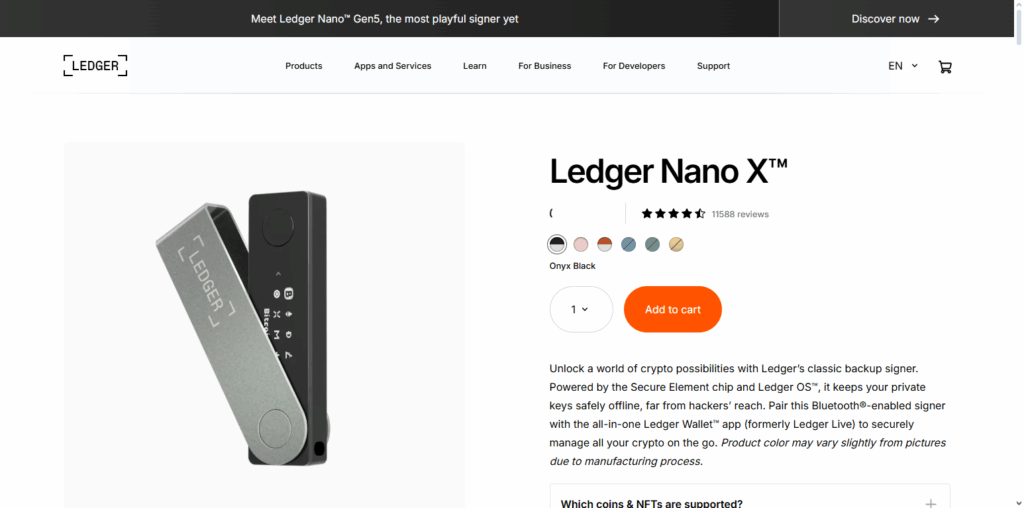
Its Bluetooth connections were fully designed with encrypted communications. The wallet supports thousands of networks.
They include Bitcoin, Ethereum, Solana, and the top ERC-20. It is fully compatible with Windows, macOS, Linux, Android, and iOS. It works over the Nano X app. It is a premium priced wallet, supporting great durability, extensive assets, and long-term security. It is one of the best options for crypto holders.
Pros & Cons Ledger Nano X
Pros:
- The Secure Element chip is designed to keep private keys secure from hardware attacks.
- Suitable for long-term diversified portfolios since it offers support for thousands of assets.
- Bluetooth feature is convenient for securing mobile access and uses no security tradeoffs.
Cons:
- Wallets without these features in hardware are cheaper.
- The firmware is not completely open-source.
- Third-parties have limited access with Ledger Live.
2. Trezor Model T
Trezor Model T is considered among the best in the industry for holding crypto assets in to non custodial wallets for extended periods. This is because the company employs open-source firmware, as well as generating private keys in a secure, offline, isolated environment.
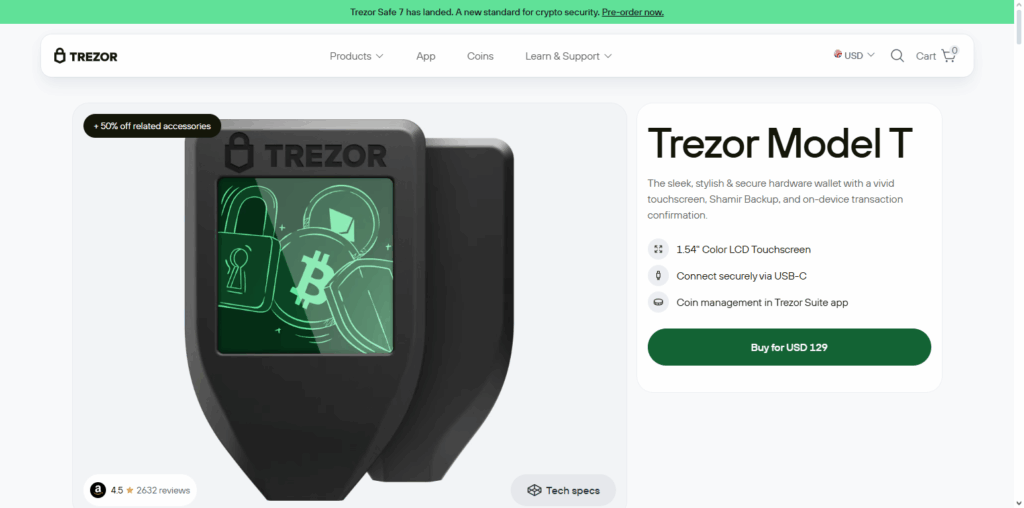
Errors in passphrase entry are minimized and extra security is provided by the touchscreen interface. Model T is compatible with, and supports, the primary networks, Bitcoin, Ethereum, Litecoin, and an additional several hundred ERC-20 tokens.
Trezor Suite is compatible with Windows, macOS, Linux, and Android. Model T has strong, consistent backup and reliabilitiy built for more experienced crypto holders needing to maximize security and with a willingess to spend a bit more.
Pros & Cons Trezor Model T
Pros:
- Greater transparency and trust from the community with fully open-source firmware.
- More secure passphrase entry with the touchscreen interface.
- The long-term protection is strengthened with excellent backup choices, such as Shamir Backup.
Cons:
- It is rated as one of the most expensive hardware wallets on the market.
- It doesn’t have a Secure Element chip, a characteristic that is the subject of debate for some users.
- This wallet has a smaller asset range than Ledger.
3. BitBox02
BitBox02 is one of the best non-custodial wallets for long-term asset protection due to its swiss-engineered fully open-source architecture, security-centric, minimal-attack-surface design, and such features as dual secure chips and a microSD backup.
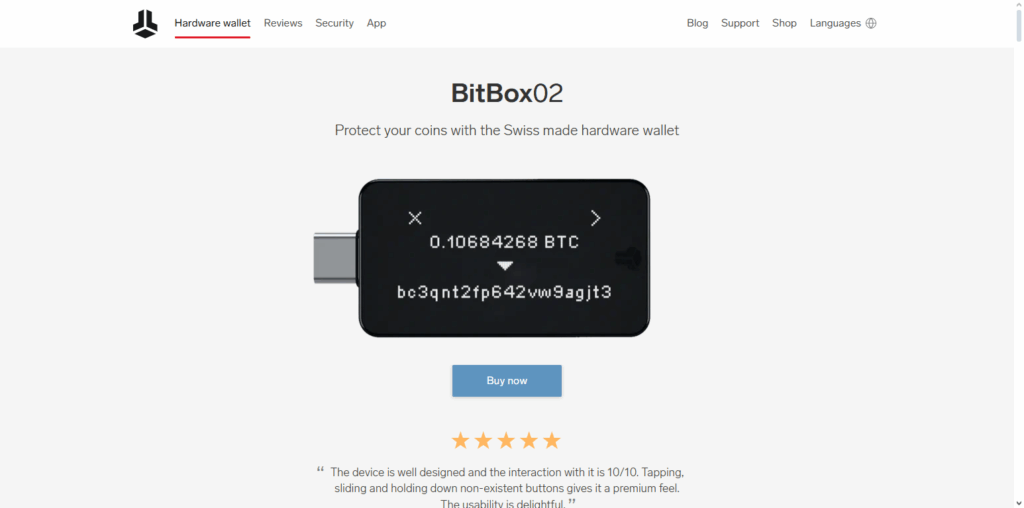
Keys are kept secure offline and without necessary exposure to the microSD, while the backup can be accessed. Major networks such as Bitcoin and Litecoin, Ethereum, and ERC-20 tokens are supported, and the wallets work with just about any operating system,
including windows, macOS, Linux, and Android. Considering the mid-pricing of competitor hardware wallets, this is a great long-term asset storage option for clients prioritizing minimalistic yet sturdy protection, transparency, and quality long-term durability.
Pros & Cons BitBox02
Pros:
- Long-term security is enhanced with the Swiss-made design, which has a minimal attack surface.
- The MicroSD backup system facilitates the uncomplicated offline recovery of files from secure storage.
- Transparent security auditing is possible thanks to open-source firmware.
Cons:
- The minimal interface can be difficult for beginners.
- Compared with larger wallets, support for multi-chain is less.
- Less third-party integrations than Ledger or Trezor.
4. Keystone Pro
Keystone isn’t perfect, but when it comes to long-term non-custodial withdrawals, they’re arguably the safest option available in the crypto market. In this circuitless, air-gapped design, the device’s private keys cannot be exposed via USB, Bluetooth, or Wi-Fi.
The company’s security features—a full metal casing, secure element chip, and fingerprint—significantly increase the risk involved in a digital heist of the unit. All sensitive device operations remain off the internet when using the QR-code transaction signing.
Supporting the most widely utilized networks—Bitcoin, Ethereum, Polkadot, and others—this wallet is useful with all Android and iOS devices, and desktop apps via companion software. Being in a higher pricing tier, the Keystone is best suited for long-term crypto investors with an apparent greater need for electronic isolation and durability.
Pros & Cons Keystone Pro
Pros:
- Attacks that occur through the internet are impossible due to the completely offline architecture.
- The metal casing and finger print security features make this wallet physically secure.
- Offline approvals are done through QR and provide security while transacting.
Cons:
- Cuts into pocket space more than most hardware wallets.
- Casual users may find the price to be significantly more expensive than the competition.
- It has limited features and requires a companion app.
5. Ellipal Titan
Ellipal Titan is regarded as one of the safest non-custodial wallets for long-term retention as it is completely air-gapped and has a solid metal body that cannot be tempered with, taken apart or intruded upon physically.
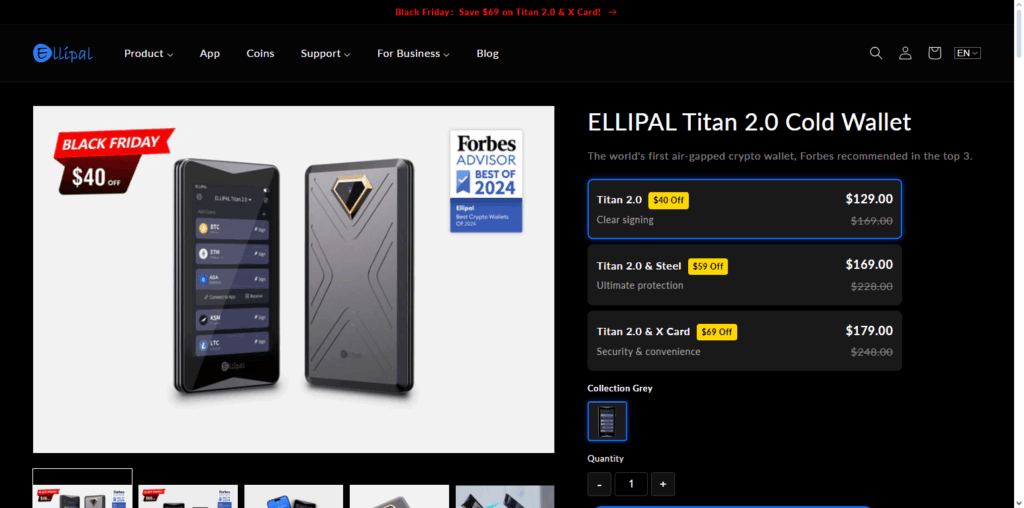
Its QR-based transaction system guarantees removal of the private key taken over the Internet or information ports, thus eliminating the risk of remote attacks. Titan supports all major networks such as Bitcoin, Ethereum, BNB Chain, and Litecoin, as well as numerous ERC-20 and BEP-20 tokens.
It is connected to Android and iOS via the Ellipal mobile app. Ellipal Titan is one of the most expensive products on the market, and it is the best choice for long-term holders being one of the most isolated, durable and easy to use.
Pros & Cons Ellipal Titan
Pros:
- Perfect for isolated storage; completely air-gapped. No USB, Bluetooth, or Wi-Fi.
- Its casing is made from solid metal, making it resistant to tampering and drop.
- You can keep your private keys untouched from any other device due to QR coded transactions.
Cons:
- Advanced users may be inconvenienced by a lack of wired connectivity.
- The pricing is above many entry-level devices.
- Limited integration is available with some third-party wallets.
6. Exodus Wallet
Exodus has earned a reputation for providing users with one of the safest and most reliable non-custodial wallets. This is primarily because self-custodial wallet users are in full control of their private keys.
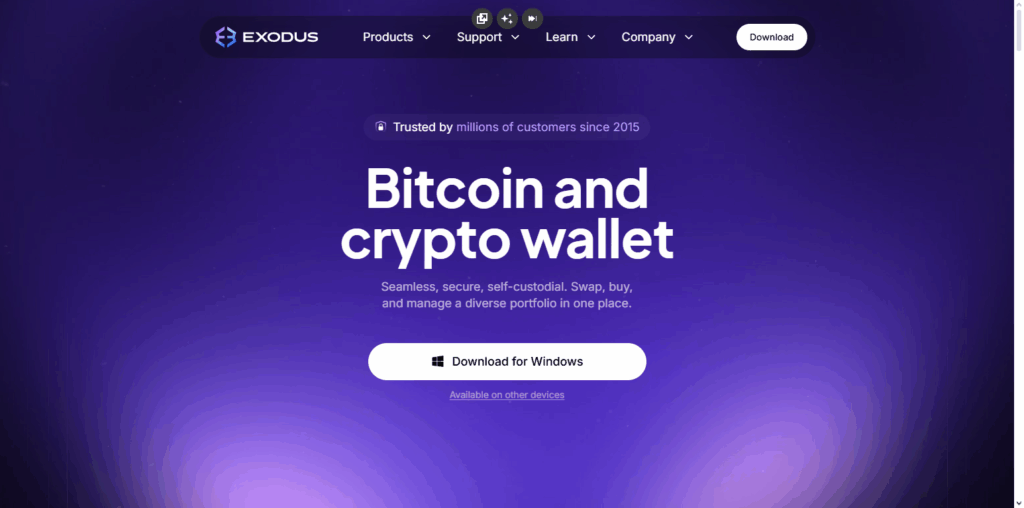
Exodus also maintains a user-friendly interface that decreases the likelihood of user error. Exodus provides a fully integrated automated backup systems and encrypts all of the users data and funds.
Exodus has extensive cross-chain compatibility; including Bitcoin, Ethereum, Solana, BNB Chain, and hundreds of multi-chain tokens. Exodus is accessible on every major computing and mobile platform. The Exodus wallet is completely free to use which positively affects any users bottom line.
Pros & Cons Exodus Wallet
Pros:
- It features a clean and intuitive interface which is highly beginner-friendly.
- The wallet has a large capacity, holding hundreds of networks and tokens, allowing for diverse and long-term holders.
- Additional security can be achieved with the integration of hardware wallets.
Cons:
- Not many areas of this wallet can be audited due to it being partially closed-source.
- If the wallet is not paired with a hardware wallet, it is not ideal for large holdings.
- The mobile version is less secure than the hardware versions.
7. Trust Wallet
Being a non-custodial wallet, Trust Wallet is one of the best solutions for long-term storage as it allows the user to the sole gatekeeper of the private keys. Trust Wallet is designed as a security-centric, light mobile platform which reduces the risk of security threats for the end user.
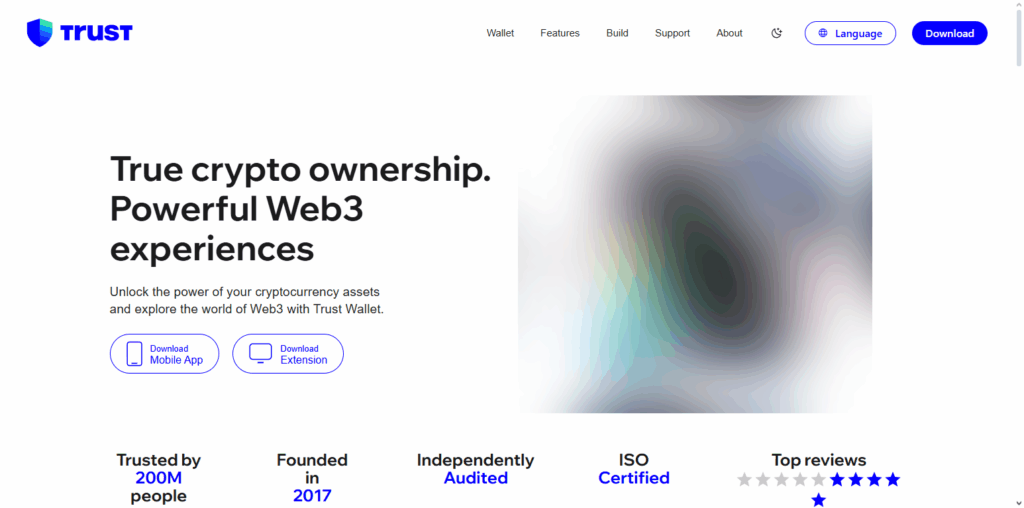
Trust Wallet’s built-in system for saving the backup phrase and keys is a third party custodial wallet system with which none of your funds can be accessed. Trust Wallet is also highly accessible and offers a plethora of networks and thousands of cross-chain tokens. They include Bitcoin, Ethereum, BNB Chain, Solana, and Polygon.
Trust Wallet is available for free, and it’s accessible for many different user profiles as well. It contains no security compromises and offers great versatility in accessing DeFi and DApps.
Pros & Cons Trust Wallet
Pros:
- It is extremely intuitive and has strong support for multiple chains.
- The private keys are completely controlled by the user, which ensures the long term protection of their assets.
- Users can securely enter Web3 through the DApp browser.
Cons:
- There is increased sensitivity to the security protocols of the mobile devices due to the mobile-only design.
- There is reduced external visibility due to closed-source elements.
- Compared to storage in hardware wallets, the security is lower as we are talking long-term storage of large amounts.
8. Zengo
Zengo is one of the safest non-custodial wallet providers for long-term storage due to the use of leading industry MPC cryptography which eliminates a common single point of failure incurred through the use of a traditional private key.
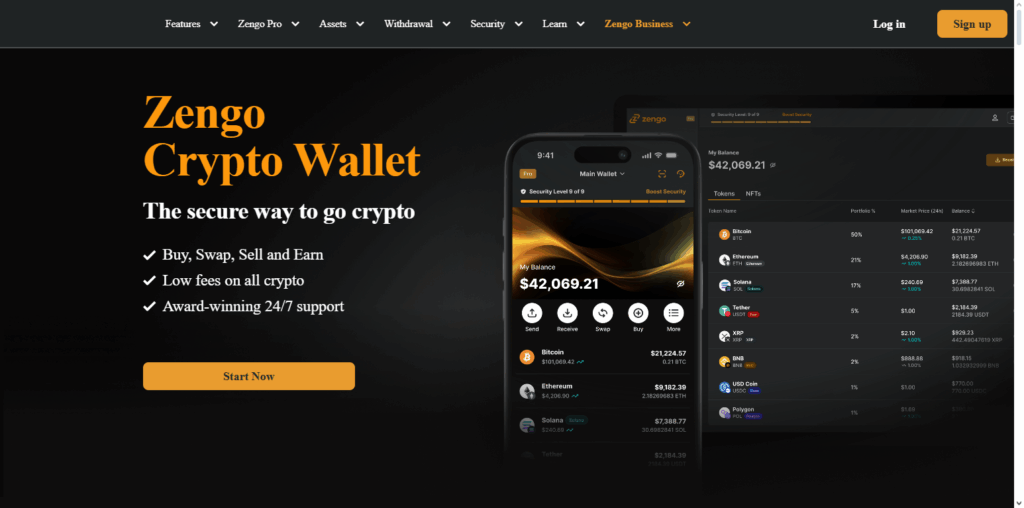
Zengo’s 3-factor authentication system via facial recognition, encrypted cloud backup, and device defenses makes for a very robust storage system to meet the needs of long-term holders.
Zengo’s wallet supports the leading coins including Bitcoin, Ethereum, Polygon, and BNB along with many ERC-20 tokens. Their app is live on Android and iOS, and has a very seamless user experience. No other wallet combines Zengo’s level of safety and modernity with a flexible long-term storage solution.
Pros & Cons Zengo
Pros:
- There is no risk of losing traditional private keys due to the incorporation of MPC security.
- There is the use of 3-factor authentication and no seed phrases are used for recovery.
- The design is clean and modern and is ideal for beginners and advanced long-term users.
Cons:
- Some more advanced users may prefer traditional seed-based wallets.
- Compared to MetaMask or Trust Wallet, there is limited support for networks.
- There is the requirement of a paid subscription to access all the security features.
9. MetaMask
MetaMask can be recognized as a secure long-term storage option as they are considered non-custodial wallet providers that allow customers to retain custody of their private keys. With a minimalistic open-source structure, security audits can be done frequently.
Also, they allow connections to hardware wallets which makes long-term storage safer. They cover all of Ethereum, all EVM-compatible networks, and innumerable ERC-20, ERC-721, and ERC-1155 tokens.
Additionally, they are available on several platforms like Chrome, Firefox, Edge, Brave, iOS, and Android. There are no costs associated with the wallet itself as optional fees apply to costs related to transactions, making it a viable option for keeping cryptocurrency for a long time.
Pros & Cons MetaMask
Pros:
- For long-term engagement in Web3, supports all EVM networks.
- There is transparency due to the open-source components.
- It offers the ability to connect to external hardware wallets for improved security.
Cons:
- The operation is entirely browser-based, which is especially susceptible to phishing.
- There is no support for Bitcoin.
- It requires a lot of user cybersecurity with their own devices.
10. Wasabi Wallet
Wasabi Wallet is viewed as one of the most secure non-custodial wallet providers for long-term holding as virtually all of its systems are built with privacy-first architecture so that users maintain control of their Bitcoins and still receive the product’s top anonymity tools, such as automatic CoinJoin.
The wallet’s open-sourced model permits ongoing scrutiny from the community, resulting in a further boost of security and transparency over an indefinite period of time, and Were only focusing on the Bitcoin support network, where privacy is very focused, as opposed to competing in a multi-chain support model.
The wallets run on Windows, Mac, and Linux and are compatible with actual wallets for further security. In addition to prioritizing privacy, it is one of the most secure wallets for long-term Bitcoin holders, and is free, which also adds to the value.
Pros & Cons Wasabi Wallet
Pros:
- There is a strong focus on privacy with the built-in CoinJoin, which offers anonymous storage.
- It is open-source and has undergone multiple audits by privacy experts.
- It is designed to be secure with long-term storage of Bitcoin.
Cons:
- It only supports Bitcoin, which makes it unsuitable for users with multiple asset portfolios.
- It requires an understanding of privacy tools for it to be used correctly.
- The transaction fees are higher due to the CoinJoin functionality.
Benefits Of Safest Non-Custodial Wallet Providers for Long-Term Holding
Total Asset Control: Users receive their own private keys, granting full control without the need for an exchange or third-party custodians.
Security and Privacy: Funds cannot be hacked or stolen because private keys will be stored offline or with top-level encrypted protection.
Best for Long-Term Storage: These are best suited for long-term storing due to devices with hardware protection, offline signing, and recovery capabilities.
Safe from Exchange Downtimes: Funds will always be secure even if the trading platforms are offline, bankrupt, or face regulatory issues.
Long-term Customized Security: backup seeds, Shamir’s secret sharing, MPC, air-gapped designs, and other custom security options like passphrases increase protective control for the long term.
Wide Range of Supported Assets: Top non custodial wallets support major blockchain networks and thousands of tokens, fitting diverse portfolios.
Accessible on Multiple Devices: Many of them can be accessed on different hardware, mobile, and desktop devices which allows accessibility without compromising safety.
No Custodial Fees: Users will not pay additional custodial fees for holding, since these wallets decentralized and are not interfaced with central services.
Increased Assurance Due to Openness – For extended dependability, active monitoring by the community continues because of the possibility of open-source and peer-assessed works.
Conclusion
Opting for a safe non custodial wallet is vital for anyone intending to hold cryptocurrency for an extended time. These wallets allow users full control of their private keys and protect opposing custodial exchanges and custodial platforms that may have a security flaw or operational failure.
Air gapped hardware, non custodial open source security frameworks, custodial MPC, and encrypted mobile environments; all of these verified small vendors provide unique to their own circle strong protection, extensive network support, and customizable recovery solutions.
After obtaining one fiducial custodial wallet of one’s own choosing with proper backups, infinite peace of mind is achieved.
FAQ
If the recovery phrase is lost, access to the wallet and funds may be permanently gone. Many safe wallets provide backup options like microSD storage, passphrases, or MPC recovery to reduce this risk.
Wallets like Exodus, Trust Wallet, and Zengo are beginner-friendly due to simple interfaces, easy backups, and minimal setup requirements while still offering strong security.
Yes. Most leading non-custodial wallets support multichain assets, including Bitcoin, Ethereum, stablecoins, and various altcoins. Some wallets, like Wasabi, focus only on Bitcoin for specialized privacy.