


Crypto investors now have more options for generating passive income without depending on conventional banks thanks to decentralized finance, or DeFi.
Through lending, staking, and providing liquidity, individuals can create rewards through blockchain-based systems. The Top DeFi Protocols Paying Passive Income, their operation, and the reasons for their growing popularity as investment options in the cryptocurrency ecosystem will all be covered in this article.
Key Point & Top DeFi Protocols Paying Passive Income
| Platform | Key Point |
|---|---|
| Compound Finance | Algorithmic crypto lending and borrowing platform where users earn interest by supplying assets to liquidity pools. |
| Aave | One of the largest DeFi lending platforms, known for flash loans and variable/stable interest rates. |
| Lido Finance | Provides liquid staking, allowing users to stake assets like ETH while still using them in DeFi via stETH tokens. |
| Rocket Pool | A decentralized Ethereum staking protocol that allows users to stake ETH with lower minimum requirements. |
| Curve Finance | A DEX optimized for stablecoin trading with very low slippage and efficient liquidity pools. |
| Yearn Finance | Yield aggregation platform that automatically moves funds between DeFi protocols to maximize returns. |
| Balancer | A DEX and automated portfolio manager that allows customizable liquidity pools with multiple tokens. |
| SushiSwap | Community-driven DEX offering token swaps, staking, yield farming, and DeFi tools. |
| GMX | A decentralized perpetual futures exchange allowing low-slippage leveraged trading on-chain. |
| dYdX Chain | A layer-1 blockchain dedicated to decentralized derivatives trading, built for high-performance perpetual markets. |
1. Compound Finance
Compound Finance is a decentralized protocol for lending that lets users earn passive income by putting a cryptocurrency into a liquidity pool. When users deposit assets such as ETH, USDC, or DAI, the protocol does the lending to borrowers who are paying interest. This interest is then returned to the liquidity providers.
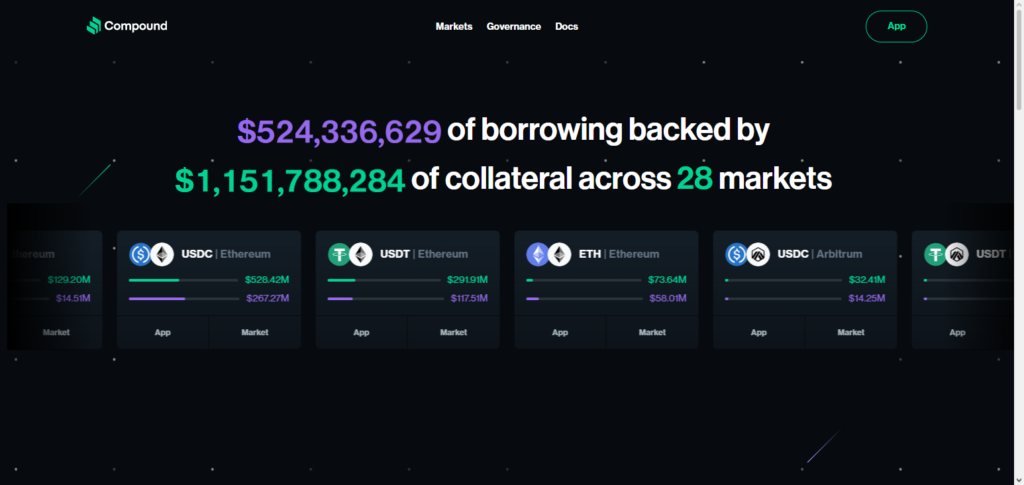
Passive income streams are, therefore, built. The platform automates lending by not having a middleman through the use of smart contracts. Compound Finance has a unique algorithmic interest rate model, therefore, is one of the Top DeFi Protocols Paying Passive Income.
DeFi investors have also shown interest in the protocol as participants receive governance tokens (COMP), which entitles them to vote, in addition to the reward.
Compound Finance Features, Pros & Cons
Features
- Interest rates are based on supply and demand in an algorithmic model.
- Borrowing and lending is decentralized with no middlemen.
- Users receive rewards in the form of governance tokens (COMP).
- Crypto assets supported: ETH, USDC, and DAI.
- Entirely managed by smart contracts on the blockchain.
Pros
- It is a lending system that is simple to understand and is great for beginners.
- Interest rates and liquidity pools are transparent.
- Interest is paid, and users receive token rewards, generating passive income.
- It is a highly trusted, and reliable DeFi platform.
- With governance tokens (COMP), users can vote.
Cons
- Interest rates are highly likely to change.
- Advanced trading options are very limited.
- There is always an element of risk with smart contracts.
- Gas fees on Ethereum can be particularly high.
- Yield is sometimes less than other protocols in DeFi.
2. Aave
Aave is among one of the largest DeFi lending platforms that is highly advanced in technology. The platform allows its users to deposit crypto and earn interest on that crypto, or take out a loan against it.
To lend out money, users take the crypto they want to lend and deposit it into a liquidity pool. Users earn yields ‘passively’ based on how many borrowers take out loans.
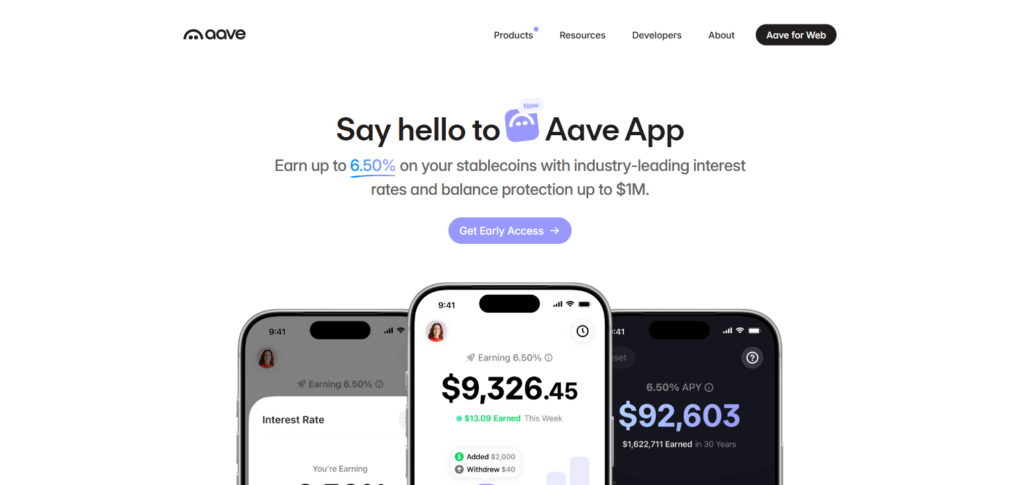
Aave allows its users to earn interest on crypto such as ETH, USDT, and DAI and is considered one of the Top DeFi Protocols Paying Passive Income.
AAVE is the governance token of Aave and provides users with voting privileges on updates and governance policies. DeFi investors choose Aave because of its high security, high liquidity, and strong cross-chain support.
Aave Features, Pros & Cons
Features
- variable and stable interest rates,
- Unsecured Flash loans.
- Multi-chain interoperability, including Ethereum and Layer-2.
- AAVE tokens are used for governance.
- Advanced risk management and collateral swapping.
Pros
- The protocol is highly secure and has been published in many audits.
- The system has a Strong ecosystem and Large liquidity pools.
- Flash loans.
- Various ways to earn income.
- Engaged developer and user community.
Cons
- Complicated functions for novice users.
- The possibility of liquidation to losing your assets.
- Too much gas fees on Ethereum mainnet.
- You must have collateral to borrow.
- Yields may not be as high as you expect.
3. Lido Finance
Lido Finance enables users to stake cryptocurrencies, such as Ethereum, without locking their assets for long periods. Instead, Lido users stake ETH and receive stETH tokens, which represent their staked ETH plus rewards.
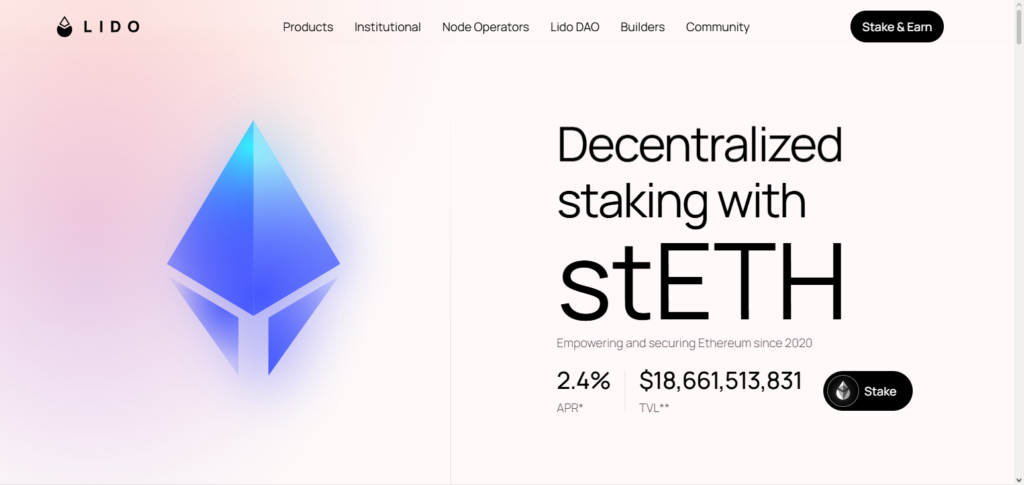
Users can utilize their stETH tokens in other DeFi activities, such as lending, and still receive staked rewards. Lido Finance is the most popular platform for liquid staking because users earn Ethereum network validation rewards and can perform other activities in DeFi, such as lending, liquidity mining, and staked ETH farming.
This unique opportunity to earn in two ways has made Lido Finance one of the largest staking providers in decentralized finance.
Lido Finance Features, Pros & Cons
Features
- Offers liquid staking for Ethereum and other blockchains.
- Users get stETH tokens for staked ETH.
- Users can participate in DeFi while staking.
- No minimum to stake.
- You rewards will automatically become 1 more reward.
Pros
- More flexibility than traditional staking.
- You can earn rewards for staking and still withdraw anytime.
- 3rd largest in Ethereum staking market.
- Good for beginners.
- Staking integrated with DeFi.
Cons
- Some share of large validators is a centralization risk.
- There’s a level of risk with smart contracts.
- The price of stETH may be temporarily detached from ETH.
- Ethereum staking rewards are dependent on Network.
- The most powerful governance tokens are in the hands of a few.
4. Rocket Pool
Rocket Pool is a decentralized Ethereum staking network. It aims to make staking as easy as possible. While traditional staking requires 32 ETH, Rocket Pool lets users stake ETH in smaller amounts. For ETH staked in Rocket Pool, users receive rETH tokens, which represent the staked assets and the rewards earned.
Rocket Pool is one of the most trusted protocols, thanks to its decentralized node operator system and trust minimization. In addition to the staking rewards, node operators earn ETH from validating transactions on the Ethereum network.
This unique combination of staking rewards and DeFi functionality gives Rocket Pool users the opportunity to earn passive income, while contributing to the decentralized security and infrastructure of the Ethereum network.
Rocket Pool Features, Pros & Cons
Features
- Ethereum staking network that is decentralized.
- Users get rETH tokens for staked ETH.
- You can stake with a smaller amount than you would as a solo staker.
- Node operators can earn extra rewards.
- Uses RPL tokens for community governance.
Pros
- Staking infrastructure is 100% decentralized.
- ETH staking threshold is lower.
- Secure and trust-minimized system.
- Help Ethereum network decentralization.
- Offer staking rewards.
Cons
- Less liquidity than bigger staking services.
- Technical knowledge is required for node operators.
- Limited asset support beyond Ethereum.
- Potential weak points are Smart Contract.
- Market value of rETH tokens changes.
5. Curve Finance
Curve Finance is a decentralized exchange (DEX) designed specifically for efficient trading and swapping of stablecoins and low-volatility assets. Its innovative automated market maker (AMM) model enables users to exchange stablecoins with minimal slippage and costs.
Liquidity providers (LPs) earn trading fees and CRV tokens in pools where they deposit stablecoins. Because of the liquidity mining and staking opportunities offered by Curve, it is ranked among the **Top DeFi Protocols Paying Passive Income** and incentivivizes many other DeFi protocols to use Curve pools in their yield generation strategies.
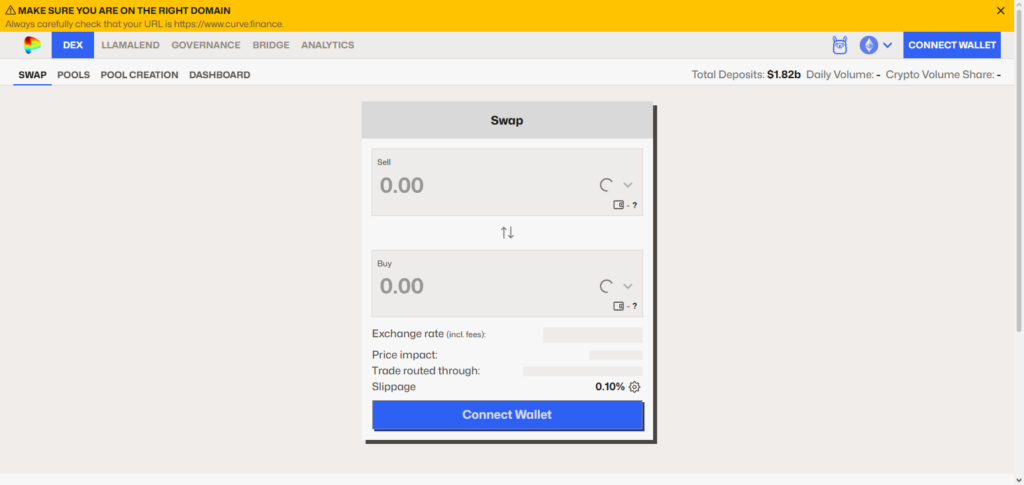
Due to the high trading volume of stablecoins in the crypto market, it is a reliable way to earn passive income through liquidity provision.
As a result, Curve has established itself as a reliable passive income liquidity provisioning platform. Curve’s pools are integrated with yield generation strategies across a diverse array of decentralized finance (DeFi) protocols.
Curve Finance Features, Pros & Cons
Features
- Stablecoin trading is prioritized.
- Implement the Automated Market Maker (AMM) model.
- Low slippage and high liquidity.
- Provide liquidity mining rewards in the form of CRV tokens.
- Many DeFi protocols can be integrated.
Pros
- Stablecoin trading has really low fees.
- Pools have more than enough liquidity.
- Liquidity providers can earn good rewards.
- Integration with DeFi ecosystem is great.
- Yield from stablecoin is a safe option.
Cons
- Beginners may find the interface confusing.
- Liquidity pools may suffer from impermanent loss.
- Stablecoin market’s stability is needed.
- Ethereum transaction fees can be high.
- Knowledge of liquidity strategies is needed.
6. Yearn Finance
Yearn Finance is a yield aggregator that automatically optimizes the returns of users’ crypto investments. Rather than spending time trying to track the best yield farming opportunities, users simply deposit their assets into Yearn vaults.
The platform’s smart contracts do the rest, automatically moving the funds to the best performing DeFi protocols in real time. As one of the Top DeFi Protocols Paying Passive Income, Yearn Finance also helps yield farming become more straightforward, while more advanced users will find it to be a more efficient platform.
The platform employs vault strategies and YFI governance tokens to distribute the rewards. These automated strategies rebalance investments across lending and liquidity platforms to help users earn passive income in DeFi without having to actively be involved.
Yearn Finance Features, Pros & Cons
Features
- Strategies for yield farming are automated.
- Smart contracts in vaults are used to optimize the yield.
- Multiple DeFi platforms can be integrated.
- YFI tokens are used for governance.
- Yields are higher if there is rebalancing.
Pros
- Automated management of investment strategies.
- Saves time for investors searching for yield.
- Access to sophisticated strategies in DeFi.
- Better allocation of capital.
- Large and competent developer community.
Cons
- Smart contract systems are complicated.
- Vault strategies may pose potential risks.
- More advanced users have greater opacity.
- Vault management fees are charged.
- The returns are contingent upon DeFi market conditions.
7. Balancer
Balancer is an automated portfolio management and decentralized exchange protocol. Customers can manage their own liquidity pools via multiple tokens.

Liquidity providers, by funding pools, receive trading fees from currency swaps conducted on Balancer. Balancer also permits pool compositions of up to eight tokens and has the ability to customize weight distributions. Balancer is classified as one of the Top DeFi Protocols Paying Passive Income.
Beyond trading fees, Balancer liquidity providers receive BAL governance tokens. DeFi projects receive efficient liquidity management of their tokens through the Balancer platform. Balancer combines automated portfolio balancing and liquidity providing. This allows investors to earn passive income.
Balancer Features, Pros & Cons
Features
- Multi-token liquidity pools.
- Automated portfolio balancing.
- Token weights can be distributed and adjusted.
- Liquidity mining via BAL tokens.
- A decentralized exchange is in place.
Pros
- Liquidity pools are designed with flexibility.
- Stake tokens and collect trading fees.
- Portfolio diversification is made easier.
- Create your own liquidity mining pool.
- Managing assets becomes easier.
Cons
- Impermanent loss is a risk.
- High complexity in pool setups,.
- Compared to other DEXs, liquidity is lower.
- Concept of token weights must be understood.
- Exposure to risks of Smart contract.
8. SushiSwap
SushiSwap is a decentralized exchange that enables a wide variety of crypto-based transactions and services, including token swaps, liquidity provision, staking, yield farming, and liquidity mining.
Users who provide liquidity by depositing their tokens into liquidity pools are rewarded with liquidity provider (LP) tokens that correspond to their share of the pool. Users can then stake their LP tokens to earn SUSHI tokens, a reward that incentivizes participation.
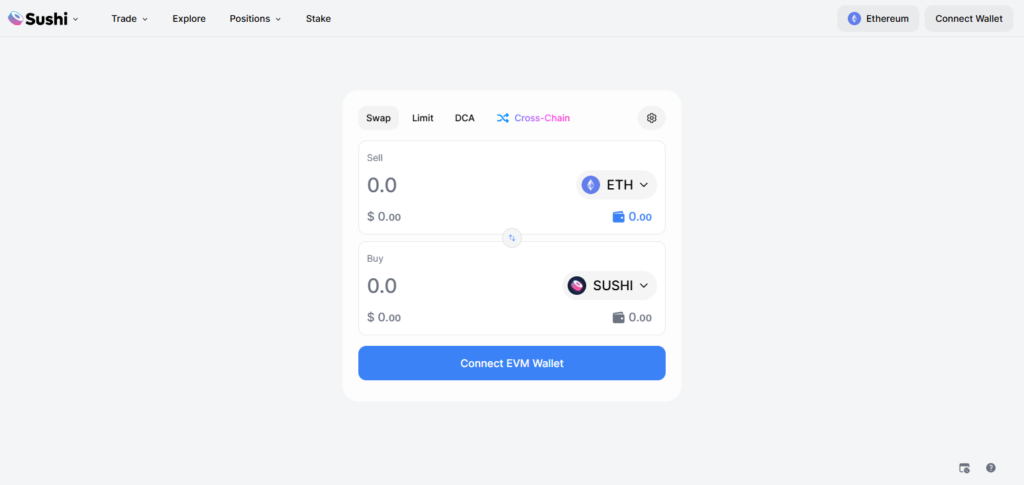
As a leader in the Crypto-Economy, SushiSwap provides several additional earning options through its implemented farming pools, staking services, and yield lending offerings.
SushiSwap has integrated a diverse range of decentralized finance (DeFi) services, including a lending marketplace and an NFT marketplace, which expand its offering.
SushiSwap employes a community governance model that fosters decentralized participation in SushiSwap governance and decision-making, providing passive income through the aforementioned services.
SushiSwap Features, Pros & Cons
Features
- Liquidity pool-based token swaps.
- Yield farming and staking.
- Governance via SUSHI tokens.
- DeFi ecosystem across multiple chains.
- NFT and lending services.
Pros
- Governance is community-based and robust.
- Various ways to earn in DeFi.
- Supports multiple chains.
- Liquidity mining is awarded.
- Comprehensive DeFi services ecosystem.
Cons
- Smaller DEXs face competition from larger ones.
- Liquidity providers face the risk of impermanent loss.
- Risks are associated with smart contracts.
- Liquidity provider rewards are volatile.
- Beginners will face difficulties in DeFi because of its complexity.
9. GMX
GMX is a decentralized perpetual futures exchange that allows users to trade cryptocurrencies with leverage directly from their wallets.

Unlike order book models, GMX has a novel liquidity pool structure in which liquidity providers deposit assets into the GLP pool. Liquidity providers receive a share of trading fees and funding rates created by the traders.
GMX is unique among the Top DeFi Protocols Paying Passive Income because liquidity providers are, in effect, revenue stakeholders and counter traders. Due to the revenue-sharing framework of this model, consistent passive income can be expected, especially in thriving crypto derivative trading markets.
GMX Features, Pros & Cons
Features
- Futures trading of decentralized perpetual contracts.
- Trading through the GLP liquidity pool.
- Trading with high multiples leveraged up to.
- Liquidity providers earn revenue.
- Avalanche and Arbitrum networks as foundation.
Pros
- Earnings from trading.
- Trading with low slippage.
- Trading on-chain is transparent.
- Liquidity providers earn rewards.
- Ecosystem for derivatives trading is developing.
Cons
- Counterparty risk is for traders.
- Trading derivatives is complex.
- Return on GLP is impacted by volatility.
- Less assets are supported.
- High understanding of leverage is required.
10. dYdX Chain
dYdX Chain is its own blockchain for trading derivatives (specifically perpetual futures). Users can open leveraged trades and do not have to use a centralized exchange. Users who provide liquidity and hold dYdX tokens earn a share of the trade fees and receive a share of the staking rewards. Top DeFi Protocols Paying Passive Income recognizes dYdX Chain for offering income opportunities via token staking and liquidity provision.

The protocol moved to a new layer 1 blockchain to enhance speed, scalability and decentralization. dYdX Chain balances high-performance trading systems and decentralized governance, allowing investors to earn a passive income from the rapidly expanding decentralized derivatives market.
dYdX CHAIN Features, Pros & Cons
Features
- Futures exchange of decentralized perpetual contracts.
- Own Layer 1 blockchain.
- Order book trading fast.
- Governance by the DYDX token.
- Liquidity incentives & staking.
Pros
- Infrastructure for trading advanced.
- Fees for trading lesser than centralized exchanges.
- Governance is decentralized.
- Tools for trading at the professional level.
- Market liquidity for derivatives is strong.
Cons
- Beginners will find it complex.
- Trading with leverage is high risk.
- Demands knowledge of sophisticated trading techniques.
- Market engagement determines liquidity.
- There is a lack of clarity on regulation in derivatives trading.
Conclusion
Top DeFi protocols that offer passive income present new alternatives for passive income generation opportunities for an investing system that hasn’t relied on banks and other financial intermediaries.
For instance, Compound Finance and Aave offer interest through lending, while other DeFi protocols such as Lido Finance and Rocket Pool offer passive income through blockchain staking. On the other hand, liquidity pools such as Curve Finance, Balancer and SushiSwap offer passive income generation through liquidity mining and trading fees.
Moreover, other advanced yield optimization strategies through Yearn Finance and derivatives offerings such as GMX and dYdX Chain create the potential for passive income Possibilities in all ecosystems of DeFi unparalleled.
It is evident that long-term passive income generation within the digital economy is supremely reinforced with the growing adoption of blockchain and the new financial innovations for the new financial products that DeFi continues to adopt.
FAQ
What are DeFi protocols that pay passive income?
DeFi protocols are decentralized financial platforms built on blockchain that allow users to earn passive income through activities such as staking, lending, liquidity providing, and yield farming. Platforms like Aave and Compound Finance allow users to deposit crypto assets and earn interest from borrowers without needing traditional banks.
How can investors earn passive income from DeFi?
Investors can earn passive income by lending their crypto, staking tokens, or providing liquidity to decentralized exchanges. For example, staking platforms like Lido Finance and Rocket Pool provide staking rewards, while liquidity platforms like Curve Finance reward users with trading fees and token incentives.
Which DeFi protocols are considered the most reliable for passive income?
Some of the most widely used and trusted DeFi platforms include Aave, Compound Finance, Yearn Finance, and Curve Finance. These protocols have large liquidity pools, active communities, and strong security audits.
Is earning passive income through DeFi safe?
While DeFi can offer attractive yields, it also comes with risks such as smart contract vulnerabilities, market volatility, and liquidity risks. Even established platforms like SushiSwap or Balancer require users to carefully research and manage risk before investing.