


The top AI cryptocurrency projects competing with the Bitcoin ecosystem will be covered in this article. These cutting-edge technologies improve automation, smart contracts, data security, and predictive analytics by fusing blockchain technology with artificial intelligence.
These initiatives, which range from AI-powered marketplaces to autonomous agents, are changing the cryptocurrency environment and providing new options outside of conventional cryptocurrencies like Bitcoin.
Key Point & Top AI Crypto Projects Rivaling Bitcoin Ecosystem
| Project | Key Points |
|---|---|
| Fetch.ai | Decentralized AI platform for autonomous agents, enabling smart contracts, data sharing, and automation in finance, logistics, and IoT. |
| SingularityNET (AGIX) | AI marketplace allowing developers to create, share, and monetize AI services on blockchain; focuses on decentralized intelligence. |
| Ocean Protocol | Provides decentralized data exchange for AI training, enabling secure, privacy-preserving data sharing and monetization. |
| Numerai / Erasure Protocol | Uses encrypted data for AI-driven hedge fund predictions; incentivizes data scientists with cryptocurrency for model accuracy. |
| Cortex (CTXC) | Decentralized AI blockchain supporting AI model integration into smart contracts for on-chain inference and automated decision-making. |
| Velas AI Blockchain | High-performance AI-powered blockchain combining machine learning consensus with fast, scalable transactions and smart contract support. |
| Matrix AI Network | Focused on AI-driven blockchain optimization, including self-learning smart contracts, intelligent consensus, and adaptive security features. |
| Oraichain | AI-focused oracle network connecting AI APIs with smart contracts, enabling decentralized AI model integration and decision-making. |
| Bittensor (TAO) | Open-source decentralized machine learning network where participants contribute AI models and earn rewards for network contributions. |
| Forta AI Security Network | Real-time monitoring and threat detection for blockchain networks using AI to identify vulnerabilities, exploits, and anomalies. |
1. Fetch.ai
Fetch.ai is building a decentralized platform for autonomous AI-based agents that can make real-time decisions and conduct transactions for provide and procure services in the places of finance, logistics, and the Internet of Things.

With autonomous agents, AI-based economic activity can be achieved in certain domains like decentralized finance and supply chain management. Fetch.ai’s system uses blockchain for smart contracts and secure transactions.
Of the Top AI Crypto Projects Rivaling Bitcoin Ecosystem, Fetch.ai is distinguished from the field because it uses machine learning for network self-organization and automated smart decentralized applications.
Fetch.ai Features, Pros & Cons
Features:
- Autonomous economic agents for the completion of tasks.
- AI-enhanced smart contracts.
- Economic systems with multiple agents.
- Supply chain and IoT optimization.
- Decentralized Finance (DeFi) offerings.
Pros:
- Creates possibilities for automation and optimization of multiple industries.
- Provides a highly secure and fully decentralized network.
- Highly scalable agent-based architecture.
- Provides a dedicated focus for the real-world utilization of AI.
- Provides an active community of developers.
Cons:
- The adoption of the platform is limited.
- Significant learning curve is required before the platform can be used.
- Increased network users means increased network efficiency.
- Competing AI blockchain platforms cause a growing number of alternatives.
- The finance aspect of AI is subject to regulation.
2. SingularityNET (AGIX)
SingularityNET is a blockchain-based platform for AI services where AI developers can make AI services available for the purposes of monetization. The algorithms that the users can access range from natural language processing to predictive analytics.
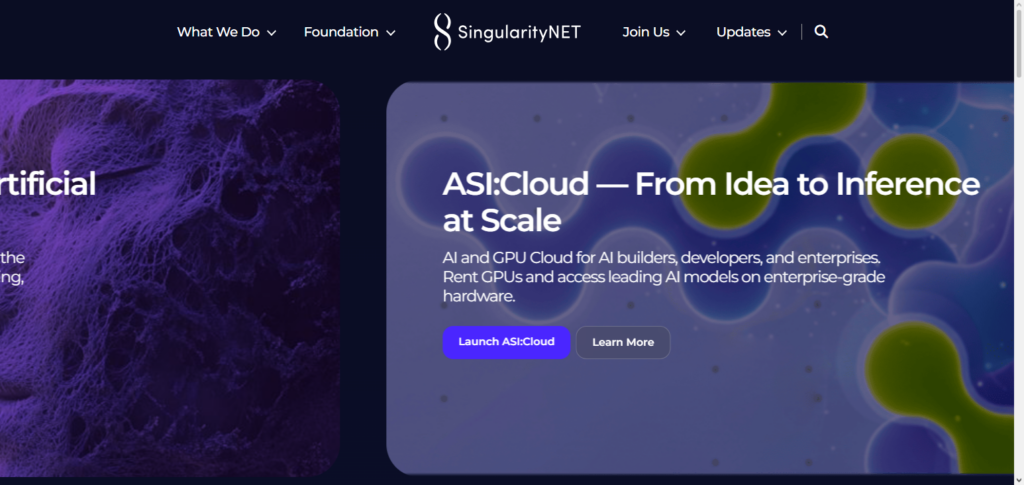
Contributors to the platform get paid in AGIX tokens. AGIX is one of the Top AI Crypto Projects Rivaling Bitcoin Ecosystem, and it is focused on decentralized intelligence so that no one can monopolize the control of AI.
SingularityNET uses a Smart contract on the Ethereum blockchain, therefore it is transparent and can be used alongside other blockchain technology. The platform also seeks to enable collaborations between different AI systems in order to build an ecosystem of AI agents that can communicate, learn, and evolve to solve practical problems in the real world.
SingularityNET (AGIX) Features, Pros & Cons
Features:
- Marketplace for decentralized AI services.
- AI services can be monetized.
- Compatible with smart contracts on Ethereum.
- Collaboration among AI agents.
- Ecosystem based on the AGIX token.
Pros:
- Access to AI is made easier.
- Innovation is encouraged as a by-product of the token incentive system.
- AI services with high-diversity is supported.
- Strong integration of blockchain systems for safety and transparency.
- AI governance provides a strong roadmap.
Cons:
- The performance of the Ethereum network is a requirement.
- Adoption of the platform on a widespread basis is unlikely.
- AI-related transactions are subject to fluctuations based on token volatility.
- There may be periods of low liquidity within the marketplace.* Competing AI projects might dominate the market.
3. Ocean Protocol
Ocean Protocol functions as a decentralized data exchange, designed specifically for the purpose of facilitating data and AI marketplaces. By using Ocean Protocol, data owners are able to keep control and maintain the privacy of their datasets, while still being able to monetize the datasets.
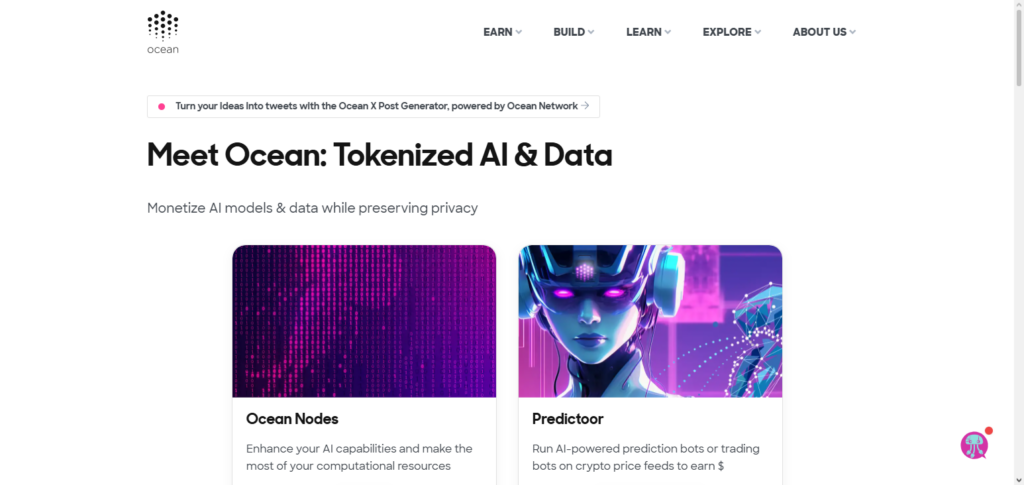
Additionally, developers of AI models are able to gain access to datasets of superior quality, which they may utilize to enrich their models. By using blockchain technology, Ocean Protocol offers the functionalities of data usage transparency, secure transactional data, and traceability for each unique usage of the data.
For these reasons and more, it is high on the list of AI Crypto Projects and Bitcoin Ecosystem competitors.
It provides AI innovation a way to be ethical and decentralized. Ocean Protocol helps AI and blockchain work better together by solving the issue of data liquidity. It better employs privacy and incentivized tokens to promote the development of smarter AI technology in industries including, but not limited to, finance, research, and healthcare.
Ocean Protocol Features, Pros & Cons
Features:
- Decentralized marketplace for data.
- Data sharing is done while preserving user privacy.
- Access to data is tokenized (OCEAN token).
- Data sets for training AI models are accepted.
- Data on the blockchain is trackable.
Pros:
- Users can protect their privacy while monetizing their datasets.
- Decentralized data monetization fosters AI innovation.
- Transactions on the platform are secure and transparent.
- A versatile platform for researchers and businesses.
- Global data liquidity is improved.
Cons:
- The platform’s adoption by AI developers and data providers is uncertain.
- Potential for market saturation with a competition for decentralized data storage.
- Interaction with the platform is not user friendly. Technical expertise is needed.
- The data provided may not always be of good quality.
- The token provided as a monetary incentive to users may lose value.
4. Numerai / Erasure Protocol
Participants at Numerai, a hedge fund that uses artificial intelligence and relies on the models of data scientists around the world, use encrypted data sets to shield their intellectual property.
Each participant prediction is recorded, and their success is compensated with NMR tokens. Erasure Protocol, on the other hand, helps secure data prediction markets.

These are markets in which users stake tokens on the accuracy of the predictive model. Within the Numerai / Erasure Protocol / Celo ecosystem, Numerai exemplifies the potential of decentralized AI. It fosters a community that safely incentivizes the accuracy of AI models in a decentralized manner across borders.
The integration of finance, AI, and blockchain is transforming predictive methodologies and the underlying strategies of markets in a decentralized manner.
Numerai / Erasure Protocol Features, Pros & Cons
Features:
- Predictions for AI hedge funds are sourced from a group.
- Data sets are encrypted for confidentiality.
- The incentive system is tokenized (NMR).
- Decentralized markets for predictions.
- Staking via Erasure Protocol integration.
Pros:
- Global collaboration on AI projects is encouraged.
- Models that are predictive are financially rewarded.
- The confidentiality of data is maintained.
- Unique fusion of AI and blockchain.
- Moves away from traditional structures of hedge funds.
Cons:
- Novice investors may find predictive analytics overwhelming.
- Success of the platform is fully dependent on the involvement of data scientists.
- The NMR token is subject to price fluctuation.
- The platform is not widely known.
- Predictive analytics is highly competitive.
5. Cortex (CTXC)
Cortex is a decentralized AI blockchain. This means it allows smart contracts to incorporate AI models for on-chain inference.
Therefore, developers have the option to deploy the AI models on the blockchain to create contracts that can change depending on the data inputs they receive.
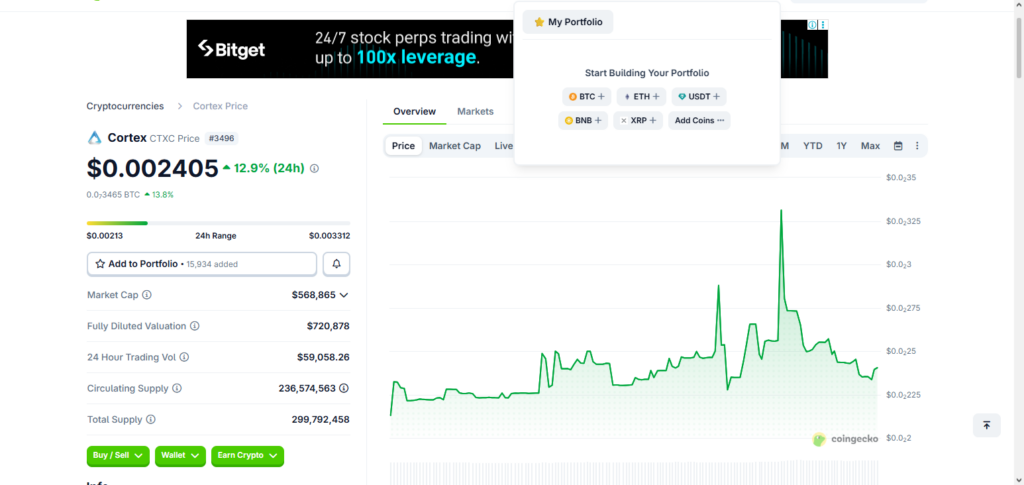
From the Top AI Crypto Projects Rivaling the Bitcoin Ecosystem, Cortex stands out because it can integrate AI and blockchain’s immutability and therefore, also allows decentralized machine learning.
Its ecosystem provides the AI models that developers can use for applications such as fraud detection, image recognition, and automated decision-making. For projects that want to combine AI-enabled decision-making with the execution of smart contracts, Cortex is a key platform.
Cortex (CTXC) Features, Pros & Cons
Features:
- Smart contracts with integrated AI.
- Deployment of AI models on-chain.
- Ecosystem for decentralized machine learning.
- AI inference on blockchain.
- Compatibility with Cortex Virtual Machine (CVM).
Pros:
- Smart contracts can be made intelligent.
- Development of AI in decentralized applications (DApps) is supported.
- Decision-making in blockchain is improved.
- AI can be deployed transparently and on-chain.
- Developer activity is high.
Cons:
- Adoption is limited to tech communities.
- There is complexity for developers.
- Other AI blockchain solutions are offered.
- There are issues with network scalability.
- There is a dependence on the blockchain.
6. Velas AI Blockchain
The Velas AI Blockchain is considered one of the fastest blockchains available today, with the unique ability of leveraging artificial intelligence (AI) in conjunction with machine learning (ML) to facilitate rapid and scalable transactional processing.
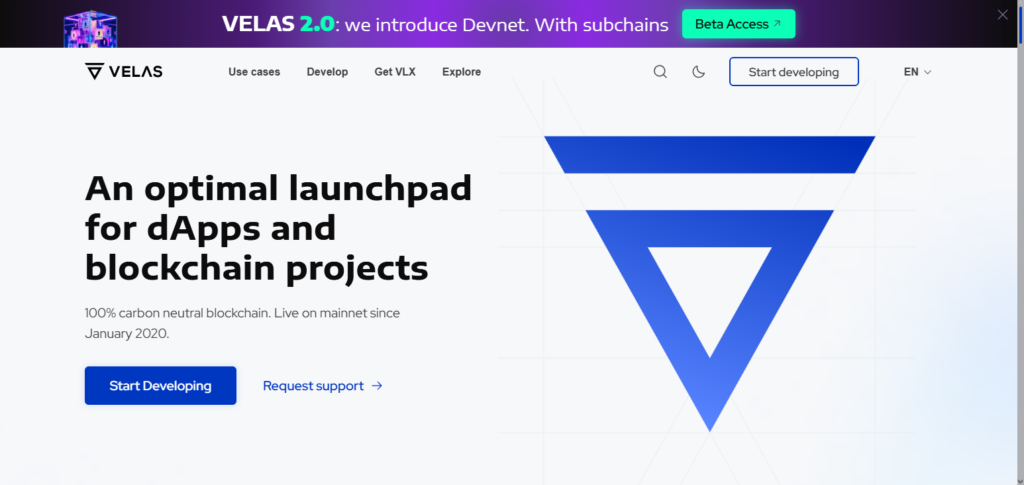
Its innovative AI consensus mechanism enables a balanced approach to speed, energy consumption, and security. As an emerging player in the Top AI Crypto Projects Rivaling Bitcoin Ecosystem, Velas provides an opportunity for developers to create decentralized applications (dApps) with embedded AI functionality on an open and distributed ledger.
Its ecosystem includes smart contracts, decentralized finance (DeFi), and non-fungible token (NFT) marketplaces. As the first AI/Blockchain fusion technology provider, Velas delivers the most flexible and fastest adaptable ecosystem to facilitate the deployment of AI (i.e. algorithmically) optimized real-time network) applications.
Velas AI Blockchain Features, Pros & Cons
Features:
- Use of AI in the consensus mechanism.
- Quick transaction processing.
- Supports smart contracts.
- Blockchains that can be scaled.
- Integration with DeFi and NFTs.
Pros:
- Blockchain that is fast and uses less energy.
- AI improves the efficiency of the network.
- Many uses are supported.
- Developers can build in a scalable environment.
- AI and blockchain come together.
Cons:
- Not as recognized as larger blockchains.
- A technical understanding is necessary.
- Network operations via AI consensus is novel.
- Competing blockchains exist.
- Mainstream adoption is difficult.
7. Matrix AI Network
Self-learning smart contracts, intelligent consensus, and adaptive security protocols are the main features of the AI-focused blockchain platform Matrix AI Network. AI algorithms can improve transaction speed, identify abnormalities, and optimize blockchain performance thanks to its architecture.
Developers can effectively incorporate AI into decentralized apps with Matrix AI Network, one of the Top AI Crypto Projects Rivaling the Bitcoin Ecosystem. In order to minimize human intervention, the platform facilitates automatic contract and network operation optimization.
Matrix AI Network seeks to provide a scalable, intelligent ecosystem where AI-driven solutions improve security, lower computing costs, and speed decentralized innovation by fusing machine learning with blockchain technology.
Matrix AI Network Features, Pros & Cons
Features:
- Smart contracts that can learn.
- AI-driven consensus.
- Security that is adaptive.
- Blockchain that is optimized.5. Support for Intelligent DApps.
Pros:
- Integrating AI with blockchain improves efficiency.
- Autonomous smart contracts lead to less manual processing.
- AI tech provides built-in security.
- Adaptable for enterprise and developer scalability.
- Fosters decentralized app innovations.
Cons:
- Limited adoption.
- Non-tech users find it complicated.
- AI optimization determines the speed of the network.
- Other AI-enabled blockchains compete for market share.
- Ecosystem growth is a prerequisite.
8. Oraichain
Oraichain is a network of oracles with a focus on AI, linking smart contracts to AI. It allows smart contracts to incorporate real-time AI for the purposes of prediction, verification and data analysis.
In the Top AI Crypto Projects Rivaling the Bitcoin Ecosystem, Oraichain guarantees the integration of decentralized AI models while retaining trust and transparency. Its ecosystem applies to DeFi, NFTs and automated decision making.
With Oraichain, developers can incorporate blockchain contracts to perform complex on-chain activities, such as sentiment analysis, fraud detection, or self-governance, which expands the decentralized systems.
Oraichain Features, Pros & Cons
Features:
- Smart contracts integrated with AI oracles.
- AI APIs in the network for real-time execution.
- Decentralized execution of models.
- Integrates with DeFi, Supports NFTs, and Governance.
- AI services in a tokenized economy.
Pros:
- Directly integrates AI with smart contracts.
- Increases the quality of blockchain app decisions.
- Decentralized oracle network is transparent.
- Offers a diverse selection of AI models.
- First to merge AI and DeFi.
Cons:
- Speed may be constrained due to oracle dependency.
- Adoption won’t happen unless developers get involved.
- Competing oracle networks exist.
- Token value fluctuates.
- DApps integrated with AI face challenges.
9. Bittensor (TAO)
Bittensor is an open-source, decentralized machine learning (ML) network. Participants build AI (artificial intelligence) models to add to the ecosystem and receive TAO tokens as payment. This platform rewards AI developers for their contribution to an open-access neural network.

Bittensor is among the top AI Crypto Projects Rivaling the Bitcoin Ecosystem. Due to its decentralized nature, Bittensor encourages the development of AI through innovation and participation on a global scale, as no one can monopolize the innovation of the network.
The AI models can learn and adapt to one another over time and, as a result, improve their performance and accuracy. Bittensor is an example of the leading edge of decentralized AI. It is the first of its kind to combine the blockchain payment system with collective machine learning, to provide the foundation for a network of scalable, adaptable intelligence.
Bittensor (TAO) Features, Pros & Cons
Features:
- Network for machine learning that is decentralized.
- AI models created by the community.
- TAO tokens are given as rewards.
- AI open-source.
- Neural networks that are scalable and flexible.
Pros:
- The ability to collaborate on AI is global and unrestricted.
- Offers reward programs for user participation.
- Decentralized AI training that is transparent.
- Network is adaptive and evolving.
- Fosters creativity through an open-source framework.
Cons:
- Limited niche use outside of AI communities.
- Incentives depend on TAO token volatility.
- New user technical challenges.
- Other decentralized AI projects in competition.
- For optimal performance network growth is essential.
10. Forta AI Security Network
Forta AI Security Network is a decentralized security network that tracks blockchain activity and identifies threats in real time. It has developed AI technology that detects vulnerabilities, exploitation, and other anomalous activity relating to smart contracts and blockchain technology.
Forta has positioned itself as a top competitor in securing the Bitcoin ecosystem and offers improved security and transparency for decentralized applications.
Through Forta’s ecosystem, developers, validators, and users are alerted to potential threats in real time, which is important to mitigating the risks associated with DeFi and NFT platforms.
By using AI and distributed technology, Forta protects blockchain ecosystems, cementing AI-powered security as a necessity for the future of decentralized networks.
Forta AI Security Network Features, Pros & Cons
Features:
- Monitoring of blockchains in real-time.
- Threat detection through AI.
- Notification of exploits and anomalies.
- Smart contracts and DeFi services are supported.
- Security network is decentralized.
Pros:
- Real-time blockchain security is enhanced.
- Damage is avoided through early detection of vulnerabilities.
- Decentralized ecosystems that are variously supported.
- Monitoring through AI that is scalable.
- Primary for DeFi and NFT security.
Cons:
- AI model accuracy is the greatest determinant.
- Developer community is the most aware.
- Technical knowledge is needed for integration.
- Competes with blockchain security solutions.
- New threats require continuous updates.
Conclusion
The emergence of AI-powered blockchain initiatives is changing the cryptocurrency scene by providing cutting-edge alternatives to conventional cryptocurrencies like Bitcoin.
Artificial intelligence is being integrated into decentralized networks by platforms like Fetch.ai, SingularityNET, Ocean Protocol, and Bittensor to improve automation, data security, and predictive analytics.
These initiatives are changing the way blockchain works, from autonomous agents and AI-powered smart contracts to real-time threat detection using Forta.
The Top AI Crypto Projects Rivaling the Bitcoin Ecosystem aim to propel more intelligent, effective, and cooperative decentralized apps, paving the way for the next wave of blockchain innovation.
FAQ
What are AI crypto projects?
AI crypto projects combine artificial intelligence with blockchain technology to enable smarter, automated, and decentralized applications. They often use AI for tasks like predictive analytics, autonomous decision-making, and data security.
How do these projects rival Bitcoin?
While Bitcoin focuses on digital currency, AI crypto projects enhance blockchain functionality with intelligent features, automation, and decentralized data networks, offering broader use cases beyond simple transactions.
Which are the top AI crypto projects?
Leading projects include Fetch.ai, SingularityNET (AGIX), Ocean Protocol, Numerai, Cortex (CTXC), Velas AI Blockchain, Matrix AI Network, Oraichain, Bittensor (TAO), and Forta AI Security Network.