


This article will review the Best Crypto Exchange APIs available to developers, traders, and businesses interested in using real-time market data and automated trades to develop their own crypto applications.
APIs provide connectivity and integration to exchanges, secure and reliable historical data, and sophisticated trading features. For crypto software and services, these APIs are indispensable.
Why Use Crypto Exchange APIs?
Real-Time Market Info: Offers data about pricing and trading volume, etc. to help analyze and make decisions.
Automated Strategies: Use pre-set rules to automatically execute buys and sells.
Improved Efficiency: Capture trades quickly as orders can be placed in an instant.
Multiple Exchanges: Use APIs to manage trades across different exchanges from one location.
Custom Applications: Use API data to build tools and apps for trading and managing assets.
Portfolio Management: Offers tools to track and analyze the performance of assets across exchanges.
Less Manual Effort: Automating Buy/Sell orders reduces time and potential trading errors.
Better UX: APIs provide the ability to offer live market data and the ability to trade from your site or app.
Secure Accounts: Encrypted API Keys provide a level of security for user accounts.
Grow Trading: As your trading volume and business grows, APIs can accommodate the level of trading requested.
Benefits of Using Crypto Exchange APIs
Instant Reach to Markets: Get access to live crypto prices and updates to help you make smart trades.
Efficient Trade Automation: Make trades based on specific instructions, limiting the need for your involvement.
Swift Transaction Processing: Buy and sell at the perfect time without the delay.
Unified Trade Management: Handle trades on various crypto exchanges all at once.
Automation Trade Improvements: Calculate and take care of trades and portfolios, leaving no room for error.
Thorough Real Time Tracking: See balances, history, and how your assets are doing.
Convenient Creation of Customized Bots: Design trading bots and apps using easy to work with APIs.
Account Safety: User accounts are protected with various security measures.
Reduced Trade Management Cost: Save both time and money with automated trades and account management.
Easily Expandable Interface: An infrastructure that can manage a higher volume of trades with more exchanges while adding more features.
Common Challenges and Risks
API Rate Limits High-frequency trading is complicated if exchanges limit the amount of API requests.
Market Volatility Fast moving prices make investing/trading even riskier.
Security Threats There are many ways that accounts can be compromised such as stolen API keys, phishing attempts, and other types of unauthorized account access.
Exchange Downtime Servers being down for maintenance can halt trading and lag order placement.
Network Latency API responses may lag when the market is busy, hurting the ability to execute a trade.
Regulatory Compliance Sudden changes to the law surrounding cryptocurrency may affect APIs, trading methods, or where trading can occur.
Integration Complexity For Developers, integrating multiple exchanges can be very difficult because of unique structures for each API.
Incomplete or Delayed Data Synchronization of market data can lead to missed trading opportunities.
Transaction Failures Orders may be placed and not executed due to a lack of liquidity, congestion of the network, or issues with the exchange itself.
Version Updates Keeping applications updated is very difficult as APIs and endpoints change frequently.
Key Point & Best Crypto Exchange APIs
| Crypto Exchange API | Key Point |
|---|---|
| Kaiko API | Provides institutional-grade cryptocurrency market data with real-time and historical pricing across global exchanges. |
| CoinAPI | Delivers unified market data, OHLCV, order books, and trading information from multiple crypto exchanges. |
| Binance API | Offers real-time trading, account management, market data, and order execution on Binance Exchange. |
| Kraken API | Enables secure trading, account access, market data retrieval, and automated cryptocurrency transactions. |
| Bitstamp API | Provides reliable market data, order management, and trading features for institutional and retail users. |
| Gemini API | Supports secure cryptocurrency trading, portfolio management, and real-time exchange market information. |
| CoinStats API | Offers crypto portfolio tracking, market analytics, pricing data, and wallet integration capabilities. |
| DexScreener API | Delivers real-time decentralized exchange (DEX) token prices, liquidity, trading pairs, and market analytics. |
| Glassnode API | Provides advanced blockchain analytics, on-chain metrics, and cryptocurrency market intelligence for investors. |
| Messari API | Supplies comprehensive crypto market data, asset research, |
1. Kaiko API
Kaiko API offers institutional-grade crypto market data with historical and real-time feeds for thousands of trading pairs. Their data benchmarks, focuses on indices, and provides compliance-ready data sets.
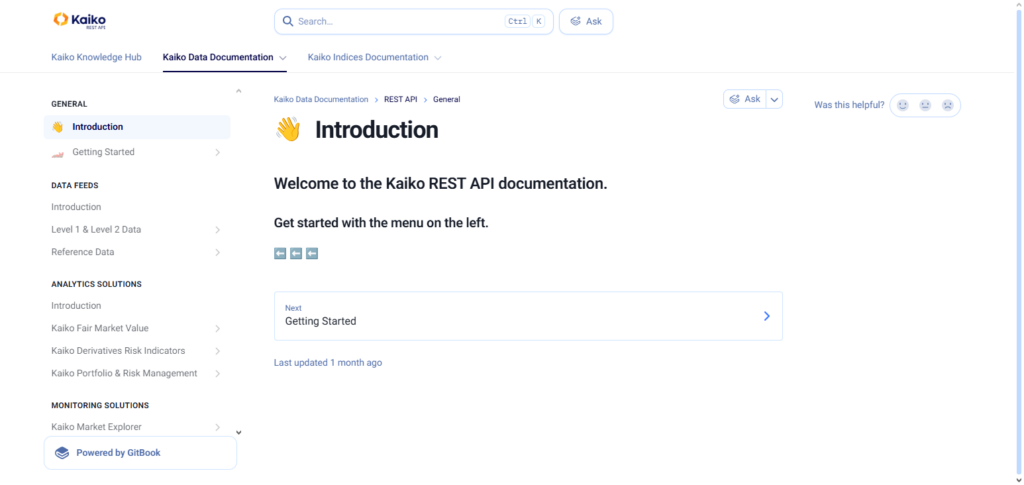
Due to their focus on accuracy and reliability, they provide enterprise-level pricing and support advanced analytics and compliance reporting. Kaiko API’s datasets provide coverage of spot, derivatives and DeFi markets. For all the reasons above, Kaiko API is one of the Best Crypto Exchange APIs.
| Feature | Details |
|---|---|
| Coverage | Institutional-grade market data, indices, benchmarks |
| Data Types | Spot, derivatives, DeFi, historical & real-time |
| Compliance | Enterprise-ready, regulatory reporting |
| Pricing | Enterprise-level subscription |
| Best Use Case | Hedge funds, banks, institutional dashboards |
Kaiko API Benefits & Drawbacks
Benefits:
- High Quality, Institutional-grade datasets for compliance.
- Historical data + real-time updates.
- Spot, Derivatives, and DeFi data coverage.
- Data is reliable for enterprise dashboards.
- Data for Benchmark & Index creation.
Drawbacks:
- Very high enterprise pricing.
- Very limited free/demo access.
- Small team integrations are very challenging.
- Very enterprise focused, zero retail.
- Strong infrastructure and resources are a must.
2. CoinAPI
CoinAPI collects data from more than four hundred exchanges. They offer developers a singular API schema. They simplify the integration of market data, order books, and trades, by standardizing everything. This allows developers to build trading bots and portfolio trackers.
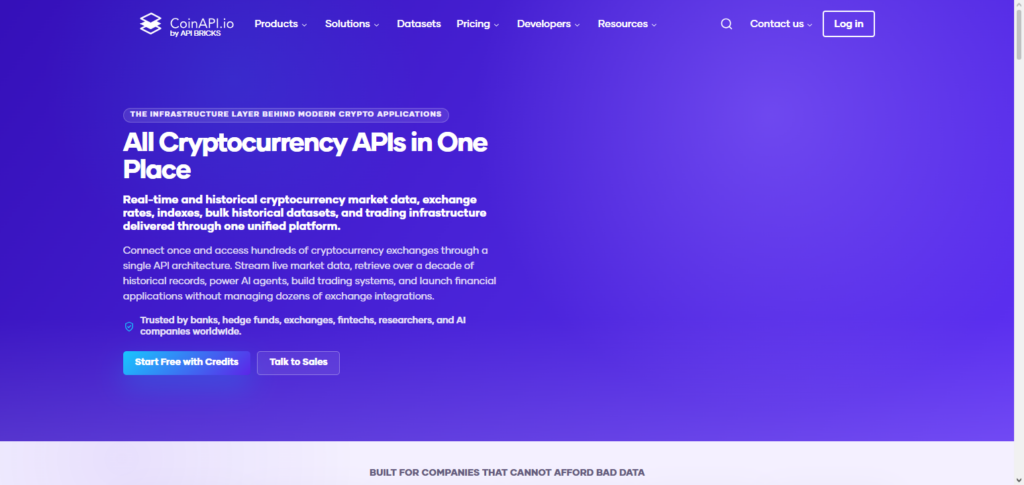
They have a lot of different pricing options, going from $79.00/month, and a ‘free credit tier’ to maintain a customer base. Devs prefer them for their expansive data aggregation and uniform APIs that simplify coding. CoinAPI is an optimal offering from fully incorporating aggregation APIs for all exchanges.
| Feature | Details |
|---|---|
| Coverage | 400+ exchanges aggregated |
| Schema | Unified data format across venues |
| Data Types | Market data, order books, trades |
| Pricing | Free credits, paid plans from $79/month |
| Best Use Case | Multi-exchange trading bots & portfolio trackers |
CoinAPI Benefits & Drawbacks
Benefits:
- 400+ exchange aggregation.
- Simplified coding with a unified schema.
- Very good documentation.
- Great for arbitrage bots.
- High quality historical datasets.
Drawbacks:
- Paid plans start at $79/month.
- Free tier is very limited.
- Rate limits can affect scaling.
- Heavy data may slow down apps.
- Very low DeFi focus.
3. Binance API
The Binance API provides excellent trading bot infrastructure with access to liquidity and spot, futures, margin and options trading. It has a free API option that has rate limits, as well. Also, there are many sophisticated trading bot infrastructures that utilize deep order books and structured API requests.
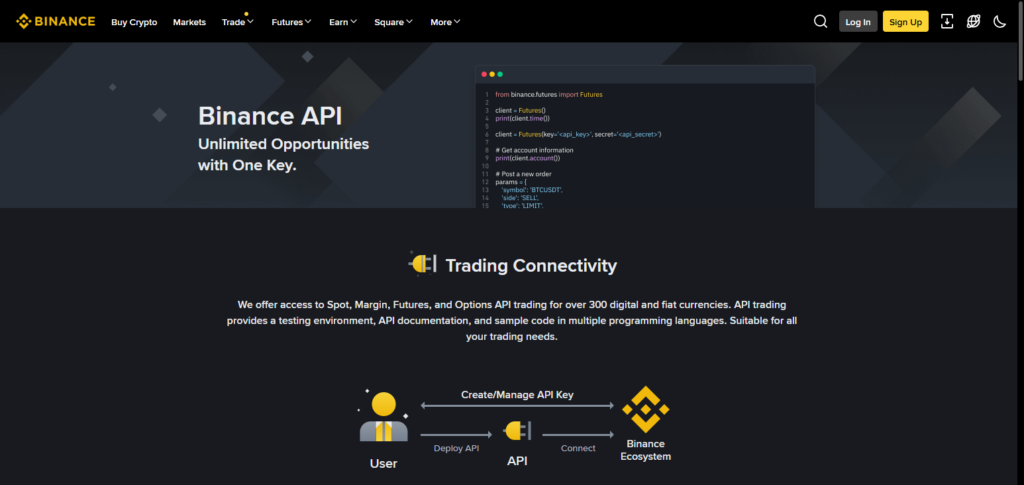
The breadth and depth of Binance’s market and product offerings as well as the Exchange’s volume and global reach can easily make the Binance API the best crypto exchange API for both retail and institutional traders.
| Feature | Details |
|---|---|
| Coverage | Largest exchange by volume |
| Data Types | Spot, futures, margin, options |
| Access | Free with trading fees |
| Liquidity | Deep order books, high-frequency support |
| Best Use Case | Trading bots, execution platforms |
Binance API Benefits & Drawbacks
Benefits:
- Very deep liquidity for the largest exchange.
- Free with trading fees.
- Spot, Futures, Margin, and Options, all supported.
- Excellent WebSocket feeds.
- Very good for trading bots.
** Drawbacks:**
- Some regions have regulatory issues.
- Rate limits for free tier.
- Very complex for beginners.
- Heavy reliance on the Binance ecosystem.
- Regional bans are a very real concern.
4. Kraken API
Kraken API is designed with security and compliance in mind and offers advanced trading capabilities. Spot, futures, staking, and specialized fiat gateways mean Kraken API operates uniquely in regulated environments.
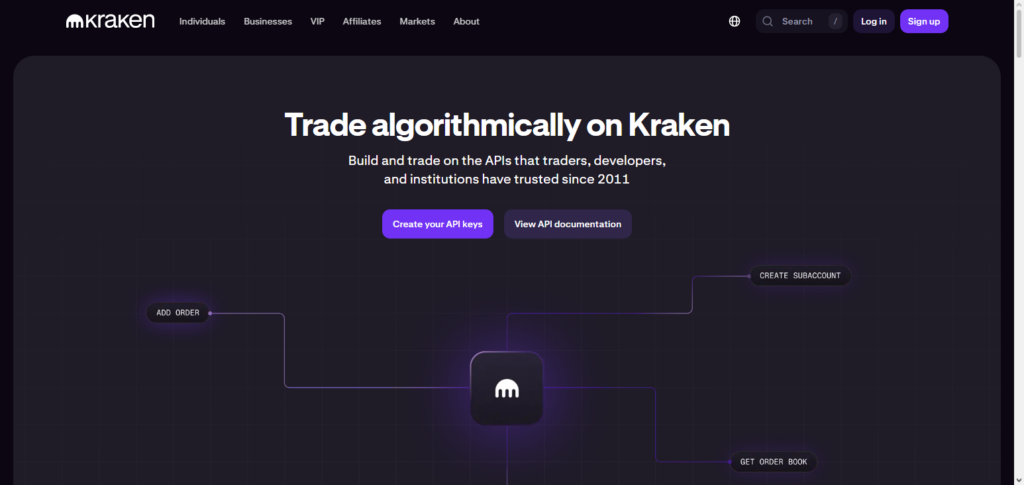
With detailed documentation and WebSocket real-time trading support, it is a developers’ favorite. Added to Kraken’s security and regulatory track record, its API has earned a reputation as a sure bet for institutional-grade applications.
Along with free access and built-in trading fees, it is easily used in exchange for compliance. For crypto trading concerns based on regulations, Kraken API is one of the Best Crypto Exchange APIs for secure trading.
| Feature | Details |
|---|---|
| Coverage | Spot, futures, staking, fiat gateways |
| Security | Strong compliance & transparency |
| Access | Free with trading fees |
| Feeds | REST & WebSocket for real-time trading |
| Best Use Case | Regulated trading environments |
Kraken API Benefits & Drawbacks
Benefits:
- Good compliance & transparency.
- Secure with staking & fiat.
- Free with trading.
- Good WebSocket feeds.
Drawbacks:
- Less liquidity than Binance.
- Limited DeFi.
- Difficult for beginners to use.
- Paid tiers for advanced features.
- Slower to integrate for new devs.
5. Bitstamp API
Bitstamp API is one of the Best Crypto Exchange APIs because of their years of trustworthiness in the market and the reliable European exchange data they provide. They have REST and WebSocket endpoints for trading, order books and historical data.
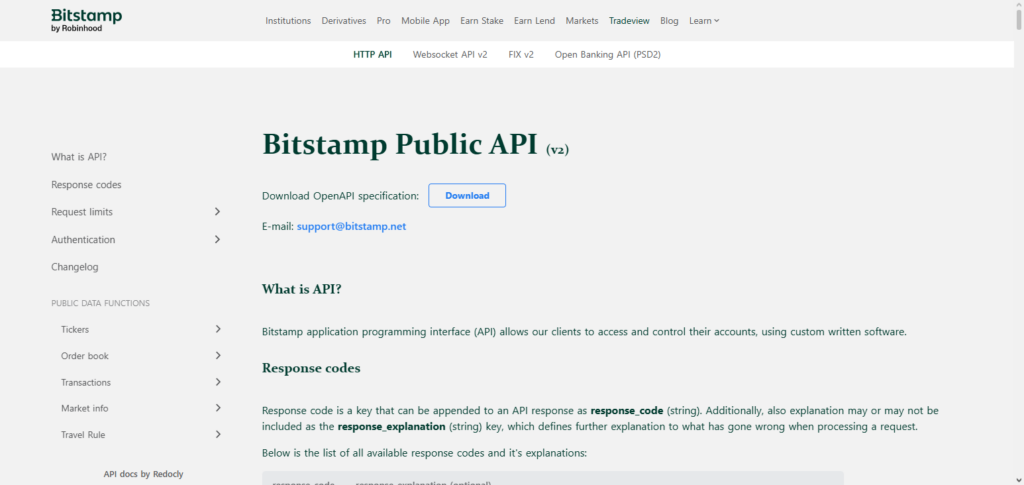
Bitstamp API is one of the more common APIs found because of their legal safety and stability. They have a free to use API with trading fees and their institutional partnerships provide added trust in the API. For a regulated and stable exchange, their reliability and compliance proves the Bitstamp API is one of the Best Crypto Exchange APIs you could use.
| Feature | Details |
|---|---|
| Coverage | European exchange data |
| Data Types | Trading, order books, historical data |
| Compliance | Long-standing regulated venue |
| Access | Free with trading fees |
| Best Use Case | EU-focused institutional apps |
Bitstamp API Benefits & Drawbacks
Benefits
- Long standing European exchange
- Secure, regulated environment
- REST / WebSocket endpoints
- Free access, paid tiers
- Historical data consistency
Drawbacks
- Small market coverage
- Less product diversity
- Less innovative
- Rate limits
- Focused on EU primarily
6. Gemini API
The Gemini API builds highly regulated exchange services on top of strong custody solutions. In addition to market data and spot trading, Gemini provides secure wallet solutions. Gemini API is compliant and provides security at an institutional level.
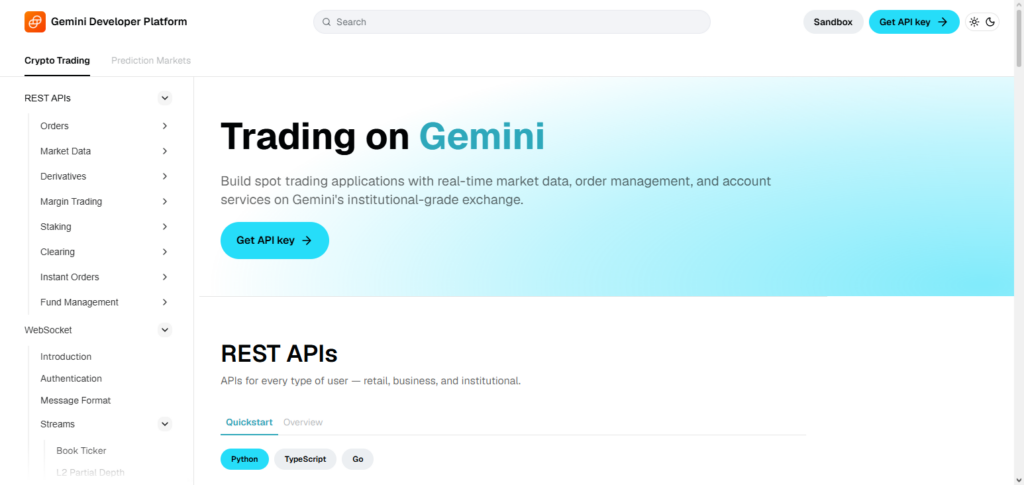
As a result, enterprises and fintech companies trust Gemini API. Gemini provides free access and has trading fees. Gemini is also provider premium services to institutional clients.
Gemini is a leading choice in regulated markets because of its transparency. Gemini is also a highly trusted crypto exchange API for secure and compliant crypto exchange services in the US.
| Feature | Details |
|---|---|
| Coverage | US-regulated exchange |
| Security | Custody & governance transparency |
| Data Types | Spot trading, wallets, market data |
| Access | Free with trading fees |
| Best Use Case | Institutional trust & compliance apps |
Gemini API Benefits & Drawbacks
Benefits
- EU exchange with regulations
- Highly trusted custody solutions
- Transparent governance
- Free access, paid tiers
- Institutional trust
Drawbacks
- Liquidity much less than Binance
- Limited global access
- Paid tiers to access higher data levels
- Complex compliance
- Focused on US primarily
7. CoinStats API
CoinStats API combines data from the markets, wallets, DeFi, and token safety into one product and integrates all the disparate pieces into one cohesive API. Each month, you can use 20,000 credits for free, with a subscription model that begins at $49.
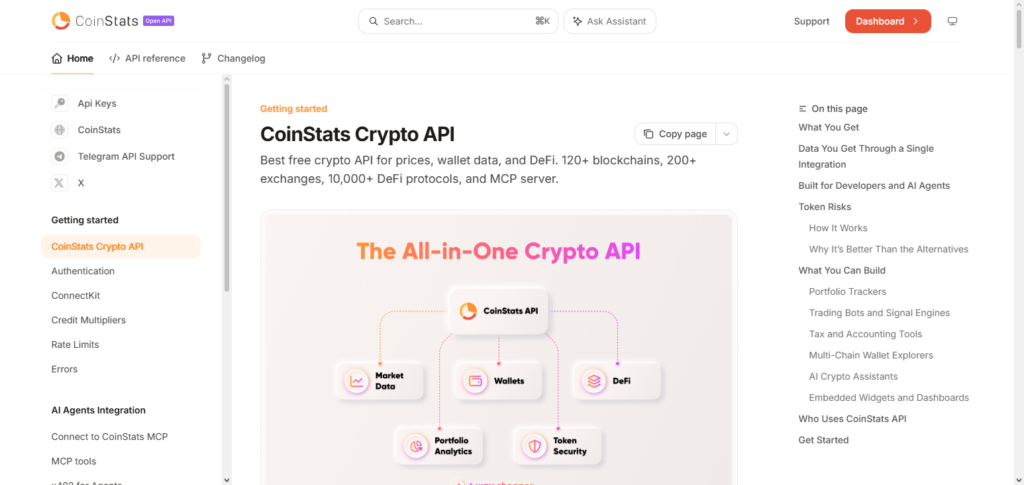
From apps that create and manage digital portfolios and wallets to apps that track and analyze DeFi services, developers have a plethora of options to choose from.
Due to all the available options, this API can easily support retail users. With all the data it compiles from several exchanges, along with wallet and token data, CoinStats API is one of the Best Crypto Exchange APIs for total portfolio fulfillment and management.
| Feature | Details |
|---|---|
| Coverage | Market, wallet, DeFi, token security |
| Free Tier | 20,000 credits/month |
| Pricing | Paid plans from $49/month |
| Integration | Portfolio dashboards & wallet apps |
| Best Use Case | Retail-focused portfolio management |
CoinStats API Benefits & Drawbacks
Benefits
- Wide market, wallet, DeFi, token security coverage
- 20,000 credits / month for free
- Easy portfolio integration
- Retail dashboards
- Affordable plans
Drawbacks
- Free tiers are not good for scaling
- Paid plans start at $49 / month
- Less focus on higher institutions
- Rate limits
- Less coverage than CoinAPI per exchange
8. DexScreener API
The DexScreener API is a free resource giving instant access to data from Decentralized Exchanges (DEX) pairs, requiring no account. This resource is popular in DeFi, and for token and liquidity tracking.
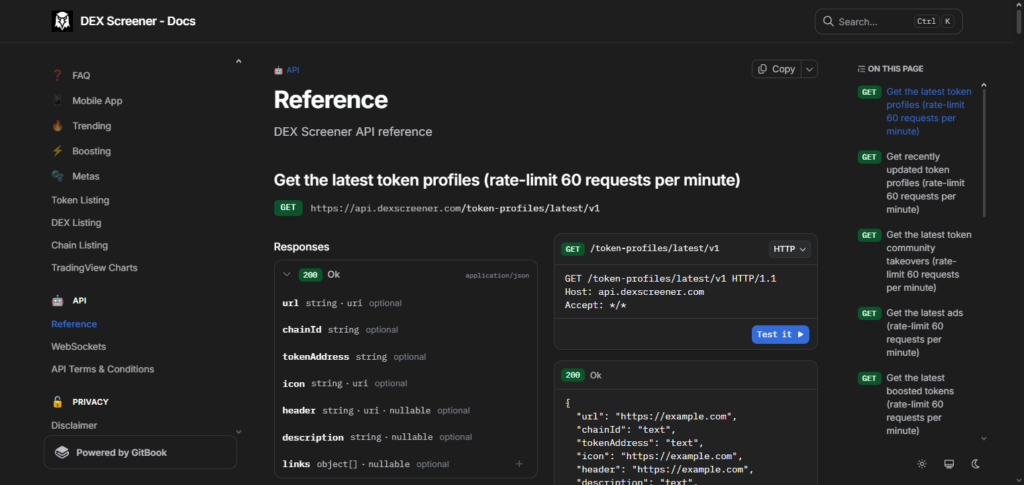
The API provides an easy way for developers to access trading pairs, volumes, and price data via multiple DEXs. Because of its simplicity, this API can easily be integrated into apps and dashboards. For DeFi and decentralized trading related projects, this API is among the Best Free Crypto Exchange APIs for instant DEX data.
| Feature | Details |
|---|---|
| Coverage | Decentralized exchange (DEX) pair data |
| Access | Free, no signup required |
| Data Types | Trading pairs, volumes, liquidity |
| Simplicity | Lightweight & instant integration |
| Best Use Case | DeFi apps & token trackers |
DexScreener API Benefits & Drawbacks
Benefits
- Free with no signup
- Instant DEX pair data
- Easy integration
- DeFi focused
- Liquidity and token tracking
Drawbacks
- Only DEX data
- No central exchange data
- No historical data
- Rate limits
- Less focus on higher institutions
9. Glassnode API
With 200+ entity-adjusted metrics for several blockchains, the Glassnode API is excellent for on-chain analytics. Their services break down data to help you analyze user activity, network transactions, liquidity, and user types.
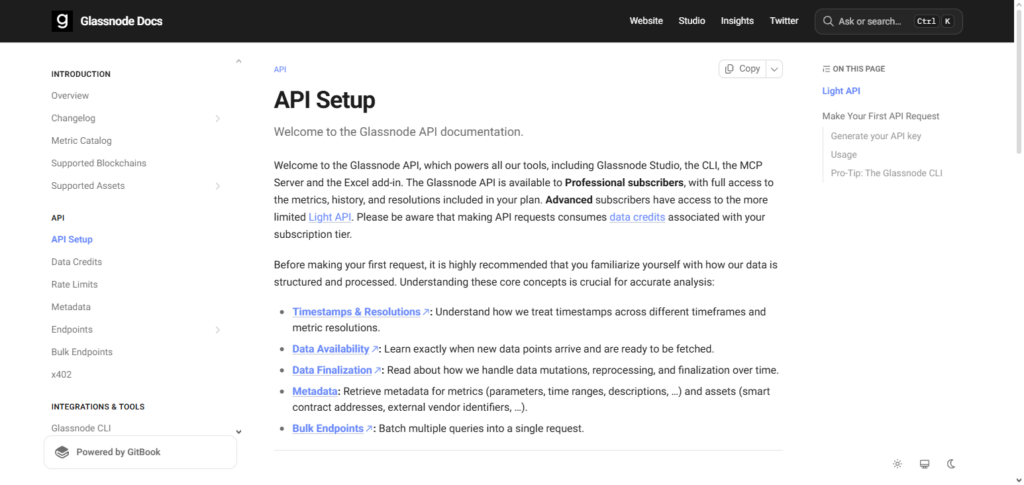
Unfortunately, their free tier limits you to basic dashboards and higher tiers start at $39 per month. Analysts/investors appreciate Glassnode’s metrics, but other services provide extensive analytics for free, making their tier structure unsustainable for some projects.
For in-depth analytic projects, the Glassnode API is one of the Best Crypto Exchange APIs for blockchain analytics.
| Feature | Details |
|---|---|
| Coverage | On-chain analytics for BTC, ETH, others |
| Metrics | 200+ entity-adjusted indicators |
| Free Tier | Dashboard-only |
| Pricing | Paid plans from $39/month |
| Best Use Case | Blockchain intelligence & research |
Glassnode API Benefits & Drawbacks
Benefits
- 200+ entity adjusted metrics
- Highly trusted blockchain intel
- BTC, ETH, others covered
- Research friendly
- Paid plans for advanced insights
Drawbacks
- Free tier inhibits advanced insights
- Plans begin at $39/month.
- Analytics, not trading.
- Complicated for beginners.
- Limited exchange connections.
10. Messari API
Messari API provides research-based data with asset profiles, governance updates, and metrics on fundamentals. The free tier offers 20 requests per minute, while paid plans start at $29 per month. Likely due to the transparency and detailed reporting that Messari includes, developers tend to build research platforms, governance dashboards, and fundamental analysis tools using Messari API.
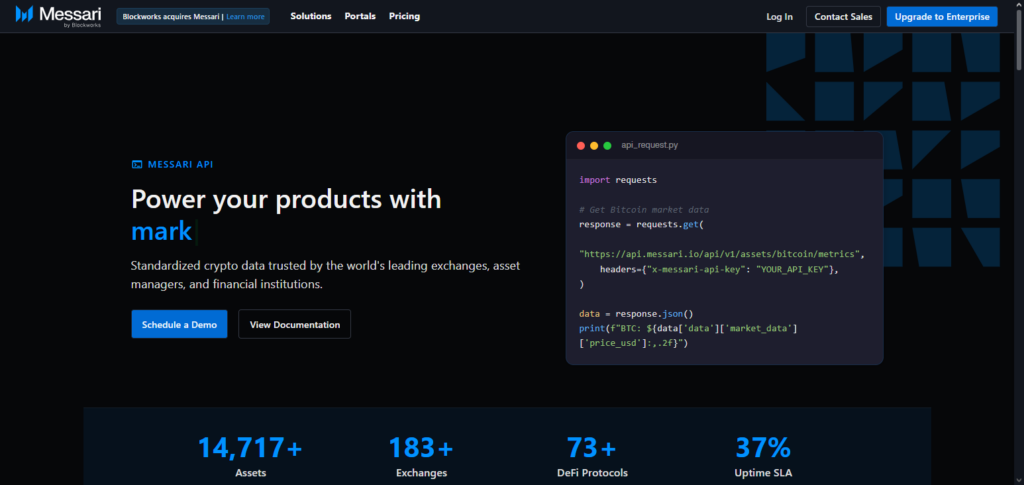
Because of this transparency and reporting, it is a trusted source for both institutional and retail users. Messari API is also among the Best Crypto Exchange APIs for fundamentals and governance, due to its focus on governance, and analytically research-based tools.
| Feature | Details |
|---|---|
| Coverage | Research-driven fundamentals & governance |
| Free Tier | 20 requests/minute |
| Pricing | Paid plans from $29/month |
| Data Types | Asset profiles, governance updates |
| Best Use Case | Research platforms & institutional dashboards |
Messari API Benefits & Drawbacks
Benefits:
- Analytics-driven fundamentals.
- Governance updates.
- 20 requests/min in free tier.
- Cheap paid plans. (29$/month)
- Focus on transparency.
Drawbacks:
- Free tier: low requests.
- Paid tier for scaling.
- Research > trading.
- Less coverage than CoinAPI.
- Governance info lags.
Conclusion
Analyzing the Best Crypto Exchange APIs demonstrates that the unique type of developer and how large the project is will determine the specific Crypto Exchange API needed. For instance, the Kaiko API specializes in professional analytics, and CoinAPI focuses on combining many exchanges.
The Binance API is the best for liquidity, and if you also consider the APIs of Kraken and Gemini for compliance, you cover the needs of the entire market.
Bitstamp is excellent for quality European service and CoinStats for complete portfolio management. For on-chain analytics, the leaders are the Glassnode API and Messari API. If you want fast, free, DeFi data, DexScreener is the place to go.
The Best Crypto Exchange APIs are not about one winner, but the right use case for the right tool, such as trading bots, compliance dashboards, portfolio apps and blockchain research, etc. These Crypto APIs are the foundation for all crypto development now and in the future for all users, whether institutional or retail.
FAQ
Which API is best for trading bots?
The Binance API is the most popular choice for trading bots due to its deep liquidity, diverse product suite (spot, futures, margin), and free access with trading fees. It supports high-frequency trading and algorithmic strategies, making it ideal for execution-heavy applications.
Which API is best for institutional analytics?
The Kaiko API is the leader in institutional-grade analytics, offering benchmarks, indices, and compliance-ready datasets. It’s widely used by hedge funds, banks, and enterprise platforms that require precision and regulatory adherence.
Which API is best for multi-exchange data aggregation?
The CoinAPI aggregates data from 400+ exchanges with a unified schema, making it perfect for developers who need standardized market data across multiple venues. It’s especially useful for portfolio trackers and arbitrage bots.
Which API is best for regulated environments?
Both Kraken API and Gemini API excel in regulated environments. Kraken is known for transparency and compliance in Europe and the US, while Gemini offers strong custody solutions and US regulatory trust.