


In this article, I will talk about the best Smart Account Platforms for Crypto Users, discussing their account architecture, supported chains, authentication options, gas abstraction, recovery methods, pricing, security and key functionalities. This guide compares the best smart-account solutions to help crypto users find platforms that offer more flexibility, easier transactions, programmable controls, and a better Web3 experience.
What Are Smart Account Platforms?
Smart account platforms are blockchain wallet and infrastructure solutions that enable crypto accounts to be programmable rather than merely traditional private-key transactions. They can enable features such as account abstraction, passkey authentication, transaction batching, gas sponsorship, spending limits, session keys, and social recovery.
These platforms can cater to individual crypto users, developers, DAO’s, gaming applications and Defi projects. Depending on the platform, smart accounts may leverage standards such as ERC-4337, ERC-7579 or ERC-6900 to offer flexible account management, improved user experience, and more granular transaction controls.
Key Points
| Platform | Key Strength |
|---|---|
| Safe Smart Account | The most established smart account ecosystem for self-custody, DAOs, treasuries, multisig security, and modular account abstraction. |
| Coinbase Smart Wallet | Passkey-native smart wallet with ERC-4337 support, gas abstraction, and a streamlined onboarding experience for mainstream users. |
| ZeroDev Kernel | Modular smart account framework supporting ERC-7579 modules, session keys, passkeys, and advanced wallet customization. |
| Biconomy Nexus | Smart account platform focused on gasless transactions, transaction batching, and cross-chain user experiences. |
| Alchemy Smart Wallets | Smart account solution integrated with Account Kit, bundlers, paymasters, and EIP-7702 support. |
| Privy | Embedded smart wallet platform combining social login, passkeys, authentication, and account abstraction. |
| Sequence Wallet | Gaming-focused smart wallet ecosystem with session keys, sponsored transactions, and multi-chain support. |
| Argent | Smart wallet built around native account abstraction and social recovery, particularly within the Starknet ecosystem. |
| Soul Wallet | Passkey-enabled self-custody smart wallet with guardian-based recovery and ERC-4337 compatibility. |
| Magic | Embedded wallet and smart account platform designed to simplify onboarding through email and social authentication. |
1. Safe Smart Account
Safe Smart Account is a programmable, self-custodial smart-contract account for multisig wallets, DAOs, teams and treasury management. Instead of being built directly into the core account, its account model is based on Safe smart contract technology and ERC-4337 is available via the Safe4337Module.
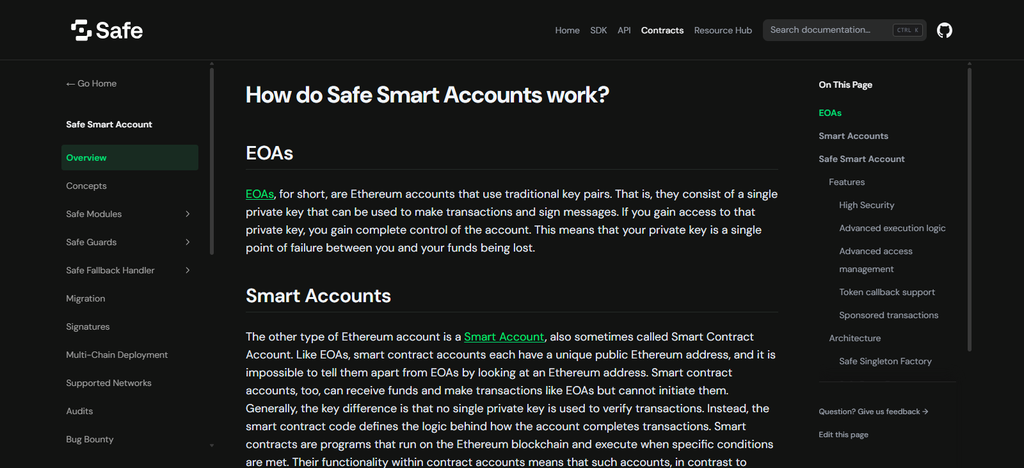
It supports Ethereum and a variety of EVM networks. Authentication is done with many owners and configurable signing thresholds with passkeys and recovery modules available. Gas Model: native or supported token gas abstraction.
Recovery: co-signers, custodians, and recovery keys Pricing: Safe Wallet is free to use. Paid plans for API infrastructure.
Why Safe Smart Account Stands Out
- Multisig-first security: Good for DAOs, teams, and treasury accounts that require multiple approvals.
- Modular architecture. Add modules for permissions, recovery, spending controls, and custom account logic.
- ERC-4337 support: Can add account abstraction features such as sponsor transactions and UserOperations.
Enterprise-ready: Built for organizations with substantial on-chain assets and operational wallets. - Self-custody: Account ownership is held by users and organizations, not a centralized custodian.
| Key Capability | Details |
|---|---|
| Multisig Security | Uses configurable owner thresholds for collective transaction approval. |
| Smart Contract Account | Safe accounts are programmable smart-contract wallets rather than conventional EOAs. |
| ERC-4337 Support | Safe can use account abstraction through its ERC-4337 module. |
| Transaction Policies | Modules can add custom permissions, roles, spending rules, and execution logic. |
| Treasury Management | Strong fit for DAOs, organizations, protocols, and crypto treasury operations. |
| Recovery | Recovery can be designed through owners, guardians, and Safe modules. |
| Multi-Chain | Available across a broad range of EVM networks. |
| Gas Abstraction | ERC-4337 integration enables bundler and paymaster-based transaction flows. |
2. Coinbase Smart Wallet
Coinbase Smart Wallet is a consumer-focused smart-contract wallet built around easy onboarding and passkey authentication. It provides ERC-4337-style account abstraction and is compatible with EVM chains including Base, Ethereum, Optimism, Arbitrum, Polygon and Avalanche C-Chain.
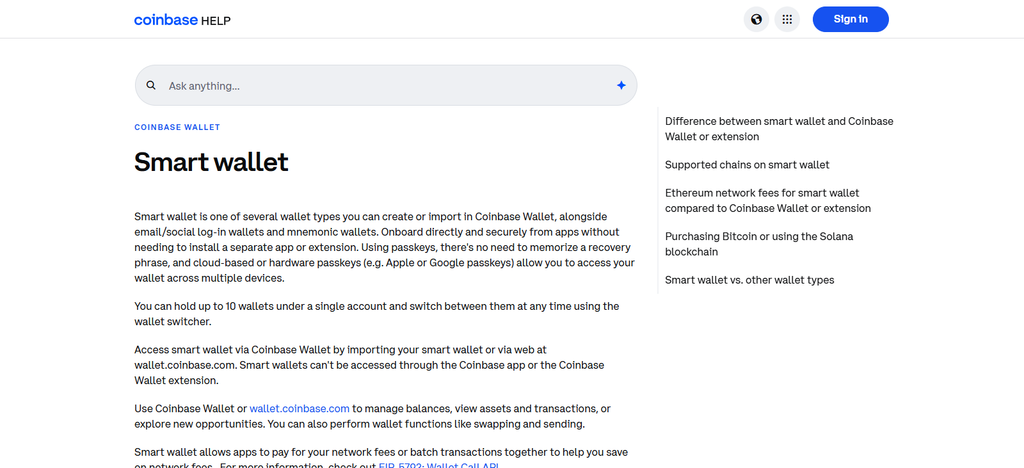
Authentication: Apple or Google passkeys, with optional recovery options Gas Model: Users can get app-sponsored network fees and transaction batching.
Coinbase supports some fee-payment flows. Recovery: optional recovery phrase or passkey backup, but loss of the relevant credentials can create recovery limitations. Pricing: no separate subscription fee for the wallet itself, normal network fees may apply.
Why Coinbase Smart Wallet Stands Out
- Gasless experiences: Applications can subsidize transaction fees to reduce friction for new crypto users.
- Passkey-first onboarding: Users are able to create and access wallets using familiar device-based authentication.
- UX-friendly for the consumer: Removes a lot of the complexity of traditional seed-phrase wallets.
Coinbase ecosystem: Utilizes the broader on-chain infrastructure and Base ecosystem of Coinbase. - Easy Web3 access: Perfect for applications targeting the mainstream user that may not be familiar with crypto wallets.
| Key Capability | Details |
|---|---|
| Passkey Authentication | Users can authenticate with Apple or Google passkeys instead of managing a seed phrase. |
| ERC-4337 Account | Built as an ERC-4337-compatible smart-contract wallet. |
| Gas Sponsorship | Applications can sponsor network fees for users. |
| Transaction Batching | Multiple operations can be combined to simplify user transactions. |
| Coinbase Funding | Eligible users can use linked Coinbase balances for certain on-chain transactions. |
| Multi-Device Access | Cloud or hardware passkeys can provide access across supported devices. |
| EVM Support | Supports EVM-compatible networks including Base, Ethereum, Optimism, Arbitrum, Polygon, and Avalanche C-Chain. |
| Simple Onboarding | Users can create the wallet directly from supported applications without installing an extension. |
3. ZeroDev Kernel
ZeroDev Kernel is a modular smart-account infrastructure for Web3 developers, not for end-wallet users. It supports both ERC-4337 and EIP-7702 and Kernel uses modular components for validation, execution, permissions, policies and session keys. Supports 50+ networks depending on the deployment you configure.
Authentication: Passkeys, social login, multisig, programmable signers. Gas Model: contributed sponsored gas and ERC-20 gas payments through its infrastructure.
Recovery: configurable recovery and key-management mechanisms. Pricing: ZeroDev has developer plans and pay-as-you-go infrastructure pricing. The most important differentiator is the combination of smart accounts, permissions, gas abstraction and chain abstraction.
Why ZeroDev Kernel Stands Out
- Very modular: Custom validation, execution, permissions and authentications for developers.
ERC-7579 architecture: Defines a standard way to build modular smart accounts. - Advanced permissions: Session keys and policy controls provide limited application or agent access.
- Multiple authentications: Developers are able to combine passkeys, social login, multisig and other signer options.
- Developer-focused: Especially powerful for teams building complex wallets, autonomous agents and account abstraction applications.
| Key Capability | Details |
|---|---|
| Modular Architecture | Kernel uses modular validators and execution components for customizable accounts. |
| ERC-7579 | Provides a modular smart-account architecture based around ERC-7579. |
| ERC-4337 | Designed for account-abstraction workflows using UserOperations. |
| EIP-7702 | Supports upgrading existing EOAs with smart-account functionality. |
| Session Keys | Developers can give applications or agents limited transaction permissions. |
| Custom Authentication | Supports passkeys, multisig, embedded wallets, MPC, and other signer systems. |
| Permission Controls | Applications can define restricted authorization and execution policies. |
| Developer Infrastructure | Designed primarily as an SDK/account layer for developers building wallets and Web3 applications. |
4. Biconomy Nexus
Biconomy Nexus is a modular smart-account solution for developers building account abstraction applications. Its architecture is based on ERC-7579 modular accounts and ERC-4337 infrastructure that lets applications add validation, execution, permissions and other modules.
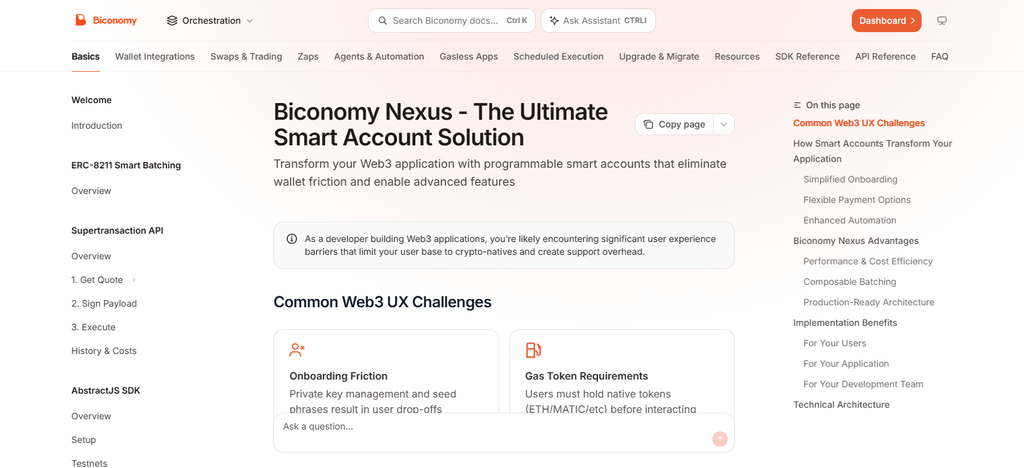
It supports multiple EVM compatible networks via Biconomy’s infrastructure. Authentication: Configurable smart-account validators, multiple signer mechanisms. Gas Model: Biconomy offers paymaster and transaction-sponsorship infrastructure to provide gasless experiences.
Recovery: recovery method is not fixed in this case, it is contingent upon the account modules and validators configured. Pricing: The infrastructure cost is dependent on the Biconomy services and usage opted for. It’s particularly well suited for embedded Web3 applications and advanced AA developers.
Why Biconomy Nexus Stands Out
- ERC-4337 Infrastructure: Links smart accounts to bundlers and account-abstraction transaction flows.
- Paymaster functionality: Allows developers to sponsor gas and build gasless user experiences.
- Flexible permissions: Useful for applications that need to perform controlled and recurring wallet actions.
- Scalable infrastructure: For Web3 apps that want programmable accounts but don’t want to build the whole AA stack themselves
| Key Capability | Details |
|---|---|
| Modular Smart Account | Nexus is designed as a modular smart-account implementation. |
| ERC-7579 | Uses modular account architecture for validators, executors, and extensions. |
| ERC-4337 | Works with account-abstraction infrastructure and UserOperations. |
| Paymaster Integration | Enables applications to sponsor user gas through Biconomy infrastructure. |
| Gasless UX | Developers can create transactions where users do not directly pay native gas. |
| Session Keys | Supports controlled permissions for recurring or application-specific actions. |
| Custom Signers | Applications can integrate different authentication and signing mechanisms. |
| High-Volume Applications | Designed for applications that need scalable smart-account infrastructure. |
5. Alchemy Smart Wallets
Alchemy Smart Wallets Developer infrastructure for programmable smart accounts Modular Account V2 with ERC-6900 ERC-4337 compatible infrastructure for programmable smart accounts The account supports modular authentication and permissions including WebAuthn/passkeys, multisig, session keys, spending limits, and allowlists It is designed for EVM apps and can be deployed on supported Alchemy networks.
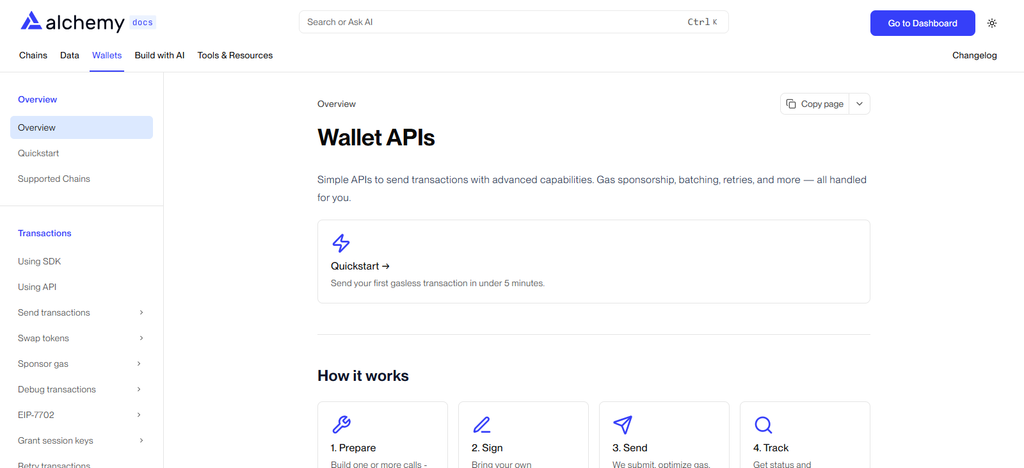
Gas Model: Alchemy Gas Manager supports sponsored transactions with configurable policies. Recovery: depends on the authentication and modules chosen. Pricing: Alchemy uses a pay-for-usage infrastructure pricing model and smart-account deployments to optimize for lower gas costs. It is great for developers building scalable consumer or enterprise applications.
Why Alchemy Smart Wallets Stands Out
- Modular Account V2: An extendable architecture for adding account functionality using modules.
- Permission controls: Developers are able to set spending caps, contract allowlists and restricted actions.
Passkey support: WebAuthn authentication provides a familiar, and potentially passwordless, onboarding experience. - Developer infrastructure: Smart accounts built into Alchemy’s full stack of blockchain developer tools.
Gas Management: Applications can sponsor transactions and create a more seamless onboarding experience for non-native gas token holders
| Key Capability | Details |
|---|---|
| Modular Account V2 | Alchemy’s advanced smart account is built around ERC-6900 modularity. |
| ERC-6900 Modules | Developers can add authentication, permissions, and execution modules. |
| Session Keys | Supports temporary permissions for automated or repeated application actions. |
| WebAuthn | Passkeys and biometric authentication can be implemented through validation modules. |
| Spending Limits | Developers can restrict ERC-20 and native-token spending. |
| Allowlists | Permissions can restrict which contracts or destinations an account can interact with. |
| EIP-7702 | Supports smart-account functionality for existing EOAs. |
| Gas Efficiency | Modular Account V2 is optimized for lower account deployment and execution costs. |
6. Privy
Privy is an embedded-wallet and wallet-infrastructure platform that enables applications to build user wallets without forcing users through the traditional seed-phrase onboarding process. Broad EVM and Solana wallet connectivity through its smart-wallet stack enabling account abstraction and embedded wallets.
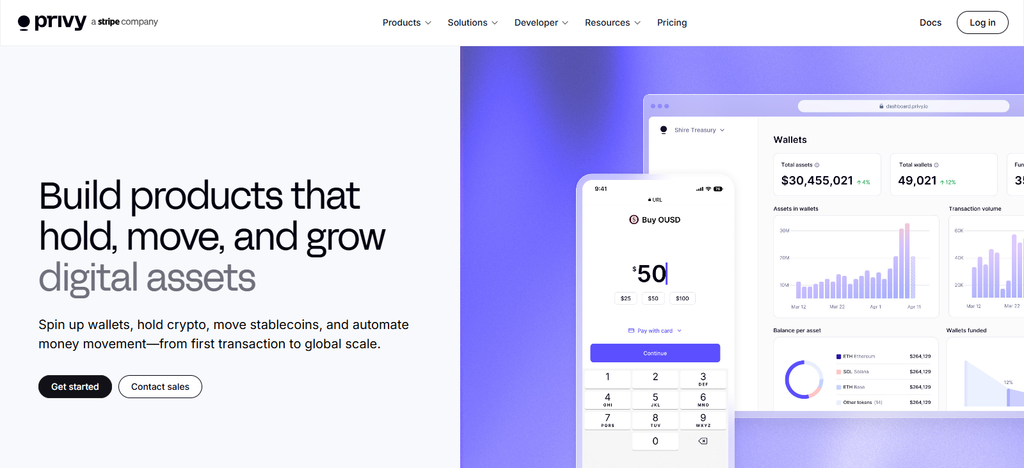
Authentication: email, SMS, social accounts, passkeys and other application-ready methods. Gas Model: native gas sponsorship, funding, bridging capabilities available.
Recovery: Privy offers key management and recovery infrastructure, not just seed phrases. Pricing: Free Developer tier with up to 50K signatures & $1M/month transaction volume, paid Core from $299/month, Scale from $499/month.
Why Privy Stands Out
- Web2-style onboarding: Email, social authentication, and other familiar login methods can simplify wallet creation.
- Embedded wallets: Crypto wallets can operate directly inside an application’s interface.
- Developer-friendly: SDKs and APIs allow teams to integrate wallet functionality without building key-management infrastructure from scratch.
- Flexible wallet experience: Can support both embedded and external wallet users within applications.
- Consumer-focused: Particularly useful for apps that want to introduce blockchain functionality without making users learn traditional wallet management.
| Key Capability | Details |
|---|---|
| Embedded Wallets | Applications can create wallets directly inside their own user experience. |
| Social Login | Supports familiar authentication approaches such as email and social login. |
| Passkeys | Can provide passwordless authentication for supported wallet experiences. |
| Smart Wallet Integration | Privy wallets can be connected with smart-account infrastructure. |
| Session Keys | Enables applications to delegate limited actions without exposing complete wallet control. |
| Key Management | Provides infrastructure for wallet creation, signing, and recovery. |
| Multi-Chain | Designed for applications supporting multiple blockchain environments. |
| Developer SDK | Provides APIs and SDKs for integrating wallet functionality into applications. |
7. Sequence Wallet
Sequence Wallet is an embedded smart-wallet platform with a strong focus on Web3 applications, gaming and consumer experiences. It offers programmable wallet infrastructure so applications can create wallets directly in their interfaces, without requiring users to manage traditional browser extensions.
AA Model: smart-account features with abstraction of transactions and wallet infrastructure defined by the developer. Supported Chains: a variety of EVM chains running on top of the Sequence deployment. Authentication: familiar Web2-style onboarding options, social. Gas Model: applications may sponsor transaction fees, enabling gasless experiences.
Recovery: account access is built around user-friendly authentication instead of traditional seed-phrase-only recovery. Pricing developer pricing is usage-based and depends on the Sequence services selected – more appropriate for apps than retail wallets sold over the counter.
Why Sequence Wallet Stands Out
- Gaming-focused design: Built with frequent blockchain interactions and Web3 gaming workflows in mind.
- Embedded wallet experience: Users can interact with wallets without constantly switching between applications.
- Social onboarding: Familiar login methods can reduce friction for non-crypto-native users.
- Gasless transactions: Developers can absorb transaction costs to create smoother in-game experiences.
- Developer ecosystem: Provides wallet and blockchain tools designed specifically for consumer applications and games.
| Key Capability | Details |
|---|---|
| Embedded Wallets | Wallets can be integrated directly into games and Web3 applications. |
| Social Login | Users can onboard through familiar authentication flows. |
| Smart Accounts | Provides programmable wallet infrastructure for application users. |
| Gasless Transactions | Applications can sponsor transactions for a smoother user experience. |
| Session Keys | Useful for games and applications requiring repeated interactions. |
| Gaming Infrastructure | Designed particularly around blockchain games and consumer applications. |
| Transaction Relaying | Sequence provides infrastructure for submitting transactions without requiring users to manage every gas step. |
| Developer SDK | Provides tools for integrating wallets and blockchain interactions into applications. |
8. Argent
Argent is a self-custodial smart-contract wallet, and has a particularly strong account-abstraction history. Its architecture is different for each network: Starknet uses native account abstraction, whereas Argent’s EVM wallet products use smart-contract account technology and account-abstraction infrastructure.
It supports Starknet and select Ethereum Layer-2s including Ethereum, Arbitrum, Optimism, Base and Polygon. Authentication: passkey and sign-in with account Gas Model: Account abstraction mechanisms can be used to support sponsored or simplified transaction experiences where available.
Recovery: Historically Argent was more focused on guardians and social recovery but current products and recovery flows are different. Pricing: The wallet itself is free, but you’ll still pay fees to the blockchain network.
Why Argent Stands Out
- Heavy Starknet focus: Especially well suited for users and applications on the Starknet ecosystem.
- Native account abstraction: Starknet’s account model allows for programmable transaction validation, without the need for traditional EOA architecture.
- Guardian recovery: Trusted guardians can provide an alternative way to recover.
Self-custodial design: Users own their assets, instead of giving them to a centralized provider.
DeFi usability: Integrates smart account capabilities with an interface for interacting with Starknet applications.
| Key Capability | Details |
|---|---|
| Native Account Abstraction | Argent’s Starknet wallet benefits from Starknet’s native account-abstraction architecture. |
| Guardian Recovery | Guardians can help users recover access without relying solely on a traditional seed phrase. |
| Social Recovery | Recovery can involve trusted contacts or configured guardians. |
| Passkey Support | Modern authentication can reduce dependence on conventional wallet keys. |
| Session Keys | Starknet applications can use session-based authorization for repeated interactions. |
| DeFi Integration | Designed for interacting with the Starknet ecosystem and decentralized applications. |
| Self-Custody | Users retain control over their account rather than relying on a centralized custodian. |
| Starknet Focus | Particularly suited to users whose activity is concentrated on Starknet. |
9. Soul Wallet
Soul Wallet A self-custodial smart-wallet project that leverages Ethereum account abstraction to offer programmable wallet features beyond typical EOAs. Based on ERC-4337 smart-account concepts, it allows for batched transactions, custom validation, and more flexible account management.
Supported Chains: mostly EVM compatible chains where its contracts & infrastructure are deployed. Authentication: smart-account ownership and programmable validation can overcome the drawbacks of a single traditional private key.
Gas Model: Paymasters can enable sponsored transactions through ERC-4337 infrastructure. Recovery: Configurable account level recovery mechanisms. Pricing: Open-source wallet software, but users still pay applicable blockchain gas or infrastructure costs.
Why Soul Wallet Stands Out
- Open source model: Developers and the community at large can view and evaluate its smart-account architecture.
- Account abstraction: Leverages Ethereum’s smart-account model to give wallets programmatic behavior.
Passkey-friendly: Modern authentication can lower the dependency on legacy seed-phrase processes.
Social Recovery: Guardian-based recovery is an alternative in cases where users lose access to their primary authentication method.
Self-custody: Provides users with programmable wallet features and ownership of their assets.
| Key Capability | Details |
|---|---|
| ERC-4337 | Built around Ethereum account-abstraction infrastructure. |
| Passkey Authentication | Designed to support passwordless/passkey-style wallet access. |
| Guardian Recovery | Social recovery allows trusted guardians to participate in account recovery. |
| Self-Custody | Users maintain control rather than relying on a centralized exchange account. |
| Paymaster Support | Can use sponsored-gas infrastructure for more convenient transactions. |
| Batched Transactions | Smart-account architecture can combine multiple operations. |
| Open Source | Its development model emphasizes transparent and auditable smart-contract infrastructure. |
| EVM Compatibility | Designed for EVM-based networks where the relevant contracts and infrastructure are deployed. |
10. Magic Smart Account
Magic Smart Account combines smart-account features with embedded-wallet onboarding for apps that want to offer users a Web3 experience without the need to handle traditional seed phrases. Its focus is specifically on wallets within developer products and not on a traditional standalone retail wallet.
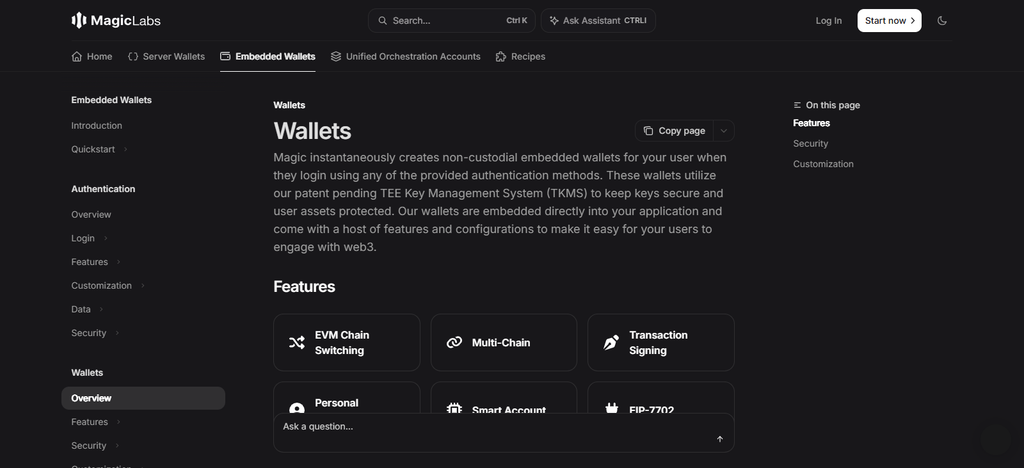
AA Model: applications can include smart-account and account-abstraction functionality. Authentication: Magic supports common authentication methods such as email, social authentication, and passwordless flows depending on the implementation.
Gas Model: The infrastructure available enables applications to build sponsored or simplified transaction experiences. Recovery: Access to the wallet is tied to the application’s authentication and wallet management architecture. Pricing: Magic pricing is based on developer usage and products, so the costs will depend on the wallet activity and services selected.
Why Magic Smart Account Stands Out
- Embedded wallet technology: Enables applications to embed wallets within their own user interfaces.
- Familiar authentication: Email and social login options can help make onboarding Web3 easier for mainstream users.
- Passwordless experience: No more hassle of setting up a traditional wallet and managing seed-phrases.
- Developer friendly: SDKs and infrastructure for teams building blockchain wallets into their applications.
- Smart-account integration: Can be integrated with account-abstraction infrastructure to provide more automated and user-friendly transaction experiences.
| Key Capability | Details |
|---|---|
| Embedded Wallets | Developers can place wallet functionality directly inside applications. |
| Email Authentication | Users can access wallets through familiar email-based onboarding. |
| Social Authentication | Applications can use social login for simpler Web3 access. |
| Passwordless UX | Reduces dependence on traditional seed-phrase onboarding. |
| Smart Account Integration | Magic can act as an authentication and wallet layer for smart-account applications. |
| Gas Abstraction | Developers can build sponsored transaction experiences around supported smart-account infrastructure. |
| Developer SDK | APIs and SDKs simplify wallet integration into Web3 applications. |
| Multi-Chain Development | Designed for applications that need wallet infrastructure across blockchain networks. |
Conclusion
Smart account platforms are adding features like account abstraction, passkey authentication, gas sponsorship, transaction batching, session keys and social recovery to make crypto wallets more flexible, secure and user-friendly.
What works best for you depends on your needs, whether you’re a retail crypto user, DeFi user, DAO, developer or Web3 application. Safe, Coinbase Smart Wallet, ZeroDev Kernel,
Biconomy Nexus, Alchemy Smart Wallets, Privy, Sequence, Argent, Soul Wallet and Magic all provide different flavors of smart-account functionality, providing users with more choice for a simpler and more programmable Web3 experience.
FAQ
What is a smart account in crypto?
A smart account is a programmable blockchain account that can provide features beyond a traditional externally owned account, including transaction batching, gas sponsorship, custom authentication, spending controls, and recovery options.
How is a smart account different from a normal crypto wallet?
Traditional wallets generally depend on a private key to authorize transactions. Smart accounts use programmable smart-contract logic, allowing features such as passkeys, social recovery, spending limits, session keys, and sponsored transactions.
Are smart accounts safe for crypto users?
Smart accounts can provide additional security controls, but their safety depends on the account contracts, authentication method, modules, recovery configuration, and application integrations being used.
Do smart accounts require a seed phrase?
Not necessarily. Some smart-account platforms support passkeys, social authentication, hardware wallets, multisig, or other authentication methods instead of requiring users to manage a traditional seed phrase.