


In this article, I’ll cover the Best Blockchain Attestation Platforms for creating, issuing and verifying trusted digital claims. We will evaluate the platforms according to their attestation model, blockchain support, privacy features, verification methods, developer integrations, schemas, and real-world use cases. This comparison will help developers, Web3 projects, enterprises and users to understand which infrastructure is best suited for their specific requirements.
What Are Blockchain Attestation Platforms?
Blockchain attestation platforms are infrastructural systems that enable people, organizations and applications to create, issue, store and verify cryptographically signed claims on or adjacent to blockchain networks.
An attestation can attest to information including identity, credentials, reputation, eligibility, compliance, ownership, or participation without requiring users to rely only on centralized databases. These platforms often use schemas, electronic signatures, decentralized identifiers, intelligent contracts, or zero-knowledge proofs to establish trust.
Depending on the system, attestations can be recorded on-chain, stored off-chain or used in hybrid models, making them applicable to Web3 identity, governance, DeFi, credentials, Sybil resistance, RWA verification and AI-related use cases.
Key Points
| Platform | Key Strength | Best For |
|---|---|---|
| Ethereum Attestation Service (EAS) | Open infrastructure for creating on-chain and off-chain attestations using structured data. | Identity, credentials, reputation, DAO governance |
| Sign Protocol | Omni-chain attestation protocol that enables users and organizations to attest and verify information across blockchains. | Cross-chain credentials and verification |
| Verax | Public on-chain attestation registry focused on discoverability, composability, and reputation data. | Reputation systems and ecosystem credentials |
| Human Passport | Issues verifiable credentials and proof-of-personhood attestations to combat Sybil attacks. | DAO voting, airdrops, community access |
| Galxe Passport | Credential-based identity platform that stores and verifies user achievements and participation records. | Loyalty programs and Web3 communities |
| Coinbase Verifications | Enables trusted identity and KYC-related attestations for wallet holders. | Identity verification and compliance |
| Polygon ID | Privacy-focused credential and attestation framework based on zero-knowledge proofs. | Decentralized identity and selective disclosure |
| Civic Pass | Delivers reusable identity attestations and access credentials for Web3 applications. | Compliance and gated access |
| SpruceID | Supports decentralized identity credentials and verifiable attestation workflows. | Enterprise identity and credential sharing |
| Cheqd | Provides decentralized credential issuance and verification infrastructure using DIDs and attestations. | SSI ecosystems and digital trust networks |
1. Ethereum Attestation Service (EAS)
The Ethereum Attestation Service (EAS) is an open, permissionless attestation infrastructure that is proposed as a public-good protocol for building structured on-chain and off-chain attestations. The core of its model is the use of SchemaRegistry to define data structures and EAS contracts to create attestations.
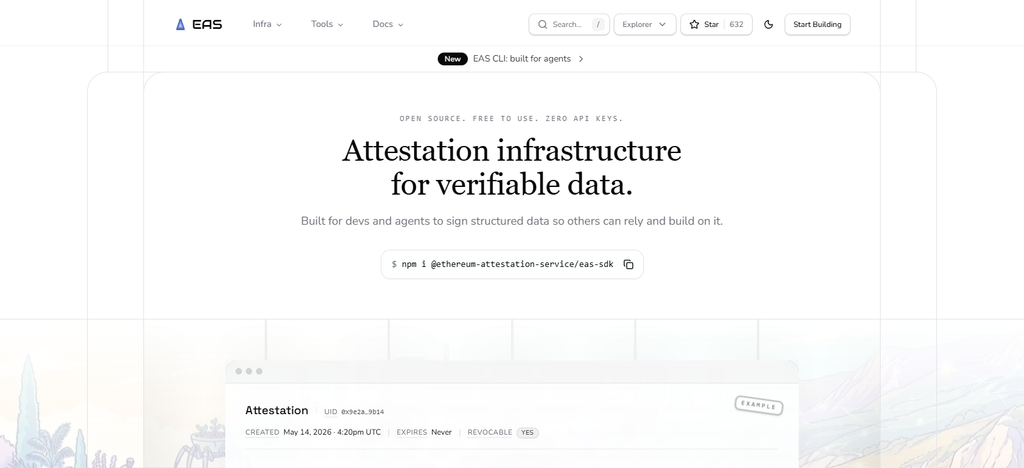
EAS is deployed on EVM networks such as Ethereum, Optimism, Base, Arbitrum, and Polygon. It is integrated by developers via the EAS SDK, GraphQL APIs, indexers, explorers and intelligent contracts. Attestations may include issuers, recipients, expiration, revocation, references and encoded data. EAS also supports zero knowledge based verification and private data for privacy sensitive application.
Key Strength: Open, permissionless attestation infrastructure with flexible schemas and on-chain/off-chain support.
Best For: Web3 identity, reputation, credentials, governance and smart-contract verification
Ethereum Attestation Service (EAS) Benefits & Drawbacks
| Benefits | Drawbacks |
|---|---|
| Open and permissionless attestation infrastructure | Public on-chain data can create privacy considerations |
| Supports custom schemas for different applications | Schema design can require technical expertise |
| Supports on-chain and off-chain attestations | Gas costs may apply to on-chain attestations |
| Integrates well with EVM smart contracts | Primarily suited to developers and Web3 applications |
| Useful for identity, reputation, credentials, and governance | Cross-chain deployments can require additional integration work |
2. Signing algorithm
The Sign Protocol of EthSign is an omni-chain attestation infrastructure that allows applications to create, verify, and query structured claims across chains. Its core attestation model uses schemas, contexts and cryptographic signatures, with attestations that can be stored on-chain or off-chain. The protocol supports public, private and hybrid attestations.
It provides mechanisms for selective disclosure and privacy. Its protocol infrastructure, schemas, APIs and integration tooling allow developers to connect applications with verifiable evidence. Its architecture is geared toward identity, reputation, credentials, compliance and digital-trust applications where claims need to be machine-readable and auditable.
Core strength:** Omni-chain attestation infrastructure for structured, portable and privacy-preserving claims.
Best For: Cross-chain credentials, identity, reputation, compliance and verifiable data applications.
Sign Protocol Benefits & Drawbacks
| Benefits | Drawbacks |
|---|---|
| Designed for multi-chain attestation use cases | Cross-chain implementations can add integration complexity |
| Supports structured schemas and attestations | Developers may need to understand its protocol architecture |
| Offers on-chain and off-chain approaches | Privacy configuration depends on the implementation |
| Suitable for portable credentials and claims | Ecosystem adoption varies across supported networks |
| Provides developer-oriented integration tools | More complex than simple credential-verification solutions |
3. Verax
In 2023 we launched Verax , a shared on-chain attestation registry to simplify the discovery, consumption, and composition of public attestations for decentralized applications. Its core model is to have attestations in a shared registry rather than each application needing its own attestation infrastructure.
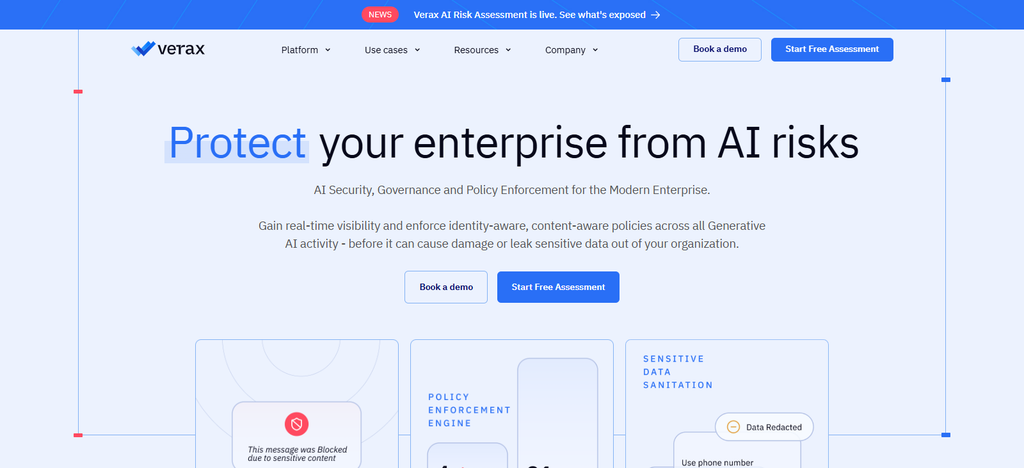
Verax supports EVM networks like Linea, Arbitrum, Base and BNB Chain Schemas define the structure of attestations, and portals manage the issuance logic for each domain Developers are able to integrate using its TypeScript SDK, smart contract, subgraphs, explorer and Graph-based tooling. Attestations can be of addresses, DIDs, IPFS hashes or other attestations, allowing for composable reputation and data relationships.
Key Strength: Shared attestation registry designed for discovering, consuming, and composing attestations across applications.
Best For: Composable reputation, reusable credentials, and applications that need shared attestation infrastructure.
Verax Benefits & Drawbacks
| Benefits | Drawbacks |
|---|---|
| Shared registry makes attestations easier for applications to discover | Relatively specialized compared with general identity platforms |
| Supports composable attestations | Developers need to understand registry and portal concepts |
| Designed for reusable Web3 data | EVM-focused architecture can limit non-EVM use cases |
| Can connect different applications to common attestations | Ecosystem coverage may vary by deployment |
| Useful for reputation and credential infrastructure | Advanced integrations can require smart-contract knowledge |
4. The human passport
Human Passport (Previously Gitcoin Passport) is a decentralized identity and Sybil-resistance tool that is centered around the proof of human-ness through multiple verification signals. Its Passport Stamps system aggregates credentials and verification signals into a composite Passport score, and developers are able to access these signals via **Stamps API v2, Passport Embed, and smart contracts.
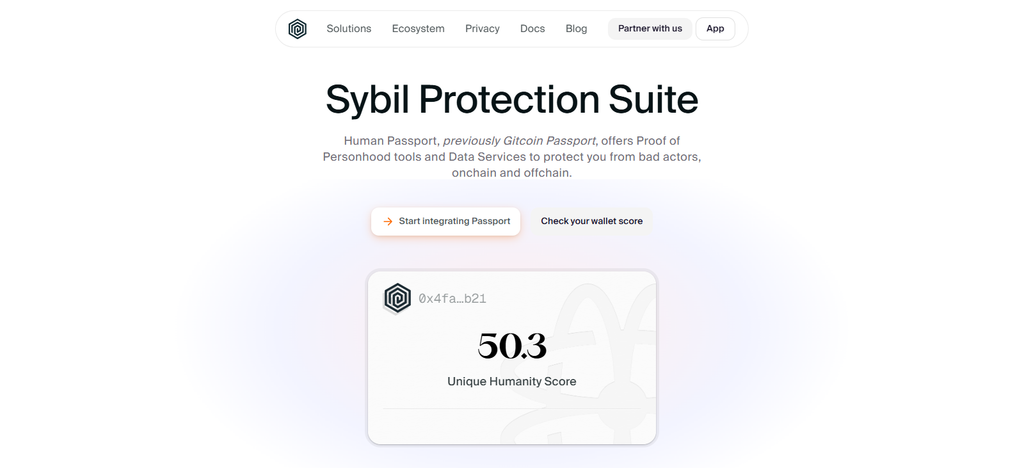
It supports networks such as Optimism, Base, Arbitrum, Linea, Scroll, Shape, and zkSync for various on-chain functionality. Individual verifications can issue attestations on Optimism, Base, and Stellar. The architecture relies on cryptographic credentials and attestations, rather than exposing personal information directly. On-chain Passport data can be pulled from EAS and Verax registries.
Key Strength: Combines multiple verification signals and credentials for Sybil resistance and human verification.
Best For: DAO governance, airdrops, community access, identity verification, and anti-Sybil applications.
Human Passport Benefits & Drawbacks
| Benefits | Drawbacks |
|---|---|
| Strong focus on Sybil resistance and human verification | Some verification methods may require users to provide additional evidence |
| Combines multiple identity and reputation signals | Passport scores can depend on available verification signals |
| Supports developer APIs and application integrations | Not primarily a general-purpose attestation registry |
| Useful for Web3 communities and governance | Some verification options can have geographic or eligibility limitations |
| Can help reduce duplicate or fraudulent participation | Users may have privacy concerns depending on the verification method |
5. Galxe Passport
Galxe Passport is a Web3 identity and verification platform that enables users to reuse verified identity information across applications while minimizing exposure of sensitive data. Galxe Passport V2 launched in 2024 and the current V3 is focused on compliance-ready identity verification, privacy and Sybil resistance.
Its model is not a general-purpose attestation registry but a combination of identity credentials, encrypted data commitments, verification records, and zero-knowledge proofs.
Web3 developers are able to leverage Passport for onboarding, KYC, geo-fenced access, RWA products, and identity-based experiences. Supported compliance workflows include privacy features such as a Private Data Vault, ZK proofs, encrypted identity data, and facial re-verification.
Key Strength: Privacy-focused Web3 identity with reusable verification, encrypted identity data, and zero-knowledge capabilities.
Best For: KYC, compliant onboarding, Web3 identity, RWA applications, and Sybil-resistant user access.
Galxe Passport Benefits & Drawbacks
| Benefits | Drawbacks |
|---|---|
| Designed for reusable Web3 identity verification | More focused on identity than general-purpose attestations |
| Includes privacy-oriented identity infrastructure | Compliance-oriented verification can introduce onboarding friction |
| Supports KYC and Sybil-resistance use cases | Some features depend on supported verification providers |
| Useful for Web3 applications and RWA projects | Users may need to complete identity checks for certain features |
| Can reduce repeated verification across applications | Availability of specific verification features can vary by region |
6. Coinbase Verifications
Coinbase Verifications is a dedicated on-chain verification system built by Coinbase that uses the Ethereum Attestation Service to issue Coinbase-verified attestations. The current production implementation is on Base where EAS stores and manages the attestations and uses Coinbase specific schemas, attester contracts, resolvers, and an indexer to identify authorized verification records.
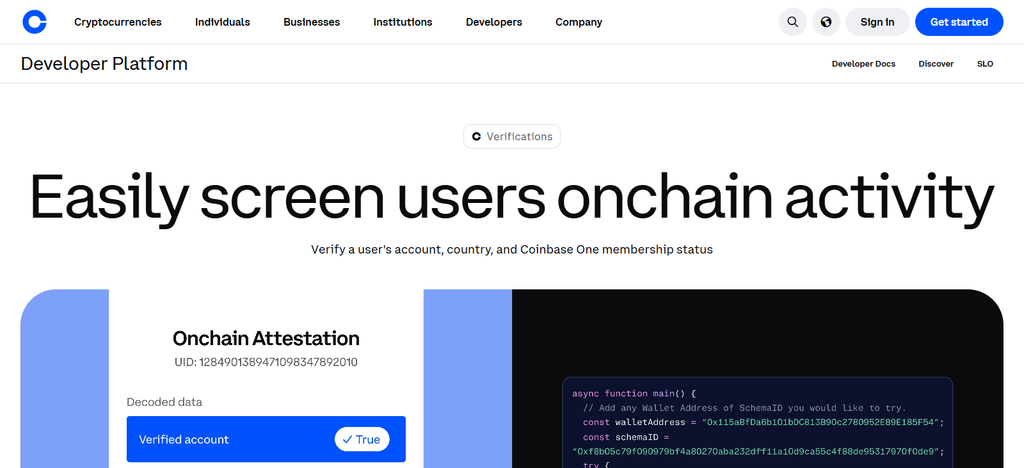
Eligible Coinbase customers can use the core model to verify the status of their account and optionally provide country data that can then be linked to a self-custodial EVM wallet. Developers are able to query the attestations, and verify their schema and issuer. It’s not a general credential issuance system, it’s meant for access control, verified-user experiences, and on-chain application benefits.
Key Strength: Coinbase-backed attestations that enable eligible users to prove certain Coinbase verification information on-chain.
Best For: Verified-user access, identity-based Web3 applications, and applications in the Base ecosystem.
Coinbase Verifications Benefits & Drawbacks
| Benefits | Drawbacks |
|---|---|
| Provides Coinbase-backed verification information | Closely tied to Coinbase’s verification ecosystem |
| Uses on-chain attestations for verifiable claims | Limited compared with general-purpose attestation protocols |
| Useful for Base-based applications | Primarily designed around specific Coinbase verification claims |
| Can simplify verified-user access | Users need an eligible Coinbase account and verification status |
| Attestations can be checked programmatically | Not intended to replace a complete decentralized identity system |
7. Polygon ID
Launched in 2022, Polygon ID is a decentralized identity platform based on zero-knowledge cryptography and self-sovereign identity. Its core model combines verifiable credentials, claims, decentralized identifiers and ZK proofs. It allows a user to prove specific attributes without disclosing unnecessary underlying information.
Polygon ID is designed for identity, KYC, KYB, access control and attestation use cases on the blockchain. Its developer ecosystem includes identity wallets, SDKs, platform services, Connect functionality and tools for creating and verifying zkProofs.
Zero-knowledge proofs make it possible for applications to verify claims instead of receiving all credential data, ensuring privacy is core to the architecture.
Key Strength: Zero-knowledge identity infrastructure allowing users to prove credentials without revealing personal information not needed for verification.
Best For: Private identity verification, KYC, credentials, access control and decentralized identity apps.
Polygon ID Benefits & Drawbacks
| Benefits | Drawbacks |
|---|---|
| Strong zero-knowledge privacy architecture | ZK identity systems can be technically complex |
| Supports verifiable credentials and decentralized identity | Developers need familiarity with identity and proof concepts |
| Enables selective disclosure of information | Integration can require additional identity infrastructure |
| Useful for KYC and credential verification | Ecosystem compatibility depends on supported standards and tools |
| Can reduce unnecessary exposure of personal information | User experience may vary depending on the verification workflow |
8. Civic Pass
Civic Pass launched in 2021 is Civic’s on-chain identity and access-control product bridging off-chain verifiable credentials and blockchain-based permissions. Its core model is off-chain identity verification with an on-chain pass, allowing intelligent contracts and decentralized applications to verify whether a wallet satisfies a set of pre-defined conditions without direct access to the underlying personal data.
Civic created the system for multi-chain Web3 apps, such as DeFi, DAOs, NFT projects, and access control services. Developers are able to embed Civic Pass into applications and intelligent contracts for eligibility checking. Its privacy architecture keeps sensitive verification data off-chain, with the relevant authorization state represented on-chain.
Key Strength: Connects off-chain identity verification with on-chain eligibility and access control, minimizing the exposure of personal information.
Best For: DeFi, DAOs, NFT use cases, gated communities and identity-based Web3 access.
Civic Pass Benefits & Drawbacks
| Benefits | Drawbacks |
|---|---|
| Connects identity verification with on-chain access control | Some use cases require centralized verification components |
| Keeps sensitive identity information away from the blockchain | Users may face verification requirements before gaining access |
| Useful for Sybil resistance and gated applications | Pass requirements can vary between applications |
| Designed for DeFi, DAOs, NFTs, and Web3 services | Less suitable for general-purpose attestation creation |
| Can automate eligibility checks for supported applications | Dependence on Civic’s verification infrastructure can affect portability |
9. SpruceID
Launched in 2020, SpruceID offers decentralized identity and digital credential infrastructure, rather than a traditional public attestation registry. At the core of the model are Decentralized Identifiers, Verifiable Credentials, Verifiable Presentations, and user-controlled data.
The platform’s open-source technology powers identity applications for government, enterprise, wallet and blockchain with implementations aligned to W3C Verifiable Credentials, OpenID4VC, ISO mobile-driver-license standards and related identity specifications.
Developers are able to connect using SpruceID libraries, SDKs and open source components including SSI and mobile credential tooling. Privacy is achieved through user-controlled credential storage, information minimization, cryptographic verification and selective disclosure, rather than storing raw identity data directly on-chain.
Key Strength: Open-source decentralized identity infrastructure built around verifiable credentials, DIDs, and user-controlled identity data.
Best For: Digital credentials, government identity, enterprise identity, wallets, and standards-based SSI applications.
SpruceID Benefits & Drawbacks
| Benefits | Drawbacks |
|---|---|
| Strong focus on open standards and decentralized identity | Implementation can be more complex than basic credential systems |
| Supports DIDs and Verifiable Credentials | Requires identity infrastructure beyond a simple blockchain transaction |
| Open-source components support customization | Developers may need standards expertise |
| Suitable for enterprise and government credential systems | Not primarily an on-chain attestation registry |
| Emphasizes user-controlled identity data | Adoption and interoperability can depend on implementation choices |
10. cheqd
cheqd is a purpose-built decentralized identity blockchain built on the Cosmos SDK, founded in 2021 with its network mainnet launching in November 2021. Its core model is on Decentralized Identifiers, Verifiable Credentials, schemas, status lists, trust registries and identity related resources instead of generic EVM attestations.
The cheqd Network is built on IBC interoperability and uses the native CHEQ token for network transactions and identity related payments. Developers are able to integrate via cheqd Studio REST APIs, SDKs, or direct ledger integration.
Privacy comes from verifiable credentials and user-controlled identity data, so that verification can happen without putting all personal information on-chain. It is mainly focused on reusable digital identity and trusted data infrastructure.
Key Strength: Dedicated decentralized identity network supporting verifiable credentials, DIDs, trust infrastructure, and identity data management.
Best For: Enterprise credentials, compliance, digital identity, professional credentials, and reusable verifiable data.
cheqd Benefits & Drawbacks
| Benefits | Drawbacks |
|---|---|
| Purpose-built network for decentralized identity | Requires understanding of its dedicated network ecosystem |
| Supports DIDs and Verifiable Credentials | Less focused on general-purpose EVM attestations |
| Provides infrastructure for trust registries and credential status | Integration can be more involved than using a simple API |
| Useful for enterprise and compliance credentials | Network-specific architecture may not fit every Web3 application |
| Supports reusable digital identity infrastructure | Developers may need additional tooling for broader blockchain interoperability |
Blockchain Attestation Platforms Comparison
| Platform | Core Attestation Model | Network / Blockchain Support | Attestation Structure | Privacy | Developer Integration | Best For |
|---|---|---|---|---|---|---|
| Ethereum Attestation Service (EAS) | On-chain & off-chain | Ethereum, Base, Optimism, Arbitrum, Polygon and other EVM networks | Schema-based attestations | Off-chain data, private proofs, ZK options | SDK, APIs, smart contracts, indexers | Identity, reputation, credentials, governance |
| Sign Protocol | On-chain, off-chain & hybrid | Multi-chain / EVM-focused | Schema and structured claims | Selective disclosure and privacy-oriented options | APIs, SDKs, protocol tooling | Cross-chain credentials and verification |
| Verax | Shared on-chain registry | Multiple EVM networks | Schemas, portals and composable attestations | Depends on application design | SDK, smart contracts, subgraphs | Reputation and composable attestations |
| Human Passport | Credential and verification-based | Multiple Web3 networks | Stamps, credentials and verification signals | Privacy-focused verification options | API, Embed, smart-contract integrations | Sybil resistance and human verification |
| Galxe Passport | Identity and credential verification | Web3 / multichain ecosystem | Identity credentials and verification records | ZK, encrypted identity data, private vault | Passport integrations and APIs | KYC, identity and compliant onboarding |
| Coinbase Verifications | On-chain verification attestations | Primarily Base | EAS-based Coinbase verification claims | Limited claim-specific disclosure | Attestation queries and verification tooling | Verified-user access and Base applications |
| Polygon ID | Verifiable credentials + ZK proofs | Polygon ecosystem and broader integrations | DIDs, claims and credentials | Strong ZK and selective disclosure | SDKs, wallets, identity tools | Private identity and KYC |
| Civic Pass | Off-chain verification + on-chain pass | Multi-chain Web3 applications | Identity-based eligibility passes | Sensitive data kept off-chain | Application and smart-contract integrations | DeFi, DAOs, NFTs and access control |
| SpruceID | Verifiable credentials | Blockchain-agnostic / standards-based | DIDs, VCs and VPs | User-controlled and selective credential sharing | SDKs, libraries and APIs | Enterprise, government and digital credentials |
| cheqd | Decentralized identity & credentials | cheqd Network / Cosmos ecosystem | DIDs, VCs, schemas and trust registries | User-controlled credential data | cheqd Studio, APIs and SDKs | Enterprise identity and compliance |
Quick Technical Comparison
| Platform | Schema Support | Revocation / Status | ZK / Privacy Focus | Cross-Application Use | Main Differentiator |
|---|---|---|---|---|---|
| EAS | Strong | Yes | High | High | General-purpose attestation infrastructure |
| Sign Protocol | Strong | Yes | High | High | Omni-chain attestation approach |
| Verax | Strong | Yes | Medium | High | Shared, composable attestation registry |
| Human Passport | Credential-focused | Yes | High | High | Sybil resistance and proof of humanity |
| Galxe Passport | Identity-focused | Yes | High | High | Reusable Web3 identity |
| Coinbase Verifications | EAS schemas | Claim-specific | Limited | Medium | Coinbase-backed verification |
| Polygon ID | Credential schemas | Yes | Very High | High | ZK-based decentralized identity |
| Civic Pass | Pass/eligibility model | Yes | High | High | On-chain access control |
| SpruceID | W3C credential standards | Yes | High | High | Open standards and enterprise identity |
| cheqd | Credential/schema-based | Yes | High | High | Dedicated decentralized identity network |
Conclusion
As Web3 expands, blockchain attestation platforms are becoming essential infrastructure for verifying identity, credentials, reputation, compliance and other digital claims.
These platforms differ in their attestation models, supported networks, privacy mechanisms, developer tools and verification methods. Some are focused on open on-chain attestations, others are in the decentralized identity, zero-knowledge proofs, Sybil resistance, or reusable credentials space.
When choosing a platform, consider network compatibility, schema flexibility, privacy architecture, integration options, revocation support, and use case. With the growth of Web3 applications, interoperable and privacy-preserving attestations can provide the basis for more verifiable and trusted digital interactions.
FAQ
What is a blockchain attestation platform?
A blockchain attestation platform enables users, organizations, or applications to create and verify cryptographically signed claims. These claims can represent identity, credentials, reputation, compliance, ownership, eligibility, or other forms of verifiable information.
How do blockchain attestations work?
An issuer creates a structured claim using a defined schema and signs or records it through an attestation system. A verifier can then check the issuer, claim data, validity, expiration, and other conditions before accepting the information.
What is the difference between on-chain and off-chain attestations?
On-chain attestations are recorded directly on a blockchain and can be verified through blockchain infrastructure. Off-chain attestations keep the credential or claim outside the blockchain while using cryptographic signatures or proofs for verification, which can provide greater flexibility and privacy.
Are blockchain attestations private?
Not necessarily. Public on-chain attestations can expose information recorded on the blockchain. Platforms may instead use off-chain storage, selective disclosure, encryption, or zero-knowledge proofs to reduce exposure of sensitive information.
What are blockchain attestations used for?
Common applications include decentralized identity, credentials, reputation, Sybil resistance, DAO governance, KYC, compliance, DeFi eligibility, real-world asset verification, education credentials, and AI-related verification.