


In this article, I will cover the Best Crypto Proof-of-Reserves Platforms and how they assist in verifying digital-asset holdings, customer liabilities, wallet ownership, and reserve coverage. I’ll compare leading solutions by verification methods, asset support, independent verification, privacy, security, reporting frequency, user verification tools and general use cases for crypto exchanges, custodians, stablecoins and institutional platforms.
What Are Crypto Proof-of-Reserves Platforms?
Crypto Proof-of-Reserves platforms are tools and verification systems that allow exchanges, custodians, stablecoin issuers and other digital-asset businesses to prove that they have the assets they claim to control. Platforms could verify reserves using blockchain wallet data, cryptographic signatures,
Merkle Trees, zero-knowledge proofs, oracle networks, and independent attestations. Based on the methodology they can also compare verified assets with liabilities to customers and let users verify their account inclusion. PoR, however, is generally based on a defined scope and snapshot in time, and does not automatically prove complete financial solvency or the payment of all liabilities.
How To Choose Crypto Proof-of-Reserves Platforms
Verification Method — Verify whether the platform uses Merkle Trees, Merkle Sum Trees, zero-knowledge proofs, on-chain verification, oracle feeds or independent attestations.
Asset Coverage — See what cryptocurrencies, stablecoins, tokenized assets, and traditional reserve assets are covered in the verification process.
Liability Verification — Choose platforms that explicitly mention if customer liabilities are covered and describe the method of calculating and verifying those liabilities.
Wallet Ownership – Verify whether the platform can provide evidence that the reported reserve wallets are in fact owned and controlled by the exchange, custodian or issuer.
Independent Verification — Learn whether verification processes are performed by an independent auditor, accounting firm or qualified third party.
Customer Verification — Look for tools that enable individual customers to independently verify their balances against the custodian, perhaps using Merkle proofs or other cryptographic methods.
Frequency of Reporting — Determine if the platform provides periodic snapshots, frequent updates, or constant on-chain reserve monitoring.
Privacy Protection — Verify that the verification process protects individual customer balances and sensitive financial information.
Blockchain Support — See if the platform supports the digital resources and blockchains the business uses.
Methodology Transparency – Select a solution that clearly outlines its verification process, assumptions, reporting scope, and limitations.
Historical Reporting — Consider if users can see previous PoR reports to track changes to reserves and verification outcomes over time.
Integration & APIs — For businesses, see if the platform has APIs, dashboards, oracle integrations or other tools to plug reserve data into your internal systems.
Verification Scope — Clearly state whether the report covers certain wallets and assets or the broader obligations of the company’s customers.
Security Controls — Review how wallet data, customer information, cryptographic proofs, and verification infrastructure are protected.
Use Case Fit — Choose a platform based on whether you need exchange transparency, stablecoin backing, custody verification, RWA reserve monitoring, institutional reporting, or on-chain analytics.
Key Points
| Platform | Best For | Key Proof-of-Reserves Features |
|---|---|---|
| Chainlink Proof of Reserve | Stablecoins, wrapped assets, DeFi protocols | Automated on-chain reserve verification, decentralized oracle network, real-time collateral monitoring, circuit-breaker integrations, support for off-chain and cross-chain reserves. |
| Armanino TrustExplorer | Centralized exchanges & custodians | Independent accounting-based reserve attestations, public verification dashboards, Merkle-tree proof systems, transparency reporting. |
| The Network Firm | Crypto exchanges | Real-time Proof-of-Reserves and Proof-of-Liabilities auditing, continuous assurance framework, institutional audit services. |
| Hacken Extractor | Exchanges and custodial platforms | Automated Proof-of-Reserves reporting, liability verification, cryptographic reserve validation, public transparency pages. |
| LedgerLens | Institutional asset managers | Reserve monitoring, wallet verification, liability reconciliation, compliance-focused reporting. |
| Gate.io Proof of Reserves | Large crypto exchanges | Merkle Tree verification, user balance validation, periodic reserve disclosures, self-service verification tools. |
| Kraken Proof of Reserves | Regulated exchanges | Independent third-party audits, cryptographic account validation, transparency reports, asset verification. |
| Binance Proof of Reserves | Global exchange operators | Merkle-tree based reserve verification, publicly disclosed reserve wallets, user verification capabilities. |
| OKX Proof of Reserves | Multi-asset trading platforms | Open-source verification methodology, reserve ratio reporting, cryptographic proof systems, public wallet disclosures. |
| Nansen Portfolio & Reserve Verification | Treasury monitoring and analytics | On-chain wallet tracking, reserve visibility, asset monitoring, institutional transparency analytics. |
1. Chainlink Proof of Reserve
Chainlink Proof of Reserve is an oracle-based reserve verification infrastructure for stablecoins, wrapped assets, tokenized assets, RWAs and DeFi. Its approach is to bring reserve information on-chain via Chainlink feeds, enabling automatic, tamper-proof verification.
Assets can be on-chain, cross-chain, and some off-chain reserves. Rather than mostly verifying liabilities of exchange customers, it seeks to show collateral backing and connect reserve data to smart-contract logic. Wallet possession depends on the underlying data provider and integration.
Its security model is based on decentralized oracle infrastructure and on-chain transparency. It can also activate safeguards such as limiting minting or redemptions when reserve thresholds are not met.
Best Use Cases Chainlink Proof of Reserves
- Tokenized asset verification — Relevant for tokenized assets and RWAs where on-chain reserve information is required.
- Automated Minting Controls — Useful in applications where reserve conditions should influence smart contract operations.
- Cross-Chain Reserve Monitoring — Enables reserve data infrastructure in blockchain environments
- DeFi Collateral Transparency — Enabling DeFi applications to query reserve information via oracle infrastructure.
Institutional Asset Transparency – Useful where institutions require reserve data from custodians or other sources to be available on the blockchain. - Real-Time Reserve Feeds — Ideal for applications requiring reserve information continuously updated, rather than periodically reported.
2. TrustExplorer by Armanino
Armanino TrustExplorer is a blockchain-enabled assurance platform providing digital asset Proof-of-Reserves reporting and customer verification. It relies on traditional assurance processes and cryptographic verification, and uses Merkle-tree structures that enable users to confirm whether their balances are included without revealing other customers’ data.
Reconciliation of assets and customer balances may be performed within the scope of the assessment and reserve coverage is evaluated against reported liabilities. The underlying procedures could be wallet and asset verification.
TrustExplorer is about independent assurance, user-level verification, and privacy-preserving cryptographic proofs. Its main use case is to help exchanges and custodians deliver auditable, verifiable proof of proper accounting and collateralization of customer assets.
Best Use Cases Armanino Trust Explorer
- Exchange Proof of Reserves — For exchanges who want to prove that customer electronic assets are backed by sufficient reserves.
- Account Balance Verification — Useful for custodians who want customers to cryptographically verify account balances.
Customer Balance Verification — allows users to verify if their account information was included in the PoR review.
Third-Party assurance – Suitable for those requiring a crypto-audit and assurance procedure by an independent party. - Collateralization Verification — Helps show that electronic assets held by a service provider are sufficient to meet specific customer liabilities.
- Regulatory Transparency — Useful for digital-asset businesses that want to provide more transparency to regulators and participants in the ecosystem.
- Privacy-Preserving Verification — Use this when users want to verify their balances but not disclose the balances of other customers.
3. The Network Company
The Network Firm offers both traditional and on-chain Proof-of-Reserves services to stablecoin issuers, financial institutions, custodians, ETFs, ETPs, asset-backed tokens and RWA platforms. Its traditional method involves periodic CPA attestations that compare reserve assets against customer liabilities, while its on-chain system aggregates reserve information from on-chain and off-chain sources and makes the resulting data available via APIs and oracle infrastructure.
Assets may include electronic assets and reserve information held with banks or custodians. The PoR process includes a feature for liability verification, depending on scope. The Network Firm also supports multi-chain and multi-custodian environments, with reporting intended for transparency and blockchain-based verification.
Best Use Cases The Network Company
- Crypto Exchange Attestations — Ideal for exchanges that need to periodically attest to their reserves and liabilities.
- Stablecoin Reserve Reporting — Targeted at stablecoin issuers needing proof linking reserves to token liabilities.
- RWA Verification — Useful for tokenized real-world asset platforms needing transparency on reserves of digital and traditional assets.
Institutional Custody Supports verification environments with custodians and financial institutions. - On-Chain Reserve Data — Helpful for companies that need reserve information accessible via blockchain-based infrastructure.
- Multi-Custodian Verification — For organizations with assets held at multiple custodians or reserve locations.
CPA-Based Assurance — Appropriate for a business seeking formal accounting-oriented assurance, beyond the blockchain-based transparency.
4. Hacken Extractor
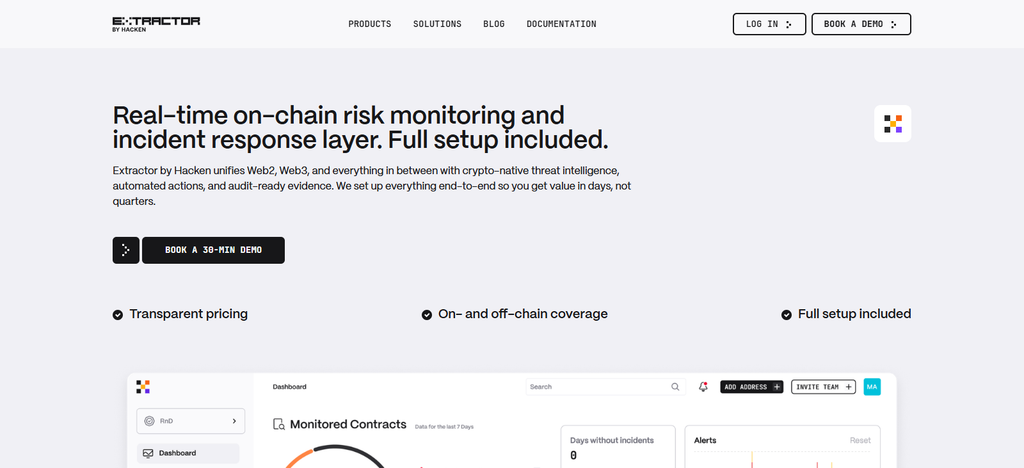
Hacken Extractor is not included in Hacken’s Proof-of-Reserves audit methodology. According to Hacken, Extractor is part of its extended security coverage, while its PoR service separately verifies reserves, liabilities, ownership and collateralization.
Hacken’s PoR technique can verify the extraction processes of client-liability, reconcile liability reports, generate Merkle trees, and cryptographically test sampled records. It can prove ownership of a wallet with signed messages or on-chain transactions, including multisig arrangements. Supported reserve assets are subject to the scope of the engagement.
The liability information collected is only that which is necessary to protect privacy. Independent Hacken auditors assess controlled in-kind assets against liabilities to determine collateralization ratios and record findings in a PoR report.
Best Use Cases Hacken Extractor
- Exchange PoR Verification — Useful for exchanges that need technical verification of in-scope reserves vs. scoped liabilities.
- Liability Verification — For projects that need cryptographic tools like Merkle Trees to verify customer-liability data.
- Wallet Verification — Useful to verify that the reported on-chain reserve assets are controlled by the relevant organization.
- Tokenized Asset Verification — For tokenized asset projects that want to show the link between digital representations and the underlying assets.
- Regulatory Transparency – Useful for crypto businesses that require documented proof of reserve-coverage to users and regulators.
- On-Demand Verification — For businesses that want reserve-coverage verification when they want it, not on a fixed reporting schedule.
- Technical Assurance — Best suited for projects needing a security-focused technical review of their PoR methodology and reserve coverage.
5. Ledger Lens
LedgerLens is the digital-asset audit and Proof-of-Reserves infrastructure, supporting Merkle-tree verification, on-chain attestations, and real-time reserve monitoring.
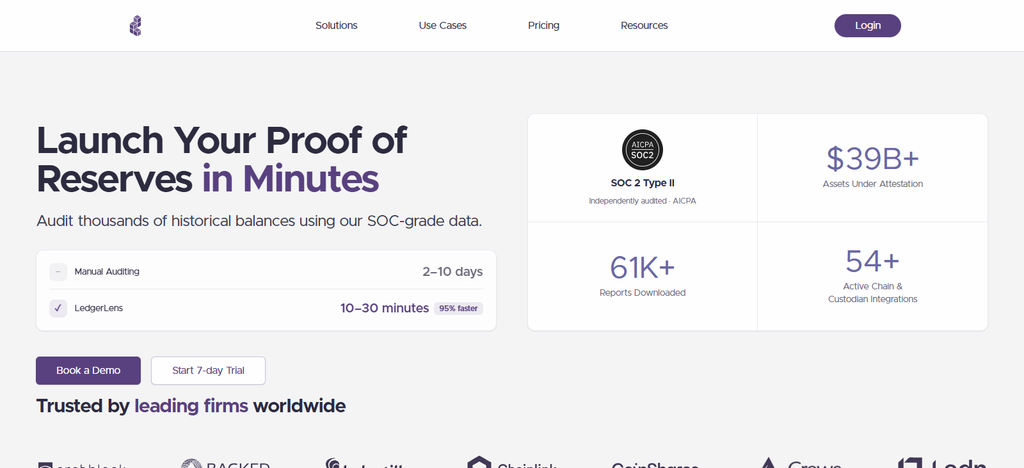
Its Merkle method pulls customer liability data, hashes balances, builds a Merkle tree, publishes the root, and allows users to verify their individual inclusion without revealing other customers’ balances. Its on-chain PoR capability can link off-chain reserves such as bank balances, Treasury securities, gold and other assets to Chainlink oracle infrastructure.
Depending on the engagement liability verification may also be combined with reserve data. LedgerLens also supports historical balance testing, multi-chain data, APIs and real-time attestations. CPA firms can use the platform to offer independent attestations.
Best Use Cases Ledger Lens
- Merkle-Based PoR – Good for platforms that need cryptographic proof that a customer has a balance and that the customer is included in an account.
- Customer Liability Verification — Ideal for companies that want to reconcile customer liabilities with verified reserves.
- On-Chain Reserve Monitoring — Good for tracking asset and reserve information on a blockchain.
- Multi-Asset Verification — Great for companies with a combination of digital and traditional asset types.
- Historical Balance Testing — Useful when verification requires examining balances at certain points in history.
Real-Time Attestations – Excellent for organizations that want to report and track their reserves more frequently. - CPA Firm Workflows — Useful for accounting firms that need infrastructure to prepare or support attestations of digital-asset reserves.
6. Gate.io Reserves Proof
Gate.io Proof of Reserves is based on Merkle Tree and zk-SNARK technology to prove the coverage of customer assets in reserves. Its system generates hashed user-balance records and outputs a Merkle root, allowing users to verify that their balances are part of the published dataset. Gate.io also checks wallet controls for relevant hot and cold wallets through designated transactions.
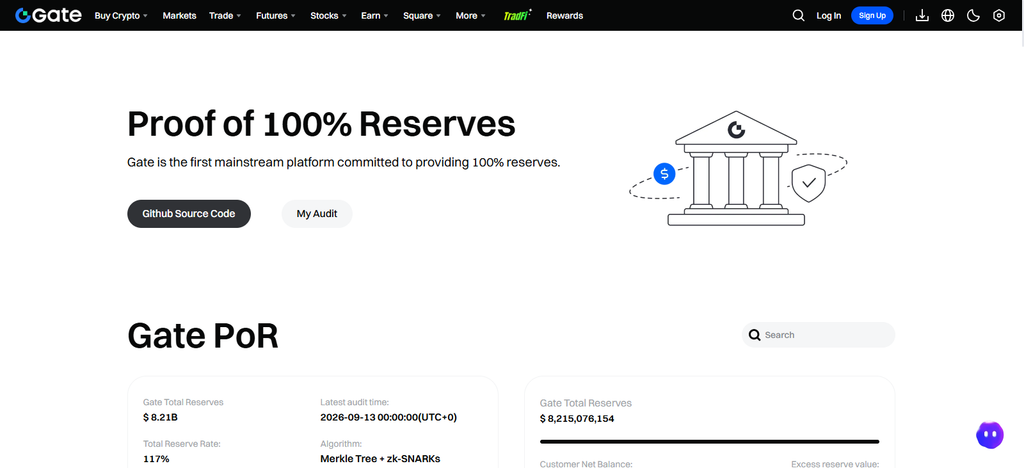
The exchange wallet balances are compared to the customer net balances to calculate the reserve coverage. Its PoR covers several cryptocurrencies, with each report defining the exact scope of assets. The cryptographic structure provides privacy by not publicly revealing individual account details, and qualified third party verification assists the assessment process.
Best Use Cases Gate.io Proof of Reserve
- Exchange Asset Proof — Used mainly to prove that assets on the exchange that are owned by customers are backed by an equivalent amount of reserves.
Merkle-Based Customer Verification — Enables users to prove that their account information is part of the cryptographic proof.
zk-Based Verification — Useful for adding cryptographic verification to reserve reporting. - Wallet Reserve Transparency — Built to audit reserve wallets held by the exchanges.
- Multi-Asset Coverage — This is handy for customers holding multiple supported cryptocurrencies on the exchange.
- Customer Trust Reporting — Offers evidence of reserve coverage in the public domain.
- Transparency of Exchange — Ideal for users of centralized exchanges who want cryptographic proof, not just a simple reserve statement.
7. Kraken Proof of Reserves
Kraken Proof of Reserves employs cryptographic verification and independent third-party accounting procedures to verify that supported client assets are backed by the corresponding assets held by Kraken. Reporting periods could be centered around major cryptos such as BTC, ETH, SOL, XRP, ADA, USDC and USDT, but the scope of each may vary.
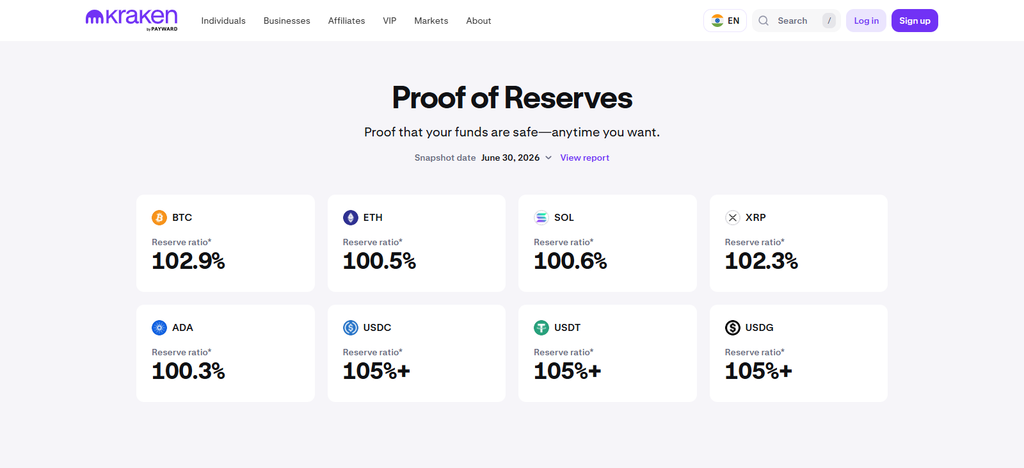
Kraken’s PoR could include spot balances, margin positions, futures balances and eligible staked assets. The account snapshot shows customer liabilities and clients can privately confirm their inclusion in the report. The ownership of the reserve is proven on-chain.
The reporting process is periodic and the methodology is disclosed with the reports so that the date of the snapshot and the products covered are key to evaluating results.
Best Use Cases Kraken’s Proof of Reserves
- Independent Accounting Review — For users requiring reserve verification by an independent third-party accountant.
- Spot Asset Verification — Used to verify the balance of specific spot assets at the reporting snapshot time.
Staking Asset Verification – applies where assets held via eligible staking services are in scope for review. - Wallet Ownership Verification — Verifies control of relevant on-chain addresses with cryptographic signatures.
- Merkle-based verification – enables individual customers to verify their inclusion without revealing the whole customer dataset.
- Periodic Reserve Reporting — Useful for customers that want a recurring evidence of reserve coverage, instead of a single historical assessment.
8. Binance Proof of Reserve
Binance Proof of Reserves uses Merkle Trees and zk-SNARKs to enable users to verify that their account balances are included in the reserve calculation. First, there is a snapshot of customer balances. Then, they check who owns the wallets for the addresses that Binance controls for reserves.
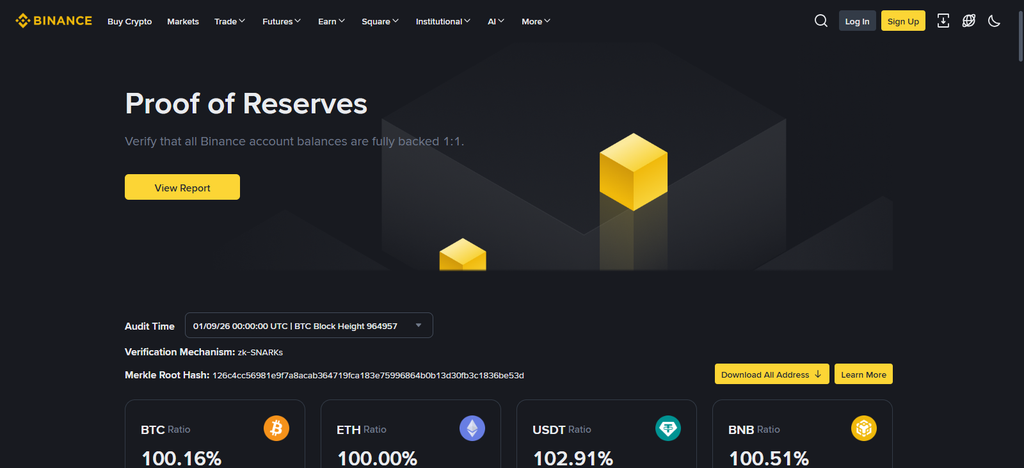
Binance then creates cryptographic proofs and a Merkle Tree that links hashed user identifiers to balances. The supported assets differ by report, and the system is designed to show that user assets held in custody are backed 1:1 by corresponding reserves.
Users can check their own Merkle inclusion without exposing the balances of other users. Binance describes the PoR as a “point-in-time snapshot,” so it does not by itself guaranty full coverage of liabilities outside the reported scope.
Best Use Cases Binance Proof of Reserve
- Exchange Reserve Verification — Intended to demonstrate that Binance client assets are backed by matching reserves.
- Merkle Tree Verification — Useful for customers who want to verify that their account balances are included in the aggregate proof.
- zk-SNARK Verification — Enables cryptographic verification of account-balance calculations without revealing any customer data publicly.
- Wallet Ownership Checks — Useful to check that reserve addresses are owned by Binance.
- Customer Balance Verification — Users can verify their Merkle info and prove inclusion.
- Multi-Asset Reserve Monitoring — Ideal for customers with various supported cryptocurrencies.
Monthly Transparency Checks – Great for users who want regular snapshots of coverage and account inclusion.
9. OKX Proof of Reserves
OKX Proof of Reserves combines on-chain wallet verification, Merkle-tree accounting, and zk-STARK cryptographic proofs into a single solution. The system snapshots account assets, stores the information in an encrypted Merkle-tree structure and applies constraints on total balances, non-negative balances and account inclusion.
OKX also releases wallet information and signed messages for users to verify wallet ownership and balances themselves. Its coverage of major cryptocurrencies includes BTC, ETH, USDT, USDC, XRP, DOGE, SOL, and OKB, but broader asset coverage is report-dependent.
The methodology allows to verify the customer-account asset against the exchange holdings on-chain without breaching the privacy of individual balances. Reports are periodic snapshots and exclude any assets beyond the defined scope.
Best Use Cases OKX Proof of Reserves
- Exchange Reserve Verification — To verify that the OKX account assets are backed by the corresponding exchange-held assets.
- zk-STARK Verification — Useful to cryptographically prove account-asset calculations while preserving individual account privacy.
- Wallet Ownership Verification Customers can verify published wallet addresses and ownership through signed messages.
- Multi-Asset Verification — Designed for customers with supported cryptocurrencies and stablecoins on the platform.
- Customer Asset Comparison — Good for comparing total account assets to on-chain wallet balances.
Open-Source Verification — Good for users who want to view or use publicly available verification tools. - Recurring PoR Reporting – Useful for customers who want regular reserve snapshots rather than a single report.
10. Nansen Portfolio & Reserve Audit
Nansen Portfolio is more a portfolio analytics and reserve-monitoring platform on-chain than an independent Proof-of-Reserves auditor. Nansen has launched Portfolio dashboards to surface exchange reserve holdings and provide blockchain transparency for addresses and assets associated with leading centralized exchanges.
Its approach is based on analyzing on-chain data, identifying wallets, tracking and aggregating portfolios and not on independently verifying customer liabilities. The platform can display assets such as tokens held on supported chains and identified exchange wallets, while liability verification is usually not part of Nansen’s portfolio monitoring function.
Wallet ownership is based on Nansen’s address attribution and blockchain data. The primary value is clear reserve tracking and portfolio analytics, but users need to be able to distinguish between seeing assets on-chain and a complete independent solvency assessment.
Best Use Cases Nansen Portfolio & Reserve Validation
- Exchange Reserve Monitoring — Can be used to monitor assets on the blockchain linked to centralized exchanges.
On-Chain Portfolio Analysis – Useful for wallet/token/chain analysis and portfolio movements. - Wallet Attribution — Useful when users need to know which blockchain addresses are associated with identified entities.
Reserve Transparency Research – Helps analysts examine publicly visible exchange holdings. - Multi-Chain Asset Tracking — Ideal for tracking electronic assets across supported blockchain networks.
- Institutional Due Diligence — Useful as an on-chain research layer for visible wallet activity and asset exposure.
- Ongoing Portfolio Monitoring — Better suited for continuous analysis of blockchain-data, rather than as a stand-alone PoR auditor for the platform.
Comparison Table: Crypto Proof-of-Reserves Platforms
| Platform | Primary PoR Method | Assets Covered | Liabilities Verification | Wallet Ownership | Independent Verification | Privacy & Security | Best Use Case |
|---|---|---|---|---|---|---|---|
| Chainlink Proof of Reserve | Oracle-based on-chain verification | Crypto, stablecoins, tokenized/RWA assets | Depends on integration | Depends on data source | Depends on implementation | Decentralized oracle infrastructure | Stablecoins, RWAs, DeFi |
| Armanino TrustExplorer | Merkle Tree + assurance procedures | Digital assets within engagement scope | Yes, within engagement scope | Included in verification procedures | Yes | Cryptographic, privacy-preserving verification | Exchange and custodian assurance |
| The Network Firm | CPA attestation + on-chain PoR | Digital and selected traditional reserve assets | Yes, depending on engagement | Verified within PoR procedures | Yes | On-chain data and reporting infrastructure | Exchanges, stablecoins, RWAs |
| Hacken Extractor | Technical PoR + Merkle-based verification | Digital assets within audit scope | Yes, depending on engagement | Yes | Hacken security/PoR review | Cryptographic and security-focused | Crypto projects and exchanges |
| LedgerLens | Merkle Trees + on-chain attestations | Digital and selected off-chain assets | Yes | Yes, depending on engagement | CPA-supported workflows | Cryptographic verification | Exchanges, custodians, attestations |
| Gate.io Proof of Reserves | Merkle Tree + zk-SNARKs | Supported cryptocurrencies | Included in PoR calculation | Yes | Third-party procedures may apply | Zero-knowledge + cryptographic verification | Exchange reserve transparency |
| Kraken Proof of Reserves | Merkle-based cryptographic verification + accounting review | Selected crypto assets | Included for covered customer balances | Yes | Independent accounting review | Privacy-preserving customer verification | Customer asset verification |
| Binance Proof of Reserves | Merkle Tree + zk-SNARKs | Supported cryptocurrencies | Included in reported customer balances | Yes | Verification methodology disclosed by Binance | Zero-knowledge cryptographic proofs | Exchange transparency |
| OKX Proof of Reserves | Merkle Tree + zk-STARKs | Supported crypto assets | Included in account-asset calculation | Yes | PoR methodology and verification tools | zk-STARK + encrypted Merkle structure | Exchange reserve verification |
| Nansen Portfolio & Reserve Verification | On-chain portfolio and wallet analytics | Blockchain-visible crypto assets | Not primarily a liability-verification service | Based on wallet attribution/on-chain data | Not an independent PoR audit | On-chain analytics | Reserve monitoring and due diligence |
Conclusion
Crypto Proof-of-Reserves platforms offer a variety of methods to verify the collateralization of digital currencies, such as on-chain wallet monitoring, oracle-based verification, Merkle trees, zero-knowledge proofs, and independent attestations.
The platforms covered in this article vary in asset coverage, liability verification, privacy mechanisms, evidence of wallet control, reporting frequency, and independent review. Some focus on exchange customer balances, others on stablecoins, tokenized assets, custodians or institutional reserves.
When evaluating a PoR solution, users should ask what exactly is included in the assets and liabilities, how ownership is verified, if customers can independently verify the results and if the report is a current or historical snapshot.
FAQ
What is a crypto Proof-of-Reserves platform?
A crypto Proof-of-Reserves platform verifies whether a cryptocurrency exchange, custodian, stablecoin issuer, or other digital-asset business holds the assets it claims to control. Depending on the platform, verification can use blockchain data, Merkle trees, zero-knowledge proofs, wallet signatures, oracle networks, or independent attestations.
How does Proof of Reserves work?
Proof of Reserves generally combines verified reserve assets with customer or other relevant liabilities. A provider may verify blockchain wallet balances, demonstrate wallet control, create cryptographic proofs of customer balances, and compare eligible assets with reported liabilities.
Does Proof of Reserves prove that a crypto company is solvent?
Not necessarily. PoR can provide evidence about specified assets and, depending on methodology, liabilities at a particular point in time. It does not automatically prove that every liability, debt, obligation, or affiliated entity is included.
What is the difference between Proof of Reserves and Proof of Liabilities?
Proof of Reserves focuses on assets controlled by an organization, while Proof of Liabilities focuses on what the organization owes customers or other parties. Evaluating both provides more meaningful information than looking at reserve assets alone.
Can users verify their own Proof-of-Reserves results?
Some platforms allow customers to independently verify their inclusion using a Merkle proof or similar cryptographic mechanism. The exact verification process differs by provider, so users should check whether individual-account verification is supported.