

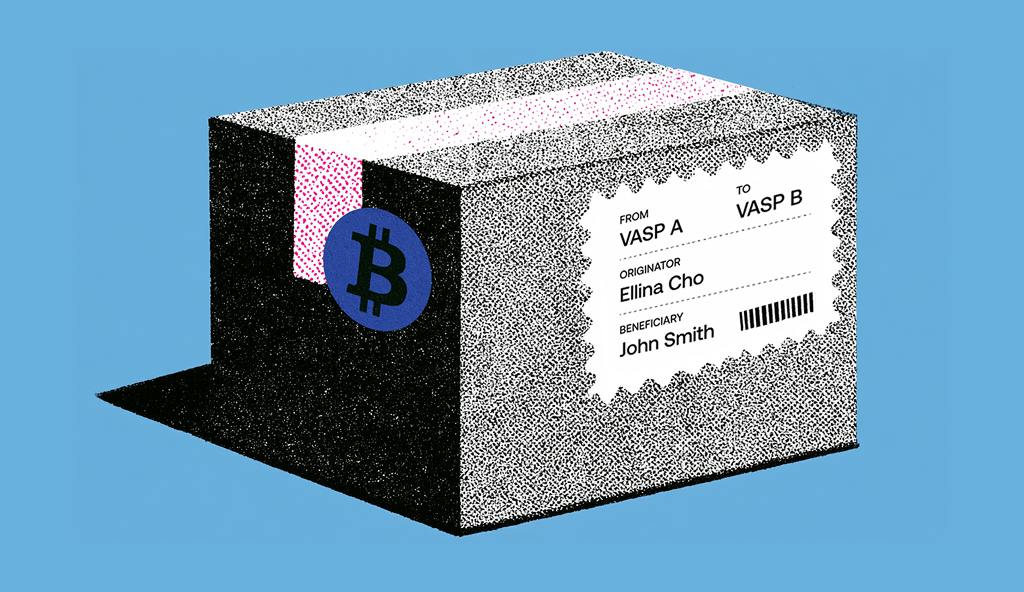
In this article, I’ll discuss the Best Crypto Travel Rule Solutions for VASPs. The focus will be on platforms that help virtual asset service providers handle regulatory data exchange, VASP verification, Travel Rule messaging, wallet verification, API integration, security and compliance workflows. The comparison also highlights important features, pricing, interoperability, availability and practical use cases to assist VASPs in assessing suitable solutions.
What Are Crypto Travel Rule Solutions?
Crypto Travel Rule solutions are compliance infrastructure and platforms that allow Virtual Asset Service Providers (VASPs) to securely collect, verify, transmit and manage the necessary information about the originators and beneficiaries of crypto transactions.
They enable exchanges, custodians, brokers and other VASPs to communicate with each other when applicable transactions are made. The solutions can include VASP discovery, Travel Rule messaging, IVMS101 data handling, API integration, counterparty verification, self-hosted wallet checks, audit trails and compliance automation.
Depending on the provider, they may also be connected to KYC, KYB, sanctions screening and transaction monitoring systems. The requirements and the way they are implemented depend on the jurisdictions where the VASP is operating.
Why Do VASPs Need Travel Rule Solutions?
Regulatory Compliance: Travel Rule solutions allow VASPs to keep the necessary originator and beneficiary details, in line with relevant virtual-asset regulations.
Automated Information Exchange: They automate the collection of required transaction information for secure transmission to participating VASPs to be exchanged, reducing manual processes.
Counterparty Verification: VASPs may be able to verify the identities of receiving or sending counterparties before sharing sensitive Travel Rule information.
Maintain Self-Hosted Wallets Some solutions offer ways to verify the ownership or control of the wallet for transactions with non-custodial wallets.
Improve Compliance Effectiveness: Repetitive compliance activities can be reduced and operational teams supported with automated rules, workflows, alerts and audit records.
Enable Interoperability: Travel Rule infrastructure can link VASPs across different networks, protocols and messaging systems.
Retain Audit Trail: Solutions are capable of recording Travel Rule communications and compliance decisions, providing organizations with documentation for any applicable regulatory requirements.
Connect to Compliance Systems: APIs and other integration tools can connect Travel Rule processes with KYC, KYB, AML, sanctions-screening, custody and transaction-monitoring systems.
Scale Transaction Operations: VASPs may utilize automated Travel Rule infrastructure to scale their transaction operations, reducing reliance on manual information exchange.
How We Selected These Travel Rule Solutions
| Selection Criteria | What We Evaluated |
|---|---|
| Travel Rule Compliance | Ability to collect, transmit, receive, and manage required originator and beneficiary information. |
| VASP Connectivity | Availability of VASP discovery, counterparty identification, and network connectivity features. |
| Interoperability | Support for different Travel Rule networks, protocols, and standardized messaging systems such as IVMS101. |
| API & Integration | APIs, SDKs, webhooks, and integration options for connecting with exchanges, custody platforms, and compliance systems. |
| Self-Hosted Wallet Support | Availability of wallet ownership or control verification for applicable transactions involving non-custodial wallets. |
| Security & Privacy | Encryption, secure data transmission, privacy controls, and protection of sensitive Travel Rule information. |
| Compliance Automation | Automated rules, transaction workflows, counterparty checks, alerts, and audit capabilities. |
| Blockchain & Asset Coverage | Supported blockchain networks, crypto assets, and transaction types where publicly documented. |
| Jurisdictional Coverage | Ability to support Travel Rule requirements across relevant countries and regulatory environments. |
| Deployment Options | Availability of cloud, API-based, hosted, on-premise, or other deployment models. |
| Pricing Transparency | Public subscription pricing, transaction-based pricing, free options, or availability of customized enterprise pricing. |
| Scalability | Suitability for different transaction volumes and VASP operational requirements. |
| Documentation | Quality and availability of product, API, compliance, and implementation documentation. |
| Practical Use Cases | Relevance for crypto exchanges, custodians, brokers, fintechs, institutional VASPs, and other virtual-asset businesses. |
Key Points
| Solution | Best For | Key Strengths |
|---|---|---|
| Notabene | Enterprise exchanges & global VASPs | Protocol-agnostic platform, multi-jurisdiction compliance workflows, counterparty due diligence, real-time transaction screening, support for multiple Travel Rule protocols. |
| Sumsub Travel Rule | VASPs seeking an all-in-one compliance stack | Covers the full Travel Rule lifecycle including VASP verification, wallet checks, data transmission, transaction monitoring, and AML screening. |
| VerifyVASP | Secure Travel Rule messaging | Global VASP directory, encrypted data exchange, FATF Travel Rule compliance, and integration with major exchanges. |
| Sygna Bridge (CoolBitX) | Cross-border crypto transfers | Widely adopted network connecting exchanges and custodians with standardized Travel Rule data sharing. |
| 21 Analytics | Privacy-focused VASPs | Open architecture, self-hosted deployment options, Bitcoin-focused compliance tools, and strong data privacy controls. |
| TRISA | Open-source Travel Rule compliance | Decentralized identity framework, interoperable messaging network, and no dependency on a single provider. |
| TRUST Network | Institutional crypto firms | Industry-backed network created by major exchanges for secure Travel Rule information exchange. |
| CODE by Coinbase | Large exchange ecosystems | Secure compliance infrastructure designed to facilitate Travel Rule data exchange between participating VASPs. |
| Binance Travel Rule Solution | Exchanges operating within Binance ecosystem | Integrated compliance workflows, automated beneficiary verification, and regional regulatory support. |
| CryptoSwift | Growing regional VASPs | Travel Rule automation, secure messaging, sanctions screening, and support for multiple compliance frameworks. |
1. Notabene
Notabene, founded in 2020 and based in New York, offers Travel Rule infrastructure for VASPs and financial institutions. Its platform addresses counterparty discovery, Travel Rule threshold checks, mandatory data collection, encrypted messaging and self-hosted wallet verification with SafeConnect.
Notabene offers API-based integration and a Node SDK, and its network can be used to identify beneficiary VASPs and exchange necessary transaction information.
Pricing includes a free, limited version of SafeTransact-Rise and paid, full-feature plans. Enterprise pricing is handled through sales. It has been built to support global VASP operations and is able to support multiple Travel Rule protocols and transaction workflows.
Notabene Features
- Travel Rule Automation: Automates the gathering and sharing of Travel Rule data between VASPs.
- Counterparty Validation: Detects and confirms Travel Rule counterparties.
Self-Hosted Wallets: SafeConnect supports proofs of wallet ownership, such as signatures and micro-transactions. - Integration: Built with integration in mind, allowing Travel Rule workflows to connect to your existing transaction systems.
- VASP Network: Allows you to exchange data with counterparties, even when they are using different Travel Rule solutions.
| Pros | Cons |
|---|---|
| Automated Travel Rule workflows | Advanced capabilities may require paid plans |
| Supports counterparty discovery | Enterprise pricing is not fully public |
| Supports self-hosted wallet verification | Setup can require technical integration |
| Provides API and integration options | Some features depend on supported networks |
| Broad VASP connectivity | Smaller VASPs may not need every feature |
2. Sumsub’s Travel Rule
Sumsub was founded in London in 2015, where it built its company as Sum and Substance. Its Travel Rule solution is part of a wider KYC, KYB, transaction-monitoring and compliance platform. VASPs can share originator & beneficiary details, set jurisdiction specific rules, manage counterparty responses and unhosted wallet workflows.
Sumsub is asset agnostic for Travel Rule data exchange, with blockchain screening coverage depending on the analytics providers connected. Integration with Sumsub’s platform and APIs is available with configurable rules and transaction workflows. “Travel Rule pricing is not a fixed rate and it is not listed publicly as a fixed rate. It is dealt with commercially.
Sumsub Travel Rule Compliance Features
- Unhosted Wallet Verification: This allows for wallet ownership verification through various methods, including cryptographic signatures and Satoshi Tests.
- AML & Sanctions Screening: Provides real-time screening and transaction monitoring capabilities.
- Custom Rules: Allows compliance teams to create workflows based on risk and jurisdiction policies.
- Audit Trails: Keeps orderly records of Travel Rule transactions and compliance activities.
| Pros | Cons |
|---|---|
| Combines Travel Rule with broader compliance tools | Can be more extensive than a standalone Travel Rule tool |
| Supports unhosted-wallet verification | Pricing is generally customized |
| Includes AML and sanctions capabilities | Integration may require implementation work |
| Configurable compliance workflows | Feature availability can vary by jurisdiction |
| Provides audit and transaction records | Enterprise users may face a broader onboarding process |
3. VASP Verification
VerifyVASP is a RegTech company from Singapore working on Travel Rule compliance for virtual asset businesses. The TravelRule API securely transmits originator and beneficiary information with end-to-end encryption and is compatible with first-party and third-party transactions.
There is also VASP verification as well as a Verify Wallet product which enables verification of self-hosted wallet ownership with mechanisms such as cryptographic signatures and micro-transactions.
VerifyVASP has over 150 member VASPs in more than 30 jurisdictions, it announced. Its technical model is built around API integration, and enterprise pricing is typically subject to negotiation directly with commercial discussions, rather than a publicly available standard price.
VASP Verification Features
- End-to-End Encryption: Encrypted communication is used to protect sensitive Travel Rule information.
- P2P Architecture: Instead of centralized storage of exchanged data, it uses a decentralized peer-to-peer architecture.
- Compliance Screening: Identity verification, sanctions screening, transaction monitoring.
- VASP Due Diligence: Enables counterparty VASP verification and due-diligence workflows.
| Pros | Cons |
|---|---|
| Dedicated Travel Rule infrastructure | Public pricing information is limited |
| API-focused architecture | Integration requires development resources |
| Supports VASP verification | Network usefulness depends on participating counterparties |
| Uses encrypted data exchange | Some advanced capabilities may require enterprise arrangements |
| Supports self-hosted wallet verification | Regional requirements can affect implementation |
4. CoolBitX Sygna Bridge
Sygna Bridge, a Travel Rule solution developed by CoolBitX, a blockchain-security company formed in 2014. In 2019, CoolBitX had launched Sygna Bridge to allow VASPs to meet the FATF Travel Rule data-sharing requirements, with Sygna Bridge 2.0 supporting the IVMS101 messaging standard.
The platform is built for secure information exchange from VASP to VASP and interoperability between Travel Rule providers. Its technical architecture is designed for use in VASP compliance and transaction workflows, not for consumer wallet use.
Sygna Bridge’s public standard pricing is not clearly disclosed, so enterprise customers typically need to reach out to CoolBitX for commercial terms and deployment details.
CoolBitX Sygna Bridge Features
- IVMS101 Support: Sygna Bridge v2 supports the IVMS101 Travel Rule messaging standard.
Secure Data Sharing: Enables VASPs to securely share required Travel Rule information. - VASP Connectivity: Links participating VASPs, via Travel Rule infrastructure.
- Developer Integration: Offers utility libraries and technical resources to assist with the integration of IVMS101 data.
- Interoperability: Leveraging standardized Travel Rule messaging to improve compatibility among diverse compliance networks.
| Pros | Cons |
|---|---|
| Supports IVMS101 | Technical implementation can require developer resources |
| Designed specifically for VASP Travel Rule communication | Public pricing is limited |
| Provides standardized messaging | Coverage depends on connected counterparties |
| Supports interoperability | May require integration with existing compliance infrastructure |
| Backed by established blockchain-security expertise | Less suitable for organizations seeking a broad all-in-one AML platform |
5. 21 Analysis
Founded in April 2020, 21 Analytics is a Swiss company building 21 Travel Rule, an on-premise compliance solution for VASPs. The platform supports Travel Rule messaging, VASP discovery,
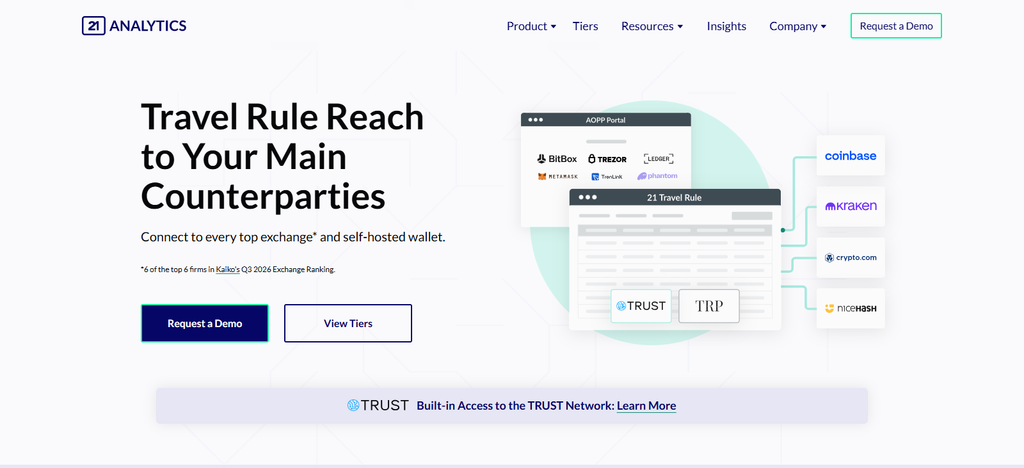
self-hosted wallet ownership verification, transaction review, audit records and interoperability with major Travel Rule networks like TRUST, TRP. It offers a GraphQL API for VASPs to integrate automated Travel Rule workflows with existing systems, and a Compliance Dashboard to assist manual operations.
The price is for an Essentials plan which includes unlimited VASP transfers and wallet verification. Enterprise has custom commercial terms. Travel Rule information remains on-premises in the customer’s infrastructure.
21 Analytics Features
- GraphQL API: The company has built its compliance dashboard in GraphQL, which can be used to integrate the platform with existing IT infrastructure. ([21 Analytics Docs][6] )
- Self-Hosted Deployment: For organizations that want more control of their compliance infrastructure.
- VASP Connectivity: Connects with several Travel Rule networks.
Compliance Operations: Provides a dashboard to manage and review Travel Rule transactions and compliance workflows.
| Pros | Cons |
|---|---|
| Supports self-hosted deployment | Self-hosting requires infrastructure management |
| Provides API integration | GraphQL integration may require developer expertise |
| Supports multiple Travel Rule networks | Enterprise capabilities may require customized arrangements |
| Provides compliance dashboard functionality | Smaller businesses may not need the full feature set |
| Offers wallet verification capabilities | Pricing can vary according to deployment and requirements |
6. TRISA
TRISA, or Travel Rule Information Sharing Architecture, is an open architecture that allows VASPs to share Travel Rule information without altering blockchain protocols. Its Envoy implementation supports encrypted peer-to-peer messaging via TRISA and TRP protocols, processing IVMS101 data, and provides a Sunrise messaging option for counterparties not on compatible networks.

TRISA also provides a Global Directory Service to discover VASPs. Envoy can be deployed via Docker and Helm, which is a good fit for organizations that want more control over infrastructure. Current Envoy options include a hosted node at $375 per month, open source at no cost, and implementation services for additional fees.
TRISA Features
- Open Architecture: TRISA offers an open architecture for secure VASP-to-VASP Travel Rule information exchange.
- VASP Discovery: Directory infrastructure allows VASPs to discover counterparties.
Encrypted Messaging: Built for safe sharing of sensitive Travel Rule data. - IVMS101 Compatibility: Supports standardized data structures for the Travel Rule.
- Open Source: TRISA’s open source Envoy implementation can be deployed by organizations that want to have more control over the infrastructure
| Pros | Cons |
|---|---|
| Open-source architecture | Requires greater technical involvement |
| Supports decentralized VASP discovery | Organizations may need to manage infrastructure |
| Supports IVMS101 | Implementation can be complex for smaller VASPs |
| Provides encrypted Travel Rule messaging | User experience depends partly on deployment configuration |
| Flexible for organizations wanting infrastructure control | Less turnkey than fully managed commercial platforms |
7. TRUST Network
TRUST, launched in February 2022, is an industry-led Travel Rule network established by a coalition of VASPs and operated with Coinbase playing a leading role. Instead of maintaining a central database of customer information, it transmits Travel Rule information directly between verified counterparties over end-to-end encrypted channels.
TRUST requires proof of ownership of the address before exchanging sensitive information and can be integrated directly into VASP payment rails. TRUSThub provides connectivity to non-TRUST members and other systems. Depending on the VASP, integration can take between two and six weeks of engineering work. TRUST is not-for-profit and has a no-fee membership tier for smaller or newer VASPs that qualify.
TRUST Network Features
- Peer-to-Peer Exchange: TRUST exchanges Travel Rule information directly between verified members, rather than storing a central repository of customer data.
- End-to-End Encryption: Travel Rule data is passed over encrypted channels.
- Proof of Address Ownership: Receiving VASPs can cryptographically prove control over the receiving address before information is shared.
- Member Verification: TRUST members must satisfy defined security, privacy and AML requirements.
- TRUSThub TRUSThub connects to VASPs outside the core TRUST membership and supports interoperability between different systems.
| Pros | Cons |
|---|---|
| Direct VASP-to-VASP information exchange | Participation requires meeting network requirements |
| Designed with privacy protection in mind | Integration still requires development work |
| Uses end-to-end encrypted communication | Benefits depend on counterparty network participation |
| Supports proof of address ownership | Primarily focused on Travel Rule connectivity |
| TRUSThub expands interoperability | Not designed as a complete AML platform |
8. CODE / CodeVASP
CODE, a Korean Travel Rule network set up by South Korea’s top digital-asset exchanges Bithumb, Coinone and Korbit, is not a Coinbase solution. It uses a proprietary protocol to verify the beneficiary VASP information and authorize the exchange of Travel Rule data through APIs.
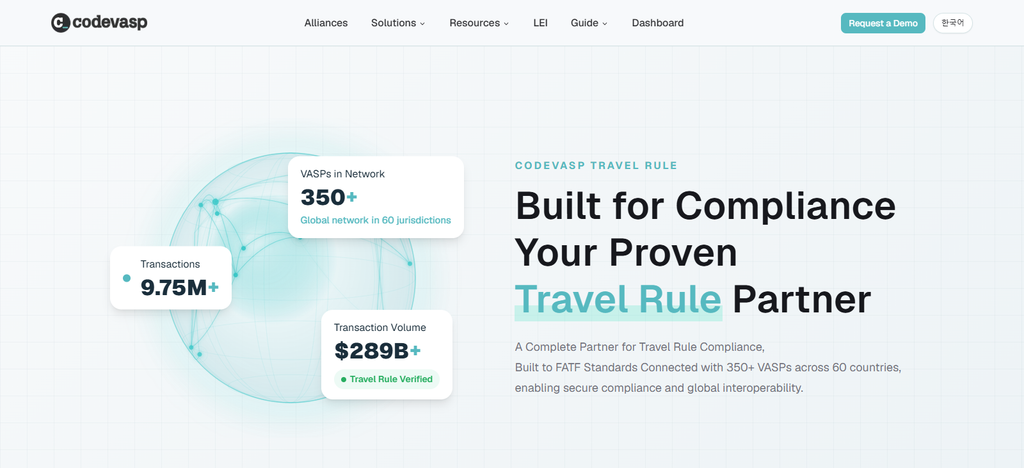
Sumsub’s use of CODE utilizes the network as a channel for authenticating beneficiary VASPs and wallet details, before securely passing on Travel Rule data. CODE encrypts information exchanged in it with the XSalsa20 algorithm.
The most important aspect of the project is secure interoperability among participating VASPs, especially in the Korean digital-asset ecosystem. Public standard pricing and full commercial stand-alone terms are not readily available.
CODE Features
- VASP Verification: CODE is designed to help participating VASPs verify counterparties before Travel Rule information is exchanged.
- API-Based Connectivity: Supports integration of Travel Rule processes into VASP transaction systems.
- Secure Messaging: Facilitates protected exchange of required Travel Rule information.
- Korean Market Focus: CODE was developed by major Korean virtual-asset exchanges and is particularly relevant to South Korea’s Travel Rule ecosystem.
- Counterparty Data: Helps participating VASPs exchange and validate beneficiary and originator information during applicable transfers.
| Pros | Cons |
|---|---|
| Supports VASP verification | Strongest relevance is within participating ecosystems |
| Designed for Travel Rule data exchange | Public pricing information is limited |
| API-based integration | Developers may be needed for implementation |
| Supports secure information transmission | Network coverage depends on participating VASPs |
| Relevant to South Korean compliance workflows | Less suitable as a standalone global AML platform |
9. Binance Travel Rule Solution
Binance’s primary tool for compliance with Travel Rules for involved VASPs is the Global Travel Rule, or GTR. GTR offers a standardized and secure method for exchanging the required Travel Rule information between counterparties, and Binance also offers Travel Rule and VASP-related API functionality.
Its developer infrastructure offers endpoints to query configured VASP lists and to support VASP related transaction workflows for the Travel Rule. With Binance’s Travel Rule, you’re able to process deposits, withdrawals and counterparty information.
Wallet workflows can include wallet-type and transaction details. GTR is VASP compliant and not intended for consumer wallet software. There is no public, standalone pricing for joining or integrating GTR, and it is not available as a standard subscription rate.
Binance Global Travel Rule Solution Features
- Global Travel Rule: Binance employs Global Travel Rule (GTR) as its main Travel Rule compliance solution.
- Safe Transfer: GTR securely transfers the required information between participating VASPs.
- Encryption: Travel Rule information is encrypted and Binance states GTR does not store PII in unencrypted form.
Multi-Regional Coverage GTR offers connectivity across multiple regions using a single platform.
One Integration: “Binance says GTR requires one integration for interoperability with participating digital-asset service providers.
| Pros | Cons |
|---|---|
| Designed for global Travel Rule connectivity | Availability can depend on jurisdiction |
| Supports secure information exchange | Integration requirements vary by VASP |
| Provides a single integration approach | Public standalone pricing is limited |
| Designed for VASP interoperability | Counterparty coverage can affect usefulness |
| Closely connected with Binance’s compliance ecosystem | Organizations may prefer provider-neutral infrastructure |
10. CryptoSwift
CryptoSwift is an API-first Travel Rule compliance platform, run by CryptoSwift OÜ, a company based in Tartu, Estonia. According to corporate records, the company has been in operation since 2022.
It offers Travel Rule messaging, VASP discovery, self-hosted wallet verification, risk scoring, automated compliance rules, webhooks, audit trails and interoperability with STRIP and partner networks.
It provides a REST API and sandbox where developers are able to test integrations before they go live in production, and it offers an on-premises PII option with its Enterprise offering. Essentials, from €600/month, includes 2,000 monthly credits. Professional, from €1,200/month. Enterprise, priced on a custom basis.
CryptoSwift Features
- API-First Architecture: Offers a REST API for Travel Rule messaging and compliance workflows.
- Self-Hosted Wallet Verification: Multiple ways to prove ownership of non-custodial wallets.
- Risk Scoring: Provides Travel Rule Risk Score and wallet-risk context to help drive compliance decisions.
- Rule Engine: Automatically determines if a transaction should proceed, wait, review or block based on configured policies.
- STRIP Standard: Uses its open source, JSON-based STRIP messaging standard to offer webhooks, sandbox testing, and partner integrations.
| Pros | Cons |
|---|---|
| API-first Travel Rule architecture | Technical integration is required |
| Supports self-hosted wallet verification | Advanced features may require higher-tier plans |
| Includes rule-engine automation | Pricing can be significant for smaller VASPs |
| Provides risk-scoring capabilities | Full functionality may require configuration |
| Offers sandbox, webhooks, and interoperability options | Smaller network coverage can be a consideration compared with larger ecosystems |
Conclusion
Crypto Travel Rule solutions help VASPs meet regulatory data-sharing requirements, and enable safe communication between originators, beneficiaries and counterparties. For instance, platforms like Notabene, Sumsub Travel Rule, VerifyVASP, Sygna Bridge, 21 Analytics, TRISA, TRUST Network, CODE, Binance Travel Rule Solution, and CryptoSwift provide various ways of VASP discovery, Travel Rule messaging, API integration, wallet verification, and compliance workflows.
When evaluating these solutions, VASPs should consider supported protocols, interoperability, jurisdictional coverage, integration requirements, security controls, self-hosted wallet capabilities, transaction volumes and pricing. The best solution will depend on a VASP’s regulatory requirements, technical infrastructure, operating markets and compliance obligations.
FAQ
What is a Crypto Travel Rule solution?
A Crypto Travel Rule solution is compliance infrastructure that helps Virtual Asset Service Providers (VASPs) securely collect, verify, exchange, and store required originator and beneficiary information during qualifying crypto transactions.
Why do VASPs need Travel Rule solutions?
VASPs use Travel Rule solutions to automate regulatory information exchange, identify counterparties, support compliance workflows, and maintain records of required transaction information across applicable jurisdictions.
What information does the Crypto Travel Rule require?
Requirements vary by jurisdiction, but Travel Rule frameworks generally involve information about the originator and beneficiary of a virtual-asset transfer, including identifying information required by applicable regulations.
What is IVMS101?
IVMS101 is a standardized data model developed by the Joint Working Group for InterVASP Messaging Standards. It provides a common structure for exchanging Travel Rule information between VASPs.