


In this article, I will introduce some of the best AI-Optimized RPC Nodes & Blockchain Data Indexers that enable developers to create tools for faster, smarter, and more scalable applications in Web3.
Highly advanced infrastructure solutions provide speed and real-time access to blockchain, automate intelligence in data processing, conduct sophisticated analytics, and provide trusted connectivity for AI agents, DeFi, blockchain gaming, ecosystems and enterprise solutions in 2026.
Key Point & Best AI-Optimized RPC Nodes & Blockchain Data Indexers
| Platform | Best For | Key Features |
|---|---|---|
| Alchemy AI RPC | Enterprise Web3 apps | AI‑driven query optimization, multi‑chain RPC |
| QuickNode AI | High‑volume apps | Predictive caching, 65+ chains |
| Chainstack AI RPC | Affordable scaling | Hybrid cloud RPC, AI node monitoring |
| Infura AI Indexer | Ethereum ecosystem | AI‑powered RPC, IPFS indexing |
| Ankr AI RPC | Cost‑efficient multi‑chain | AI latency reduction, 70+ chains |
| dRPC AI | Decentralized RPC | AI traffic routing, MEV‑resistant RPC |
| GetBlock AI | Raw blockchain data | AI query structuring, multi‑chain indexing |
| Helius AI Indexer | Solana ecosystem | AI‑optimized Solana RPC, webhook indexing |
| Triton AI RPC | Solana trading | Ultra‑low latency RPC, AI performance tuning |
| Dwellir AI RPC | Predictable pricing |
1. Alchemy AI RPC
Alchemy AI RPC is one of the top infrastructure solutions for rapidly building high-quality, intelligent Web3 applications and products. Alchemy AI RPC does this by providing developers with RPC access, smart data processing, and Web3 scaling solutions.
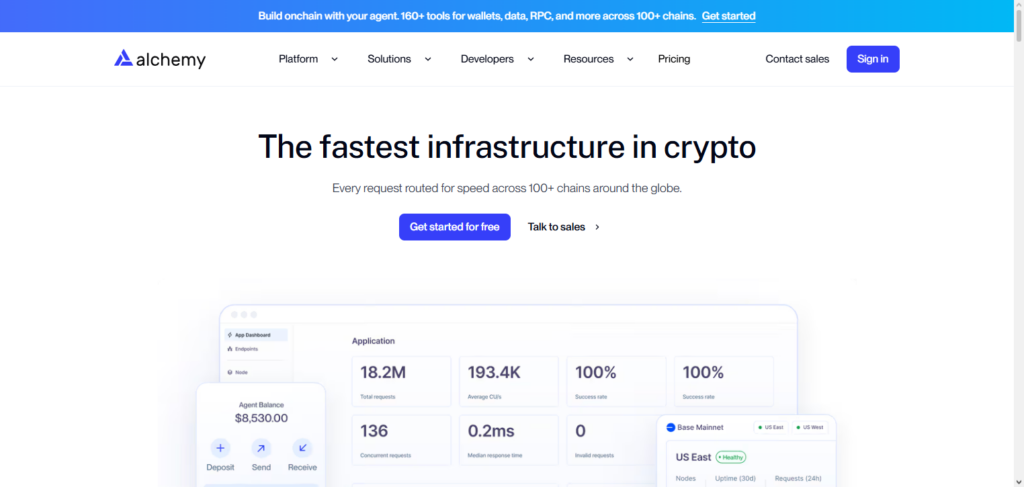
Alchemy AI RPC is able to automatically and intelligently process blockchain information, drastically reduce the time it takes to process requests, and service hundreds of millions of requests per second.
Alchemy AI RPC, along with other top RPC providers, offer developers access to up-to-date information about blockchain activity, smart contracts, NFTs, and transactions across multiple networks. Additionally, with developer tools, reliability, and support for major blockchains, Alchemy AI RPC caters to DeFi and Analytics applications, AI Web3 services, and blockchain RPC services.
Features:
- Build smart Web3 apps using Alchemy’s AI-ready blockchain APIs and infrastructure.
- Infrastructure to access multiple blockchain networks, indexed data, NFT, token, and wallet data APIs.
- Offers high-speed, high-reliability infrastructure and developer-centric tools.
- Provides blockchain data access and automation to aid the development of AI agents.
- Offers sophisticated blockchain debugging, transaction, and blockchain data monitoring tools.
Pros:
- Industry leading developer ecosystem and documentation.
- Excellent support for Ethereum and EVM based applications.
- Offers advanced blockchain data beyond basic RPC calls.
- Suitable for AI Agents, DeFi, and enterprise applications.
- Has highly reliable and scalable infrastructure.
Cons:
- Expensive for intensive use cases due to although advanced features.
- Focused on the EVM ecosystem compared to some multi-chain competition.
- Large feature set may be overwhelming for beginners.
- Pricing is based on compute units which leads to usage planning.
- Enterprise features may require higher plan tiers.
2. QuickNode AI
QuickNode AI optimizes blockchain infrastructures with a focus on intelligent automation and scalable RPC endpoints for advanced Web3 application development. QuickNode AI combines fast, optimized node access with AI technology for applications that accelerate and automate the processing of voluminous information on blockchains.
QuickNode AI, along with other top providers in this space, enables developers to create tools to monitor blockchains, process high transaction volume, and build AI connected to decentralized networks.
By supporting numerous blockchains, QuickNode AI offers enterprise-grade DeFi applications, as well as other popular DeFi applications, trading protocols, and gaming applications that require quick, accurate data feedback.
Features:
- AI-optimized blockchain infrastructure with fast RPC.
- Supports multiple blockchains with scalable node solutions. (Quicknode)
- Expands APIs, webhooks, streams and other developer tools.
- AI and Web3 applications with fast data delivery.
- Integrated marketplace for additional blockchain services.
Pros:
- Supports multiple chains well.
- Fast RPC and reliable services.
- Useful for gaming, DeFi, NFT, AI applications.
- Devtools are useful and flexible.
- Good documentation and community support.
Cons:
- High-performance features attract higher prices.
- Credit-based pricing can be unpredictable.
- Many of the tools and features are available in paid plans only.
- Large-scale users may require enterprise customizations.
- Learning how to navigate all of the tools and features can take time even for simple/beginner users.
3. Chainstack AI RPC
One of the offerings of Chainstack AI RPC is intelligent infrastructure for blockchains which includes optimized management for nodes and connectivity across multiple blockchains as well as tools for accessing blockchain data that hardware wallets integrate with.
Chainstack provides artificial intelligence (AI) focused services and technology for RPC endpoints, dedicated nodes and blockchain data services. Companies can automate certain tasks across the blockchain, analyze on-chain activities and optimize application performance with efficient data retrieval.
This service will allow you to develop AI-based services and build infrastructure that supports decentralized applications, institutional services and high volumes of blockchain-based services. Use Chainstack for your developer projects.
Features:
- Delivers Managed Blockchain Infrastructure with Scalable RPC endpoints.
- Supports Blockchain networks and deployments of dedicated nodes. (Ankr)
- API and node management interfaces serve developers.
- Blockchain Data accessible to AI applications in an optimized manner.
- Enterprise deployment is flexible.
Pros:
- Blockchain nodes are easily deployed.
- Strong enterprise infrastructure support.
- Multiprotocol and multi network support.
- Flexible Pricing.
- Reliability in production is strong.
Cons:
- Some advanced Archive features are only available in Premium Plans. (Ankr)
- Less beginner centric when compared to competitors.
- Tools lacking for AI when compared to specialized AI platforms.
- Pricing requires some technical understanding.
- Limited developer ecosystem relative to Alchemy and QuickNode.
4. Infura AI Indexer
With Infura AI Indexer, you get intelligent infrastructure for blockchains that includes optimized management for nodes and connectivity across multiple blockchains as well as tools for accessing blockchain data that hardware wallets integrate with.
Infura is one of the companies that provide artificial intelligence (AI) focused services and technology for RPC endpoints, dedicated nodes and blockchain data services.
Developers are able to collect and analyze blockchain data for AI models, wallets, DeFi applications and enterprise blockchain systems. Infura provides a solid foundation for services that support next generation decentralized applications in the Ethereum ecosystem.
Features:
- Provides reliable blockchain RPC and indexing infrastructure.
- Strong Ethereum ecosystem integration.
- Offers APIs for blockchain data access and application development.
- Supports smart contract interactions and transaction monitoring.
- Designed for scalable Web3 application development.
Pros:
- Trusted Ethereum infrastructure provider.
- Strong integration with Web3 wallets and tools.
- Reliable blockchain connectivity.
- Good security standards.
- Suitable for enterprise blockchain applications.
Cons:
- Less multi-chain flexibility compared with newer providers.
- Advanced analytics features are limited.
- Enterprise pricing may be costly.
- Developer tools are more focused on infrastructure than AI.
- Beginners may require additional blockchain knowledge.
5. Ankr AI RPC
Ankr AI RPC allows developers to access multiple blockchain networks using artificial intelligence to automate Web3 services and build scalable applications without managing nodes. Best AI-Optimized RPC Nodes & Blockchain Data Indexers, such as Ankr AI RPC, improve blockchain data availability by providing high performing API requests and real-time data.
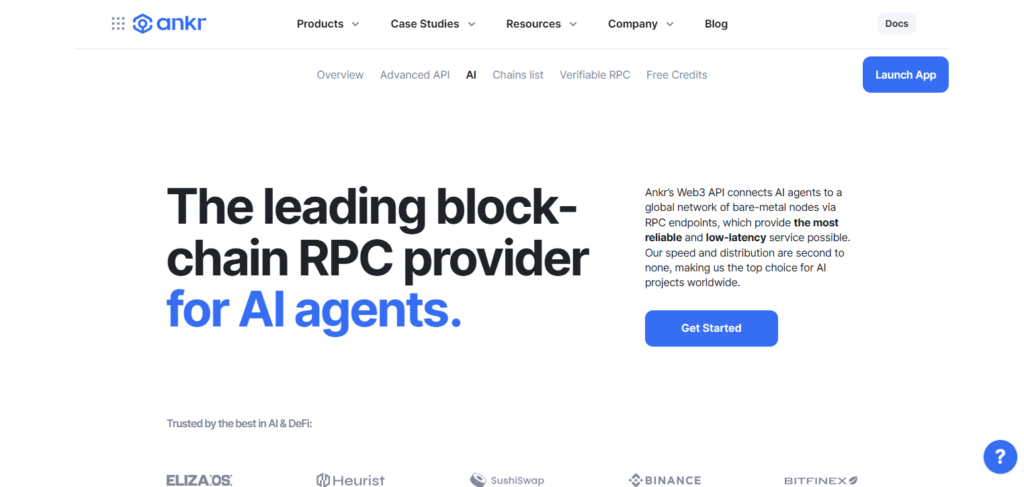
It is utilizes in multiple applications, including DeFi, gaming, and NFT ecosystems, as well as AI-driven blockchain technologies. Ankr’s provision of the infrastructure also improves availability, flexibility, and performance of the global network.
Features:
- Decentralized blockchain technology network aimed at multiple services.
- One-click access to blockchains with a fast API. (Web3WAGMI)
- Single deployment solutions across multiple blockchains.
- Supported by Web3 applications, DeFi, and AI systems.
- Offers node development.
Pros:
- Extensive coverage of blockchains.
- Infrastructure is inexpensive.
- Decentralized technology improves availability.
- Built for use across multiple blockchains.
- Impressive performance experiences for both public and enterprise users. (Web3WAGMI)
Cons:
- Performance depends on load.
- High end enterprise features are still an upgrade.
- AI features are in their early development stages.
- Documentation may be challenging for beginners.
- Not as focused on blockchain indexing as the rest of the data service providers.
6. dRPC AI
dRPC AI aims to be the first to market with a decentralized and intelligent RPC infrastructure to empower developers with fast access to multiple blockchains, enhance connection reliability, and automate request management to improve speed.
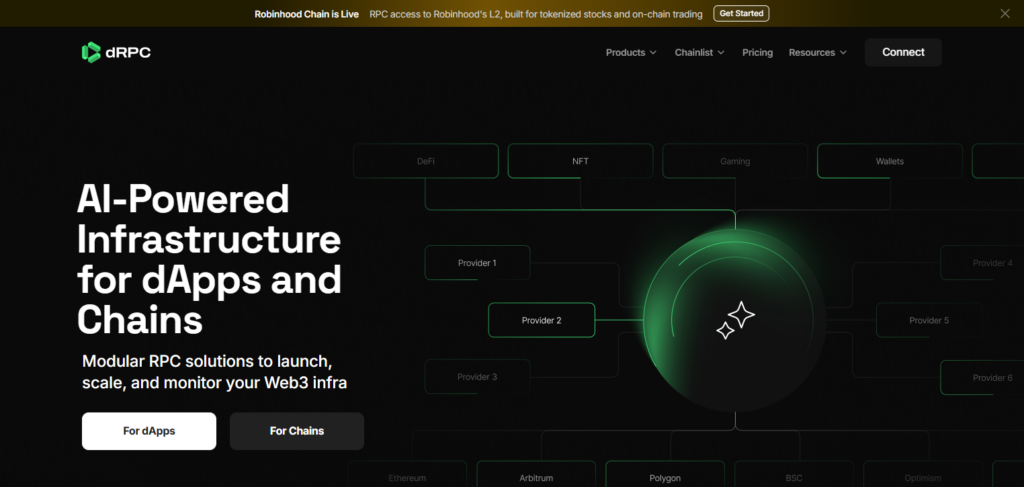
Best AI-Optimized RPC Nodes & Blockchain Data Indexers such as dRPC AI cut downtime and enhance blockchain data delivery by automatically selecting optimal infrastructure and routing Web3 applications.
The platform is designed for blockchain developers and enterprises looking to implement flexible RPC solutions within their decentralized applications. Its AI-driven approach enhances performance of blockchain infrastructure and ecosystems.
Features:
- A decentralized RPC marketplace that connects multiple node providers.
- Offers blockchain access via load balancing.
- Supports numerous blockchains.
- Reduces reliance on single-infrastructure providers.
- Provides scalable RPC solutions for Web3 developers.
Pros:
- Architecture is decentralized, which improves resilience.
- Covers multiple blockchain ecosystems.
- Flexible infrastructure.
- Adoption is inexpensive for many.
- Reduces risks from failure of single nodes. (Web3WAGMI)
Cons:
- Performance is dependent on the node provider.
- Advanced indexing features are limited.
- Smaller ecosystem when compared to major RPC providers.
- Enterprise adoption is not as high.
7. GetBlock AI
GetBlock AI offers developer centric multi-service infrastructure and APIs to access the decentralized networks. Users can opt for shared or dedicated services depending on their needs, to make it easier to pull data from blockchains and build applications.
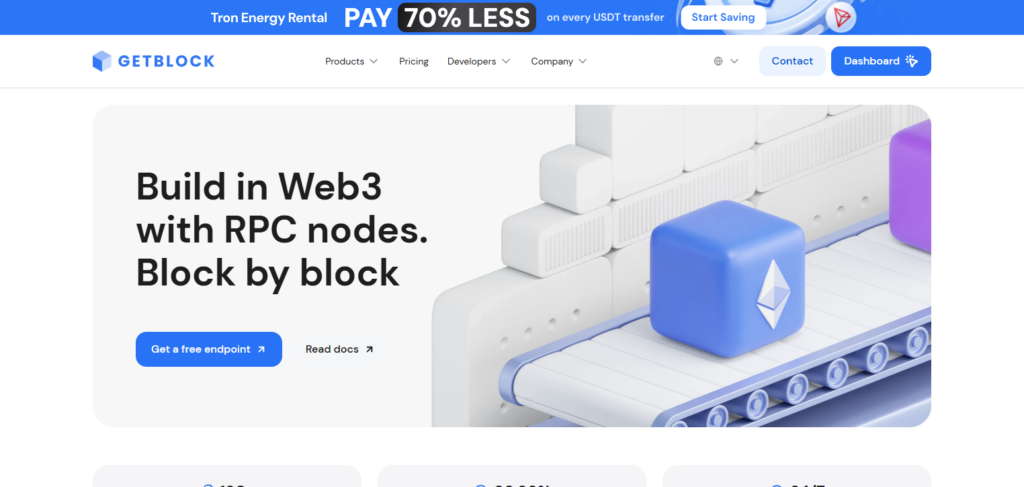
AI-enabled blockchain RPC nodes and indexing services such as GetBlock AI allow AI applications to process blockchain transactions, perform analysis on chain activities, and obtain real-time network data.
GetBlock serves developers across a number of blockchain protocols to build wallets, explorers, trading systems, and decentralized applications. Its flexible offerings improve blockchain access and data infrastructure.
Features:
- Supports access to blockchain nodes via APIs for RPC, REST, WebSocket and GraphQL. (Alchemy)
- Offers both shared and dedicated blockchain nodes.
- Covers multiple blockchan protocols.
- Supports developers in building wallets, explorers and related applications.
- Offers scalable blockchain infrastructure.
Pros:
- Offers multi-chain support.
- Dedicated node support.
- Easy integration via API.
- Suited for blockchain devs and businesses.
- Flexible infrastructure.
Cons:
- Offers limited advanced AI focused features.
- Smaller developer ecosystem compared to Alchemy.
- Pricing may be challenging for high volume use cases.
- Lacks advanced analytics.
- Requires technical Skills.
8. Helius AI Indexer
The Helius AI Indexer is a blockchain data service built specifically for Solana developers that provides optimized RPCs, APIs, and indexing paired with webhooks. AI-enabled data services allow applications to obtain structured data without requiring the application to parse and process raw network data. These services are valuable to AI-based applications,
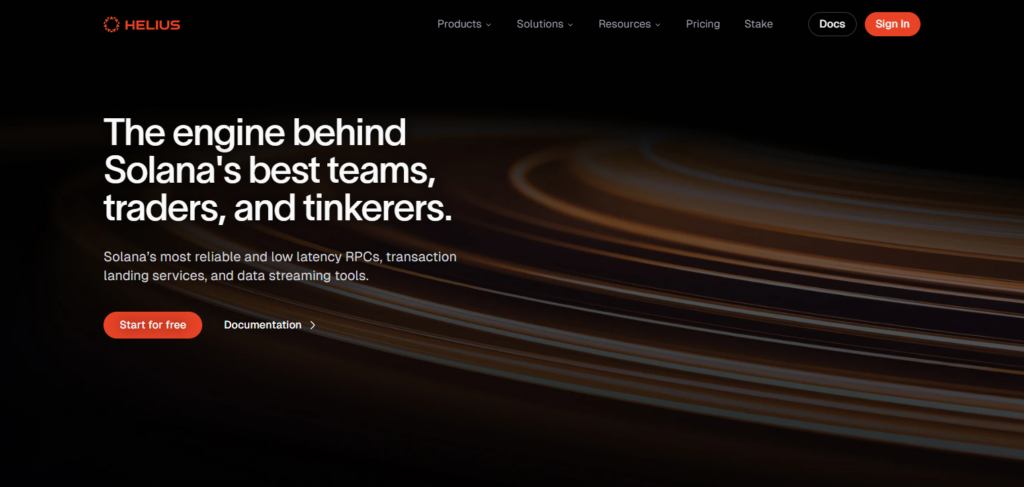
NFT platforms, gaming applications, and DeFi that require real time Solana data. Helius’s advanced indexing framework makes analyzing transactions, tracking movements of tokens, and monitoring user behaviors easier. This in turn allows developers to create more sophisticated, flexible, and intelligent applications.
Features:
- Offers specialized Solana blockchain data infrastructure for applications.
- Offers Solana RPC, APIs, webhooks and indexing tools.
- Offers structured blockchain data for application use.
- Supports NFT, DeFi, gaming and AI solutions.
- Offers real-time data access for Solana.
Pros:
- Is one of the best Solana infrastructure providers.
- Excellent indexing.
- Retrieval of blockchain data is fast.
- Developer friendly APIs.
- Well suited for Solana AI.
Cons:
- Primarily for Solana.
- Limited support for other blockchains.
- Advanced features are in the paid plans.
- Not for multi-chain.
- Smaller vendor marketplace compared to general RPC providers.
9. Triton AI RPC
Triton AI RPC offers high-speed and low-latency access to blockchains designed for fast transactions and reliability. It is optimized for use by developers constructing cutting-edge Web3 solutions that rely on fast and continuous access to blockchain data.
Triton AI RPC is among the best AI-Optimized RPC Nodes & Blockchain Data Indexers. It is able to boost application speed through optimization specifically for data requests, network monitoring, and architecture that scales to demand. It is ideal for use with Web3 projects, AI applications, and trading applications that require a high level of performance and consistency across the blockchain-based ecosystem.
Features:
- Provides high-performance RPC infrastructure for blockchain applications.
- Focuses on fast transaction processing and reliable data access.
- Supports real-time blockchain connectivity.
- Helps developers build scalable Web3 applications.
- Suitable for trading, DeFi, and AI-driven platforms.
Pros:
- Strong performance-focused infrastructure.
- Reliable RPC connectivity.
- Useful for high-frequency applications.
- Supports blockchain data requirements.
- Good option for specialized workloads.
Cons:
- Limited public information compared with larger providers.
- Smaller developer community.
- Fewer advanced APIs.
- Limited multi-chain visibility.
- Enterprise adoption is still developing.
10. Dwellir AI RPC
Dwellir AI RPC offers rapid reliable RPC access and advanced data connectivity for enterprise grade blockchain infrastructure. It helps developers build applications with integrated blockchain networks that retain performance and security.
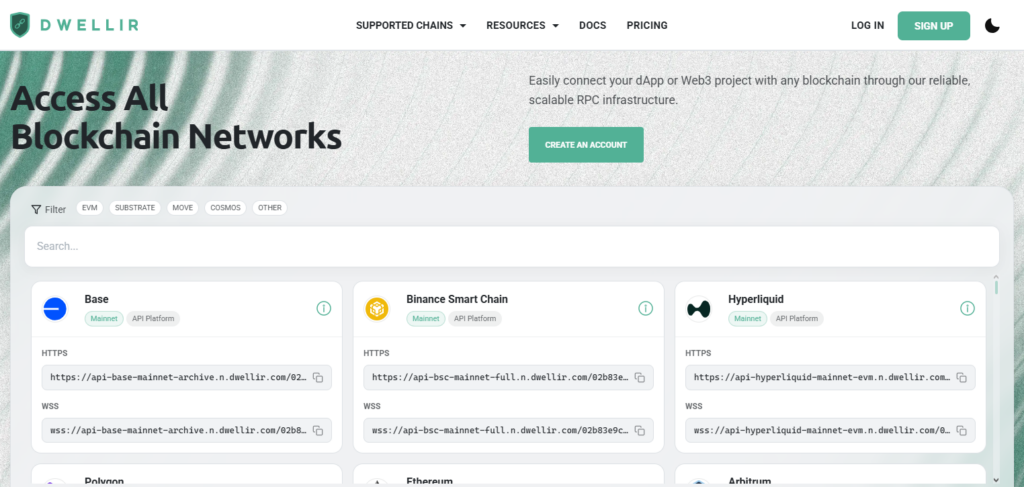
Best AI-Optimized RPC Nodes & Blockchain Data Indexers like Dwellir AI RPC assist AI-blockchain applications by offering speedy data extraction and automated processes for intelligent data workflows and network communication.
Dwellir AI RPC is designed for Web3 and FinTech applications, analytics, and other decentralized applications which have a high dependency on blockchain. It is a go-to solution for big AI blockchain deployments.
Features:
- Provides blockchain RPC infrastructure with dedicated node solutions.
- Supports reliable blockchain data access for developers.
- Offers multiple regional endpoints for performance optimization.
- Provides scalable infrastructure for Web3 applications.
- Focuses on simple deployment and reliable connectivity.
Pros:
- Easy setup for developers.
- Transparent infrastructure approach.
- Suitable for production applications.
- Reliable dedicated node options.
- Good performance optimization features.
Cons:
- Smaller ecosystem than Alchemy and QuickNode.
- Limited AI-specific features.
- Fewer advanced developer tools.
- Lower brand recognition.
- May not suit extremely large enterprise workloads.
Conclusion
AI RPC nodes and blockchain data indexers are the foundation of high performing next generation Web3 applications, AI agents, DeFi protocols, gaming and smart contract platforms and real time blockchain analytics infrastructure.
RPC nodes allow blockchain networks to be queried in real time and transactionally. In contrast, blockchain data indexers provide structured data that can be easily searched and accessed to improve application performance.
There is no shortage of offerings in the space from companies like Alchemy AI RPC, QuickNode AI, Chainstack AI RPC, Infura AI Indexer, Ankr AI RPC, dRPC AI, GetBlock AI, Helius AI Indexer, Triton AI RPC and Dwellir AI RPC. Building Web3 products has never been easier thanks to automated architectures built for reducing complexities and building across multiple blockchains. The API offerings further add to ease of product building and integration.
Most importantly, developers have to decide how well these products manage data for them so that the performance and latency of their applications are not compromised. Supported networks, API offerings, integration tools and speed of indexing are the primary factors of consideration for evaluating an infrastructure offering. As the blockchain space continues to explode, the performance of these offerings and the tenets of their architecture will, without doubt, help build a better range of applications for Web3.
FAQ
What Are AI-Optimized RPC Nodes and Blockchain Data Indexers?
AI-optimized RPC nodes and blockchain data indexers are advanced infrastructure solutions that help applications access, process, and analyze blockchain data faster. RPC nodes provide direct communication with blockchain networks, while data indexers organize raw blockchain information into structured formats for efficient queries. These technologies support AI agents, DeFi applications, Web3 platforms, and analytics tools by improving data availability, speed, and scalability.
Why Are AI-Optimized RPC Nodes Important for Web3 Applications?
AI-optimized RPC nodes improve blockchain performance by reducing latency, managing high-volume requests, and providing reliable access to real-time on-chain information. They help developers build faster wallets, trading platforms, gaming applications, and AI-powered decentralized solutions without maintaining complex blockchain infrastructure. These nodes are essential for applications that require instant transaction data, smart contract interactions, and network monitoring.
What Is the Difference Between an RPC Node and a Blockchain Data Indexer?
An RPC node provides direct access to blockchain networks, allowing applications to read current states, submit transactions, and interact with smart contracts. A blockchain data indexer processes raw blockchain information and converts it into organized, searchable data for advanced queries. RPC nodes are useful for real-time requests, while indexers are better for historical analysis, analytics, and large-scale data retrieval.