


In this article, I will discuss the Best Account Abstraction Platforms for Web3 Apps, highlighting smart account models, ERC-4337 and EIP-7702 support, paymasters, gas sponsorship, security, chain coverage, developer tools, pricing, and user experience. These platforms allow developers to create flexible Web3 applications with easier onboarding, programmable wallets, gasless transactions, transaction batching and improved multi-chain functionality.
What Are Account Abstraction Platforms?
Account Abstraction Platforms are Web3 infrastructure solutions that enable developers to create programmable and user-friendly blockchain accounts beyond just traditional externally owned accounts. They offer tools like smart accounts, ERC-4337 infrastructure, EIP-7702 support, bundlers, paymasters, gas sponsorship, transaction batching, session keys, recovery options, and developer SDKs.
These platforms can help to simplify wallet interactions by allowing applications to sponsor transaction fees, supporting alternative authentication methods, and bundling multiple transactions into a single user action. Account abstraction platforms are typically used for DeFi, Web3 gaming, wallets, payments, NFT applications and consumer-facing decentralized applications.
Key Points
| Platform | Key Strength |
|---|---|
| ZeroDev | Leading ERC-4337 platform built around the Kernel smart account framework, modular accounts, session keys, and gas sponsorship. |
| Alchemy Account Kit | Comprehensive account abstraction stack combining smart wallets, bundlers, paymasters, and developer SDKs. |
| Pimlico | Account-agnostic ERC-4337 infrastructure with bundlers, paymasters, and Permissionless.js tooling. |
| Biconomy | Full-stack account abstraction platform featuring Nexus smart accounts, gas sponsorship, and cross-chain user experiences. |
| Safe | Industry-leading smart account platform for treasury management, multisig security, and modular account abstraction. |
| Coinbase Smart Wallet | Passkey-based smart wallet solution built on ERC-4337 infrastructure and Coinbase developer tools. |
| Stackup | ERC-4337 infrastructure provider offering bundlers, paymasters, wallet tooling, and developer services. |
| Candide | Open-source account abstraction platform delivering smart accounts, paymasters, and bundler infrastructure. |
| Etherspot | Smart account infrastructure focused on gas abstraction, automation, and multi-chain Web3 experiences. |
1. ZeroDev
ZeroDev is a modular account abstraction stack that is built on top of Kernel smart accounts and is compatible with ERC-4337 and EIP-7702. Its technology covers smart accounts, UserOperations, permissions, session keys, batching transactions, sponsoring gas, and chain abstraction.
ZeroDev SDKs allow developers to plug in embedded wallets or existing wallet-as-a-service providers. Its paymaster infrastructure supports sponsored gas and ERC-20 gas payments. Chain abstraction enables users to spend assets across supported networks without manual bridging.
ZeroDev supports 50+ networks and offers permission controls for security. Prices depend on plan and usage for production, and it works for consumer apps, wallets, DeFi and AI agents.
Features
- Smart accounts with modular and flexible account architecture
- Programmable transaction infrastructure (ERC-4337)
- Account experience upgrade with EIP-7702 support
- Gas sponsorship and Paymaster features
- Wallet and Web3 app SDKs
Pros
- High modularity architecture for account abstraction
- Excellent support of advanced wallet features
Useful for DeFi and consumer applications - Provides gasless transaction experiences
- Developer-oriented infrastructure and tooling
Cons
- Advanced features can require more technical knowledge
- Configuration may be complicated for beginners
Infrastructure usage affects production costs - Some features require extra integrations
- Developers should evaluate supported networks separately
2. Alchemy Account Kit
Alchemy Account Kit is an all-in-one account abstraction platform with smart accounts, bundler infrastructure, paymaster services, and developer APIs. Its smart-account tech includes Light Account and Modular Account, with Modular Account v2 supporting EIP-7702.
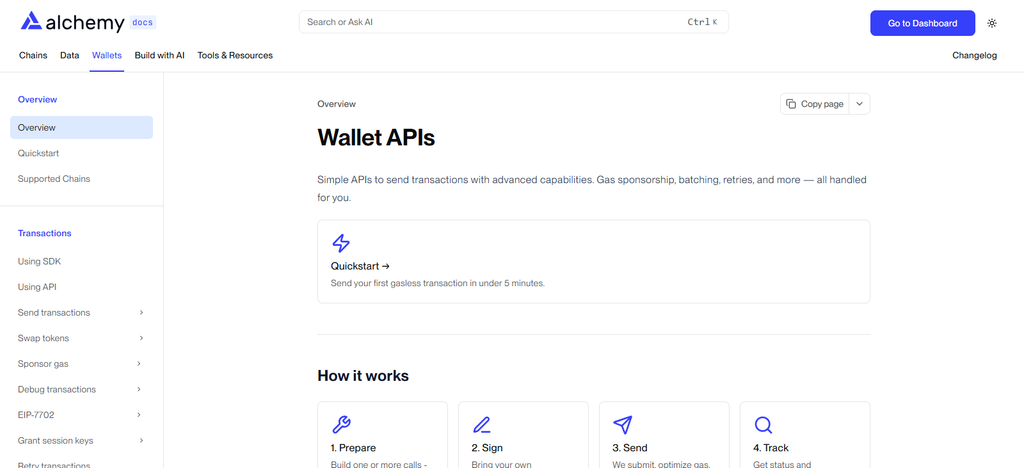
Account Kit SDKs, Bundler APIs, Gas Manager and viem-compatible smart-account packages are available for developers for building and sponsoring UserOperations. Gas Manager supports sponsored transactions with policy controls and ERC-20 gas payments.
Alchemy offers broad EVM chain coverage from Ethereum to Base, Arbitrum, Optimism, Polygon, and more. Account Kit is free to begin with, PAYG AA Gas Manager pricing includes an 8% admin fee.
Features
- Infrastructure for UserOperations bundler
- Smart Accounts and Account Abstraction SDKs
- Paymaster and Gas Manager functionality
- Sponsored transaction assistance
- Extensive developer API and EVM network coverage
Pros
- Complete Web3 developer infrastructure
- Good development tooling and well documented
- One provider bundler and paymaster
- Smooth integration with Alchemy’s existing infrastructure
- Can be used for applications spanning multiple chains
Cons
- Some advanced infrastructure features are usage based
- Platform dependency can be added by big platform
- Cost can be significant at high usage
- May seem complex at first due to broad product ecosystem
- Some features depend on supported networks
3. Pimlico
Pimlico is building the account abstraction infrastructure through its Alto bundler, paymaster services, and Permissionless.js developer library. Its design is built to work with major smart-account implementations rather than forcing developers to use one proprietary account model, giving teams flexibility when choosing wallets or smart-account contracts.
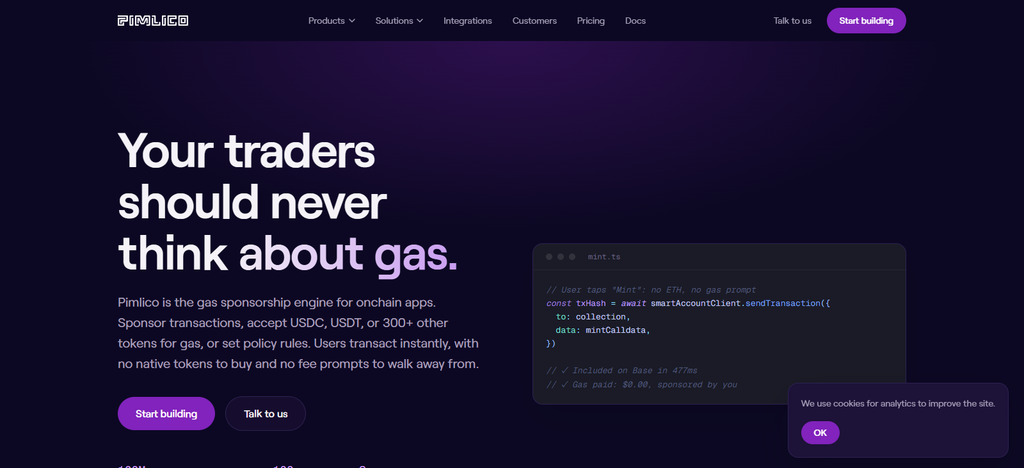
TypeScript tooling built around viem allows developers to manage UserOperations, bundling, gas sponsorship, and smart-account transactions. Pimlico supports over 100 networks including Ethereum, Base, Arbitrum, Optimism, Polygon and Gnosis. Its sponsorship system provides policies for spending and sponsored gas is charged at actual gas cost plus a stated 10% mainnet surcharge.
Features
- Bundler infra (ERC-4337)
- UserOperations Alto bundler
Paymaster & gas sponsorship services - Permissionless.js library for developer use
- Infrastructure for multi-chain account abstraction
Pros
- Focus on abstracting the account
*Provider-agnostic smart-account approach - viem based tooling with flexibility and TypeScript
- Wide network coverage
- Good for developers of custom AA stacks
Cons
- More infrastructure focused than consumer focused
- Developers might want more wallet features
- Advanced configuration may require technical expertise
- Production sponsorship costs vary.
- Not as well suited for teams that want a complete consumer wallet solution
4. Bionomy
Biconomy offers full-stack account abstraction infrastructure around smart accounts, bundling, paymasters and developer SDKs. It uses Nexus and Smart Account technologies for its current account architecture, and supports modular account functionality and ERC-7579-oriented development.
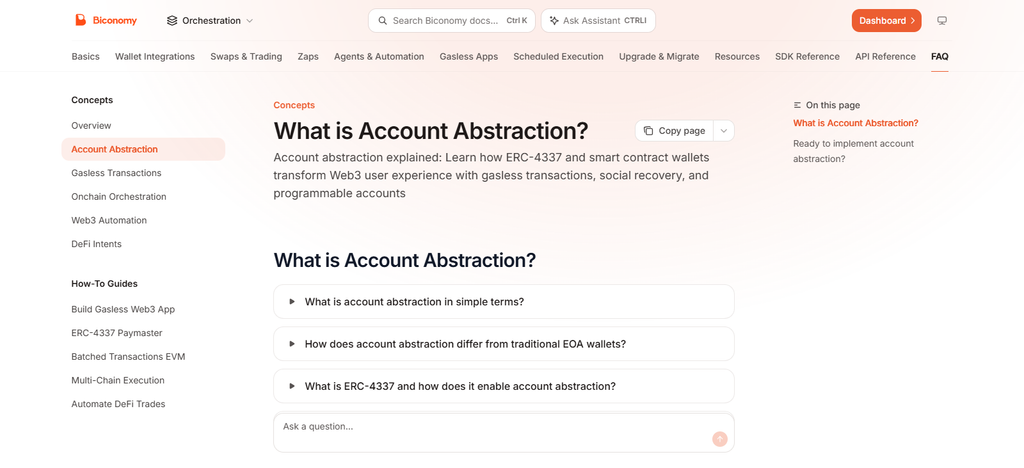
Developers are able to use Biconomy tooling to build smart-account experiences, batch transactions, sponsor gas, and simplify Web3 onboarding. It’s paymaster infrastructure enables gasless transactions and policy-based sponsorship. Its multi-chain infrastructure is targeted at applications deployed over multiple EVM networks.
Biconomy is particularly well suited for consumer applications, DeFi, gaming, and apps that require seamless transaction experiences. Cost is based on needs of infrastructure, sponsorship, and production plan selected.
Features
- Smart wallets with programmability
- Bundler and paymaster infrastructure
- Sponsoring gasless transactions
- Batching and automation of the transactions
- Multi-chain application SDKs and APIs
Pros
- Lots of focus on simple Web3 UX
- Complete account abstraction infrastructure
Onboarding helps gas sponsorship - Applicable for gaming, De-Fi and consumer applications
- Supports programmable account experiences
Cons
- Some advanced features require configuration
- Platform architecture can take time to figure out
- Sponsored transactions may increase the costs
- Provider dependency can matter for big applications
- Developers should verify feature availability by network
5. Safe
Safe provides a mature smart-account infrastructure based on modular, programmable intelligent contracts instead of traditional externally owned accounts. Its Safe Smart Account supports account abstraction workflows and ERC-4337 integrations, and its modular architecture allows developers to extend wallet functionality with additional components.
Safe provides Safe SDK, Safe APIs, transaction services and infrastructure to develop applications on top of smart accounts. It supports EVM-compatible networks, allowing developers to deploy canonical Safe contracts on new chains.
Security is a large differentiator, with extensive audits, formal verification, and long-running production use. Safe infrastructure is open source. Costs for operational infrastructure are based on deployment, indexing, hosting, and provider arrangements.
Features
- Programmable smart contract accounts
- Multisignature transaction management
- Modular account architecture
- Safe SDK and developer APIs
- Account abstraction integrations and transaction infrastructure
Pros
- Strong reputation for wallet security
- Mature smart-account ecosystem
- Excellent multisig and treasury capabilities
- Open-source infrastructure
- Suitable for DAOs and institutional applications
Cons
- More complex than basic externally owned wallets
- Some features require additional modules
- Not primarily designed for consumer onboarding
- Developers may need deeper smart-contract knowledge
- Infrastructure setup can be more involved
6. Coinbase Smart Wallet
Powered by passkeys, Coinbase Smart Wallet is a smart-account solution that seeks to eliminate seed phrases and streamline Web3 onboarding. With its account abstraction experience, users can interact with applications that sponsor network fees and support smart-wallet transactions across EVM-compatible networks.
Rather than making users install a traditional browser extension, developers are able to use Coinbase wallet infrastructure and account features. Supported networks are Base, Ethereum, Optimism, Arbitrum, Polygon and Avalanche C-Chain, with Base recommended for lower transaction costs.
Smart Wallet can also support sponsored transactions where apps can sponsor the fees. Its core strength is consumer-friendly authentication and wallet UX, especially for applications targeting mainstream users.
Features
- Passkey-based wallet authentication
- Smart-account functionality
- Gas sponsorship support
- Multi-chain EVM wallet experience
- Coinbase developer and wallet ecosystem integration
Pros
- Simple onboarding without traditional seed phrases
- Familiar user experience for mainstream users
- Passkeys improve account accessibility
- Strong integration with Coinbase infrastructure
- Useful for consumer-focused Web3 applications
Cons
- More dependent on Coinbase’s ecosystem
- Customization may be less flexible than modular AA stacks
- Developers should verify supported networks and features
- Advanced account programmability can be more limited
- Best suited to specific wallet UX requirements
7. Stack up
Stackup provides infrastructure for open, composable ERC-4337 development around account abstraction. Its stack includes the Skandha bundler, paymaster functionality, and developer tooling to enable applications to submit and process UserOperations without having to build bundler infrastructure.
Stackup is different from providers who require a proprietary smart-account model, and instead takes a more account-agnostic approach that allows developers to bring their own smart-account implementation. It has a paymaster infrastructure that allows for gas sponsorship, and can be integrated into apps that require gasless transaction experiences.
Developers may also run the relevant infrastructure themselves, for greater control. For teams that need flexible ERC-4337 infrastructure, programmable accounts, and less vendor lock-in, Stackup is the best option.
Features
- ERC-4337 bundler infrastructure
- Skandha bundler tech
- Paymaster infrastructure *
- UserOperation and Smart-account tooling
- Open and composable account abstraction stack
Pros
- smart account integrations, flexible
- Strong focus on Open ERC-4337 Infrastructure
- Helpful for developers wanting to avoid proprietary wallet stacks
- Self-hosting for more control over infrastructure
- Plays nice with custom AA implementations
Cons
- Need more technical implementation
- Wallet functionality is less consumer-oriented
- Developers may need separate smart-account parts
- Self hosting increases operational responsibility
- Infrastructure stack can be challenging for beginners
8. Candide
Candide offers open and modular account abstraction infrastructure with its AbstractionKit SDK, bundler, paymaster, and smart-account tooling. Its technology powers Safe-based smart accounts, passkeys, social recovery, spending permissions, gas sponsorship and programmable account experiences.
The stack is provider-agnostic to a degree — developers are able to plug in third-party bundlers and paymasters, or leverage Candide infrastructure. Supported networks Ethereum, Optimism, Arbitrum, Base, Polygon, BNB Chain, Celo, Gnosis, Plasma etc. Candide offers a free Starter tier with development features and limited mainnet usage, and paid Launch and Grow plans. Security audits from Ackee, Nethermind, and Certora.
Features
- Infrastructure for ERC-4337 account abstraction.
- AbstractionKit Developer SDK
- Safe-based smart accounts support
- Bundler & paymaster services
- Programmable wallet functionalities and gas sponsorship
Pros
- Open, modular development approach
- Supports various smart-account settings
gas sponsorship capabilities good - Strong focus on multi-chain
- Developer friendly abstraction tools
Cons
- Advanced configuration can be tricky
- *Smaller ecosystem compared to some of the big infrastructure providers
- Some features only available with specific integrations
- Developers need to assess chain-level availability
- Paid plans could be required for production needs
9. Etherspot
Etherspot provides account and chain abstraction infrastructure via its Modular SDK, TransactionKit, Arka Paymaster, and Skandha ERC-4337 bundler. Its modular account architecture supports ERC-7579, which allows developers to customize smart accounts with modules for security, permissions, and user-experience upgrades.
Arka supports sponsored and gasless transactions. Skandha provides bundling infrastructure with MEV-protection features and shared-mempool support. TransactionKit provides React developers with an easier layer for integration.
Etherspot also has multi-chain APIs for wallet and transaction data. It is built for multi-chain apps, wallets, DeFi and consumer Web3 products that require programmable smart accounts and flexible account abstraction components.
Features
- Smart-account infrastructure, modular
- Account architecture for ERC-7579
Skandha bundler infrastructure - Arka sponsor of paymasters and gas
- TransactionKit and multi-chain SDK tooling
Pros
- Solid modular account architecture
- Handy Multi-Chain Development Tools
- Bundler and paymaster features in a single stack
- Works well with wallets and DeFi applications
Cons
- Implementation complexity could increase with a modular architecture
- TransactionKit can ease integration
- Technical expertise needed for advanced features
- *Pricing is based on infrastructure requirements
- *Pricing is based on infrastructure requirements
Some capabilities vary by supported chains - Not so well suited for very basic wallet apps
Conclusion
Account abstraction is emerging as a core building block to build simpler and more flexible Web3 applications in 2026. Smart accounts, ERC-4337 infrastructure, EIP-7702 support, paymasters, gas sponsorship, developer SDKs, security controls, and multi-chain coverage are available through a variety of platforms including ZeroDev, Alchemy Account Kit, Pimlico, Biconomy, Safe, Coinbase Smart Wallet, Stackup, Candide and Etherspot.
The developer should compare these capabilities based on the type of application, the desired wallet experience, the supported networks, the transaction volume, the security needs, and the pricing model. The right platform makes Web3 onboarding friction-free and provides gasless transactions, programmable accounts, and a more familiar user experience.
FAQ
What is Account Abstraction in Web3?
Account abstraction allows Web3 applications to make blockchain accounts more programmable and user-friendly. It can enable features such as gasless transactions, transaction batching, customized authentication, spending controls, and smart-account recovery.
Which Account Abstraction platform is best for Web3 apps?
The best platform depends on the application’s requirements. ZeroDev, Alchemy Account Kit, Pimlico, Biconomy, Safe, Coinbase Smart Wallet, Stackup, Candide, and Etherspot each provide different combinations of smart accounts, bundlers, paymasters, SDKs, security features, and multi-chain infrastructure.
What is ERC-4337 Account Abstraction?
ERC-4337 is an Ethereum account abstraction standard that enables smart accounts without requiring changes to the Ethereum consensus layer. It uses components such as UserOperations, bundlers, EntryPoint contracts, and paymasters to support programmable transaction experiences.
What is a Paymaster in Account Abstraction?
A paymaster is a smart contract that can sponsor transaction gas for users. It allows applications to offer gasless transactions or, depending on the implementation, let users pay transaction fees using supported ERC-20 tokens instead of the network’s native token.
Can Account Abstraction support gasless transactions?
Yes. Account abstraction can enable gasless transactions through paymasters and sponsorship systems. The application, developer, or another sponsoring entity can cover the user’s network fees according to predefined policies and spending limits.