


This article will highlight optimal Crypto APIs for Developers that empower the construction of complex cryptocurrency applications, trading platforms, wallets, and Web3 solutions.
Possessing key elements like immediate market data, blockchain connections, transaction oversight, and safe integrations, these APIs are invaluable to their user base.
We will analyze the APIs’ attributes, cost to the consumer, advantages, and their scenarios of implementation. Ultimately, this will aid in the selection of the best crypto API.
What Are Crypto APIs?
Crypto APIs are bridging tools for popular apps and markets that rely on cryptocurrencies. Blockchains and their associated services are not easy to work with. Crypto APIs, therefore, help developers target crypto data, conduct trades, and handle transaction records, as well as distribute the control of network wallets and facilitate the interaction of neighboring infrastructures.
Crypto APIs are useful for building a trading platform, payment systems, NFT markets, DeFi applications, and Web3 applications. Trading platforms usually have their own proprietary APIs, like Binance API and Coinbase API. Other Crypto APIs, like Alchemy and Infura, provide other infrastructure-related API services and help with the development of decentralized applications.
Why Use Crypto APIs for Development in 2026?
Speeding Up Blockchain App Development
Developing a cryptocurrency app can be tedious when a developer needs to build a custom, complex infrastructural solution to connect to a blockchain. Luckily, Crypto APIs provides ready-to-use tools to reduce development time. This includes tools to connect the developer’s app to a blockchain, facilitate crypto trading, manage wallets, and facilitate transactions.
Simplified Integration of Crypto
Integration of new app features can be laborious for a developer. This is especially true when a developer needs to build the infrastructure for the features. Crypto APIs saves a developer time by providing endpoints and tools to integrate crypto payments, transactions, trading, wallet services, and even price tracking into their application.
Access to Live Market Data
With Crypto APIs, developers have access to a wealth of market data. In addition to order book data, Crypto APIs provide access to live trade data, trading volume, and market data. Having access to Crypto APIs can help developers build a trade, analytic, or investment app with the proper data a user would need to make an informed decision.
Available for Web3 and User Decentralized Apps
The popularity and need for reliable APIs has skyrocketed in 2026 due to the ever-increasing popularity of DeFi, Web3, NFTs, and blockchain apps. Assisted by Crypto APIs, developers can easily connect to a blockchain network, smart contracts, and user decentralized systems.
Low Infrastructure Cost
Building a custom solution for a business’s needs can be costly. It can be especially difficult to build and maintain a business’s blockchain crypto infrastructure. Crypto APIs ready blockchain infrastructure helps businesses maintain their cost and reach their goals.
Security and Reliability
Crypto APIs are one of the best solutions for developing secure and reliable applications because the leading Crypto APIs have even advanced security features like permission controls and monitoring systems.
Multi-Blockchain Support
Modern crypto APIs boast interoperability across multiple blockchain networks. Developers can build multi-ecosystem apps. Support for more blockchains means more flexible solutions for Ethereum, Polygon, Solana, Arbitrum, and beyond.
Scalability for Growing Applications
Crypto APIs accommodate a growing user base, higher volumes of transactions, and requests for more data. Therefore, they fit the needs of large-scale cryptocurrency applications, built by startups, FinTech, and enterprises.
Automation and Advanced Trading
Crypto APIs build automated trading bots and systems and even help construct tools for portfolio management and smart investments. These advanced assets help companies cater to user demands by offering advanced services.
Enterprise Adoption and Innovation
In 2026, enterprises will be able to easily adopt Crypto APIs. More enterprises will embrace blockchain for payments, finance, and digital assets. Crypto APIs will enable enterprises to turn their focus to innovative work, while they use crypto for their business.
Benefits of Using Crypto APIs for Developers
Makes Integration with Crypto Easy
Integrating payment, trading, or wallet functions and accessing blockchain data can be extremely difficult for developers because they would have to create a system to support those functions. Crypto APIs provide the necessary structures and functions as services to create applications seamlessly and with speed.
Low Development Costs
Infrastructure supporting the blockchain, the nodes, the blockchain security, and the access to the blockchain create large costs and a lengthy development period. Crypto APIs allows those costs to be reallocated to the development of the user experience and the business functions of the application.
Access to Live Blockchain Data
Developers creating financial applications, portfolio applications, or trading applications must have access to timely data. Crypto APIs provide the information necessary to keep applications functional and relevant including prices, transactional data, volume, and market data.
Integrates Wallet with Security
Managing digital assets comes with many security risks, but Crypto APIs provide the functions necessary to integrate wallet features with the security necessary to protect those assets. Balance tracking and the histories of deposits and withdrawals can also be integrated.
Blockchain Network
Smart contracts, various cryptocurrencies, and decentralized ecosystems rely on multiple blockchain networks. The majority of Crypto APIs support the structures and functions to interface with various networks empowering developers to create applications with multiple chains.
Scalability
The Crypto APIs infrastructure is reliable and allows developers to scale the applications they have created without managing additional infrastructure for networks and servers. Developers can expect their users, data requests, and transactions to be handled effortlessly.
Lowers Infrastructure Costs
Building custom blockchains will require considerable technological skill and investment. Crypto API offers affordable access to blockchain services. Startups and enterprises are able to lessen operating and development costs.
Increases Security and Compliance
Security is included during construction of the API in services of many leading Crypto sites. Services of Crypto sites help developers build secure applications and help developers to be compliant with the growing set of standards.
Fosters Development of Web3 Applications
Crypto APIs include the resources required to build decentralized applications (dApps), DeFi, and blockchain services, as well as NFT. Crypto APIs also provide simple resources to interact with smart contracts and blockchain networks.
Supports Automated Trading
With Crypto APIs, trading bots, algorithmic trading systems, and automation of investment systems can be built. The APIs help developers build financial applications by providing simple resources to interact with trading and market services.
Improves Developer Convenience
Crypto APIs provide extensive documentation, as well as SDKs, testing environments, and developer dashboards, all of which greatly simplify development and integration, and which also aid in troubleshooting.
Embraces Upcoming Blockchain Developments
Crypto APIs provide developers with the resources to be at the forefront of new developments based on blockchain, including tokenization, Web3, decentralized identity, and digital finance.
Key Point & Best Crypto APIs for Developers
| Crypto API | Key Points |
|---|---|
| Coinbase API | • Provides secure access to cryptocurrency trading, wallet, and account management features.• Supports real-time market data, transactions, and payment integrations.• Offers developer-friendly REST and WebSocket APIs.• Suitable for building crypto wallets, trading platforms, and payment apps.• Provides strong security features with institutional-grade infrastructure. |
| Binance API | • Offers high-performance trading APIs with access to a wide range of cryptocurrencies.• Supports spot, futures, margin trading, and market data services.• Provides REST, WebSocket, and FIX API options for developers.• Includes advanced order types and real-time price updates.• Ideal for high-frequency trading apps and crypto exchanges. |
| Kraken API | • Provides reliable access to crypto trading and market data services.• Supports spot trading, futures, staking, and account management features.• Offers REST and WebSocket APIs for real-time applications.• Known for strong security practices and compliance standards.• Suitable for professional trading tools and portfolio applications. |
| Gemini API | • Enables developers to integrate cryptocurrency trading and custody services.• Provides secure market data and account management capabilities.• Supports REST and WebSocket API connections.• Focuses on regulatory compliance and institutional security.• Best suited for fintech apps requiring trusted crypto infrastructure. |
| Bitstamp API | • Provides access to cryptocurrency trading, transactions, and market data.• Supports REST, WebSocket, and FIX API integrations.• Offers reliable liquidity and exchange connectivity.• Designed for both retail applications and professional trading systems.• Provides secure and stable API performance for developers. |
| OKX API | • Offers advanced trading APIs for spot, futures, options, and derivatives.• Provides real-time market data and automated trading capabilities.• Supports REST, WebSocket, and Web3 API solutions.• Includes tools for algorithmic trading and portfolio management.• Suitable for developers building advanced crypto applications. |
| KuCoin API | • Provides access to crypto trading, market data, and account services.• Supports spot, margin, futures, and automated trading integrations.• Offers REST and WebSocket APIs for real-time applications.• Includes a large selection of supported cryptocurrencies.• Useful for exchange platforms, bots, and portfolio trackers. |
| MEXC API | • Enables integration with crypto trading and market data services.• Supports spot trading, futures, and automated trading solutions.• Provides REST and WebSocket API connectivity.• Offers access to a wide range of digital assets.• Suitable for developers creating trading tools and analytics platforms. |
| Alchemy API | • Provides blockchain infrastructure APIs for Web3 developers.• Supports Ethereum, Polygon, Arbitrum, Optimism, and other networks.• Offers node infrastructure, NFT APIs, and developer tools.• Helps build decentralized applications (dApps) efficiently.• Provides scalable and reliable blockchain connectivity. |
| Infura API | • Provides blockchain node infrastructure for Web3 applications.• Supports Ethereum and multiple blockchain networks.• Offers APIs for smart contracts, wallets, and decentralized apps.• Enables scalable blockchain access without managing nodes.• Widely used by developers building Web3 and DeFi applications. |
1. Coinbase API
Coinbase was launched with an open API in 2012, allowing developers to design trading apps, payment methods, wallets, and other services. Real-time data of an extensive range of cryptocurrencies and methods of trade is offered to developers.
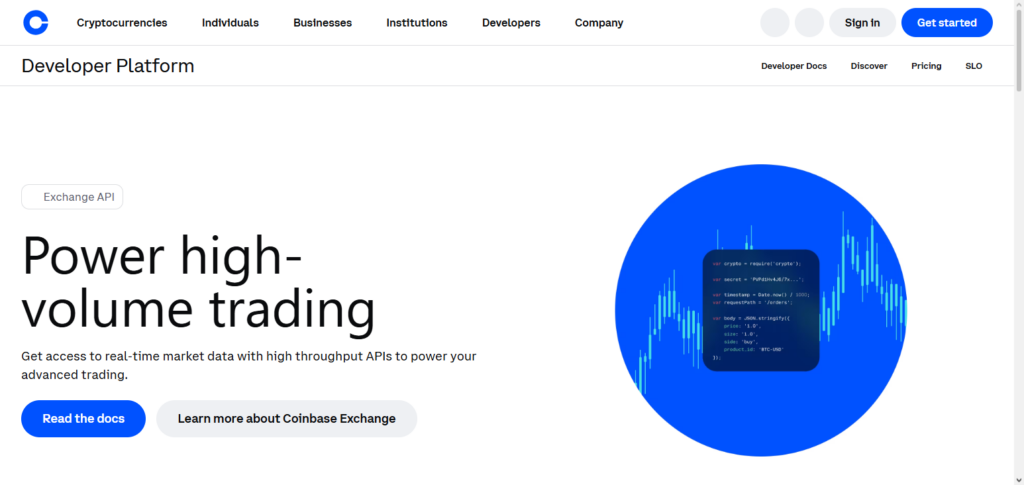
Coinbase API offers account management, cryptocurrency transactions, and trading features. API costs vary with trade volume, with basic services offered for free. Also, features with a higher trade volume will incur a higher cost. BTT, credit/debit transfers, and other cryptocurrencies are the methods for payment.
Withdrawal methods depend on the payment methods and regulations in your country. The main countries where Coinbase is offered are the US, UK, EU, Canada, Singapore, and Australia. Coinbase is also a popular API in the rest of the world.
Coinbase API Features
| Feature | Details |
|---|---|
| Trading Integration | Allows developers to integrate cryptocurrency buying, selling, and trading functionality into applications. |
| Real-Time Market Data | Provides live cryptocurrency prices, order book information, trading pairs, and market statistics. |
| Wallet Management | Enables users to manage crypto wallets, balances, transactions, and account information. |
| Payment Infrastructure | Supports crypto payment solutions for businesses and applications. |
| REST & WebSocket Support | Offers APIs for both standard requests and real-time data streaming. |
| Security Features | Provides authentication, API key management, and secure transaction processing. |
| Multi-Currency Support | Supports multiple cryptocurrencies including Bitcoin, Ethereum, and other digital assets. |
| Developer Tools | Provides documentation, SDKs, and resources for easier application development. |
2. Binance API
Binance launched their API in 2017 alongside their automated systems, portfolios, and crypto infrastructure. This API serves many developer needs and is ranked as one of the top Crypto APIs. Binance API handles spot trading, futures, margin trading, market data, and account management.
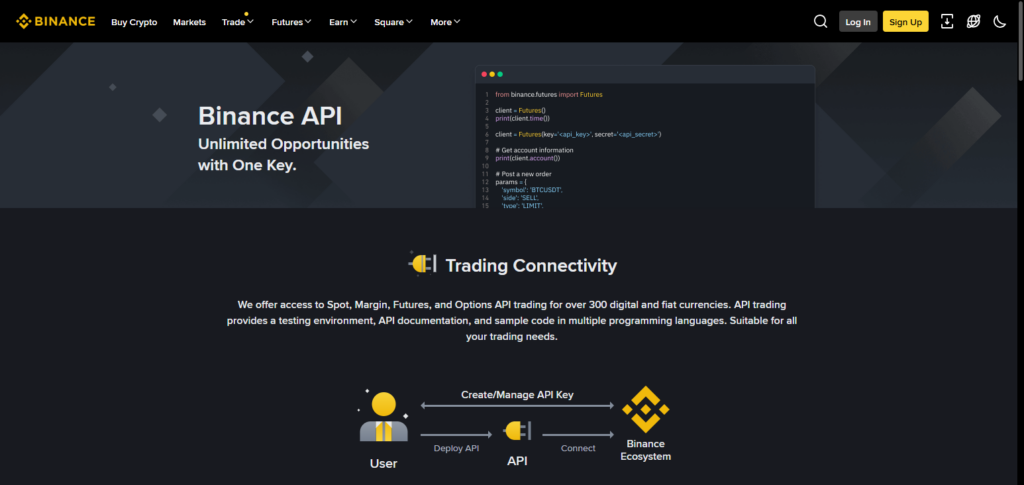
The API is largely free, but there are trading fees that depend on the transaction and the status of the user’s account. The API accepts deposits in crypto and the supported fiat payment methods. Withdrawals are the inverse and are sent to the user in a digital asset and a supported fiat cash out.
Users from many continents can access Binance. The user base is largely from Europe, Asia, Africa, and Latin America. Some services are limited in certain countries due to laws and regulations.
Binance API Features
| Feature | Details |
|---|---|
| Spot Trading API | Enables developers to create applications for cryptocurrency spot trading. |
| Futures & Margin Trading | Supports advanced trading features including futures and margin markets. |
| Real-Time Market Data | Provides live prices, order books, trade history, and market depth information. |
| Automated Trading | Allows developers to build trading bots and algorithmic strategies. |
| WebSocket API | Provides instant updates for market movements and account activities. |
| Large Crypto Support | Offers access to hundreds of cryptocurrency trading pairs. |
| Account Management | Allows users to access balances, orders, deposits, and withdrawals. |
| High Performance | Designed for applications requiring fast execution and high-volume trading. |
3. Kraken API
Launched in 2011, Kraken API helps developers and businesses build apps using a secure trading infrastructure for cryptocurrencies. Helping developers trade and analyze more easily, Kraken API is one of the Best Crypto API for Developers.
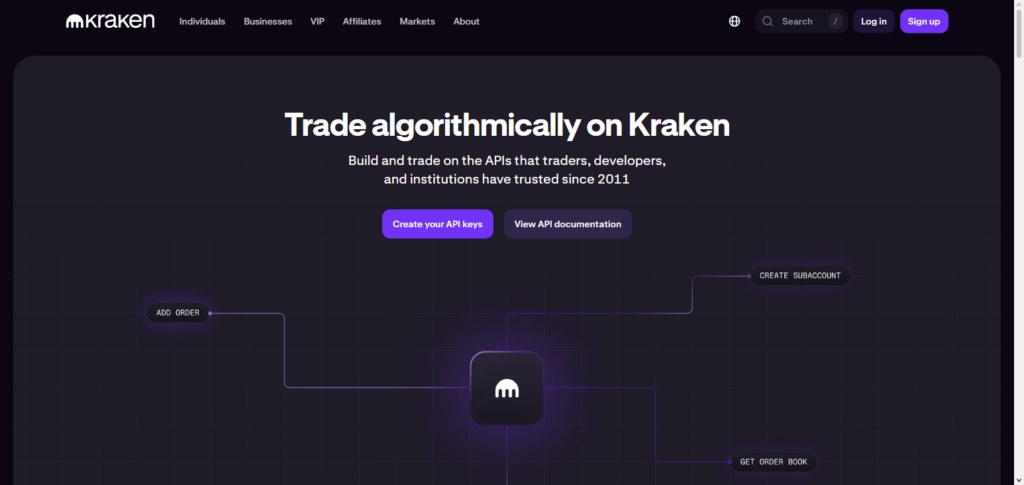
Its popular REST and WebSocket APIs encapsulate most aspects of automated trading and allow easy access to market data and account information. No additional fee is charged for API access, though a trading fee is incurred based on the volume of trade.
Like many other Crypto APIs, both bank and cryptocurrency transfers are offered for making deposits, while withdrawals (both fiat and digital) are location-based. Kraken is limited in coverage to the US, Canada, the UK, most of Europe, Japan, and Australia.
Kraken API Features
| Feature | Details |
|---|---|
| Trading API | Provides access to cryptocurrency buying, selling, and order management features. |
| Market Data Access | Offers real-time prices, charts, order books, and trading information. |
| REST & WebSocket APIs | Supports both traditional API requests and live market data streaming. |
| Account Management | Allows developers to access balances, transaction history, and user data. |
| Security Controls | Includes authentication systems and API permission management. |
| Multiple Asset Support | Supports various cryptocurrencies and fiat trading pairs. |
| Automated Trading Support | Enables developers to create trading applications and bots. |
| Institutional Tools | Provides features suitable for professional trading platforms. |
4. Gemini API
Founded in 2014, Gemini API specializes in secure cryptocurrency trading, custody, and financial infrastructures for developers. The Gemini API is recognized as one of the Best Crypto APIs for Developers due to reliable trading integrations, real-time market data, and security features at the institutional level.
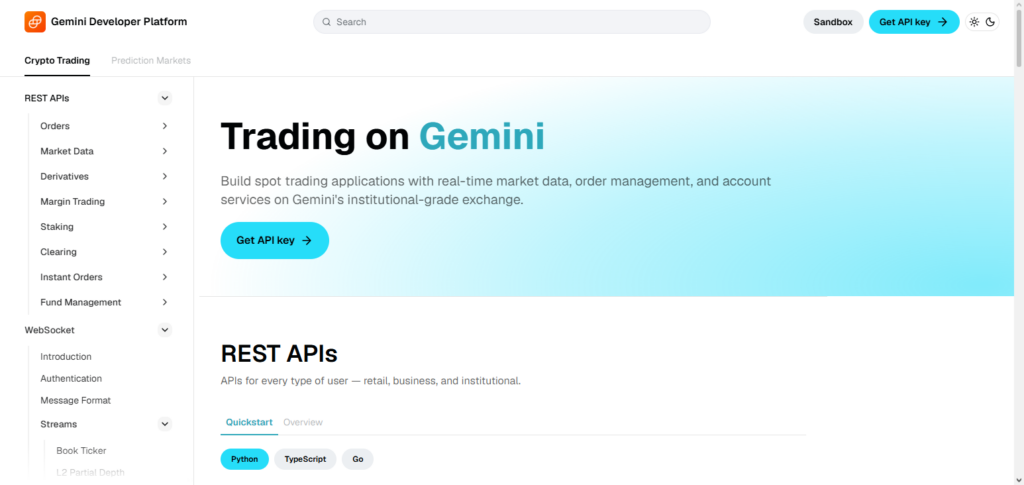
Generally, Gemini API access is at no cost; however, users are charged a trading fee based on the transaction and service consumption. Users can deposit funds via bank and debit card transfers, and crypto transfers in eligible regions.
Users can withdraw funds via a crypto transfer and fiat withdrawal through a supported bank transfer. Gemini API is mostly available in the United States, United Kingdom, European Union, Singapore, and select countries.
Gemini API Features
| Feature | Details |
|---|---|
| Crypto Trading Integration | Allows applications to connect with Gemini trading services. |
| Market Data API | Provides real-time prices, trading volume, and market information. |
| Account Services | Enables access to balances, orders, and transaction records. |
| Secure Infrastructure | Built with strong security and compliance-focused technology. |
| REST & WebSocket Support | Provides flexible API connectivity for developers. |
| Custody Integration | Supports secure digital asset storage solutions. |
| Institutional Features | Offers tools for businesses and financial applications. |
| Developer-Friendly Documentation | Provides resources for easy API implementation. |
5. Bitstamp API
Bitstamp’s API, launching in 2011 and among the earliest cryptocurrency exchange APIs, began development of the first viable cryptocurrency API for exchanges. The Bitstamp API offers developers freedom to integrate trading, account, market, transaction, and other financial application features.
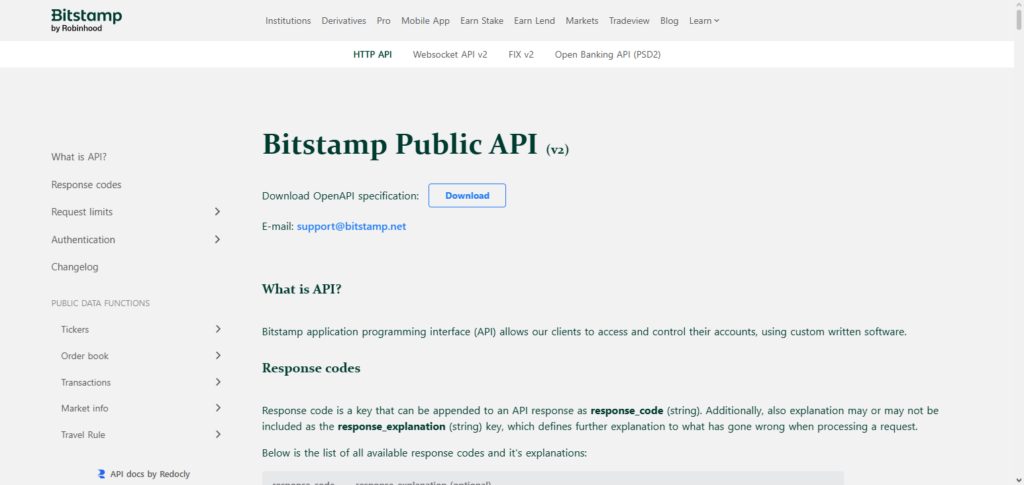
This API is free to use and has a trading fee structure based on a user’s trading volume in a month. Transfers and withdrawals are available via bank transfers, cards, and crypto payments. The API also supports other digital currencies.
Bitstamp focuses on servicing the user markets in Europe, United States, and United Kingdom, while other countries are serviced based on approval. Bitstamp provides the reliability and compliance suitable for regulated Fintech applications.
Bitstamp API Features
| Feature | Details |
|---|---|
| Trading API | Enables cryptocurrency trading integration for applications and platforms. |
| Market Data Services | Provides live prices, trading pairs, and historical market data. |
| REST API Support | Allows developers to perform trading and account-related operations. |
| WebSocket API | Provides real-time updates for market activities. |
| Account Management | Supports balances, order history, and transaction information. |
| Secure Transactions | Uses authentication and security measures for API access. |
| Fiat Support | Enables integration with crypto and traditional currency markets. |
| Reliable Infrastructure | Provides stable API services for fintech and trading applications. |
6. OKX API
Launched in 2017, the OKX API provides developers with sophisticated trading and blockchain infrastructure. As one of the best crypto APIs, it supports spot and derivatives trading, as well as Web3 and automated trading application integrations.
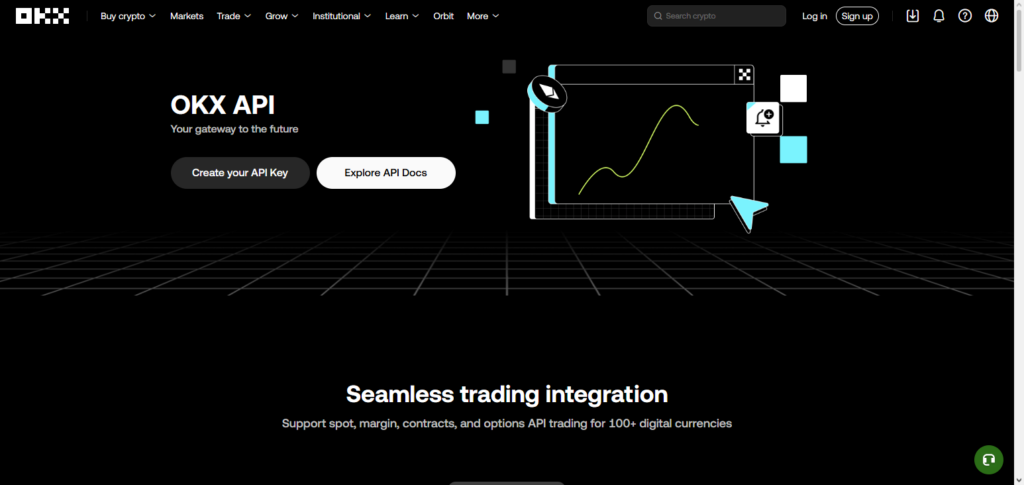
Access is free, but users pay trading fees based on their trading tier and volume. Deposits may be made as cryptocurrency transfers and select fiat payment methods. Withdrawals are made via crypto networks and supported transfer currencies.
OKX is available in many regions including Asia, Europe, and the Middle East, but offerings are limited in regions with stricter regulations. The API is leveraged by developers to build high-performance crypto applications.
OKX API Features
| Feature | Details |
|---|---|
| Spot Trading API | Allows developers to integrate cryptocurrency spot trading features. |
| Derivatives Support | Provides access to futures, options, and advanced trading markets. |
| Web3 API Tools | Supports decentralized applications, wallets, and blockchain services. |
| Real-Time Data | Offers live market prices, order books, and trading information. |
| Algorithmic Trading | Enables automated strategies and trading bot development. |
| Multiple Blockchain Support | Provides access to Web3 and blockchain-related services. |
| Portfolio Management | Helps applications track balances and trading activities. |
| High-Speed Performance | Designed for professional-grade trading applications. |
7. KuCoin API
Launched in 2017, KuCoin API provides web development tools for automated investment applications, market analysis, and cryptocurrency trading. KuCoin API is one of the Best Crypto APIs for Developers. Among the services it provides are spot trading, trading futures, trading account management, and real-time market data using REST and WebSocket connections.
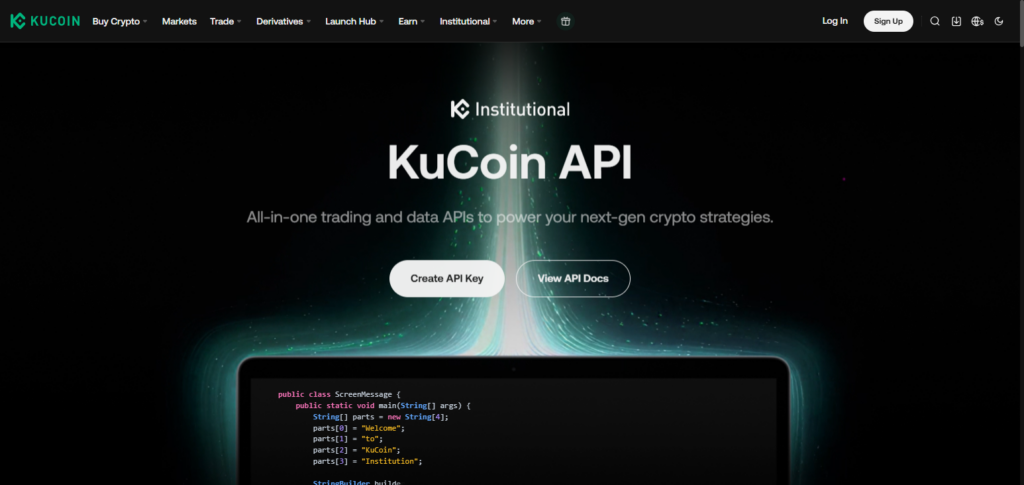
Accessing the API is free; however, there are trading fees based on user activity and the volume of trades. KuCoin users can only deposit and withdraw funds in the cryptocurrencies they support and in the fiat currencies they support. KuCoin serves users in most states of Asia, Europe, Africa, and Latin America. Some areas have restrictions based on compliance and other policies.
KuCoin API Features
| Feature | Details |
|---|---|
| Trading Integration | Provides access to spot, margin, and futures trading features. |
| Market Data API | Offers real-time prices, charts, and cryptocurrency statistics. |
| Automated Trading | Allows developers to create trading bots and automated solutions. |
| WebSocket Connectivity | Provides instant market and account updates. |
| Multiple Cryptocurrency Support | Supports a wide range of digital assets and trading pairs. |
| Account Management | Enables access to orders, balances, and transaction history. |
| Security Controls | Provides API key permissions and authentication features. |
| Developer Resources | Includes documentation and tools for easier integration. |
8. MEXC API
MEXC API, established in 2018, enables developers to use tools for automated trading, crypto trades, and access to crypto market data. MEXC is one of the Best Crypto APIs for Developers for many reasons, among which is the fact that the platform provides access to spot markets and futures, as well as an option for integration of real-time pricing data.
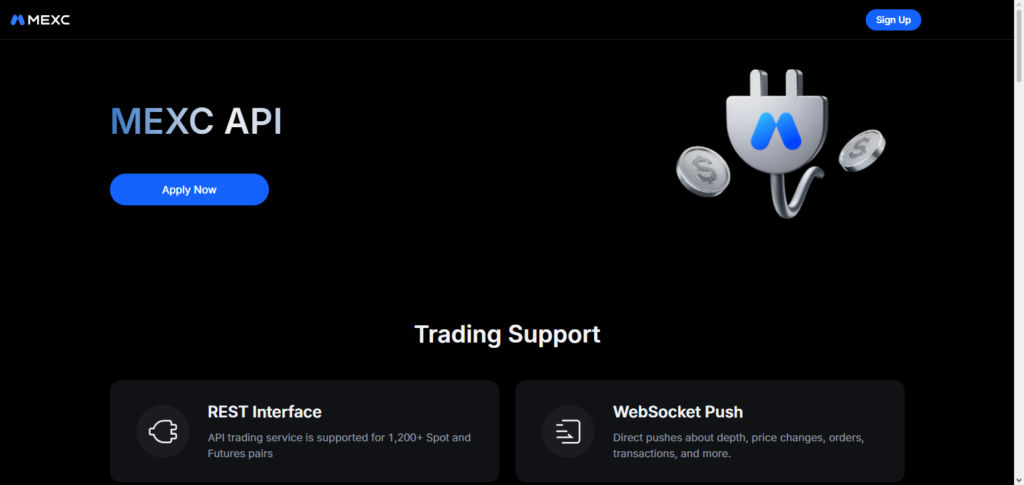
While MEXC API access is usually free, users of the API pay trading fees based on the account tier they select and their trading volume. Deposits to the trading account are made in cryptocurrencies and, to a limited extent, in fiat currencies through third parties.
Withdrawals may be made in cryptocurrencies through various blockchains. MEXC’s services are available to most countries in Asia, Europe, Africa, and Latin America, but in some countries, services may be limited.
MEXC API Features
| Feature | Details |
|---|---|
| Spot Trading API | Allows developers to integrate cryptocurrency spot trading services. |
| Futures API | Supports derivatives trading and advanced market features. |
| Market Data Access | Provides real-time prices, trading volume, and market trends. |
| WebSocket Support | Enables live updates for trading applications. |
| Automated Trading | Helps developers build crypto bots and trading systems. |
| Wide Asset Coverage | Supports many cryptocurrencies and trading pairs. |
| Account Integration | Provides access to user balances and trading activities. |
| Scalable Infrastructure | Supports applications requiring reliable exchange connectivity. |
9. Alchemy API
Founded in 2017, Alchemy API specializes in providing blockchain infrastructure as a service. With a focus on supporting Web3, unlike exchange based APIs, Alchemy offers blockchain nodes and tools for NFTs, along with smart contract and dApp support.
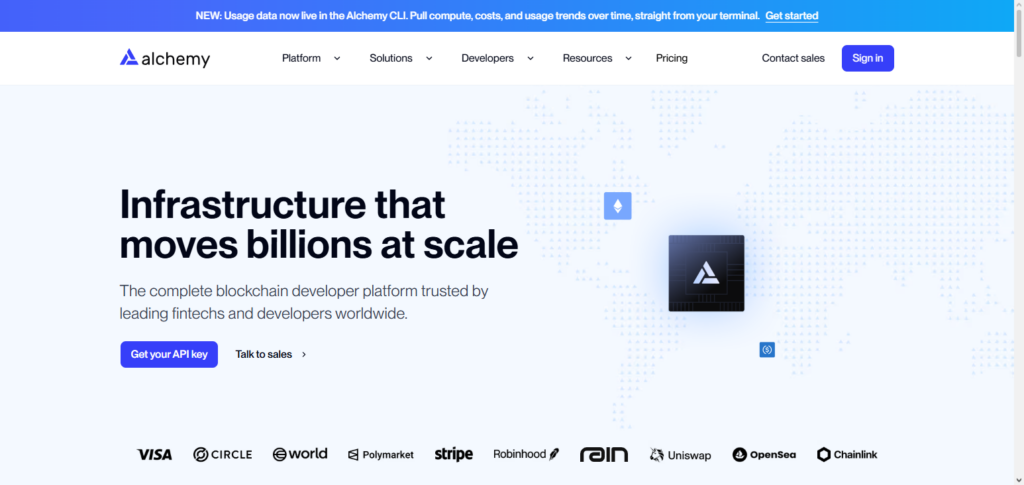
Alchemy is considered one of the Best Crypto APIs for Developers, as it offers a free developer plan with the option for paid plans with additional usage limits and enterprise plans. As infrastructure as a service,
Alchemy does not offer exchange services so it does not support crypto deposits and withdrawals. Alchemy offers support for developers in every country around the world and collaborates with the key blockchain networks of Ethereum, Polygon, Arbitrum, and Optimism.
Alchemy API Features
| Feature | Details |
|---|---|
| Blockchain Node Infrastructure | Provides reliable blockchain access without managing personal nodes. |
| Multi-Chain Support | Supports networks including Ethereum, Polygon, Arbitrum, and other chains. |
| NFT API Tools | Enables developers to access NFT data, ownership details, and metadata. |
| Smart Contract Support | Allows interaction with blockchain smart contracts. |
| Enhanced Blockchain Data | Provides advanced APIs for transaction tracking and blockchain analytics. |
| Web3 Development Tools | Helps developers build decentralized applications efficiently. |
| Scalable Infrastructure | Supports applications ranging from startups to enterprise platforms. |
| Developer Dashboard | Provides monitoring, analytics, and API management tools. |
10. Infura API
Founded in 2016, Infura API builds blockchain infrastructure to allow Web3 app developers to scale their work. Infura is a top choice for developing apps since it provides access to nodes and contracts through an API, as well as decentralized infrastructure.
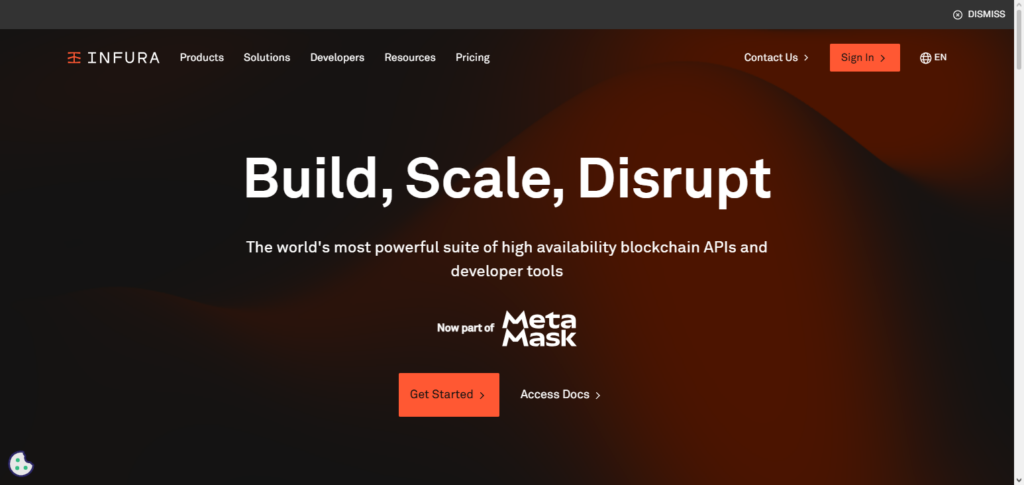
Developers do not have to build their own infrastructure. Infura has a free plan at the basic level, and offers paid plans that scale with the level of API requests and enterprise needs.
As it is not an exchange, Infura does not allow deposit and withdrawal services. Infura services the global needs of developers and API users from many countries. It provides access to many networks, including Ethereum and Polygon.
Infura API Features
| Feature | Details |
|---|---|
| Blockchain Node Access | Provides instant access to blockchain networks without running nodes. |
| Ethereum Infrastructure | Offers reliable Ethereum connectivity for Web3 applications. |
| Multi-Chain Support | Supports multiple blockchain networks for decentralized development. |
| Smart Contract Integration | Allows applications to interact with blockchain smart contracts. |
| Wallet Connectivity | Helps developers build wallet-based applications and services. |
| NFT Development Support | Provides blockchain access for NFT platforms and marketplaces. |
| Scalable API Requests | Handles high-volume blockchain interactions for applications. |
| Web3 Developer Tools | Provides documentation and infrastructure for building decentralized apps. |
Comparison Table: Best Crypto APIs for Developers in 2026
| Crypto API | Founded | Best For | Key Features | Pricing Model | Supported Platforms |
|---|---|---|---|---|---|
| Coinbase API | 2012 | Crypto wallets, payments, trading apps | Trading integration, wallet management, real-time market data, payment solutions, secure authentication | Free access with usage-based fees and trading charges | REST API, WebSocket API, Mobile & Web Applications |
| Binance API | 2017 | Trading platforms and automated bots | Spot trading, futures, margin trading, market data, WebSocket streaming, algorithmic trading | Free API access with trading fees based on volume | REST API, WebSocket API, FIX API |
| Kraken API | 2011 | Professional trading applications | Trading tools, account management, market data, secure API access, automated trading support | No API access fee; trading fees apply | REST API, WebSocket API |
| Gemini API | 2014 | Secure fintech and institutional apps | Crypto trading, custody solutions, market data, account services, compliance-focused infrastructure | Free API access with transaction-based fees | REST API, WebSocket API |
| Bitstamp API | 2011 | Financial platforms and trading solutions | Trading integration, market data, account management, transaction services, WebSocket support | Volume-based trading fees | REST API, WebSocket API, FIX API |
| OKX API | 2017 | Advanced trading and Web3 applications | Spot trading, futures, options, Web3 tools, real-time data, automated trading | Free API access with trading fees | REST API, WebSocket API |
| KuCoin API | 2017 | Trading bots and crypto applications | Spot trading, futures, market data, account services, automation tools | Free API access with trading fees | REST API, WebSocket API |
| MEXC API | 2018 | Crypto exchanges and analytics platforms | Spot trading, futures API, market data, automated trading, multiple asset support | Free API access with trading fees | REST API, WebSocket API |
| Alchemy API | 2017 | Web3 apps and dApps | Blockchain nodes, NFT APIs, smart contracts, multi-chain support, blockchain analytics | Free plan with paid developer and enterprise plans | Ethereum, Polygon, Arbitrum, Optimism, Web3 Networks |
| Infura API | 2016 | Blockchain infrastructure and dApps | Blockchain node access, Ethereum support, smart contract interaction, Web3 tools, scalable infrastructure | Free tier with usage-based paid plans | Ethereum, Polygon, IPFS, Web3 Networks |
Quick Recommendation
| Developer Need | Best Crypto API Choice |
|---|---|
| Building Crypto Trading Platform | Binance API, Coinbase API, Kraken API |
| Creating Crypto Wallet Applications | Coinbase API, Alchemy API, Infura API |
| Developing Web3 dApps | Alchemy API, Infura API |
| Building Trading Bots | Binance API, OKX API, KuCoin API |
| Enterprise Crypto Solutions | Coinbase API, Gemini API, Kraken API |
| Multi-Chain Blockchain Development | Alchemy API, Infura API |
| Accessing Real-Time Market Data | Binance API, Coinbase API, Kraken API |
Conclusion
Selecting a Crypto API as a developer entails examining the nature of the project, necessary functionalities, security requirements, and the extent of blockchain network offerings.
Trading APIs such as Coinbase, Binance, Kraken, and OKX work best for building payment applications, portfolio trackers, and trading applications. On the other hand, infrastructure APIs such as Alchemy and Infura are suitable for building Web3 and decentralized applications.
Prior to selecting a Crypto API, its reliability, price, supported countries, quality of documentation, level of security, and scalability should be evaluated. The right API helps developers build powerful, secure, and effective Cryptocurrency applications in 2026 by simplifying the integration of blockchain.
FAQ
What are Crypto APIs for Developers?
Crypto APIs are software interfaces that allow developers to integrate cryptocurrency features into applications. They provide access to blockchain data, crypto trading, wallet management, payment processing, market prices, and transaction services without building blockchain infrastructure from scratch.
Which are the Best Crypto APIs for Developers in 2026?
Some of the best crypto APIs for developers include Coinbase API, Binance API, Kraken API, Gemini API, Bitstamp API, OKX API, KuCoin API, MEXC API, Alchemy API, and Infura API. The best choice depends on whether developers need trading, blockchain data, or Web3 infrastructure.
Are Crypto APIs Free to Use?
Many crypto APIs offer free plans with limited requests and features. Advanced features, higher API limits, enterprise support, and additional services usually require paid subscriptions or usage-based pricing.
Which Crypto API is Best for Building Trading Applications?
Binance API, Coinbase API, Kraken API, and OKX API are popular choices for building trading applications because they provide real-time market data, order execution, account management, and automated trading capabilities.
Which Crypto APIs Are Best for Web3 and dApp Development?
Alchemy API and Infura API are widely used for Web3 and decentralized application development. They provide blockchain node access, smart contract interaction, NFT tools, and scalable infrastructure for dApps.