


In this article, I will review Best Intent-Based Crypto Trading Protocols for traders and developers. I will be comparing top protocols on intent execution, solver networks, trading assets, supported chains, fees, security, cross-chain capabilities, MEV protection, liquidity access, and execution models. This guide will show readers how each protocol works and select the right platform for specific needs of crypto trading.
What Are Intent-Based Crypto Trading Protocols?
Intent-based crypto trading protocols enable users to specify what they want to achieve rather than having to manually select each individual step to effect a trade. The trader can specify an outcome (e.g. swap 1 token for another at a minimum price) and solvers, fillers, relayers or market makers can decide the most efficient way to satisfy that request.
Depending on the protocol, execution can be through batch auctions, Dutch auctions, RFQ systems or cross-chain settlement. These protocols could ease trading, improve access to liquidity, decrease gas-management needs, and reduce certain MEV risks, but with added solver and settlement considerations.
How Intent-Based Trading Works
Intent-based trading decouples what a user wants from how it gets done. Instead of manually selecting a DEX, route, bridge, or liquidity pool, the user declares an intent and allows specialized actors to compete to satisfy it.
Intent creation by user: The trader sets the desired outcome e.g. swap 1 ETH for USDC for a minimum amount or transfer assets to another blockchain.
Sign and submit intent: The user signs the order or intent with the necessary conditions, token, amount, destination, expiration and minimum output.
Solvers vs Fillers: Solvers, fillers, relayers or market makers understand the intention and figure out how they can execute it. They can borrow liquidity from AMMs, private inventories, aggregators or other markets .
Pricing & Execution: Depending on the protocol, execution can be a Dutch auction, batch auction, RFQ or competitive solver model. The participant who gives the most suitable execution will have the possibility to carry out the intention.
Sourcing Liquidity: The preferred solver chooses the underlying liquidity route, rather than requiring the trader to select pools manually. Supported, this can combine multiple liquidity sources.
Trade is Carried Out: The solver or filler submits the necessary transaction(s) based on the conditions defined by the user. Some protocols also disconnect the gas costs from the user.
Settlement is Complete: The smart contract then determines whether the requirements were met and settles the transaction. Cross-chain intents may require additional relayer, messaging, or settlement infrastructure.
User gets the result they want: The process ends when the user receives the result requested, such as receiving the requested tokens or acquiring assets on the destination chain.
Key Points
| Protocol | Key Strength |
|---|---|
| CoW Protocol (CoW Swap) | Pioneer of intent-based trading using batch auctions, solver competition, and Coincidence of Wants matching for MEV-resistant execution. |
| UniswapX | Intent-based trading layer from Uniswap that uses solver networks and Dutch auctions to optimize trade execution. |
| 1inch Fusion | Resolver-based intent trading system that allows users to specify outcomes while professional resolvers handle execution. |
| Across Protocol | Intent-powered cross-chain settlement network enabling fast and efficient asset transfers through relayer competition. |
| Everclear (formerly Connext) | Intent-based cross-chain liquidity and settlement infrastructure designed for seamless asset movement across ecosystems. |
| Bebop | RFQ-based intent trading platform that provides guaranteed quotes and efficient execution for DeFi traders. |
| Hashflow | Uses off-chain market makers and intent-style quote execution to reduce slippage and MEV exposure. |
| Anoma | Purpose-built intent-centric blockchain architecture where users express desired outcomes rather than transactions. |
| Enso Network | Intent execution network designed to simplify complex DeFi operations through automated routing and execution. |
| Aurora Intents | Intent-focused infrastructure layer extending cross-chain and outcome-based execution across ecosystems. |
1. CoW Protocol (aka CoW Swap)
CoW Protocol (CoW Swap) was established in 2021 and utilizes batch auctions and solver competition to fulfilll user trading intents. Users sign orders and solvers compete to deliver the best execution available, including Coincidence of Wants opportunities.
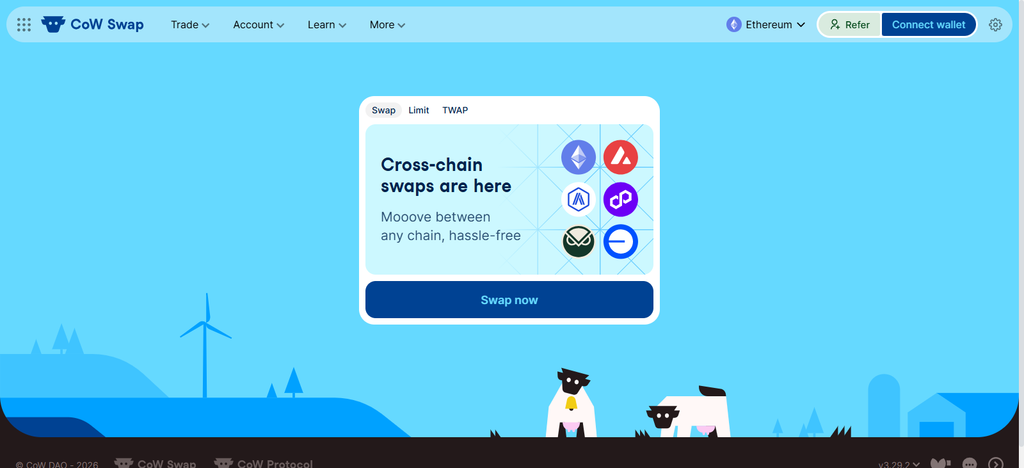
Its fee structure may include protocol, partner and price-improvement components, depending on order and network. CoW has a strong emphasis on ** MEV protection ** through batch settlement and competition between solvers.
It supports all major EVM networks and will be expanded to more ecosystems. The trading is mainly focused on ERC-20 and stable coins. Security is built on audited intelligent contracts, solver competition, and on-chain settlement mechanisms.
CoW Protocol (CoW Exchange) Features
- Intent-Based Trading: Users specify the parameters of a trade, rather than having to manually choose the path to execute it.
Batch Auctions: Aggregates orders to enhance price discovery and execution efficiency. - Solver Competition: Multiple solvers compete to find the best execution with on-chain and off-chain liquidity.
- MEV Protection: Solver competition and batch settlement reduce front-running and other MEV extraction.
- Advanced Orders: Supports limit orders, TWAP orders, and other programmable trading strategies.
| Pros | Cons |
|---|---|
| Batch auctions can improve price discovery across multiple orders. | Batch-based execution can take longer than instant AMM swaps. |
| Coincidence of Wants can match opposing trades directly. | Best execution depends on competitive solver participation. |
| Strong design for reducing common MEV extraction. | Primarily focused on supported EVM-based trading environments. |
| Gasless order submission improves user experience. | Less suitable when a trader needs immediate execution. |
| Supports advanced order types and programmable trading strategies. | Solver and off-chain auction infrastructure add architectural complexity. |
2. Uniswap X
UniswapX is a permissionless, intent-based swapping protocol powered by competitive filler auctions that launched in 2023. Traders place orders describing their desired outputs, and fillers compete to fulfilll them using public and private liquidity sources.
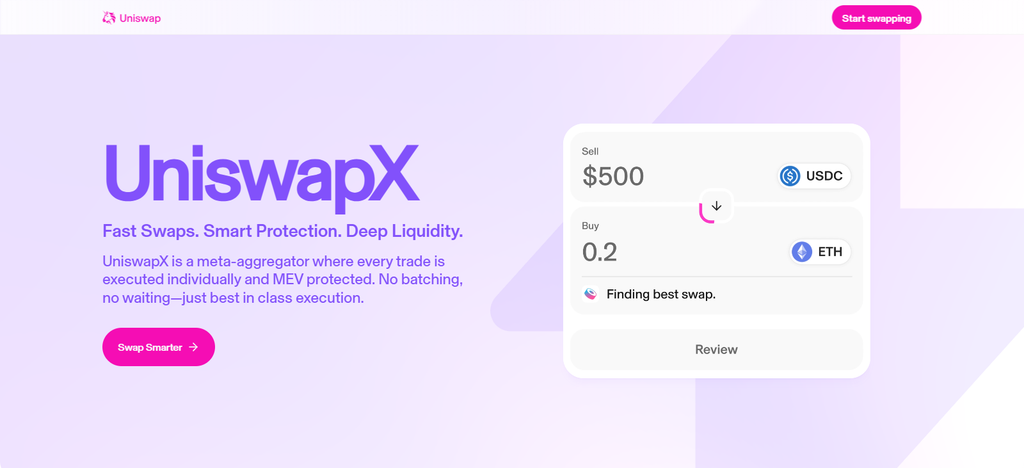
UniswapX offers gas-free swapping, protects users from many MEV risks and doesn’t charge users for failed transactions. It supports ERC-20 token trading on supported UniswapX networks and can tap liquidity beyond Uniswap pools.
The auction mechanisms are chain-dependent and may include Dutch-auction-style designs. Signed orders, reactor contracts and on-chain settlement are our security. The most interesting use case is gasless token execution efficiency.
UniswapX Features
- Gasless Swaps: Fillers pay for the transaction gas, so users can trade without having to hold the native gas token of the network.
- Competitive auctions: Fillers compete to fill signed user orders and provide competitive pricing.
- Liquidity from multiple sources: Access to public AMM liquidity and private liquidity sources.
- MEV Protection: Its application-aware architecture actively protects traders from typical MEV extraction strategies.
- Failed-Transaction Protection: Failed UniswapX swaps don’t cost users any gas fees, making trading simple.
| Pros | Cons |
|---|---|
| Fillers compete to execute signed user intents. | Execution quality depends on available filler competition. |
| Gasless trading removes the need for users to hold native gas tokens. | Cross-chain functionality can introduce additional execution complexity. |
| Accesses Uniswap and external liquidity sources. | Some less-liquid tokens may receive fewer competitive fills. |
| Dutch auctions can create competitive execution pricing. | Auction-based execution may not always be ideal for urgent trades. |
| Designed to reduce certain MEV and failed-transaction costs. | Users have less direct control over the exact execution route. |
3. 1inch Fusion
1inch Fusion – an intent-based execution mode launched in 2022 that enables users to create swap orders without paying standard network gas in supported modes. Approved resolvers fulfilll orders using a Dutch Auction, paying for the gas costs.
Fusion supports token swaps between multiple EVM networks and cross-chain Fusion capabilities for intent-based execution across networks. MEV and front-running protection, competitive pricing, failed orders for free and gas abstraction for users.
The fees vary based on the mode and route of execution. Fusion orders typically move the cost of execution to resolvers. Security is a mix of audited contracts, resolver controls, staking requirements and protocol enforced execution rules.
1inch Fusion Features
- Gasless Execution: Resolvers cover gas costs so users don’t need native tokens to support Fusion swaps
- Dutch Auctions: Competition to be the resolver is resolved with a Dutch-auction mechanism to resolve execution.
- MEV Protection: Orders are built to avoid front-running and sandwich-attack risk.
Resolver Network: Approved resolvers compete to fill orders and meet the user’s minimum acceptable output.
Fusion+: Atomic cross-chain swaps based on intent, with gas abstraction and resolver-based execution.
| Pros | Cons |
|---|---|
| Resolver competition can provide competitive execution. | Fusion execution depends heavily on resolver participation and liquidity. |
| Dutch auctions dynamically determine order execution. | The resolver-based architecture can be more complex for beginners. |
| Gas costs are abstracted from users in supported Fusion transactions. | Execution availability can vary across tokens and networks. |
| Benefits from 1inch’s broader liquidity-routing infrastructure. | Fusion and conventional 1inch swaps have different execution models. |
| Fusion+ extends intent-based execution to cross-chain swaps. | More sophisticated trading features can increase user complexity. |
4. Across Protocol
Founded in 2021, Across Protocol uses an intent-based architecture to enable fast cross-chain transfers and swaps. Users specify the asset, destination, amount, and desired outcome, and relayers compete to satisfy the intent.
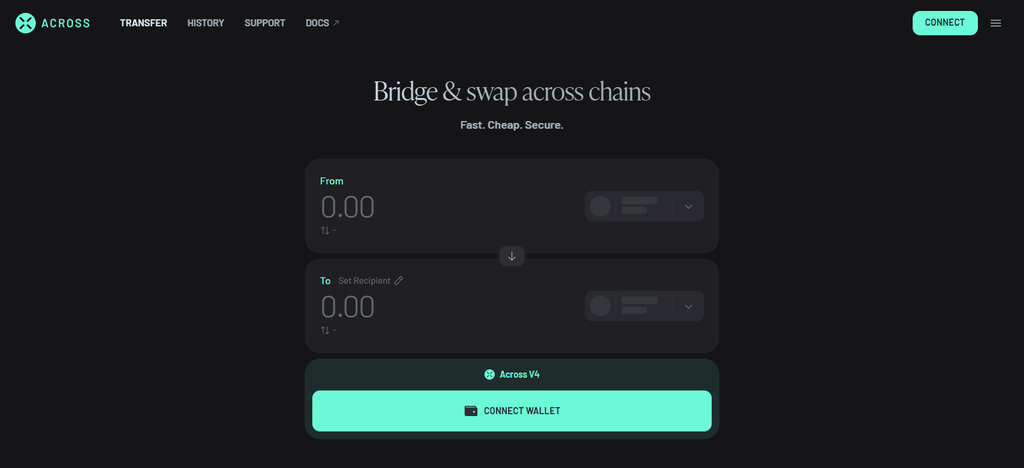
Its fee structure is mainly based on LP and relayer costs, with price based on liquidity consumption, gas, capital costs, and route conditions. Across supports a lot of major EVM networks and expanded to other chains including Solana.
Its optimistic settlement architecture confirms completed transfers once users have received destination liquidity. Its intent and relayer design minimize MEV exposure, rather than relying on traditional public-mempool routing. Across Docs.
Protocole Across Features
- Competitive Relayers: Relayers are competing to fulfilll intents and front their own capital on the destination chain.
- Cross-Chain Intents: Instead of maintaining a traditional bridge path, users specify the asset and destination they want.
- Speed: Relayers can provide liquidity on the destination chain before final settlement is complete.
- Modular architecture: RFQ, relayer and settlement layers can grow independently.
- Capital-Efficient Settlement: Aggregated verification allows for efficient settlement of multiple fills instead of verifying each fill individually.
| Pros | Cons |
|---|---|
| Designed specifically for fast cross-chain asset movement. | Cross-chain execution introduces additional settlement assumptions. |
| Relayers provide destination-chain liquidity before final settlement. | Relayer availability can affect execution quality and speed. |
| Intent architecture simplifies the traditional bridge experience. | Supported assets and routes vary by network. |
| Capital-efficient settlement reduces unnecessary liquidity movement. | Optimistic settlement introduces a verification/challenge component. |
| Strong fit for cross-chain swaps and transfers. | Less focused on sophisticated single-chain trading strategies. |
5. Everclear
Everclear, formerly Connext, is a cross-chain intent settlement layer aiming to reduce the cost of rebalancing solvers and liquidity and settle cross-chain intents. It is built around Spoke contracts and a clearing Hub for transporting intents between supported domains.

Depending on the intent configuration and route, fees can be a dynamic protocol fee, gas costs, and solver fees. Everclear supports transfers and swaps between supported chains and assets, with permissionless expansion as a core design feature.
Its security model is a combination of smart contract settlement, rebalancers, arbitrageurs and cross chain messaging. Its core strength is efficient cross-chain intent settlement and liquidity netting rather than optimizing retail swaps in the first place.
Everclear (previously Connext) Features
- Cross-Chain Clearing: The objective is to coordinate and settle cross-chain intents rather than just act as a traditional bridge.
- Intent-Based Architecture: The desired outcome is expressed by users and applications across chains while the infrastructure executes.
- Liquidity Netting: Minimizes needless cross-chain liquidity movement by netting out obligations.
- Solver and Rebalancer Support: Participants can assist in completing and rebalancing cross-chain transactions in supported domains.
Modular settlement orchestrates settlement across different blockchain environments using smart contract technology and cross-chain messaging.
| Pros | Cons |
|---|---|
| Focuses on cross-chain clearing and intent settlement. | Architecture is more infrastructure-oriented than retail-trader focused. |
| Liquidity netting can reduce unnecessary capital movement between chains. | Users may need an application interface built on top of the infrastructure. |
| Designed to coordinate liquidity across multiple blockchain environments. | Cross-chain messaging and settlement add technical complexity. |
| Supports solver and rebalancing participants. | Actual asset and chain availability depends on integrated domains. |
| Can improve capital efficiency for cross-chain applications. | Less straightforward to compare with conventional DEX swap interfaces. |
6. Bebop
Bebop was launched in 2022 and focuses on professional-grade execution of digital and standard assets through RFQ-based liquidity and intent-style trading. Instead of only using AMM curves, Bebop depends on professional liquidity providers for competitive pricing.
Its pricing model is based on transparent quotes including trading costs in the quoted execution rather than hidden charges. It supports major cryptocurrencies and stablecoins, on all supported networks. Cross-chain availability is dependent on the Bebop product and supported route.
Traders are quoted execution from liquidity providers, so its RFQ model can reduce exposure to typical AMM slippage and sandwich attacks. Bebop is particularly well-suited for traders looking for predictable pricing and efficient execution.
Bebop Features
- RFQ-Based Execution: uses requests for quotes to get competitive pricing from professional liquidity providers.
- Professional Liquidity: Market makers provide executable quotes rather than simply AMM pricing curves.
- Price protection: Quote-based execution is more predictable than traditional AMM swaps.
- Intent-Based Trading Users state what they want to trade and liquidity providers decide how to fulfilll the trade.
Multi-Chain Trading: Offers trading infrastructure for supported blockchain networks and assets, depending on the available routes.
| Pros | Cons |
|---|---|
| RFQ execution provides direct quotes from professional liquidity providers. | Liquidity can be more limited for long-tail assets. |
| Competitive market-maker quotes can improve execution for larger trades. | Reliance on professional market makers creates liquidity dependency. |
| Quote-based trading can provide predictable execution prices. | RFQ liquidity may vary depending on market conditions. |
| Well suited to stablecoin and larger asset trades. | Less universally applicable than broad AMM aggregation. |
| Intent-style execution reduces the need for users to manually select routes. | Users may have fewer options when market-maker participation is limited. |
7. Hashflow
Hashflow was born in 2021 and employs a DeFi-native RFQ model where professional market makers provide signed quotes instead of constant-product AMM pricing. Trading Fees Dynamic fees for blue-chip pairs; Static fees for other supported pairs.
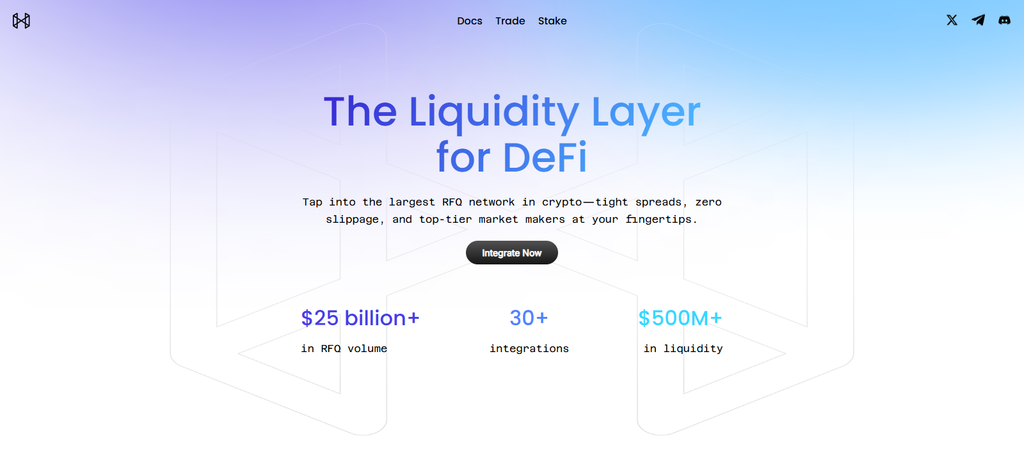
Trading fees are embedded in the quoted price. Hashflow’s multi-chain trading infrastructure supports major assets and multiple blockchain networks. And it’s cross-chain functionality allows users to swap assets between supported networks without having to deal with the usual bridge interactions themselves.
Cryptographically signed quotes are set at runtime, and provide slippage protection and resistance to front-running and sandwich attacks. Hashflow is best-suited to traders who care about predictable execution & professional liquidity.
Hashflow Features
- Zero-Slippage Quotes: Signed quotes are provided to lock in the agreed upon execution price for the duration of the trade.
- RFQ Model: Direct quotes from professional market makers on supported trading pairs.
- MEV Resistance: Its RFQ system decreases exposure to sandwich attacks and front-running.
- Cross-Chain Swaps: Allows for the transfer and exchange of assets across compatible blockchains via its cross-chain infrastructure.
- Professional Liquidity: Market makers compete to price, making Hashflow a good fit for larger or execution-sensitive trades.
| Pros | Cons |
|---|---|
| RFQ model provides executable quotes from professional market makers. | Market-maker liquidity determines available trading opportunities. |
| Fixed quotes can reduce unexpected slippage during execution. | Long-tail token coverage may be weaker than large DEX aggregators. |
| Strong focus on cross-chain asset trading. | Cross-chain execution involves additional infrastructure dependencies. |
| Quote-based architecture can reduce exposure to sandwich attacks. | RFQ execution may be less flexible than permissionless AMM liquidity. |
| Suitable for traders prioritizing predictable execution. | Pricing can vary significantly according to market-maker competition. |
8. Anoma
Anoma started in 2020 and goes beyond being just a regular token swapping protocol and expands to include intent-based infrastructure. Its architecture allows users to express desired outcomes as intents and solvers, and other participants, to identify transactions that can fulfilll those preferences. Anoma is designed for generalized intents for trading, conditional execution, coordination and more complex applications.
It aims to enable interoperability across different blockchain environments and reduce reliance on manual bridging. Because Anoma is infrastructure for generalized intent-centric applications, the applications built on Anoma, not a single, fixed exchange schedule, determine the traditional trading fees and supported asset lists. Its security model relies on enforceable intent conditions and decentralized coordination.
Anoma Features
- Intent-Driven Architecture: Intents are a first-class coordination primitive, not just another swapping feature.
- Generalized Intents: Support for intents beyond token swaps, enabling users to express more complex desired outcomes.
- Solver Based Execution: Solvers can choose transactions or execution paths based on user preferences.
- Cross-Domain Coordination: For cross-blockchain environment and application activity coordination.
- Composable DeFi Infrastructure: Its generalized architecture can enable trading, payments, applications and other programmable intent-based interactions.
| Pros | Cons |
|---|---|
| Generalized intents extend beyond simple token swaps. | Broader architecture is more complex than a conventional trading protocol. |
| Intent-centric design can support programmable user outcomes. | Its generalized model can be harder for ordinary traders to understand. |
| Solver-based coordination can automate execution decisions. | Applications and solver infrastructure are important to practical usability. |
| Designed for coordination across heterogeneous blockchain environments. | The ecosystem is less mature than established DEX platforms. |
| Can support trading, payments, and other intent-driven applications. | Direct trading comparisons with mature swap protocols can be difficult. |
9. Enso Network
Enso Network was launched in 2024 as an intent and routing infrastructure layer to simplify complex DeFi execution. Users are able to describe the desired outcome and Enso will dynamically build the routes which may include swaps, vaults, liquidity positions and multi-step DeFi actions.

It does not have a fixed list of trading pairs; the assets it supports depend on the integrated protocols and networks. Enso allows users to group multiple actions into a single execution flow, which decreases the number of manual transactions.
Fees based on chosen route, integrated protocols and execution environment. Security is ensured through smart-contract integrations and transaction routing controls. Cross-chain functionality is especially interesting to apps looking for one unified DeFi execution, and its best use case is for composable, multi-step DeFi automation.
Enso Network Features
- Multi-Step Strategies: Can support complex operations including swaps, liquidity positions, vaults and other DeFi actions.
- DeFi Intent Execution: Developers are able to describe desired outcomes without needing to manually build each underlying DeFi transaction.
- Composable Routing: Combines multiple DeFi protocols and actions into combined execution flows.
- Developer Infrastructure: The routing and execution infrastructure that is built to make it easier to develop DeFi applications.
- Automated DeFi Actions: Allows applications to link multiple protocol interactions into simplified strategies, instead of users having to do each step manually.
| Pros | Cons |
|---|---|
| Simplifies complex multi-step DeFi execution. | Execution depends on integrations with underlying DeFi protocols. |
| Developers can express outcomes instead of manually building every transaction. | More complex strategies can introduce additional smart-contract dependencies. |
| Supports composable DeFi routing and protocol interactions. | Route availability varies according to supported protocols and chains. |
| Useful for automated DeFi strategies and applications. | Primarily infrastructure-oriented rather than a standalone retail DEX. |
| Can combine multiple DeFi actions into streamlined workflows. | Developers still need to understand underlying protocol and execution risks. |
10. Aurora Intents
Aurora Intents provides cross-chain intent infrastructure with NEAR Intents which allows applications to let users move assets and perform actions across multiple blockchain ecosystems. Its network supports 30+ chains including Ethereum, Bitcoin, NEAR, Solana, BNB Chain, Base, Arbitrum, Cardano, Sui, TON, and Polygon.
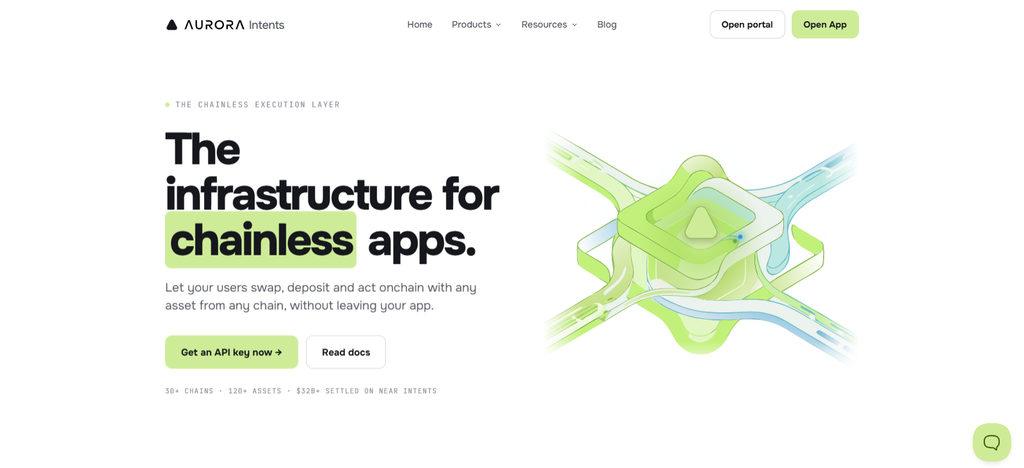
Routes available and liquidity supported determine which assets to trade. The platform provides standard and confidential intent modes, with confidential routing engineered to obscure the origin wallet and asset, while maintaining a verifiable destination.
Showing upfront fee and fast settlement execution without manual bridging. The main strength of the system is cross chain asset transfer and execution of application level intent.
Aurora Intents Features
- Multi-Chain Connectivity: For connecting assets and applications across a wide variety of supported networks.
Solver-Based Execution: Solvers determine how to fulfilll user intents given the available liquidity and routes.
Gas Abstraction: Intent-based execution allows users to avoid manual gas management across different networks. - Application Integration: Gives the infrastructure for developers to build cross-chain intent functionality into wallets, applications and trading interfaces.
| Pros | Cons |
|---|---|
| Focuses on simplified cross-chain asset execution. | Cross-chain routes remain dependent on available solvers and liquidity. |
| Users can specify desired outcomes instead of manually managing bridge routes. | Asset availability varies between supported blockchain ecosystems. |
| Can abstract gas and execution complexity from users. | Cross-chain transactions involve additional settlement and infrastructure risks. |
| Useful for wallets and applications seeking intent-based functionality. | User experience can depend heavily on the application integrating the system. |
| Designed for multi-chain asset movement and trading workflows. | More complex than a simple single-chain token swap. |
Conclusion
Intent-based crypto trading protocols are changing the way users perform swaps and cross-chain transactions by focusing on desired outcomes instead of manually routing transactions.
CoW Protocol, UniswapX, 1inch Fusion, Across, Everclear, Bebop, Hashflow, Anoma, Enso Network, and Aurora Intents merge different solvers, auctions, RFQ systems, routing and settlement mechanisms. In deciding which protocol to use, traders should consider the supported chains, trading assets, fees and execution quality,
MEV protection, security architecture and cross-chain capabilities. Developers should also consider APIs, integrations, access to liquidity and settlement flexibility. Ultimately, the best protocol depends on whether you care about trading efficiency, cross-chain execution, gas abstraction, or advanced DeFi automation.
FAQ
What are intent-based crypto trading protocols?
Intent-based crypto trading protocols allow users to specify the outcome they want, such as swapping one token for another, while solvers or fillers determine the best execution route. This can simplify trading and reduce the need for users to manage routing, gas, and transaction details manually.
How do intent-based crypto trading protocols work?
A user creates and signs an intent describing the desired trade. Solvers, fillers, relayers, or liquidity providers then compete to fulfill that request. The selected participant executes the transaction according to the protocol’s settlement rules.
Are intent-based crypto trading protocols gasless?
Some protocols provide gas abstraction or gasless trading for users, including models where solvers or fillers pay execution costs. However, gas policies differ by protocol, network, transaction type, and execution method.
Do intent-based protocols protect traders from MEV?
Many intent-based systems are designed to reduce MEV risks such as front-running and sandwich attacks. Batch auctions, private order handling, RFQ systems, solver competition, and signed quotes can help improve execution protection, although no architecture completely eliminates all MEV-related risks.