


This article covers best crypto wallet APIs. These wallet management APIs bring advanced functionality for developers and businesses to build secure crypto apps.
These APIs bring simplified blockchain integrations with wallet creation, transaction processing, multi-chain capabilities, and asset management. We cover the best crypto wallet APIs, their features, advantages, and the Web3 projects they cater to.
What is Crypto Wallet APIs?
Crypto Wallet API offers a service to incorporate crypto wallet operations through website and app integrations without the hassle of building the wallet infrastructure.
The APIs include operations needed to build a wallet such as creating a wallet, sending and receiving funds, checking wallet balance, access to the blockchain, and a list of wallet tokens and secure crypto assets. Companies develop scalable crypto apps that are safe and improve the customer experience and fit into the blockchain.
Key Benefits Of Crypto Wallet APIs for Developers
Rapid Development for Crypto Apps
Using Crypto Wallet APIs, developers no longer need to spend time and resources on developing the wallet infrastructure for their app. They can now focus on the app’s logic without having to build intricate features for the blockchain.
Simplified Blockchain Access
These APIs help developers add crypto transactions and wallet services to their apps easily, as they provide all the connections to required blockchain networks.
User Funds Safety
Crypto Wallet APIs provide several ways to help developers secure user funds. These APIs manage private keys, perform several security checks, and provide controlled access to the funds.
Support for Multiple Chains
Using just one API, developers can build features for several cryptocurrencies and blockchain networks, allowing the app to interact with many digital assets.
User-Friendly Apps
Wallet APIs enable faster wallet setup and asynchronous transactions, keeping the user engaged with the app, as they also provide constant updates for the wallet and the balances.
Eliminates Infrastructure Overhead
Using wallet APIs saves developers the cost of running complex back end systems for blockchain nodes and wallet management.
Crypto APIs with Scalability
With the ability to grow with the number of users and transactions, reliable Crypto Wallet APIs are perfect for apps at the earliest stages, as well as those designed for the enterprise level.
Integration of New Features
These APIs allow developers to add features that manage NFTs and tokens, as well as gateways for payments and interactions with smart contracts and DeFi, without building these systems themselves.
Transaction Ease and Transparency
Crypto Wallet APIs make transaction management easy by providing the ability to send, receive, track, and verify blockchain transactions.
Developer-Friendly Integration
Crypto Wallet APIs simplify blockchain development by providing dedicated documentation, SDKs, test environments, and support resources. Their developer focus welcomes new and experienced developers.
Key Features Of Crypto Wallet APIs for Developers
| Key Feature | Description |
|---|---|
| Wallet Creation & Management | Crypto Wallet APIs allow developers to create, manage, and customize digital wallets for users without building wallet infrastructure from scratch. |
| Multi-Blockchain Support | Many APIs support multiple blockchain networks such as Bitcoin, Ethereum, Solana, Polygon, and other popular chains, enabling broader crypto application development. |
| Secure Key Management | Advanced security features like private key encryption, key storage, multi-signature support, and authentication controls help protect user assets. |
| Transaction Processing | Developers can easily send, receive, track, and verify cryptocurrency transactions through simple API integrations. |
| Real-Time Balance Tracking | APIs provide real-time wallet balance updates, transaction history, and asset monitoring for better user experience. |
| Token Support | Crypto Wallet APIs support various digital assets, including cryptocurrencies, ERC-20 tokens, NFTs, and stablecoins. |
| Blockchain Node Access | Developers get direct access to blockchain networks without managing their own nodes, reducing infrastructure costs and complexity. |
| Payment Integration | These APIs enable businesses to accept crypto payments, process transfers, and create blockchain-based payment solutions. |
| Developer-Friendly Documentation | Comprehensive SDKs, API references, code examples, and testing environments make integration faster and easier. |
| Security & Compliance Tools | Features such as fraud detection, transaction monitoring, KYC/AML integrations, and compliance support help businesses build trusted crypto solutions. |
| Smart Contract Interaction | Developers can interact with decentralized applications and smart contracts for DeFi, Web3, and blockchain-based services. |
| Scalability & Performance | Reliable APIs handle high transaction volumes and growing user demands while maintaining speed and availability. |
Key Point & Best Crypto Wallet APIs
- MetaMask API – Enables dApp integration with Ethereum and EVM-compatible chains.
- Coinbase Wallet API – Provides secure Web3 access with fiat on-ramp support.
- Trust Wallet API – Offers multi-chain wallet connectivity and token management.
- Ledger Live API – Connects hardware wallets for secure transaction signing.
- Trezor Wallet API – Facilitates hardware wallet integration with open-source SDKs.
- Fireblocks Wallet API – Enterprise-grade custody and transaction orchestration.
- BitGo Wallet API – Institutional wallet solution with multi-signature security.
- Kraken Wallet API – Exchange-linked wallet API for trading and custody.
- Phantom Wallet API – Popular Solana wallet API for dApps and NFTs.
- Rainbow Wallet API – Ethereum-focused wallet API with user-friendly UX.
10 Best Crypto Wallet APIs for Developers in 2026
1. MetaMask API
The MetaMask API is the most popular Web3 wallet API because it connects to the most users. It connects to more than 30 million monthly active users and processes over 100 million transactions monthly. MetaMask API is based on EIP-1193 and offers dApps a way to connect with users (window.ethereum).
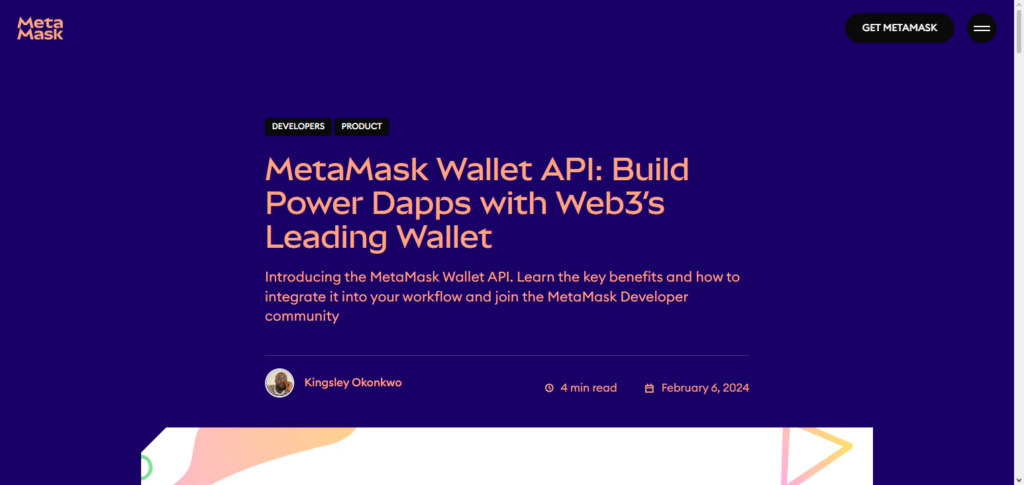
dApps using the MetaMask API can Ethereum transactions and can be made to work with other EVM-compatible chains. MetaMask Snaps allow developers to add more features.
Developers can use Snaps to add support for other chains like Solana, Cosmos, and Bitcoin. Developers can use the MetaMask software development kit (SDK) to integrate MetaMask to web, mobile, and game applications. Because of these features, MetaMask offers great API solutions for large-scale, cross-chain interoperability.
MetaMask API Features, Pros & Cons
Features
- EIP-1193 provider for Ethereum and EVM chains
- dApp integration via window.ethereum
- MetaMask Snaps for dApps on Non-EVM chains
- SDK for web, mobile, and game engine
- Active user base
Pros
- Developer’s choice
- Simple integration with dApps
- Supported by ecosystem
- Improving cross-chain compatibility
- Open-source
Cons
- Native non-EVM support is lacking
- Needs browser extension or mobile app
- Steep learning curve
- Security is user-dependent
- No support for institutional custody
2. Coinbase Wallet API
The Coinbase Wallet API provides users with an easy-to-use API to provide users with a crypto wallet. Using the Coinbase Wallet API allows users to make their wallets multi-chain across many blockchain networks. It allows users to make wallets across Ethereum, Solana, Avalanche, and other networks. There are also many options for account types and on-ramps, with support for account abstraction and smart contracts.
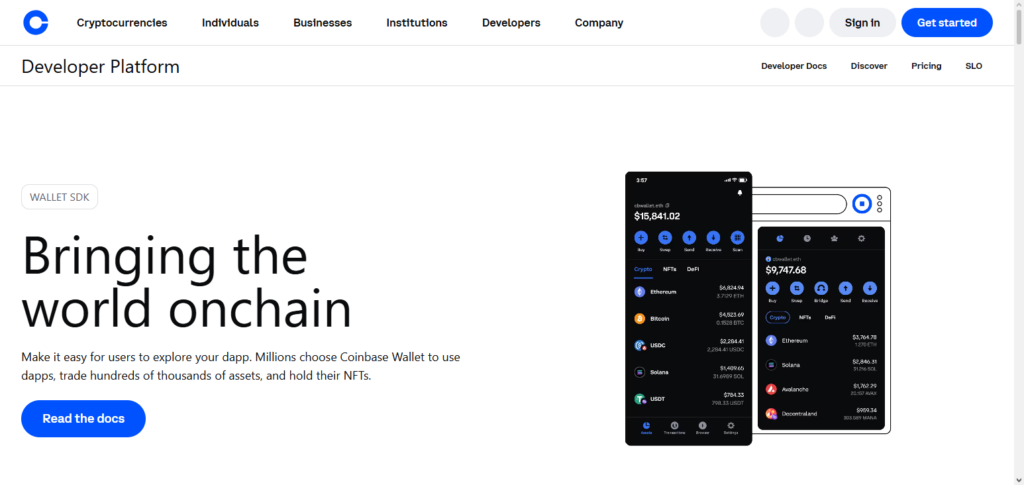
This makes the Coinbase Wallet API an excellent solution to make a wallet for any decentralized application. The API even has SDKs for both mobile and web. It has excellent security and an innovative approach to integrating walled into the Coinbase application providing users with one of the best APIs to integrate wallets.
Coinbase Wallet API Features, Pros & Cons
Features
- Supports multiple chains
- Fiat on-ramp in over 80 countries
- EOA, ERC-4337 and Solana account support
- Wallet SDK for web and mobile
- Integration support for the Coinbase ecosystem
Pros
- Simple crypto-fiat integration
- Good regulation and compliance
- Simple integration for developers
- Broad reach
- Good security
Cons
- Locked within the Coinbase ecosystem
- Less customization than other wallets
- Not fully decentralized custody
- Regulatory concerns may arise
- Neglected Hardware wallets
3. Trust Wallet API
Trust Wallet API is a self custody platform allowing multi-chain functionality that operates on 130+ blockchains. This API also has millions of supported assets. For EVM, Solana, and Bitcoin integration, developers can use the TrustConnect SDK for dApp, or for cryptographic operations, developers can utilize the Wallet Core.
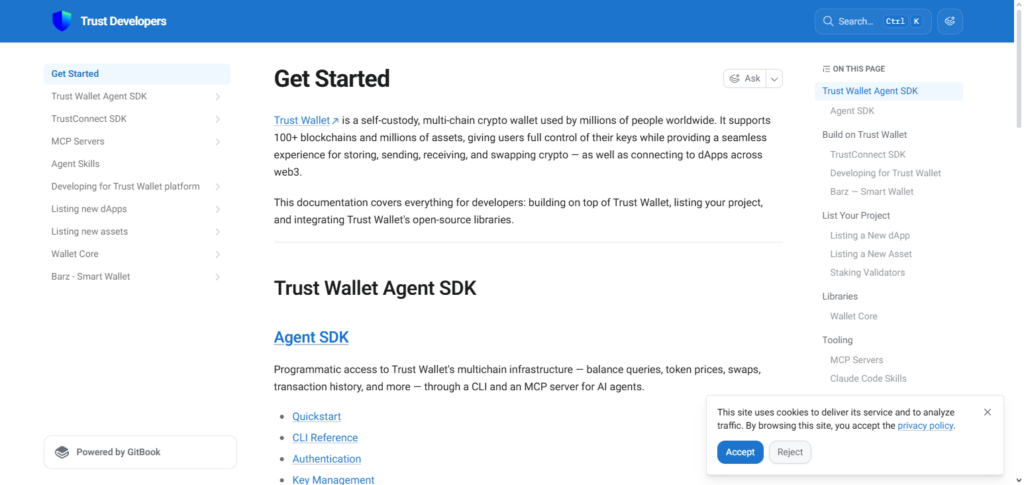
Barz Smart Wallet is also offered and is ERC-4337 compatible for programmable accounts. The Agent SDK has command access to balances, swaps, and transaction history and is customizable due to its open-source libraries. Trust Wallet is one of the top-ranked crypto wallet APIs due to its large user base and developer community as the API is multi-chain and offers flexible open-sourcing.
Trust Wallet API Features, Pros & Cons
Features:
- 130+ blockchain support
- TrustConnect SDK for dApps
- Wallet Core for cryptographic operations
- Barz Smart Wallet (ERC-4337)
- Agent SDK for balances and swaps
Pros:
- Supports advanced treasury workflows
- Transaction automation
- NFT minting and treasury management
- Policy engine and webhooks
Cons:
- Not consumer-focused
- Complex integration for small teams
- Higher costs for enterprises
- Limited open-source flexibility
- Requires enterprise licensing
4. Ledger Live API
Ledger Live API combines dApps and Ledger hardware wallets. Using hardware keys and MPC, dApps can securely sign transactions. Integrating EIP-1193 Ethereum provider methods and the Solana Wallet Standard, Ledger allows developers to incorporate their hardware wallet into a dApp via React hooks and utilities.
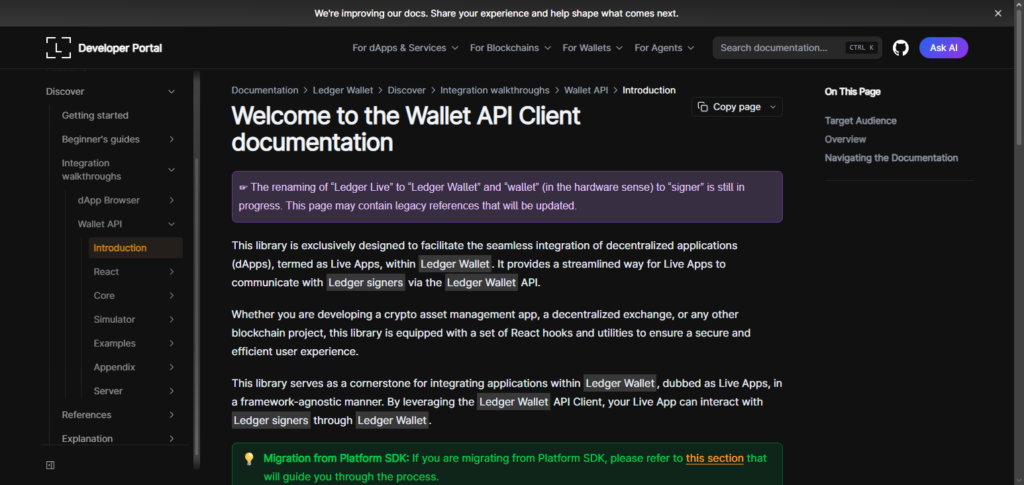
Ledger Live offers tools for transactions, account management, message signing, and querying blockchains. Ledger Live even goes a step beyond and offers policy-based permissions for methods and currencies to help comply with regulations. Ledger Live API is one of the premier crypto wallet APIs since it is hardware-based and allows developers to preserve security and offer custodial tools to their users.
Ledger Live API Features, Pros & Cons
Features:
- Integrated hardware wallets
- EIP-1193 Ethereum methods
- Supports Solana Wallet Standard
- Transaction signing
- Policies for permissions
Pros:
- Security of hardware wallets
- Institutional trust
- Compliance focus
- More than one chain
- SDKs for development
Cons:
- Ledger required
- UX less developed for end users
- More than one chain supports
- Less interactivity
- Higher effort for development
- Less focused on end users
5. Trezor Wallet API
The Trezor Wallet API allows secure third-party app integration using Trezor hardware wallets via Trezor Connect. It allows public key fetching, signing transactions, and authenticating messages on Bitcoin, Ethereum, and several other chains. Developers can utilize JSON-RPC methods to retrieve addresses and account information, or submit transactions.
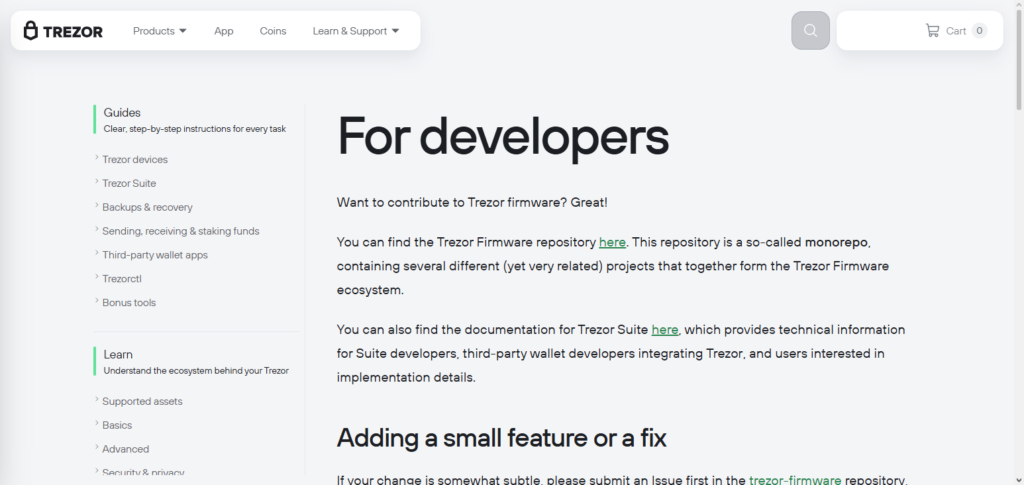
The transparency and flexibility of Trezor’s open-source nature is combined with advanced integration capabilities of the MCP servers for balances, swaps, and signing. Because of Trezor’s strong reputation with hardware security, it is one of the best crypto wallet APIs for open-source, hardware-backed integrations.
Trezor Wallet API Features, Pros & Cons
Features:
- Trezor Connect
- Signing via JSON-RPC
- Open keys and auth
- Open-source SDKs
- Multi-chain
Pros:
- Open-source and transparent
- Secure hardware
- Flexible devs
- More than one chain
- Brand trust
Cons:
- Trezor required
- Limited custody solutions
- Smaller ecosystem than Ledger
- Focus on hardware users
- Less fiat integrated
6. Fireblocks Wallet API
The Fireblocks Wallet API provides Wallet as a Service (WaaS) built upon their proprietary MPC-security model. Customers of Fireblocks have access to over 150+ blockchains along with capabilities such as raw signing, NFT minting, and treasury management.
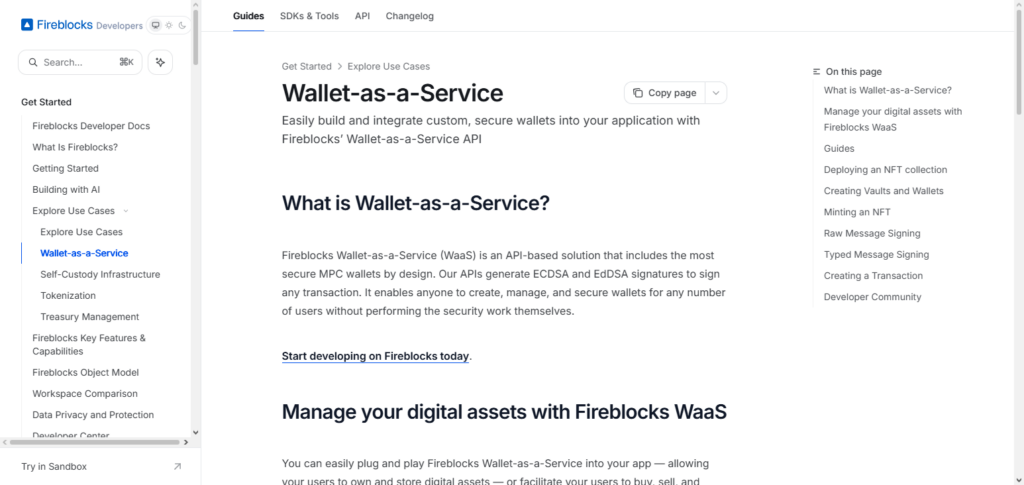
Enterprise clients can use webhooks and policy engines to automate their own custody, transaction, and policy management processes. Fireblocks’ Wallet as a Service (WaaS) offering has gained a lot of popularity in the custody services space and is used by exchanges, banks, and fintech institutions.
Fireblocks’ APIs allow enterprise users to create vaults, transfer assets, stake, and perform compliance functions. Given the enterprise-grade infrastructure that Fireblocks provides, Fireblocks also ranks as one of the best crypto wallet APIs for custody services.
Fireblocks Wallet API Features, Pros & Cons
Features:
- Wallet-as-a-Service (WaaS)
- Securities based on MPC
- 150+ supported blockchains
- Treasuries and NFTs
- Policy with webhooks
Pros:
- Enterprise custody
- Highly secure MPC
- Customized treasury workflows
- Institutional trust
- Compliance focus
Cons:
- Not for end users
- Small teams struggle
- High costs for enterprise
- Limited open-source
- Enterprise licensing
7. BitGo Wallet API
BitGo Wallet API has multi-signature and MPC wallets tailored for institutional custody. With deposit, withdrawal, trading, staking, and NFT capabilities, it provides custody solutions in a single API. Developers may access wallet information, balance, addresses, and custom policies for risk management.
BitGo partners with exchanges and provides Crypto-as-a-Service, empowering platforms to integrate user sign-ups with custody solutions. With its solid compliance and cold storage, BitGo is among the best crypto wallet APIs for regulated institutions and enterprises requiring qualified custody solutions.
BitGo Wallet API Features, Pros & Cons
Features:
- Multi-signature and MPC wallets
- Deposit, withdrawal, staking, NFTs
- Risk management policy rules
- Crypto-as-a-Service onboarding
- Institutional custody
Pros:
- Robust compliance and regulation
- Secure multi-sig infrastructure
- Trusted by institutions
- Supports several assets
- Cold storage options
Cons:
- Enterprise-oriented, less consumer-friendly
- Integration more complicated
- Open-source flexibility lacking
- Custody linked with BitGo
- Low NFT ecosystem participation
8. Kraken Wallet API
The Kraken Wallet API is linked to the Kraken Exchange and provides custody, trading and margin account services. Users execute functions related to margins and trading, as well as accessing balances.
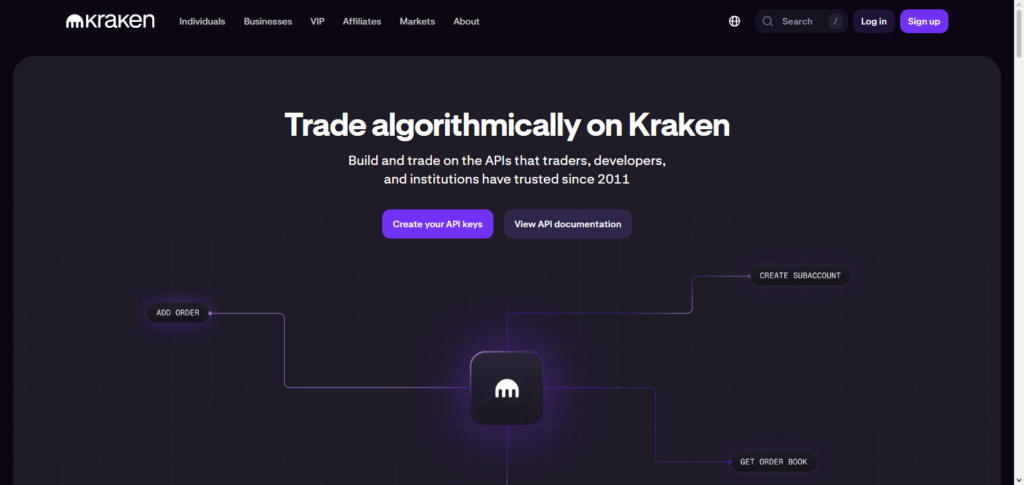
Spot, derivatives, OTC, and custody services may be integrated using REST, WebSocket, and FIX APIs. Kraken Wallet API is among the top crypto wallet APIs considering compliance and servicing institutions, especially for developers constructing trading solutions with custody linked to exchanges.
Kraken Wallet API Features, Pros & Cons
Features
- Custody linked to exchanges
- REST, WebSocket, and FIX APIs
- Margin and derivatives supported
- Collateral management
- Spot and OTC trading
Pros
- Great integration on the exchange
- Custody infrastructure that is secure
- Supports advanced trading
- Regulated and compliant trading
Cons
- Kraken bound ecosystem
- Limited open source flexibility
- Custody is not fully decentralized
- Trade focus and dApps deficiency
9. Phantom Wallet API
Phantom Wallet API provides an SDK for a multi-chain wallet system. It supports numerous chains: Solana, Ethereum, Polygon, Sui, Bitcoin, and others. Developers have access to the Phantom Connect SDK for the web and mobile, and the SDK for Server SDK for backend wallet creation and transaction signing.
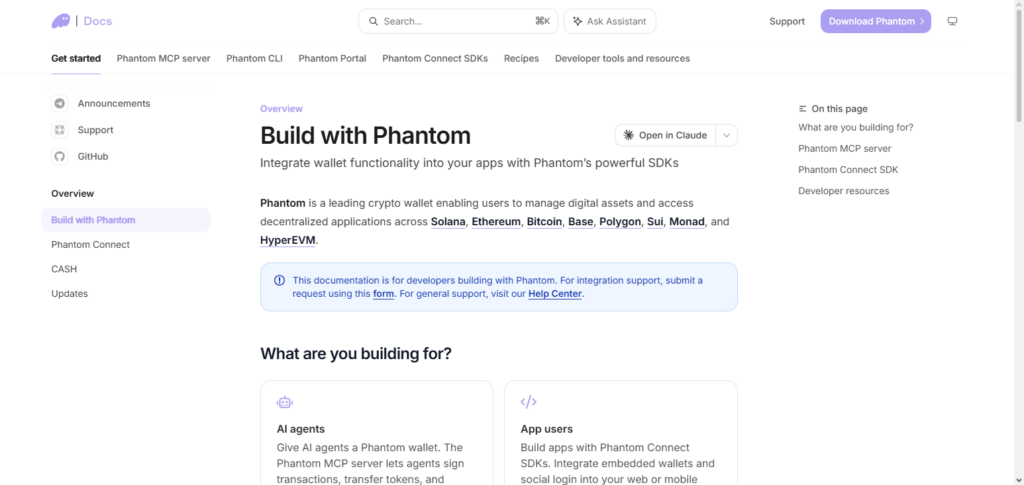
It even offers support for social logins, embedded wallets, swaps, and portfolio management. Because of its popularity with Solana, Phantom is often the first choice for NFT marketplaces and DeFi apps. Thanks to its developer-friendly SDKs and a triple-digit growth user base, Phantom is one of the top crypto wallet APIs for multi-chain dApp integration.
Phantom Wallet API Features, Pros & Cons
Features
- Multi-chain support (Solana, Ethereum, Polygon, etc.)
- Phantom Connect SDKs for web/mobile
- Server SDK for backend wallets
- Social login and embedded wallets
- NFT and DeFi integration
Pros
- Strong adoption by developers and the NFT marketplace in Solana
- Supports multiple chains
- Consumer-friendly UX
Cons
- Custody features lack enterprise focus
- Security is mobile/web dependent
- Limited fiat and smaller institutional adoption
- Consumer apps focus
10. Rainbow Wallet API
Rainbow Wallet API is unique for its design-oriented features. It focuses on Ethereum and EVM chains. It caters to multi-chain transaction histories, balances, NFT holdings, ENS profiles, swap events, and bridge events.
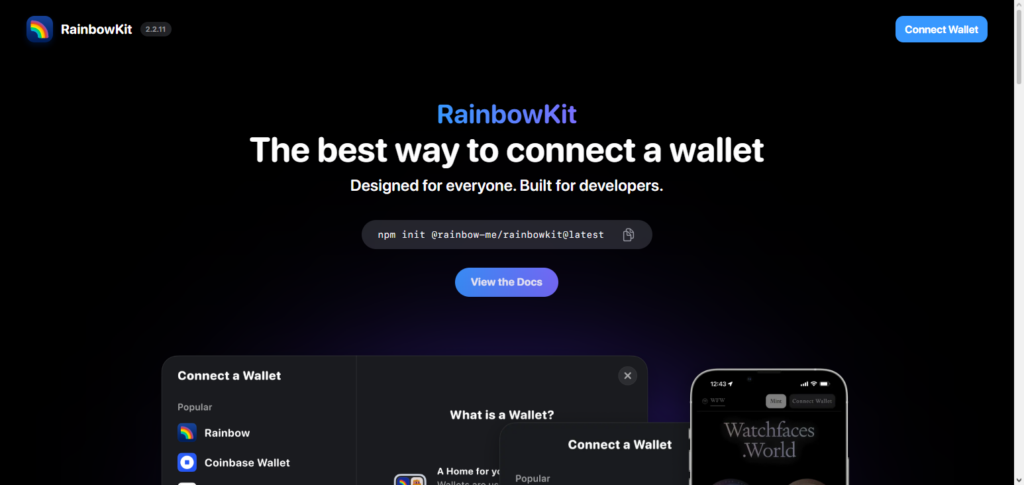
Also, developers can use OpenFinance-style endpoints to integrate Rainbow into systems for accounting, analytics, and compliance. RainbowKit is a set of React components for account connection, thus making integrations significantly easier. For its ENS-based identity features and user experience, Rainbow Wallet API is among the finest consumer-oriented APIs.
Rainbow Wallet API Features, Pros & Cons
Features
- Ethereum and EVM-centric API
- Eventful NFT holdings and ENS profiles
- Dynamic swappings and bridges
- RainbowKit React components
- Excellent UX design
Pros
- Excellent user experience
- Integration with ENS identity
- Easy SDKs based on React
- Robust support for NFTs
- Consumer-friendly
Cons
- Limited multi-chain support
- Less enterprise-grade custody
- No fiat on-ramp available
- Smaller developer ecosystem
- Primarily focused on Ethereum users
| Wallet API | Chains Supported | Custody Type | SDK / Integration | Best For |
|---|---|---|---|---|
| MetaMask API | Ethereum + EVM chains (Polygon, BSC, etc.) | Self-custody | Web SDK, Mobile SDK, MetaMask Snaps | dApp developers, Web3 integrations |
| Coinbase Wallet API | Ethereum, Solana, Polygon, Avalanche, more | Self-custody + Coinbase ecosystem | Wallet SDK (Web/Mobile) | Mainstream adoption, fiat on-ramp |
| Trust Wallet API | 130+ blockchains | Self-custody | TrustConnect SDK, Wallet Core, Agent SDK | Multi-chain dApps, open-source projects |
| Ledger Live API | Ethereum, Solana, Bitcoin, more | Hardware custody | Ledger SDK, React hooks | Security-first apps, institutional custody |
| Trezor Wallet API | Bitcoin, Ethereum, multi-chain | Hardware custody | Trezor Connect, JSON-RPC | Open-source hardware integrations |
| Fireblocks Wallet API | 150+ blockchains | MPC custody (enterprise) | WaaS API, Policy Engine | Institutions, banks, fintech custody |
| BitGo Wallet API | Multi-chain (BTC, ETH, NFTs) | Multi-sig + MPC custody | REST API, Crypto-as-a-Service | Regulated institutions, qualified custody |
| Kraken Wallet API | Exchange-linked (BTC, ETH, etc.) | Exchange custody | REST, WebSocket, FIX APIs | Trading platforms, exchange-linked custody |
| Phantom Wallet API | Solana, Ethereum, Polygon, Sui, Bitcoin | Self-custody | Phantom Connect SDKs, Server SDK | NFT marketplaces, consumer dApps |
| Rainbow Wallet API | Ethereum + EVM chains | Self-custody | RainbowKit React components | UX-driven dApps, ENS + NFT apps |
Conclusion
Developers and businesses hoping to create scalable and user friendly crypto apps need the right tools to build secure apps. The best tools offer features like wallet creation, transaction management, the ability to connect to the the blockchain, multi-chain support, and security controls.
The right API for you depends on the security requirements, the documentation, the price of the API, and the networks supported. If you are building a crypto exchange, web3 app, a payment solution, or a DeFi app, identifying the right Crypto Wallet API will greatly ease the development.
FAQ
What is a crypto wallet API?
A crypto wallet API is a developer interface that allows applications to connect with wallets for account creation, transaction signing, balance retrieval, and blockchain interaction.
Which crypto wallet API is most popular?
The MetaMask API is the most widely used, with millions of users and strong support for Ethereum and EVM-compatible chains.
Which wallet APIs support multiple blockchains?
Trust Wallet API, Coinbase Wallet API, and Phantom Wallet API support multiple chains including Ethereum, Solana, Polygon, and more.
Which wallet APIs are best for institutions?
Fireblocks Wallet API and BitGo Wallet API are designed for enterprises, offering MPC security, compliance, and custody solutions.