


In this article, I discuss the Best NFT APIs which help developers create robust NFT marketplaces, wallets, gaming platforms, and Web3 Applications.
APIs provide developers with data on NFTs and associated metadata, ownership, transactions, and marketplaces. I focus on features, benefits, and use cases for the most popular APIs so you can choose the best NFT API for your needs.
What is NFT APIs?
NFT APIs are a kind of API that programmers can use to handle NFTs. APIs of this nature allow programmers to interface with NFT-related information and data within their programs. Other APIs and similar tools allow programmers to gather NFT characteristics, ownership, historical transaction data, collection data, marketplace data, and information pertaining to the blockchain.
NFT APIs also allow programmers and developers to interface with NFT and blockchain ecosystems without constructing complicated tools and infrastructure. NFT APIs allow programmers and developers to rapidly create NFT and blockchain-based market and wallet tools, gaming platforms, analytic tools, and other Web3 and NFT-based tools.
Why Choose NFT APIs for Developers
Easy Access to Blockchain Data: Developers no longer need to build and maintain complicated blockchain infrastructure. NFT APIs make it easy for developers to access NFT metadata, ownership and transaction data, and other information on the blockchain.
Rapid Development of NFT Applications: Developers are able to create NFT marketplaces, wallets, games, and Web3 applications with greater speed by using API solutions.
Multi-Chain Functionality: Developers are able to build applications for use across various blockchain networks.
Easy NFT Management: NFT APIs enable simple management of the creation, minting, transferring, and tracking of NFT assets and collections.
Instant Access to NFT Data: Developers are provided with the most current information regarding NFT prices, sales and ownership, and activity across all marketplaces.
Better Scalability: NFT APIs are designed to support the infrastructure needs of vast quantities of users, transactions, and blockchain data.
Better User Experience: NFT APIs, combined with other supporting APIs, allow developers to provide users with rapid searching and tracking of wallets and digital assets.
Lower Development Costs: NFT APIs significantly reduce the costs associated developing and supporting the blockchain backend and indexing systems.
Greater Trust and Validation: Secure professional NFT APIs provide a safe and verified connection for decentrally hosted DApps.
Support for Development of New Ideas: NFT APIs fuel the continued development of Web3 applications such as NFT-based games, collectible and metaverse applications, and creator-based platforms.
Benefits Of NFT APIs for Developers
Easier NFT Implementation: With NFT APIs, developers can implement functions like tracking NFTs, verifying NFT ownership, and adding NFT marketplaces without extensive blockchain-related coding.
Quicker Development of Applications: With various API-based solutions at hand, developers can build NFT marketplaces, wallets, NFT-based games, and other Web3 applications in less time.
Instant Access to NFT Data: NFT APIs offer access to the latest updates on the pricing of NFTs, their transactions and ownership, NFT collections, and the activity of NFT marketplaces.
Multi-Chain Support: Several NFT APIs support various blockchains, thus allowing developers to build applications that are accessible to a wider audience.
Simplified Infrastructure: Developers save the hassle of running their own blockchain nodes and/or their own indexing infrastructures, thus saving on the maintenance costs.
Better Management of NFT Data: With the help of APIs, NFT metadata and their transaction and ownership histories are organized and structured.
Greater Scalability of Applications: NFT APIs help provide the infrastructure needed to support many users and high transaction volumes, along with a significant amount of blockchain data.
More Sophisticated NFT Functionality: Developers can implement NFT minting, integrated marketplaces, analytics, wallet tracking, and other features related to NFT collections.
Key Point & Best NFT APIs
1. OpenSea API
- Provides access to NFT marketplace data, collections, assets, trades, and ownership details.
- Supports developers in building NFT marketplaces, tracking tools, and Web3 applications.
2. Rarible API
- Offers NFT marketplace data, minting features, trading history, and collection management tools.
- Helps developers integrate NFT buying, selling, and creation functionality into apps.
3. NFTPort
- Provides simple NFT APIs for minting, indexing, and managing NFTs across multiple blockchains.
- Supports Ethereum, Polygon, and other networks with developer-friendly tools.
4. Covalent API
- Delivers multi-chain blockchain data, including NFT ownership, metadata, transactions, and balances.
- Enables developers to build NFT analytics dashboards and Web3 applications.
5. Etherscan API
- Provides Ethereum blockchain data, including NFT transactions, token transfers, and contract information.
- Useful for tracking NFT activity and verifying smart contract details.
6. Infura NFT API
- Offers scalable blockchain infrastructure with NFT data access and IPFS support.
- Helps developers build reliable NFT applications without managing blockchain nodes.
7. Magic Eden API
- Provides access to NFT marketplace listings, collections, sales, and trading data.
- Supports developers building NFT platforms with marketplace integration features.
8. SimpleHash API
- Provides unified NFT data across multiple blockchains with metadata, ownership, and pricing information.
- Helps developers create NFT wallets, marketplaces, and analytics platforms.
9. BlockSpan API
- Offers NFT indexing, wallet tracking, metadata retrieval, and blockchain analytics tools.
- Supports fast access to NFT data for Web3 applications and platforms.
10. Zora API
- Provides NFT creation, minting, marketplace, and protocol data access.
- Enables developers to build decentralized NFT apps and creator-focused platforms.
10 Best NFT APIs for Developers in 2026
1. OpenSea API
OpenSea API is among the best NFT APIs for a reason. Developers can access NFT marketplace data on collections, assets, ownership, sales, and listings and trading data. Developers can create NFT marketplaces and trackers and analytics platforms and Web3 applications.
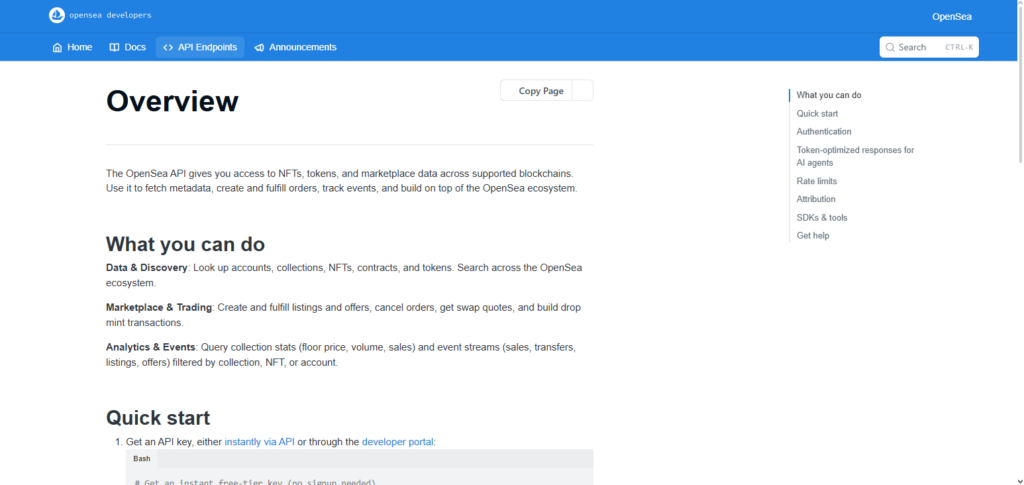
The OpenSea API supports Ethereum and other networks. Additionally, the API provides metadata retrieval and asset management. Businesses can integrate NFT discovery, trading data, and collection stats easily.
| Property | Details |
|---|---|
| Primary Use | NFT marketplace data access and asset discovery |
| Supported Networks | Ethereum, Polygon, Base, and other supported chains |
| Key Features | NFT metadata, collections, ownership, sales history |
| Best For | NFT marketplaces, portfolio trackers, Web3 apps |
| Data Access | Real-time NFT listings, trades, and asset information |
OpenSea API Advantages & Disadvantages
Advantages:
- One of the largest NFT database APIs.
- Has NFT metadata and analytics for Owners, Collections, and Sales.
- Easy to integrate NFT marketplaces and Web3 apps.
- Multi-chain API support.
- Provides marketplace analytics.
Disadvantages:
- OpenSea API rate limits affects high-demand apps.
- Primarily fetches marketplace data, and has limited blockchain endpoint services.
- API key and OpenSea permission for advanced marketplace queries.
- Limited flexibility compared to self-hosted APIs.
- OpenSea API is only as healthy as the OpenSea marketplace.
2. Rarible API
Rarible API is one of the best NFT APIs. Developers can use the API to build applications with NFT marketplace functionality. With Rarible API, developers can access NFT collections, NFT-related token metadata, marketplace activity logs and trading history, and NFT ownership data.
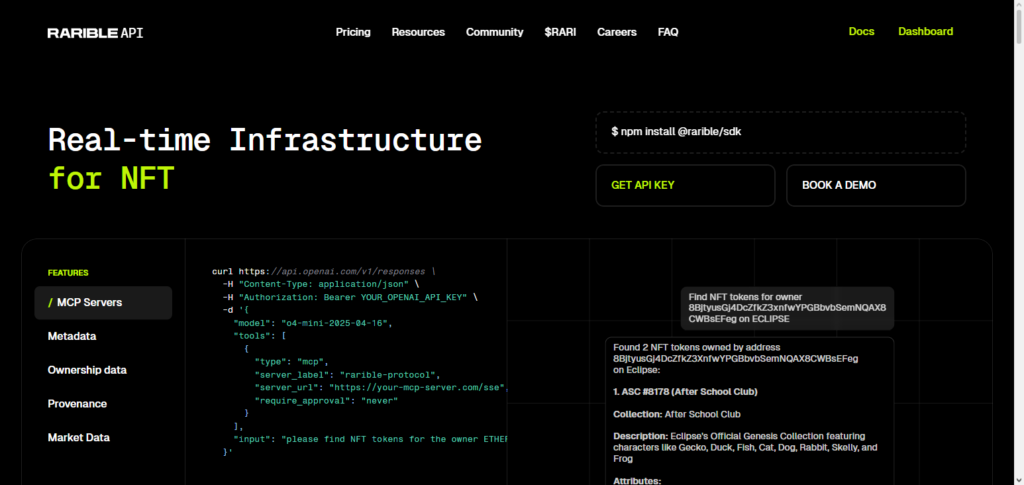
Developers can build platforms, marketplaces, and Web3 applications that allow users to buy and sell and mint NFTs. Additionally, the Rarible API supports multiple blockchains and NFT data is simplified. This API is suitable for creators, businesses, and developers of decentralized applications.
| Property | Details |
|---|---|
| Primary Use | NFT marketplace integration and asset management |
| Supported Networks | Ethereum, Polygon, Tezos, Flow, and more |
| Key Features | NFT creation, trading data, collections, metadata |
| Best For | NFT marketplaces and creator platforms |
| Data Access | Marketplace activity, ownership, and token details |
Rarible API Advantages & Disadvantages
Advantages:
- Integrates directly with NFT marketplaces.
- Supports NFT creation, trading, and collection.
- Provides multi-chain NFT data.
- Good for decentralized marketplace development.
- Developer-friendly.
Disadvantages:
- Can offer more simplified and easy-to-use documentation.
- Most of the marketplace data is within the Rarible ecosystem.
- Limited advanced analytics.
- User demand affects API performance.
- Some features may need coding.
3. NFTPort
NFTPort makes creating and managing NFTs easier across several blockchains, including Ethereum and Polygon. NFTPort provides tools to help developers retrieve NFT metadata, track ownership, view transactions, and even automate NFT minting. Developers building NFT-based applications need to handle lots of NFT-related infrastructure.
NFTPort eliminates the burden of preparing and controlling the required blockchain infrastructure. NFTPort is an applicable solution for Web3 projects, gaming and NFT marketplaces, and even digital collectible frameworks as it offers the necessary NFT-related data and management services.
| Property | Details |
|---|---|
| Primary Use | NFT minting, indexing, and blockchain asset management |
| Supported Networks | Ethereum, Polygon, and other Web3 networks |
| Key Features | NFT minting API, metadata management, indexing |
| Best For | NFT apps, gaming platforms, and marketplaces |
| Data Access | NFT ownership, transfers, and blockchain records |
NFTPort Advantages & Disadvantages
Advantages:
- User-friendly NFT minting and management.
- Supports multi-chain.
- NFT Indexing and Metadata Services.
- Minimal management of Blockchain infrastructure.
- Great for NFT marketplaces and Game.
Disadvantages:
- Free plans and features are limited.
- Small NFT marketplace ecosystems.
- Some Blockchain features are limited.
- Requires advanced technical knowledge.
4. Covalent API
Covalent API is one of the best NFT APIs for detailed blockchain and NFT information across multiple networks. Covalent provides NFT developers a single interface API to gather the NFT information of ownership, balances, transactions, metadata, and the activity of wallets.
Covalent supports many blockchains, especially useful for developing multi-chain NFT applications; NFT analytics dashboards and tracking portfolio tools.
The API also helps developers extract blockchain information by simplifying the on-chain information into usable formats. Developers and businesses build scalable and comprehensive NFT Web3 tools and platforms using the Covalent API.
| Property | Details |
|---|---|
| Primary Use | Multi-chain blockchain and NFT data access |
| Supported Networks | Ethereum, Polygon, BNB Chain, Avalanche, and more |
| Key Features | NFT balances, transactions, wallet data, analytics |
| Best For | Web3 analytics platforms and portfolio applications |
| Data Access | Structured blockchain and NFT information |
Covalent API Advantages & Disadvantages
Advantages :
- Excellent support for multi-chain data.
- Tracks NFT ownership and transactions.
- Offers in-depth analysis.
- Addresses queries regarding multi-chain data.
- Can support extensive Web3 apps.
Disadvantages:
- API can be daunting for beginners.
- Costs may increase as API is used more.
- Knowledge of data structure is required.
- Some rare NFT data may be unavailable.
- Speed is dependent on data availability.
5. Etherscan API
Etherscan API is one of the top API choices for developers dealing with Ethereum-based NFT projects. The Etherscan API enables access to various blockchain details such as NFT transactions, smart contract details, token transfers, wallet addresses, and Ethereum network data. Etherscan API provides developers with the ability to track NFT transfers, validate transactions, and analyze smart contract interactions.
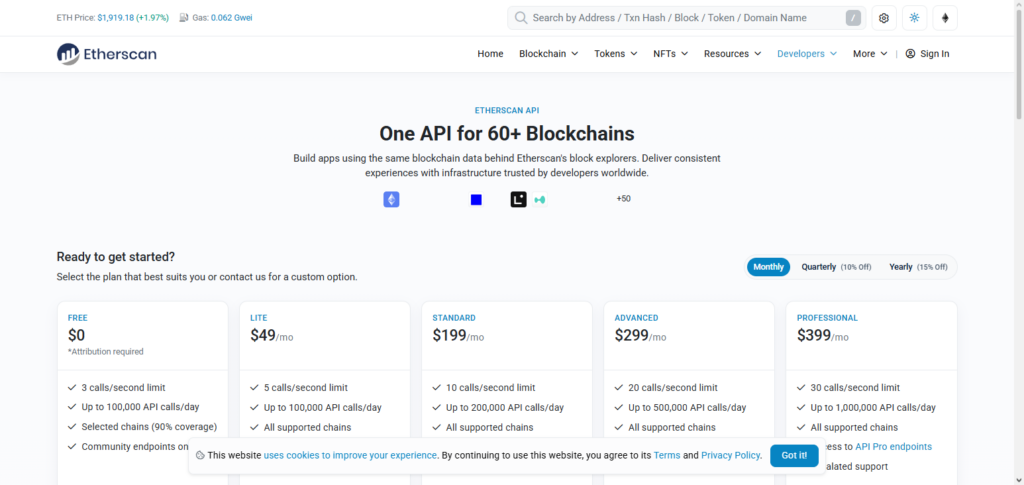
The API is extensively used for blockchain explorers, NFT trackers, and analytic applications. With easy and reliable data access for Ethereum, the Etherscan API enables developers to build NFT applications that are efficient, transparent, and do not require the processing of raw blockchain data.
| Property | Details |
|---|---|
| Primary Use | Ethereum blockchain data retrieval |
| Supported Networks | Ethereum and Etherscan-supported chains |
| Key Features | Transaction tracking, contract data, NFT transfers |
| Best For | Ethereum NFT monitoring and verification tools |
| Data Access | Blockchain transactions, wallet activity, smart contracts |
Etherscan API Advantages & Disadvantages
Advantages :
- Data provided is from the Ethereum blockchain.
- Transaction and smart contract data are available.
- Well regarded in the blockchain development community.
- Access to Ethereum based NFT activity.
- Useful for applications based on data verification and tracking.
Disadvantages:
- Data is limited to the Ethereum network.
- Very little support for data from other blockchains.
- API limitations can impact large apps.
- Knowledge of blockchain is required for API usage.
- Cannot support full marketplace capabilities.
6. Infura NFT API
As one of the top NFT APIs, Infura NFT API provides scalable blockchain infrastructure and NFT data. Developers can work on Ethereum and other blockchains, as well as IPFS storage of NFT metadata. Infura provides applications with the ability to find NFT data, handle digital assets, and communicate with decentralized networks.
It is a preferred API for Web3 developers for NFT marketplaces, wallets, games, and DApps. Offering fast infrastructure and safe blockchain connections, Infura NFT API makes the problems regarding the upkeep of blockchain nodes disappear.
| Property | Details |
|---|---|
| Primary Use | Blockchain infrastructure and NFT application development |
| Supported Networks | Ethereum, Polygon, IPFS, and Web3 networks |
| Key Features | Node access, NFT data, IPFS storage support |
| Best For | Enterprise Web3 applications and developers |
| Data Access | Blockchain connectivity and decentralized storage data |
Infura NFT API Advantages & Disadvantages
Advantages :
- Reliable Ethereum infrastructure.
- Connects to IPFS for NFT Metadata.
- Advanced Web3 tools.
- No more managing Ethereum Nodes.
Disadvantages:
- Can get expensive.
- Knowledge of development for integration.
- Limited marketplace functions.
- More focused on blockchain infrastructure.
- Features may be unavailable based on Network availability.
7. Magic Eden API
Magic Eden API is one of the Best NFT APIs because it allows developers access to data and trading information pertaining to NFT marketplaces. You can gather data for NFT collections, listings, sales, auctions and market activity on all supported blockchain networks. Developers can use Magic Eden data for NFT marketplaces and analytics in gaming and Web3 apps.
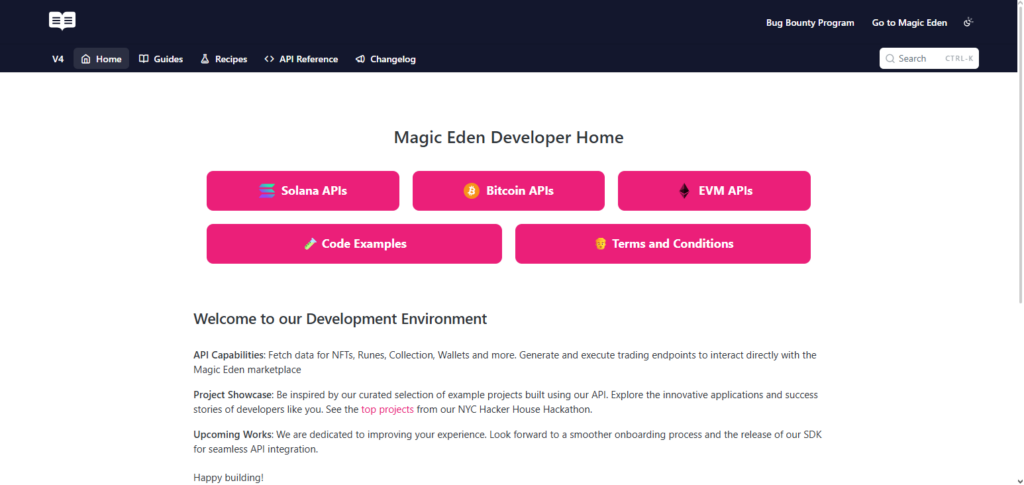
This API is ideal for businesses who want to monitor trends and collections for NFT, and keeps users informed in real time on digital assets. Magic Eden API has marketplace-centric features, and because of that, it helps developers and DApp builders create fun NFT experiences.
| Property | Details |
|---|---|
| Primary Use | NFT marketplace data and trading integration |
| Supported Networks | Solana, Ethereum, Polygon, Bitcoin, and others |
| Key Features | NFT listings, collections, sales, marketplace insights |
| Best For | NFT marketplaces and trading applications |
| Data Access | Marketplace activity and collection information |
Magic Eden API Advantages & Disadvantages
Advantages :
- Provides NFT marketplace data and trading information.
- Supports popular NFT ecosystems.
- Useful for NFT analytics and marketplace applications.
- Provides collection and listing information.
- Helps developers access real-time NFT market activity.
Disadvantages:
- Primarily focused on Magic Eden marketplace data.
- API availability may vary by blockchain.
- Limited customization options.
- Requires understanding of NFT marketplace workflows.
- Smaller developer ecosystem compared to Ethereum-focused APIs.
8. SimpleHash API
Among NFT APIs, SimpleHash is one of the best choices. It provides unified cross-chain NFT data. Its API enables developers to easily access NFT metadata, ownership, collection data, floor prices, sales history, and more. The SimpleHash API facilitates the integration of NFT data for wallets, marketplaces, portfolio trackers, and Web3 applications.
It serves multiple chains and provides reliable NFT data without the need for developers to create cumbersome indexing systems. With rapid data access, the SimpleHash API is the optimal choice for companies that are building NFT-targeted products and services.
| Property | Details |
|---|---|
| Primary Use | Multi-chain NFT data aggregation |
| Supported Networks | Ethereum, Polygon, Solana, Base, and more |
| Key Features | NFT metadata, ownership, pricing, collection data |
| Best For | Wallets, analytics tools, and NFT platforms |
| Data Access | Unified NFT data from multiple blockchains |
SimpleHash API Advantages & Disadvantages
Advantages:
- Unified NFT data across numerous blockchains.
- Retrieves NFT metadata quickly.
- Tracks NFT ownership and collections.
- Multi-chain NFT development simplified.
- Builds wallets and portfolio apps.
Disadvantages:
- Most features are behind a paywall.
- Relies on indexing of external blockchains.
- May miss some NFT marketplaces.
- Limited creation of NFTs.
- Costs can increase significantly for high-volume requests.
9. BlockSpan API
Among the NFT APIs, the BlockSpan API has the best NFT indexing and blockchain analytic solutions. It gives developers access to NFT ownership, wallets and their activity, token metadata, transfers, and blockchain transactions. Developers can build NFT marketplaces, trackers, portfolios, and tools on Web3.
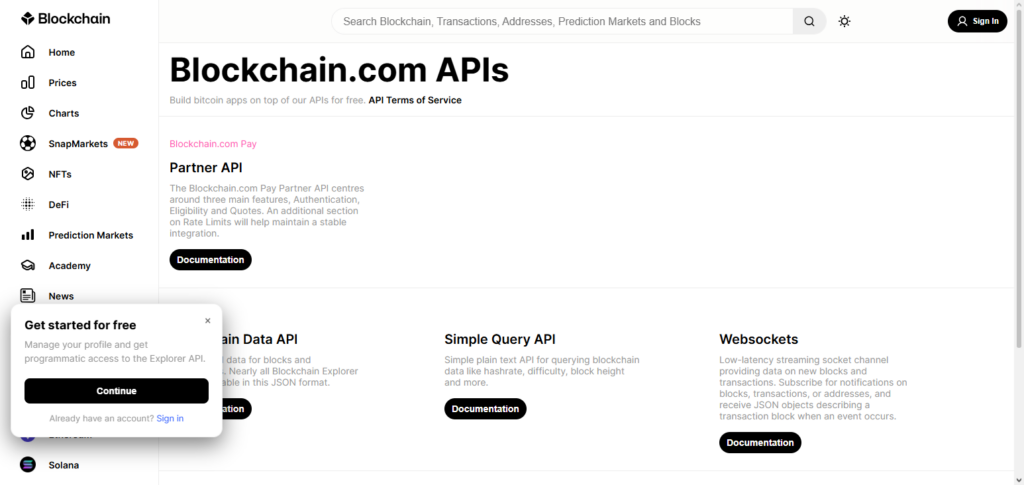
There are many NFT APIs that make blockchain data collection easier, but none offer data in such a clean and convenient format. BlockSpan offers NFT monitoring and facilitates the discovery of digital assets. Combining these features allows companies to design applications and tools that offer deep analytic insights for the digital assets tracked.
| Property | Details |
|---|---|
| Primary Use | NFT indexing and blockchain analytics |
| Supported Networks | Ethereum and selected blockchain networks |
| Key Features | NFT tracking, wallet analysis, asset discovery |
| Best For | NFT monitoring and Web3 analytics applications |
| Data Access | Token ownership, transfers, and blockchain records |
BlockSpan API Advantages & Disadvantages
Advantages:
- Advanced NFT indexing.
- Tracks wallets and assets.
- Covers deep blockchain analysis.
- Construct NFT-monitoring apps.
- Offers unstructured access to NFT data.
Disadvantages:
- Less known than many competing NFT APIs.
- Less documentation.
- Knowledge of blockchain is a necessity.
- Costs are very usage-based
- Scarcity of very specific marketplace features.
10. Zora API
Zora API is an up-and-coming contender among the Best NFT APIs for Devs Interested in Building Creator-Centric NFT Apps and Decentralized Platforms. It collects the NFT creation and minting and marketplace and protocol activities. Developers can utilize Zora API in social, marketplace, game, and Web3 NFT-enabled applications.
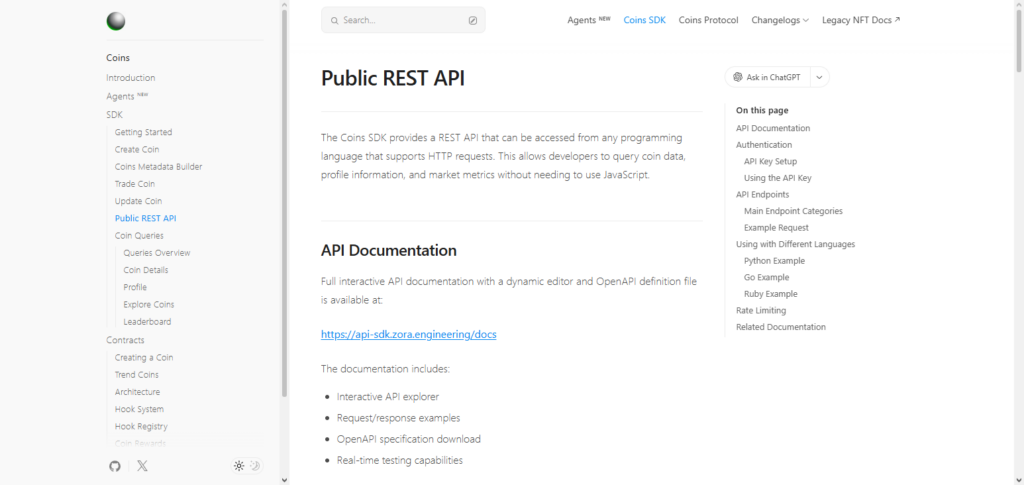
The API is creator-centric, to an extent, and aims at the decentralized ownership of digital assets. With its flexible NFT infrastructure and open protocol features, Zora API assists the developer community in constructing novel NFT user experiences and addresses the complexity of blockchain development in the NFT arena.
| Property | Details |
|---|---|
| Primary Use | NFT creation and decentralized creator applications |
| Supported Networks | Ethereum, Base, and Zora Network |
| Key Features | NFT minting, protocol data, creator tools |
| Best For | Artists, creators, and Web3 communities |
| Data Access | NFT protocol activity and digital asset information |
Zora API Advantages & Disadvantages
Advantages:
- Great for NFT apps that center around creators.
- Creates minting and decentralized NFT experiences.
- Development is supported by open protocols.
- Great for Web3 creators/ communities.
- Supports awesome, outside-the-box NFT ideas.
Disadvantages:
- Smaller than established marketplaces.
- Limited support for standard NFT marketplace features.
- Web3 development is a must.
- Less useful for enterprise NFT analytics.
- Adoption not on par with older platforms.
Comparison Table of Best NFT APIs
| NFT API | Best For | Supported Networks | Key Features | Developer Benefits |
|---|---|---|---|---|
| OpenSea API | NFT marketplace applications | Ethereum, Polygon, Base, and other supported chains | NFT metadata, collections, ownership, sales data | Easy marketplace integration and NFT discovery |
| Rarible API | NFT marketplaces and creator platforms | Ethereum, Polygon, Tezos, Flow, and more | NFT trading, minting, collections, marketplace data | Helps build decentralized NFT applications |
| NFTPort | NFT minting and management | Ethereum, Polygon, and other networks | NFT indexing, minting, metadata management | Simplifies NFT development and asset handling |
| Covalent API | Blockchain analytics and Web3 apps | Ethereum, Polygon, BNB Chain, Avalanche, and more | NFT balances, transactions, wallet data | Provides detailed multi-chain blockchain insights |
| Etherscan API | Ethereum NFT tracking | Ethereum and supported chains | Transaction data, smart contracts, NFT transfers | Reliable Ethereum blockchain information |
| Infura NFT API | Enterprise Web3 development | Ethereum, Polygon, IPFS, and Web3 networks | Blockchain access, node infrastructure, IPFS support | Provides scalable blockchain connectivity |
| Magic Eden API | NFT marketplace and trading apps | Solana, Ethereum, Polygon, Bitcoin, and others | NFT listings, sales, collections, market data | Access to real-time marketplace activity |
| SimpleHash API | Multi-chain NFT applications | Ethereum, Solana, Polygon, Base, and more | NFT metadata, ownership, pricing, collections | Unified NFT data across multiple blockchains |
| BlockSpan API | NFT analytics and tracking tools | Ethereum and selected networks | NFT indexing, wallet tracking, asset discovery | Efficient blockchain data management |
| Zora API | Creator-focused NFT platforms | Ethereum, Base, Zora Network | NFT minting, protocol data, creator tools | Supports decentralized NFT innovation |
Conclusion
The best NFT APIs provide developers with the tools to build rich NFT marketplaces, wallets, and analytics tools, as well as Web3 apps. Accessible blockchain data is the foundation for these tools. APIs such as OpenSea and Rarible facilitate the tracking of NFTs, accessing of metadata, verification of ownership, and integrations with marketplaces.
Considerations for the best API for your needs include; which blockchains are supported, pricing, scalability, and the features you require. With the increased acceptance of digital assets, NFT APIs are simplifying blockchain development for rapid innovation in the Web3 space.
FAQ
What are NFT APIs?
NFT APIs are developer tools that provide access to NFT data, including metadata, ownership details, transactions, collections, and marketplace information through simple API connections.
Why should developers use NFT APIs?
NFT APIs help developers build NFT applications faster by eliminating the need to create complex blockchain infrastructure for accessing and managing digital asset data.
Which are the Best NFT APIs for developers?
Some of the Best NFT APIs include OpenSea API, Rarible API, NFTPort, Covalent API, Etherscan API, Infura NFT API, Magic Eden API, SimpleHash API, BlockSpan API, and Zora API.
Can NFT APIs support multiple blockchains?
Yes, many NFT APIs support multiple blockchain networks such as Ethereum, Polygon, Solana, and other Web3 ecosystems for multi-chain NFT applications.