

I’ll go over the top cryptocurrency wallets that offer transaction screening in this post, emphasizing systems that combine strong security, AML/KYC compliance, and real-time sanctions monitoring.
In today’s complicated crypto ecosystem, these wallets ensure regulatory compliance, operational efficiency, and peace of mind by assisting institutions and enterprises in safely transferring digital assets while lowering exposure to high-risk or prohibited addresses.
Benefits Of Crypto Wallets Supporting Transaction Screening
Greater Regulatory Compliance: Screening transactions in real time helps businesses with the prevention of money laundering (AML) and Know Your Customer (KYC) guidelines and possible global sanctions avoiding legal and regulatory risks.
Sanctions Risk Mitigation: Screening the transaction helps evade sending and receiving transactions to and from blacklisted wallets. It protects the institution from the sanctions and the loss of reputational capital.
Fraud and Risk Management: Transaction screening and loss protection together reduce the risk of fraud, loss, and unauthorized transactions.
Integrated Operational Efficiency: Automating transactional screening eliminates some of the manual reviews, cutting down the compliance process time, and, in turn, allowing quicker and safer transfers of assets.
Outstanding Auditing: Audit logs and compliance reports serve organizations to prove compliance during audits and internal reviews.
Safe Cross-Border Transactions: Identifying risky jurisdictions and entities is undertaken before a transaction is initiated supporting the safety of international transfers.
Institutional Adoption: It provides a sense of trust and transparency to investors, trading companies, and businesses making crypto custody safer and operationally scalable.
Key Point & Best Crypto Wallets Supporting Transaction Screening List
| Platform | Key Point |
|---|---|
| Fireblocks | Enterprise-grade MPC wallet infrastructure with secure asset transfers, DeFi access, and policy-based controls for institutions. |
| BitGo | Regulated institutional custodian offering insured cold storage, multi-signature wallets, and compliance-focused asset protection. |
| Coinbase Custody | Qualified custodian providing offline cold storage, strong regulatory compliance, and seamless integration with Coinbase ecosystem. |
| Ledger Enterprise | Hardware-backed institutional custody combining HSM security, customizable governance, and enterprise key management. |
| Copper ClearLoop | Off-exchange settlement network enabling secure trading without moving assets, reducing counterparty and exchange risk. |
| Qredo | Decentralized MPC-based custody platform enabling cross-chain transfers, DeFi participation, and policy-driven governance. |
| Zengo Business | Keyless MPC wallet designed for businesses, focusing on simplicity, recovery security, and operational risk reduction. |
| Matrixport Custody | Institutional-grade custody integrated with trading, lending, and yield services within the Matrixport ecosystem. |
| Gemini Custody | SOC-certified, regulated custodian offering insured cold storage with strong compliance and transparency standards. |
| Kraken Custody | Secure institutional custody solution emphasizing operational security, regulatory compliance, and deep crypto expertise. |
1. Fireblocks
Fireblocks is an institutional crypto custody platform that focuses on security and compliance. They use transaction screening tools to help customers move their assets.
Best for institutional customers and businesses that need to safely store and move digital assets. Key strengths Fireblocks uses multi-party computation (MPC) to remove single points of failure and secure private keys.
Service description Fireblocks’ transaction screening offers compliance monitoring for global businesses by screening transaction counterparties against sanction lists. Features Apart from security and compliance, organizations gain a comprehensive service because of real-time analytics, API and custody, automated workflows, and insurance.
Fireblocks Features, Pros & Cons
Features
- MPC wallet infrastructure
- Real-time transaction screening
- Built-in integrations for AML/KYC
- Policy-based automated workflows
- Automation & institutional API
Pros
- Strong MPC security minimizes risk of key compromise.
- Built-in screening prevents problematic transactions.
- Automated workflows are supported by APIs.
- Compliance partners for AML/KYC integrations.
- Internal controls are enforced by custom policies.
Cons
- Smaller firms may find their enterprise pricing prohibitive.
- New users may find the system complex.
- For deeper compliance, third-party analytics is a requirement.
- Non-institutions may find it unsuitable.
- Most advanced features require integration.
2. BitGo
BitGo is one of the leading digital asset custodians with a reputation for multi-signature wallets and regulatory compliance. Best for businesses and institutions requiring crypto storage with insurance and safe advanced transaction features.
BitGo’s key strength is regulatory compliance paired with marketplace surveillance on protection screen. In the middle, BitGo’s compliance screen on the outbound protection screen services logs to OFAC and internal risk criteria to lessen the risks on the protected zones.
Features include a mix of cold and hot wallets, insurance for custody assets, portfolio management, and APIs for seamless service. BitGo’s enterprise level crypto asset management with regulatory compliance keeps crypto safe.
BitGo Features, Pros & Cons
Features
- Security Multi-signature wallet
- Filter & Monitor Transaction
- Coverage for insurance is optional
- Controls Access policy based
- Tools settlement & Staking
Pros
- Boosted security by using the multi-sig model.
- There are filtering features that will help detect loss transactions that are potentially sanctioned.
- Financial security is implemented with the insurance.
- Policies come with governance that is adjustable.
- The advanced practices for institutional will be supported.
Cons
- There are limits and exclusions that are insurance reliant.
- Delays can come with onboarding.
- Less built in analytics than some competitors.
- Some aspects of custody not fully decentralized.
- Advanced tools may require add ons.
3. Coinbase Custody
Coinbase Custody is an institutional-grade service provider that balances storage and security. This makes Coinbase Custody a service that most professional investors would appreciate. Best for large financial enterprises and high-net-worth investors that require custody of their cryptographic currency.
Coinbase Custody provides monitoring and reporting of real-time compliance gaps. Key advantage of Coinbase Custody is its integration with Coinbase Exchange. Coinbase Custody is able to offer its customers security storage and liquidity.
This service is combined with Coinbase custody’s compliance and transaction monitoring/ screening service. This service ensures that all customers do not lose custody of their cryptographic currency to unpermitted entities.
Notable features like account controls and an institutional dashboard service are among Coinbase Custody customers. Segregated cold storage, insurance, and staking are offered to customers as well. This makes Coinbase Custody a qualified service provider with regulatory guidelines.
Coinbase Custody Features, Pros & Cons
Features
- Regulated custody with insurance
- Built in transaction monitoring
- Automated systems for AML & sanctions
- Institutional level APIs and reporting
- Access to deep market liquidity
Pros
- Storage insurance increases trust from institutions.
- APIs and reporting improve workflow.
- Increased compliance means decreased risk.
- Monitoring reduces risk of exposure to sanctioned addresses.
- Wide range of supported assets.
Cons
- Less competition means higher fees.
- Increased regulations means longer times to move assets.
- Less supported assets, compliance and regulations.
- More stringent, longer, and difficult to complete user onboarding.
- Custody solution not focused on self custody.
4. Ledger Enterprise
Providing a balance between compliance and security, Ledger Enterprise caters to institutional clientele by combining high-security hardware wallets with tailored compliance solutions. Best for organizations that wish to retain ownership of the private keys, transcending compliance barriers with transaction screening.
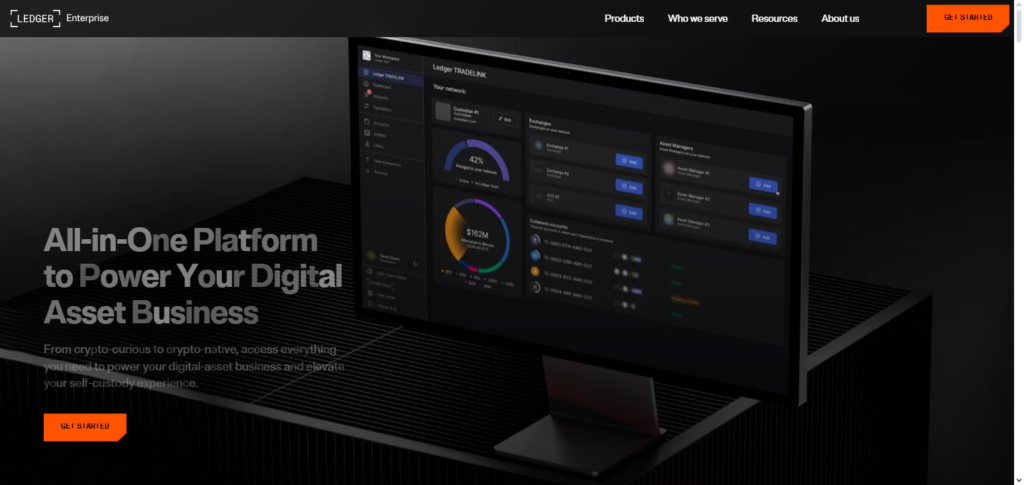
Its key strength is the product combination of an air gapped hardware security with enterprise grade software that offers safe transfer execution.
Ledger Enterprise, mid-paragraph, provides blended software and enterprise grade hardware solutions to ensure compliance with sanction and watchlist screening, while maintaining security to support transactional screening. Offered solutions include the management of security keys, extensive audit trails, cold storage, multi-user access, and API integration.
Ledger Enterprise Features, Pros & Cons
Features
- Hardware anchored custody (HSM)
- Controls for transaction approvals
- Compliance monitoring features
- Role based governance and policies
- Auditable compliance logs
Pros
- Physical separation increases security.
- Restriction controls improve security.
- Compliance tools can be added for sanctions.
- Regulators audits are easier with compliance logs.
- Corporations gain full control over custody.
Cons
- More analytics tools aren’t included.
- Operational costs may increase with more hardware.
- Not designed for the cloud.
- Costs for enterprises are higher.
- Less built in liquidity features.
5. Copper ClearLoop
ClearLoop integrates with several custody providers, focusing on insured and compliant digital asset transfers. Best for companies wanting seamless transaction tracking and smooth risk management. Its key strength is real-time transaction screening, pre-approval, and counterparty check against sanctions and internal compliance policies.
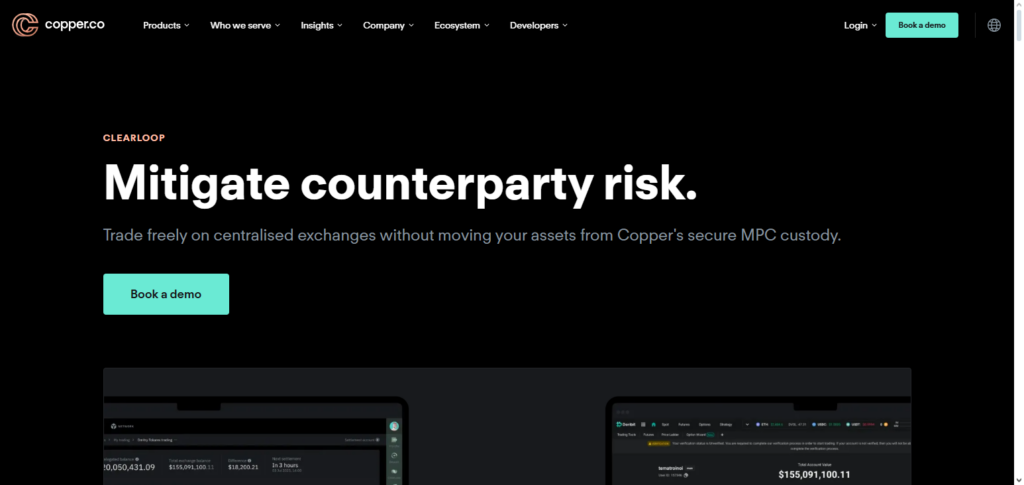
In the middle of the paragraph, ClearLoop’s system blocks and signals transfers to high-risk jurisdictions, helping users to avoid interacting with high-risk addresses. Features include connectivity across custodians, API workflow automation, real-time compliance updates, simultaneous user support, and automated compliance reporting.
Keeping the asset safety and regulatory policy balance, ClearLoop allows institutions to provide uninterrupted workflows for crypto assets, making it the best option for companies dealing with crypto in complex modules.
Copper ClearLoop Features, Pros & Cons
Features
- Off-Exchange Settlement Networks
- Instant on-Chain Settlement
- Integrated Compliance Filters
- Counterparty Risk Mitigation
- Liquidity Provider Connectivity
Pros
- Minimization of risk exposure due to settlement speed.
- Support of built-in filters to avoid high-risk transactions.
- Less reliance on intermediaries.
- Increased efficiency of settlement at an institutional level.
- Connectivity to primary sources of liquidity.
Cons
- No proprietary custody wallet.
- Needs institutional-level infrastructure.
- Potentially required third-party analytics for thorough screening.
- Adoption still being developed.
- Not designed for retail user integration.
6. Qredo
For institutional crypto users, Qredo offers compliance tools and decentralized custody solutions. Best for companies wanting regulatory-safe, cross-chain transactions. Its key strength is maintaining private key custody on the MPC-based decentralized network while providing instant settlement. In the middle of the paragraph, Qredo alleviates compliance concerns by prescreening transactions.
Features include cross-chain transactions, multi-party approval, wallet insurance, enterprise-grade access control, and real-time transaction monitoring. For institutions who want to move assets across networks while still following regulations, Qredo is the best option, combining automation compliance with decentralization.
Qredo Features, Pros & Cons
Features
- Decentralized Network of MPC Custody
- Support for Cross-Chain Settlement
- Policy-Based Transaction Approvals
- Integrated Screening
- On-Chain Governance
Pros
- With cross-chain functionality, it’ll allow for flexibility across a variety of portfolios.
- Distributed architecture lowers the risk of a single point of system failure.
- Policy enforcement for compliance workflows.
- Screening tools can be incorporated.
- Settlement is real time.
Cons
- The onboarding process is technical, requiring a decent amount of expertise.
- The system relies on the participation of the network.
- Lack of comprehensive compliance may require external screening solutions.
- Insufficient token insurance.
- Limited applicability to uncommon or niche tokens.
7. Zengo Business
Zengo Business provides MPC-based custody solutions that are keyless and tailored for enterprise-grade custody with compliance requirements. Best for medium-to-large businesses who want better control and safe storage of keys.
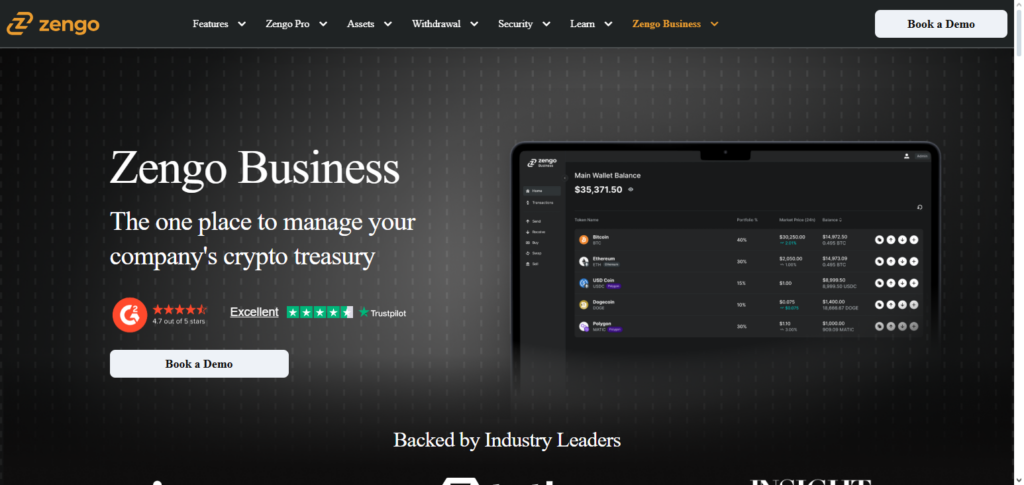
Its key strength is reducing private key control and maintaining custody level security with multi-party computation. Mid-paragraph, Zengo Business offers support for transaction screening by integrating with OFAC and in-house risk databases for the purpose of blocking risky, unauthorized transactions.
Features mobile and web applications, multi-user management, secure approval, insurance, and audit reports. Zengo offers the best user experience in terms of compliance and is thus preferred by organizations with efficiency and compliance requirements.
Zengo Business Features, Pros & Cons
Features
- Signing without keys via MPC
- Synch team governance & multi-layer approvals
- Integration of transaction screening
- Interface that is user-friendly
- Controls of access by roles
Pros
- Simple governance for teams.
- Usability suits enterprise staff.
- Integrates with compliance partners.
- Flexible permissioning
- Keyless MPC enhances security posture
Cons
- Need for unbundled analytics.
- Not ideal for deep institutional settlement.
- Fewer stored assets.
- Limited hold on cold storage.
- Not a fully custodial balance.
8. Matrixport Custody
Matrixport Custody is the provider of institutional-grade crypto custody alongside sophisticated automation and transaction screening compliance tools. Best for asset managers and enterprises that require insured custody and other financial services.
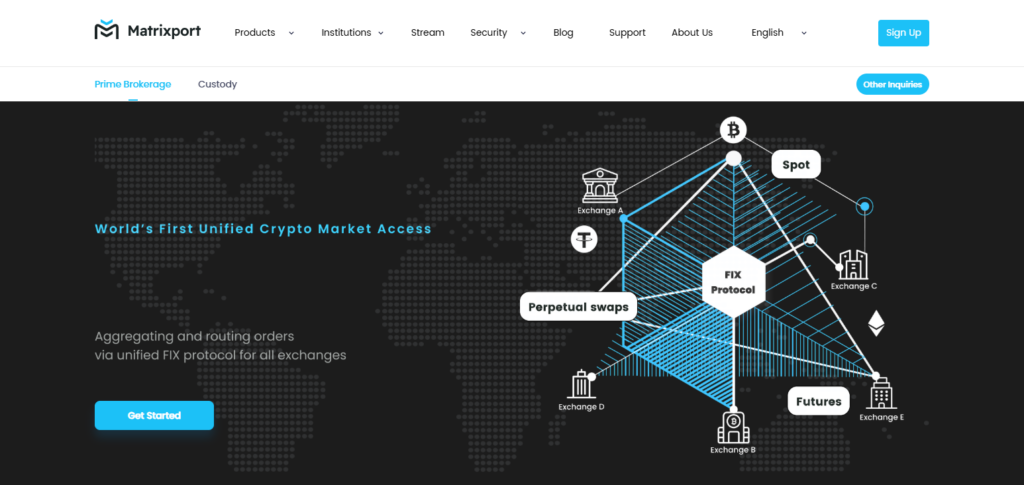
Its key strength lies in the combination of storage safety and the line of financial services such as lending and trading.
Mid-paragraph, Matrixport complies with the transaction screening of sanction lists and flagged addresses for safe transfer compliance. Features cold and hot wallet services, multi-signature, API, insurance, and enterprise dashboards. Matrixport provides operational risk minimization by keeping custody and compliance in one platform.
Matrixport Custody Features, Pros & Cons
Features
- Custody, trading, lending, and everything via an integrated platform.
- Compliance scanning within the platform
- Custom policy regulation
- Analytics and reporting suite
- Support for multiple assets
Pros
- Having compliance scanning built into workflows.
- Policies is better aligned to the risk they represent.
- More analytics to monitor transfers.
- Support for multiple assets.
- The integrated platform minimizes operational silos.
- More analytics to monitor transfers.
Cons
- New users experience some platform complexity.
- The evolving compliance tooling compared to the specialists provides some gaps.
- Service type determine how high the pricing is.
- The platform is not fully decentralized.
- The complexity is higher for the enterprise teams.
9. Gemini Custody
Gemini Custody offers fully regulated custody services and advanced transaction monitoring to institutional clients. Best for businesses that want a compliant crypto storage partner. Its key strength is regulatory coverage and fully insured storage.
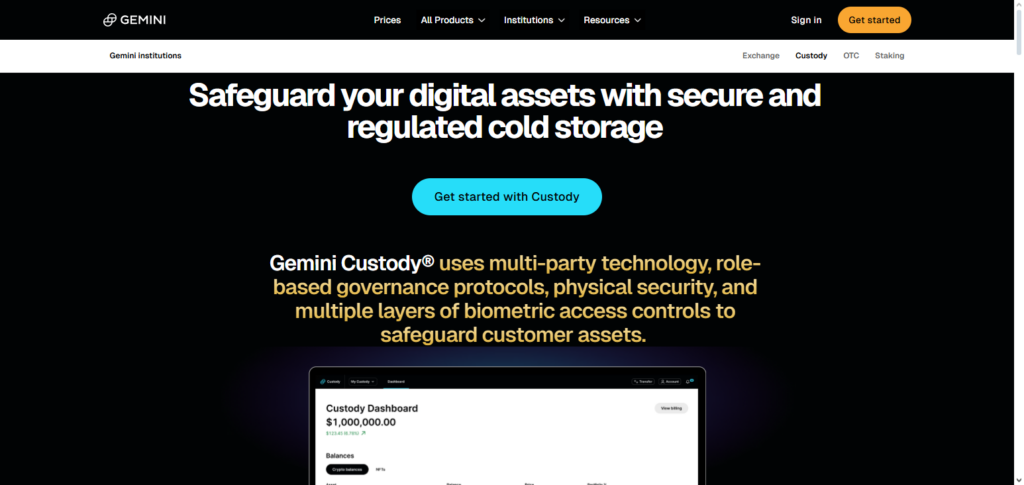
Mid-paragraph, Gemini screen tools for sanctioned counterparties that automatically screen transactions.
Features include segregated cold storage, hot wallets for liquidity, multi-user permissions, API integration, and compliance monitoring. Gemini Custody secures managed crypto holdings for enterprises without the surrounding legal and financial risks.
Gemini Custody Features, Pros & Cons
Features
- Regulatory compliance for custody
- Sanction/AML Compliance
- Digital asset insurance
- Separate accounts for institutions
- Tools for auditing and reporting
Pros
- Trustworthiness due to regulation
- Insurance and compliance screening mitigate risk
- Separate institution accounts to minimize distributor risk
- Easier reporting for audits
Cons
- Costs may be more than custodial
- Compliance checks may slow down transfers
- DeFi access may be limited
- Self-custody options are restricted
- Onboarding processes can be extensive
10. Kraken Custody
Kraken Custody has custody services that include insurance, transaction compliance monitoring, and custodial crypto storage for institutional clients. Best for institutional investors, regulated funds, and custodian partnerships.
Its key strength is security, compliance, and merging the custodial services of the Kraken exchange. Mid-paragraph, custodial services of Kraken monitor transactions to maintain safety and sanctioned hot wallet access.
Features include custody of insured accounts, cold and hot wallets, multi-user, and API management. Reporting compliance is automated. Kraken Custody provides goal-oriented transparency on regulatory compliance to institutions.
Kraken Custody Features, Pros & Cons
Features
- Bankruptcy-remote custody
- Reserve proof transparency
- Maintaining compliance of KYC and AML
- Institution APIs
- Monitoring risk of transactions
Pros
- Trust increases by transparent proof of reserves
- Comprehensive systems reduce risks for sanctions
- Imported APIs can automate screening risk workflows
- Safe segregated accounts
- Reasonable pricing for institutions
Cons
- More difficult than competing interfaces
- Advanced analytic dashboards may be lacking
- Limited staking and governance on-chain
- Slower support for newly launched tokens
- Inappropriate for customers who are not institutions
Conclusion
Institutions and companies working in a regulated digital asset environment must select the best cryptocurrency wallets that offer transaction screening. Platforms that combine robust security with integrated AML, sanctions monitoring, and policy-based transaction restrictions include Fireblocks, BitGo, Coinbase Custody, Ledger Enterprise, and Gemini Custody.
Without sacrificing operational effectiveness, these wallets assist businesses in identifying questionable conduct, lowering compliance risk, and satisfying international regulatory standards. Adopting custody solutions with integrated or integrable transaction screening guarantees safer asset management, increased transparency, and sustained confidence in cryptocurrency operations as regulations change.
FAQ
A crypto wallet with transaction screening is a wallet that incorporates monitoring tools to analyze transactions for compliance, suspicious activity, or policy violations. This feature helps institutions prevent sending or receiving funds tied to illicit sources, sanction lists, or high-risk addresses.
Transaction screening helps mitigate regulatory and compliance risk by detecting potentially risky transfers before execution. It supports AML/KYC policies, helps avoid sanctions violations, and improves transparency for institutional operations.
Top crypto wallets and custody platforms supporting transaction screening include Fireblocks, BitGo, Coinbase Custody, Ledger Enterprise (via integrations), Gemini Custody, Qredo, and Kraken Custody. These solutions offer varying degrees of built-in monitoring or third-party screening integrations.
These wallets use in-house or third-party analytics to scan addresses against sanction lists, AML databases, and risk signals. They can block high-risk transactions, provide alerts, and generate audit logs needed for regulatory reporting.