

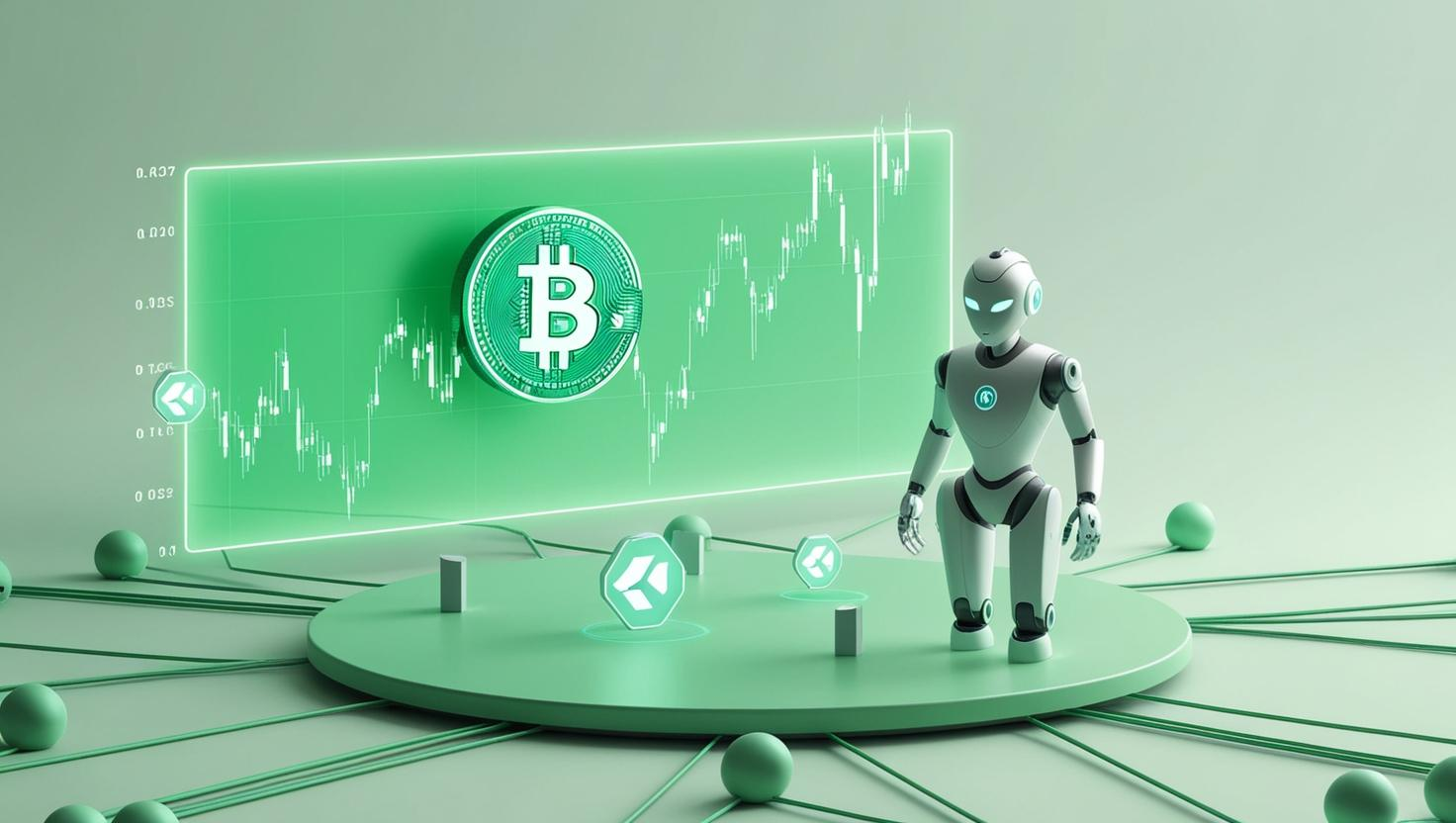
This article examines how artificial intelligence and cryptocurrencies are coming together to form innovative and disruptive financial models within the new digital economy.
The integration of AI and blockchain technologies opens the possibility of more intelligent, rapid, and reliably transparent financial systems. This remarkable combination is pioneering the new age of decentralized finance and smart asset management.
What is AI and Cryptocurrency?
AI and Cryptocurrency are pivotal emerging technologies increasingly changing the economic landscape. The fundamental concept of AI is the automation of decision-making processes, data analysis, and predictive assessments.
In the finance sector, AI’s automation of customer service, and fraud detection, and trading algorithms is indicative of the technology’s value. Cryptocurrency is digital currency (money) with blockchain technology and is used for decentralized, secure, and transparent transactions without third parties.
The automation of cross-crypto transactions and decision-making enhances trading, broadens the scope of real-time data analysis and secure real-time trading, and completes automation of sophisticated transaction processes across decentralized systems.
The pairing of AI and Cryptocurrency accelerates the automation and decentralization of advanced crypto economic systems.
How AI + Crypto Are Merging to Create New Financial Models

Example: AI Based Crypto Lending Platform
Step 1: Data gathering
- The platform gathers massive amounts of on-chain data (transaction history, wallet activities, and market trends ) as well as off-chain data (social sentiment, news, and macroeconomic indicators) .
- The AI analyzes this data to estimate the possible risk profile of the borrower and gauge future market movement.
Step 2: AI Risk Assessment
- Credit risk evaluation happens automatically when AI assesses the diverse patterns and user behavior.
- AI assesses the crypto behavior patterns, type of collateral, and trading patterns to estimate default risk, eliminating the reliance on an outdated credit score.
Step 3: Smart Contract Automation
- The lending platform automates the loans using blockchain smart contracts.
- AI’s risk assessment determines how the interest rate, loan duration, and liquidation thresholds, among other things, are changed.
Step 4: Interest Rate Adjustments
- AI assesses the borrower’s risk and the market conditions and their relation to volatility in real time.
- The interest rate will change to defend the lender’s money and keep the system stable when market or borrower risk increases.
Step 5: Learning
- The system’s AI continuously calibrates its predictive model to integrate new data.
- Gradually, the process of lending becomes more efficient, more secure, and more customized for the different behaviors of users in the crypto space.
Step 6: Outcome
- With optimized returns, risk to the lenders is mitigated.
- For the borrowers, the process of gaining access to a loan becomes quicker and more equitable.
- The system runs independently, integrating the unparalleled transparency of blockchain technology with the smart capabilities of artificial intelligence.
Benefits of AI-Crypto Integration
Enhanced Financial Decision-Making
By predicting market movements and formulating innovative trading strategies, AI helps in the analysis of price predictive patterns, which culminates in higher accuracy of trading decisions and AI-infused profitability.
Advanced Security and Fraud Detection
AI increases crypto network security by identifying and quelling potentially fraudulent and malicious activities, documenting erratic patterns, and monitoring and stopping crypto hacks in real time.
Greater Automation and Efficiency
The integration of AI and smart contracts signifies a steep increase in the automation of routine financial tasks, leading to the elimination of operational delays, reduction of human error in financial processes, and a steep decline in processing time.
Customized Financial Products
AI analytics tool give crypto and decentralized finance (DeFi) users tailored investment recommendations, dynamic portfolio management, and risk scoping which broadens the financial scope for users.
Higher Market Liquidity
AI liquidty optimizing algorithms and automated market-making helps in predicting liquidty imbalances between supply and demand and managing order books.
More Effective Risk Management
AI instruments estimating and predicting portfolio crypto volatility and rebalancing crypto holdings helps avoid prolonged unsustainable financial system failures.
Real-World Examples and Use Cases
SingularityNET (AGIX)
- Generated via blockchain technology, Singularity is the first fully decentralized marketplace for AI services.
- Developers publish, share, and monetize their AI algorithms for crypto payments.
- It encourages cooperative AI rather than reliance on centralized AI systems.
Fetch.AI (FET)
- Encapsulates AI with blockchain technology to create autonomous “agents” which carry out tasks such as trading, data analysis, and logistics optimization.
- Fetch.AI enables decentralized machine-to-machine economic interactions.
- It helps the design of smart cities, supply chains, and AI-enabled DeFi systems.
Numerai (NMR)
- Data scientists anonymously submit AI models, which empowers a hedge fund.
- In combination with the NMR token, blockchain technology is utilized for the equitable distribution of rewards.
- It enhances investment strategies by combining crypto incentives with AI-powered predictive analytics.
Ocean Protocol (OCEAN)
- It incorporates blockchain technology to provide secure decentralized data exchange.
- AI developers gain access to tokenized datasets and can train and refine their models.
- Data monetization is encouraged, and private ownership rights are preserved.
Cortex (CTXC)
- It allows the integration of AI models to be executed on a blockchain.
- AI inference can be incorporated directly into smart contracts.* Empowers smart dApps capable of making realtime driven AI decisions.
DeepBrain Chain (DBC)
- A blockchain-based decentralized AI computing platform designed for cost-efficient AI model training.
- Provides idle GPU resources for use by AI model developers in the community.
- Involves AI project developers in cost effective crypto payment systems which improves project for project effort in AI.
SingularityDAO (SDAO)
- DeFi platform which combines AI and automated crypto for smart portfolio management.
- Rebalances token baskets by predicting automated AI market trends.
- Automated systems help investors increase their profit while minimizing risk in a data driven approach.
Challenges and Risks
Data Privacy and Security Issues
In order for AI to work effectively, huge amounts of data need to be processed, however, there are risks to the privacy and confidentiality of sensitive data when such data is shared on public blockchains. Finding the right balance between transparency and protection is difficult.
Uncertainty in Regulations
There are new and emerging frameworks of legislation concerning both AI technologies and cryptocurrency. The absence of well defined regulations concerning AI driven crypto systems pose risks to developers, investors and users.
Energy Consumption and Scalability
There are issues regarding scalability and increased energy consumption because the simultaneous blockchain operations and AI model entries require extensive computational power.
Ethical Issues and Bias
AI systems are capable of making unfair decisions especially in the lending systems and financial models because of the biases in the training data. It is difficult to guarantee fairness and accountability in such systems.
Vulnerability of Smart Contracts
The execution of AI driven decisions through smart contracts may result in loss of funds and abuse due to coding mistakes or gaps in security.
Issues with Interoperability
There are serious technical issues in the integration of AI frameworks with different blockchain systems, resulting in the lack of seamless interaction between different systems.
Lack of Transparency in AI Models
Due to the hard-to-explain, non-predictable, and non-auditable outcomes of AI, it is classed as a ‘black box.’ This is an issue for accountable financial systems.
Market Manipulation Risks
AI-powered trading bots can engage in crypto market manipulation by arbitraging small market inefficiencies. This brings forth issues of fairness and stability.
The Future of AI + Crypto Finance
The predicted convergence of AI and Crypto finance will develop intelligent, automated, and decentralized discrimination finance systems. As systems of artificial intelligence developed, blockchains will also become more automated and efficient with the use of predictive analytics and dynamic risk assessment.
AI will also decentralize real-time automated optimizations of lending, trading, and investment in Double Entry systems of finance without the need of human operators.
For systems of AI to process and use operational data, blockchains will create immutable environments of trust and security. These self-sustaining finance systems will democratize and modernize the global economy, fully decentralizing transactions, governance, and even systems of innovation.
Conclusion
To sum up, the integration of AI with cryptocurrency has a transforming role in the future of modern financial systems. AI’s smart data processing combined with the characteristics of blockchain technology’s decentralization and transparency are paving the way for innovative financial models that increase speed, equity, and efficiency.
Integration of AI in automated trading, predictive analytics, decentralized AI marketplaces, and smart contracts is certainly triggering innovative advancements in the economy worldwide.
There are still obstacles in the form of regulations and security, but the integration of AI with cryptocurrency is ushering a new era in finance where it is smart, decentralized, and is within reach of everyone.
FAQ
AI and crypto integration refers to combining artificial intelligence’s analytical power with blockchain’s transparency and decentralization. Together, they create smarter financial systems that can automate trading, detect fraud, and optimize decentralized finance (DeFi) operations.
AI is used to analyze market data, predict price trends, automate trading strategies, enhance blockchain security, and improve decision-making in crypto platforms. It helps users and institutions manage assets more intelligently.
The combination of AI and crypto improves efficiency, accuracy, and transparency in finance. It enables automated trading, predictive analytics, personalized financial services, and secure decentralized systems.
Projects like SingularityNET, Fetch.ai, Numerai, and Cortex are leading the way in merging AI with blockchain. They offer decentralized AI marketplaces, intelligent trading systems, and blockchain-based data sharing.
Yes, risks include data privacy concerns, biased AI algorithms, regulatory uncertainty, and smart contract vulnerabilities. Managing these challenges requires strong governance, audits, and transparent AI models.