


I’ll talk about the future of tokenized stocks and synthetic assets in this post. These cutting-edge financial products are transforming investment by fusing traditional markets with blockchain technology.
While synthetic assets mimic asset prices without ownership, tokenized stocks enable fractional ownership of actual shares. Together, they aim to shape the next financial era by providing investors worldwide with new opportunities, 24/7 trading, and increased accessibility.
What is Tokenized Stocks?
Digital copies of conventional firm shares made on a blockchain are known as tokenized stocks. Every token has the same market value, dividends, and corporate rights as a real-world stock.

They make high-value stocks more accessible to individual traders worldwide by enabling investors to buy fractional shares. On blockchain-based platforms, tokenized stocks are available for trading around-the-clock and provide lower transaction fees and quicker settlement than traditional exchanges.
To ensure stability and trust, the underlying stocks that support the tokens are usually held by a licensed custodian. This invention opens up new possibilities for contemporary investing by fusing traditional share ownership with the efficiency, security, and transparency of blockchain technology.
What is Synthetic Assets?
Blockchain-based financial products known as “synthetic assets” are made to mimic the value of actual assets, including stocks, commodities, indexes, or currencies, without requiring direct ownership.
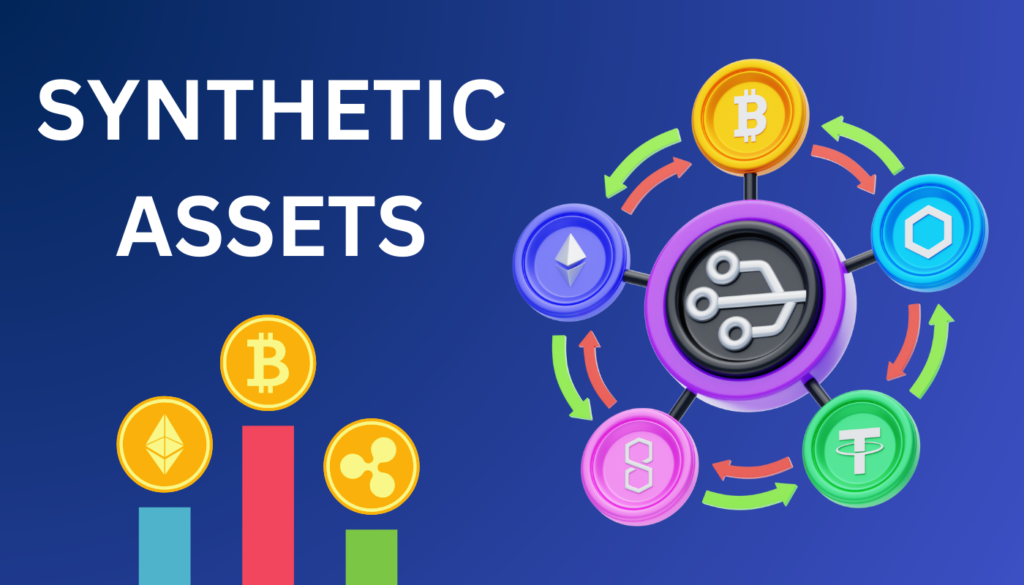
They are developed on decentralized finance (DeFi) platforms utilizing smart contracts that automate transactions, track pricing, and manage collateral. Investors can effectively speculate on price movements, hedge positions, and obtain exposure to a variety of markets with synthetic assets.
They rely on decentralized liquidity pools for stability while providing advantages like fractional ownership, round-the-clock trade, and worldwide accessibility. Synthetic assets are changing how investors access and engage with conventional financial markets by fusing blockchain transparency, automation, and flexibility.
How Tokenized Stocks and Synthetic Assets Work
How Tokenized Stocks Work
Secured on Blockchains: The tokenized form of an individual stock is recorded on a blockchain.
Real World Asset Backing: The physical stock represented by the digital token is kept with a licensed custodian.
Partial Shares Available: Investors can buy less than a full share of a company.
Tokens Trade Anytime: Tokens can be traded on supported platforms at any time, even when the stock exchange is closed.
Immediate Blockchain Transactions: Stocks are settled on the blockchain, which means less time and money are spent on stock trading.
How Synthetic Assets Work
Asset Value Replication: Synthetic assets are able to replicate the value of an asset without ownership.
Managed by Smart Contracts: Smart contracts take care of the collateral, the price of the asset, and the rules of the contract.
Source of Liquidity: Decentralized liquidity pools serve as a source of liquidity.
Market Exposure: Investors can take on additional market exposure, hedge risk, or do so at a relatively low cost.
Blockchain Security: All trades and prices on the blockchain are transparent and cannot be altered.
Benefits of Tokenized Stocks & Synthetic Assets
Benefits of Tokenized Stocks
Fractional Trading: Tokenized stocks enable potential investors to financially commit to a greater diversity of stocks, while also enabling access to traditionally high-priced stocks for fractional shares.
Global Trading Anytime: Global markets allow sock trading at any time of day versus the limited trading hours of traditional exchanges.
Cost-Efficient Trading: Costs associated with trading and transactions are reduced significantly through the use of blockchain technology.
Universal Market Access: Retail investors can easily enter the market without the necessity of local brokerage accounts.
Trustless Verification: All blockchain trading transactions are end-to-end secured through the use of trading verification via blockchain technology.
Benefits of Synthetic Assets
Indirect Exposure: Markets and trading can be accessed indirectly without the necessity of owning the assets.
Portfolio Protection: Structuring a trading strategy towards profit through the use of derivatives is possible.
Non-Custodial Direct Trading: DeFi trading is possible without the use of a central authority.
Affordable Access: Access to markets is possible even with small amounts of capital.
Adaptable Trading: Tradeable funds are made available through decentralized trading, which can be accessed flexibly.
Real-World Use Cases
Tokenized Stocks
Equity Accessibility: Without signing up with a local brokerage, investors can buy fractions of the company Apple, or the company Tesla, and other types of equity.
Trading Outside Traditional Market Hours: Companies like FTX and Binance are able to offer tokenized stocks and trade them at any time, even after the markets have shut.
Portfolio Diversification: Retail investors can buy and become part-owners of multiple expensive stocks, as well as become part-owners of multiple cheap stocks.
Dividends: Token holders can receive dividends, and as a result of purchasing a token, an investor can become entitled to a portion of a company’s equity.
Synthetic Assets
DeFi: With the DeFi buildout, assets like gold, oil, foreign currencies and other types of assets can be tracked and managed by investors using synthetic assets offered by the Synthetix blockchain.
Investment Without Ownership: Synthetic assets can be used to hedge an asset from fluctuating in price, or to speculate on it.
Access to Offshore Markets: Global markets can be traded without brokers.
New Synthetic Derivatives: Complex financial strategies can be formed across the entire distribution of a decentralized network.
Risks and Challenges
Legal & Regulatory Risk
- Legislation on synthetic assets and tokenized stocks varies across the world. These laws may range from vague to in the process of being updated.
- These laws may create compliance issues that may in turn lead to legal penalties and/or may restrict the ability to trade the synthetic assets/tokens.
Market Risk
- Market risks can be associated with tokenized stocks and synthetic assets due to their underlying assets, and the potential for rapid price fluctuations. These risks can be exacerbated in illiquid markets.
- Small scale investors in particular are more likely to lose their investments in the tokenized stocks and synthetic assets.
ustody & Counterparty Risk
- Custody risks may be present with tokenized stocks, as custodians must securely store underlying assets.
- Counterparty risks may be present with synthetic assets due to the reliance on collateral, and the presence of smart contracts that may lead to loss due to flaws.
Security Risk
- Smart contracts may have weaknesses that are exploited by hackers.
- Risk of loss is present due to the loss of private keys and breaches of the platform.
Liquidity Risk
- If a token or synthetic asset has low trading volume, it can become increasingly difficult to buy and/or sell the item.
Key Differences Between Tokenized Stocks & Synthetic Assets
| Aspect | Tokenized Stocks | Synthetic Assets |
|---|---|---|
| Definition | Digital representation of real-world stocks on a blockchain | Blockchain-based derivatives that replicate the value of assets without ownership |
| Ownership | Backed by actual underlying shares; investors hold a fraction of real stock | No direct ownership of the underlying asset; value is mirrored via smart contracts |
| Trading | Can be traded 24/7 on supported platforms | Traded on DeFi protocols or decentralized exchanges |
| Dividends & Rights | Token holders may receive dividends and shareholder rights | Typically no dividends or ownership rights; value changes with the underlying asset |
| Backing | Custodian holds real shares to back tokens | Collateral and smart contracts maintain asset value |
| Use Case | Access to traditional stock markets with fractional ownership | Hedging, speculation, and exposure to various assets in DeFi |
| Risk | Custodian or platform failure; regulatory compliance | Smart contract vulnerabilities, collateral risk, and price tracking issues |
The Future of Tokenized Stocks & Synthetic Assets
Investing will be transformed by the future of synthetic assets and tokenized stock markets. Blockchain technology improves with time, and so will the usage of tokenized stocks and synthetic assets, along with the accessibility to all investors, the ability to trade globally, invest incrementally in ownership and trade stocks all hours of everyday.
Traditional financial institutions are integrating tokenized stocks and synthetic assets, providing the first time Decentralized Finance (DeFi) and Centralized Finance (CeFi) collab. AI synthetic assets are future instruments of trading which will operate on cross-chain and will add to the existing superior regulatory frameworks with liquidity, security and transparency.
The existing economic volatility and uncertainty will always exists but the benefits outweigh the challenges and will always exist in multiple ways. Access to previously inaccessible markets, democratized investing, an overall increase of efficiencies for all markets and a new way of how the world engages with the markets will be the ultimate accomplishments of synthetic assets and tokenized stocks.
Conclusion
Tokenized equities and synthetic assets have the potential to revolutionize international investing by improving market accessibility, efficiency, and transparency.
These developments expose investors to both conventional and alternative assets while combining the advantages of blockchain technology, such as security, fractional ownership, and round-the-clock trading.
Even though there are still issues like market volatility, regulatory uncertainty, and security threats, substantial growth is anticipated as long as technology continues to progress and become more integrated with traditional finance.
Tokenized and synthetic assets have the potential to democratize investment, improve portfolio diversification, and give investors new means of risk management and global market participation as their use grows, thereby influencing the financial landscape of the future.
FAQ
What are synthetic assets?
Synthetic assets are blockchain-based derivatives that mirror the value of real-world assets, like stocks, commodities, or indices, without requiring direct ownership.
What are tokenized stocks?
Tokenized stocks are digital representations of traditional shares on a blockchain, allowing fractional ownership, 24/7 trading, and global access while being backed by real underlying stocks.
Are tokenized stocks and synthetic assets legal?
Legality varies by jurisdiction. Some countries regulate them like securities, while others are still developing clear rules. Investors should check local regulations.
What are the main benefits?
Benefits include fractional ownership, global accessibility, 24/7 trading, lower costs, transparency, and portfolio diversification opportunities.