

This article covers The Rise of Modular Blockchains, an approach changing the landscape of the blockchain world.
By disaggregating execution, consensus, and data availability onto different layers, modular blockchains offer improved scalability, customizability, and greater security.
This new architecture is further advancing the Web3 evolution by providing decentralized apps across finance, gaming, and other areas with higher speeds, lower transaction costs, and increased interoperability.
Understanding Modular Blockchains
Modular Blockchains represent a new way of thinking about blockchain technology by decoupling the blockchain layer functions of execution, consensus, and data availability into specialized blockchains.
In contrast to monolithic blockchains, which are still the most common, modular blockchains offer the potential to vastly improve scalability and recast efficiency and flexibility by distributing blockchain responsibilities.
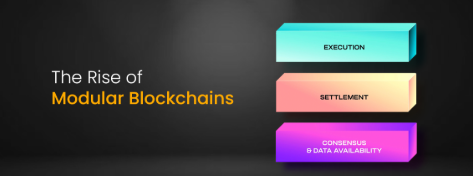
In a 3-layer modular blockchain, the execution layer handles the transactions and smart contracts, the consensus layer provides secure validation, and the data availability layer ensures the data remains accessible and attestable.
This decoupling fosters specialization and the enhancement of interoperability, making modular blockchains an exciting new building block for Web3 applications.
The Rise of Modular Blockchains
Scalability Improvements
Modular blockchains can layer the splitting of block services so that more transactions can be processed without the system slowing down.
Flexibility for Developers
Each layer can be adjusted for different application needs, leading to more refined targeted services for DeFi, NFTs, and others.
Enhanced Security
By separating and isolating the consensus, execution, and data layers of a system, the fundamental risks of a system can be managed and bespoke protective measures can be implemented.
Interoperability
Modular systems naturally have more efficient and easier pathways to enable systems to work and communicate with other systems.
Innovation Acceleration
Modular systems simplified upgrades and integrations, which permits more rapid innovation and adoption, especially in the experimental arenas of the Web3 ecosystem.
Advantages of Modular Blockchains for Web3
Scalability: Modular blockchains are able to handle more transactions without congestion as execution, consensus, and data layers are dissociated.
Flexibility & Customization: Monolithic blockchains impose certain limitations on developers, but with modular blockchains, developers can adjust each layer to particular applications.
Lower Costs: Offloading functions to specialized layers eases the computational demand, which in turn, decreases the transactional and operational costs.
Interoperability: The modular architecture permits disparate blockchain systems to engage more freely, facilitating applications that span multiple blockchains.
Faster Upgrades: The ability to innovate and alter protocols of the layers independently accelerates the upgrade process.
Enhanced Security: The isolation of layers increases the difficulty of executing an attack, hence increasing the resilience of the network to hostile attempts.
Real-World Examples and Case Studies
Celestia
Developers can scale and customize blockchains without having to build a consensus mechanism from scratch because it disassociates consensus and data availability from execution.
Polygon Avail
Streamline your blockchains’ access to and storage of transactional data by leveraging this modular data availability layer to enhance your blockchains’ scalability and efficiency.
EigenLayer
Extends network modularity and strengthens Ethereum’s security stake by allowing Ethereum assets to be restaked to secure additional layers.
Fuel Network
An execution modular blockchain that augments the speed and minimizes the costs of transactions for decentralized applications.
Optimism + Ethereum Integration
Fulfills modularity principles by separating execution from consensus in Ethereum, showcasing the scalability potential of Layer-2 modular approaches.
Challenges and Limitations
Complex Architecture
More design and implementation complexity comes from separating execution, consensus, and data layers.
Security Trade-Offs
Modularity may improve security, but security gaps will arise from inter-layer communication.
Adoption Hurdles
Established monolithic ecosystems may resist switching to modular due to bonding and network effects.
Higher Coordination Needs
Multiple layers cause communication and synchronization overheads, making systems more complex to develop and maintain.
Limited Developer Expertise
There are currently few developers that are experienced to build modular blockchain solutions.
Potential Latency Issues
Layers that interact may slow down a system compared to fully integrated monolithic chains.
The Future of Web3 with Modular Blockchains
The future of Web3 will be overtly influenced by the advent of modular blockchains. These blockchains provide the necessary infrastructure for decentralized applications to be scalable, adaptable, and more efficient.
By compartmentalizing execution, consensus, and data availability, modular blockchains enhance interoperability, facilitating quicker transaction processing and reduction of costs.
This architecture promotes developer ingenuity and rapid innovation on customized solutions in areas such as DeFi, NFTs, gaming, and various enterprise applications.
Furthermore, modular architectures simplify the use of Layer-2, other scalability solutions, and disparate blockchain ecosystems to create advanced, seamless, and effective Web3 ecosystems.
As adoption increases, modular blockchains will set new benchmarks on the decentralization, security, and efficiency of the network.
Pros & Cons
| Pros | Cons |
|---|---|
| Scalability: Can handle more transactions by separating execution, consensus, and data layers. | Complex Architecture: Designing and implementing multiple layers is more complicated than monolithic chains. |
| Flexibility & Customization: Developers can tailor each layer for specific applications. | Security Trade-Offs: Interactions between layers may introduce new vulnerabilities. |
| Lower Costs: Offloading tasks reduces computational load and transaction fees. | Higher Coordination Needs: Layers require strong synchronization, increasing maintenance complexity. |
| Interoperability: Easier cross-chain communication and integration. | Limited Developer Expertise: Fewer developers are skilled in modular blockchain design. |
| Faster Upgrades: Independent layers allow quicker implementation of innovations. | Potential Latency Issues: Cross-layer operations may introduce delays compared to monolithic chains. |
| Enhanced Security: Isolation of layers limits attack surfaces and improves resilience. | Adoption Hurdles: Existing networks may resist switching due to compatibility and network effects. |
Conclusion
Modular Blockchains are the latest evolution of blockchain technology.Monolithic Blockchains are designed and built using a single trunk and core while modular Blockchains are the opposite by using multiple core components and different blocks as structures.
The separation of the execution, consensus, and data availability layers provides unprecedented levels of scalability, modularity, and security for Web3 applications.
Despite challenges such as design complexity and the cross-layer symbiosis problem, the anticipatable value of modular Blockchains such as speedy transactions, reduced expenses, cross-functionality, and new solutions focusing on value will certainly position modular Blockchains as a vital component for the coming decentralized ecosystem.
These types of Blockchains will certainly change the way developers design, use, and expand decentralized apps.
FAQ
Modular blockchains separate core functions—execution, consensus, and data availability—into distinct layers. This improves scalability, flexibility, and security compared to traditional monolithic blockchains.
Traditional blockchains handle all tasks within a single layer, while modular blockchains distribute responsibilities across specialized layers, enabling faster transactions and easier customization.
Key benefits include scalability, lower costs, enhanced security, interoperability between networks, and the ability to upgrade layers independently.
They involve complex architecture, potential cross-layer security risks, higher coordination needs, and limited developer expertise.
While adoption is still growing, modular blockchains are well-positioned to drive innovation, scalability, and efficiency in the Web3 ecosystem.