

The top stablecoins for low-risk cryptocurrency investing will be covered in this post, along with how these virtual assets allow investors to safeguard their money while still taking advantage of blockchain technology.
You will gain knowledge of dependable, fiat-backed, decentralized options, their salient characteristics, and how to use them to create a safer, more balanced portfolio and protect against market volatility.
What Are Stablecoins?
Stablecoins are a class of cryptocurrency that peg themselves to an underlying asset, usually a fiat currency like the US dollar, the euro, or the Singapore dollar, in order to maintain a stable value.
Stablecoins seek to offer price stability while preserving the advantages of blockchain technology, such as quick transactions, transparency, and decentralization, in contrast to conventional cryptocurrencies like Bitcoin or Ethereum, which are quite erratic.
They can be divided into three types of stablecoins: algorithmic, crypto-backed, and fiat-backed. Each uses a different method to keep its peg in place.
They are perfect for trading, protecting against market volatility, generating passive income in DeFi, and acting as a secure digital store of value because of their stability.
How to Choose the Best Stablecoin for Low-Risk Investing
Type of Collateral: For the most stable option, go with a Fiat-backed stablecoin like USDT or BUSD. If you want a more decentralized option, go with a crypto backed or algorithmic stablecoin like sUSD or FRAX, but there is more risk involved.
Legal Protections: For the least amount of regulatory and operational risk, go for a stablecoin that has been regulated and audited like GUSD, BUSD, or PAX.
Liquidity: Look for a crypto backed stablecoin that is accepted across a multitude of exchanges and DeFi platforms that way you can easily convert and transaction quickly.
Transparency: Look for a stablecoin that has completed reserve auditing, and a company that has completed the Know Your Customer (KYC) process.
Use Case: Determine what your reason for investing is: is it for trading, for savings, to participate in DeFi, for cross border transactions, etc.
Key Point & Best Stablecoins for Low-Risk Crypto Investing List
| Stablecoin | Peg Mechanism / Notes |
|---|---|
| USDT (Tether) | Fiat-collateralized, pegged 1:1 to USD |
| BUSD (Binance USD) | Fiat-backed 1:1 USD |
| GUSD (Gemini Dollar) | Fully USD-backed, regulated in the US |
| PAX Dollar (USDP) | Fiat-backed, 1:1 USD, regulated |
| TrueUSD (TUSD) | USD-backed, independently verified reserves |
| sUSD (Synthetix USD) | Algorithmic / crypto-collateralized |
| FRAX | Partially algorithmic, partially collateralized |
| LUSD (Liquity USD) | Crypto-collateralized (ETH) |
| XSGD | USD-backed, pegged to SGD |
| USN (Near Protocol) | Algorithmic, pegged 1:1 USD |
1. USDT (Tether)
Tether (USDT) has become one of the most common stablecoins in the crypto world. USDT has issued Tether Limited, and it is available on several blockchains (Ethereum, Tron, and Solana). Tether is fully backed by fiat currency, meaning it has a 1:1 peg with the US Dollar. This increases its stability during extreme price fluctuations.
It has become very liquid and is widely used in crypto. Because of its great market presence, USDT has become one of the best stablecoins. It is one of the best stablecoins for low-risk investing for crypto.
USDT (Tether) Features, Advantages & Disadvantages
Features
- Backed with US money and worth 1:1.
- Available on multiple networks (Ethereum, Tron, Solana).
- Markets worldwide with lots of trading volume.
- Frequent confirmations for US money.
- Many exchanges and payment networks.
Advantages
- Many consumers and traders.
- Stable with 1:1 money.
- Blockchains with fast settlement.
- Good for parking flexible assets.
- Good for big trading and arbitraging.
Disadvantages
- Doubts about money backing.
- Issues due to someone’s control.
- Money issues around the world.
- Doubts about the transparency.
- Compared to other stablecoins, limited money can be made.
2. BUSD (Binance USD)
BUSD is a stablecoin pegged to the U.S. dollar that is issued by Binance and Paxos. BUSD runs primarily on the Ethereum blockchain as well as Binance Smart Chain and is fully U.S. dollar backed, meaning for each BUSD in circulation, there is an equivalent U.S. dollar in reserve.
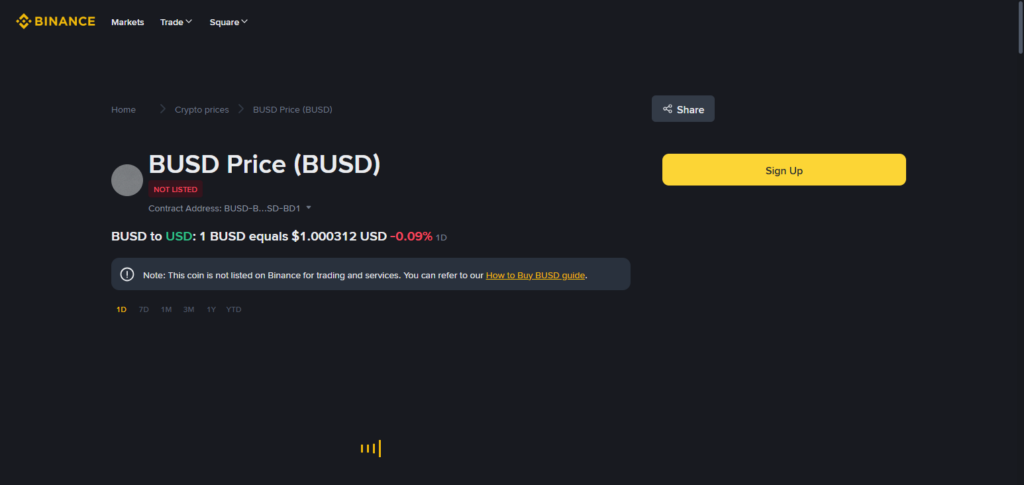
BUSD is regulated by the New York State Department of Financial Services (NYDFS) and is fully USD collateralized giving the coin security and full regulatory compliance. Responsible investors often favor BUSD due to the low possibility for volatility and is often deemed as a low risk investment since stablecoins typically don’t fluctuate in value.
All in all, due to BUSD’s compliance and liquidity, BUSD is one of the top choices for stablecoins to invest in when looking for lower risk investments in the crypto market.
BUSD (Binance USD) Features, Advantages & Disadvantages
Features
- US money backed and money issuer is NYDFS.
- Available on Ethereum and BSC.
- Money backed with audits.
- Partners with Binance.
- Big trading volume and cheap fees.
Advantages
- Compliance with the laws.
- Good for investors without risks.
- Easy to change.
- Integrating with all exchanges and DeFi.
- Good with audits and transparency.
Disadvantages
- Control by Binance/Paxos.
- Little use outside of the Binance circle.
- Dependent on fiat banking infrastructure.
- Slight risk from regulatory changes.
- Less flexible in algorithmic DeFi protocols.
3. GUSD (Gemini Dollar)
Due to its fully regulated oversight, Gemini Dollar or GUSD is also able to be considered as one of the top choices to invest in lower risk stablecoins in the crypto market. GUSD operates on the Ethereum blockchain and holds a one-to-one U.S. dollar reserve backed system in order to maintain the value of the GUSD to the U.S. dollar, and regularly has its collateral audited.
GUSD is a stablecoin issued by Gemini Trust which is a U.S. based and regulated exchange. GUSD enables customers and investors to transfer capital across the Ethereum blockchain with the peace of mind that the capital is stable. GUSD is noted for its regulatory compliance, risk collateralization, and safety and security. No other stablecoin is able to provide the same level of compliance and safety as GUSD.
GUSD (Gemini Dollar) Features, Advantages & Disadvantages
Features:
- Secure USD backing and regulation in the US.
- Built on the Ethereum blockchain.
- Periodic audits to ensure reserve safety.
- Ethereum-based contracts support.
- Safety and compliance to regulation.
Advantages:
- Audit-proof regulation.
- Secure operational transparency.
- USD reliability.
- Corporate and institutional reliability.
- Fast DeFi integration.
Disadvantages:
- Solely Ethereum blockchain support.
- Less popular than USDT and BUSD.
- Gemini Trust control centralization.
- Active banking fiat dependency.
- Stale liquidity compared to dominant crypto stablecoins.
4. PAX Dollar (USDP)
PAX Dollar, previously Paxos Standard, is a fully USD-backed and regulated stablecoin offered by the Paxos Trust Company. PAX runs on the Ethereum blockchain and maintains a consistent peg to the dollar, with reserves in fully audited bank accounts.
PAX is particularly known for its transparency, producing attestation reports on a monthly basis which detail the reserve amount. PAX Dollar is fully integrated with the most popular centralized and decentralized finance (DeFi) apps.
Investors looking for a safe and reliable yield generator are able to use PAX Dollar with confidence. For these reasons, PAX Dollar (USDP) is a trusted and reliable stablecoin with regulatory authorities, making it suitable for investing in crypto with little risk.
PAX Dollar (USDP) Features, Advantages & Disadvantages
Features:
- USD reserves that are fully audited.
- Paxos Trust Company regulation.
- Built on Ethereum blockchain.
- Consistent USD peg at 1:1.
- DeFi and payment apps support.
Advantages:
- High regulation respect.
- Reserves and audits and transparency.
- Low risk invest safe.
- Holds DeFi apps neatly.
- Predictable stability for institutional application.
Disadvantages:
- Centralized issuer.
- Ethereum limits outside ecosystem adoption.
- Banking fiat dependency.
- Scant development in algorithms or DeFi components.
- Trading volumes lower than USDT/BUSD.
5. TrueUSD (TUSD)
TrueUSD is a USD-backed stablecoin and is a product of the Company TrustToken. TrueUSD is issued on several blockchain networks, notably Ethereum and Binance Smart Chain, and is assuaged for its transparency through audits.
By using TrueUSD, users can prevent significant losses in value by creating a non-volatile means of payment. Because of its independent reserve data confirmation, users can have faith in the coins’ stability.
Exchanged throughout the globe and on DeFi networks, TrueUSD has a proven reputation of being a stablecoin for risk-free crypto investing and providing a safe alternative to cryptocurrencies that are not regulated.
TrueUSD (TUSD) Features, Advantages & Disadvantages
Features:
- Fully USD-backed with multiple custodians.
- Periodic audits conducted to verify reserves.
- Crossed multi-chain support including Ethereum and Binance Smart Chain.
- Transparency focus with 1:1 USD peg.
- Widely exchange-listed, and thus, DeFi-compatible.
Advantages:
- Labeled Low-risk exposure.
- Decentralized custody mitigates single-point-of-failure risks.
- Transparent reserve observations against audits.
- Supports multiple chains.
- Decent access with lending and DeFi solutions.
Disadvantages:
- Compared to USDT, TrueUSD has lower adoption.
- There are still risks associated with centralized issuance.
- Compliance to fiat banking and the regulations that govern it.
- Scarce and limited yield opportunities.
- Compared to dominant stablecoins, a lower number of liquid assets.
6. sUSD (Synthetix USD)
The Synthetix protocol creates the Ethereum-based stablecoin known as sUSD. In contrast to stablecoins backed by fiat, sUSD is crypto-collateralized, mostly supported by SNX tokens, and keeps its peg through a decentralized mechanism.
Trading, lending, and exposure to synthetic assets are made possible by its smooth integration into DeFi ecosystems. Users interested in non-fiat-backed stablecoins are drawn to sUSD because it offers decentralization and transparency, despite being a little more complicated than conventional stablecoins.
sUSD is a prominent choice among the top stablecoins for low-risk cryptocurrency investing, especially for individuals looking to gain exposure to DeFi protocols, despite the small risks associated with crypto collateral.
sUSD (Synthetix USD) Features, Advantages & Disadvantages
Features:
- Stablecoin backed by crypto (collateralized by SNX).
- Built on the Ethereum.
- Synthetix lacks centralized control, and it’s also governed as a protocol.
- During the trading of synthetic assets, it can also be used within DeFi.
- It utilizes an algorithm, and thus, can be maintained the peg via over-collateralization.
Advantages:
- Throughout the entire ecosystem, it’s fully decentralized and transparent.
- Interoperability with the entire DeFi ecosystem.
- It’s possible that it can be minted or lent via synthetic assets.
- United States peg by protocol incentives.
- Absence of fiat-banking dependency.
Disadvantages:
- Ignoring the crypto volatility. It is a little riskier.
- SNX collateral has to be locked in to mint it.
- In adoption, it’s limited outside the DeFi.
- Investors may struggle with algorithmic complexity.
- In extreme market conditions, a peg may move.
7. FRAX
Frax is a stablecoin for Ethereum, and for its USD peg, crypto collateral is combined with algorithmic stabilization. Other than partially algorithmic, its other structure consists of a collateral reserve backed by a stable yet flexible mint and burn ecosystem. FRAX is a flexible and low volatility stable coin which offers yield potential as well.

Although its other systems are fairly low risk, FRAX is one of the very top stablecoins for low risk crypto investing as it is one of the very top options for entirely decentralized stablecoins.
FRAX Features, Advantages & Disadvantages
Features:
- Partially algorithmic.
- Partially backed with crypto, and algorithmically stabilized.
- On Ethereum.
- Peg maintenance through mint-and-burn.
- Accepted in DeFi lending-liquidity pools.
Advantages:
- Efficient capital use.
- Yield generation through DeFi.
- Transparent and decentralized.
- High scalability and flexibility.
- Low market volatility.
Disadvantages:
- Risks involved with the algorithmic part.
- Less widespread usage.
- Peg instability in extreme market conditions.
- Mint/burn mechanic complexity.
- Low fiat integration.
8. LUSD (Liquity USD)
The Liquity protocol issues LUSD (Liquity USD), which is a decentralized stablecoin. Heavily collateralized with ETH, Liquity USD is able to maintain its stability via over-collateralization, liquidity mining, and smart contract mechanisms.
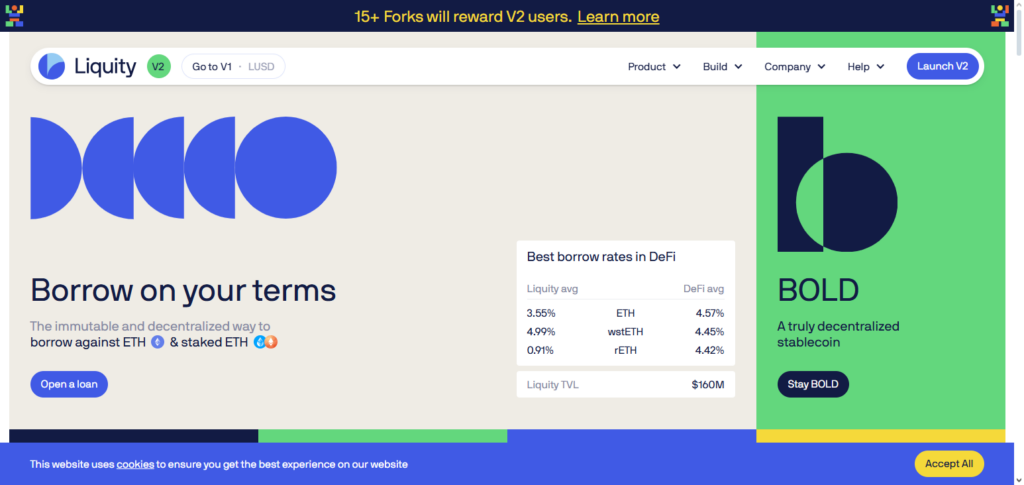
Being primarily used in the Liquity lending platform, LUSD provides stability and liquidity without the need for traditional USD (or any fiat currency) liquidity. Because LUSD can offer customers fully decentralized and censorship resistant transactions, the coin is attractive to many investors, particularly for those with a lower risk tolerance. For investors in stablecoins, LUSD is a preferred option.
LUSD (Liquity USD) Features, Advantages & Disadvantages
Features:
- Fully ETH collateralized.
- 1:1 peg to USD.
- Ethereum and smart contracts based.
- Over collateralized with decentralized issuance.
- Available in the Liquity lending ecosystem.
Advantages:
- Transparency in a decentralized system.
- No fiat banking system.
- Safe in DeFi lending and borrowing.
- No risk and certainty for the investors.
- Smart contracts with the best safety.
Disadvantages:
- Available only with ETH collateral.
- Rapid ETH drops cause a little risk.
- Less liquidity than USDT/BUSD.
- Little use in trading platforms.
- Advanced investors only, for other its complex.
9. XSGD
XSGD is a stablecoin issued by the Singapore Monetary Authority. XSGD is pegged to the Singapore Dollar (SGD) with 1:1 backing. Integration with Ethereum is seamless and fully regulated, is built using scalable and blockless technologies, and coupled with the liquidity of DeFi technologies.
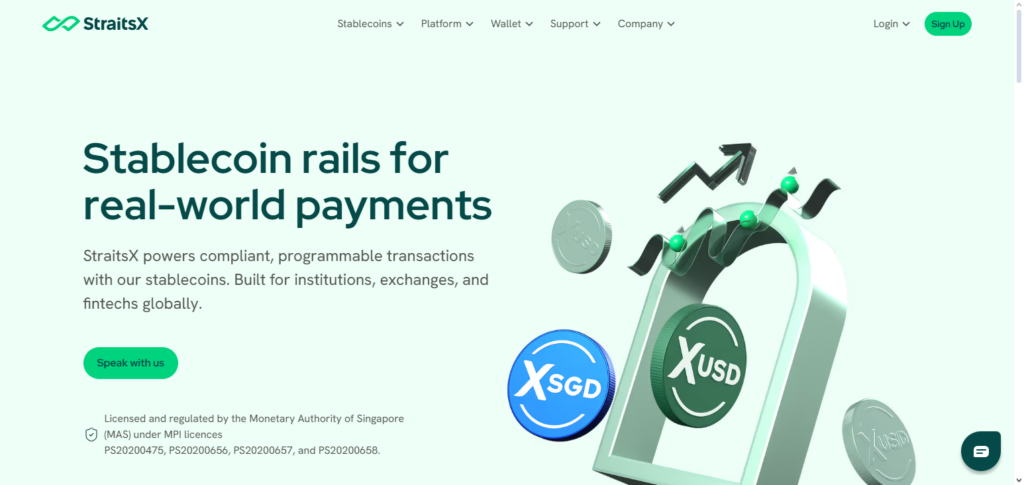
For individuals looking to have Singapore Dollar (SGD) exposure, coupled with regulated, low volatility assets, XSGD is a great option and available in ASIA. For investors in stablecoins looking to minimize risk, XSGD provides a great option in the Singapore Dollar.
XSGD Features, Advantages & Disadvantages
Features:
- $1 pegged stablecoin.
- Fully-licensed and fiat backed.
- Ethereum blockchain.
- Fast and low-cost transactions.
- Payment and DeFi platform integration.
Advantages:
- Completely transparent and regulated.
- Great choice for investors in Asia.
- Stability, as it is pegged to the SGD.
- Low volatility, making it safe to trade.
- Available on many DeFi platforms.
Disadvantages:
- Outside of Singapore and Asia, very little adoption.
- Centralized issuer.
- Reliance on fiat banking services.
- Compared to USD-pegged stablecoins, XSGD has lower liquidity.
- Fewer opportunities to earn yield.
10. USN (Near Protocol)
The NEAR Protocol blockchain is home to the algorithmic stablecoin USN. On-chain processes that manufacture and burn tokens to maintain a 1:1 USD peg are used to maintain its value. With its extensive integration with the NEAR environment, USN provides DeFi apps and inexpensive, fast transactions.

It is decentralized and depends on protocol incentives for stability, in contrast to fiat-backed currency. Although there is considerable risk associated with algorithmic currencies, USN’s design guarantees steady liquidity and peg maintenance.
Because of this, USN is one of the greatest stablecoins for low-risk cryptocurrency investing, especially for those looking to gain exposure to new blockchain ecosystems.
USN (Near Protocol) Features, Advantages & Disadvantages
Features:
- NEAR Protocol’s native algorithmic stablecoin.
- Tracks peg through automated mint and burn.
- NEAR blockchain’s fast and low-cost transactions.
- NEAR DeFi ecosystem integration.
- Community governance.
Advantages:
- Fast and in a decentralized manner.
- NEAR ecosystem DeFi platforms are supported.
- Provides liquidity on new blockchain networks.
- No fiat reserves means no peg risk.
Disadvantages:
- Increased risk due to an algorithmic peg.
- Limited adoption beyond NEAR ecosystem.
- Extremely volatile in bear markets.
- Needs some background to fully understand the mechanisms of the protocol.
- Limited integrations across blockchain platforms.
Risks to Consider
Regulatory Risk: For fully fiat-backed stablecoins such as GUSD or BUSD, the implementation of new or altered restrictions and regulations from the government could obstruct their business.
Reserve Management Risk: In the event the stablecoin’s reserves are insufficient, unverified, and/or poorly managed (e.g. coins with inadequate or no auditing), the currency’s peg can possibly fail.
Algorithmic Risk: In times of extreme market conditions, algorithmic stablecoins such as FRAX or USN that utilize smart contracts to sustain the valuation peg, may fail.
Smart Contract Risk: Crypto-backed stablecoins like LUSD and sUSD are reliant on smart contracts and may have flaws or bugs.
Liquidity Risk: In times of high volatility in the markets, it may be difficult to convert certain stablecoins to cash or other assets, especially for coins that are not as widely used.
Conclusion
For investors looking to manage the erratic cryptocurrency market while protecting their wealth, stablecoins have emerged as a crucial instrument.
Because of their stability, transparency, and usefulness across many blockchains and DeFi platforms, USDT, BUSD, GUSD, PAX (USDP), TrueUSD (TUSD), sUSD, FRAX, LUSD, XSGD, and USN stand out among them. While cryptocurrency-backed or algorithmic choices like sUSD, FRAX, and USN offer decentralization with minimal risk, fiat-backed stablecoins like USDT, BUSD, and GUSD offer the utmost security and regulatory guarantee.
Investors can protect wealth, streamline transactions, and engage in cryptocurrency markets intelligently by selecting any of these coins. All things considered, these stablecoins are thought to be the greatest choices for low-risk cryptocurrency investing since they strike a balance between accessibility, security, and liquidity.
FAQ
What is a stablecoin?
A stablecoin is a type of cryptocurrency designed to maintain a stable value, usually pegged to a fiat currency like the US Dollar or Singapore Dollar. They are used to reduce volatility, facilitate trading, and provide a safe store of value within the crypto ecosystem.
Why are stablecoins considered low-risk?
Stablecoins are backed either by fiat reserves, cryptocurrencies, or algorithms, which help maintain a consistent value. This stability minimizes exposure to crypto market swings, making them a safer option for investors looking to preserve capital.
Which are the most popular stablecoins?
Some of the most widely used stablecoins include USDT (Tether), BUSD (Binance USD), GUSD (Gemini Dollar), PAX (USDP), and TrueUSD (TUSD). These coins are known for their liquidity, transparency, and regulatory compliance.
What is the difference between fiat-backed and algorithmic stablecoins?
Fiat-backed stablecoins like USDT, BUSD, and GUSD hold actual reserves of fiat currency to maintain their peg. Algorithmic stablecoins, such as USN or FRAX, rely on smart contracts and protocol incentives to stabilize value, making them slightly riskier but more decentralized.
Can stablecoins be used for investments?
Yes. While they are not designed for high returns, stablecoins allow investors to earn interest in DeFi protocols, move funds quickly, or hedge against market volatility, making them ideal for low-risk crypto investing.