


I’ll talk about how cryptocurrency might permanently replace traditional banking in this post. Because they provide quicker transactions, cheaper costs, and worldwide accessibility, cryptocurrencies and blockchain technology are revolutionizing the financial industry.
Peer-to-peer lending, savings, and payments are made possible by cryptocurrency, which offers creative alternatives to traditional banks as decentralized finance (DeFi) expands. This move has the potential to drastically alter how we handle and transfer money globally.
About Traditional Banking
The term “traditional banking” describes the traditional financial system in which banks serve as middlemen between depositors and borrowers.
These organizations offer services such checking and savings accounts, credit facilities, loans, and investment goods.
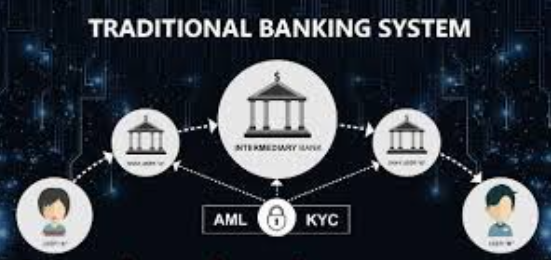
To maintain monetary policy, safeguard consumers, and maintain financial stability, central banks and other government agencies strictly oversee them.
Although traditional banks provide established infrastructure, security, and trust, they frequently have expensive fees, lengthy processing times, and restricted access for those living in distant or underbanked areas.
They are also susceptible to fraud, bureaucratic inefficiencies, and systemic dangers due to their centralized structure.
How Crypto Could Replace Traditional Banking Forever

Decentralization
Allows you to transact with others without the need of a bank or other middlemen.
Reduced Transaction Costs
The cost of processing a transaction can often be avoided with cryptocurrencies.
B186 Transactions
The processing of an international bank transfer can take between 3 to 5 business days, but with cryptocurrency, that time can be reduced to minutes.
Universal Availability
You can hold, send, or receive cryptocurrencies anywhere in the world with only an internet connection, eliminating barriers to banking.
Increased Trust
The use of blockchain can enhance trust due to the fact that fraud is virtually eliminated.
Active Money
Money that is controlled by smart contracts can be used to initiate payments, loans, and other functions automatically.
Security and Privacy
The use of cryptocurrency can give you more control of your data and allows for the use of encrypted transactions in place of data collection by a central authority.
New Possibilities
The potential for the creation of DeFi platforms for lending, borrowing, and investing without traditional banks is possible through cryptocurrencies.
Key Technologies Enabling Crypto Banking
Blockchain Technology – As the basis for protecting and securing transactions, they utilize a decentralized and unchanging ledger regarding the order to process transactions.
Smart Contracts – These contracts provide self-executions that automate financial agreements, lending, and payments that do not involve third parties.
Stablecoins – By linkage to a fiat currency, the crypto currency’s price volatility is lowered, thus allowing it to facilitate digital payments with a predictable currency.
Decentralized Finance (DeFi) Platforms – Lending, borrowing, staking, and trading are enabled outside of the framework of traditional banking.
Crypto Wallets – They facilitate the secure and managed control of currency.
Payment Gateways & Bridges – They also facilitate the acceptance of crypto for commerce and the integration of crypto and fiat.
Consensus Mechanisms – They include Proof-of-Work, Proof-of-Stake, and others that guarantee the security, validation, and decentralized nature of transactions.
Layer-2 Scaling Solutions – These are tools projected to elevate the Ethereum and other major blockchain technologies regarding the traction of cost.
Advantages Over Traditional Banking
Decentralization
No need to rely on a bank or intermediary to manage your funds.
Reduced Transaction Costs
Moving money across borders costs significantly less with crypto.
Immediate Transactions
Most bank transactions settle in multiple days, while transfers using crypto can take place in seconds.
Borderless Accessibility
The crypto market can be accessed by anyone on the internet, increasing access to the unbanked.
Fewer Trust Issues
Trust can often be de-emphasized in a relationship when it becomes possible to directly verify compliance with the other party’s obligations, especially in regard to honest commitments, with a blockchain.
Financial Privacy
Unlike with banks or other traditional systems of payment, a user is not required to give up private information to some other party to effect a payment.
Open Finance
The financial system can be improved with the adoption of a variety of new banking services.
Problems with Traditional Banking
| Problem | Description |
|---|---|
| High Fees | Banks often charge account maintenance, transfer, and hidden service fees. |
| Slow Transactions | Cross-border payments and fund transfers can take several days to settle. |
| Limited Accessibility | Millions worldwide remain unbanked or underbanked, especially in remote areas. |
| Centralized Control | Banks hold full control over users’ funds, making them vulnerable to mismanagement or freezing accounts. |
| Lack of Transparency | Users have limited visibility into how transactions and fees are processed. |
| Bureaucratic Procedures | Opening accounts, getting loans, or accessing financial services often involves lengthy paperwork. |
| Susceptible to Fraud & Systemic Risks | Centralized systems are prone to hacking, fraud, or financial crises impacting many customers. |
Challenges and Risks
Regulatory Uncertainty
Due to the fact that there are no regulations governing the financial (especially banking) industry, and are currently no regulations for the crypto industry, there is a combination of legal and compliance risks.
Price Volatility
The value of a cryptocurrency can be extremely high, and can fall to a zero value, creating issues for savings and transactional payments.
Cyber Security Threats
There is the risk of hacking, scams, and phishing that can steal customers wallets and wallets through exchange sites.
Low Adoption
Due to the fact there is not widespread Banking Cryptocurrency use or acceptance.
Scalability Problems
Some blockchain networks have high volumes of transactions and are unbearably slow to use, there are also high costs.
Consumer Protection Issues
There are no protections for transactions, with no insurances, and they are (depending on the transaction) irreversible.
Unfriendly Technical Complexity
The totality of responsibility for managing the private keys, wallets, and other devices, e.g, DeFi devices, is a daunting experience for many.
Environmental Issues
The most well known of cryptocurrencies are those of the Proof of Work (PoW) type, and are of extremely high energy consuming types.
Real-World Use Cases
Cross-Border Payments
Payments can be made internationally in a matter of seconds using either cryptocurrencies or stablecoins. Other than the initial investment in the cryptocurrency, there is a minimal cost to make a payment.
Decentralized Lending & Borrowing
One can become a lender on a decentralized financial system such as Aave and Compound and be a bank in that system.
Savings & Yield Generation
Every person having a cryptocurrency wallet can become a lender in some decentralized financial systems.
Remittances
A worker can send a cryptocurrency payment to his home country, which is a method of payment that is inexpensive and quick.
Merchant Payments
A business can make a payment to one of its customers using a payment systems (such as PayPal) that is independent of a financial institution (e.g., bank) and a payment system that accepts cryptocurrencies.
Tokenized Assets
A person can trade digital tokens for real estate, stocks, and commodities as a representation of such (as a digital token).
Decentralized Insurance
One does not need to pay for insurance to get covered.
Micropayments & Streaming Payments
One can receive micro payment through digital services or make a payment for streaming service.
Future Outlook

As blockchain and decentralized finance continue to develop, the future of cryptocurrency banking is bright. Because they provide quicker, less expensive, and more accessible financial services, cryptocurrencies and stablecoins have the potential to supplement or perhaps completely replace conventional banking institutions.
Central banks and governments are investigating digital currencies, indicating possible hybrid models that combine fiat and cryptocurrency systems.
As technology advances, concerns like security, scalability, and regulatory compliance will probably be resolved, increasing widespread adoption. Because cryptocurrency gives unbanked people access to financial services, emerging economies stand to gain the most.
The trend suggests a financial ecosystem where decentralized, transparent, and programmable money plays a key role, changing how people and corporations manage, transfer, and increase wealth, despite ongoing hurdles.
Conclusion
To sum up, blockchain technology and cryptocurrencies are gradually changing the financial environment. Cryptocurrency is a strong alternative to traditional banking since it offers decentralization, quicker transactions, less fees, and increased accessibility.
Even if there are still issues with adoption, security, and regulations, continuous advancements in DeFi, stablecoins, and smart contracts are filling these gaps. The potential for cryptocurrency to supplement—and perhaps replace—traditional banking is growing as more people, companies, and even governments adopt digital currencies.
A transparent, effective, and inclusive financial system where individuals have more control over their finances is what the future holds, indicating a radical change in the way we save, spend, and transfer wealth around the world.
FAQ
How does crypto make banking faster and cheaper?
Crypto uses decentralized networks and blockchain, which cut out intermediaries, enabling near-instant transactions with minimal fees, including cross-border transfers.
Can crypto completely replace traditional banks?
While crypto can handle many banking functions like payments, lending, and savings, full replacement depends on regulatory adoption, scalability, and mainstream trust. Hybrid models may emerge first.
Who can benefit from crypto banking?
Anyone with internet access, especially unbanked populations, global workers sending remittances, and people seeking faster, cheaper, and more transparent financial services.
What are the biggest challenges for crypto banking adoption?
Regulatory uncertainty, volatility, cybersecurity risks, technical complexity, and limited public awareness remain the primary obstacles.