


This article describes the best tokenized AI model marketplaces. I’ll explain how select blockchain networks and smart contract platforms construct marketplaces for the exchange of AI models, datasets, and computational resources.
Included in this analysis are Ocean Protocol, SingularityNET v3, and Fetch.ai Marketplace, to name a few. Each marketplace, at a minimum, provides a secure and transparent means for the exchange of models, datasets, and resources. The platforms listed above and others use native crypto tokens to make payments, oversee stakeholder control, and engage marketplace participants.
As a result, each of these marketplaces contains the means to provide access to more AI services, and in the process, extend collaborative work opportunities in the digital economy around the globe.
What Are Tokenized AI Model Marketplaces?
Tokenized AI model marketplaces offer trading services for AI models, datasets, and compute resources using blockchain-based tokens. These marketplaces provide a global, decentralized, and safe economy for monetizing AI services without the need for a centralized intermediary.
Each marketplace ensures that their native token is used for payments, staking and governance, creating a balanced incentive system for developers, data providers, and compute providers respectively.
Some of these marketplaces empower people to build models with natural language processing (NLP), computer vision, and financial prediction. Marketplaces such as SingularityNET v3 and the Fetch.ai Marketplace are some of the marketplaces where LLMs and autonomous agents can be built.
How Tokenized AI Model Marketplaces Work
Blockchain Infrastructure
AI model marketplaces are built on top of decentralized blockchains (Ethereum, Cosmos, Polkadot, Subtensor, etc.) to ensure transparency, immutability, and trustless transactions.
Native Tokens
Each marketplace issues their own native token (e.g. OCEAN, AGIX, FET, TAO, CTXC, DBC, PHA, AKT, AIGENSYN) which can be used for payments, staking, governance, and/or as incentives.
Model Publishing
AI models or datasets can be published by developers to the marketplace through smart contracts or datatokens for safe access and monetization.
Pricing Mechanisms
Pricing can vary from marketplace to marketplace and can be set to a fixed token cost, reverse auctions, staking-based rewards, or can be set dynamically based on demand and success metrics.
Access & APIs
Users and enterprises can access AI models via APIs or agent frameworks and can incur costs in tokens for model or data usage.
Compute & GPU Rentals
There are marketplaces that provide GPU rentals for AI model training and inference. For instance, Akash and DeepBrain Chain.
Validation & Governance
Validators or DAOs can ensure model quality and verify model outputs. They also set the community governance mechanisms via token-based voting.
Supported AI Models
Marketplaces provide support for a wide variety of AI models including LLMs, Natural Language Processing (NLP), computer vision, financial prediction, and distributed machine learning.
Key Point & Best Tokenized AI Model Marketplaces
| Marketplace | Best For | Key Features |
|---|---|---|
| Ocean Protocol | Decentralized AI assets | Tokenized datasets + models, royalties |
| SingularityNET v3 | AI service trading | Multi‑agent AI marketplace, tokenized APIs |
| Fetch.ai Marketplace | Autonomous agents | Tokenized AI agents, intent‑based execution |
| Numerai Signals | Quant models | Tokenized trading signals, hedge fund integration |
| Bittensor (TAO) | AI model mining | Tokenized AI networks, staking rewards |
| Cortex Labs | On‑chain inference | Tokenized ML models, blockchain execution |
| DeepBrain Chain | GPU + AI models | Tokenized compute + model licensing |
| Phala AI Market | Confidential AI | Tokenized models with TEE privacy |
| Akash AI Marketplace | Compute + models | Tokenized AI hosting, decentralized cloud |
| Gensyn Protocol | Training orchestration | Tokenized training jobs, proof‑of‑compute |
1. Ocean Protocol
Ocean Protocol was founded in 2017 by Trent McConaghy and Bruce Pon. The protocol was built on top of Ethereum but later moved to multiple chains. Ocean’s pricing model incorporates datatokens (ERC-20) and data NFTs (ERC-721). Datatokens can be used for either fixed or dynamic pricing.
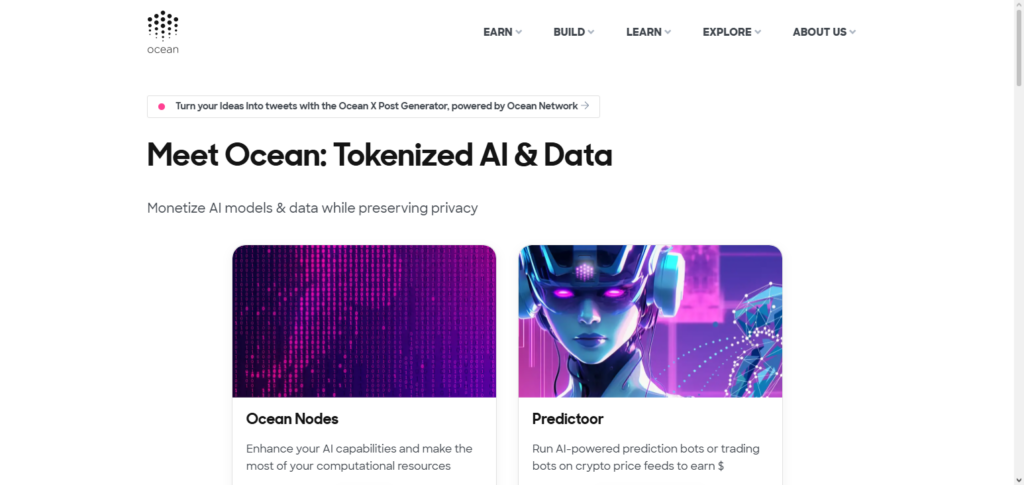
A unique feature of Ocean is that AI models can train on private datasets without exposing the data. AI models that can be trained on Ocean include machine learning pipelines, predictive bots, and analytics models.
Ocean is primarily used for AI training, healthcare, finance, and research; therefore, it fits the definition of a decentralized marketplace for secure data monetization.
| Feature | Details |
|---|---|
| Founded Year | 2017 |
| Blockchain | Ethereum + multi-chain support |
| Token | OCEAN (ERC-20) |
| Pricing Model | Datatokens & NFTs (fixed/dynamic pricing) |
| Core Innovation | Compute-to-data (privacy-preserving AI training) |
| Supported AI Models | ML pipelines, predictive analytics, healthcare AI |
| Use Cases | Finance, research, healthcare, enterprise data sharing |
| Governance | DAO-based with community voting |
2. SingularityNET v3
In 2017, SingularityNET started as a project within Dr. Ben Goertzel’s lab. Today, SingularityNET is audaciously working to establish a Decentralized AI Network on its own layer-2 (HyperCycle) within Ethereum and Cardano. Developers of AI services can sell their services at a price of an AI service token, and the services are available through an API.
The supported services include tokenized NLP, image recognition, and DeFi AI agents. SingularityNET v3 is mainly focused on AI agent interoperability through the AI-DSL. SingularityNET continues to be one of the largest attempts at a Decentralized AI marketplace and strives towards providing access to AI services to those who do not currently have that opportunity.
| Feature | Details |
|---|---|
| Founded Year | 2017 |
| Blockchain | Ethereum + Cardano |
| Token | AGIX (migrating to ASI) |
| Pricing Model | Token-based service payments |
| Core Innovation | AI-DSL for agent interoperability |
| Supported AI Models | NLP, robotics, image recognition, DeFi agents |
| Use Cases | AI services marketplace, robotics, DeFi |
| Governance | Community-driven via DAO |
3. Fetch.ai Marketplace
Fetch.ai was started in 2017 by Humayun Sheikh. Fetch.ai is a Cosmos SDK blockchain with Tendermint consensus. Fetch.ai’s price model uses the FET token for staking and governance. Transactions can be made through the FET token.
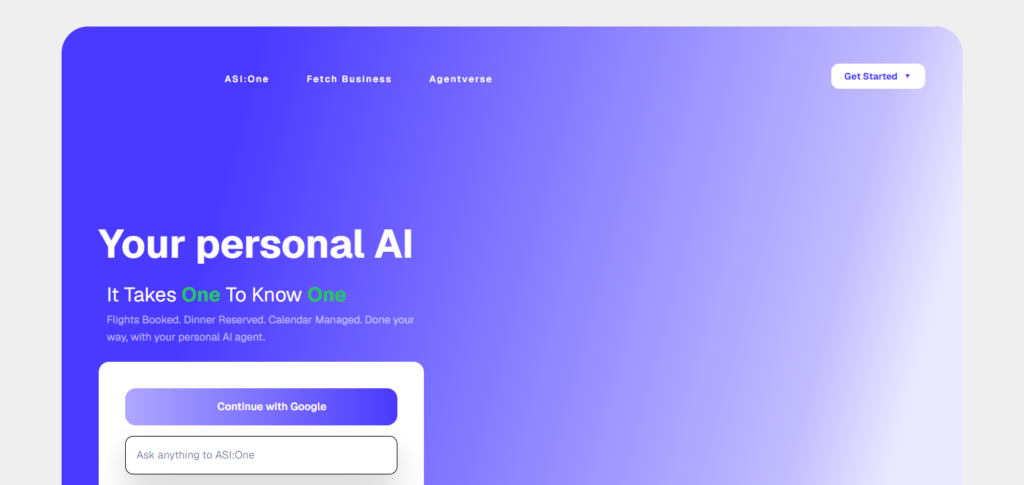
Fetch.ai has created a platform to develop smart contracts for artificial intelligence where users can build AI that cooperates and negotiates with other AI agents and can be used for many different tasks. Fetch.ai provides building blocks for AI systems within different industries.
Some of the AI systems supported by Fetch.ai include DeFi bots, supply chain optimizers, energy grid balancers, and mobility systems. Fetch.ai is an AI-based decentralized platform that enables a fully decentralized digital economy.
| Feature | Details |
|---|---|
| Founded Year | 2017 |
| Blockchain | Cosmos SDK |
| Token | FET |
| Pricing Model | Agent-to-agent token transactions |
| Core Innovation | Autonomous Economic Agents (AEAs) |
| Supported AI Models | Multi-agent systems, supply chain, energy grids |
| Use Cases | Mobility, logistics, DeFi automation |
| Governance | Staking & community governance |
4. Numerai Signals
Founded by Richard Craib in 2015, Numerai launched the first decentralized hedge fund and operates on the Ethereum blockchain with the Numeraire (NMR) token. The pricing model within Numerai relies on staking.
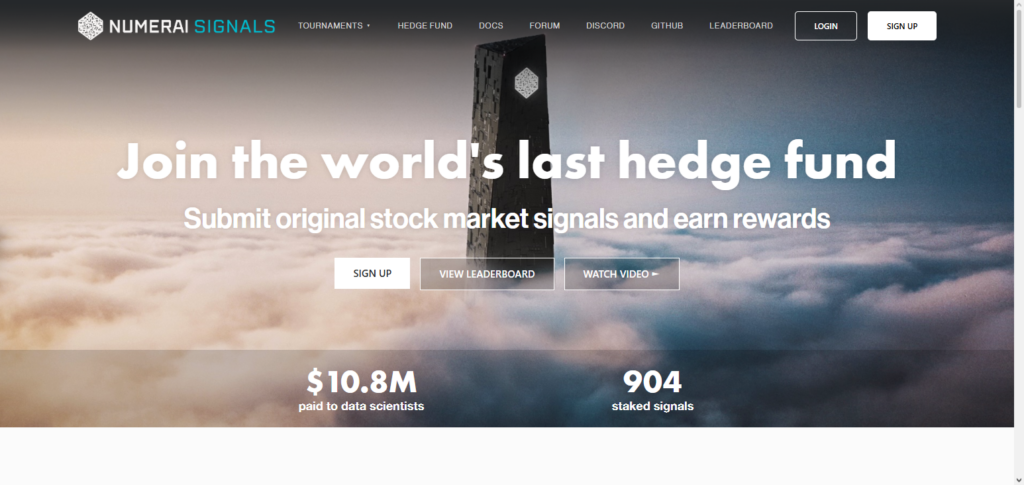
Data scientists stake NMR to deploy their models and stand to earn rewards for accurate predictions. Poorly performing models result in financial loss due to staked tokens. In 2020, Numerai launched Numerai Signals, a service which allows quants to upload stock market signals from any dataset.
Supported AI models include financial prediction models, stock signals and meta-model ensembles. Numerai is the first of its kind to crowdsource hedge fund strategies utilizing thousands of models to create an active trading strategy with institutional backing from JPMorgan.
| Feature | Details |
|---|---|
| Founded Year | 2015 |
| Blockchain | Ethereum |
| Token | NMR |
| Pricing Model | Staking-based rewards/penalties |
| Core Innovation | Crowdsourced hedge fund AI |
| Supported AI Models | Financial prediction, stock signals |
| Use Cases | Quant trading, hedge fund strategies |
| Governance | Token staking & model performance |
5. Bittensor (TAO)
Bittensor operates its own blockchain (Subtensor) and was started in 2021 by Jacob Steeves and Ala Shaabana. Their pricing model is TAO tokens (mined tokens that undergo currently unfolding halving events), supplemented by subnet-specific tokens with the upgrade of dTAO (i.e., TAO).
Currently implemented AI models comprise of LLMs (and) image synthesizers and other tasks such as protein folding, financial forecasting and, computation.
This marketplace is organized into subnets, with each subnet containing a dedicated AI task. Here, miners provide models and validators score the outputs. Because of its fair launch and decentralized incentive (system), Bittensor has earned the moniker of “Bitcoin of AI.”
| Feature | Details |
|---|---|
| Founded Year | 2021 |
| Blockchain | Subtensor |
| Token | TAO |
| Pricing Model | Mining rewards & subnet incentives |
| Core Innovation | Subnets for specialized AI tasks |
| Supported AI Models | LLMs, image synthesis, protein folding |
| Use Cases | Decentralized AI compute & validation |
| Governance | Validators score outputs & reward miners |
6. Cortex Labs
Cortex Labs was created in Singapore in 2017 by Ziqi Chen. Cortex Labs custom-built its blockchain, which includes Ethereum-compatible smart contracts. Cortex Labs utilizes its CTXC token in its pricing model that integrates developers directly with smart contracts for payments needed for AI inference on chain.
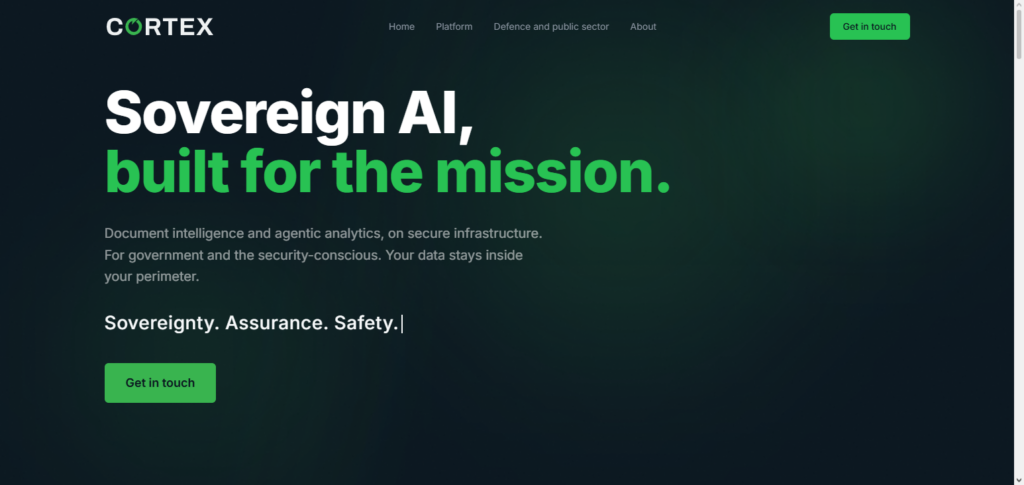
AI models include computer vision, NLP, recommendation systems, and AI smart contracts. Developers can not only upload models to Cortex Labs’ decentralized marketplace, but dApp creators can build applications using available models on the marketplace. Cortex Labs is unique in providing the integration of blockchain-based execution of smart contracts with AI inferences.
| Feature | Details |
|---|---|
| Founded Year | 2017 |
| Blockchain | Cortex Chain (Ethereum-compatible) |
| Token | CTXC |
| Pricing Model | On-chain AI inference payments |
| Core Innovation | AI inference inside smart contracts |
| Supported AI Models | Computer vision, NLP, recommendations |
| Use Cases | AI-powered dApps, blockchain AI |
| Governance | Token-based ecosystem governance |
7. DeepBrain Chain
DeepBrain Chain, founded in 2017 by Yong He, began on NEO, but moved its operations to its Layer 1 blockchain in 2021. DeepBrain Chain’s pricing model uses the DBC token and provides cloud GPU rentals at 70% less than AWS. Their supported AI models include LLMs, inference pipelines, cloud gaming, rendering, and zero-knowledge computing.
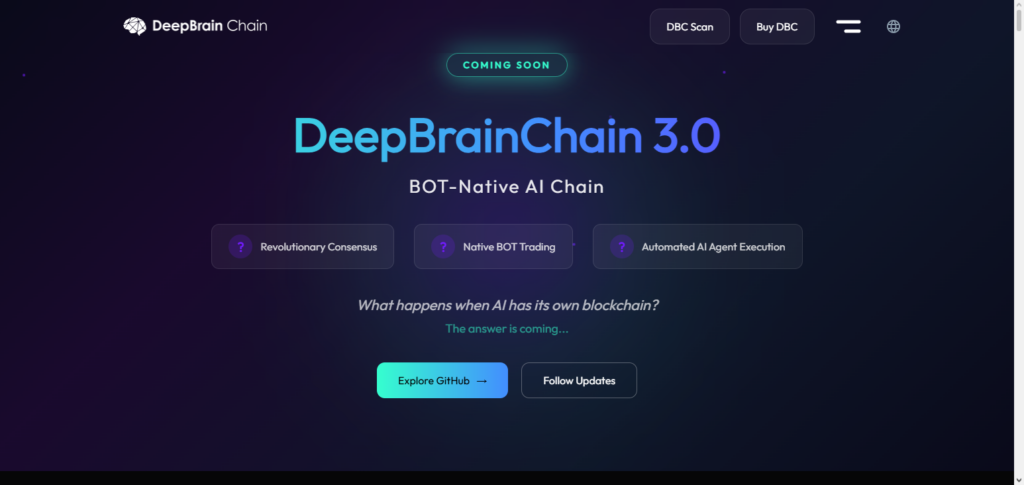
Their marketplace provides a bridge between GPU suppliers and AI developers so that they may build decentralized compute infrastructure. DeepBrain Chain provides privacy-preserving AI training and is focused on providing AI and metaverse technology to enterprises in Asia.
| Feature | Details |
|---|---|
| Founded Year | 2017 |
| Blockchain | NEO → custom chain |
| Token | DBC |
| Pricing Model | GPU rental marketplace |
| Core Innovation | Low-cost decentralized GPU compute |
| Supported AI Models | LLMs, inference pipelines, rendering |
| Use Cases | AI training, metaverse, cloud gaming |
| Governance | Token staking & compute providers |
8. Phala AI Market
Phala was created by Marvin Tong and Hang Yin in 2018 and launched on Polkadot (moved to Ethereum L2 in 2025). It offers a pricing structure with its PHA token for staking, governance, and paying for confidential compute.
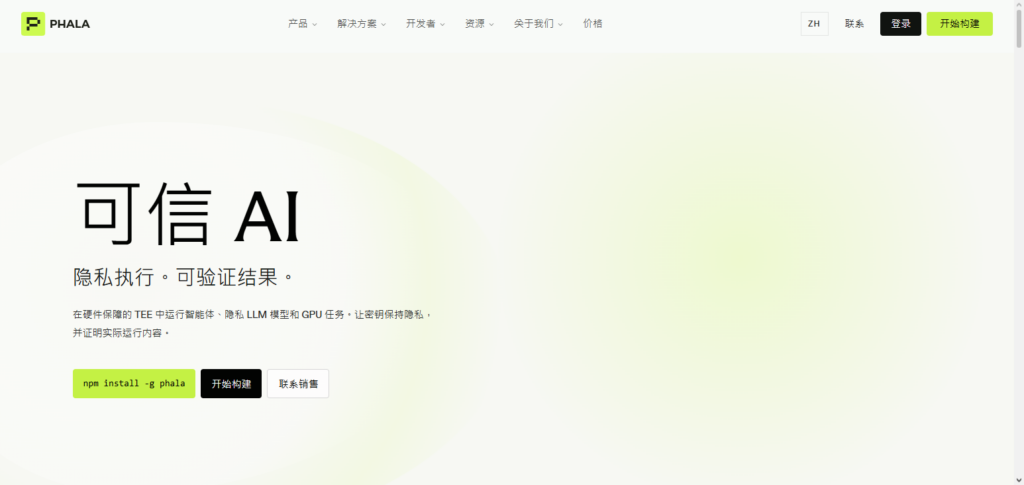
LLMs, confidential AI, AI agents, zero-knowledge proof reference providers, and GPU-based inference models are some of the AI models supported by Phala. Phala is focused on confidential computing. To guarantee privacy, Phala uses Intel TDX and NVIDIA’s Confidential GPUs.
The AI Market supported by Phala creates verifiable private AI. The focus of the AI Market is on allowing cryptographic workload execution proofs, which makes the AI Market attractive to organizations building private AI infrastructure.
| Feature | Details |
|---|---|
| Founded Year | 2018 |
| Blockchain | Polkadot → Ethereum L2 |
| Token | PHA |
| Pricing Model | Confidential compute token payments |
| Core Innovation | Verifiable confidential AI workloads |
| Supported AI Models | LLMs, ZKP generators, GPU inference |
| Use Cases | Enterprise AI, privacy-preserving compute |
| Governance | DAO + staking mechanisms |
9. Akash AI Marketplace
Building on the Cosmos SDK, Akash was founded in 2018 by Greg Osuri and Adam Bozanich. The AKT token is the base currency for their price model. The Burn-Mint Equilibrium (BME) mechanism also converts AKT to stable credits (ACT), which is pegged to USD.
LLMs, DeepSeek V3, inference APIs, and other AI models and tools that require GPU-intensive Computations are among the available models at Akash. Utilizing the same concept as reverse auction mechanics, providers bid to offer compute services at the lowest price.
Akash is known to offer around 70–85% savings against major centralized cloud services. It therefore, claims to be the first and largest decentralized GPU marketplace.
| Feature | Details |
|---|---|
| Founded Year | 2018 |
| Blockchain | Cosmos SDK |
| Token | AKT |
| Pricing Model | Reverse auction + stable credits (ACT) |
| Core Innovation | Decentralized GPU marketplace |
| Supported AI Models | LLMs, inference APIs, GPU workloads |
| Use Cases | Cloud compute, AI inference, cost savings |
| Governance | Burn-Mint Equilibrium (BME) model |
10. Gensyn Protocol
Established in 2020, Gensyn is an Ethereum Layer-2 (OP Stack) that offers artificial intelligence services. It uses the AI token (AIGENSYN) in its buy-and-burn mechanism which is linked to the revenue generated by the network. Some of the supported AI models are distributed Machine Learning, Natural Language Processing,
Computer Vision, and decentralized prediction markets. Gensyn has developed a novel cryptographic method known as Proof-of-Learning which allows verification of Machine Learning tasks without the need for computation.
Its first product, Delphi, is an AI-settled prediction market. Founded by a16z Crypto and Galaxy Digital, Gensyn hopes to provide computing services to allow users to fulfill their AI related tasks.
| Feature | Details |
|---|---|
| Founded Year | 2020 |
| Blockchain | Ethereum Layer-2 (OP Stack) |
| Token | AIGENSYN |
| Pricing Model | Buy-and-burn tied to revenue |
| Core Innovation | Proof-of-Learning verification |
| Supported AI Models | Distributed ML, NLP, computer vision |
| Use Cases | AI training, prediction markets |
| Governance | DAO + validator verification |
Comparison Table: Best Tokenized AI Marketplaces
| Marketplace | Founded Year | Blockchain | Pricing Model | Supported AI Models |
|---|---|---|---|---|
| Ocean Protocol | 2017 | Ethereum + multi-chain | Datatokens & NFTs (fixed/dynamic) | ML pipelines, predictive analytics, healthcare AI |
| SingularityNET v3 | 2017 | Ethereum + Cardano | AGIX/ASI token payments | NLP, robotics, image recognition, DeFi agents |
| Fetch.ai Marketplace | 2017 | Cosmos SDK | FET token transactions | Multi-agent systems, supply chain, energy grids |
| Numerai Signals | 2015 | Ethereum | NMR staking rewards/penalties | Financial prediction, stock signals |
| Bittensor (TAO) | 2021 | Subtensor | TAO mining & subnet incentives | LLMs, image synthesis, protein folding |
| Cortex Labs | 2017 | Cortex Chain (Ethereum-compatible) | CTXC token for inference | Computer vision, NLP, recommendations |
| DeepBrain Chain | 2017 | NEO → custom chain | DBC GPU rental marketplace | LLMs, inference pipelines, rendering |
| Phala AI Market | 2018 | Polkadot → Ethereum L2 | PHA token for confidential compute | LLMs, ZKP generators, GPU inference |
| Akash AI Marketplace | 2018 | Cosmos SDK | Reverse auction + ACT credits | LLMs, inference APIs, GPU workloads |
| Gensyn Protocol | 2020 | Ethereum Layer-2 (OP Stack) | AIGENSYN buy-and-burn | Distributed ML, NLP, computer vision |
Conclusion
The use of tokenized AI marketplaces illuminates the potential for decentralized intelligence and the fusion of blockchain technology and AI. The emphasis of platforms like Ocean Protocol, SingularityNET v3, and Fetch.ai Marketplace and Numerai Signals is on accessible AI services.
Autonomous agents and financial predictions are the focuses of Fetch.ai Marketplace as well as Numerai Signals. Bittensor (TAO), Cortex Labs, and DeepBrain Chain emphasize other networks and AI inference that are innovative and scalable.
Phala AI Market and Akash AI Marketplace provide GPU power that is both confidential and cost effective, and Gensyn Protocol is the first to create proof-of-learning for AI training that is decentralized.
Taken as a collective, these marketplaces demonstrate what is to come for how we think of AI and how it is monetized. These marketplaces are a departure from thinking of AI and how it is monetized in a competitive manner. Instead, they are complimentary.
There is something in each marketplace for many possible uses: secure data exchange and different types of AI agents (autonomous and verifiable decentralized training). There are marketplaces that provide scalable AI and compute that are affordable, as well.
FAQ
What are tokenized AI marketplaces?
Tokenized AI marketplaces are decentralized platforms where AI models, datasets, and compute resources are exchanged using blockchain-based tokens. They enable transparent pricing, secure transactions, and global accessibility without centralized control.
Which marketplaces are the most popular?
Leading platforms include Ocean Protocol, SingularityNET v3, Fetch.ai Marketplace, Numerai Signals, Bittensor (TAO), Cortex Labs, DeepBrain Chain, Phala AI Market, Akash AI Marketplace, and Gensyn Protocol. Each specializes in different aspects like data exchange, autonomous agents, financial modeling, or GPU compute.
How do these marketplaces handle pricing?
Pricing models vary:
Ocean Protocol uses datatokens and NFTs.
SingularityNET uses AGIX tokens for service payments.
Fetch.ai uses FET for agent transactions.
Numerai uses staking with NMR.
Akash uses reverse auctions with AKT credits. Others rely on native tokens with staking, burning, or dynamic pricing mechanisms.