

This article explores AI agents and crypto, especially regarding AI agents’ use of blockchain for transacting with other agents over the internet. With the help of stablecoins and smart contracts, AI agents are able to perform financial transactions very quickly and easily, and eliminate the need for financial intermediaries to perform microtransactions. With this technology, completely decentralized, secure and efficient machine-to-machine economies are possible at a large scale.
What Are AI Agents?
AI agents are types of software that enable computers and other devices to run tasks, create and implement decisions, and communicate with digital environments. These software agents utilize a range of advanced computing technologies including, for example, machine learning and deep learning.
In combination, these technologies enable software to understand and interpret complex problems and environments. AI agents facilitate among others automated financial transactions, trading, and payments.
The popularity of AI agents in financial services and other areas is based on a number of factors, including the advantages of automation and removal of human interference. Transactions, for example, may be automated 24 hours a day, 7 days a week. Additionally, AI agents may be programmed to identify improvement opportunities and enhance themselves.
What Are Machine Payments?
Machine payments are financial transactions between devices, systems, or software without human interaction. Using blockchain and artificial intelligence (AI) gives machines the ability to process payments and transact with each other.

An example of this is an electric vehicle making a payment to a charging station. With machine payments, micro-transactions to settle a data transfer between devices on the Internet of Things (IoT) is also possible. Like human payments, machine payments make use of contracts (agreements) to ascertain the terms of the transaction.
Digital money and a ledger to record the transaction give machine payments the means to transact. Machine payments provide a means for machines to make payments between each other, and enables a true economy between machines.
Why Crypto Is Important for AI Agent Payments
Decentralization: The use of banks and intermediaries will no longer be necessary, and AI agents will be free to transact and transfer funds across the globe.
Security: Blockchain provides a safe and secure ledger over which transactions will be immutably recorded.
Smart Contracts: The terms of a contract will be programmable, and payments will be automatically effected when the conditions of the contract are met.
Accessibility: The use of crypto will provide AI agents the means to interact in a global financial system.
Microtransactions: Crypto will allow AI agents to perform and process millions of microtransactions.
Efficiency: Settlements effected by the crypto economy will be considerably faster than the global banking system.
Transparency: Public records of all transactions provide a means for auditing and verifying the activities of AI agents.
How AI Agents and Crypto Work
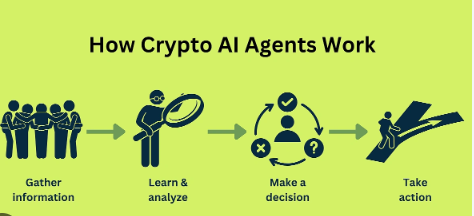
AI Agents
AI agents are capable of thinking and acting on their own.
Blockchain
Cryptocurrencies are governed and operated by blockchain technology. Hence, intelligent agents are provided with a mechanism for online financial transactions that is secured and transparent.
Smart Contracts
Intelligent agents can avail the service of blockchain technology for automating payments, by using smart contracts.
Machine to Machine Payment
The Internet of Things (IoT) and other similar technologies can benefit from agent technologies for automating and integrating financial transactions.
Cryptocurrency Transactions
AI agents are equipped with the intelligence to make cryptocurrency transactions.
Cross border Transactions
Transacting cryptocurrencies facilitate cross border financial transactions.
Micro Transactions
Cryptocurrencies, in conjunction with AI, facilitate and support millions of financial transactions.
Benefits of AI Agent + Crypto Payments
Autonomy: AI agents can execute payments without human intervention, enabling true machine‑to‑machine commerce.
Transaction Speed: Settlement in the traditional banking system isasyncronous and can lead to delays. Crypto payments overcome this challenge.
Cost Effectiveness: The absence of financial intermediaries results in a reduction of the cost of transactions.
International Transactions: Agents can perform cross border transactions.
Support for Microtransactions: Crypto payments can facilitate micro transactions.
Transaction Validity: Transactions are irreversible and therefore valid.
Inspecting Agent Activities: A public ledger proves to the end user the activities of an Agent.
Processing large Volume Transactions: The blockchain is equipped to process a large volume of transactions.
New Business: Integration of AI agents and crypto payments facilitates new business.
Stablecoins and Machine Payments
| Stablecoins | Machine Payments |
|---|---|
| Provide price stability by pegging to fiat currencies like USD or EUR. | Enable autonomous devices and AI agents to transact without human input. |
| Reduce volatility compared to traditional cryptocurrencies. | Facilitate microtransactions between IoT devices, vehicles, and digital platforms. |
| Ensure predictable transaction values for AI agents. | Operate seamlessly across borders using blockchain infrastructure. |
| Improve trust and adoption in automated ecosystems. | Execute payments instantly via smart contracts and decentralized ledgers. |
| Support scalability for billions of small, real‑time transactions. | Lower costs by removing intermediaries and banking delays. |
Key Use Cases for AI Agent Crypto Payments
| Use Case | Details |
|---|---|
| IoT Transactions | Smart devices autonomously pay for services like data sharing, energy usage, or bandwidth. |
| Autonomous Vehicles | Cars handle tolls, parking, and charging payments without human involvement. |
| Supply Chain | AI agents settle invoices, track goods, and release payments via smart contracts. |
| Cloud Services | Agents pay for computing power, storage, or APIs in real time. |
| Decentralized Marketplaces | Machines trade digital assets, data, or services directly with each other. |
| Energy Grids | Smart meters and grids autonomously pay and balance energy consumption. |
| Healthcare IoT | Medical devices handle secure microtransactions for patient data exchange. |
| Gaming & Virtual Worlds | AI agents manage in‑game purchases, NFT trades, and digital asset transfers. |
Smart Contracts and Autonomous Transactions

Smart contracts and automated transactions are the foundations of financial systems powered by artificial intelligence. Smart contracts are digital agreements, coded as computer programs, that automatically execute a contract when specific conditions are met.
Smart contracts, combined with AI, allow financial transactions to be fully automated. For instance, an autonomous vehicle can pay a charging station to charge it. Smart contracts create a means for computers and other devices to automatically exchange money and other forms of value.
Because smart contract transactions are recorded on a blockchain, the transfers are automatically and irreversibly recorded. Smart contracts allow for the creation of automated, secure, and irreversible financial systems.
AI Agent Wallets and Payment Infrastructure
| AI Agent Wallets | Payment Infrastructure |
|---|---|
| Digital Identity | Provides unique authentication for agents to transact securely. |
| Crypto Storage | Holds stablecoins, tokens, and digital assets for autonomous use. |
| Multi‑Currency Support | Enables agents to handle payments across different blockchains. |
| Smart Contract Integration | Automates transactions when predefined conditions are met. |
| Security Protocols | Uses encryption, private keys, and decentralized verification. |
| Scalability | Handles billions of microtransactions across IoT ecosystems. |
| Interoperability | Connects wallets with multiple networks and payment rails. |
| Compliance | Ensures adherence to regulations like KYC and AML. |
| Real‑Time Settlement | Processes payments instantly, reducing delays and costs. |
| Decentralized Ledger | Maintains transparent, tamper‑proof records of all transactions. |
Challenges and Risks
Security: Security of AI agents and cryptowallets can not be ensured and they can fall victim to hacking and phishing as well as exploits by smart contracts.
Regulation: There are risks of legal liability for “bad” transactions by autonomous agents.
Scalability: Blockchain will become quickly overwhelmed processing large numbers of low-value transactions.
Payments Integration: Different cryptocurrencies and blockchains may not interoperate.
Cryptocurrency Stability: Use of unstable cryptocurrencies introduces uncertainty in the value of a transaction.
Ethics: There are questions of responsibility when autonomous agents make financial transactions.
Transparency: Use of cryptocurrencies makes transactions irrevocable and sometimes raises concerns about the privacy of the transacting parties.
Unintended Payments: Falls in the reliability of an artificial intelligence to perform its function or bugs in a smart contract can result in unintentional payments.
Acceptance: There may be reluctance by businesses or the public to adopt this technology.
AI Agent Payment Security
Encryption: Transactions and related private keys are secured by advanced cryptography.
Multi-Factor Authentication: Payments by agents are authenticated by more than one factor.
Smart Contracts: Bugs and weaknesses in contracts are evaluated by means of audits.
Ledger: Transactions are by means of a blockchain.
Wallets: AI agent wallets are secured by means of cryptography.
Access Controls and Authorization: Controls and authorization are implemented to restrict payments to only agents.
Fraud Detection: AI is employed to determine of there are irregular transactions.
Compliance: Agents are employed to verify and meet requirements of KYC and AML.
Availability:AI is employed to meet service level agreements.
Resilience and Recovery: Systems are implemented to recover the service in case of failure.
AI Agents + Crypto vs Traditional Machine Payments
| AI Agents + Crypto | Traditional Machine Payments |
|---|---|
| Autonomy: Agents execute payments independently using blockchain and smart contracts. | Human Oversight: Requires manual approval or centralized system intervention. |
| Speed: Instant settlement across borders with no banking delays. | Delays: Transactions depend on banks, clearing houses, and intermediaries. |
| Cost Efficiency: Eliminates intermediaries, reducing fees and operational costs. | High Fees: Involves multiple parties, increasing transaction costs. |
| Global Reach: Seamless cross‑border transactions using universal digital currencies. | Currency Barriers: Requires conversion, adding complexity and cost. |
| Microtransactions: Supports tiny, real‑time payments ideal for IoT ecosystems. | Limited Microtransactions: Traditional systems struggle with small, frequent payments. |
| Transparency: Blockchain provides immutable, auditable records of all transactions. | Opaque Systems: Centralized ledgers limit visibility and trust. |
| Scalability: Capable of handling billions of autonomous transactions. | Scalability Limits: Legacy infrastructure struggles with massive transaction volumes. |
| Innovation: Enables new models like decentralized marketplaces and autonomous commerce. | Conventional Models: Restricted to existing financial frameworks and institutions. |
Real-World Applications to Watch
The potential uses of AI agents and cryptocurrency payments in real-world situations is expanding, allowing for the automation of more and more digital transactions. For example, the future is not too far away when we will have automated transactions for parking and charging, as well as tolls in driverless taxis and vehicles.
We are beginning to see the automation of transactions for energy, as well as other metering services, like the distribution of electricity. The use of AI agents to monitor and control the execution of smart contracts for the release of payments based on the fulfillment of conditions is taking off in the areas of logistics and supply chain management.
The use of intelligent agents is spreading to areas such as finance and commerce. We are beginning to see decentralized and distributed commerce, as well as payments, in areas as diverse as virtual worlds, gaming, healthcare, and entertainment.
Future of Machine Payments

The payment systems of the future will utilize stable digital currencies, AI, and blockchain technology. Payment systems will be fully autonomous and allow machines to conduct financial transactions with no involvement by humans.
Payment AI will allow financial transactions to occur in the real-time economy. Payment AI, coupled with blockchain technology and smart contracts, will facilitate the real time economy where trust is achieved by the automation of contracts.
The world’s first global real time currency will be achieved by a stablecoin. In the future, business success may hinge on the integration of autonomous payment systems. While there are various hurdles to overcome, such as global regulations, the future will be dominated by autonomous payment systems, particularly in the areas of trade, transportation, and the production of goods and services.
Conclusion
AI agents will be able to make secure, global payments using blockchain technology. This technology will allow for 24/7 transactions without the need for human intervention.Blockchain will allow for the creation of decentralized markets and promote international microtransactions.
AI agents will be able to conduct financial transactions without the need for a traditional financial intermediary. Of course, there will be obstacles such as international regulations and the ability for blockchain to scale to market demands.
Blockchain technology provides a secure platform for international transactions and may eventually disrupt the current financial markets. Eventually, AI agents will be able to manage and manipulate finances to optimize financial markets.
FAQs
What are AI agents?
AI agents are autonomous software programs that make decisions, perform tasks, and execute payments without human input.
How do machine payments work?
Machine payments are automated transactions between devices or systems, often powered by blockchain and smart contracts.
Why is crypto important for AI agents?
Crypto enables secure, borderless, and instant payments, supporting microtransactions and reducing reliance on banks.
What role do stablecoins play?
Stablecoins provide price stability, ensuring predictable transaction values for AI agents.