

I will examine the Best Decentralized Proxy Networks for Fast Web3 Data in this article considering leading networks that provide fast blockchain accessibility, bolster RPC optimization, and supply dependable decentralized connectivity.
You will understand how these networks facilitate Web3 App development by improving performance, reducing the response time, and offering safe and fast data access. Additionally, these networks save time for creators of contemporary decentralized applications operating on multiple blockchain systems.
What is Decentralized Proxy Networks for Fast Web3 Data?
A Decentralized Proxy Network for Rapid Web3 data integrates distributed blockchain infrastructure. It channels Remote Procedure Call (RPC) requests through a multitude of independent nodes, rather than a single centralized node, providing greater speed, reliability, and scalability, with improved resistance to censorship.
Unchained data is information on transactions, smart contracts, wallet activities, and on-chain events. Proxied RPC requests across a global network of independent nodes eliminates the latency of unchained data and minimizes downtime and outages of an overloaded or malfunctioning independent node.
Decentralized Proxy Networks for Rapid Web3 Data, offer the highly trusted, real time, and lightning fast cross-chain Web3 Data needed by Decentralized Applications (dApps), Decentralized Finance (DeFi) protocols, Non-Fungible Token (NFT) marketplaces, and blockchain analytic services.
How To Select Decentralized Proxy Networks for Fast Web3 Data
Network Speed & Latency: To ensure the fastest access, look for low-latency RPC response times.
Multi-Chain Support: Check if the network covers extra chains, like Polygon, BNB Chain, etc., apart from Ethereum.
Uptime & Reliability: A distribution of decentralized nodes will support optimal uptime with minimum outages.
Scalability: Web3 Proxy Networks require the ability to manage an extremely high request volume during peak time.
Security Features: Encryption, authentication, and secure APIs should be prioritized to ensure the integrity of the data flow.
Global Node Distribution: Providers with world-wide nodes will support better and more timely data.
Developer Tools & API Support: The network should be easily integrable, and have good documentation and support.
Pricing & Cost Efficiency: Check the price/ performance ratio.
Redundancy & Failover Systems: Networks should have backup nodes to protect against outages.
Real-Time Data Handling: Support for the rapid-fire nature of blockchain data and capabilities of event-streaming should be considered.
Benefits Of Decentralized Proxy Networks for Fast Web3 Data
High-Speed Data Access – Local proxy nodes improve the speed of RPC calls by optimizing the route through the decentralized nodes.
Improved Reliability – Redundancy of independent servers means that there is less potential for downtime.
Better Scalability – Peak demand on a blockchain is handled more easily by a decentralized network.
Censorship Resistance – Control over a single network does not enable total control over access to Web3 data.
Enhanced Security – Transmission is more secure with a decentralized and distributed architecture.
Global Performance Optimization – Increased coverage means decreased latency.
Fault Tolerance – The network continues to operate if some nodes become unavailable.
Real-Time Blockchain Access – Changes to transactions and smart contracts are available instantly.
Cost Efficiency – Using a decentralized proxy eliminates the cost of setting up and maintaining self-hosted nodes.
Developer-Friendly Integration – Pre-built APIs and development tools promote rapid blockchain development.
Key Point & Best Decentralized Proxy Networks for Fast Web3 Data
- Pocket Network – Community-powered decentralized RPC network with distributed node infrastructure for reliable Web3 data access.
- Ankr RPC – High-performance multi-chain RPC service offering low-latency blockchain connectivity and global node coverage.
- Chainstack Decentralized RPC – Enterprise-grade decentralized RPC platform with scalable infrastructure and high uptime.
- Blast API – Developer-focused blockchain API providing fast, secure, and distributed RPC endpoints across multiple networks.
- QuickNode Decentralized – Optimized decentralized node infrastructure delivering high-speed RPC performance with enhanced reliability.
- Nodereal Proxy – Advanced blockchain gateway offering load-balanced RPC access for scalable decentralized applications.
- GetBlock – Multi-chain blockchain node provider with decentralized RPC endpoints and instant API access.
- Infura Decentralized Mode – Hybrid decentralized RPC solution designed to improve resilience, redundancy, and network availability.
- Alchemy Decentralized RPC – Feature-rich decentralized RPC service with enhanced developer tools and high-throughput blockchain access.
- Moralis Streams – Real-time Web3 data streaming platform delivering instant blockchain event notifications through scalable infrastructure.
10 Best Decentralized Proxy Networks for Fast Web3 Data
1. Pocket Network
Pocket Network is a decentralized protocol which services dApps via a network of node operators. Compared to centralized services, Pocket Network increases reliability, resistance to censorship, and privacy. It has a multi-chain ecosystem.
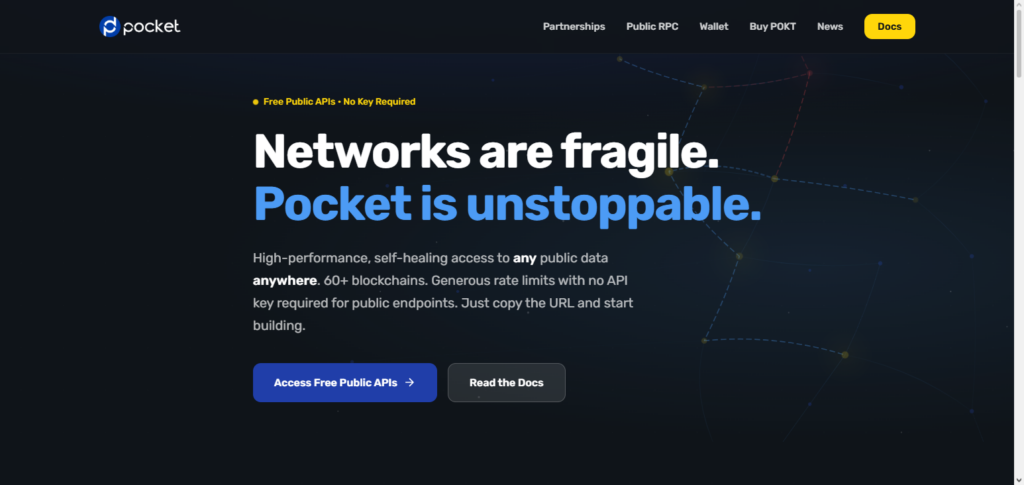
It utilizes incentives and tokens to promote quality and availability of nodes. Pocket Network deserves it’s place as one of the Best Decentralized Proxy Networks for Fast Web3 Data. It is also highly scalable and offers distributed request routing with a robust fault tolerance.
It is for this reason that Pocket Network is frequently employed by services needing reliable ease of access to on-chain operations and data: DeFi, NFT, Wallets, and blockchain analytics.
Pocket Network Details
| Feature | Details |
|---|---|
| Decentralized Infrastructure | Uses a distributed network of independent node operators instead of centralized servers. |
| Multi-Blockchain Support | Supports Ethereum, Polygon, Solana, Avalanche, BNB Chain, and many other blockchains. |
| High Availability | Multiple nodes ensure continuous RPC service with minimal downtime. |
| Token Incentive Model | Node operators are rewarded for providing reliable infrastructure. |
| Censorship Resistance | Distributed architecture reduces dependence on any single provider. |
| Automatic Load Distribution | Blockchain requests are balanced across available nodes. |
| Enterprise Scalability | Suitable for high-volume Web3 applications and enterprise deployments. |
2. Ankr RPC
Ankr RPC is decentralized infrastructure that services multiple blockchains thanks to a global reach. It also offers fast access to RPC endpoints and added features like automated failovers, smart routing, and scalable APIs for developers who no longer want the hassle of managing nodes.
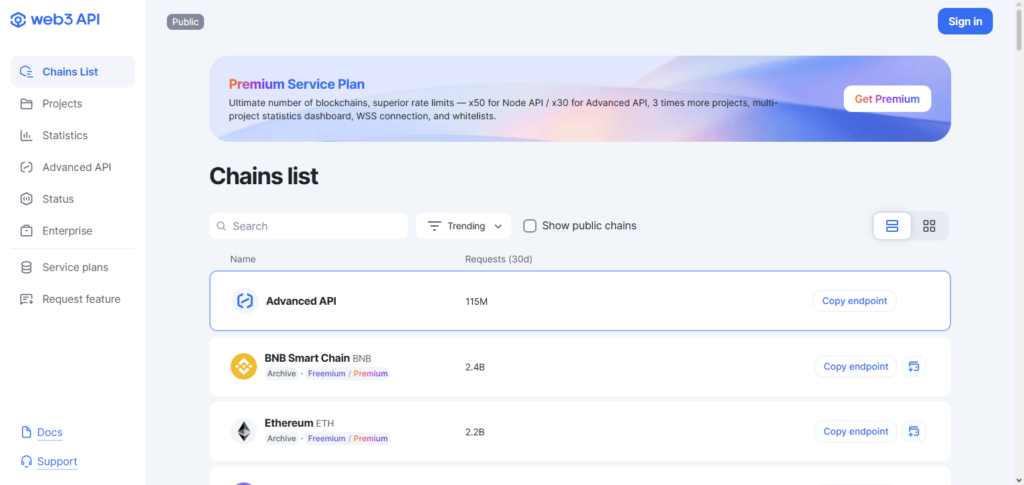
Ankr RPC nodes service high transaction volumes and also maintain a high level of performance for applications. A robust combination of decentralized node access and enterprise-grade services, Ankr RPC deserves to be described as one of the Best Decentralized Proxy Networks for Fast Web3 Data.
Fast and reliable communication is a requirement for modern blockchains. For this reason, Ankr RPC is found in Web3 gaming platforms, DeFi, NFT, crypto wallet services, and enterprise blockchain services.
Ankr RPC Details
| Feature | Details |
| Global Node Network | RPC nodes are distributed worldwide for lower latency. |
| Multi-Chain RPC | Supports dozens of public blockchain networks. |
| High-Speed Performance | Optimized infrastructure delivers fast RPC responses. |
| Load Balancing | Automatically distributes traffic across multiple servers. |
| Premium APIs | Advanced APIs for enterprise blockchain applications. |
| Developer Dashboard | Includes monitoring, analytics, and API management tools. |
| Secure Infrastructure | Enterprise-grade security and reliable uptime. |
3. Chainstack Decentralized RPC
Chainstack Decentralized RPC provides enterprise-level infrastructure for distributed requests from clients across nodes. This architecture minimizes single points of failure and supports consistent application performance even during periods of peak load.
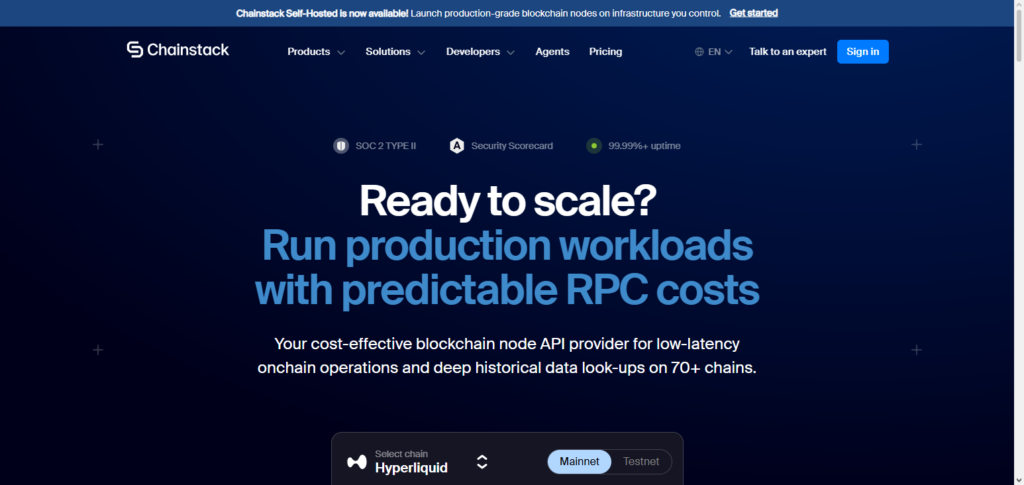
Chainstack supports a multitude of blockchains and provides monitoring, management of APIs, and tools for deployment at scale. Chainstack earns its place as one of the Best Decentralized Proxy Networks for Fast Web3 Data with excellent uptime, security, and operational adaptability.
Chainstack is appropriate for financial companies as well as blockchain and DeFi companies and is especially useful for decentralized exchange and NFT projects as well as for firms needing fast and flexible blockchain connections.
Chainstack Decentralized RPC Details
| Feature | Details |
| Enterprise Infrastructure | Built for production-grade blockchain applications. |
| Decentralized RPC Routing | Requests are distributed across multiple blockchain nodes. |
| Multiple Blockchain Support | Compatible with numerous Layer 1 and Layer 2 networks. |
| Monitoring Tools | Real-time performance and node monitoring. |
| API Management | Easy endpoint management and authentication. |
| High Uptime | Designed for reliable blockchain connectivity. |
| Scalable Deployment | Supports startups and enterprise workloads. |
4. Blast API
Blast API is a decentralized backend that provides a simple and efficient way for developers to create fast RPC endpoints across multiple blockchains without the hassle of maintaining full nodes.
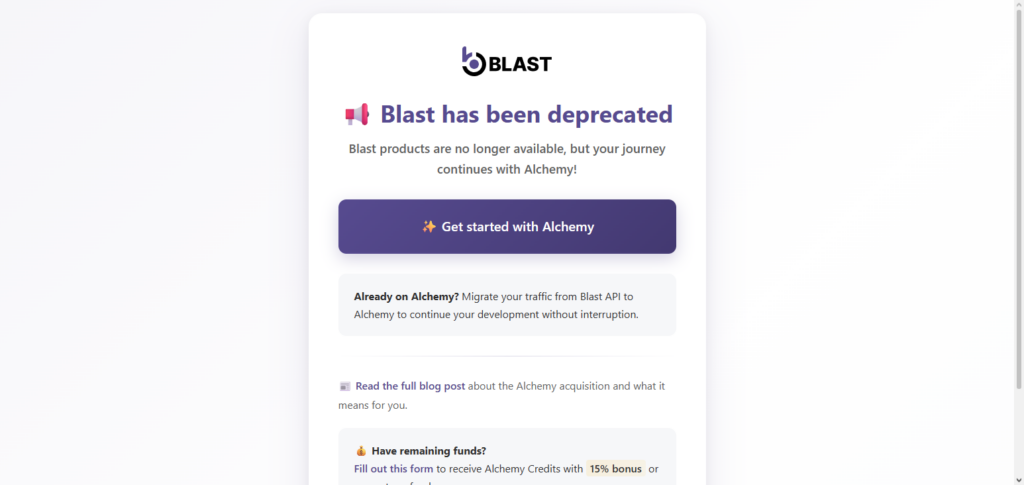
It enables developers to manage requests efficiently without compromising security. It applies automated scaling to provide API access at a secure level, thereby supporting a great number of networks.
Blast API makes it easy for developers of high throughput blockchains to maintain their applications with minimal effort. It is one of the Best Decentralized Proxy Networks for Fast Web3 Data and is well suited for DeFi applications, NFT projects, and other Web3 Applications.
Blast API Details
| Feature | Details |
| Fast RPC Endpoints | Optimized for low-latency blockchain communication. |
| Multi-Network Support | Connects to multiple blockchain ecosystems. |
| Auto Scaling | Infrastructure scales automatically during traffic spikes. |
| Secure API Access | Authentication and encrypted communication. |
| Node Redundancy | Backup infrastructure improves reliability. |
| Developer-Friendly Integration | Simple API implementation for dApps. |
| High Availability | Designed for uninterrupted blockchain services. |
5. QuickNode Decentralized
QuickNode Decentralized combines distributed, high-speed RPC backends with advanced node infrastructure. Equipped with intelligent caching, load balancing, API auth, and fast sync, QuickNode Decentralized combines a multitude of intelligent services.
QuickNode Decentralized, on top of all this, maintains a large number of blockchains. QuickNode also happens to be one of the Best Decentralized Proxy Networks for Fast Web3 Data.
QuickNode Decentralized uses enterprise-level proxy reliability, analysis, and scaling, making it very popular among DeFi, NFT, gaming, and data-blocking services. QuickNode Decentralized also happens to be a very popular data-blocking service.
QuickNode Decentralized Details
| Feature | Details |
| Intelligent Caching | Improves RPC response speed and efficiency. |
| Distributed Infrastructure | Multiple nodes increase performance and reliability. |
| Fast Node Synchronization | Keeps blockchain data current. |
| Advanced Analytics | Usage tracking and performance insights. |
| API Security | Secure authentication and endpoint protection. |
| Load Balancing | Even traffic distribution for stable performance. |
| Enterprise Support | Suitable for high-volume Web3 applications. |
6. Nodereal Proxy
Nodereal Proxy combines distributed RPC with smart request routing and traffic optimization to provide scalable blockchain infrastructure. Nodereal Proxy makes connectivity to multiple blockchains simpler and more reliable.
For developers, this service solves the problems of poor API security and a lack of analytics and enterprise-grade infrastructure in Web3. As one of the Best Decentralized Proxy Networks for Fast Web3 Data, Nodereal Proxy is reliable, eliminating pain points for financial, NFT, wallet, and analytics services.
Nodereal Proxy Details
| Feature | Details |
| Smart Request Routing | Optimizes blockchain requests automatically. |
| Multi-Chain Compatibility | Supports several blockchain ecosystems. |
| Low-Latency Infrastructure | Fast blockchain communication worldwide. |
| Traffic Optimization | Improves application performance during heavy usage. |
| API Analytics | Monitors request performance and usage. |
| Enterprise Scalability | Handles growing Web3 infrastructure demands. |
| Reliable RPC Access | High availability through distributed nodes. |
7. GetBlock
GetBlock is a blockchain node provider that helps developers access full nodes or shared nodes. Using GetBlock’s decentralized RPC infrastructure, developers no longer need to set up or manage blockchain nodes to create and connect their applications.

GetBlock combines high availability of decentralized proxy nodes and scalable infrastructure to offer fast Web3 data with reasonable prices. Many DeFi projects, NFT marketplaces, crypto wallets and blockchain analytics, and enterprise blockchain applications use GetBlock.
GetBlock Details
| Feature | Details |
| Instant Node Access | Connect to blockchain nodes immediately. |
| Shared & Dedicated Nodes | Flexible infrastructure options for developers. |
| Multi-Blockchain Support | Supports numerous public blockchain networks. |
| API Authentication | Secure access with API keys. |
| High Availability | Reliable blockchain connectivity with minimal downtime. |
| Scalable Infrastructure | Suitable for startups and enterprises. |
| Easy Integration | Simple RPC endpoint deployment. |
8. Infura Decentralized Mode
Infura Decentralized Mode is an improvement to traditional blockchain systems that offers a way to decentralized routing, which ultimately means an even greater reduction in reliance on centralized servers.
This mode uses a combination of advanced enterprise systems and a greater accessibility of distributed nodes to create more dependable and secure RPC for and within the supported blockchain networks. As one of the Best Decentralized Proxy Networks for Fast Web3 Data, Infura Decentralized Mode offers intelligent traffic distribution and redundancy for scalable communications on the blockchains.
This mode is frequently used among dApps, Decentralized Finance solutions and services, NFT platforms and exchanges, as well as blockchain wallet services.
Infura Decentralized Mode Details
| Feature | Details |
| Decentralized Request Routing | Improves resilience through distributed infrastructure. |
| High Reliability | Redundant nodes minimize outages. |
| Enterprise Infrastructure | Trusted by production Web3 applications. |
| Secure RPC Access | Encrypted blockchain communication. |
| Automatic Failover | Traffic shifts during node failures. |
| Multiple Network Support | Compatible with major blockchain ecosystems. |
| Performance Optimization | Low latency with intelligent routing. |
9. Alchemy Decentralized RPC
Alchemy Decentralized RPC offers powerful and innovative blockchain infrastructure with decentralized RPC services tailored toward high-performance Web3 apps. It provides developers with simplified tools, such as monitor dashboards, debugging, intelligent caching, and flexible access to scalable blockchains.
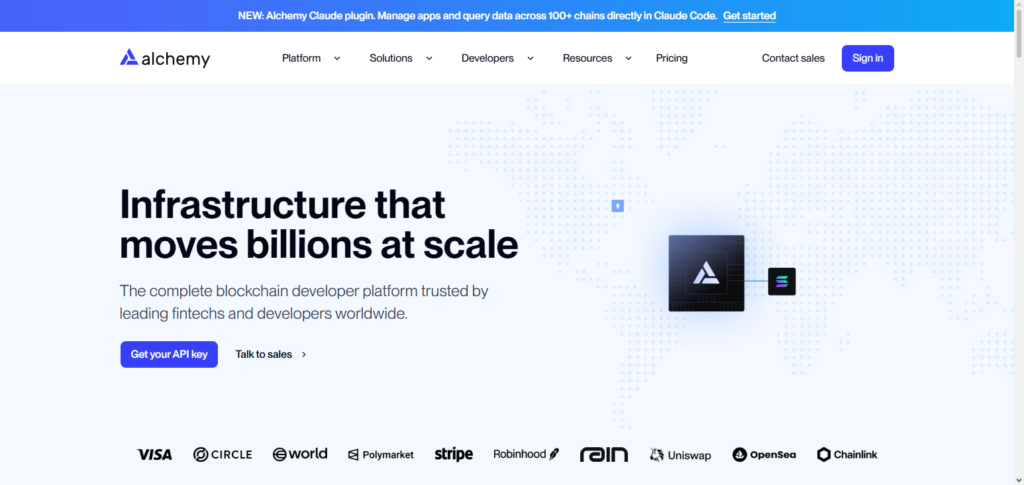
This makes developing decentralized apps much easier. Alchemy is named as one of the Best Decentralized Proxy Networks for Fast Web3 Data for a reason. It combines enterprise-proven infrastructure and powerful services for developers.
It’s no surprise that Alchemy is developer’s #1 choice for NFT marketplaces, DeFi protocols, wallets, blockchain analytics, gaming apps, enterprise blockchain apps, and countless other projects that need fast, safe, and reliable highly demanded blockchain services.
Alchemy Decentralized RPC Details
| Feature | Details |
| Advanced Developer Tools | Includes debugging, monitoring, and analytics. |
| Distributed RPC Infrastructure | High-performance decentralized blockchain access. |
| Smart Caching | Improves application response times. |
| High Throughput | Handles millions of blockchain requests efficiently. |
| Real-Time Monitoring | Tracks node health and API performance. |
| Enterprise Security | Robust authentication and infrastructure protection. |
| Scalable APIs | Supports projects from startups to enterprises. |
10. Moralis Streams
Moralis Streams is real-time data streaming for blockchain that sends events to your apps instantly using webhooks and APIs by monitoring blockchain activity. Developers no longer need to waste time and resources by leaving nodes open to guarantee updates.
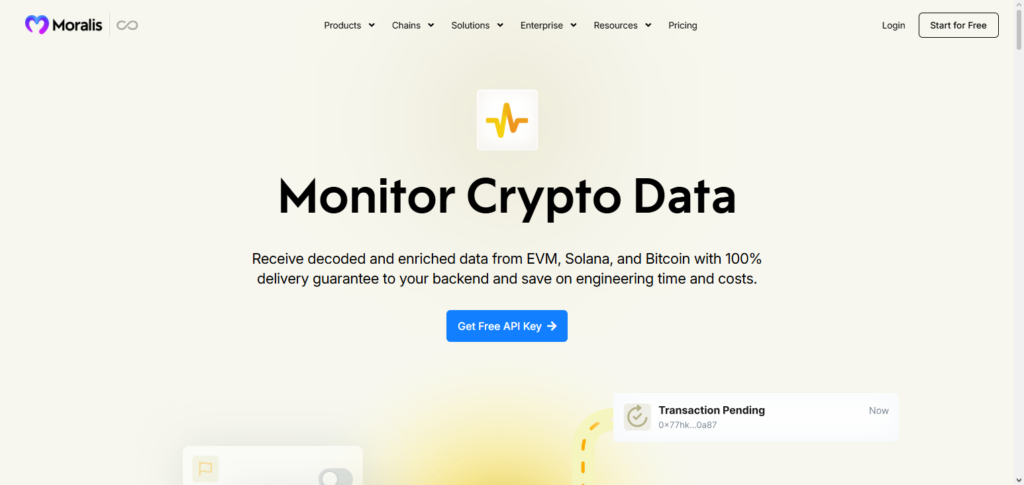
Moralis Streams is one of the Best Decentralized Proxy Networks for Fast Web3 Data and is proven excellent in real-time, cross-network, and scalable blockchains.
Moralis is the #1 choice for all decentralized apps, enterprise systems, and trading and analytics apps that require low latency event processing and continuous data synchronization with blockchains.
Moralis Streams Details
| Feature | Details |
| Real-Time Blockchain Events | Instant notifications for blockchain activity. |
| Webhook Integration | Sends blockchain events directly to applications. |
| Multi-Chain Monitoring | Tracks activity across multiple blockchain networks. |
| Smart Contract Event Tracking | Monitors custom contract interactions. |
| Wallet Monitoring | Detects wallet transactions in real time. |
| NFT & Token Tracking | Supports NFT transfers and token movements. |
| Scalable Event Processing | Handles high-volume blockchain event streaming efficiently. |
Conclusion
Choosing high-speed web3 data decentralized proxy networks should revolve around the performance, scalability, and security considerations of your specific use case. Proxy networks such as Pocket Network, Ankr RPC, Chainstack, Blast API, QuickNode, and many others come with lots of great features such as decentralized infrastructures, low-latency RPC, real-time blockchain data, enterprise-level assurance, etc.
Ensuring the selection of the appropriate platform offers developers features such as minimal downtime with better data availability and superior speed to develop Web3 applications. When determining the best decentralized proxy network, features such as offered blockchains, network availability, billing, and API and network scalability are worth considering to ensure the success of your use case.
FAQ
What are decentralized proxy networks for Web3?
Decentralized proxy networks are distributed infrastructures that route blockchain requests through multiple nodes instead of relying on a single centralized server. They improve speed, reliability, security, and censorship resistance for Web3 applications.
Why should developers use decentralized proxy networks?
Developers use decentralized proxy networks to reduce downtime, improve RPC performance, increase scalability, enhance privacy, and ensure reliable access to blockchain data across multiple networks.
Which are the Best Decentralized Proxy Networks for Fast Web3 Data?
Some of the leading platforms include Pocket Network, Ankr RPC, Chainstack Decentralized RPC, Blast API, QuickNode Decentralized, Nodereal Proxy, GetBlock, Infura Decentralized Mode, Alchemy Decentralized RPC, and Moralis Streams.
How do decentralized proxy networks improve Web3 performance?
They distribute requests across multiple blockchain nodes, reducing latency, preventing bottlenecks, balancing traffic efficiently, and maintaining high availability even during periods of heavy network activity.