


In this article, I will talk about the best DeFi AI Data Labeling and RLHF Token platforms and how they help with AI training data, human feedback, and contributor rewards.
These frameworks consist of decentralized networks, AI stacks, data marketplaces, and blockchain rewards. They enable more community-centric model building. We will cover some key features of each framework and some benefits and drawbacks for their use cases.
Key Points
| Platform | Best For | Key Features |
|---|---|---|
| LabDAO | Scientific datasets | Decentralized annotation, tokenized rewards |
| Giza Protocol | AI model training | On‑chain RLHF pipelines, zkML integration |
| Bittensor (TAO) | Global AI contributors | Tokenized RLHF, decentralized AI subnet incentives |
| SingularityNET v3 | Multi‑agent AI | AI service marketplace, RLHF token staking |
| Ocean Protocol | Data liquidity | Tokenized datasets, decentralized labeling markets |
| Numeraire (Numerai) | Financial AI models | Crowdsourced predictions, RLHF‑style token rewards |
| Cortex DAO | AI governance | RLHF token pools, decentralized model curation |
| Fetch.ai Agents | Autonomous AI agents | Agent‑driven labeling, tokenized coordination |
| DeepDAO RLHF Hub | Governance datasets | DAO‑driven annotation, token incentives |
| Symbiotic AI Data Pools | Institutional AI | ERC‑20 vault safety, tokenized RLHF contributions |
1. LabDAO
LabDAO describes itself as a decentralized research organization with an aim to make tools and resources for research and computing more accessible to the public. This project connects researchers with services and computing, and therefore is relevant to decentralized AI data ecosystems, though they do not operate as an RLHF labeling marketplace.
For a comparison of the Best Decentralized AI Data Labeling & RLHF Token Platforms, LabDAO represents something more along the lines of an infrastructure for the decentralization of scientific AI research and data-based experiments.
Their business model is open to collaboration and sharing of infrastructure and is intended to provide participants the freedom to choose when and how they engage. LabDAO should not be characterized as an RLHF annotation platform unless any service they provide is specifically for that purpose.
LabDAO Features, Pros & Cons
Features
- Provides decentralized infrastructure for scientific research and computational biology.
- The Lab Exchange links researchers to computational and lab resources.
- Offers tools for reproducible research workflows.
- Utilizes decentralized frameworks for scientific computing and data workflows.
- Although not exclusively, it is related to AI research (Frontiers).
Pros
- Has an open and collaborative research system.
- Strong focus on scientific reproducibility.
- Is helpful for decentralized computational research.
- Supports AI augmented scientific research workflows.
- Offers a different perspective on distributed computational research.
Cons
- Not designed for RLHF labeling.
- More aligned with scientific research as opposed to general AI data annotation.
- Still building its token and incentive systems.
- Advanced workflows are not user friendly.
- Smaller ecosystem than major AI platforms.
2. Giza Protocol
Giza Protocol centers on autonomous AI agents and the automation of Finance 2.0, rather than being a human-feedback focused data-labeling marketplace. Its infrastructure is composed of AI agents that interface with financial applications built on blockchains and are capable of executing a myriad of strategies. For the Best Decentralized AI Data Labeling & RLHF Token Platforms list, Giza would be more accurately placed within the decentralized AI-agent platforms.
Its combination of AI automation with blockchain infrastructure, where AI agents can perform CRUD operations without the need for centralized intermediaries, makes it relevant in the context of the decentralized AI ecosystem. When exploring the decentralized AI ecosystem, it is important to note the differences between what Giza offers, AI agent execution, and the actual collection of RLHF datasets, preference labeling, and tokenized annotation.
Giza Protocol Features, Pros & Cons
Features
- Emphasizes autonomous AI and decentralized applications.
- Designed to enable AI agents to work within blockchain environments.
- Useful for automated financial and Web3 workflows.
- Provides tools and frameworks for programmable agent-based operations.
- Is better classified as decentralized AI-agent infrastructure than a typical RLHF platform.
Pros
- Has strong AI-agent focus.
- Is useful for blockchain automation.
- Supports autonomous workflows.
- Integrates AI within Web3.
- Is useful for developers building agent-based applications.
Cons
- Not a dedicated human-feedback labeling platform.
- Has limited RLHF functionalities.
- Is primarily designed for agents and blockchain applications.
- Requires Web3 development.
- May not be useful for organizations seeking significant annotation.
3. Bittensor (TAO)
Bittensor is one of the most compelling examples of decentralized AI infrastructure within this list. Its network consists of independent subnets, where miners generate digital commodities related to AI, such as computation, prediction, and inference, while validators assess the outputs. Contributors are rewarded TAO based on their contribution within the network.

In a Best Decentralized AI Data Labeling & RLHF Token Platforms assessment, Bittensor is more accurately classified as a decentralized AI network for incentives rather than an RLHF labeling marketplace. Its subnet structure is aimed at the design of AI task differentiators and their associated incentive mechanisms, which makes this network of particular importance to decentralized AI training and assessment.
Bittensor (TAO) Features, Pros & Cons
Features
- A decentralized network of specialized subnets that are structured to…
- Validators check how good participant contributions are.
- Miners produce outputs or services related to AI.
- TAO is the core economic incentive of the network.
- Provides focused AI services through independent subnets.
Pros
- Decentralized AI Infrastructure.
- AI related economic incentives.
- Flexible subnets.
- Open participation.
- Relevant to decentralized AI model evaluation/contribution.
Cons
- Learning the technology may be difficult.
- Subnets differ in quality and purpose.
- Token economics may lead to uncertain markets.
- Subnets differ in focus, many do not focus on RLHF.
- Performance relies on the incentive and validation system.
4. SingularityNET v3
SingularityNET has created a decentralized AI marketplace to connect developers of AI services and users seeking to access AI services. Built using blockchain technology, users can access AI services in areas of model inference, training, image and video processing, speech, natural language, and numerous other AI capabilities.
When pitted against other Decentralized AI Data Labeling & RLHF Token Platforms, SingularityNET would be considered a decentralized AI service infrastructure, and not a dedicated RLHF labeling system. The ecosystem uses ASI (FET), while old AGIX is removed. This makes SingularityNET relevant for monetizing and collaborating on decentralized AI services.
SingularityNET v3 Features, Pros & Cons
Features:
- Decentralized AI service marketplace.
- AI service developers can build and publish AI services.
- Supports many AI technology services
- AI services built on open networks.
- Allies with Fetch.ai and Ocean Protocol. (Fetch.ai)
Pros:
- Wide ecosystem of AI Services.
- Good for decentralized AI development.
- Good for discovery and monetization of AI Services.
- Useful for developers and AI Service providers.
- AI Service independence relies heavily on this network.
Cons:
- Not optimized for RLHF data labeling.
- More complex AI Service marketplace.
- Knowledge of Web 3.0 is useful.
- Complex token ecosystem.
- Quality and utility of individual AI Services may vary.
5. Ocean Protocol
For infrastructure, Ocean Protocol is important to decentralized AI data. It provides data and compute markets built on data NFTs, data tokens, Compute-to-Data, and Ocean Nodes. This allows data providers to maintain control while giving AI and data specialists the ability to manipulate the data.
In a Best Decentralized AI Data Labeling & RLHF Token Platforms comparison, Ocean is positioned to be a decentralized data infrastructure provider rather than a data compute and RLHF annotation provider.
Ocean’s infrastructure is capable of providing AI training datasets, data marketplaces, compute, and annotations and predictions. Ocean provides privacy-preserving data access mechanisms and data tokens, adding to its relevance of addressing the decentralized AI data economy.
Ocean Protocol Features, Pros & Cons
Features
- Decentralized data and compute protocol.
- Supports data NFTs and datatokens.
- Provides token-based access control for data services.
- Compute-to-Data enables algorithms to work with data without directly exposing the dataset.
- Can support AI training data, models, predictions, and other data assets.
Pros
- Strong focus on decentralized data ownership.
- Useful for AI training-data ecosystems.
- Privacy-oriented Compute-to-Data architecture.
- Supports programmable data access.
- Relevant to data monetization and AI development.
Cons
- Not a dedicated RLHF annotation marketplace.
- Data providers still need to manage dataset quality.
- Blockchain concepts can create a learning curve.
- Token-based access may add operational complexity.
- Requires suitable infrastructure for specific AI workloads.
6. Numeraire (Numerai)
Numerai is a decentralized, data-centric ecosystem designed to produce machine-learning predictions and offers a distinct model compared to RLHF. It provides data to data scientists who then create models and offer predictions. Model predictions may be staked in NMR, and while model success is rewarded, poor models may be punished by a loss of NMR.
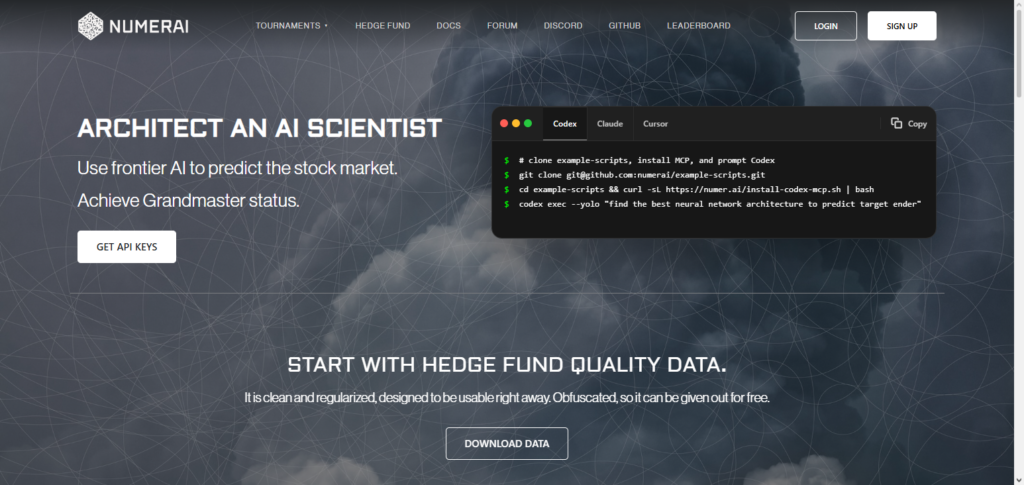
In a Best Decentralized AI Data Labeling & RLHF Token Platforms comparison, Numerai best fits the description of a token-governed machine learning participation platform.
Its NMR staking provides a clear mechanism to signal the importance of high-quality predictions toward the creation of Numerai’s Meta Model. It is well suited for decentralized AI ecosystems, but is not an RLHF human-preference labeling marketplace.
Numeraire (Numerai) Features, Pros & Cons
Features
- A machine-learning ecosystem built on a decentralized platform.
- Data scientists build models, and on the platform, users make predictions.
- Employs a mechanism called NMR for staking and rewards.
- Connection between rewards and model or signal performance.
- Emphasizes machine-learning contributions over RLHF labeling.
Pros
- Machine-learning community.
- Well-developed performance-related reward system.
- Employs crypto economics to incentivize contributions.
- Increased model competition.
- Well-developed idea for participation in machine learning.
Cons
- Not an RLHF-focused platform.
- Focused on financial predictions.
- Requires data science skills and quantitative skills.
- There is a financial risk with staking.
- Not broadly applicable for AI annotation.
7. Cortex DAO
Cortex DAO should be approached with caution in this category because I could not verify an extant project officially named “Cortex DAO” that operates as a decentralized AI data-labeling or RLHF token platform. The closest verified project is Cortex Protocol.
Cortex Protocol is infrastructure for on-chain AI agents. Cortex Protocol’s documentation cites two main elements: The Cortex Trading Agent and the Cortex Agent Platform, through which AI agents access blockchain networks. For this listing of Best Decentralized AI Data Labeling & RLHF Token Platforms, Cortex Protocol seems to be positioned more as adjacent decentralized AI agent infrastructure rather than a direct RLHF annotation marketplace.
The Cortex Agent Platform is designed to enable developers of custom AI agents to deploy them to the platform with distinct objectives, datasets, and on-chain constraints. The ecosystem uses a CX token for AI agent purposes in staking and transactions. This creates a financial layer for the deployment and usage of decentralized AI agents on the platform.
For a listing of Best Decentralized AI Data Labeling & RLHF Token Platform, the most pertinent aspect is the combination of AI and blockchain with execution and incentivization of autonomous agents; however, there are no verified cases of Cortex providing a dedicated marketplace for CX where human annotators are compensated for RLHF labeling.
Cortex DAO Features, Pros & Cons
Features
- The name Cortex DAO cannot be sufficiently verified as an established decentralized RLHF/data labeling platform.
- There are many unrelated Cortex projects, for example, Cortex Labs and Cortex Protocol.
- Cortex Protocol is focused on on-chain AI.
- Cortex Labs focuses on executing AI models on-chain.
- Thus, RLHF or labeling features should not be mentioned without referring to the exact project.
Pros
- Projects related to Cortex show good integration of AI with Blockchain.
- Some of the Cortex infrastructures provide on-chain AI.
- May have a connection to decentralized AI.
- Integration of Blockchain provides a level of transparency.
- Some infrastructures within the Cortex ecosystems offer AI-agent capabilities.
Cons
- The term “Cortex DAO” is vague.
- There is no confirmation for dedicated RLHF capabilities.
- Should not be claimed as a developed labeling marketplace.
- The tokens and governance structure will depend on the particular Cortex project.
- Has to be verified at the project level prior to being included in a ranking.
8. Fetch.ai Agents
Fetch.ai, a member of the Artificial Superintelligence Alliance, is building decentralized AI agents that can discover, communicate, negotiate, and perform services. Its architecture is built on a blockchain framework for identity, service discovery, transactions, and multi-agent workflows.
In the context of our comparison of Best Decentralized AI Data Labeling & RLHF Token Platforms, Fetch.ai Agents are better classified as a decentralized AI-agent infrastructure, and not as a specific framework for RLHF data labeling. Fetch.ai Agents are most relevant to autonomous AI services and machine-to-machine communications and interactions.
In the context of our comparison of Best Decentralized AI Data Labeling & RLHF Token Platforms, SingularityNET documentation also notes that ASI (FET) is the token for the infrastructure of their AI services marketplace.
Fetch.ai Agents Features, Pros & Cons
Features
- Focuses on autonomous AI agents.
- Agents can find useful services and perform actions in a decentralized eco-system.
- Offers AI agents in combination with Blockchain.
- Built for machine-to-machine communication.
- Fetch.ai is building the agent infrastructure in the decentralized AI ecosystem. ([Fetch.ai][2])
Pros
- Capable of developing autonomous agents.
- Useful in building automated workflows within Web3.
- Capable of machine-to-machine communication.
- Offers plenty of possibilities in a decentralized ecosystem.
- Well suited for developing AI agents.
Cons
- It is not a dedicated RLHF labeling platform.
- They do not focus on collecting human feedback.
- Developing agents is a complex task.
- Blockchain complexities may increase development difficulties.
- Least suitable in providing traditional annotation services.
- It should not be considered an RLHF data labeling platform by default.
9. DeepDAO RLHF Hub
The DeepDAO RLHF Hub should not be regarded as a verified standalone RLHF platform. DeepDAO is primarily an engine that helps users discover and analyze data on governance, members, proposals, and votes as well as treasury and DAO activity.
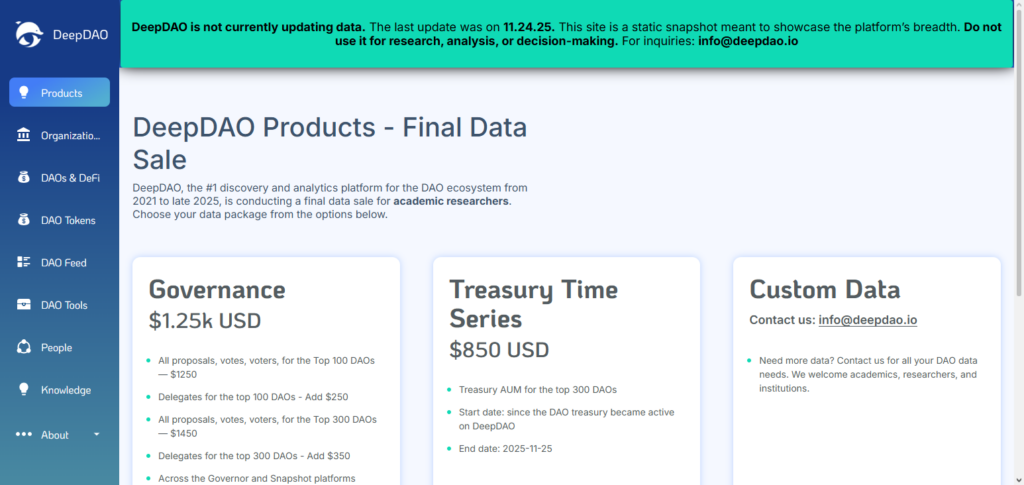
In the “Best Decentralized AI Data Labeling & RLHF Token Platforms” comparison, DeepDAO is best described as an adjacent DAO data-related resource as opposed to a human-feedback labeling marketplace.
DeepDAO’s stated products include DAO analytics and API data, but there is no verified dedicated RLHF annotation system, contributor labeling marketplace, or RLHF token reward mechanism. This clarifies that there are currently no verified RLHF token reward mechanisms within DeepDAO and allows for accurate claims to be made.
DeepDAO RLHF Hub Features, Pros & Cons
Features
- No reliable evidence was found confirming a dedicated DeepDAO RLHF Hub.
- DeepDAO is primarily associated with DAO analytics and governance information.
- It should not automatically be categorized as an RLHF data-labeling platform.
- Its core relevance is closer to DAO research and analytics.
- Specific RLHF, annotation, or token-reward features require verification.
Pros
- DeepDAO provides useful DAO ecosystem information.
- Relevant to decentralized governance research.
- Can help analyze DAO-related activity.
- Useful for understanding decentralized organizations.
- Could provide contextual data for Web3 research.
Cons
- Dedicated RLHF functionality is not verified.
- Not established as an AI annotation marketplace.
- No verified RLHF reward mechanism identified.
- Should not be compared directly with dedicated AI-data platforms.
- The “RLHF Hub” designation may create misleading expectations.
10. Symbiotic AI Data Pools
“Symbiotic AI Data Pools” deserves careful consideration too. Per official Symbiotic documentation, Symbiotic consists of vaults, curators, allocators, applications, operators, and programmable collateral. Symbiotic’s Core V2 focuses on interacting committed capital with applications.
This architecture makes Symbiotic similar to the Best Decentralized AI Data Labeling & RLHF Token Platforms, but Symbiotic is not an AI data-labeling platform. It is related to decentralized infrastructure and economic security, but at this point there isn’t enough evidence to argue Symbiotic offers RLHF data pools or annotation rewards.
Symbiotic AI Data Pools Features, Pros & Cons
Features
- Symbiotic is a modular coordination layer for programmable economic security.
- Uses independently managed vaults.
- Connects applications with capital and economic-security infrastructure.
- Supports multiple participant roles and integration paths.
- Its core purpose is economic security rather than AI data labeling or RLHF.
Pros
- Modular infrastructure.
- Programmable economic-security design.
- Flexible vault architecture.
- Useful for decentralized application infrastructure.
- Can coordinate capital across different participants.
Cons
- Not an AI data-labeling platform.
- No verified dedicated RLHF marketplace.
- No verified AI annotation reward system.
- Primarily focused on economic security.
- Should be treated as adjacent infrastructure rather than a direct RLHF competitor.
Conclusion
The best decentralized AI data labeling and RLHF token platforms are helping build an open AI ecosystem by connecting data, contributors, AI models, and blockchain incentives.
Bittensor is one among many that use different approaches to AI, access to data and models, and rewards for contributors. Bittensor uses a decentralized network and TAO to reward contributions, while Ocean Protocol uses tokenized data, privacy preserving Compute-to-Data, and AI resources. Numerai incentivizes good machine learning predictions with NMR staking.
It also is crucial to distinguish the RLHF and data labeling platforms from broader Decentralized AI. Not all Decentralized AI networks provide human feedback collection or annotation marketplaces.
When selecting a platform, consider the types of data contributions supported, the reward mechanism, token economy, the level of privacy afforded to providers, the available quality assurance processes, community engagement, and the platform’s transparency.
As Decentralized AI continues its journey, these platforms can change the ecosystem and make high quality data contributions and AI work more accessible to contributors, while giving them control of how their work is valued.
FAQ
What are decentralized AI data labeling and RLHF token platforms?
Decentralized AI data-labeling and RLHF platforms use blockchain, distributed networks, or token-based incentives to coordinate AI data contributions, model evaluation, annotation, or feedback. Instead of relying entirely on one centralized company, these ecosystems can distribute participation among contributors, validators, developers, and data providers. However, not every decentralized AI platform provides traditional RLHF labeling. Some focus on AI services, data marketplaces, model evaluation, or decentralized compute.
Which is the best decentralized AI platform for AI contributions?
Bittensor is one of the strongest options for decentralized AI contributions because its network uses specialized subnets where miners perform AI-related work and validators evaluate results. Its ecosystem includes subnets covering different AI tasks, including data labeling and reinforcement-learning-related workloads.
How does Bittensor reward AI contributors?
Bittensor uses a subnet-based incentive system. Miners provide the work defined by a subnet, while validators evaluate miner outputs and assign weights. Emissions are then distributed according to the network’s incentive and consensus mechanisms. Participants can also stake TAO into subnet pools and receive subnet-specific alpha exposure.
Is Ocean Protocol suitable for AI training data?
Yes. Ocean Protocol is designed as decentralized data and compute infrastructure and can support AI training data, models, predictions, and other data services. Its technology includes data NFTs, datatokens, Ocean Nodes, and Compute-to-Data. Compute-to-Data allows data to remain under the data holder’s control while authorized algorithms operate on it.