


In this article, I’ll be discussing the Best Blockchain Interoperability Protocols for developers building cross-chain applications. We will compare leading protocols by messaging capabilities, supported Blockchain networks, security models, smart-contract support, performance, fees, monitoring tools and developer experience. This guide helps developers find the right interoperability infrastructure for secure and efficient multichain applications.
What Are Blockchain Interoperability Protocols?
Blockchain interoperability protocols are infrastructure layers that enable communication, data exchange, token transfer, and smart contract interaction among disparate blockchain networks and ecosystems. Rather than siloing applications on one chain, these protocols allow developers to build cross-chain and omnichain applications.
Depending on the architecture, they can authenticate cross-chain activity using messaging networks, validators, light clients, guardians or customizable verification systems.
Common features include: send any message, transfer tokens, call cross-chain contracts, govern, sync application data. These protocols are usually evaluated by developers based on chain coverage, security model, performance, fees, smart contract compatibility, developer tools and monitoring capabilities.
Why Do Developers Need Blockchain Interoperability Protocols?
Build Cross-Chain Applications: Interoperability protocols enable developers to link applications on multiple blockchains so users can access the same application, assets or functionality without being restricted to a single network.
Enable Interchain Messaging: Developers are able to send arbitrary data, instructions and contract calls between blockchains. This allows applications to coordinate activities across networks without the need to manually build separate communication systems.
Token Transfer Between Chains: Interoperability infrastructure allows tokens to be transferred across the supported chains with different mechanisms such as lock-and-mint, burn-and-mint or native-token transfer models.
Raise Liquidity: DeFi applications can tap into liquidity across different networks by connecting different ecosystems. Developers are able to create apps that interact with assets and users on multiple blockchains.
Power cross-chain applications: This means developers are able to build applications where contracts, assets and application logic can exist across multiple networks, creating a more interconnected user experience than deploying isolated versions on individual chains.
Access Numerous Blockchain Ecosystems: Different networks have different strengths, such as lower transaction costs, faster execution, specialized virtual machines, or unique user communities. Interoperability lets developers connect these ecosystems within a single application.
Application agility improved: Developers are able to choose different networks for different workloads, but still communicate across them. This can help apps optimize execution costs, performance, liquidity, and user accessibility.
Key Points
| Protocol | Key Point |
|---|---|
| Chainlink CCIP | Provides cross-chain messaging and token transfer infrastructure using Chainlink’s interoperability framework. |
| LayerZero | Enables omnichain messaging that allows applications and assets to communicate across multiple blockchains. |
| Wormhole | Delivers cross-chain messaging and asset transfer infrastructure with strong support for Solana and non-EVM networks. |
| Axelar | Operates a dedicated cross-chain network that connects blockchains through generalized message passing. |
| Hyperlane | Provides permissionless cross-chain messaging with customizable security models for developers. |
| Cosmos IBC | Enables protocol-level interoperability between Cosmos ecosystem blockchains through standardized communication channels. |
| Polkadot XCM | Allows parachains and consensus systems within the Polkadot ecosystem to exchange messages and assets. |
| Avalanche Warp Messaging (AWM) | Provides native interoperability and authenticated messaging between Avalanche Layer 1 networks and subnets. |
| Interchain Token Service (ITS) | Axelar’s interoperability framework for deploying and managing tokens across multiple connected blockchains. |
| Native Token Transfers (NTT) | Wormhole’s interoperability standard designed for moving native assets across multiple blockchain networks. |
1. Chainlink CCIP
2023: Chainlink CCIP launched as a cross-chain interoperability protocol to transfer messages, tokens, or both. Its messaging layer can handle arbitrary data and programmable token transfers across an expanding list of EVM and non-EVM networks like Ethereum, Arbitrum, Base, Avalanche, Solana and Aptos. Security is provided by Chainlink decentralized oracle networks, rate limits, timelocked upgrades and other verification options.
Developers are able to build intelligent contracts with CCIP contracts, SDKs, APIs, and CLI tools. Performance depends on chain finality, lane conditions and execution settings. Fees are charged for messaging, execution and token-transfer operations. CCIP monitoring tools are available to track the status of messages and lanes.
| Category | Details |
|---|---|
| Core Feature | Cross-chain messaging and token-transfer infrastructure for building interoperable applications |
| Messaging | Supports arbitrary messages and programmable token transfers between supported networks |
| Chain Coverage | Supports a broad range of EVM and selected non-EVM networks |
| Security Model | Uses Chainlink decentralized oracle infrastructure, multiple security checks, rate limits, and additional safeguards |
| Smart Contract Support | Developers can send messages and trigger destination-chain smart-contract logic |
| Token Transfers | Supports cross-chain token transfers through configurable token pools and programmable transfers |
| Performance | Designed for reliable cross-chain execution, with timing influenced by source-chain finality and destination execution |
| Fees | Costs can include messaging, token-transfer, execution, and destination-chain gas |
| Monitoring | Provides CCIP transaction monitoring for tracking cross-chain transaction status |
| Developer Tools | APIs, SDKs, smart-contract interfaces, CLI tooling, tutorials, and development resources |
| Pros | Strong security architecture, extensive infrastructure, programmable transfers, developer tooling, and enterprise-oriented design |
| Cons | Fees and execution time vary by network; developers must understand CCIP-specific configuration and supported-chain limitations |
2. LayerZero
LayerZero was founded in 2022 to facilitate permissionless omnichain messaging for supported blockchain ecosystems. Its Endpoint is the main interface for sending and receiving messages. Applications can configure messaging libraries and security components to suit their needs.
Chain coverage includes the major EVM networks and a number of non-EVM ecosystems, suitable for multichain applications, governance, DeFi and token infrastructure. Big interest area is in smart-contract integration, working with endpoints, message payloads, GUIDs, nonces and receive functions.
Performance depends on destination chain confirmation and configured security options. Fees typically relate to the costs of destination execution and messaging, while message identifiers and endpoint infrastructure facilitate monitoring.
| Category | Details |
|---|---|
| Core Feature | Permissionless omnichain messaging infrastructure |
| Messaging | Enables arbitrary application messages and cross-chain smart-contract communication |
| Chain Coverage | Supports a large selection of EVM and non-EVM blockchain environments |
| Security Model | Uses configurable security components and Message Libraries, allowing applications to customize verification |
| Smart Contract Support | Strong smart-contract integration through LayerZero Endpoints and messaging interfaces |
| Token Transfers | Supports omnichain token applications and token-transfer infrastructure |
| Performance | Uses modular messaging infrastructure designed for efficient cross-chain message processing |
| Fees | Applications pay messaging and destination execution costs based on their configured pathway |
| Monitoring | Unique message identifiers, nonces, payload hashes, and endpoint state help track message delivery |
| Developer Tools | Endpoints, SDKs, contracts, Message Libraries, Executors, and development documentation |
| Pros | Highly customizable, broad ecosystem coverage, strong smart-contract support, modular architecture |
| Cons | Security configuration can be technically complex; developers need to understand the selected verification and execution configuration |
3. Worm Hole
Wormhole, 2021 born, is a cross-chain messaging and token-transfer infrastructure for multichain applications. It has a messaging system for arbitrary data transmission across a broad spectrum of blockchain ecosystems, covering EVM chains, Solana and other connected networks.
The Wormhole Guardian network watches messages and produces signed Verified Action Approvals that the relayers send to destination chains to provide security. Wormhole Core contracts and SDKs are available for developers to build intelligent contracts. Performance depends on source-chain finality,
Guardian verification and destination execution. Fees vary based on blockchain and integration. Wormhole also provides visibility through message identifiers and transaction data, while its NTT framework allows for the movement of native-token without relying on traditional wrapped assets.
| Category | Details |
|---|---|
| Core Feature | Multichain messaging, token transfers, governance, and interoperability infrastructure |
| Messaging | Supports arbitrary cross-chain messages for dApps, governance, data coordination, and other workflows |
| Chain Coverage | Broad multichain coverage including major EVM networks and Solana |
| Security Model | Uses the decentralized Wormhole Guardian network to observe and sign messages |
| Smart Contract Support | Core contracts allow applications to publish and verify cross-chain messages |
| Token Transfers | Supports Wrapped Token Transfers and Native Token Transfers |
| Performance | Depends on source-chain finality, Guardian verification, relaying, and destination execution |
| Fees | Costs vary by source and destination network and the selected Wormhole product |
| Monitoring | VAA identifiers, transaction data, explorers, and Wormhole developer tooling help track messages |
| Developer Tools | TypeScript SDK, Core Messaging, Executors, Connect, NTT, and token-transfer infrastructure |
| Pros | Strong multichain reach, flexible messaging, Solana support, multiple token-transfer options |
| Cons | Developers must understand Guardian-based verification and the specific security assumptions of each integration |
4. Axelar
Axelar launched its network in 2022 . It offers generalized cross-chain communication through General Message Passing, allowing applications to call functions and intelligent contracts across connected blockchains. It includes EVM and non-EVM networks connected through Axelar gateways.
Security is based on Axelar validators reaching consensus and approving cross-chain commands before execution on the destination chain. Developers are able to send messages or messages with tokens using Gateway contracts and Axelar SDKs.
Performance depends on source-chain confirmation, Axelar consensus, relaying and destination execution. Cross-chain calls are made possible with pre-paid gas. Axelar fees are generally gas for Axelar processing and destination-chain execution. Developers are able to track the transaction progress and recovery needs with AxelarScan and SDK-based status tracking.
| Category | Details |
|---|---|
| Core Feature | General Message Passing and cross-chain communication for interchain applications |
| Messaging | GMP allows applications to call functions and smart contracts on connected chains |
| Chain Coverage | Supports EVM and non-EVM networks with Axelar infrastructure deployed |
| Security Model | Uses Axelar’s proof-of-stake validator network and gateway verification |
| Smart Contract Support | Supports cross-chain smart-contract calls using Gateway and Axelar Executable interfaces |
| Token Transfers | Supports cross-chain token transfers and Interchain Tokens |
| Performance | Depends on source confirmation, Axelar validator consensus, relaying, and destination execution |
| Fees | Developers generally need to account for source transactions, Axelar processing, relayer costs, and destination gas |
| Monitoring | Axelarscan provides transaction and General Message Passing status tracking |
| Developer Tools | AxelarJS SDK, APIs, Gateway contracts, GMP tools, and developer documentation |
| Pros | General-purpose cross-chain calls, strong smart-contract functionality, broad interoperability approach |
| Cons | Cross-chain execution introduces additional dependencies; gas estimation and recovery can require developer attention |
5. Hyperlanes
In 2022, Hyperlane launched as a permissionless, modular interoperability protocol that enables developers to connect blockchain networks without requiring centralized approval for integrations. Its messaging architecture includes Mailbox contracts, relayers and configurable Interchain Security Modules, allowing applications to determine how messages are verified. This means that Hyperlane supports EVM and other environments .
Warp Routes brings interoperability to token transfers . Mailbox interfaces and Hyperlane tooling can be consumed directly by smart-contract developers.
Performance depends on the availability of the relayer, on the confirmation of the source chain and on the selected security configuration. A universal protocol does not have a single price, fees are usually gas and relaying costs. Developers are able to track message identifiers and monitor delivery status using Hyperlane explorers.
| Category | Details |
|---|---|
| Core Feature | Permissionless and modular interoperability infrastructure |
| Messaging | Provides cross-chain messaging through Mailbox contracts |
| Chain Coverage | Supports EVM and additional blockchain environments through its modular architecture |
| Security Model | Uses configurable Interchain Security Modules so applications can customize verification |
| Smart Contract Support | Developers can integrate Mailbox contracts into cross-chain applications |
| Token Transfers | Warp Routes provide infrastructure for cross-chain token movement |
| Performance | Depends on source-chain confirmation, relayer availability, and selected security configuration |
| Fees | Costs generally include blockchain gas and relaying expenses |
| Monitoring | Message identifiers and Hyperlane explorer infrastructure can be used to track delivery |
| Developer Tools | Mailbox contracts, SDKs, Warp Routes, relayers, and security modules |
| Pros | Permissionless deployment, modular security, customizable architecture, strong developer flexibility |
| Cons | Configuration flexibility can increase technical complexity and security responsibility for developers |
6. Cosmos IBC
Cosmos Stargate upgrade in 2021 production ready Cosmos IBC or Inter-Blockchain Communication enables native communication between independently operated blockchain zones. IBC doesn’t rely on a single external bridge network. Instead, it uses light clients, channels, packets and relayers to verify and transport cross-chain information.
It has the most robust coverage in the Cosmos ecosystem and IBC-enabled chains but implementations can be extended beyond Cosmos Smart-contract support depends on the chain you’re connected to, and its execution environment. Performance depends on block times, finality, relayer activity and packet processing.
The main source of the fees is the transaction costs of the source and destination chains. Developers are able to watch packets, channels, acknowledgments and relayer activity through IBC explorers and chain tooling.
| Category | Details |
|---|---|
| Core Feature | Native inter-blockchain communication between IBC-enabled networks |
| Messaging | Uses packets, channels, acknowledgements, and relayers for cross-chain communication |
| Chain Coverage | Primarily focused on Cosmos and IBC-enabled blockchain ecosystems |
| Security Model | Uses light clients to verify the state and consensus of connected chains |
| Smart Contract Support | Depends on the connected chain and its execution environment |
| Token Transfers | Supports native asset transfers through IBC token-transfer mechanisms |
| Performance | Influenced by block times, chain finality, relayer activity, and packet processing |
| Fees | Primarily depend on source and destination blockchain transaction fees |
| Monitoring | Developers can monitor packets, channels, acknowledgements, and relayer activity |
| Developer Tools | IBC libraries, chain SDKs, relayers, explorers, and Cosmos ecosystem tooling |
| Pros | Native interoperability model, strong Cosmos ecosystem integration, light-client verification |
| Cons | Best suited to IBC-enabled ecosystems; integration can require deeper protocol-level understanding |
7. Polkadot XCM
The Polkadot ecosystem parachain architecture introduced the Polkadot XCM around 2021–2022 and defines a standardized format for communicating instructions and transferring assets between compatible consensus systems.
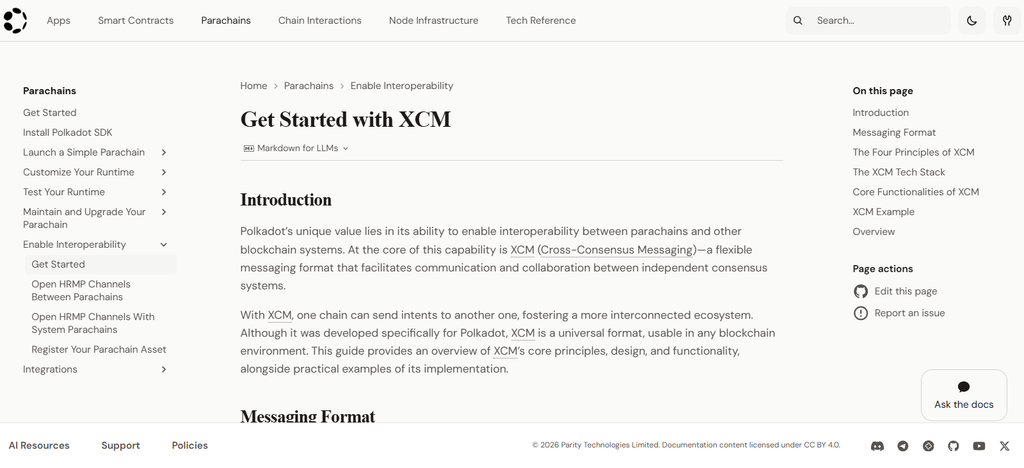
In fact, XCM is a messaging format, not a bridge protocol in itself; delivery is handled by Polkadot’s interoperability infrastructure. Polkadot, the relay chain, parachains and connected systems through bridges are where it has the strongest coverage. Shared validator security of Polkadot secures native parachain communication.
XCM enables developers to transfer assets, make remote calls, governance, and complex workflows, including Solidity access via an XCM precompile. Fees depend on source and destination chains. Tools like Chopsticks make it possible to test and debug XCM messages .
| Category | Details |
|---|---|
| Core Feature | Standardized messaging format for communication between Polkadot ecosystem networks |
| Messaging | XCM communicates instructions, assets, calls, and other cross-consensus operations |
| Chain Coverage | Primarily Polkadot, its parachains, relay-chain environment, and connected systems |
| Security Model | Native parachain communication benefits from Polkadot’s shared security architecture |
| Smart Contract Support | Supports cross-chain application logic and can be accessed by smart contracts through appropriate interfaces |
| Token Transfers | Supports cross-chain asset transfers and complex asset operations |
| Performance | Benefits from native ecosystem integration, although execution depends on participating chains |
| Fees | Fees depend on the source, destination, execution path, and required computational resources |
| Monitoring | Polkadot explorers and ecosystem development tools can track XCM operations |
| Developer Tools | XCM libraries, SDKs, runtime interfaces, testing tools, and development environments |
| Pros | Native ecosystem integration, shared security, powerful messaging model, support for complex instructions |
| Cons | Primarily valuable within the Polkadot ecosystem; XCM concepts can have a steeper learning curve for new developers |
8. Avalanche Warp Messaging (AWM)
Avalanche Warp Messaging was launched with Avalanche’s Avalanche Warp Messaging architecture in 2022 to facilitate native communication between Avalanche L1s and connected Avalanche networks. AWM leverages Avalanche’s validator infrastructure to generate and validate signed messages, enabling one Avalanche network to communicate with another without relying on a conventional centralized messaging provider.
It’s more about the Avalanche ecosystem as opposed to universal multichain connectivity. Avalanche’s messaging primitives allow developers to build cross-chain applications, governance systems, token transfers and smart-contract interactions.
Performance gains from Avalanche’s fast consensus environment, but final execution is still subject to destination-chain conditions. Avalanche tooling also provides developers with visibility into message and validator-related activity. Fees are primarily transaction and destination execution based, rather than a global messaging subscription.
| Category | Details |
|---|---|
| Core Feature | Native communication between Avalanche L1s and Avalanche ecosystem networks |
| Messaging | Enables Avalanche networks to send authenticated messages to one another |
| Chain Coverage | Primarily targets Avalanche L1s and connected Avalanche infrastructure |
| Security Model | Uses Avalanche validator-based message signing and verification |
| Smart Contract Support | Enables smart contracts to create and consume cross-chain messages |
| Token Transfers | Can support cross-chain asset and application workflows when combined with appropriate Avalanche infrastructure |
| Performance | Benefits from Avalanche’s consensus and fast-finality environment |
| Fees | Costs mainly come from transactions and execution on the participating Avalanche networks |
| Monitoring | Avalanche explorers and network tooling can be used to inspect transactions and cross-chain activity |
| Developer Tools | Avalanche SDKs, Warp messaging components, smart-contract interfaces, and development tools |
| Pros | Native Avalanche integration, validator-backed authentication, fast ecosystem communication |
| Cons | More ecosystem-specific than general-purpose interoperability protocols; broader cross-chain use requires additional infrastructure |
9. Interchain Token Service (ITS)
Interchain Token Service (ITS) is an interoperability-oriented token infrastructure associated with Axelar that allows tokens to operate across connected blockchain networks while maintaining coordinated supply and cross-chain functionality.
It is meant for developers and token issuers who want a programmable multichain token deployment and not a manual build of separate bridge contracts. Coverage depends on the chains supported by the underlying interoperability infrastructure. Security inherits the relevant Axelar gateway and validator architecture.
Smart-contract integrations can support token transfers and cross-chain token operations. Performance is a function of source confirmation, validator consensus, relaying and destination execution. The fees are paid in cross-chain gas and execution fee. Axelar tooling and transaction tracking allows developers to track token-transfer operations and cross-chain execution status.
| Category | Details |
|---|---|
| Core Feature | Infrastructure for deploying and managing tokens across multiple connected blockchains |
| Messaging | Uses Axelar interoperability infrastructure for cross-chain token-related communication |
| Chain Coverage | Depends on chains supported by the underlying Axelar ecosystem |
| Security Model | Uses Axelar’s gateway, validator, and cross-chain verification infrastructure |
| Smart Contract Support | Designed for smart-contract-based token deployment, transfers, and interchain applications |
| Token Transfers | Core purpose is creating and managing interoperable tokens across supported chains |
| Performance | Depends on Axelar consensus, source confirmation, routing, and destination execution |
| Fees | Cross-chain operations require applicable network, gas, and interoperability costs |
| Monitoring | Axelar transaction infrastructure and explorer tools can track interchain token operations |
| Developer Tools | Interchain Token Service contracts, Axelar SDK/API, token deployment infrastructure, and developer documentation |
| Pros | Useful for multichain token issuers, programmable token infrastructure, and interchain dApps |
| Cons | More specialized than general messaging protocols; token architecture and cross-chain configuration require careful implementation |
10. Native Token Transfers (NTT)
Native Token Transfers, or NTT is Wormhole’s framework for transferring a project’s own native token across multiple chains without a traditional wrapped representation. NTT became a major Wormhole token-transfer framework in the 2020s and supports configurable burn-and-mint or hub-and-spoke style deployment models.
Security leverages NTT Managers, Transceivers, attestations, rate limits and configurable control of access. Developers keep ownership of their token contracts, and can customize metadata, upgrades and token policies.
The fees depend on the source and destination networks and the performance depends on the message verification and destination execution. NTT is particularly well-suited for stablecoins, governance tokens, DeFi assets, and multichain native-token deployments, as it is monitored via transfer events and Wormhole tooling.
| Category | Details |
|---|---|
| Core Feature | Moves a project’s native token across chains without requiring conventional wrapped-token representations |
| Messaging | Uses Wormhole’s cross-chain messaging infrastructure to coordinate transfers |
| Chain Coverage | Supports chains available through the Wormhole NTT ecosystem |
| Security Model | Uses Wormhole messaging and Guardian-signed attestations, with NTT Managers and Transceivers handling transfers |
| Smart Contract Support | Uses token contracts, NTT Managers, and Transceivers to manage cross-chain operations |
| Token Transfers | Supports native-token movement through mint/burn or lock/unlock-style configurations |
| Performance | Depends on source-chain finality, Guardian verification, message delivery, and destination execution |
| Fees | Costs vary according to source and destination blockchain gas and Wormhole-related execution |
| Monitoring | Wormhole tooling and transfer information can be used to follow NTT transactions |
| Developer Tools | NTT SDK/tooling, Manager contracts, Transceivers, deployment configurations, and Wormhole messaging infrastructure |
| Pros | Preserves native token ownership and design, configurable controls, avoids conventional wrapped-token UX |
| Cons | Requires careful supply and deployment management; cross-chain configuration can be technically complex |
Conclusion
In 2026, blockchain interoperability protocols are becoming essential infrastructure for developers building applications across multiple networks. Chainlink CCIP, LayerZero, Wormhole, Axelar, Hyperlane, Cosmos IBC, Polkadot XCM, Avalanche Warp Messaging, Interchain Token Service and Native Token Transfers approach cross-chain messaging, token transfers, security and smart-contract communication differently.
The right choice will depend on supported chains, security architecture, performance, fees, developer tooling and monitoring capabilities. Developers should consider these factors along with their application requirements rather than choosing a protocol solely based on chain coverage or popularity.
FAQ
What is a blockchain interoperability protocol?
A blockchain interoperability protocol enables different blockchain networks to communicate, exchange data, transfer tokens, or trigger smart-contract actions without requiring users or applications to remain on a single chain.
Which blockchain interoperability protocol is best for developers?
There is no single best option for every project. Chainlink CCIP, LayerZero, Wormhole, Axelar, Hyperlane, Cosmos IBC, and Polkadot XCM differ in chain coverage, security architecture, messaging capabilities, fees, and developer tooling.
What is the difference between interoperability and a blockchain bridge?
Interoperability is the broader concept of enabling blockchain communication. A bridge is typically designed to move assets between networks, while modern interoperability protocols can also transmit arbitrary messages and execute cross-chain smart-contract functions.
Which interoperability protocols support cross-chain messaging?
Several major protocols support cross-chain messaging, including Chainlink CCIP, LayerZero, Wormhole, Axelar, Hyperlane, Cosmos IBC, and Polkadot XCM. Their messaging architectures and security models differ significantly.