


In this article, I will talk about the Best Modular Blockchain Infrastructure Providers for Web3 developers & blockchain teams. We will compare top platforms by architecture, data availability, settlement, interoperability, customization, developer experience, scalability, pricing and security.
This guide will assist you to understand the strengths of each provider and find the right modular infrastructure to build scalable, flexible and application-specific blockchain networks.
What Are Modular Blockchain Infrastructure Providers?
Modular Blockchain Architecture Providers are platforms that assist developers in building blockchain networks by splitting up core functions such as execution, consensus, data availability, settlement, sequencing and security into specialized components.
Instead of having to manage all blockchain functionality in one system, developers are able to choose and combine different infrastructure layers according to their needs. These providers can support rollups, layer-2s, appchains, and specific application blockchains.
It provides more customization, scalability, and efficiency, and allows development teams to optimize specific components, instead of building the entire blockchain stack from scratch.
What Makes a Modular Infrastructure Provider Different?
Unlike traditional blockchain infrastructure, a modular infrastructure provider allows developers to pick and choose specific components and stitch them together, rather than relying on one fully integrated network.
Some of the key differences include architecture flexibility, execution environments, data availability options, settlement choices, sequencing, security models, interoperability, customization and developer tooling. Some providers specialize in a single layer, like data availability or shared sequencing, and some provide more general rollup or appchain infrastructure.
This modular approach allows teams to optimize a blockchain for specific requirements like scalability, transaction costs, performance, security, application design and ecosystem connectivity.
Key Points
| Modular Blockchain Infrastructure Provider | Key Point |
|---|---|
| Celestia | Modular data availability and consensus layer |
| EigenLayer | Ethereum restaking infrastructure for modular services |
| Avail | Unified data availability, security, and interoperability layer |
| Dymension | RollApp infrastructure for modular blockchains |
| Eclipse | Modular Layer 2 combining Ethereum and Solana technologies |
| Fuel | Modular execution layer with parallel transaction processing |
| Espresso Systems | Shared sequencing infrastructure for rollups |
| AltLayer | Rollup-as-a-Service for modular blockchain deployment |
| Movement Labs | Modular Move-based blockchain infrastructure |
| Saga | Dedicated appchain infrastructure built on modular architecture |
1. Celestia
Celestia is a modular blockchain that focuses mostly on data availability over execution and launched on mainnet in 2023. Founded in 2019, Celestia It has an architecture that separates consensus and DA from execution and settlement, using Data Availability Sampling and Namespaced Merkle Trees.
Pricing is blob/data usage and network fees. APIs and tooling give rollup teams a strong developer experience. Customization is achieved by letting developers pick their own execution and settlement layers. Interoperability supports multiple rollup architectures, Settlement remains external. Its major strength is scalable specialized DA infrastructure.
Celestia Features
- Data Availability Sampling (DAS): This enables nodes to verify data availability without downloading the entire dataset.
- Modular Architecture: Separates availability of data and consensus from execution and settlement.
- Namespaced Merkle Trees: Enables rollups to retrieve and prove their own transaction data in an efficient manner.
- Rollup-Friendly Infrastructure: Infrastructure for developers building rollups and application-specific chains.
- Scalable DA Layer: Intended to scale data throughput with network capacity.
| Pros | Cons |
|---|---|
| Strong data availability sampling and scalable DA architecture | Requires reliance on a separate DA network and validator ecosystem |
| Highly suitable for rollups and modular chains | DA finality can be slower than some competing approaches |
| Flexible execution and settlement choices | Developers must manage additional infrastructure dependencies |
| Supports lightweight verification through sampling | TIA-based network economics add another ecosystem dependency |
| Large modular ecosystem and broad rollup integrations | Not designed to provide native application execution or settlement |
2. EigenLayer
An Ethereum-based restaking protocol, EigenLayer, was launched in 2023 and allows developers to build actively validated services like data availability infrastructure through EigenDA.
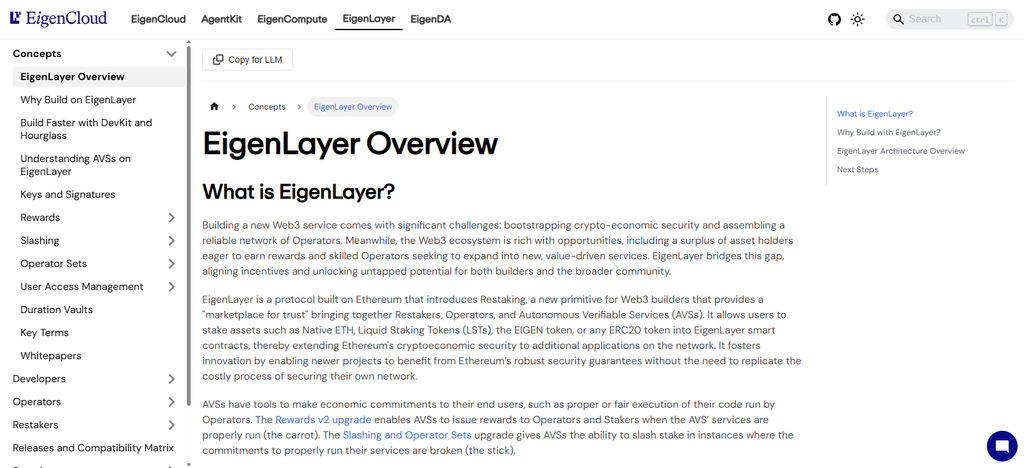
It is not an execution chain in the traditional sense but rather leverages Ethereum-restaked economic security. The price is set based on operator economics and service requirements. Developer Experience is about integrating AVSs and Ethereum infrastructure.
Customization enables services to define their own validation requirements. Security Ethereum security. Settlement Ethereum settlement. Interoperability Ethereum connectivity helps. EigenDA is a dedicated provider of high-throughput DA for rollups and modular blockchain applications.
EigenLayer features
- Ethereum Restaking: Economically collateralizes other blockchain services with restaked ETH.
- Actively Validated Services: lets developers build services secured by decentralized operators.
EigenDA: Specialized data availability infrastructure for rollups and apps. - Shared Security: Enables the economic security of Ethereum to be leveraged by multiple services.
- Modular Service Model: Developers are able to build specialized infrastructure without building an entirely new security network.
| Pros | Cons |
|---|---|
| Leverages Ethereum-based restaking for economic security | Adds complexity through restaking and AVS dependencies |
| EigenDA provides high-throughput DA infrastructure | Security assumptions differ from Ethereum’s native DA |
| Useful for Ethereum-centric rollup infrastructure | Operator and service configuration can be technically complex |
| Enables shared security for multiple services | Ecosystem participants must understand restaking-related risks |
| Supports modular infrastructure development | Ethereum dependency can introduce settlement and finality constraints |
3. Avail
Avail is a specialized blockchain infrastructure project for data availability of rollups and modular chains, founded in 2020. Its architecture decouples DA from execution and uses erasure coding, polynomial commitments and Data Availability Sampling. Pricing is largely based on the amount of data sent to the network.
Developer Experience aims to attract rollup developers with integration tools and APIs. Customization is achieved by giving projects the choice of their own execution and settlement environments. ** Interoperability** is meant for multiple rollups ecosystems and Settlement can be kept external. Avail is best suited for projects that require dedicated, scalable DA infrastructure.
Avail Features
- Erasure Coding: Helps to recover unavailable pieces of the blockchain data.
- Data Availability Layer: Supplies the required infrastructure to publish and validate blockchain data.
- Data Availability Sampling: Allows light clients to check data availability efficiently.
- Rollup Support: Designed to provide scalable DA infrastructure for rollups and application-specific chains.
- Modular Architecture: Decouples DA from execution and settlement layers.
| Pros | Cons |
|---|---|
| Purpose-built data availability infrastructure | Primarily focused on DA rather than complete blockchain execution |
| Uses KZG commitments and data availability sampling | Requires integration with external execution and settlement layers |
| Fast data availability confirmation design | Adds another infrastructure dependency to a modular stack |
| Suitable for rollups and application-specific chains | Economic security differs from Ethereum-native solutions |
| Supports flexible modular blockchain architectures | Developers may need additional tooling for complete deployment |
4. Dimension
Dymension is a platform for application-specific rollups called RollApps, and its mainnet ecosystem was launched in 2024. Its architecture is flexible — a settlement layer combined with modular RollApps and configurable execution environments.
Pricing is based on network and deployment requirements, not a one-time infrastructure fee. Developer Experience – tooling for RollApp to make chain deployment easier. Customization involves application specific execution, tokens and economic parameters.
Interoperability is improved by the larger IBC ecosystem. Settlement is done via Dymension’s settlement infrastructure, and DA Options can be modular based on the deployment architecture, making it suitable for application specific chains.
Dymension Features
- RollApps: Developers are able to create rollup-based blockchain environments for their applications.
- Modular Architecture: Decouples application execution from the settlement and other functions of the blockchain.
IBC Interoperability: Connects applications to compatible ecosystems using Inter-Blockchain Communication. - Customizable Networks: Provides projects with the ability to customize parameters of the blockchain for application requirements.
- Simplified Deployment: Provides infrastructure to ease the deployment of application-specific chains.
| Pros | Cons |
|---|---|
| RollApps simplify application-specific blockchain deployment | RollApp architecture adds another layer of ecosystem dependency |
| Strong focus on modular blockchain development | Less suitable for teams wanting a completely independent stack |
| IBC provides connectivity across compatible chains | Developers need to understand Dymension-specific infrastructure |
| Supports customizable application environments | Costs can vary depending on network architecture and usage |
| Designed for scalable application-specific networks | Ecosystem maturity should be evaluated for long-term deployments |
5. Eclipse
Eclipse is a modular Ethereum-settled Layer 2 launching on mainnet in 2025 that uses the Solana Virtual Machine for execution. Its architecture separates execution, settlement and data availability. This allows Eclipse to combine SVM performance with Ethereum settlement. Pricing is not a simple infrastructure subscription but follows the economics of L2 transactions.
Dev Experience helps Solana compatible tooling, but is tied to Ethereum. Customization SVM-based application development. Interoperability between Ethereum and Solana based ecosystems. Settlement is Ethereum and DA is provided by Celestia. This architecture allows developers to have the Solana style execution with the Ethereum style settlement.
Eclipse Features
- Solana Virtual Machine: The engine to execute transactions using SVM tech for high performance.
- Ethereum Settlement: Uses Ethereum as the settlement layer in its Layer 2 architecture.
- Celestia DA: Celestia for scalable data availability.
- Ethereum Compatibility: Bridges SVM-based execution with the Ethereum ecosystem.
- High-Performance Execution: Built for applications requiring fast and parallelized transaction processing.
| Pros | Cons |
|---|---|
| Combines Solana Virtual Machine execution with Ethereum settlement | Architecture depends on multiple external infrastructure layers |
| High-performance execution is suitable for demanding applications | SVM development can require specialized ecosystem knowledge |
| Celestia provides scalable data availability | Cross-ecosystem integration can increase technical complexity |
| Connects Solana-style execution with Ethereum infrastructure | Developers must understand both SVM and Ethereum environments |
| Attractive for high-throughput applications | The modular design introduces more infrastructure dependencies |
6. Fuel
Fuel is a modular execution infrastructure project, built around parallel transaction execution and its FuelVM, founded in 2019. The architecture separates execution from the other blockchain functions, so that a dedicated infrastructure can handle different layers.
The economics of network transactions determines the pricing, and the deployment cost depends on the application architecture. Developer Experience is built on top of the Fuel toolchain, SDKs, and Sway programming language.
A strong emphasis is placed on customization, especially for application-specific execution. Interoperability connects Fuel apps to the wider blockchain ecosystem. The modular stack can offer Settlement and DA, allowing developers room for maneuver when constructing scalable applications and rollup-style networks.
Fuel Features
- FuelVM: Delivers a specialized virtual machine designed for running blockchains.
Parallel Execution: Supports parallel transaction processing to enhance execution performance. - Sway Language: Provides a programming language designed for building Fuel applications.
- UTXO-Based Architecture: Adopts a transaction model for scalable and efficient execution.
Modular Design: Offers a decoupled execution environment from other blockchain components, promoting flexible infrastructure configurations.
| Pros | Cons |
|---|---|
| FuelVM is designed specifically for efficient blockchain execution | Smaller developer ecosystem than major EVM environments |
| Supports parallel transaction execution | Developers may need to learn Sway and Fuel-specific tooling |
| Provides a specialized execution layer for modular applications | Compatibility with existing Ethereum tooling can require adaptation |
| Strong customization for application-specific execution | Additional infrastructure may be required for a complete stack |
| Designed for scalable blockchain applications | Ecosystem adoption should be considered before large deployments |
7. Espresso Systems
Espresso Systems (founded in 2022) is building modular infrastructure for shared sequencing and fast finality for rollups. The architecture separates the sequencing of transactions from the execution of individual rollups, allowing multiple chains to share infrastructure.
Pricing is driven by network-service and sequencing requirements, not a developer subscription. Developer Experience Focuses on compatibility with existing rollup stacks and modular blockchain frameworks. Customization allows rollups to keep their execution environments but outsource sequencing.
Interoperability is a key feature as common sequencing can order transactions across the rollups involved. Settlement is still configurable, while DA Options can be selected separately through the larger modular stack.
Espresso Systems Features
- Shared Sequencing: Offers a standard system for sequencing that can be shared by multiple rollups.
- Fast Finality: Built to offer fast transaction finality among participating networks.
- Rollup Integration: Can integrate with various rollup frameworks without replacing their execution environments.
- Cross-Rollup Coordination: Helps coordinate transactions and state between connected rollups.
- Modular Infrastructure: Decouples sequencing from execution, settlement and data availability.
| Pros | Cons |
|---|---|
| Shared sequencing can reduce fragmentation between rollups | Shared sequencing introduces an additional infrastructure dependency |
| Provides fast confirmations for connected chains | Integration can be technically complex for existing networks |
| Designed to work with multiple rollup architectures | Benefits depend on ecosystem and participating-chain adoption |
| Can work alongside external DA providers | Developers must coordinate sequencing with other modular components |
| Improves cross-rollup coordination and interoperability | Operational requirements can increase for complex deployments |
8. AltLayer
AltLayer, which launched in 2022, offers a modular infrastructure for Rollups-as-a-Service and Restaked Rollups. Its architecture combines existing roll-up stacks with three modular services: VITAL for verification, MACH for fast finality and SQUAD for decentralized sequencing.
The price depends on your deployment and infrastructure requirements. Developer Experience is a big focus, with tooling to make rollup creation easy. Customization includes EVM, WASM and multiple roll-up frameworks.
Interoperability supports multiple rollup ecosystems. Settlement is able to use external networks, and DA Options are Celestia, EigenDA and Avail . This makes AltLayer particularly useful for teams wanting configurable rollup infrastructure without building all components themselves.
AltLayer Features
- Rollups-as-a-Service: Simplifies deployment of custom rollups for Web3 apps.
- Restaked Rollups: Improve rollup security and verification with restaking-based infrastructure.
- MACH: Fast finality service for rollup applications.
SQUAD: Enables decentralized ordering for rollups.
VITAL: Offers verification services of the correctness of the rollup state.
| Pros | Cons |
|---|---|
| Supports Rollups-as-a-Service and simplified deployment | Multiple configuration choices can increase architectural complexity |
| Works with several rollup stacks and DA layers | Infrastructure costs depend heavily on deployment requirements |
| Restaked Rollups can add crypto-economic security | Restaking introduces additional security assumptions |
| Supports ephemeral and persistent rollup models | Advanced configurations may require experienced blockchain teams |
| Strong flexibility across the modular stack | Choosing between available components can require careful evaluation |
9. Movement Lab
Movement Labs is a developer of modular blockchain infrastructure built on the Move programming language and Move-based execution. It was founded in 2022. Its architecture is designed to bring Move execution to Ethereum-connected environments while decoupling execution from other infrastructure components.
Pricing will depend on network and deployment configuration. Move tooling, SDKs, and compatibility with the Ethereum ecosystem improve developer experience. Customization includes programmable blockchain environments and application-specific execution.
Interoperability is bridging Move applications to Ethereum and other ecosystems. Settlement is able to utilize Ethereum-based infrastructure, DA Options are reliant on the modular architecture selected. This is especially relevant for developers looking for Move-based application infrastructure.
Movement Lab Features
- Move Execution: Employs the Move programming language and execution engine for blockchain applications.
- Modular Architecture: Separates execution from other infrastructure components, increasing flexibility.
- Ethereum Integration: Built to bridge Move applications with the Ethereum-centric ecosystems.
- Parallel Execution: Offers methods to enhance the performance of transaction processing.
- Customizable Infrastructure: Developers are able to build customized environments for their applications with configurable blockchain capabilities
| Pros | Cons |
|---|---|
| Move-based architecture provides an alternative to traditional EVM execution | Move has a smaller developer pool than Solidity/EVM |
| Strong focus on secure programmable execution | Developers may need to learn Move-specific tooling |
| Designed to connect Move applications with Ethereum ecosystems | Cross-ecosystem integration can add technical complexity |
| Supports customizable blockchain infrastructure | Deployment architecture can be more complex than using a standard L2 |
| Suitable for applications seeking Move-based execution | Long-term ecosystem maturity should be evaluated |
10. Saga
Founded in 2022, Saga is a modular blockchain infrastructure platform that aims to launch application specific chains called Chainlets. Its architecture allows applications to deploy dedicated execution environments, while benefiting from Saga’s wider security and interoperability framework.

Pricing is on a per-network deployment and per-infrastructure usage basis, not a single standard software subscription. Developer Experience is about making it easier to create chains and deploy them to applications.
Customisation includes dedicated environments, application economics and configurable blockchain parameters. Interoperability is a big focus, thanks to Saga’s multi-chain ecosystem. Settlement and security can be managed via Saga’s infrastructure, while DA Options are dependent on the architecture chosen. This makes Saga suitable for gaming and high throughput applications.
Saga Features
- Automated Deployment: Makes it easy to create and manage dedicated chains.
Interoperability: Built to connect Chainlets into a larger multi-chain ecosystem. - Infrastructure for Specific Applications: Dedicated environments for applications needing custom blockchain resources.
- Gaming Focus: Supports high-throughput use cases such as gaming and applications that require dedicated blockchain infrastructure.
| Pros | Cons |
|---|---|
| Chainlets provide dedicated application-specific blockchain environments | Dedicated chains can introduce additional operational requirements |
| Strong focus on application-specific deployment | Developers must manage more infrastructure than a standard dApp |
| Useful for gaming and high-throughput applications | Ecosystem dependency can affect long-term flexibility |
| Provides a multi-chain-oriented architecture | Interoperability requirements can add technical complexity |
| Enables greater control over application-specific blockchain resources | Total costs depend on deployment, usage, and infrastructure configuration |
Conclusion
Modular blockchain infrastructure is a key component of scalable and application-specific Web3 networks in 2026. This list of providers spans different parts of the modular stack, from data availability with Celestia and Avail to shared security and sequencing with EigenLayer and Espresso Systems.
Dymension, Eclipse, Fuel, AltLayer, Movement Labs, and Saga provide flexible solutions for application-specific execution and chain deployment. The right option depends on your needs for architecture, customization, pricing, developer experience, interoperability, settlement and DA options. By considering these factors against each other, developers are able to select the infrastructure that best meets their performance, security and long-term ecosystem objectives.
FAQ
What is modular blockchain infrastructure?
Modular blockchain infrastructure separates core blockchain functions such as execution, data availability, settlement, consensus, and sequencing into specialized components. This allows developers to build more scalable and customizable networks.
Which is the best modular blockchain infrastructure provider in 2026?
There is no single best provider for every project. Celestia and Avail are strong for data availability, EigenLayer for restaked infrastructure, while AltLayer, Dymension, Fuel, Eclipse, Movement Labs, and Saga target different modular deployment requirements.
What is data availability in modular blockchains?
Data availability ensures that transaction data required to verify blockchain activity is published and accessible. Specialized DA networks allow execution layers and rollups to outsource this function instead of handling it independently.
Why do developers use modular blockchain infrastructure?
Developers use modular infrastructure to reduce development complexity, improve scalability, customize individual blockchain components, and select specialized solutions for execution, DA, settlement, sequencing, or security.