


This article will consider The Best Tokenized Asset Platforms for Financial Institutions. These include Securitize, INX Digital, Tokeny, tZERO, Polymath, Bitfinex Securities, Swarm Markets, RealT, Ondo Finance, and Figure Markets.
Partnered with these companies, banks, funds, and enterprises can radically alter the way they engage with capital raising, offering tokenization of securities across equities, debt, real property and alternatives with compliance, efficiency and interjurisdiction, fulfilling unmet institutional demands and real challenges posed by the law.
Why Choose Tokenized Asset Platforms for Financial Institutions
Faster Asset Settlement: Tokenized infrastructure offers the flexibility to support settlement on an asset-by-asset basis, thus enabling near real-time settlement.
Lower Operational Complexity: Digital shared record keeping and accounting ledgers across legal entities and/or financial services providers greatly reduce operational complexity.
Programmable Financial Assets: Smart contracts oc societal contract, financial services providers can offer automated services for interest payments, collateral transfers, redemptions, and other asset-related services.
Stronger Compliance Integration: Institutional platforms can embed investor eligibility, transfer restrictions, know your customer (KYC), and other compliance requirements in workflows.
Improved Collateral Management: Tokenized securities can improve collateral liquidity and capital efficiency.
24/7 Market Infrastructure: Instead of initiating transactions based on the operational hours of market infrastructures, tokenized assets provide the flexibility to support asset issuance, transfer, and settlement continuously and on a continuous basis.
Better Transparency and Auditability: Shared ledgers and a record of ownership and transactions can increase the efficiency of monitoring and auditing.
Benefits Of Tokenized Asset Platforms for Financial Institutions
Increased Liquidity
Tokenized assets allow for fractional ownership. This means securities, land, and bonds can be traded on secondary markets. Since tokenized assets are more liquid, it also tends to make the underlying assets more liquid.
Compliance
Institutions that use Securitize’s and INX Digital’s solutions will not have an issue with compliance, since KYC/AML and securities regulations will be integrated directly into the smart contracts.
Market Accessibility
Tokenized asset platforms allow for cross-border market accessibility that traditional banking formats do not. Because of this, banks and funds are able to gain access to international markets and diversify their holdings.
Streamlined Operations
Because of processes like smart contracts, blockchain technology allows for a reduction in back office functions. With this technology, some compliance functions will be automated.
Expanded Market Access
Because of tokenized assets, banks and other financial institutions can access tokenized forms of virtually all financial and physical assets (as well as nontraditional assets).
Key Points
| Platform | Core Focus | Key Features | Best For |
|---|---|---|---|
| Securitize | Tokenized private equity & funds | SEC‑registered, fractional shares, KYC/AML | Institutional investors & PE funds |
| INX Digital | Security tokens & equities | Regulated trading, compliance‑first | Banks & broker‑dealers |
| Tokeny | Institutional tokenization | ERC‑3643 compliance, investor onboarding | European financial institutions |
| tZERO | Digital securities exchange | ATS licensed, secondary liquidity | Hedge funds & brokerages |
| Polymath | Security token standards | ST20 protocol, compliance automation | Asset managers |
| Bitfinex Securities | Tokenized bonds & equities | Regulated in Kazakhstan & El Salvador | Global institutions |
| Swarm Markets | DeFi + securities | BaFin‑regulated, tokenized stocks & bonds | EU‑based institutions |
| RealT | Tokenized real estate | Fractional property ownership, US compliance | Real estate funds |
| Ondo Finance | Tokenized treasuries & bonds | Institutional yield products | Asset managers & banks |
| Figure Markets | Blockchain lending & securities | Provenance blockchain, tokenized loans | Credit institutions |
1. Securitize
Securitize has asserted itself as the leading platform for digitalizing private equity and debt securities. There is growing institutional interest in blockchain solutions as private equity and venture capital markets become more active. Tokenized securities have the fastest growing market and are expected to have billions of dollars in total issuance.
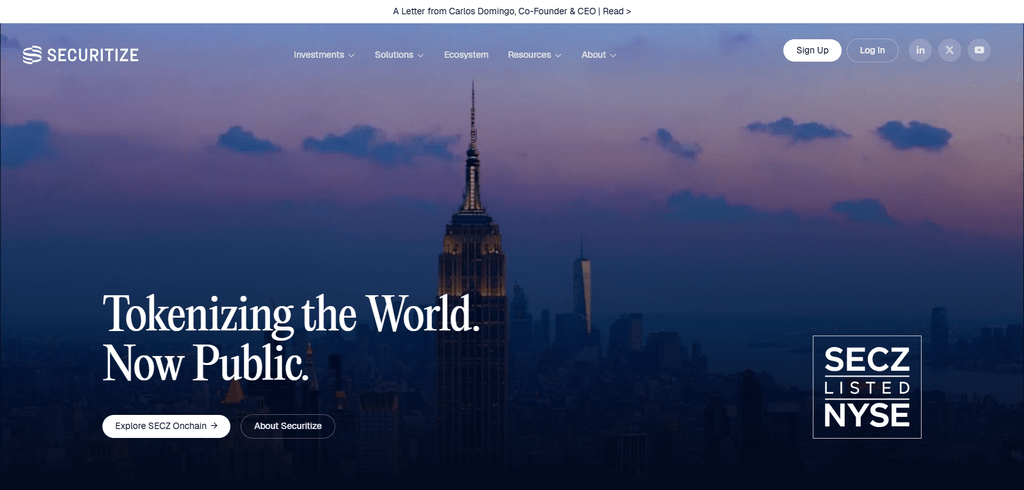
While Securitize has benefitted from regulatory approvals, there are difficulties in expanding liquidity and educating investors. Private equity shares, private equity funds, and private debt all fall within the private securities market.
Institutional clients want to use Securitize to optimize their businesses and make their operations more visible. However, there are barriers to adoption due to fragmented regulations. Securitize is working to build a connection between asset markets and blockchain.
Securitize Attributes
- Compliance Infrastructure: The Firm offers SEC-compliant frameworks for tokenized securities.
- Institutional Demand: Strong adoption amongst private equity and venture capital firms.
- Market Growth: Increasing volume of private securities tokenized.
- Challenges: Fragmented and shifting regulations, scalability of liquidity.
- Asset Classes: Equity, debt, private funds.
| Benefits | Drawbacks |
|---|---|
| SEC‑registered and compliant infrastructure | Liquidity scaling remains limited |
| Strong institutional adoption in private equity | Regulatory fragmentation across regions |
| Efficient digital issuance of securities | Investor education still needed |
| Expanding market growth in tokenized assets | Secondary market depth is shallow |
| Bridges traditional finance with blockchain | Adoption hurdles in retail segments |
2. INX Digital
INX Digital offers a compliant trading platform for digital assets and securities targeting institutions. INX offers cross-border markets and helps facilitate the growing volume of tokenized equity and debt. INX’s customer outreach and secures partnerships with corporations to help facilitate security token offerings.
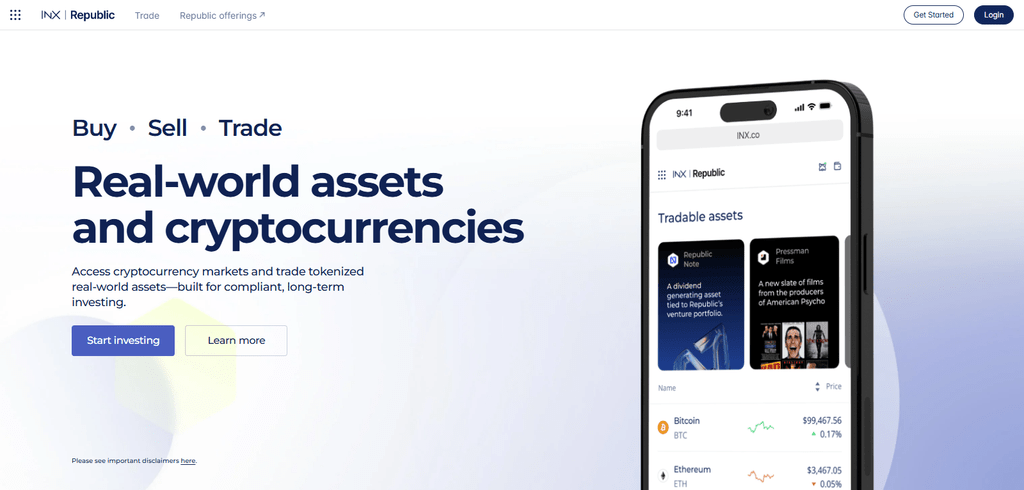
Lack of liquid markets, coupled with complexity across multiple jurisdictions, remains a challenge. INX Digital has a unique opportunity to offer liquid markets for a range of traditional finance assets (equities, debt, and hybrids) via Regulated Securities exchanges to Institutions across the globe interested in diversification. The rapid adoption of tokenized financial assets cements INX’s market leading position of delivering regulated exchanges for digital assets.
INX Digital Attributes
- Regulated Exchange: Licensed digital securities trading platform for crypto.
- Institutional Demand: Corporate clients issuing security tokens through INX.
- Market Growth: Increasing issuance of tokenized equity and debt.
- Challenges: Complexity of competing regulatory frameworks.
- Asset Classes: Equities, debt, hybrids.
| Benefits | Drawbacks |
|---|---|
| Licensed exchange for securities and crypto | Complex jurisdictional regulations |
| Enables cross‑border participation | Liquidity challenges in secondary markets |
| Institutional partnerships for token issuance | Limited retail investor engagement |
| Growing tokenized equity and debt market | Compliance costs are high |
| Transparent and regulated environment | Market adoption slower than crypto trading |
3. Tokeny
Tokeny is a service provider for tokenization of securities. Their infrastructure allows for the tokenization of equity, debt, and funds (even ones regulated) within smart contracts. Market data and growth show Tokeny’s platforms serving Europe and Asia first.
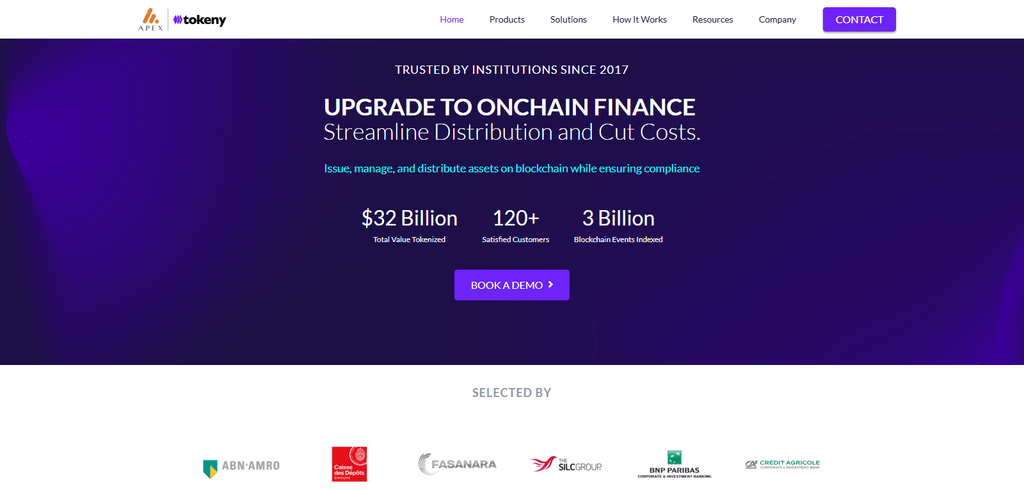
Institutional interest is building as the asset management industry explores blockchain. Barriers currently are blockchain interoperability and regulation fragmentation. Tokeny supports private equity and real estate funds, as well as their own platform.
Institutional clients have a preference for Tokeny’s approach due to the regulatory risk. Within the current market, the main barrier is the absence of market liquidity, but Tokeny’s focus on technology has made them a leading player in the tokenized capital markets.
Tokeny Attributes
- Tokenization Infrastructure: Smart contract compliance built in tokenization.
- Institutional Demand: Asset managers using tokenization to improve workflow.
- Market Growth: Tokenization in Europe and Asia.
- Challenges: Incomplete blockchain connectivity and fragmented regulations.
- Asset Classes: Private equity, real estate, and funds.
| Benefits | Drawbacks |
|---|---|
| Smart contract compliance automation | Interoperability issues across blockchains |
| Strong adoption in Europe and Asia | Fragmented regulatory landscape |
| Supports multiple asset classes | Liquidity remains constrained |
| Appeals to institutional asset managers | Investor onboarding challenges |
| Infrastructure backbone for tokenization | Limited awareness outside institutional circles |
4. tZERO
tZERO is the first market for qualified participants to trade digital securities in a regulated capacity. tZERO offers liquidity in the secondary market for security tokens as new security tokens are issued and as new firms look to digitize raise capital through blockchain technology.
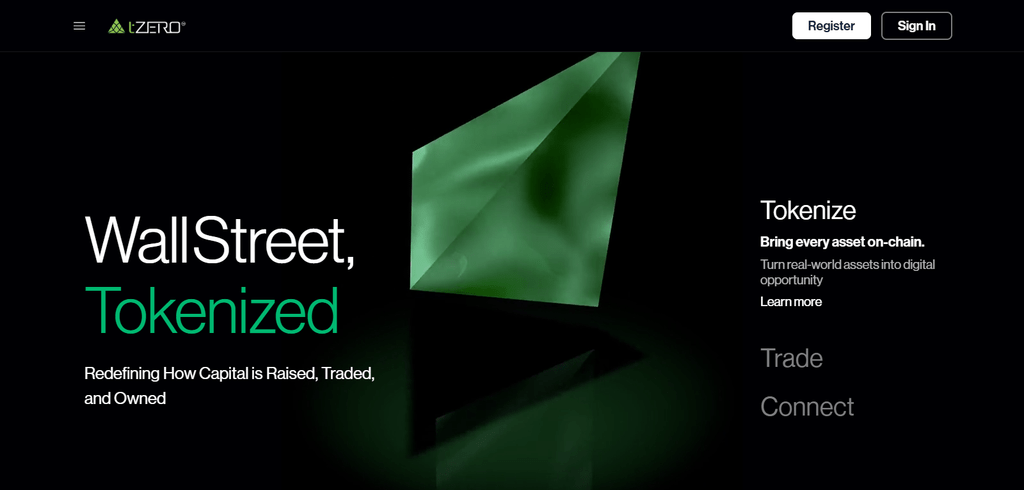
Participation in security token offerings is still the purview of institutional investors and large firms while retail participation is still developing. Securities available include equity, debt, and alternative investments.
With respect to traditional financial markets and blockchain technology, tZERO has developed infrastructure for securities. However, bringing liquidity to the market remains a challenge. The increasing institutional interest in the security token space is reflected in the growth of tZERO, a market pioneer for regulated trading of digital assets.
tZERO Attributes
- Digital Marketplace: Regulated trading of tokenized securities.
- Institutional Demand: Firms utilizing blockchain for capital raises.
- Market Growth: Increasing tokenized equity and debt issuances.
- Challenges: illiquid and low participation of retail investors.
- Asset Classes: Equities, debt, alternative asset classes.
| Benefits | Drawbacks |
|---|---|
| Regulated marketplace for digital securities | Limited retail participation |
| Provides secondary market liquidity | Liquidity scaling remains difficult |
| Strong institutional interest | Regulatory harmonization is slow |
| Expanding tokenized equity and debt issuance | Market penetration still modest |
| Bridges traditional and blockchain finance | Adoption hurdles persist |
5. Polymath
Polymath creates blockchain technology that aids in the issuance of compliance oriented security tokens for the institutional market. Private equity and real estate markets have seen the highest levels of growth for tokenized securities. Institutional demand is indicated by partnerships with token allocating broker-dealers.
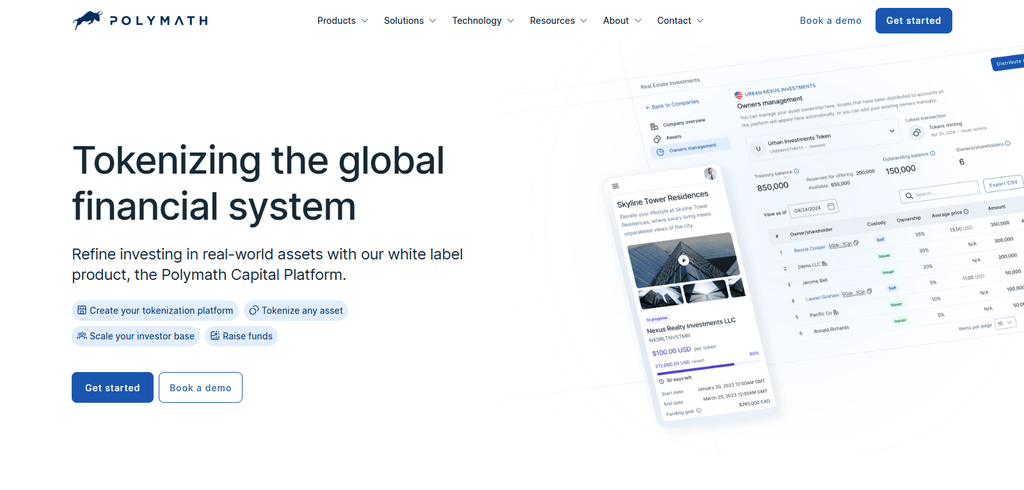
Limited investor understanding is one of the biggest constraints, along with the presence of ambiguous regulations. Securities backed by equity, bonds, and funds are all supported. Polymath’s emphasis on compliance means that a user base of institutions is likely. Even though liquidity is scarce,Polymath is likely to grow as capital markets transform. Polymath is in prime position as an essential security token infrastructure provider.
Polymath Attributes
- Security Token Framework: Compliant blockchain standards for issuance.
- Institutional Demand: Partnerships for blockchain-based fundraising.
- Market Growth: Private equity, real estate.
- Challenges: Volatile regulation, lack of investor Porter.
- Asset Classes: Equity, debt, fund.
| Benefits | Drawbacks |
|---|---|
| Blockchain standards for security tokens | Regulatory uncertainty persists |
| Partnerships with issuers for fundraising | Investor education gaps |
| Expanding private equity and real estate tokenization | Liquidity remains constrained |
| Compliance‑focused framework | Adoption slower than expected |
| Foundational infrastructure for tokenized markets | Limited secondary trading venues |
6. Bitfinex Securities
Bitfinex Securities has a regulated trading venue for tokenized securities meant for institutional investors looking to diversify. Tokenized debt and equity are showing signs of growing market activity. Institutional demand is growing in Asia and the Middle East. There are some growing pains from regulatory arbitrage and a lack of liquidity in secondary markets. Bonds and equities, and even alternative instruments, can be tradeable assets.
Bitfinex Securities is attempting to create a regulated trading venue for tokenized securities because of the markets it has already built, even though it knows there are adoption problems. Bitfinex Securities is a reflection of the increasing interest institutional investors have in tokenized capital markets.
Bitfinex Securities Attributes
- Regulated Venue: Tokenized securities trading focused on institutions.
- Demand: Growing interest in Asia and the Middle East.
- Market: Growth in the issuance of tokenized debt and equity.
- Issues: Regulatory fragmentation and weak liquidity.
- Assets: Equity and bonds and other instruments.
| Benefits | Drawbacks |
|---|---|
| Regulated venue for tokenized securities | Regulatory fragmentation challenges |
| Strong institutional demand in Asia/Middle East | Shallow secondary market liquidity |
| Supports equities, bonds, alternatives | Limited global adoption |
| Leverages crypto exchange expertise | Compliance costs remain high |
| Expanding issuance of tokenized debt/equity | Market growth slower than crypto assets |
7. Swarm Markets
Swarm Markets builds regulated DeFi infrastructure for tokenized, complaint trading of securities with Institutions. Growth data from the DeFi market suggests that DeFi is merging with traditional finance. Swarm is one of the first to build in this space.
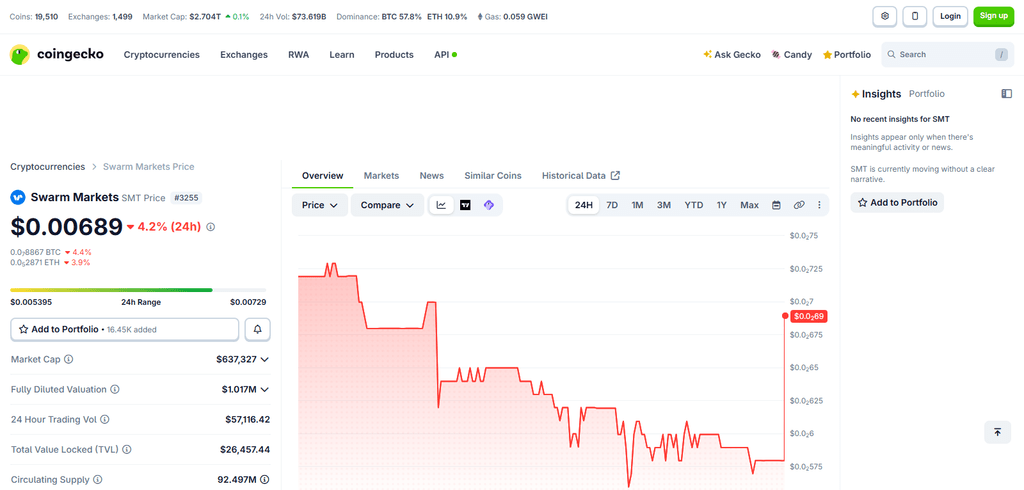
Decentralized infrastructure is gaining significant interest among traditional firms. Swarm is solving problems of regulatory clarity and liquidity.
Among the first of its kind, Swarm Markets is well positioned to attract institutions seeking to innovate within the compliance overlap between DeFi and traditional finance. While DeFi and TradFi are starting to merge, there are still a lot of roadblocks when it comes to user adoption.
Swarm Markets Attributes
- Regulated DeFi: Decentralized market making with compliance.
- Demand: Institutional interest in decentralized markets.
- Market: Integrating DeFi with traditional finance.
- Issues: Regulatory issues and liquidity.
- Assets: Equity, debt or loans, and alternative assets.
| Benefits | Drawbacks |
|---|---|
| First regulated DeFi exchange | Regulatory clarity still evolving |
| Combines DeFi with compliance | Liquidity scaling challenges |
| Appeals to institutions seeking innovation | Adoption hurdles remain significant |
| Supports multiple asset classes | Market education required |
| Pioneering convergence of DeFi and TradFi | Limited mainstream participation |
8. RealT
RealT specializes in tokenized real estate. Investors can buy part of a property. Data on market growth shows that real estate tokenization is projected to grow exponentially, with billions of dollars traded. The emerging demand comes from funds that buy fractionalized assets. There are risks associated with the rapid growth of this market.
These risks include unclear regulation and the complexities of managing a property. RealT has primarily residential and commercial real estate. RealT’s model further democratizes the ability to invest in real estate because it is accessible to both retail and institutional investors. The model emphasizes the growth of the tokenized asset market. RealT has growing pains of managing liquidity.
RealT Attributes
- Real Estate: Tokenized real estate for fractional ownership.
- Demand: Funds with an interest in fractionalized real estate.
- Market: Rapid growth in tokenization of property.
- Issues: Regulatory issues and real estate management.
- Assets: Real estate.
| Benefits | Drawbacks |
|---|---|
| Fractional ownership of real estate | Regulatory uncertainty in property tokenization |
| Democratizes access to real estate | Property management complexities |
| Expanding tokenized property markets | Liquidity remains limited |
| Appeals to retail and institutional investors | Secondary trading venues are few |
| Strong growth in residential/commercial assets | Adoption hurdles in traditional real estate |
9. Ondo Finance
Ondo Finance leverages blockchain technology in order to create tokenized fixed-income products. Data show there is strong market interest in tokenized treasuries and bonds. Institutional demand comes from yield hungry funds looking to use blockchain technology. Issues such as regulatory framework and liquidity are currently being tackled.
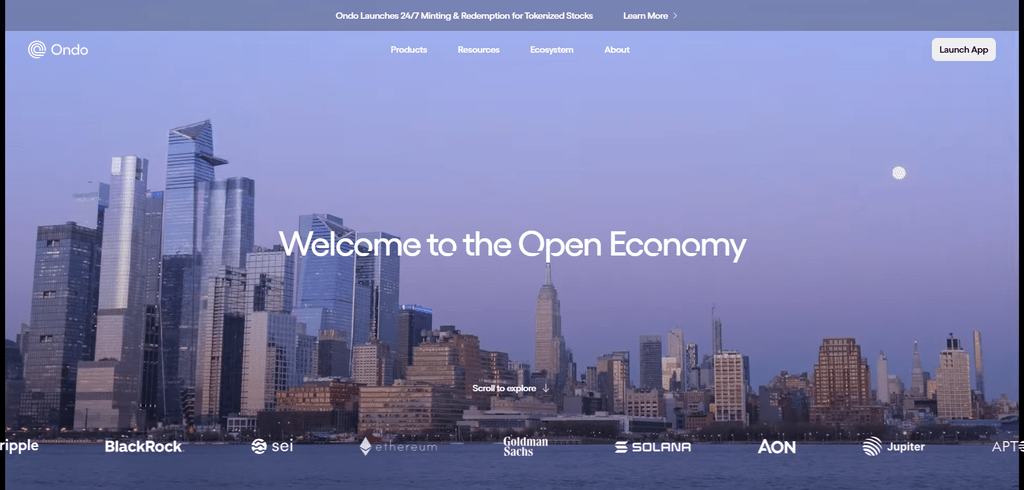
Treasuries, bonds, and structured products are among the asset classes Ondo is focused on. Ondo’s focus on institutional fixed income products gives it the edge in this sector. Its focus on fixed income products reflects increasing institutional interest in blockchain technology against the backdrop of the current regulations in the market.
Ondo Finance Attributes
- Bonds: Focused on fixed income and commodities.
- Demand: High interest from yield funds.
- Market: Growing demand for tokenized fixed income.
- Issues: Regulatory and liquidity concerns.
- Assets: Treasury notes and bonds and structured finance.
| Benefits | Drawbacks |
|---|---|
| Focused on tokenized fixed income | Regulatory clarity still needed |
| Strong institutional demand for yield | Liquidity scaling challenges |
| Supports treasuries, bonds, structured products | Market adoption slower than equities |
| Bridges traditional finance with blockchain | Compliance costs remain high |
| Expanding demand for tokenized fixed income | Limited retail participation |
10. Figure Markets
Figures Markets tokenizes loans, equity, and alternative assets on the blockchain with an emphasis on institutional clients. Growth data shows a large interest in tokenized lending and equity. Institutional demand is also apparent in the partnerships they’ve made with banks and funds. However, scaling secondary markets, among other things, challenges them. Loans, equity and funds are the types of assets they cover.
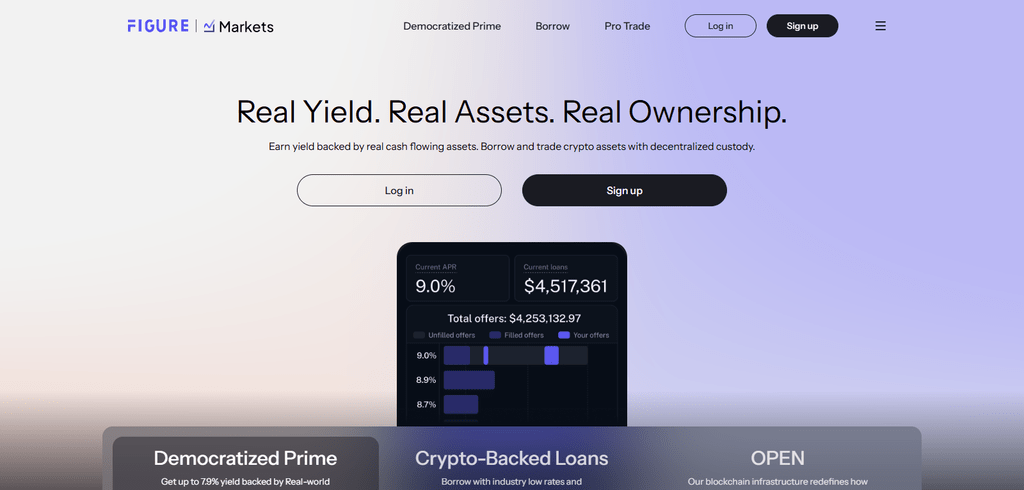
Institutional clients, especially those with a focus on efficiency and transparency, are especially interested in the blockchain technology that Figures has built. They alsoare the first movers in blockchain based lending and capital markets, and have built strong product offerings in this space.
Figure Markets Attributes
- Blockchain Lending: Tokenized loans and equity.
- Demand: Partnerships with banks and funds.
- Market: Rapidly growing tokenized lending and equity.
- Issues: Regulatory and the trading of tokenized securities.
- Assets: Equity, loans, and funds.
| Benefits | Drawbacks |
|---|---|
| Blockchain‑based lending and equity | Regulatory fragmentation challenges |
| Partnerships with banks and funds | Secondary market depth remains shallow |
| Expanding tokenized lending and equity issuance | Adoption hurdles in retail segments |
| Transparency and efficiency in capital markets | Compliance costs are significant |
| Strong institutional adoption | Liquidity scaling remains difficult |
Conclusion
The study of Securitize, INX Digital, Tokeny, and others show us the emergence of blockchain in capital markets is rapidly gaining popularity.
We are seeing strong market data signaling that tokenization is expanding into equities, debt, real estate and fixed income, with billions slated towards transactions. The strong demand from institutions is caused by the efficiency, transparency, and compliance that tokenization provides, although fragmented regulations and liquidity issues hamper wide-spread adoption. Each of the platforms has their own niche in the different areas of private equity or fixed income or DeFi and real estate.
The data shows that the main concerns are regulatory difficulties, depth of liquid securities markets, and education of potential investors. Even with these concerns, it is clear that tokenization of securities is becoming the standard and not the exception. These platforms are designing a new financial network that is more efficient and more compliant by integrating all markets around the world as they continue to mature.
FAQ
What does Securitize do?
It tokenizes private securities with SEC‑registered compliance.
Who uses it?
Private equity firms, venture capital, and institutional investors.
What asset classes are supported?
Equity, debt, and private funds.
What’s the main benefit?
Regulatory approval and strong institutional trust.
What’s the challenge?
Liquidity scaling and fragmented regulations.