


This article describes the leading AI-Managed Liquid Restaking & AVS Node Operators reshaping blockchain infrastructures in 2026. To help users assess platforms, we will review restaking support, AVS compatibility, security, pricing, automation, node reliability and scalability, for each of the leading platforms. This review will help users better comprehend each platform’s strengths, weaknesses, and the best decentralized staking infrastructure and architecture for which they would be best employed.
What Are AI-Managed Liquid Restaking & AVS Node Operators?
AI-Managed Liquid Restaking & AVS Node Operators integrate liquid restaking and automated or AI-enabled node operations. Liquid restaking dynamically enables users to continue staking to boost the security of the network while allowing users to retain the opportunity of earning rewards from said staking. AVS operators run the infrastructure for validating specialized SaaS Networks.
By automating and employing AI to manage nodes, operators are afforded node health monitoring, anomaly detection, resource optimization, prediction of future failures, and workload management, among other features. Not all automated node operators are truly AI-managed.
Thus, users are advised to evaluate the restaking and AVS support offered, as well as security, reliability, transparency, automation, slashing protection, decentralization, and fees before delegating their assets.
Why AI-Managed Restaking Matters in 2026
Continuous Validator/AVS Node Monitoring: AI-based systems can monitor nodes in real time and flag suspicious behavior or potential failures before they impact performance.
Predictive Failure Identification: Certain machine learning models have the capability of analyzing various performance and infrastructure related data in order to determine the likelihood of service impact related to performance issues, including downtime or overload issues.
AVS Performance Enhancement: As the number of specialized infrastructures required for different AVS grows, automation may help service providers allocate resources in a way that will enhance performance.
Optimal Resource Use: AI can optimize the network by managing the performance of computing resources in the cloud and enable service providers to offer performance while reducing overhead costs.
Automation of Responses to Events: Automated systems can help reduce the time needed to respond to events on the network and to prioritize issues caused by operational lapses compared to the time needed during monitoring.
Slashing Risk & AI: AI can help reduce the consequences of failed maintenance tasks; however, AI cannot fully remove the risk of slashing and should not be relied upon as a replacement for controls.
Management of Infrastructure Within Multiple AVS: Increasingly, service providers need to manage their resources across different AVSs. Automation can reduce the complexity of management and tracking performance within different services.
Advanced Reward Analysis: Intelligent systems can analyze performance and help service providers determine potential rewards taking into consideration performance, AVS incentives, and operational costs.
Sophisticated Infrastructure: AI can help manage the network when the number of providers and AVSs increases.
24/7 Operational Clarity: Unlike the periodic checking done manually, automated systems provide ongoing clarity and insight related to the operational performance of infrastructure and node health.
Automation and Analytics: Automation and analytics can construct a network of reporting, monitoring, and compliance, all of which can limit the resource demands placed on larger delegators and improve operational efficiencies for staking service providers.
Emerging Infrastructure for Web3: As AI-assisted services expand into decentralized AI and computation, data availability and interoperability, the streamlining of the management of infrastructure and the successful running of advanced computing systems hinges on automated systems.
Key Point
| Operator | Best For | Key Features |
|---|---|---|
| EigenLayer AVS AI Nodes | Institutional staking | AI‑managed validator orchestration, slashing risk reduction |
| Karak AI Node Network | Cross‑chain AVSs | Predictive routing, multi‑asset restaking pools |
| Symbiotic AI Operators | Risk‑averse stakers | ERC‑20 vault safety, AI‑driven liquidity allocation |
| P2P.org AI Restaking | Institutional validators | AI monitoring, slashing insurance, enterprise dashboards |
| Figment AI AVS Nodes | Enterprise adoption | AI‑powered node ops, compliance‑ready infrastructure |
| Everstake AI Restaking | Retail + institutional | AI‑managed validator pools, yield optimization |
| Blockdaemon AI AVS Ops | Custodial institutions | AI node orchestration, institutional custody integration |
| Chorus One AI Restaking | Multi‑chain staking | AI‑driven validator ops, cross‑chain AVS routing |
| Allnodes AI AVS | Retail stakers | AI‑managed validator hosting, slashing protection |
| Stakefish AI Restaking | Community validators | AI‑powered node ops, decentralized governance |
1. EigenLayer AVS AI Nodes
EigenLayer AVS AI Nodes is the first to apply AI to restaking, and offers more advanced automation for their validators and a decrease in the risk of slashing. Their system applies machine learning to optimize node uptime, and automate delegation and increases cross-chain liquidity.
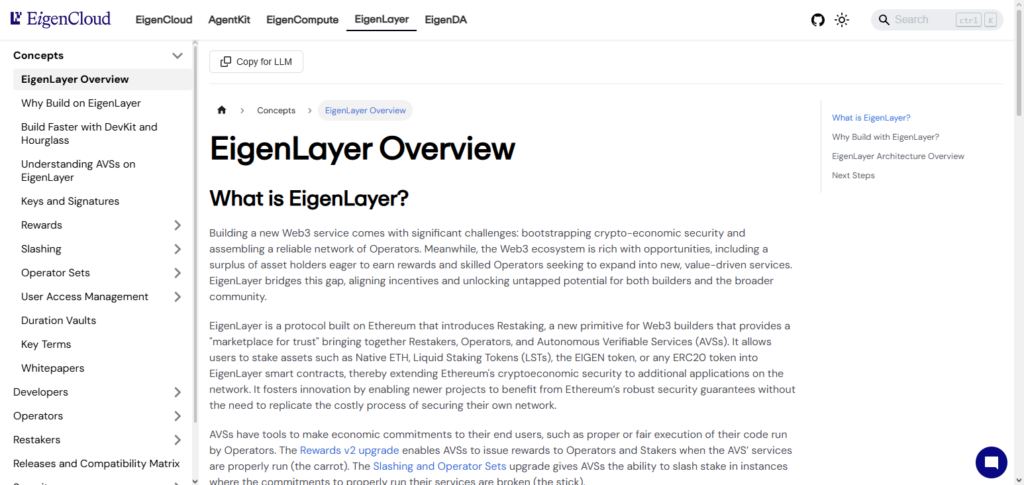
They offer very good pricing and flexible fee structures based on the size of the validator. Security is enhanced in the EigenLayer AVS system by real time detection of threats, and enhanced monitoring. Automation includes predictive failure and a smart failure system, making the EigenLayer AVS system one of the most advanced among all AI managed systems.
EigenLayer AVS AI Nodes Features
- AVS Ecosystem: Connects restakers and node operators to Actively Validated Services.
- Restaking Infrastructure: Facilitates Ethereum restaking and the participation of delegated operators.
- Operator Choice: Operators may choose different AVSs based on their infrastructure.
- Potential for Automation: Can offer tooling for the automated monitoring, deployment, and management of nodes.
- Economic Security: Provides additional cryptoeconomic security for AVSs using restaked assets.
| Pros | Cons |
|---|---|
| Large and growing AVS ecosystem | Complex restaking architecture |
| Strong Ethereum ecosystem integration | Additional slashing risks |
| Supports operator delegation | AVS-specific risks vary |
| Broad infrastructure ecosystem | Not inherently an AI-managed platform |
| Strong developer adoption | Rewards can change over time |
2. Karak AI Node Network
Karak AI Node Network has focused on AI for restaking, and has very good automation with scalability and efficiency in mind. Their pricing is transparent with tiers for large and small capital stakes. Security is strengthened by slash prevention and detection of abnormal activity.

Automation includes balancing and routing systems to oversee liquidity optimally within AVS. Karak’s AI nodes minimize validator activity while increasing restaking efficiency, making them a great choice for cost effective, sustainable restaking for enterprises.
Karak AI Node Network Features
- Flexible Restaking: Offers a framework for flexible restaking of diverse assets and the securing of services.
- DSS Participation: Operators may choose to participate in Distributed Secure Services that have varied operational demands.
- Restaking Diversity: Offers a diverse range of liquid restaking and restaking assets.
- Automation of Operations: Management and monitoring of vaults and infrastructure can be automated.
- Flexible Design: Can support diverse operators, assets, services, and configurations across different networks.
| Pros | Cons |
|---|---|
| Modular restaking architecture | Relatively complex ecosystem |
| Supports multiple asset types | Risk varies by DSS |
| Flexible operator participation | Less mature than established staking markets |
| Supports automated vault workflows | AI capabilities should be independently verified |
| Designed for multiple services | Smart-contract risks remain |
3. Symbiotic AI Operators
Symbiotic AI Operators provide AI automated services for stake delegation with a focus on interoperability and decentralized governance.
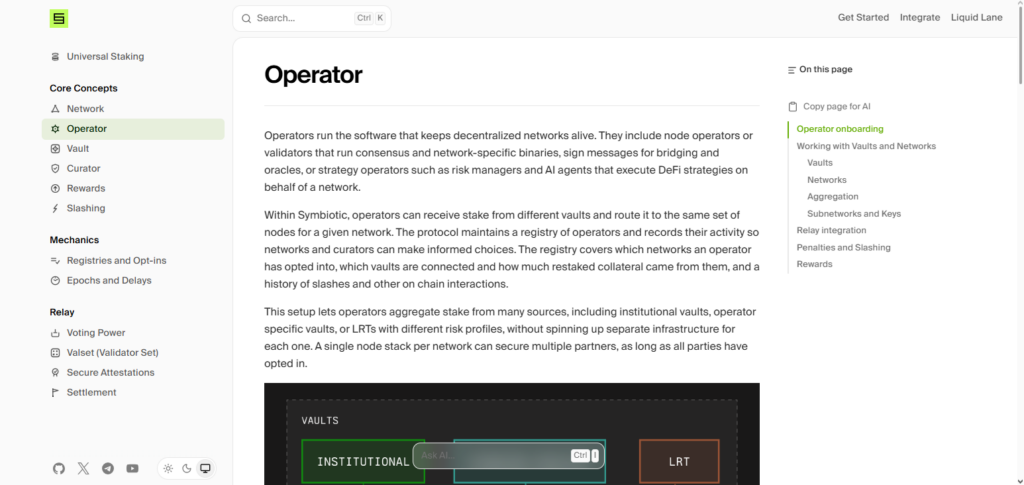
They have very competitive prices which involve performance-based fees charged against validator rewards. Security is guaranteed through AI-driven monitoring and automated compliance checks along with advanced watchdog systems designed to defend against slashing attacks. Automation extends to flexible strategies for delegating stake and optimization of liquidity across multiple AVS networks.
Symbiotic AI Operators strike a great balance between efficiency and decentralization, making their services very suitable for users focused on both earning yield and governing in a restaking environment.
Symbiotic AI Operators Features
- Flexible Design: Supports diverse operator and vault configurations for restaking.
- AI Agent Inclusion: The design of its operator structures incorporates AI agents as a potential operator type.
- Open Participation: Supports networks that operators can join by registering.
- Vault-Driven Delegation: Vaults determine the collateral and delegation ties between restakers and operators.
- Cross-Network Capability: Operators can support several networks with the same infrastructure.
| Pros | Cons |
|---|---|
| Highly modular architecture | Can be difficult for beginners |
| Supports flexible operator configurations | Network-specific risks |
| Explicitly accommodates AI agents | AI functionality depends on individual operators |
| Permissionless operator participation | Emerging ecosystem |
| Flexible vault and delegation model | Reward structures can vary |
4. P2P.org AI Restaking
P2P.org AI Restaking uses advanced AI to build a reliable infrastructure for the management of validator nodes. Like Symbiotic AI Operators, they have performance-based pricing with optional value-added services for institutions.
Security is improved with predictive AI-based systems to prevent slashing attacks and with automated fallback systems. Automation extends to smart systems for flexible delegation of stake and optimization of liquidity across AVS networks. P2P.org is a trusted service provider to both large institutions as well as small retail stakers for their AI-restaking services.
P2P.org AI Restaking Features
- Restaking Automation API: Offers an API to automate EigenLayer restaking.
- Professional Staking Infrastructure: Caters to the demands of professional and institutional staking.
- Automated Operations: Eases the processes of setting up a node, creating an EigenPod, and selecting and delegating operators.
- Non-Custodial Model: Grants users full control and custody of their assets and keys.
- Scalable Infrastructure: Merges staking infrastructure and automated operations tools.
| Pros | Cons |
|---|---|
| Restaking API supports automation | API-focused rather than AI-native |
| Strong institutional orientation | Pricing may depend on arrangement |
| Professional validator infrastructure | Restaking risks remain |
| Supports EigenLayer workflows | Some advanced features may require technical integration |
| Non-custodial infrastructure approach | Availability depends on supported networks/services |
5. Figment AI AVS Nodes
Figment AI AVS Nodes combines enterprise-grade stake delegation services with AI-driven automation for delegated stake management. Their pricing model is very straightforward and involves subscription-based payments for servicing delegators.
Security is enhanced through AI-based monitoring and slashing prevention. Automation extends to optimization of delegated stake management and liquidity. Figment’s AI-driven nodes are very reliable and easy to integrate and for these reasons they are preferred by large institutions over their competitors for services related to the EigenLayer AVS framework.
Figment AI AVS Nodes Features
- Professional Node Infrastructure: Has built large-scale validation infrastructure for professional users.
- EigenLayer Participation: Allows users to restake and AVS participate within EigenLayer.
- AVS Infrastructure: Operators can deliver infrastructure for services that need extra validation.
- Operational Monitoring: Professional infrastructure enables monitoring and managing the performance of validators.
- Institutional Focus: Created to target institutions that need managed staking and blockchain infrastructure.
| Pros | Cons |
|---|---|
| Institutional-grade infrastructure | Primarily targeted at professional users |
| Professional validator operations | Not inherently an AI-native operator |
| EigenLayer ecosystem participation | Fees may be less attractive for small users |
| Strong infrastructure expertise | AVS coverage can change |
| Enterprise-oriented support | Restaking adds additional risk |
6. Everstake AI Restaking
Everstake AI Restaking uses AI to create validator management systems that are simple and cost efficient. Their pricing means they can target retail customers with their low fee structure.
AI driven monitoring combined with automated slashing prevention and protocols designed for the AVS system mean that customers of Everstake AI Restaking can rest easy knowing their staking is protected. Everstake AI Restaking strives to create accessible validator systems to all customers, no matter the size of the stake. They strive to provide reliable systems for generating yield.
Everstake AI Restaking Features
- Professional Validator Infrastructure: Has built large-scale validator and blockchain node infrastructure.
- EigenLayer Support: Permits participation in Ethereum restaking with provided assets and configurations.
- Liquid Restaking Compatibility: Allows participation in selective liquid staking and restaking ecosystems.
- Node Monitoring: Maintains validator performance and uptime through infrastructure monitoring.
- Automated Management: Operational tools can ease the burden of validators and infrastructure guardianship.
| Pros | Cons |
|---|---|
| Established validator infrastructure | AI management is not the core offering |
| Supports Ethereum restaking | Fees depend on the service |
| Large-scale operational experience | AVS support can vary |
| Professional monitoring capabilities | Restaking introduces slashing exposure |
| Broad blockchain infrastructure expertise | May be more suitable for experienced users |
7. Blockdaemon AI AVS Ops
Blockdaemon AI AVS Ops uses advanced AI to offer automated, top of the line, restaking services to its customers. With their enterprise pricing and premium support, they target larger clients. AS with many restaking services, securing the system involves automated compliance and AI driven monitoring and systems designed to minimize the risk of slashing.
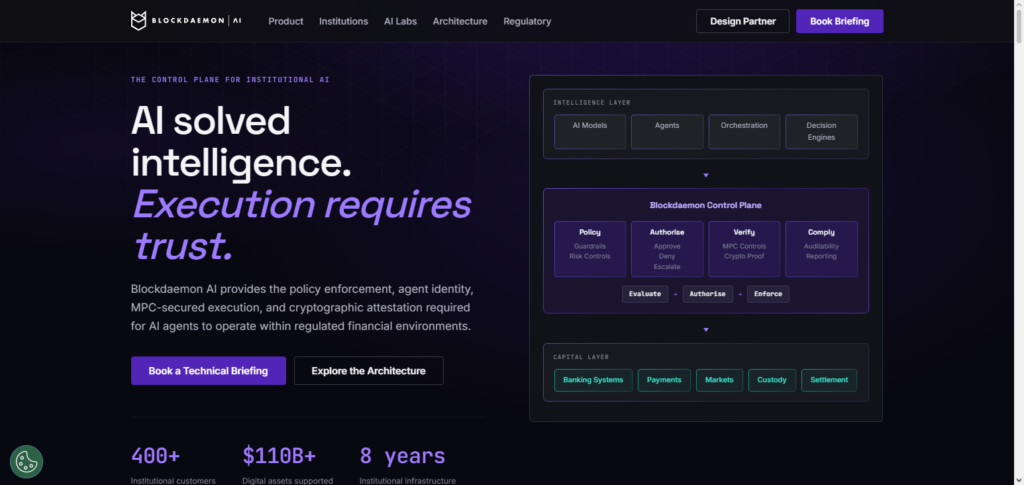
Systems designed for predictive optimization of validator performance and dynamic scaling as well as routing of liquidity are available. Blockdaemon AI AVS Ops, a trusted service for restaking in multiple AVS systems, provides restaking services with high availability and yield consistency.
Blockdaemon AI AVS Ops Features
- Institutional Restaking: Offers infrastructure specifically tailored for professional and institutional users.
- EigenLayer & Symbiotic: Allows participation across key restaking ecosystems.
- Simplified Restaking: Provides easy steps for delegating and controlling restaked positions.
- Infrastructure Automation: Emphasizes efficient operations through automated management and infrastructure monitoring.
- Enterprise Security: Concentrates on advanced security for institutional use, resilient infrastructure, and operational limitations.
| Pros | Cons |
|---|---|
| Strong institutional infrastructure | Primarily enterprise-focused |
| Supports major restaking ecosystems | Pricing may be less transparent publicly |
| Professional security controls | Not necessarily AI-managed |
| Scalable infrastructure | Complex for individual users |
| Strong operational tooling | AVS-specific risks remain |
8. Chorus One AI Restaking
Chorus One AI Restaking incorporates AI into validator management to simplify the process and maximize efficiency. Their unique performance based pricing means customers pay for validator services when rewards are generated.

Security systems are designed with AI driven monitoring and automated systems designed to prevent slashing. Like other restaking services, systems are designed to delegate and optimize liquidity as well as predictively scale validators. Because of their community driven, transparent and governance focused services, customers find Chorus One an ideal restaking service.
Chorus One AI Restaking Features
- Professional Staking Infrastructure: Provides enterprise-grade validator and blockchain infrastructure.
- Restaking Participation: Joins new restaking ecosystems and operator cohorts.
- AVS Infrastructure: Able to provide services requiring professional node operations.
- Monitoring & Reliability: Concerned with making certain validators are online and with managing and building resilient infrastructure.
- Automation Support: Uses technology and tools of the trade to automate control of nodes and lessen the work required to maintain them.
| Pros | Cons |
|---|---|
| Professional validator infrastructure | AI capabilities should not be assumed |
| Experience with institutional staking | Primarily suited to professional users |
| Participation in restaking ecosystems | Operator fees can vary |
| Strong infrastructure operations | AVS availability may change |
| Focus on reliability and security | Restaking adds additional technical risk |
9. Allnodes AI AVS
Affordability and automation are the pillars of Allnodes AI AVS’s AI-based validator management system. Their pricing is built on flat-rate offerings designed to support retail stakers. They use AI-based security features alongside automated slashing protection and AVS compliance.
Their AI AVS automation includes systems for smart delegation, liquidity optimization, and predictive failover systems. Of particular interest is their progressive service to make validator restaking easier for common stakers. They are one of the engineering companies in the ecosystem that structure their designs to be the most accessible and user-centered.
Allnodes AI AVS Features
- Node Infrastructure: Offers managed services for blockchain nodes and validator infrastructure.
- Restaking Ecosystem: Joins new restaking and operator ecosystems.
- Automated Node Management: Offers the ability to automate the deployment and management of blockchain infrastructure.
- Monitoring Tools: Provides capabilities to monitor the health and availability of nodes and the operation of the system.
- Multi-Network Support: Provides infrastructure services to multiple blockchain ecosystems and services.
| Pros | Cons |
|---|---|
| Managed node infrastructure | Not specifically an AI-native AVS operator |
| Broad blockchain infrastructure experience | AVS participation may vary |
| Automated node-management capabilities | Different services have different fee structures |
| Monitoring and operational tooling | Restaking risks remain |
| Accessible infrastructure model | Advanced AVS operations may require technical knowledge |
10. Stakefish AI Restaking
Stakefish AI Restaking integrates AI to help users manage participants in validation, prioritizing yield and decentralization. Different user groups have distinct pricing structures to choose from, along with various levels of flexibility. AI is also used to improve security with built-in AI monitoring, automated defenses against slashing, and AVS protocol compliance.

Automation includes adaptive delegation, liquidity balancing, and predictive validator scaling. Users of the Stakefish AI Decentralization solution trust the service all around the world. This is mainly due to the combination of high levels of security, yields, and decentralization.
Stakefish AI Restaking Features
- Ethereum Staking: Offers professional Ethereum validator infrastructure.
- EigenLayer Restaking: Provides infrastructure for restaking and delegation via EigenLayer.
- AVS Participation: Enables involvement in the currently validated services.
- Validator Reliability: Concerned with the uptime of infrastructure and the professional operations of nodes.
- Operational Automation: Focuses on using automated systems for the management and monitoring of validators to enhance infrastructure.
| Pros | Cons |
|---|---|
| Strong Ethereum staking experience | AI management is not its primary positioning |
| EigenLayer restaking participation | AVS support can change |
| Professional validator infrastructure | Restaking introduces additional slashing risks |
| Focus on validator reliability | Rewards are not guaranteed |
| Established infrastructure operations | May be better suited to experienced users |
Best AI-Managed Liquid Restaking & AVS Node Operators Comparison
| Platform | Restaking Support | AVS Support | AI/Automation | Security | Pricing | Best For |
|---|---|---|---|---|---|---|
| EigenLayer AVS AI Nodes | Ethereum, restaked ETH/LSTs | Extensive AVS ecosystem | Automation-focused | Strong ecosystem security | Varies by AVS/operator | AVS ecosystem participation |
| Karak AI Node Network | Multi-asset restaking | DSS-based services | Automated workflows | Modular security | Varies by service | Flexible restaking |
| Symbiotic AI Operators | Modular restaking | Multiple networks/services | AI-agent compatible | Vault/network-based security | Network-specific | Modular operators |
| P2P.org AI Restaking | EigenLayer | Supported AVSs | API & automation | Institutional infrastructure | Custom/varies | Institutional restaking |
| Figment AI AVS Nodes | Ethereum/EigenLayer | Selected AVSs | Infrastructure automation | Enterprise-grade | Custom/varies | Institutional users |
| Everstake AI Restaking | Ethereum/restaking | Selected AVSs | Monitoring & automation | Professional infrastructure | Varies | Professional staking |
| Blockdaemon AI AVS Ops | EigenLayer & Symbiotic | Supported AVSs | Automated operations | Enterprise security | Custom | Institutions & enterprises |
| Chorus One AI Restaking | Ethereum/restaking | Selected networks | Operational automation | Professional infrastructure | Varies | Institutional staking |
| Allnodes AI AVS | Supported restaking networks | Selected AVSs | Node automation | Managed infrastructure | Service-dependent | Managed node operations |
| Stakefish AI Restaking | Ethereum/EigenLayer | Selected AVSs | Validator automation | Professional infrastructure | Varies | Ethereum restaking |
Conclusion
The Best AI-Managed Liquid Restaking & AVS Node Operators simplify and improve the infrastructure of blockchains. Through EigenLayer and other restaking ecosystems, operators have the ability to build infrastructure for AVSs while delegators have the opportunity to restake their assets to professional operators.
Operator selection requires more than a simple look at expected returns. AVS support,restaking, security architecture, automated uptime, price, and delegation are a few of the many factors an investor should consider.
While automation decreases the burden of operation, it should not be overly trusted and given to AI. For example, P2P.org has automated restaking, and through its API, has documented restaking for operators and simplified the overall process.
The operator market is competitive. While competitive, operators will differentiate themselves based on strong security, AVS support, transparent economics, and better automation. Automation will likely become a staple of the restaking market as AI-managed nodes begin to support areas of blockchain like AI and computation. Users should still perform restaking due diligence as it increases several risks including contract risks, operator risks, liquidity risks, and some level of permanent loss.
FAQ
What are AI-managed liquid restaking and AVS node operators?
AI-managed liquid restaking and AVS node operators combine restaking infrastructure with automation, monitoring, analytics, and potentially AI-assisted operational tools. In an EigenLayer-style architecture, operators run infrastructure and opt into AVSs, while restakers delegate stake to them.
What is liquid restaking?
Liquid restaking allows users to restake assets while retaining a liquid representation that may be used elsewhere in DeFi. It can improve capital efficiency, but users should consider smart-contract, liquidity, operator, and slashing risks before participating.
What is an AVS?
An Actively Validated Service (AVS) is a service secured by restaked assets and supported by operators that perform specific validation or computational tasks. AVSs can require different types of off-chain infrastructure depending on their purpose.
How does AI improve AVS node operations?
AI can potentially help with anomaly detection, predictive monitoring, resource optimization, incident prioritization, performance analysis, and automated operational decisions. However, AI-managed, AI-assisted, and ordinary automated infrastructure are different categories and should not be treated as interchangeable.