


I will discuss the best cross-chain AI oracles for on-chain pricing. These allow blockchain applications to retrieve accurate real-world pricing data spanning multiple networks. We will look at the primary differentiators of these AI oracles and their pricing infrastructure, cross-chain support, pros, cons, and ideal use cases. We will also look at how each of these oracles will impact the developers in the Web3 space and the DeFi ecosystem. Following our analysis, we will make our final recommendations.
How To Select Cross-Chain AI Oracles for On-Chain Pricing
Check Cross-Chain Coverage: Consider an oracle that supports all the blockchain networks your app is using or planning to use in the future. Verify if you can securely transfer pricing data to other chains and if each of the required networks has the specific asset feeds you need. Cross-chain delivery architectures may affect security, latency, and the complexity of integration.
Evaluate Price Accuracy: Look at how the oracle sources and aggregates pricing data. Look for providers that utilize multiple reputable data sources or utilize first-party data in a transparent way. It is especially important to have accurate aggregation for lending, liquidation, derivatives, and automated trading because an incorrect price can result in an adverse financial impact.
Prioritize Data Freshness and Latency: Real-time applications require pricing data that is updated frequently enough to meet the risk model. Check heartbeat intervals, frequency of updates, and acceptable stale data time periods. For example, Pyth recommends that developers perform explicit staleness checks since network or data-provider interruptions can result in the use of outdated pricing data.
Compare Push vs. Pull Architecture: Know how prices reach your smart contract. In a push model, data is written to a smart contract periodically. In a pull model, smart contract updates are requested or submitted by a user. A pull model may provide fresher data and may result in reduced update costs, but may also require more integration.
Assess Oracle Security: Security should be one of the most important factors when selecting an oracle. Look at the validator and/or node design, the variety of data sources, cryptographic proofs, and economic incentives and failure handling and how decentralized the system is.
Assess AI Capabilities: Understand if your provider hosts predictive analytics, data AI models consume, AI-assisted validation, and/or AI inference. Understanding these nuances is necessary to avoid using traditional oracles as fully AI-powered systems.
Examine Supported Assets and Feeds: Ensure your provider supports your application’s required cryptocurrencies, stablecoins, tokenized assets, forex pairs, commodities, and other assets. Determine if feeds are available on every targeted chain and if specialized assets have sufficient market coverage.
Evaluate Update Frequency and Gas Costs: With numerous price queries, Oracle economies can affect DeFi apps. Assess feed-update fees, gas costs, subscription costs, API costs, and any additional cross-chain messaging fees. For pull oracles such as Pyth, the consumer has to perform the updates and incur the costs.
Inspect Data Providence: Assess how price data is aggregated and where price data originates. One example is API3, which emphasizes the first-party oracle architecture. API providers deliver first-hand data using the first-party oracle, thus eliminating the need for a traditional third-party oracle.
Define Stale-Price and Failure Protection: Adequate Oracle integration defines the operations to be invoked when prices cease to be updated, blockchain congestion occurs, a data provider is unavailable, or when cross-chain messaging is delayed. It is safer to define explicit freshness thresholds and fallback operations, as opposed to assuming that the most recently stored price is safe.
Key Point
- Chainlink CCIP + AI Feeds: Cross-chain infrastructure combining secure interoperability with reliable data feeds for AI-powered DeFi applications.
- Pyth Network AI Router: Delivers fast, high-frequency market data across multiple blockchains for AI-driven pricing and trading systems.
- Band Protocol AI Oracles: Provides decentralized data feeds that can support AI applications, smart contracts, and cross-chain DeFi protocols.
- API3 Airnode AI: Enables decentralized applications to access first-party API data through Airnode infrastructure and AI-focused integrations.
- DIA (Decentralized Information Asset): Offers customizable, transparent oracle feeds for real-time asset prices and cross-chain applications.
- Tellor AI Oracles: Uses a decentralized reporting network to provide verifiable external data for smart contracts and AI-enabled Web3 applications.
- Witnet AI Oracle: Provides decentralized data verification and cross-chain oracle services for applications requiring tamper-resistant external information.
- SupraOracles AI Bridge: Combines cross-chain interoperability with oracle infrastructure to deliver fast and reliable data across blockchain networks.
- Oraichain AI Oracle: Integrates AI capabilities with decentralized oracle technology to deliver intelligent data validation and Web3 automation.
- Kaiko AI Oracles: Focuses on institutional-grade crypto market data that can support AI-powered analytics, pricing, and blockchain applications.
10 Best Cross-Chain AI Oracles for On-Chain Pricing
1. Chainlink CCIP + AI Feeds
Chainlink CCIP allows data and asset transfers across blockchains using its decentralized oracle infrastructure. CCIP facilitates secure cross-chain communication, and Chainlink Data Feeds provide market data for smart contract consumption.
This with CCIP is especially useful to DeFi apps that require consistency in pricing across multiple networks, such as lending, derivatives, and automated trading.
For developers analyzing the Best Cross-Chain AI Oracles for On-Chain Pricing, Chainlink scores well for its mature oracle infrastructure and broad interoperability. Its strength is more in integrating cross-chain messaging and externally sourced data over a single blockchain.
Chainlink CCIP + AI Feeds Features
| Features | Details |
|---|---|
| Cross-Chain Support | CCIP is designed for secure communication and data transfer between supported blockchain networks. |
| Oracle Infrastructure | Chainlink provides decentralized data feeds that can supply market and asset pricing information to smart contracts. |
| AI Compatibility | Can serve as a reliable data layer for AI agents, automated strategies, and intelligent DeFi applications. |
| Security | Uses Chainlink’s established decentralized oracle infrastructure and risk-management architecture. |
| Best For | Cross-chain DeFi, lending, derivatives, tokenized assets, and AI-powered financial applications. |
Pros
- Robust cross-chain structure.
- Deeply integrated and established oracle ecosystem.
- Appropriate for DeFi and institutional applications.
- Provides trustworthy external data.
- Good infrastructure for AI agent systems.
Cons
- Technically difficult to integrate.
- Costs can differ per network and based on use.
- AI capabilities are integration-focused and not inherently part of the oracle.
- Availability of feeds and networks must be assessed individually.
2. Pyth Network AI Router
In contrast to its peer AI-only oracles, Pyth Network is more a real-time financial data and oracle network. Pyth’s architecture provides a pricing information assembly line, where pricing information from multiple first-party publishers is assembled and delivered to supported blockchains.
Real-time via Pyth’s Router provides a distribution layer for calculating median prices, confidence intervals, as well as bid/ask and other market metrics, with support for multiple blockchains.
For Best Cross-Chain AI Oracles for On-Chain Pricing, Pyth is especially relevant to AI trading agents and DeFi automation, as AI models can manipulate market data at the speed of transaction, while smart contracts get price rebates. This cross-chain infrastructure aims at the wide dissemination of price feeds.
Pyth Network AI Router Features
| Features | Details |
|---|---|
| Real-Time Pricing | Pyth aggregates pricing information from multiple first-party publishers. |
| Cross-Chain Delivery | Pyth prices can be transferred and verified across 100+ blockchains. |
| Publisher Network | Data comes from exchanges, banks, trading firms, and market makers. |
| Update Frequency | Pyth Core supports frequent price updates, including on-demand updates every 400ms. |
| AI Use Cases | Useful as a high-frequency market-data layer for AI trading agents and analytics systems. |
Pros
- Market-data delivery is extremely fast.
- Excellent first-party data model.
- Wide blockchain coverage.
- Supplies prices and confidence levels.
- Excellent for trading and general DeFi use.
Cons
- On-chain price updates inherently have an associated cost. ([Pyth 開發者中心][4])
- Developers have to implement the update mechanisms.
- It is not strictly an AI-focused oracle.
- Feed availability varies by asset and blockchain.
3. Band Protocol AI Oracles
Band Protocol creates blockchain infrastructure to connect smart contracts with external data. This layer is capable of supporting automated asset pricing and FX pricing services for blockchain applications.
While invasive AI integration would require a dedicated description of Band Protocol as an AI Oracle, it should be noted that its oracle stack can provide an important data layer for web3 AI applications.
For developers working on the Best Cross-Chain AI Oracles for On-Chain Pricing and who are looking for decentralized external data delivery and multi-chain support, Band Protocol should be considered.
Web3 developers can easily integrate oracle data with AI models to be employed for market analysis, risk evaluation, trading strategies, and other similar use cases.
Band Protocol AI Oracles Features
| Features | Details |
|---|---|
| Decentralized Data | Connects external information with smart contracts through oracle infrastructure. |
| Price Feeds | Can provide cryptocurrency and other financial data for blockchain applications. |
| Cross-Chain Orientation | Designed for blockchain applications operating across different networks. |
| AI Compatibility | Oracle data can be used as an input for AI-powered DeFi and Web3 applications. |
| Best For | DeFi protocols, smart contracts, data-driven applications, and automated financial systems. |
Pros
- Decentralized method to source external data.
- Adaptable to demands of financial applications built on blockchain.
- Decentralized AI data layer.
- Cross-chain gives better application scope.
Cons
- Not mainly an AI oracle.
- Data availability is dependent on the feed and the network.
- Developers need to evaluate the security of each individual feed.
- Some applications may need a smaller ecosystem.
4. API3 Airnode AI
API3’s Airnode lets first-party API providers connect to blockchain apps instead of having to use a traditional intermediary oracle node, thus, making infrastructure for oracles. Thanks to Airnode, it is possible to send first-party data to Web3, which is useful for apps that require provenance of data.
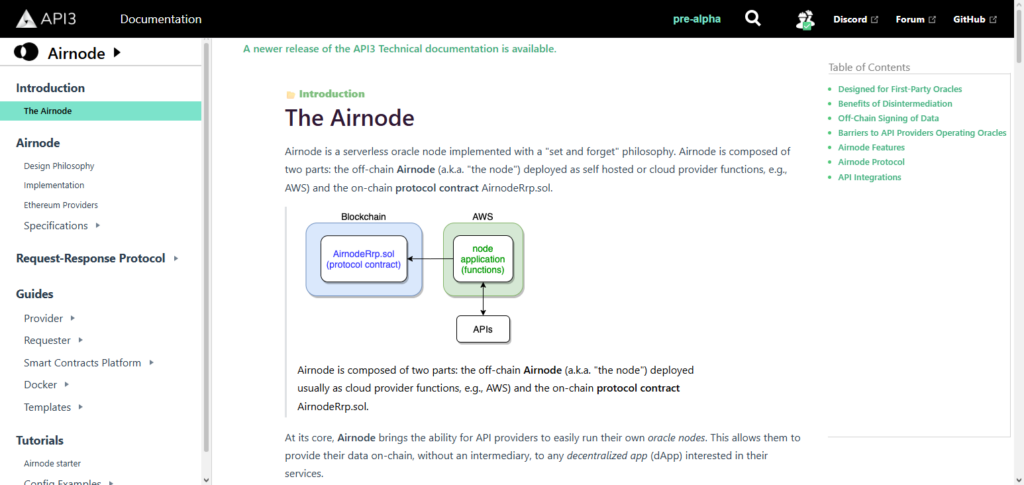
Thus, when AI-powered protocols require first-party API data as market or reference data to generate on-chain decisions, API3 becomes relevant.
Additionally, when smart contracts need to access outside data, API3’s first-party approach helps data providers to preserve more control of their data. Developers can use its architecture for pricing, analytics, automated apps, and various other data-related services built on blockchain.
API3 Airnode AI Features
| Features | Details |
|---|---|
| First-Party Data | API3 focuses on first-party oracle data, where API providers can operate their own oracle infrastructure. |
| Airnode | Airnode connects API providers with blockchain applications without requiring traditional third-party node operators. |
| Data Transparency | Signed API data can provide verifiable information about its source. |
| AI Compatibility | External API data can become an input for AI agents and intelligent smart contracts. |
| Best For | Applications requiring direct API-provider data and customizable Web3 data feeds. |
Pros
- Strong first-party data focus.
- Improved data-source transparency.
- Helpful for specialized API integrations.
- Good for AI and DeFi data-oriented applications.
- Lowers reliance on traditional middle-man oracle service providers.
Cons
- Must have API providers undergo participation.
- Can be technically complex for integration.
- Data integrity is still reliant on the provided API.
- Not inherently an AI model platform.
5. DIA (Decentralized Information Asset)
DIA is a decentralized oracle platform which focuses on offering blockchain applications transparent and customizable data feeds. DIA is relevant when external data are transformed into on-chain usable data and thus, used by AI-powered protocols.
Among the Best Cross-Chain AI Oracles for On-Chain Pricing, DIA can be used as a platform for projects which want configurable data sources instead of being fully dependent on a standardized data feed. AI trading systems,
DeFi applications, and automated strategies can use oracle-delivered data as an input for analysis and decision-making. However, developers should know what feeds are offered and whether the data are supported, as well as, how often feeds are updated and what chains are supported.
DIA (Decentralized Information Asset) Features
| Features | Details |
|---|---|
| Data Feeds | Provides decentralized data infrastructure for blockchain applications. |
| Customizable Data | Can support customized datasets and oracle requirements. |
| Pricing Data | Useful for crypto assets, financial markets, and DeFi pricing applications. |
| Cross-Chain Use | Designed to make data available across multiple blockchain environments. |
| AI Compatibility | Data feeds can support AI-powered analytics, trading, and automated decision systems. |
Pros
- Adaptable data architecture.
- Beneficial for customized oracle solutions.
- Appropriate for DeFi pricing solutions.
- Capable of supporting multiple data types.
- AI could utilize its external data.
Cons
- Feed quality depends on sources.
- Not strictly an AI oracle.
- Developers must assess each data set.
- Specialized feeds may need integration.
6. Tellor AI Oracles
As an open data economy, Tellor consists of a network of economically activated reporters with which consensus around data requests is reached. Instead of viewing Tellor as an AI oracle, more accurately, it should be seen as a flexible infrastructure that helps blockchain applications get external data. For the Best Cross-Chain AI Oracles for On-Chain Pricing,
Tellor can help with AI applications when there is a requirement for reliable market or reference data on chain. Additionally, Tellor’s open reporting model can work with applications that need custom data requests.
Tellor’s economic incentives help reporters maintain reporting accuracy. Developers should evaluate each of these factors for the different use cases: participation of reporters, mechanisms for disputes, data availability, and integration.
Tellor AI Oracles Features
| Features | Details |
|---|---|
| Decentralized Reporting | Tellor uses a decentralized reporting model for bringing external information on-chain. |
| Data Verification | Economic incentives and dispute mechanisms are important parts of its oracle design. |
| Custom Data | Can be useful when applications require specific external data requests. |
| AI Compatibility | Oracle data can be consumed by AI-driven DeFi and Web3 applications. |
| Best For | Decentralized applications requiring flexible external data and verification. |
Pros
- Decentralized reporting model.
- Flexible data-request architecture.
- Good for tailored applications.
- Supports smart contracts that integrate AI.
- Economic incentives promote reporting of data.
Cons
- Data availability relies on reporters.
- Reporting and dispute mechanisms need to be assessed.
- May add extra layers of complexity when integrating.
- Not an AI-centric oracle.
7. Witnet AI Oracle
Witnet is an oracle network that helps decentralized applications retrieve and verify external data for use by smart contracts. Since many applications cannot obtain needed data directly from blockchain networks, Witnet’s architecture is useful.
Like many oracle networks, Witnet is not specific to AI. That said, as a flexible data input layer, Witnet can be used to serve AI-focused DeFi applications and other such automated agents and predictive systems.
In comparison to the Best Cross-Chain AI Oracles for On-Chain Pricing, Witnet’s technology is relevant for developers that need decentralized data retrieval and verification. Some of the applications include: asset and event-based pricing, prediction markets, automated trading and investment systems, and others that require external, trusted data.
Witnet AI Oracle Features
| Features | Details |
|---|---|
| Decentralized Oracle | Witnet retrieves and verifies external information for smart contracts. |
| Data Retrieval | Useful for connecting blockchain applications with off-chain information. |
| Cross-Chain Potential | Supports oracle functionality across blockchain ecosystems. |
| AI Compatibility | Verified external information can be used by AI-powered applications and agents. |
| Use Cases | DeFi pricing, prediction markets, automated contracts, and data-driven applications. |
Pros
- Data retrieval in a decentralized manner.
- Good for external-data verification.
- Enables various use cases across blockchains.
- Can provide data for AI applications.
- Good for tailored data applications.
Cons
- Not an AI-centric oracle.
- Data feed availability requires assessment by the developer.
- Oracle can be complex to set up.
- Varies by application and blockchain.
8. SupraOracles AI Bridge
Supra has adopted a new identity as an infrastructure platform with additional services related to oracles, bridging, automation, and AI. Bundled with low-latency cross-chain data infrastructure and Threshold AI Oracles, Supra’s DORA architecture leverages Byzantine fault tolerance to pull and aggregate price data.
Supra’s DORA makes an interesting contribution in the space of on-chain pricing oracles as its ecosystem integrates oracle, cross-chain, and AI services. This ecosystem complements DeFi, automated trading, prediction markets, and other applications that require real-time external data.
SupraOracles AI Bridge Features
| Features | Details |
|---|---|
| Oracle Infrastructure | Supra provides decentralized data feeds for blockchain applications. |
| Cross-Chain Technology | Its infrastructure combines oracle and interoperability capabilities. |
| AI Integration | Supra has developed AI-oriented oracle infrastructure for bringing AI-generated insights on-chain. |
| Low-Latency Data | Designed for applications requiring timely financial and blockchain data. |
| Best For | DeFi, cross-chain applications, automated trading, and AI-agent infrastructure. |
Pros
- Offers both oracle and cross-chain functions.
- Compared to traditional oracle networks, AI plays a much more integral role across their ecosystem.
- Built for low-latency applications.
- Beneficial for cross-chain DeFi systems.
- Supports use cases focused on automation.
Cons
- A more complex ecosystem can lead to more challenges for integration.
- Developers must determine the level of support for individual networks.
- AI-oracle systems can differ significantly from traditional price-feed systems.
- New integrations should focus on long-term commitments.
9. Oraichain AI Oracle
Oraichain differentiates itself from most oracle networks in that it focuses on building blockchain and AI synergy infrastructure. Machine learning infrastructure enables smart contracts to connect with data and information generated/validated by AI, thereby enabling sophisticated analytics, smart classification, and advanced intelligent web 3 applications.
For Best Cross-Chain AI Oracles for On-Chain Pricing, Oraichain is more relevant for AI intensive applications that use the oracles to compute AI, rather than external data feeds. For production deployment in DeFi, developers must make the distinction between AI inference services and traditional market-price oracle services.
Oraichain AI Oracle Features
| Features | Details |
|---|---|
| AI-Native Focus | Oraichain is specifically focused on combining blockchain infrastructure with artificial intelligence. |
| AI Oracle | Designed to connect AI services and information with decentralized applications. |
| Smart Contracts | Enables blockchain applications to consume AI-related data or services. |
| Automation | Useful for AI-driven decision-making and Web3 automation. |
| Best For | AI-powered dApps, intelligent DeFi, data analytics, and AI-agent ecosystems. |
Pros
- Very strong positioning as an AI-focused service.
- Tailored for the convergence of AI and blockchain.
- Benefits the creation of intelligent dApps.
- Supports AI-centric Web3 offerings.
- Moves beyond a price-only oracle paradigm.
Cons
- Likely not go-to for standard market-price feeds.
- Outputs from AI need proper validation.
- Distinction between AI inferences and market price data must be made.
- Compatibility in the ecosystem must be ensured for each instance.
10. Kaiko AI Oracles
Kaiko is more of an institutional digital asset market-data provider than it is an AI oracle network. Kaiko On-Chain makes some Robust Pair Prices accessible on-chain so that blockchain protocols can integrate institutional-grade pricing.
In addition, Kaiko has other infrastructure such as market data and digital asset indices and fair-value pricing services. In the Best Cross-Chain AI Oracles for On-Chain Pricing category,
Kaiko is an excellent data source for pricing and risk analysis and for use in automated finance by AI agents and other financial applications. Kaiko’s on-chain oracle technology connects smart contracts and decentralized finance (DeFi) with institutional market data.
Kaiko AI Oracles Features
| Features | Details |
|---|---|
| Institutional Market Data | Kaiko specializes in digital-asset market data for institutional and professional applications. |
| On-Chain Pricing | Kaiko provides on-chain pricing infrastructure for blockchain applications. |
| Data Quality | Focuses on market data, pricing, analytics, and reference information. |
| AI Compatibility | High-quality market data can feed AI trading, analytics, risk, and valuation systems. |
| Best For | Institutional DeFi, AI trading systems, financial analytics, and on-chain pricing. |
Pros
- Strong focus on market data for institutional use.
- Valuable for pricing applications.
- Supports AI trading and analytics.
- Offers more extensive market data than basic crypto pricing.
- Well-suited for institutional blockchain applications.
Cons
- Market data provider rather than an AI-centric oracle.
- Features for institutions may be more advanced than basic DeFi feeds.
- Pricing, licensing, and value must be assessed for provisions.
- Coverage and integration are subject to the specific data offering.
Quick Comparison
| Oracle | Main Strength | AI Fit | Cross-Chain Focus | Best For |
|---|---|---|---|---|
| Chainlink CCIP + AI Feeds | Interoperability + oracle infrastructure | High | Excellent | Cross-chain DeFi |
| Pyth Network | Real-time market data | High | Excellent | Trading & DeFi |
| Band Protocol | Decentralized data | Medium | High | Smart contracts |
| API3 Airnode | First-party APIs | High | High | Custom data |
| DIA | Customizable data | High | High | DeFi pricing |
| Tellor | Decentralized reporting | Medium | High | Custom data |
| Witnet | Data verification | Medium | High | Data-dependent dApps |
| Supra | Oracle + interoperability + AI | High | Excellent | AI-powered DeFi |
| Oraichain | AI-native infrastructure | Excellent | High | AI dApps |
| Kaiko | Institutional market data | High | High | Professional pricing |
Conclusion
The Best Cross-Chain AI Oracles for On-Chain Pricing entail many factors including data accuracy, speed of updates, security, cross-chain coverage, transparency, and AI compatibility.
Chainlink is a good option for providing secure cross-chain infrastructure, while Pyth is well-suited to providing low latency market data. API3 is notable for first-party data delivery and Supra offers oracle infrastructure and cross-chain messaging along with AI-oracle research.
When choosing an oracle for AI trading agents, lending protocols, derivatives, or any other type of automated DeFi platform, consideration should be given to the security and latency of the oracle, as well as potential stale price risk.
Before an oracle is deployed, several other considerations should be made including data source diversity, update frequency, how frequently the failure state is addressed, supported chains, and the overall safety of the oracle. Creating a safe and verifiable oracle combined with AI and oracle infrastructure creates a more responsive and data-oriented on-chain application.
FAQ
What are cross-chain AI oracles?
Cross-chain AI oracles connect blockchain applications with external data and, in some cases, AI-generated insights across multiple blockchain networks. They help smart contracts access pricing, market, and analytical information that is not available natively on-chain.
Why are AI oracles important for on-chain pricing?
AI oracles can enhance on-chain pricing by combining external market data with intelligent analysis, anomaly detection, or automated decision-making. This can help DeFi protocols, trading agents, and financial applications respond more efficiently to changing market conditions.
Which is the best cross-chain oracle for real-time pricing?
There is no single best option for every application. Chainlink and Pyth Network are strong choices for applications prioritizing established oracle infrastructure and real-time market data, while API3, DIA, Supra, and others may suit different data and integration requirements.
Are cross-chain AI oracles secure?
Security varies by architecture, data sources, validator or reporter design, and cross-chain mechanism. Developers should evaluate decentralization, data-source diversity, update frequency, dispute mechanisms, and safeguards against manipulated or stale prices.