


In this article, I will discuss the Best Appchain Infrastructure Platforms for Web3. I will cover leading solutions for building application-specific blockchains. We’ll explore their architecture, execution environments, security models, customization, interoperability, performance, developer tooling, ecosystem support, and use cases to help Web3 teams select the optimal infrastructure for scalable, secure, and application-centric blockchain development in 2026.
What Are Appchain Infrastructure Platforms?
Appchain infrastructure platforms are development frameworks and services that aid Web3 teams to build and run application-specific blockchains for a use case. Instead of competing for blockspace on a general-purpose blockchain, an appchain provides dedicated execution, customizable fees, governance, performance, security and network rules.
These platforms may consist of execution environments, consensus mechanisms, settlement, data availability, interoperability, validators, sequencing, developer tools. Depending on the architecture, appchains can be sovereign blockchains, rollups or application-specific networks connected to ecosystems such as Ethereum, Cosmos or other settlement and interoperability layers.
Key Points
| Appchain Infrastructure Platform | Key Point |
|---|---|
| Polygon CDK | Build customizable ZK-powered appchains |
| OP Stack (Optimism) | Launch Ethereum-compatible Layer 2 appchains |
| Arbitrum Orbit | Create permissioned or public app-specific chains |
| Avalanche Subnets | Dedicated blockchain networks with custom validators |
| Cosmos SDK | Sovereign appchain development framework |
| Celestia | Modular data availability for appchains |
| zkSync ZK Stack | Deploy interoperable ZK rollup appchains |
| Starknet Stack (Madara) | Cairo-based appchain infrastructure |
| Dymension RollApps | Rollup-based appchains with shared infrastructure |
| Saga | Appchain-as-a-Service for Web3 developers |
1. Polygon CDK
Polygon CDK, launched in 2023, is a modular toolkit for building Ethereum-aligned ZK-powered chains and application-specific networks. Its architecture combines customizable execution with Polygon’s interop infrastructure, including AggLayer connectivity.
The stack provides EVM-compatible execution which eases the migration of Solidity applications and familiar Ethereum tooling. Security can be built around ZK proofs and Ethereum settlement and different proof and consensus configurations can be used for current CDK deployments. Developers are able to tailor gas economics, sequencing, data availability, and chain parameters.
The performance is designed for scalable, dedicated execution and the Polygon ecosystem provides access to Ethereum liquidity, Polygon tooling and cross-chain interoperability.
Features
- Building EVM-compatible ZK-chains
- Configuration and architecture of modular chains
- Settlement and security options compatible with Ethereum
- Interoperability features based on AggLayer
- Support for custom chain infrastructure
Pros
- Scaling solution based on ZK
Flexible infrastructure to support application-specific chains - Access to the wider Polygon ecosystem
- Good for projects that need dedicated execution
Cons
- ZK infrastructure increases technical complexity
may require specialized resources to demonstrate infrastructure - Architecture can be difficult for small dev teams
- Ecosystem parts are still changing
- Deployment decisions require careful infrastructure planning
2. OP Stack (Optimism)
Optimism’s 2022 release, OP Stack, is an open-source modular framework for building Ethereum Layer-2 and application-specific chains. Its architecture separates the main functions of a blockchain such as execution, settlement, sequencing and data availability, while being highly compatible with Ethereum.
The execution environment is EVM-equivalent so existing Ethereum contracts and developer tooling can generally be used with little to no changes. In the standard rollup model security is anchored to Ethereum using commitments and fault-proof infrastructure.
Developers are able to customize gas tokens, fees, throughput, precompiles and data availability providers. As for advantages, interoperability and shared infrastructure are big ones considering its ecosystem of many OP Stack chains and the larger Superchain vision.
Features
- EVM equivalent execution
- Modular L2 Stack on Ethereum
- Sequencing flexibility and fee structure
- Fault-proof architecture and settlement on Ethereum
- Superchains: Interoperability and ecosystem support
Pros
- Big Superchain ecosystem
- Well-known Ethereum development environment
- Mature Open Source Technology
- Modular flexible architecture
- Solid tooling for developers
Cons
- Knowledge of rollup infrastructure is required
- Sequencer operation brings operational responsibilities
- Some customization requires high tech knowledge
- Ecosystem-specific dependencies can complicate things.
Performance depends on configuration and underlying infrastructure
3. Arbitrum Orbit
Arbitrum Orbit is part of Arbitrum’s strategy for customizable chains and allows developers to launch dedicated Arbitrum Rollup or AnyTrust chains powered by the Nitro tech stack. It offers an Ethereum-compatible execution environment with support for Solidity and Arbitrum Stylus, and also supports Rust smart contract support via WebAssembly.
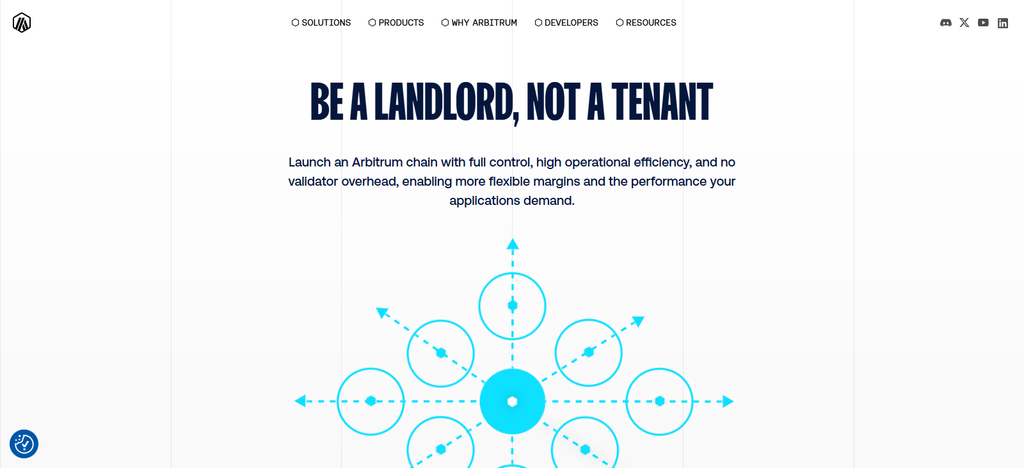
The security is dependent on the chosen chain model, with Rollups relying on Ethereum-oriented settlement and AnyTrust offering a different data-availability trade-off. Orbit provides granular control over gas tokens, governance, throughput, privacy, data availability and precompiles. Arbitrum’s Nitro tooling, Ethereum compatibility, bridges and an existing developer community make it well-suited for DeFi, gaming and specialized applications, which its ecosystem can benefit from.
Features
- Custom Arbitrum Rollup and AnyTrust chains
- Execution compatible with Nitro EVM
- Additional programming environments in Arbitrum Stylus
- Customization of chain and gas-token
Data-availability options to match your needs
Pros
- Great Ethereum compatibility
- Nitro Technology proven
- Chain that is highly customizable
- Stylus adds more development options
- Ideal for DeFi, gaming, and niche applications
Cons
- Technical expertise required for rollup infrastructure
- Security model depends on deployment configuration
- Higher maintenance requirements for advanced customization
- Steep trade-offs in data availability decisions
- Running dedicated infrastructure requires continuous resources
4. Avalanche sub-networks
Avalanche Subnets are a means of creating application-specific blockchains with dedicated validator sets and configurable network rules; they are increasingly represented by Avalanche L1 architecture.
The architecture separates individual application workloads from the shared Primary Network to help reduce congestion and competition for resources. Subnet-EVM is an EVM-compatible execution environment built on top of the Avalanche codebase, but custom virtual machines can be created as well. Avalanche consensus uses Snowman/Snowman++ for supported chains, and validators secure each network.
Developers are able to customize gas tokens, access control, validator requirements, virtual machines, and network parameters. Native Avalanche Interchain Messaging allows networks to communicate with each other, and independent execution means predictable performance for gaming, DeFi, institutions and other specialized applications.
Features
- Dedicated application-specific blockchains
- Avalanche consensus technology
- EVM-compatible Subnet-EVM
- Custom virtual-machine support
- Configurable validators and network rules
Pros
- High application-level customization
- Dedicated blockspace
- EVM compatibility
- Flexible validator architecture
- Suitable for gaming and high-throughput applications
Cons
- Dedicated validator infrastructure may be required
- Smaller chains may face ecosystem bootstrapping challenges
- Cross-chain liquidity can require additional infrastructure
- Custom configurations increase operational complexity
- Validator requirements vary by architecture
5. Cosmos SDK
Cosmos SDK is a modular framework to build sovereign application-specific Layer-1 blockchains instead of just deploying contracts on an existing chain. Launched in 2019. Its architecture is composed of reusable modules for accounts, governance, staking, tokenization, and application logic, and developers are able to build custom modules for specialized needs.
Cosmos SDK chains use CometBFT for consensus, offering configurable Byzantine-fault-tolerant consensus and fast finality. The execution environment is application-specific, and can be written around custom state-machine logic.
One of the strengths is the interoperability through IBC, which means native communication between compatible ecosystems. Its large ecosystem + developer tooling + deep customization make it fit for DeFi, gaming, payments, infrastructure and enterprise focused sovereign chains.
Features
- Modular blockchain development framework
- Custom application-specific modules
- CometBFT consensus integration
- Native IBC interoperability
- Sovereign blockchain architecture
Pros
- Extremely high customization
- Strong appchain development model
- Mature modular ecosystem
- Native cross-chain communication through IBC
- Suitable for specialized L1 applications
Cons
- Requires substantial blockchain engineering expertise
- Teams are responsible for more infrastructure
- Security depends heavily on the selected validator model
- Custom modules increase development complexity
- Launching a sovereign chain requires ecosystem planning
6. Celestia
Celestia is a modular data-availability network launched in 2023 that differs from traditional appchain frameworks in that it provides the data availability and consensus layer instead of a full application execution environment. Its architecture decouples data availability from execution and settlement, enabling developers to build rollups or sovereign chains on top of it.
Celestia uses Proof-of-Stake consensus and Data Availability Sampling, which allows light nodes to verify that block data is available without downloading the entire block.
Namespaced Merkle Trees enable applications to efficiently access relevant data. It’s useful for scalable rollups, sovereign chains and modular Web3 infrastructure, enabling developers to combine Celestia with different virtual machines and execution frameworks.
Features
- Modular data availability infrastructure
- Data availability for sampling
- Proof of Stake consensus
Namespaced Merkle Trees - Support for roll-up and modular blockchains
Pros
- Decouples execution from data availability
Built for scalable blockchain data - Reduces the need to validate the full data set
- Supports multiple runtime environments
- Good for modular roll-up architecture
Cons
- Not a full appchain framework on its own
“requires additional execution infrastructure
Requires another blockchain layer for settlement - Modular architectures can increase complexity of integration
Developers have to coordinate multiple pieces of infrastructure
7. zkSync ZK Stack
In 2023, zkSync announced ZK Stack, a modular framework to build customizable ZK-powered blockchain networks that can connect to the wider zkSync ecosystem. Its architecture is designed for zero-knowledge proofing and Ethereum settlement.
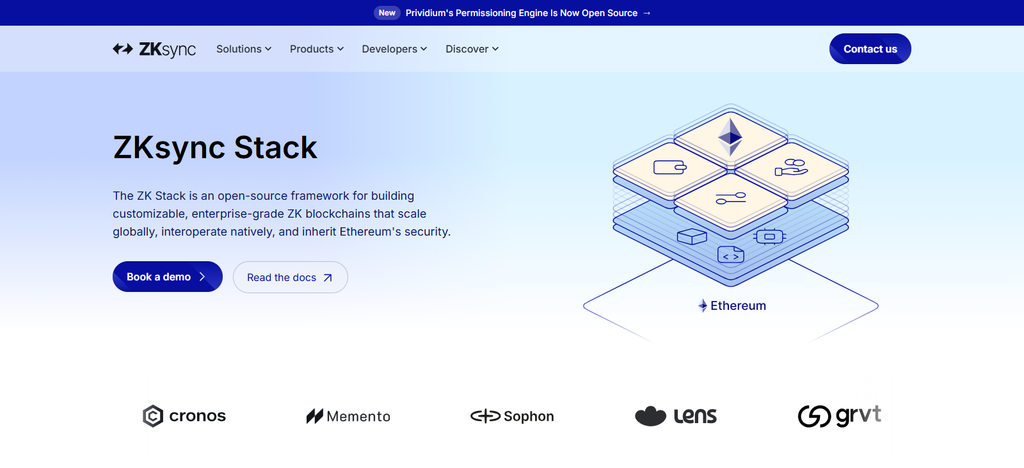
ZKsync chains are organized in a series of interlocked rollups. The execution environment is built on ZKsync’s technology stack and increasingly includes components of the ZKsync OS for high-performance chain operation.
Security is inherited from Ethereum via validity proofs, while chains can customize infrastructure and operating parameters. Interoperability is a big feature with shared bridges and the Elastic Network allowing chains to share users and liquidity. The ecosystem is especially relevant for DeFi, gaming, payments and application-specific high throughput chains.
Features
- Modular framework for ZK-based chains
- Architecture compatible with Ethereum
- Validity proofs (zero-knowledge)
- Dedicated chain infrastructure
- Compatibility with the rest of the zkSync ecosystem
Pros
- ZK scaling tech that’s robust
- Compatibility with Ethereum
- Security model for validity proof
High level of customization - Good for high throughput application specific chains
Pros
- ZK tech can require specialist expertise
- Operational complexity with demonstration infrastructure
- Tooling and architecture are still in flux
Migration must take into account ecosystem-specific factors - Smaller teams may have a steeper learning curve
8. Starknet Stack (Madara)
Madara is an open source implementation of the Starknet Stack that allows developers to build customizable application specific chains that can settle to Starknet or Ethereum. Its architecture separates the gateway, sequencer, orchestrator, prover, verifier and settlement components, which gives developers more control over how their application chain works.
Madara provides a Starknet-focused technology and supports custom execution logic instead of forcing developers into a standard EVM environment. Security is inherited from proofs of settlement and validity, while the underlying Starknet ecosystem provides access to infrastructure secured by Ethereum.
Chain rules and performance features can be customized by developers to suit application requirements. Madara is well suited for gaming, DeFi, privacy-focused applications and specialized high-throughput Web3 networks.
Features
- Modular, Starknet-based chain infrastructure
- Modular design for prover and sequencer
- STARK-based validity proof technology
- Configuration of flexible execution and chaining
- Connectivity to Starknet ecosystem
Pros
- ZK advanced technology
- Advanced level of customization
Modular blockchain architecture - Good potential for strong scaling
- Appropriate for specialized uses
Cons
- Developer pool is smaller than EVM ecosystems
- Learning required for Cairo-based development
ZK infrastructure is technically challenging - Tooling could be less familiar for Solidity developers
- Production deployment requires specific expertise
9. Dymsion RollApps
Launched in 2022, Dymension offers infrastructure to deploy modular application-specific rollups, known as RollApps. Its design separates application execution from settlement, with the Dymension Hub acting as a settlement and interoperability layer.
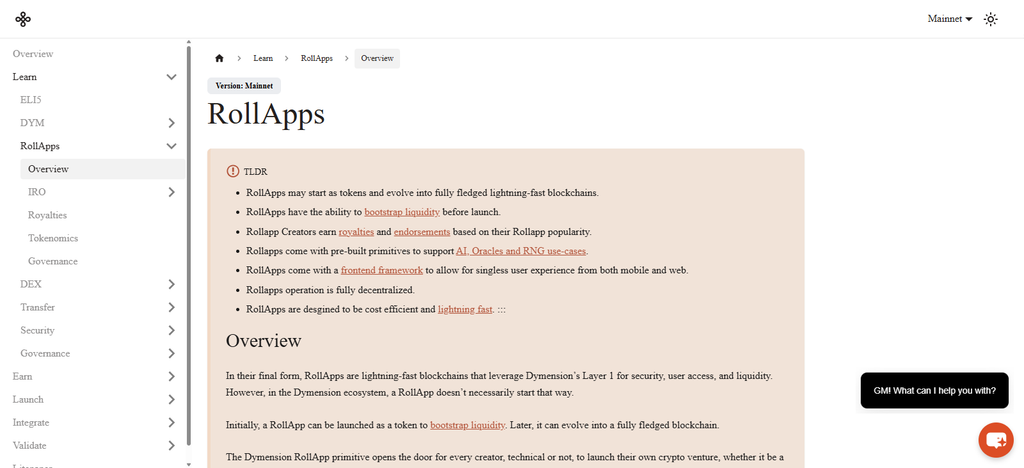
You can use the RollApp Development Kit to build RollApps that provide reusable blockchain functionality and allow for application-specific customization. The ecosystem is built on top of the Cosmos technology and IBC, giving RollApps native communication capabilities with the wider IBC ecosystem.
Dymension uses a Cosmos-based Proof-of-Stake architecture for its settlement layer, and each RollApp can dedicate its resources to running applications. This model is especially valuable for gaming, DeFi, consumer applications and projects that need dedicated blockspace without having to create every blockchain element from scratch.
Features
- Application-specific RollApp architecture
- Dymension Hub settlement layer
- Cosmos-based infrastructure
- Native IBC interoperability
- RollApp development tooling
Pros
- Dedicated execution environments
- Strong Cosmos ecosystem compatibility
- Native IBC connectivity
- Modular architecture
- Suitable for gaming and consumer applications
Cons
- Smaller ecosystem than major Ethereum L2 frameworks
- Developers need to understand modular architecture
- RollApp infrastructure adds operational considerations
- Liquidity may require cross-chain integrations
- Long-term ecosystem development remains important
10. Saga.
Founded in 2022, Saga revolves around dedicated application-specific blockchains called Chainlets. These Chainlets are built to offer scalable and isolated execution environments designed for Web3 applications. The architecture consists of a shared security and orchestration layer called Saga, while allowing Chainlets to run as dedicated application networks.
The platform offers developers the ability to use different virtual machines and infrastructure configurations, providing flexibility to developers regarding execution environments and chain economics.
Chainlets can even implement their own fee models and application-specific blockspace, reducing competition for resources with unrelated applications. Interoperability is a core part of the broader Saga ecosystem and horizontal scaling enables multiple Chainlets to operate in parallel. Saga’s focus is on gaming, entertainment, consumer applications and high throughput Web3 projects.
Features
- Application-specific Chainlets
- Shared security and orchestration infrastructure
- Dedicated blockspace
- Scalable multi-chain architecture
- Focus on gaming and consumer applications
Pros
- Designed specifically for application chains
- Dedicated execution environments
- Strong focus on gaming infrastructure
- Horizontal scaling across Chainlets
- Customizable application-specific infrastructure
Cons
- Relatively specialized ecosystem
- Additional infrastructure can increase complexity
- Projects need to evaluate Chainlet economics carefully
- Cross-chain liquidity may require additional integration
- Best suited to applications that benefit from dedicated infrastructure
Conclusion
Appchain infrastructure is emerging as an important building block for Web3 applications that require dedicated blockspace, predictable performance, customizable economics, and more control over execution. The platforms on this list span from Ethereum-aligned rollup stacks like Polygon CDK, OP Stack, Arbitrum Orbit, and ZK Stack to sovereign and modular frameworks like Cosmos SDK, Avalanche, Dymension, and Saga. Celestia is focused on modular data availability and Madara is providing flexible Starknet-based infrastructure. Ultimately, the best choice hinges on a project’s security model, execution requirements, interoperability needs, level of customization, developer resources, and long-term scalability strategy.
FAQ
What is an Appchain Infrastructure Platform?
An appchain infrastructure platform provides the tools and underlying architecture required to launch a blockchain optimized for a specific application or use case. It can provide execution, consensus, security, interoperability, settlement, data availability, and developer tooling.
Why Use an Appchain Instead of a Standard L1 or L2?
Appchains give projects greater control over blockspace, transaction fees, execution rules, governance, performance, and application-specific requirements. They can be useful when a project has workloads that do not fit efficiently on a shared blockchain.
Which Appchain Platform Is Best for Ethereum Developers?
Polygon CDK, OP Stack, Arbitrum Orbit, and zkSync ZK Stack are strong options for teams that want Ethereum compatibility and access to familiar EVM development tools. The right choice depends on security, customization, interoperability, and deployment requirements.
How Do Appchains Handle Security?
Security varies by platform. Some appchains can rely on Ethereum through rollup and validity-proof designs, while others use shared security or their own validator networks. Developers should evaluate who secures the chain and what responsibilities they must operate themselves.