

In this article, I will review the Best Smart Contract Monitoring Platforms for Web3 Security & Blockchain Monitoring. We will review top platforms based on smart contract monitoring, security detection, supported networks, developer onboarding, real-time alerts, automation and overall features. This comparison will help developers, security teams, and Web3 projects make the right choice for a monitoring platform.
What Is Smart Contract Monitoring?
Smart Contract Monitoring is the ongoing tracking of deployed intelligent contracts and their on-chain activity to detect unusual, unauthorized, or potentially malicious behavior. Real-time monitoring of transactions, contract functions, events, token transfers, ownership changes, administrative permissions, upgrades, balances and other key activities on blockchain.
Tools such as Forta, OpenZeppelin Monitor, Tenderly, Hypernative and others can be set up to alert when certain conditions or suspicious patterns are met. This enables developers, protocols, exchanges and security teams to quickly investigate incidents and in some cases trigger automated responses such as pausing contracts or triggering emergency procedures.
To summarize, smart contract monitoring offers a crucial layer of ongoing security, operational visibility, threat detection and risk management after a smart contract has been deployed.
Why Smart Contract Monitoring Matters in 2026
Defense against attacks in real-time – Smart agreements are always running after deployment, leaving them open to attacks at any time. Monitoring offers real-time insight into transactions, contract interactions and abnormal activity, allowing security teams to identify suspicious behavior as an incident unfolds, rather than after funds have been lost.
Prevention of Exploits – Monitoring can identify unusual transaction patterns, unexpected contract calls, unusual token transfers, and changes in contract behavior. Usually, transactions on blockchain are irreversible, so early detection is crucial. Rapid detection of an attack can buy a protocol some valuable time to investigate and trigger protective measures.
**Protection of electronic assets – DeFi protocols, DAOs, bridges, exchanges, and other Web3 applications can hold large amounts of digital resources. Regular monitoring allows you to spot unauthorized transfers, suspicious withdrawals, unusual liquidity movements, and other activity that might indicate an attempt to steal funds.
Detection of Privileged-Account Abuse – A smart contract may depend on administrators, multisignature wallets, upgrade keys or other privileged accounts. By watching these accounts, you can detect abnormal ownership transfers, permission modifications, contract upgrades, or questionable administrative operations that might threaten a secure protocol.
**Continuous Security Post-Deployment **– A security audit typically assesses a contract pre- or at-deployment, but the threat landscape continues to evolve afterward. Smart contract monitoring adds another layer of protection, through monitoring the contract during its operational life, and identifying new or unexpected risks.
Faster incident response – Monitoring systems can notify developers and security teams immediately if pre-set conditions or suspicious patterns are detected. The sooner the alert, the less time it takes to investigate an incident and it can allow organizations to trigger emergency procedures, such as suspending affected functionality or escalating an incident to security staff.
Protection Across Multiple Blockchain Networks – Today’s Web3 apps are built on multiple chains like Ethereum, Layer-2, Sidechains, and Subnets. By giving centralized visibility across these environments, multichain monitoring helps security teams detect threats that may move between chains or exploit cross-chain infrastructure.
Detect Business-Logic Attacks – Not all attacks are based on simple coding vulnerabilities. The attacker may exploit economic incentives, governance mechanisms, price oracles, liquidity mechanisms, or interaction between multiple contracts. Advanced monitoring can establish behavioral baselines and detect unusual activity that may indicate manipulation of a protocol’s intended business logic.
Automated Security Response – Alerts become more useful when they can kick off pre-defined actions. The threats identified can trigger automated alerts, workflows, circuit breakers or other emergency responses depending on the system. Automation helps reduce reliance on manual intervention which can be too slow in a fast evolving blockchain attack.
Improved Trust & Transparency – Web3 projects are under more scrutiny now than ever before from users, investors, developers, and institutional players demanding better security practices. Continuous surveillance offers evidence of an active protocol watching its infrastructure and responding to threats, which can increase operational transparency and user confidence.
Support for Compliance and Risk Management – As blockchain applications continue to be integrated with financial institutions and regulated markets, there is a need for better transaction monitoring and risk-management processes within organizations. Monitoring can be used to detect suspicious activity, maintain security records, support investigations and incorporate blockchain activity into broader compliance and governance programs.
ESSENTIAL FOR 24/7 BLOCKCHAIN FUNCTIONING – Public blockchains function 24/7, unlike traditional systems that may operate only during business hours. Therefore attacks can happen at any time including outside of normal working hours. Automated smart contract monitoring provides continuous security coverage, reducing the likelihood of an incident going undetected if the security team is away.
**Reduces Dependence on Human Oversight ** It is difficult to manually review blockchain transactions as protocols can create thousands or millions of transactions. Automated monitoring tools can sift through huge amounts of blockchain data and flag events that need a human eye, letting security teams focus their resources on the most serious threats.
Supports a Layered Security Strategy – In 2026, smart contract monitoring should be viewed as a complement to audits, formal verification, secure development practices, penetration testing and incident-response planning, not a replacement for them. Instead, it provides a continuous security layer after deployment, in parallel with preventive controls, and allows organizations to detect and respond to threats throughout the entire lifecycle of the contract.
Key Points
| Platform | Key Point |
|---|---|
| Forta | Leading decentralized smart contract monitoring network with detection bots across multiple chains. |
| OpenZeppelin Defender Monitor | Industry-standard monitoring and operational security platform for smart contracts. |
| Tenderly Alerts | Strong developer tooling combining monitoring, simulation, and debugging. |
| Hypernative | Advanced threat prevention platform focused on pre-exploit detection. |
| Hexagate | Specialized in real-time security monitoring and attack mitigation. |
| Blocknative | Best known for mempool visibility and transaction monitoring. |
| ChainPatrol | Monitors emerging Web3 threats beyond smart contracts alone. |
| TRM Labs | Combines blockchain intelligence with risk monitoring capabilities. |
| Ironblocks | Automated security enforcement and exploit protection. |
1. Forta
Launch: Forta was launched in 2021, developed in Q1 2021 and made available to the public after its beta period. Smart Contract Monitoring Forta allows for ongoing tracking of the blockchain activity through detection bots that detect events related to security, finance, operations, and governance. Supported Networks Layer 1s, Layer 2s, sidechains.
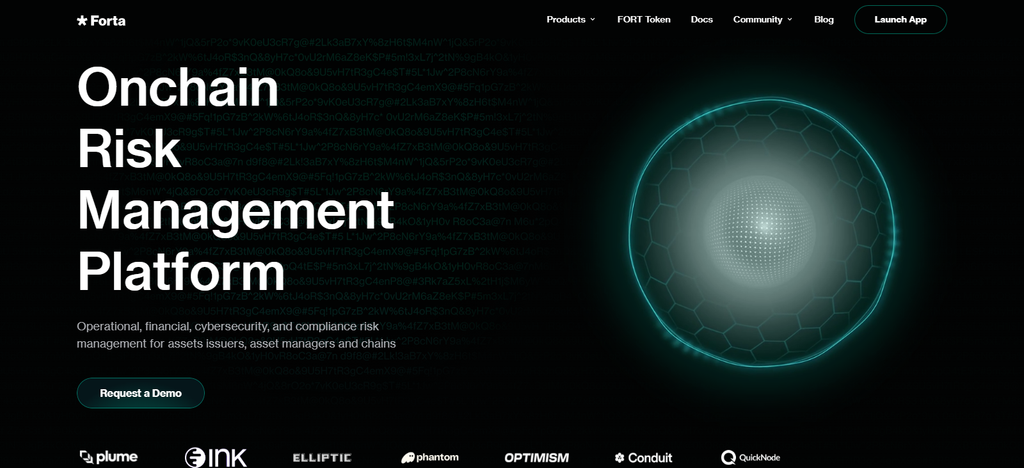
Security Detection: It monitors threats and anomalies across DeFi, bridges, NFTs, governance and smart-contract activity. Automation: Alerts can automate operations response. Developer Integration: Build and publish custom detection bots and deliver alerts through email, webhooks and APIs.
Forta Features
- Detection Bots: It uses detection bots created by security researchers and developers, specifically to look for certain threats.
- Multi-Chain Monitoring: Provides monitoring for major blockchain networks such as Ethereum and a number of Layer-2 and EVM chains.
- Security Alerts: Raises alerts when suspicious on-chain activity or potential security incidents are identified.
- Developer Integrations: Provides APIs and tools that enable developers and security teams to embed Forta alerts into their own applications and security workflows.
| Pros | Cons |
|---|---|
| Real-time monitoring of on-chain activity | Large volumes of alerts can create noise |
| Strong focus on Web3 threat detection | Configuration may require security expertise |
| Community-driven detection bots | Quality can vary depending on detection logic |
| Supports multiple blockchain networks | Advanced monitoring can become complex |
| APIs enable developer integration | Best suited to teams comfortable with technical integrations |
2. OpenZeppelin Defender Monitor
Launch: OpenZeppelin Defender was first announced in October 2020, with Defender 2.0 becoming generally available in February 2024. However, Defender was deprecated on July 1, 2026 and users were redirected to OpenZeppelin Monitor.
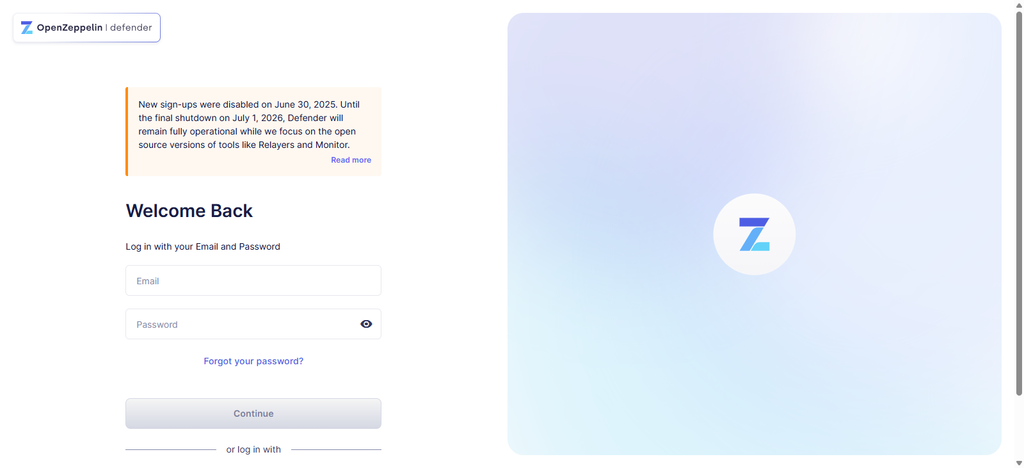
Smart Contract Monitoring The successor monitors contract transactions, events, governance, access control, suspicious activity, financial activity and technical risks. Supported Networks: OpenZeppelin Monitor supports EVM-compatible networks, as well as Stellar and Solana, with partial Midnight support.
Automation: Ability to run custom scripts and on-chain responses. Developer Integrations: Slack, Discord, Telegram, Email, Webhooks, APIs, Scripts.
OpenZeppelin Defender Monitor Features
- Smart Contract Monitoring: Monitors deployed intelligent contracts, functions, events, transactions, ownership changes and other significant contract activity.
- Security Alerts: Notifies you of predefined events or potentially dangerous contract activity.
- Access-Control Monitoring: Enables teams to track administrative roles, ownership changes, upgrades, and privileged operations.
Multichain Support: Built to watch intelligent contracts on supported blockchain networks and in Web3 environments. - Developer Integration: Provides APIs, monitoring configurations, notifications and integrations that assist development and security teams with managing deployed contracts.
| Pros | Cons |
|---|---|
| Strong smart-contract monitoring capabilities | Original Defender platform has been transitioned/deprecated |
| Developed by a well-known smart-contract security organization | Migration to newer OpenZeppelin tooling may require effort |
| Useful for monitoring contract events and administrative actions | Primarily focused on smart-contract and operational security |
| Good integration with OpenZeppelin ecosystem | Advanced configuration can require technical knowledge |
| Useful for development and security teams | Some features may depend on supported networks and services |
3. Tenderly Alerts
Launch: Tenderly was founded in 2018, and initially built around debugging and monitoring Ethereum smart contract software. Smart Contract Monitoring: Tenderly Monitor provides instant notifications for contract events, state changes, balances and function calls, with one monitoring rule that can be used for multiple networks.
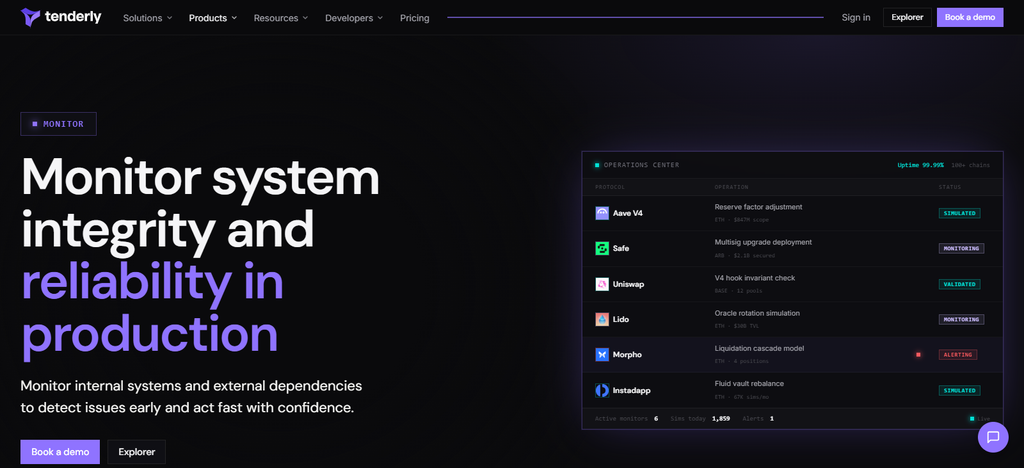
Supported Networks: Tenderly supports all EVM networks like Ethereum, Arbitrum, Optimism, Base, Polygon, Linea and other supported chains. Security Detection: Teams can monitor liquidity, governance, oracle conditions, positions, transactions, and operational failures.
Automation: Web3 Actions can perform preset responses. Developer integration Email, Slack, Telegram, Discord, PagerDuty, APIs, simulations, and developer tooling are supported.
Tenderly alerts Features
- Transaction Monitoring: Monitors Blockchain transactions and provides detailed information on successful and failed transaction activity.
- Smart Contract Monitoring: Monitor contract events, function calls, token transfers, balances and state changes.
- Custom Alerts: Developers are able to configure custom conditions and get alerted when certain things happen on the blockchain.
Transaction Simulation: Enables developers to simulate transactions prior to execution, to identify potential failures or unexpected behavior. - Automation: Connects alerts with automated actions and workflows, allowing teams to quickly react to detected blockchain events.
| Pros | Cons |
|---|---|
| Excellent transaction and smart-contract monitoring | Advanced features may require paid plans |
| Powerful transaction simulation capabilities | Can be more developer-oriented than beginner-friendly |
| Detailed debugging and execution information | Primarily focused on EVM-compatible environments |
| Customizable alerts and monitoring conditions | Large monitoring setups may become complex |
| Strong APIs and developer tools | Not primarily designed as a complete financial-crime platform |
4. Hypernative
The founders of Launch Hypernative, Gal Sagie and Dan Caspi, started the company in 2022 as a security-intelligence firm dedicated to proactive protection of online assets. Smart Contract Monitoring: The platform constantly monitors standardized transactions, wallets, governance, price feeds, mempool activity and other on-chain and off-chain signals.
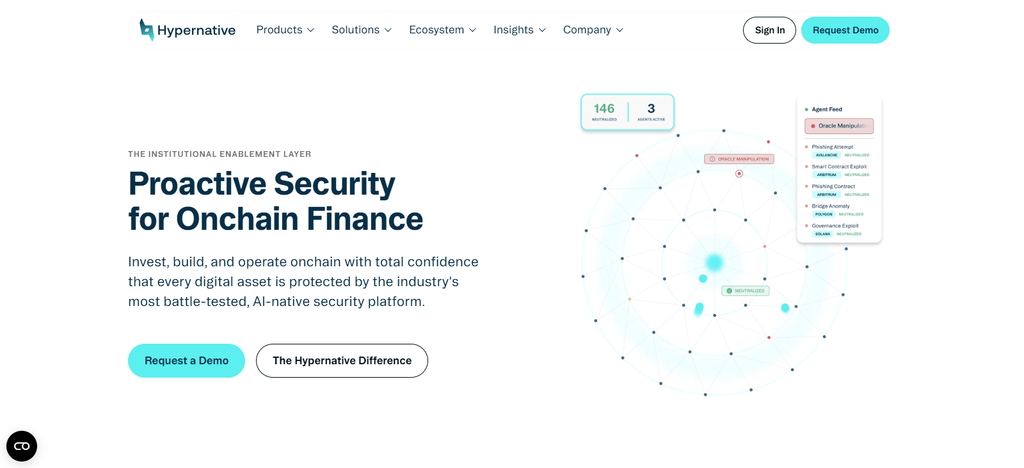
Supported Networks: Hypernative currently tracks 75+ chains. Security Detection: It uses an AI-based system to cover over 300 types of risks including exploit, flash-loan attacks, oracle manipulation, governance risks, bridge failures, private key compromise and de-pegging incidents.
Automation: Trigger custom actions, move funds, unwind positions or pause contracts automatically. Developer integration: custom agents, webhooks, Safe, Fireblocks, Slack, Telegram and PagerDuty integrations.
Hypernative Features
- Proactive Threat Detection: Continuously analyzes transactions, contracts, wallets and network activity to detect blockchain threats before or during an attack.
- AI-Based Security: Utilizes machine learning, behavioral analysis, graph analysis and other technologies to identify complex attack patterns.
- Attack Detection: Identifies threats including flash-loan attacks, oracle manipulation, governance attacks, bridge exploits, and compromised accounts.
Multi-Chain Monitoring: Offers security monitoring across a wide array of blockchain networks and Web3 ecosystems. - Automated Response: Can correlate security alerts with automated protective actions, such as halting protocols, activating circuit breakers, or beginning emergency procedures.
| Pros | Cons |
|---|---|
| Strong real-time and proactive threat detection | Enterprise-focused capabilities can be expensive |
| Uses AI and advanced behavioral analysis | May be more complex than basic monitoring tools |
| Supports automated security responses | Configuration requires security expertise |
| Detects sophisticated Web3 attacks | Primarily targeted toward professional security teams |
| Broad multichain monitoring capabilities | Some advanced functionality may require platform integration |
5. Hexagate
Launch: Hexagate was founded in 2022 and built its platform around Web3 threat prevention and automated risk management. Smart Contract Monitoring: Its solution provides real-time monitoring of smart contracts, on-chain assets, wallets, and blockchain activity.
Supported Networks: Hexagate was designed for multi-chain Web3 environments, although current network availability should be checked directly for a specific deployment. Security Detection: Its technology uses machine learning and an invariant-monitoring approach to identify malicious activity, operational faults, financial threats, and other blockchain risks. Automation: It supports proactive exploit prevention and post-incident response workflows.
Developer Integration: Hexagate provides a security and analytics API alongside its SaaS security platform, making it suitable for enterprise security and risk-management workflows.
Hexagate Features
- Continuous Threat Monitoring: Continuously monitors Web3 infrastructure and blockchain activity for possible security threats.
- Real-Time Detection: Detects suspicious transactions, unusual behavior, exploits, and other signs of blockchain attacks.
- Threat Intelligence: Provides security teams with insights into emerging Web3 threats and malicious on-chain activity.
Multichain Security: For monitoring applications and infrastructure deployed across multiple blockchain ecosystems. - Security Response: Enables organizations to link detected threats to response workflows so security teams can rapidly investigate and remediate incidents.
| Pros | Cons |
|---|---|
| Provides continuous Web3 security monitoring | Enterprise-oriented implementation can require resources |
| Focuses on real-time threat detection | Advanced features may require technical expertise |
| Helps security teams identify blockchain threats quickly | Can be more than needed for small projects |
| Supports security operations and response workflows | Configuration of detection rules may be complex |
| Useful for professional Web3 security teams | Pricing and feature availability may vary by deployment |
6. Blocknative
Blocknative is a blockchain infrastructure and transaction monitoring company, best known for its mempool and transaction intelligence. With its Smart Contract Monitoring features, you can see pending transactions before they are confirmed, which is especially helpful for apps that need to know about transactions early.

Blocknative can help with Security Detection by surfacing suspicious transaction behavior, failed transactions, gas issues, and other conditions that a developer may want to observe before a transaction is confirmed. Its infrastructure powers major EVM ecosystems providing real-time blockchain data with APIs and developer tools.
One of the key strengths is the Developer Integration with APIs, SDKs, webhooks and transaction data services. Automation can be built around real-time transaction events, enabling applications and infrastructure teams to trigger actions based on mempool or transaction conditions.
Blocknative Features
- Mempool Monitoring: Offers a real-time view of pending blockchain transactions, before they are confirmed on-chain.
- Transaction Intelligence: Provides developers with deep insight on transaction status, execution, gas, and confirmation.
- Real-Time Data: Provides low-latency blockchain transaction data for use cases that require instant information.
Developer APIs: APIs, SDKs, and WebSocket-based infrastructure to integrate blockchain data into applications.
Event-Driven Automation: Developers are able to react to real-time transaction and mempool events to initiate automated actions, alerts, trading strategies, or security workflows.
| Pros | Cons |
|---|---|
| Excellent real-time mempool visibility | Mempool data can be technically complex |
| Provides low-latency transaction information | More focused on transaction infrastructure than complete security |
| Useful for monitoring pending transactions | Requires developer knowledge for advanced use |
| Strong APIs and developer integrations | Not primarily a smart-contract auditing platform |
| Useful for trading, infrastructure, and monitoring applications | Coverage and functionality vary by network |
7. ChainPatrol
ChainPatrol is mainly focused on protecting Web3 users, communities, brands and projects from phishing, scams, impersonation, malicious websites, fraudulent tokens and other online threats. This makes its Smart Contract Monitoring distinct from platforms like Tenderly or OpenZeppelin Monitor, not only focusing on contract behavior but on the wider Web3 threat landscape.
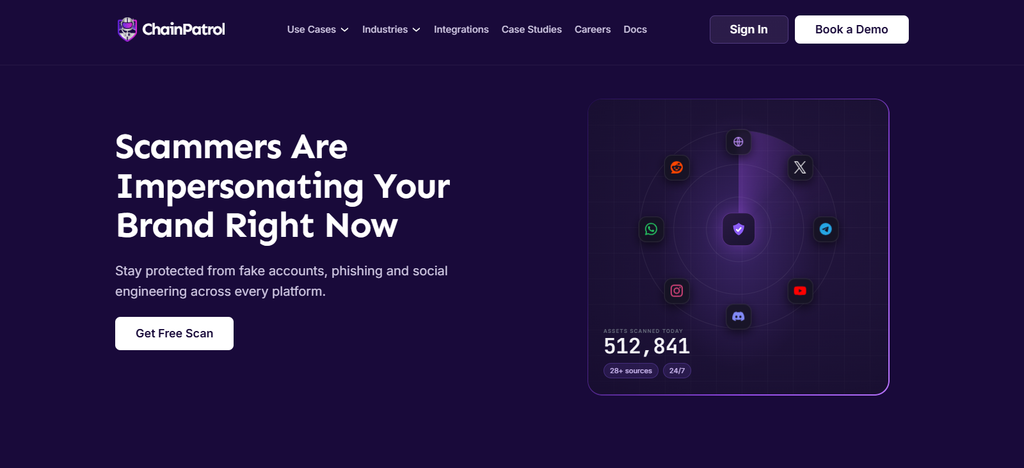
Automated threat discovery and reporting to identify malicious infrastructure and emerging attacks ChainPatrol Security Detection It’s cross Web3 ecosystem and has integrations with security networks like Forta and Blowfish.
With Developer Integration, projects and security teams can incorporate threat intelligence into their protection workflows. Automation is especially critical for automated detection, reporting, and takedown processes aiming to shorten the lifespan of bad web3 infrastructure.
ChainPatrol Features
- Phishing Detection: Identifies phishing websites, scam pages, fake applications and other malicious resources aiming at Web3 users.
- Scam Protection: Assists in recognizing scams, malicious tokens, fraudulent projects and impersonation campaigns.
- Brand Protection: Protects Web3 companies, protocols, communities and brands from impersonation and malicious domains on the web.
- Threat Discovery Automation: Ongoing detection of new malicious websites, domains, social profiles and other Web3 threats.
Takedown Automation: Enables security teams to report and orchestrate the takedown of malicious infrastructure, thus decreasing the time users are exposed.
| Pros | Cons |
|---|---|
| Strong protection against phishing and scams | Less focused on deep smart-contract monitoring |
| Detects malicious websites and impersonation | Primarily addresses external/Web3 threat infrastructure |
| Useful for brand and community protection | Not a replacement for smart-contract auditing |
| Automated threat discovery and reporting | Security teams may need complementary monitoring tools |
| Helps coordinate malicious-content takedowns | Effectiveness depends partly on external takedown processes |
8. TRM Labs
TRM Labs is a blockchain intelligence and financial-crime risk infrastructure provider, not a smart-contract alerting platform first and foremost. Therefore, its Smart Contract Monitoring capabilities are less focused on monitoring individual contract functions and more on analyzing blockchain addresses, transactions, assets, counterparties and illicit activity.
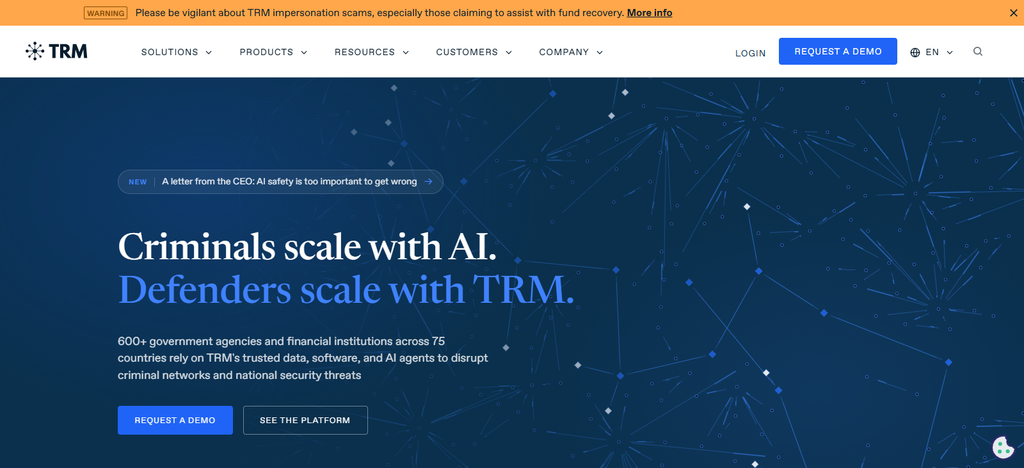
TRM offers behavioral intelligence to identify scams, laundering typologies, sanctions exposure and other suspicious blockchain activity for Security Detection. Its intelligence platform currently indexes 65+ chains, 1.9 billion+ assets and offers risk-screening for 184+ blockchains.
TRM’s data and screening infrastructure is available for developer integrations. Automation can assist with transaction screening, risk scoring, investigations, compliance workflows and alert-driven financial crime operations.
TRM Labs Features
- Blockchain Intelligence: Full Blockchain data and intelligence for transaction, wallet, entity and digital asset analysis.
Risk Detection: Detects suspicious blockchain activity, scams, illicit finance, sanctions exposure, and other risks of financial crime. - Transaction Screening: Enables organizations to screen blockchain transactions and addresses for potential compliance and security risks.
Investigations: Offers tools for tracing funds, analyzing transaction relationships, and investigating financial activity on the blockchain.
Compliance Automation: Risk scoring, monitoring, screening, alerts, and compliance workflows can be automated for financial institutions and Web3 organizations.
| Pros | Cons |
|---|---|
| Powerful blockchain intelligence and analytics | Primarily designed for professional and enterprise users |
| Strong transaction and wallet risk analysis | Can be expensive for smaller organizations |
| Useful for compliance and financial-crime investigations | More focused on financial intelligence than contract monitoring |
| Supports transaction screening and risk assessment | Requires trained investigators for advanced investigations |
| Extensive blockchain and asset intelligence | May be excessive for simple Web3 monitoring requirements |
9. Ironblocks
Ironblocks is a Web3 cybersecurity company committed to protecting blockchain ecosystems, decentralized applications and digital resources through 24/7 threat detection and response. The Smart Contract Monitoring approach is focused on monitoring on-chain activity and detecting potentially malicious or abnormal behavior that affects protocols and assets.
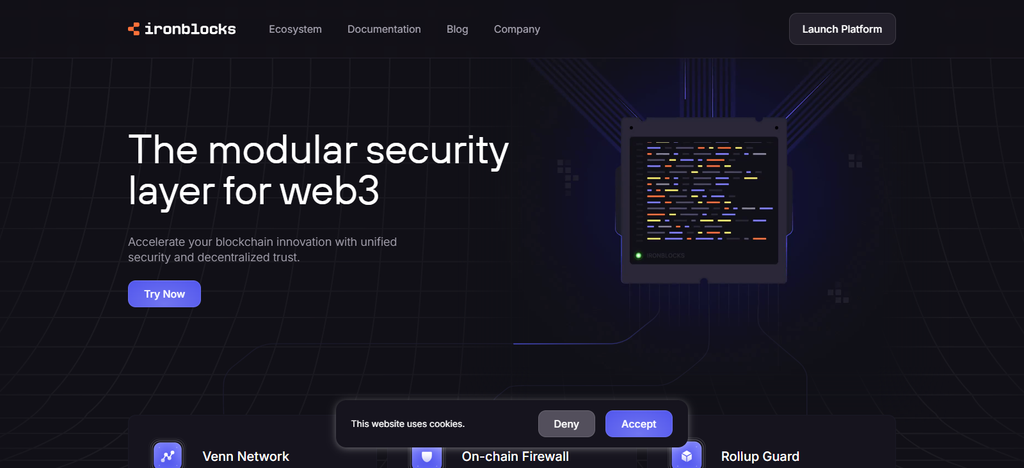
For Security Detection, Ironblocks focuses on live threat intelligence, suspicious transaction detection, exploit detection and security-event analysis. Designed for blockchain and Web3, not traditional enterprise networks. Developer Integration is meant to connect security intelligence to protocols, wallets, infrastructure and operational security systems.
Automation is an essential part of the security model, as detected threats can be associated with response mechanisms, so organizations will be able to cut down the manual investigation time and respond faster to blockchain incidents.
Ironblocks Features
- Real-time security monitoring: Monitors blockchain activity in real-time to detect suspicious transactions and attacks.
- Threat detection: Detects malicious behavior, anomalous transactions, exploits and other security signals that impact Web3 protocols.
- On-Chain Intelligence: Analyzes blockchain activity to give security teams knowledge of potential threats and attack patterns.
- Web3 Security Integration: Integrate with blockchain protocols, wallets, infrastructure and security operations for improved threat visibility.
- Automated Response: Links threat detection to protective and incident-response mechanisms for rapid security responses.
| Pros | Cons |
|---|---|
| Focuses strongly on Web3 cybersecurity | Advanced security capabilities can require technical expertise |
| Provides real-time threat monitoring | May be more suitable for professional security teams |
| Helps identify suspicious blockchain activity | Smaller projects may not need all capabilities |
| Can integrate security intelligence into Web3 infrastructure | Implementation may require engineering resources |
| Supports rapid security response | Pricing and feature availability can depend on deployment requirements |
Conclusion
To conclude, Forta, OpenZeppelin Defender Monitor, Tenderly Alerts, Hypernative, Hexagate, Blocknative, ChainPatrol, TRM Labs and Ironblocks offer unique but complementary solutions for blockchain security, smart contract monitoring, threat detection and automation.
Forta and Hypernative are heavily focused on real-time security intelligence and threat detection, while OpenZeppelin Defender Monitor and Tenderly will be especially useful for developers and smart contract operations. Hexagate, Ironblocks and Blocknative focus on proactive monitoring and swift response and ChainPatrol is very much focused on phishing, scams and malicious Web3 assets. TRM Labs offers more extensive blockchain intelligence and risk analytics.
The best platform really depends on the primary need, whether that is smart contract monitoring, real-time security detection, developer integration, compliance, threat intelligence or automated response. Together, these solutions highlight the growing importance of continuous blockchain monitoring and
FAQ
What is the role of automation in blockchain security?
Automation allows security systems to respond to detected threats without requiring every incident to be handled manually. Depending on the platform, an alert can trigger notifications, investigations, transaction blocking, contract pauses, circuit breakers, emergency procedures, or other predefined actions. Hypernative, Tenderly, OpenZeppelin’s tooling, Forta, and other platforms can support different forms of alert-driven or automated workflows, helping reduce response time during security incidents.
Which platform is best for developers?
For developers, Tenderly and OpenZeppelin’s tooling are particularly useful because they integrate closely with smart-contract development and operational workflows. Tenderly is strong for simulation, debugging, transaction analysis, monitoring, and development. OpenZeppelin is well known for smart-contract security and contract-management tooling. Forta is also valuable for developers who want to create or integrate custom blockchain threat-detection logic.
Which platform is best for phishing and scam protection?
ChainPatrol is one of the strongest choices among the listed platforms for phishing, scam, impersonation, and malicious-Web3-infrastructure protection. Its focus is different from platforms such as Tenderly or OpenZeppelin, which concentrate more heavily on smart contracts and blockchain operations. For comprehensive security, an organization can use ChainPatrol alongside on-chain monitoring and smart-contract security tools.
Can these platforms be used together?
Yes. In fact, combining multiple platforms can provide broader security coverage. For example, Tenderly or OpenZeppelin can monitor smart-contract operations, Forta or Hypernative can detect on-chain threats, Blocknative can provide pending-transaction intelligence, ChainPatrol can protect against phishing and malicious infrastructure, and TRM Labs can support blockchain investigations and compliance. Using complementary tools creates multiple layers of protection rather than relying on a single security solution.