


In this article, I am going to talk about the Best Real-Time Blockchain Data Streaming Platforms for developers and businesses. We will look at platforms that provide fast, reliable and scalable blockchain data for applications, analytics, trading, DeFi and Web3 infrastructure. The comparison is based on real-time performance, blockchain coverage, streaming capabilities, reliability, pricing, data access, and developer experience.
What Are Real-Time Blockchain Data Streaming Platforms?
Real-time blockchain data streaming platforms are infrastructure services that continuously gather, process, and deliver on-chain data to applications in real-time as the blockchain action unfolds. Developers may subscribe to receive live blocks, transactions, smart contract events, token transfers, DEX trades, wallet activity, logs and other blockchain events via streaming interfaces, instead of having to poll RPC endpoints repeatedly.
These platforms may expose data via WebSockets, gRPC, webhooks, Kafka, or custom streaming protocols. They also offer filtering, decoded events, historical backfills, replay and blockchain reorganization handling, which makes them useful to trading systems, DeFi applications, analytics dashboards, monitoring tools, AI agents and real-time Web3 data pipelines.
How We Selected These 10 Platforms
Real Time Performance: We examined the ability of platforms to deliver new blockchain events and enable low-latency applications.
Streaming Interfaces: We evaluated WebSockets, gRPC, webhooks, Kafka, Substreams and other techniques available for streaming data.
Data Coverage: Platforms were assessed on their coverage of blocks, transactions, logs, smart-contract events, token transfers, trades, wallet activity, and other on-chain data.
Filtering Capabilities: We investigated whether developers have the ability to filter streams by contracts, addresses, transactions, events, tokens, or other blockchain parameters.
Recovery & Backfill: We looked into replay, historical backfill, cursor based recovery and other features that help avoid missed blockchain events.
Reorganization Management: Platforms were assessed on how well they handle blockchain reorganizations and deliver more consistent event data.
Data Destinations: 1. We wondered if streamed data can be delivered to databases, APIs, webhooks, cloud storage, Kafka or even your custom app.
Developer Experience: Documentation, SDKs, APIs, setup complexity and overall ease of integration are considered in the evaluation.
Scalability: We tested their capability to handle increasing numbers of events, concurrent streams and production-level blockchain applications.
Price & Availability: We looked at free tiers, entry level plans, usage based pricing and how the costs scale for developers and businesses.
Key Points
| Platform | Key Strength |
|---|---|
| QuickNode Streams | Enterprise-grade real-time blockchain streaming across 60+ chains |
| Goldsky | Sub-second blockchain data pipelines and streaming infrastructure |
| Alchemy | Real-time webhooks, subscriptions, and blockchain event monitoring |
| StreamingFast | High-performance blockchain streaming built on Firehose technology |
| SubQuery | Real-time indexing and data streaming for multi-chain applications |
| Subsquid | Decentralized blockchain data processing and event streaming |
| Chainbase | Real-time Web3 data infrastructure and data streams |
| Helius | Advanced Solana event streaming and webhook infrastructure |
| The Graph | Near real-time indexed blockchain data access |
| Streamr | Decentralized real-time data streaming network |
1. QuickNode Streams
QuickNode, a blockchain infrastructure company founded in 2017, today launched QuickNode Streams, a service delivering blockchain data continuously across a wide, multi-chain ecosystem. Its Streams product provides real-time and historical data workflows, including filtering, backfilling, re-organization handling and delivery to multiple destinations.
Pricing is based on usage, and depends on workload and plan. Blockchain support includes many EVM and non-EVM chains that QuickNode supports. ** Streaming interfaces** are not only traditional WebSockets but also managed Streams. Data destinations can be webhooks and other supported endpoints. Its greatest strength is the combination of live streaming and recovery-oriented infrastructure.
QuickNode Streams — Ideal For
- Webhook-based event delivery & automation
- Real-time blockchain data streaming multi-chain
- DeFi, Trading & Transaction Monitoring Applications
Customizable Filtering and Processing of Blockchain Events - Backfill and reorganization handling for production applications
QuickNode Streams Key Strengths
- Live stream of blockchain data
- Large multi-chain infrastructure
- Processing and filtering custom events
- Blockchain reorganization support and backfill
- Scalable infrastructure production workloads
2. Goldsky
Founded in 2022, Goldsky is a blockchain data infrastructure company specializing in real-time pipelines, subgraphs and database synchronization. Its modern Turbo Pipelines are the replacement for the previous Mirror product, meant to keep on-chain data flowing to off-chain databases.
Pricing Available for experimentation with free credits, production usage is pay-as-you-go for compute and data volume. 150+ chains covered by Blockchain coverage.
The streaming performance is optimized for continuous pipeline processing, and the reliability is achieved by managed indexing and pipeline infrastructure. Data destinations include hosted PostgreSQL and other pipeline outputs, making Goldsky particularly useful for applications that require live blockchain data inside database.
Goldsky – Ideal For
- Blockchain data pipelines in real time
- Direct streaming of on-chain data to databases.
- App backends and DeFi analytics
- Cross-chain data synchronization and indexing
- Data transformation that can be customized by the developer
Goldsky Key Strengths
- Real-time data pipelines for blockchain
- DB direct sync
- Flexibility of data transformation
- Extensive multi-chain coverage
- Developer Indexing Infrastructure
3. Alchemy
Alchemy – Founded in 2017, Alchemy is a full-stack Web3 infrastructure platform providing blockchain nodes, APIs, Smart WebSockets, webhooks, and developer data services. Pricing is tiered, with a free tier of 30 million compute units each month.
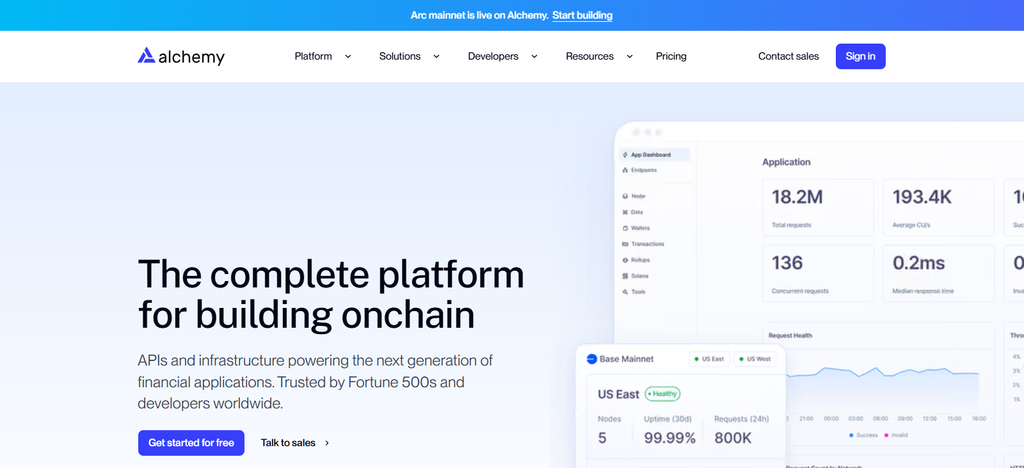
After that, you pay as you go at a rate that starts at $0.525 per million compute units, with enterprise options also available. Blockchain coverage Covers many of the major mainnets and testnets. Real-time performance with Smart WebSockets and scalable throughput.
Streaming interfaces are WebSockets and webhooks. Applications can consume transaction, token, NFT, transfer and blockchain data. Reliability is enhanced by enterprise-grade performance options and managed infrastructure.
Alchemy Ideal For
- Development of general Web3 applications
- Websockets and webhooks for realtime blockchain events
- Applications for NFTs, tokens, wallets and transactions
- For wide blockchain infrastructure developers
- Managed Node and API Services for Scalable Apps
Alchemy Key Strengths
- Robust blockchain infrastructure ecosystem
- WebSockets and webhook event delivery
- Broad coverage of chains and APIs
- Scalable node infrastructure
- Strong developer tooling and documentation
4. Streaming Fast
StreamingFast (2018): The company aims to extract and process high-throughput blockchain data via its Firehose and Substreams technology. Firehose captures blockchain execution data and exposes it as a stream, enabling both historical processing and live data at the chain head.
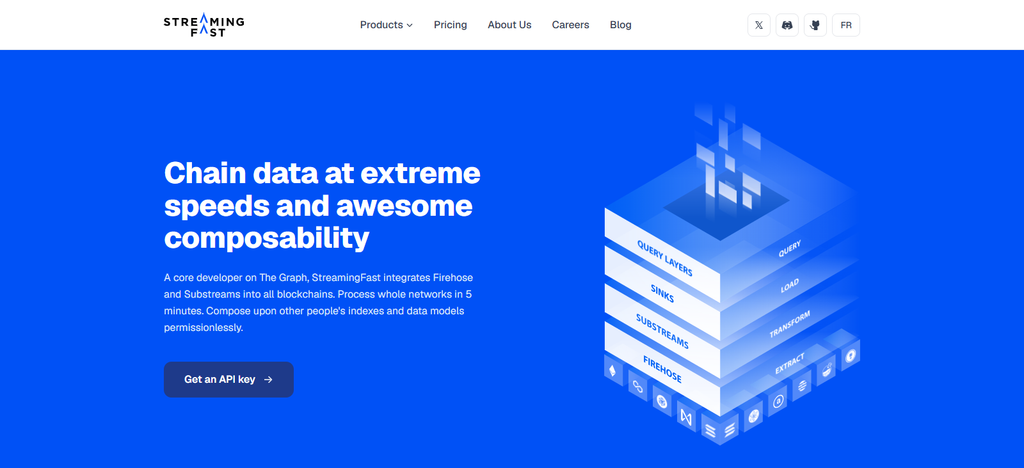
Pricing is based on the deployment and service configuration, not a single subscription. Blockchain coverage is based on chains supported by Firehose ecosystem and The Graph infrastructure.
Streaming interfaces: Firehose, Substreams Data feeds to indexing and downstream processing systems. Its main strength is parallelized, streaming-first processing, built for large-scale indexing, historical backfills, and continuous blockchain data pipelines.
StreamingFast Ideal For
- High performance blockchain data processing
- Indexing and large scale data analytics
- Backfilling of historical blockchain data
Substreams pipelines, realtime and historical - Parallel processing for data-intensive applications
StreamingFast Key Strengths
- Large scale processing of blockchain data
- Architecture of Firehose and Substreams
- Data processing parallelization
Robust historical data capabilities - Optimized for large-scale indexing workloads
5. SubQuery
SubQuery is a blockchain data indexing and infrastructure platform founded in 2021, that enables developers to turn on-chain activity into structured, queryable datasets. Its ecosystem enables blockchain indexing, APIs and real-time data workflows across multiple networks.
Pricing varies depending on the chosen infrastructure and usage needs, with developer-oriented access and scalable production options. Blockchain coverage is comprehensive and covers a wide spectrum of blockchain ecosystems. real-time performance is dependent on the indexed network and project configuration.
Streaming and data interfaces offer indexed blockchain data to applications, analytics systems and APIs. The key benefit is the ability to customize the indexing for developers who want structured blockchain data rather than raw node responses.
SubQuery — Ideal For
- Customized blockchain indexing
- On-chain datasets structured and queriable
- Web3 application development (multi-chain)
Blockchain analytics and decentralized applications - Developers building custom data APIs
SubQuery Key Strengths
- Programmable Blockchain Data Indexing
- Data infrastructure for multiple chains
- Queryable structured data sets
- Developer tools for indexing
- Flexible APIs for Web3 Apps
6. Subsquid
Subsquid is a modular blockchain data platform with a focus on data ingestion, transformation, indexing and querying. Founded in 2021. Its architecture decouples blockchain data retrieval from developer-defined processing, enabling teams to build custom data pipelines using its SDK and squid framework.
Pricing is based on the data infrastructure and the usage pattern. Blockchain coverage covers a wide range of ecosystems and seeks to support projects that require historical and continuously updated blockchain datasets.
Real-time performance depends on the data source and the indexing architecture used. Streaming interfaces are centered on its data processing ecosystem. Outputs can be exposed through APIs, GraphQL, and analytics-centric applications. The most powerful feature is the ability to customize processing of data on the blockchain in an ETL style.
Subsquid — Ideal For
- Custom blockchain data extractions
- Indexing of historical and real time data
- Advanced data pipelines transformations
- Developers requiring flexible blockchain ETL workflows
- Data-intensive research, analytics and web3 applications
Subsquid Key Strengths
- Real-time blockchain data scraping
- Strong indexing and ETL features
- Transformation of custom data
- Processing historical data
- Developer controlled data pipelines
7. Chainbase
Chainbase is a multi-chain blockchain data infrastructure platform that provides continuous access to on-chain information for applications, analytics, and AI-driven workloads. Its pricing is based on API, data and infrastructure usage with free or developer access and scalable plans.
Blockchain coverage is based on comprehensive multi-chain support, allowing developers to interact with multiple networks through unified data services. Real-time performance is related to providing up-to-date blockchain events and structured information with little operational overhead.
Streaming interfaces are well suited for event-oriented data consumption, and outputs are well suited for applications, analytics pipelines, and conventional artificial intelligence systems. The main advantage is that it combines multi-chain access with a single layer of data.
Chainbase — Ideal For
- Cross-chain unified access to blockchain data
- AI agents and Web3 apps powered by AI
- On-chain data discovery and analytics
- Developers building on different blockchain networks
- Blockchain datasets structured for applications
Chainbase Key Strengths
- Multi-chain data infrastructure integrated
Distributed block chains data sets - On-chain data in real-time
- Heavy emphasis on AI and Web3 apps
- Simplified cross-chain data integration
8. Helius.
Founded in 2022, Helius is a Solana-focused infrastructure platform that provides RPC services, APIs, webhooks and high performance real-time streaming via LaserStream. Pricing starts at Free, Developer is $49/month, Business $499/month and Professional is $999/month with enterprise pricing available.
The focus of blockchain coverage is Solana. One of the biggest advantages is real-time performance, LaserStream is accessible via WebSockets and gRPC. Reliability and recovery includes globally distributed infrastructure, regional redundancy, and historical replay. Data destinations are dependent on the integration and streaming supports filtered Solana transactions, accounts, blocks and program activity.
Helius – Ideal For
- Solana-centric applications
- Live Solana transactions and account data
High-performance trading and DeFi applications - Analytics and monitoring tools for Solana
- Developers requiring WebSocket and gRPC streaming
Helius Key Strengths
- High performance real-time data streaming
- WebSocket & gRPC support
- Rich Solana API’s and dev tools
- Solid infrastructure for high-volume application
9. The Graph
The Graph, launched in 2018, is a decentralized blockchain indexing protocol that has grown from indexing Ethereum to a larger multi-chain data ecosystem. Its Substreams technology offers a high-performance mechanism for parallelized execution of real-time and historical blockchain data processing.
Pricing: hosted Substreams access is free to start. Paid plans begin at $100/month and scale based on blocks processed, egress, workers, and concurrent streams. streaming interfaces: Substreams and related indexing infrastructure. Reliability features: cursor-managed reconnection to avoid missing transactions. It is especially useful for DeFi analytics, trading systems, AI agents and large-scale blockchain indexing.
The Graph – Ideal For
- Indexing of the decentralized blockchain
- DeFi and Web3 analysis
- Systematic query of blockchain data
- Historical and real-time data processing
- Developers building applications on indexed on-chain data
The Graph Key Strengths
- Indexing decentralized blockchains
- Subgraphs for powerful data querying
- Multi-chain indexing system
- Processing of historical and real-time data
- Vibrant Web3 developer community
10. Streamr
Streamr was founded in 2017 as a decentralized peer-to-peer real-time data network, therefore, it is not a traditional centralized blockchain data provider. Its infrastructure is based on a publish/subscribe model to enable continuous data flow between producers and consumers.
Pricing can be based on the specific data stream, network participation and marketplace or sponsorship model rather than traditional API subscription.
The key differentiator is not Blockchain coverage as Streamr is designed to carry many types of real-time data, including Web3 and IoT data. Streaming interfaces use its decentralized network and SDK. Reliability is achieved by distributed nodes and peer to peer architecture.
Streamr — Ideal For
- Distributed real-time data distribution
*Peer-to-peer streaming of data - Web3 and IoT data apps
- Open data networks and data marketplaces
Apps searching for decentralized alternatives to centralized streaming infrastructure
Streamr – Key Strengths
- Decentralized streaming (peer to peer)
- Real-time data transfer
- Open data streaming architecture
- Web3 and IoT use cases support
- Reduced reliance on centralized data infrastructure
Conclusion
Developers are using real-time blockchain data streaming platforms to build trading systems, DeFi apps, analytics dashboards, AI agents, monitoring tools, and data pipelines. Which is best depends on what blockchains you need to cover, latency, streaming interface, reliability, recovery options, pricing model, and destination support.
For a flexible multi-chain pipeline, QuickNode Streams and Goldsky are solid picks, Helius is a great option for Solana-specific applications, and StreamingFast, The Graph, SubQuery, and Subsquid provide robust indexing and data processing capabilities.
Alchemy offers a broad developer infrastructure, Chainbase focuses on unified blockchain data and Streamr enables decentralized real time data delivery. By considering these factors together, teams can select the appropriate streaming infrastructure for production workloads.
FAQ
What are real-time blockchain data streaming platforms?
Real-time blockchain data streaming platforms continuously deliver blockchain events such as blocks, transactions, smart-contract logs, token transfers, trades, and wallet activity to applications without requiring constant polling.
Why use blockchain data streaming instead of RPC APIs?
Streaming reduces the need for repeated polling and is better suited for applications that need continuous event updates. RPC APIs are generally better for individual requests, queries, and specific blockchain state information.
Which blockchain data streaming platform is best for developers?
The best option depends on the use case. Alchemy and QuickNode are strong general-purpose choices, Helius is particularly suitable for Solana, while Goldsky, StreamingFast, SubQuery, Subsquid, and The Graph are useful for indexing and data pipelines.
What blockchain data can these platforms stream?
Depending on the provider, developers can stream blocks, transactions, smart-contract events, logs, token transfers, DEX trades, wallet activity, NFT events, protocol activity, and other on-chain information.
Which platform is best for Solana real-time data?
Helius is a strong choice for Solana-focused applications because it provides dedicated Solana infrastructure and real-time streaming through interfaces such as WebSockets and gRPC.