


I will review some of the best crypto portfolio analytics for professional traders in this article. These systems offer advanced crypto portfolio analytics tools to track performance and manage risk across multiple wallets, centralized and decentralized exchange accounts, and DeFi protocols.
Professional traders use them for accurate profit and loss calculations and tax reporting. To accommodate the busy needs of their users, these systems offer the integration of AI and sentiment analysis, real-time/instant order book feeds, and several other institutional-grade offerings.
What is Crypto Portfolio Analytics Platforms?
CoinStats, Kubera, CoinTracking, Zerion, and CoinTracker, among others, compile all of your wallets and exchanges by integrating with APIs. These platforms show users how their portfolios are performing in real-time and track their profits and losses.
They also offer tax reporting services and provide analytics on staking and DeFi, along with tracking NFTs. Other advanced portfolios provide AI suggestions, risk exposures, and cross-chain analytics to provide insights and track hidden losses.
They range from free to $500 per month, depending on the features you wish to unlock. Institutions are offered compliance-ready reports at an enterprise level. The use of automated, real-time global analytics makes crypto portfolio tracking an essential tool for retail traders and institutional investors.
Key Points
| Platform | Core Focus | Key Features | Best For |
|---|---|---|---|
| Coin Metrics | Institutional data & benchmarks | On‑chain metrics, indexes, risk analytics | Asset managers & funds |
| Kaiko | Market data feeds | Liquidity metrics, derivatives analytics | Hedge funds |
| Glassnode | On‑chain intelligence | Wallet flows, liquidity signals | Quant traders |
| Messari Pro | Research + analytics | Asset profiles, compliance data | Institutional research desks |
| Chainalysis | Compliance + monitoring | AML/KYC APIs, transaction risk scoring | Banks & regulators |
| CryptoCompare | Pricing & indices | FCA‑regulated benchmarks, ETF data | Structured products |
| Amberdata | DeFi + derivatives analytics | Yield curves, risk metrics | Institutional DeFi investors |
| Lukka | Tax + accounting data | Audit‑ready pricing, portfolio reconciliation | Funds & custodians |
| Santiment | Behavioral analytics | Social sentiment, token metrics | Quant funds & traders |
| Nansen | Wallet intelligence | Smart money tracking, DeFi portfolio analytics | Hedge funds & VCs |
1. Coin Metrics
Coin Metrics was founded in 2017 by Nic Carter, Aleksei Nokhrin, and Tim Rice. With institutional grade on-chain metrics, market data, and benchmark pricing for 1500+ digital assets, Coin Metrics offers products such as the Network Data Pro, Market Data Feed, and CM Reference Rates. These products are aligned with the IOSCO standards.
Pricing is determined on an enterprise basis, depending on API requests and the number of assets. Coin Metrics was acquired by Talos for $100M in 2025 to add on to their institutional trading infrastructure. Coin Metrics is trusted due to their benchmark grade methodology, and their partnerships with Goldman Sachs and MSCI.
Coin Metrics
Features
- Institutional-grade network and market datasets.
- Blockchain-level asset and transaction metrics.
- Historical and real-time market information.
- Reference rates and digital-asset indexes.
- API, streaming and downloadable data access.
Pros
- Strong combination of on-chain and market intelligence.
- Suitable for quantitative financial research.
- Useful for institutional valuation workflows.
- Supports detailed historical analysis.
- Flexible for custom data integrations.
Cons
- Advanced datasets can require technical expertise.
- Large datasets may increase infrastructure requirements.
- Enterprise implementations can take time.
- Metric selection may be complex for new users.
- Smaller firms may not require its full data range.
2. Kaiko
Founded in 2014 with headquarters in Paris, Kaiko has Ambre Soubiran as CEO. Kaiko pulls data from over 100 exchanges and provides trade, order-book, and derivatives data to clients like Deutsche Börse and ICE Global Network. Kaiko’s Series B investment in 2022 was for $53M, and they subsequently bought Amberdata in 2026 in order to have AI-powered analytics and provide derivatives.
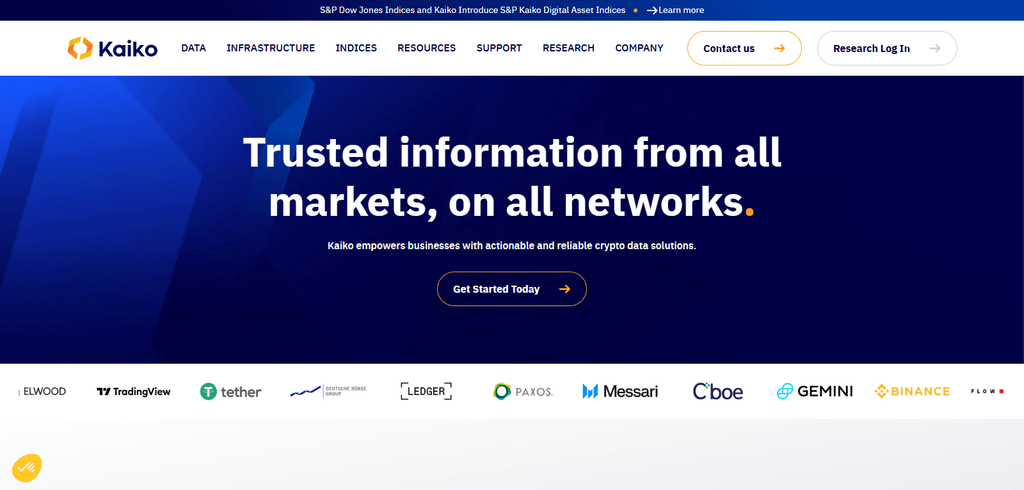
Their prices start at $1,500 for their Fair Market Value package and are $1,000 to $4,333 for the Market Explorer datasets. Kaiko is EU Benchmark Regulation compliant and has SOC-2 Type II certification to serve regulated banks and exchanges. Their data feeds are both centralized and decentralized. Kaiko has compliance-focused feeds across different markets and venues.
Kaiko
Features
- Level 1 and Level 2 cryptocurrency market data.
- Exchange trade and order-book information.
- Spot and derivatives market coverage.
- Liquidity and market-depth analytics.
- Digital-asset benchmarks and reference pricing.
Pros
- Strong focus on institutional market data.
- Excellent for liquidity analysis.
- Useful for trading and risk teams.
- Detailed exchange-level information.
- Supports granular market-data requirements.
Cons
- Primarily targeted at professional users.
- Advanced datasets can require specialized integration.
- High-volume data usage may increase costs.
- Extensive functionality can be complex.
- Smaller institutions may not need every dataset.
3. Glassnode
Glassnode is an on-chain analytics company with 1700+ metrics and 1500+ assets provided via Glassnode Studio and APIs. Glassnode’s methodology uses wallet address clustering to analyze on-chain behavior, HODL waves, and realized profits and losses. Glassnode is bootstrapped, which means they have not taken any outside funding, and instead, they rely on subscriptions for revenue.
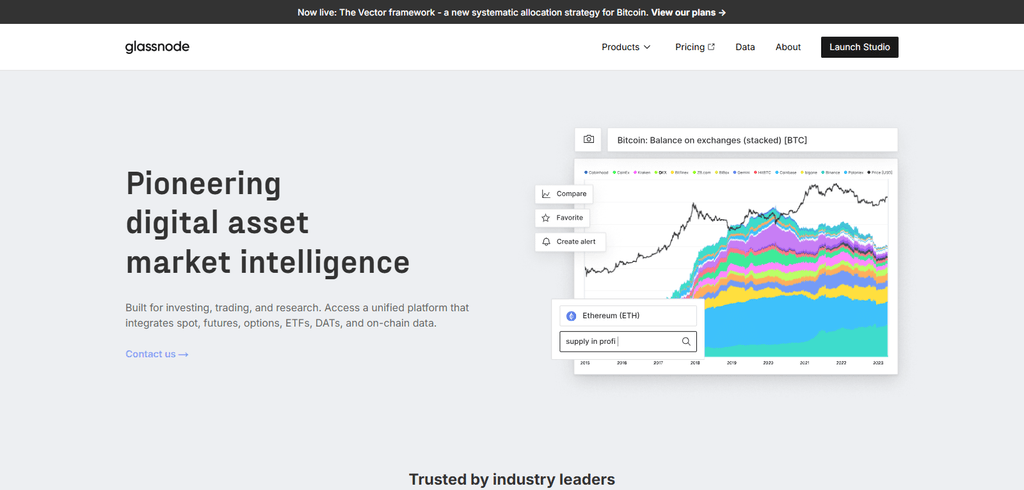
The subscriptions have a free option, which gives limited on-chain metrics, while Glassnode Advanced and Professional plans have a price range of $29–$799/month depending on the provided API and data history. Glassnode has 500+ institutional clients and is known for its behavioral on-chain analytics over the traditional count of transactions.
Glassnode
Features
- Blockchain network and market metrics.
- Exchange inflows and outflows.
- Investor profitability metrics.
- Supply and holder behavior analysis.
- API access to on-chain time-series data.
Pros
- Excellent blockchain analytics.
- Useful for institutional investment research.
- Signal extraction for market cycles.
- Supports extensive metrics research.
- Integration of network and market data.
Cons
- Some blockchain analytics knowledge needed.
- Not designed primarily as a compliance tool.
- Less focus on raw trading tools.
- More complex analytics can have a learning curve.
- Some institutions may require additional data sources.
4. Messari Pro
Messari, founded in 2018 in New York, by Ryan Selkis and Dan McArdle, relies on its research-led approach to gather on-chain data, token unlocks, fundraises, and sentiment analysis for over 40,000 assets.
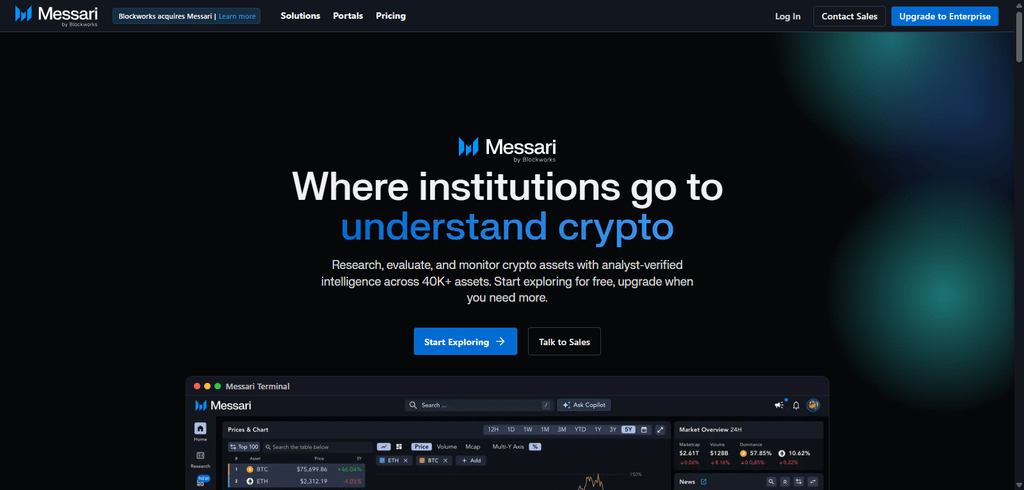
The Enterprise plan is priced at $5,000/year, which is a dedicated plan for research, diligence, and data via the API. Messari’s Series B (2022) was its most notable funding round, which totaled $35M, but Messari was acquired by Blockworks in 2026 for $10M, showing the pressure Messari was under in the market.
Funds and exchanges rely on Messari Pro for protocol-level insights. Its annual Mainnet conference adds to its popularity. Its differentiating advantage is the combination of datasets and deep analyst research.
Messari Pro
Features
- Digital-asset research reports.
- Comprehensive cryptocurrency and protocol reports.
- Market and ecosystem reports.
- Asset research for investment objectives.
- Platforms for research and due-diligence.
Pros
- Excellent qualitative research.
- Value for investment committees.
- Simplifies digital-asset due diligence.
- Allows for project and sector comparisons.
- Integrates research with asset data.
Cons
- Less useful for high-frequency market data.
- May need additional quantitative research.
- Not designed for in-depth blockchain research.
- More institutional research can be expensive.
- Complementary data for trading may also be needed.
5. Chainalysis
Chainalysis was established in 2014 in New York as the pioneer of blockchain forensics and compliance tools. Since then, the company built Reactor, KYT, and Crypto Incident Response. Chainalysis provides services to law enforcement and banking sectors all over the globe with contracts that span over 70 nations.
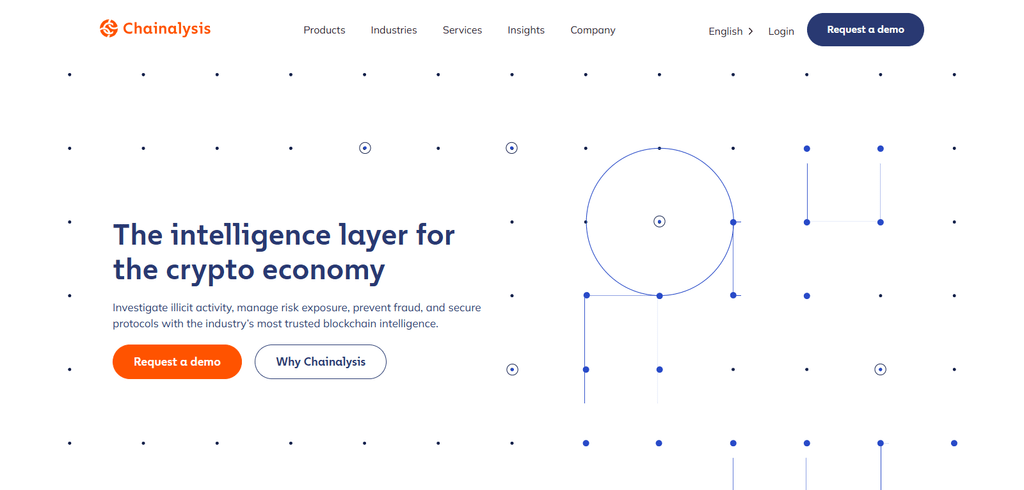
Chainalysis maintains a competitive edge through a proprietary database that links blockchain addresses to physical entities. Pricing is a company secret, and it’s estimated that customers pay at least $50K annually for its services. In 2021, Chainalysis captured $100M in funding and a $2B valuation. The company dominates the industry and is used by organizations conducting AML/KYC compliance and crypto crime investigations.
Chainalysis
Features
- Blockchain transaction intelligence.
- Wallet and entity identification.
- Cryptocurrency risk scoring.
- Transaction monitoring capabilities.
- Investigative and fund-tracing tools.
Pros
- Strong fit for regulated financial institutions.
- Useful for AML and transaction-risk programs.
- Supports blockchain investigations.
- Helps identify suspicious transaction patterns.
- Valuable for compliance and risk teams.
Cons
- More focused on compliance than market pricing.
- Not designed as a primary trading-data feed.
- Implementation may require specialist teams.
- Advanced investigation workflows can be complex.
- Financial institutions may need separate market-data providers.
6. CryptoCompare
Founded in 2014 by Charles Hayter and Vlad Cealicu, CryptoCompare is an FCA-authorized Benchmark Administrator providing data for over 5,300 cryptocurrencies and 240,000 trading pairs. They use their own proprietary benchmark, the CCCAGG, which is widely used in the crypto industry for trading and financial products.
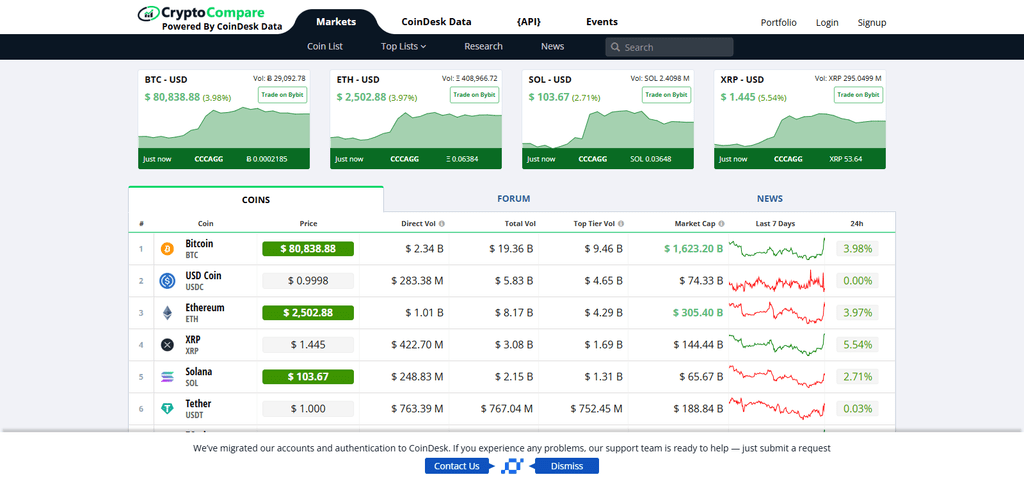
They provide free data for non-commercial users while charging between $80 and $200 per month for commercial use, and offer various enterprise packages. CryptoCompare is a comprehensive data provider, integrating trading, order books, blockchain, and social data. Their main strength lies in their regulated benchmarks, and their focus on serving institutional clients.
CryptoCompare
Features
- Real-time crypto and market data
- Real-time exchange level data
- Historical crypto datasets
- Real-time market data feeds
- Crypto indices and market intelligence
Pros
- Market data coverage is good.
- Useful for financial applications.
- Suited for historical market assessments.
- Suitable for API-based applications.
- Provides several types of crypto market data.
Cons
- Focused more on market data.
- Less market focused for blockchain data.
- Advanced institutional clients will need further market analysis.
- Data usage scenarios should be matched carefully.
- Complex institutional workflows may require additional market data providers.
7. Amberdata
Shawn Douglass and Tongtong Gong started Amberdata in 2017. Amberdata offers APIs and its GVOL platform to deliver market, on-chain, and DeFi data and derivatives data. Amberdata covers over 1,000 exchanges and 500,000 trading pairs. Amberdata raised a total of $45M, including its $30M Series B Round in 2022 led by Knollwood Investment Advisory.
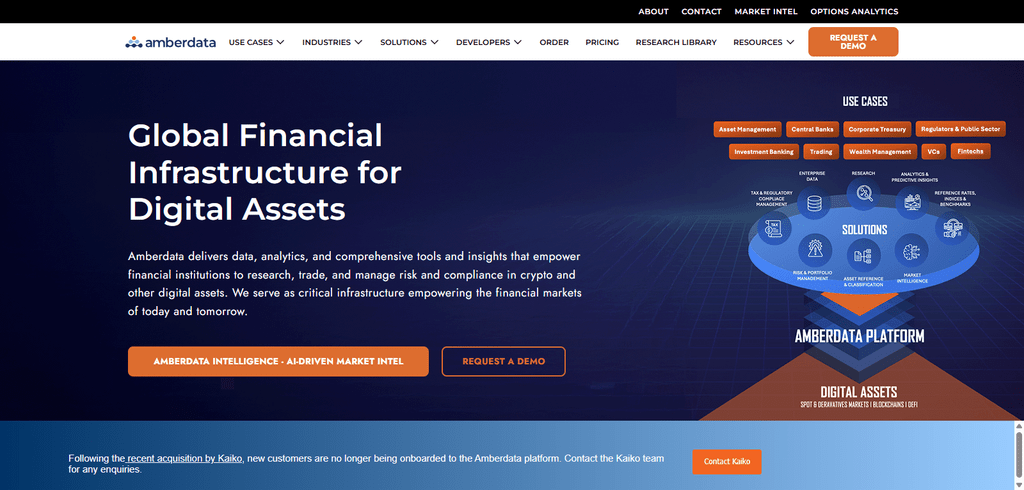
Amberdata offers tool pricing meant for enterprises, and has a pricing strategy for individual clients. In 2026, Kaiko acquired Amberdata. Amberdata specializes in derivatives analytics and offers unique capabilities in data and analytics focused on derivatives, which makes it a necessity for funds that engage in options and futures trading.
Amberdata
Features
- Real-time crypto market data
- On-chain blockchain datasets
- DeFi and liquidity analytics
- Derivatives market data
- APIs and cloud data delivery
Pros
- Market data and blockchain dataset integration.
- Strong coverage for DeFi (Decentralized Finance).
- Good for quantitative analyst research.
- Framework for data workflows.
- Suited for detailed derivatives analysis.
Cons
- Requires a lot of infrastructure for large datasets.
- Some features are possibly too advanced.
- Can require some technical work for integration.
- Can be complex for data workflows.
- A lot of data workflows require careful selection of datasets.
8. Lukka
Established in 2014 by Jake Benson, Lukka offers enterprise SaaS for digital asset data management and pricing for tax reporting. Based in NYC, it raised $209M across 9 rounds and had a $1.3B valuation in 2022. Products include Lukka Prime (pricing), Lukka Reference Data, and Enterprise Data Management SaaS used by clients State Street and S&P Global.
Pricing is offered at the enterprise level to funds, auditors, or regulators. Lukka provides differentiation within the market by offering data that’s ready to support an audit with SOC 1/2 Type II compliance. This data and capability supports the reporting and reconciliation of NAV in institutional finance.
Lukka
Features
- Institutional digital-asset data.
- Structured cryptocurrency asset information.
- Digital-asset valuation support.
- Financial reporting-oriented data.
- Enterprise data solutions for crypto workflows.
Pros
- Designed around institutional requirements.
- Useful for accounting and finance teams.
- Structured datasets simplify analysis.
- Supports enterprise digital-asset operations.
- Valuable for financial reporting workflows.
Cons
- Less focused on high-frequency trading data.
- Not primarily designed for blockchain investigations.
- May require complementary market intelligence.
- Enterprise integration can require technical work.
- Basic crypto users may not need its institutional capabilities.
9. Santiment
Maksim Balashevich constructed Santiment as a behavioral analytics firm in 2016 in Zug, Switzerland. Sanbase is Santiment’s main offering, and combines on-chain flows, social data, developer data for more than 2,500 individual assets.
Santiment secured $12.2M through an ICO in 2017, which carried the sold-day SAN providing subscription value. Sanbase offers free access with prolonged delays, a $49/mo subscription for Sanbase Pro, and API access for enterprise packages.
Social sentiment tracking is Santiment’s differentiator as they analyze Twitter, Telegram, and GitHub for market psychology shifts. They are heavily used by hedge funds and retail traders for contrarian signal data.
Santiment
Features
- On-chain cryptocurrency metrics.
- Social-media sentiment indicators.
- Developer activity tracking.
- Token-holder behavior analytics.
- Market and behavioral intelligence.
Pros
- Combines on-chain and alternative data.
- Useful for market research.
- Strong sentiment-analysis capabilities.
- Helps identify emerging crypto trends.
- Provides behavioral signals beyond price data.
Cons
- Social data can contain significant noise.
- Not designed primarily for institutional market feeds.
- Sentiment metrics require contextual interpretation.
- Less focused on financial compliance.
- Professional institutions may need additional market infrastructure.
10. Nansen
Nansen was launched in 2020 in Singapore and was co-founded by Alex Svanevik, Evgeny Medvedev, and Lars Bakke Krogvig. They aggregate and analyze 500 million plus wallets across over 25 blockchains. They track whales, Smart Money movements and NFTs.
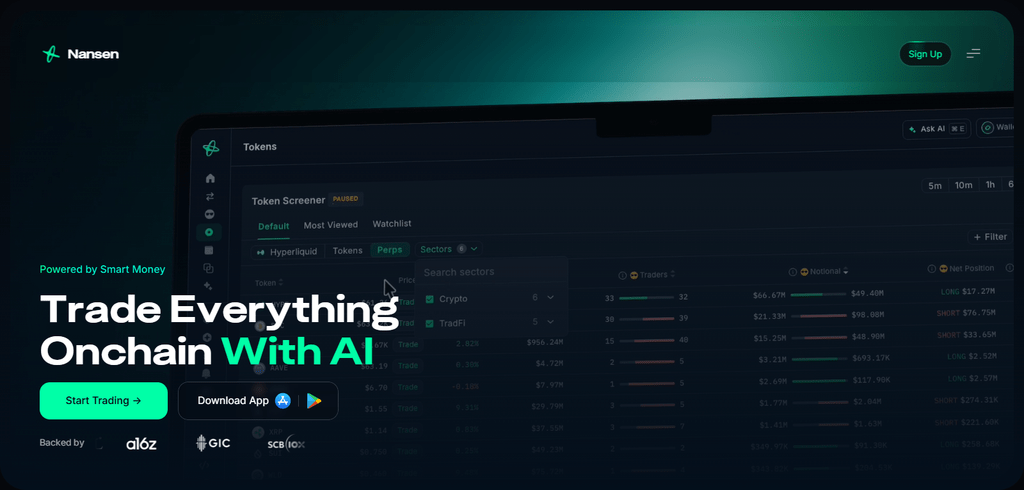
Nansen and its investors have a strong track record. In 2021, the company closed its Series B round at $75M with a valuation of $750M. This was led by Accel and a16z. Nansen counts many successful clients and charges them monthly subscription fees that range from $150 to $1,000 for an Enterprise subscription. Nansen allows clients to create online alerts for blockchain data events. Nansen released Nansen AI in 2025.
Nansen
Features
- Blockchain wallet intelligence.
- Smart-money wallet tracking.
- Token-flow analysis.
- DeFi ecosystem monitoring.
- On-chain portfolio and address analytics.
Pros
- Strong wallet-level visibility.
- Useful for tracking capital movements.
- Effective for DeFi research.
- Helps identify notable on-chain activity.
- Simplifies complex blockchain intelligence.
Cons
- Primarily focused on on-chain intelligence.
- Wallet labels require careful interpretation.
- Not a replacement for market-data benchmarks.
- Traditional financial institutions may need complementary datasets.
- Advanced on-chain analysis can require specialist knowledge.
Conclusion
The landscape of crypto data shows the sharp push into the institutional world of digital assets. While Coin Metrics concentrated on benchmarking pricing data, Kaiko focused on offering regulatory compliant data feeds. Glassnode created the space for behavioral data analytics, while Messari Pro, formerly Lyric, focused on research. Chainalysis built the compliance lens, CryptoCompare built the indexing lens,
Amberdata built the derivatives lens, Lukka built an audit ready SaaS, Santiment focused on sentimental data, and Nansen built wallet intelligence. Founded between 2014 and 2020, the firms are now serving hedge funds, exchanges, regulators, and enterprises. Their pricing models range from retail subscriptions to enterprise contracts, ensuring there is something in the market for all user tiers. Taken together, they provide the much needed institutional infrastructure of crypto market transparency and adoption.
FAQ
What is Coin Metrics?
Coin Metrics, founded in 2017, offers benchmark-grade on-chain and market data for institutions.
What does Kaiko provide?
Kaiko, founded in 2014, delivers regulated market feeds and derivatives data for banks and exchanges.
What is Glassnode known for?
Glassnode, founded in 2018, specializes in behavioral on-chain analytics and wallet clustering.
What is Messari Pro?
Messari Pro, launched in 2018, combines deep analyst research with structured crypto datasets.
What does Chainalysis do?
Chainalysis, founded in 2014, is the leader in blockchain forensics and AML/KYC compliance.