


This article will examine the Best Digital Asset Research Platforms for Institutional Investors in 2026. These platforms provide advanced analytics and compliance-ready data as well as AI-driven insights to help hedge funds, banks, and asset managers increase the sophistication of their investment decisions.
These tools provide a range of on-chain metrics and intelligence related to digital wallets, governance research, and analysis of sentiment. As such, they provide the trusted foundation on which firms stand as they approach the digital asset ecosystem.
Benefits Of Digital Asset Research Platforms
Complete Data Access: Institutions need to have access to thousands of coins, a variety of exchanges, wallets, and protocols in order to understand the entire market.
On-Chain Visibility: Glassnode and Nansen are two examples of companies that provide a blockchain research service with high levels of detail and even on-chain research and transaction liquidity.
Trust and Regulatory Compliance: Certifications such as SOC 2 and SEC‑registered advisory arms build trust and provide a high level of compliance with regulations.
Predictive Dashboards: AI-driven platforms help analyze markets with automation.
Counterparty Research: Arkham and IntoTheBlock help institutional clients with research on counterparties, illegal money flows, and market risks.
Fundamental Research: Messari and Delphi Digital have tools that help with fundamental research and tracking governance.
Investor Sentiment Research: Santiment provides fundamental research based on social sentiment along with on-chain data.
Premium Integration Tools: APIs, Bloomberg plug-ins, and enterprise workflows are integrated to provide seamless adoption for trading desks and funds.
Key Features Of Digital Asset Research Platforms
| Feature | Description | Institutional Value |
|---|---|---|
| On‑Chain Analytics | Tracks blockchain transactions, liquidity, and cycles. | Helps hedge funds and banks monitor market health. |
| Wallet Intelligence | Labeled addresses, smart money tracking, entity attribution. | Enables institutions to follow capital flows and counterparties. |
| Fundamental Research | Reports, governance tracking, disclosure frameworks. | Provides deep insights into protocol health and sustainability. |
| Financial Metrics | Income statements, balance sheets, valuation models. | Bridges traditional finance with DeFi analytics. |
| Market Data Coverage | Thousands of coins, exchanges, and chains tracked. | Ensures breadth of institutional data feeds. |
| Compliance Certifications | SOC 2, ISO, SEC‑registered advisory signals. | Builds trust and regulatory readiness for institutions. |
| AI Integration | Predictive dashboards, conversational querying, automation. | Future‑ready workflows for faster institutional decision‑making. |
| Sentiment & Behavioral Analytics | Social sentiment blended with on‑chain flows. | Helps anticipate market psychology and investor behavior. |
Key Points
- Lambda Finance — AI‑native multi‑asset research platform bridging crypto, equities, and macro data.
- Glassnode — Industry benchmark for on‑chain analytics with 200+ institutional metrics.
- Nansen — Real‑time wallet intelligence with 300M+ labeled addresses for capital flow tracking.
- Messari — Comprehensive subscription research with governance and fundamental insights.
- Token Terminal — Financial‑style analytics for DeFi protocols with revenue and valuation metrics.
- CoinGecko — Broadest market data coverage with SOC 2 Type II certified institutional API.
- Arkham Intelligence — AI‑powered entity attribution and forensic wallet intelligence.
- IntoTheBlock — Accessible AI dashboards combining on‑chain signals and institutional indicators.
- Delphi Digital — Premium macro and crypto theses tailored for institutional research.
- Santiment — Behavioral and sentiment analytics blending social and on‑chain data.
10 Best Digital Asset Research Platforms 2026
1. Lambda Finance
Lambda Finance, launched in 2023, is the first platform to provide institutional tier AI research for multi-asset trading across crypto, stocks, and macro markets.
Lambda Finance uses Conversational AI through MCP and automatically queries over 10,000 tickers with both historical and live data. With a free tier and enterprise pricing starting at $19/month, Lambda has made its product accessible while creating a product that can expand with its customers, specifically hedge funds and banks.
Still in the early stages of obtaining compliance certifications, Lambda Finance is building toward SOC 2 compliance, which will help the firm obtain trust from its institutional clients. The firm’s differentiator is its AI-driven workflow automation to integrate traditional finance and digital assets in one unified dashboard.
Lambda Finance Upsides & Downsides
Upsides:
- AI-enabled seamless workflows that transcend Crypto, Equities, and Macro.
- Querying done in a conversational manner through the MCP integration
- Affordable pricing tiers that begin at $19/month
- Real-time and historical coverage of over 10,000 tickers
- Integrates TradFi and DeFi within a single interface
Downsides:
- Early stage compliance certifications
- Less brand recognition when compared to existing players in the market
- Smaller client base from the Institutional side
- Coverage that is still expanding
- Requires IT to adjust for the AI workflows
| Unique Features |
|---|
| • Founded in 2023 as an AI‑native multi‑asset research platform. |
| • Covers crypto, equities, and macro data in one dashboard. |
| • Conversational querying via MCP AI integration. |
| • Pricing ranges from free tier to $19/month enterprise. |
| • Real‑time + historical coverage of 10,000+ tickers. |
| • Early compliance readiness, building toward SOC 2. |
| • Workflow automation bridging TradFi and DeFi. |
| • Designed for hedge funds and banks needing cross‑asset insights. |
2. Glassnode
Founded in 2018, Glassnode quickly grew the reputation of being the industry leader in on‑chain data analysis. Glassnode provides tiered pricing, ranging freely available data all the way up to a price of $699 USD a month for their institutional offering.
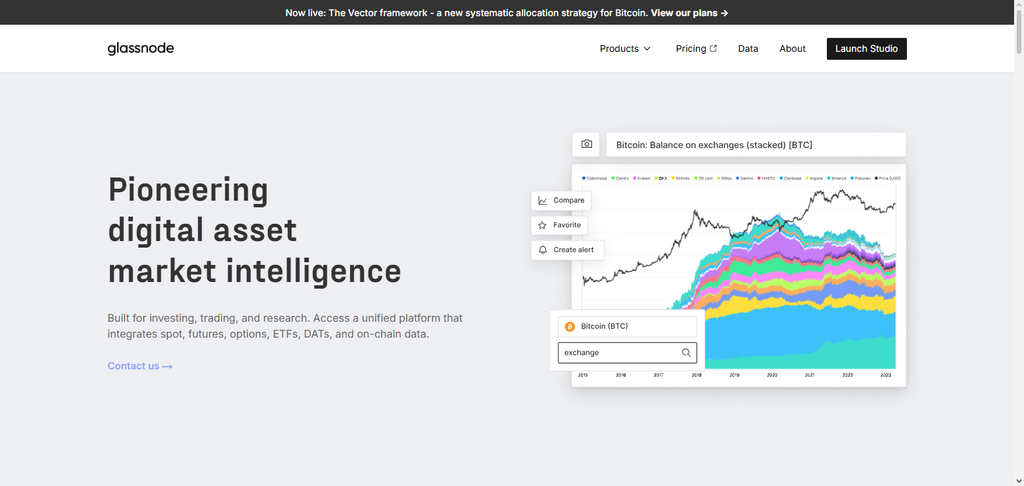
Their data spans over 3,500 metrics on 1,500+ assets and provides the user with over 15 years of historical data. They also offer enterprise grade solutions that have been validated by the granting of SOC 2 certification, which reflects the understanding Glassnode has for the compliance focus of regulated services.
Hedge Funds and other Asset Management firms utilize Glassnode’s offerings to perform cycle analysis, to manage liquidity and dashboard reporting. The breadth of digits asset analyses (specifically, BTC and ETH) is unique to Glassnode (among competitors), and therefore make it a necessity for funds with exposure to these assets.
Glassnode Upsides & Downsides
Upsides:
- Gold standard in on-chain analytics
- More than 3,500 metrics across 1,500 assets
- Enterprise grade SOC 2 certified hosting
- Deep BTC/ETH Cycle Analysis
- Trusted by banks and hedge funds
Downsides:
- Premium pricing that starts at $699+ per month
- Focused predominantly on BTC/ETH, with less altcoins
- Complex dashboards
- Limited TradFi integration
- Heightened institutional learning curve
| Unique Features |
|---|
| • Founded in 2018, benchmark for on‑chain analytics. |
| • Pricing from free tier to $699+/month institutional. |
| • 3,500+ metrics across 1,500+ assets. |
| • 15 years of historical blockchain data. |
| • SOC 2 certified, enterprise‑grade hosting. |
| • Institutional dashboards trusted by funds and banks. |
| • Deep BTC/ETH cycle analysis unmatched in industry. |
| • Used for liquidity monitoring and risk management. |
3. Nansen
In 2019, Nansen debuted with a specialization in wallet intelligence and on-chain entity tracking. Prices start at free options with advanced institutional features at $69 per month. The platform tracks over 500 million labeled wallets across 25+ blockchains, giving fund managers unmatched advantage if they choose to use the platforms.
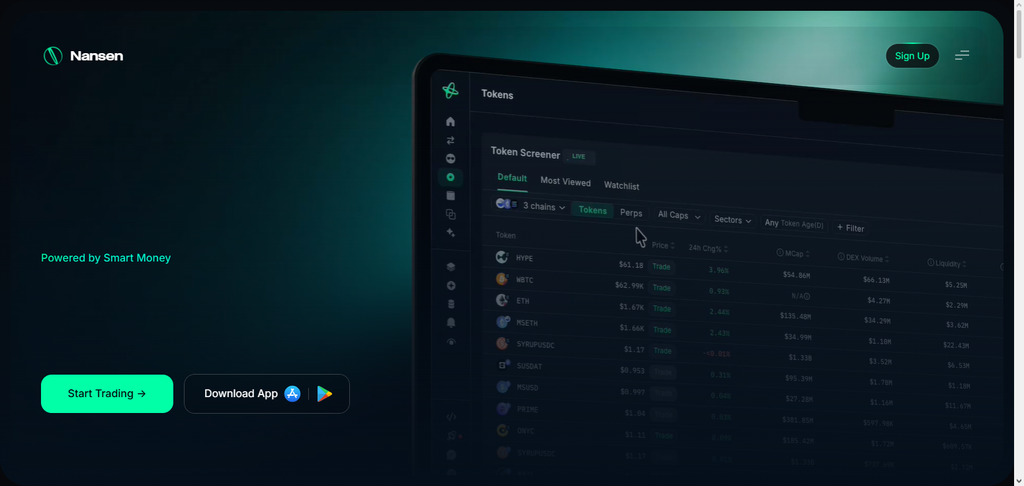
Nansen has built their product on Google Cloud’s BigQuery, offering institutional security and scalability. Strong compliance and enterprise integrations offer the flexibility for regulated fund flows. Nansen’s opportunity rests in their ability to track real-time “smart money” in DeFi and institutional investing flows. Asset Fund Managers rely on Nansen for real-time wholesale market sentiment.
Nansen Upsides & Downsides
Upsides:
- Over 500 million labeled wallets across 25+ chains
- Real-time tracking of “smart money”
- Google Cloud BigQuery as its underpinning technology
- Strong institutional security
- Scalable whale activity monitoring
Downsides:
- Cost can be high for advanced tiers
- High reliance on labeling accuracy of wallets
- Limited macro coverage
- Complex
- Less formalized compliance certifications
| Unique Features |
|---|
| • Founded in 2019, wallet intelligence leader. |
| • Pricing from free tier to $69/month advanced. |
| • 500M+ labeled wallets across 25+ chains. |
| • Real‑time “smart money” tracking. |
| • Built on Google Cloud BigQuery infrastructure. |
| • Institutional‑grade scalability and security. |
| • Capital flow monitoring for hedge funds. |
| • Whale activity and liquidity analysis at scale. |
4. Messari
Messari, founded in 2018, is a subscription-based research provider for detailed fundamental analysis of digital assets. Prices of packages are tailored for banks, funds, and exchanges. Messari researches more than 40,000 assets across 210+ exchanges which includes tracking of governance structures and creation of disclosure frameworks and long-form research reports.
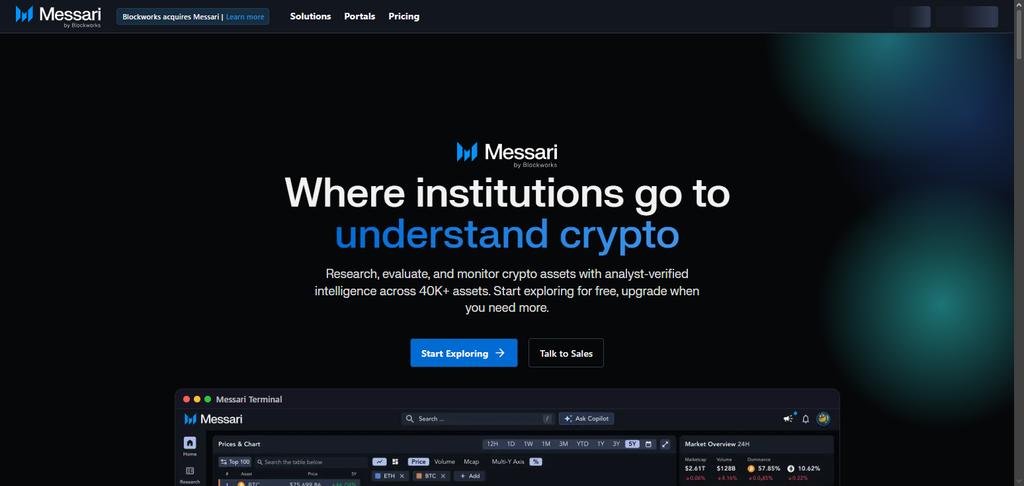
Messari has compliance partnerships and disclosure standards which makes it a preferred research provider for regulated institutions. This also is what makes Messari unique: the combination of fundamental analysis with governance monitoring draws critical investment. Blockworks acquisition of Messari further elevated Messari’s position in the institutional market as a leader in providing quality crypto research.
Messari Upsides & Downsides
Upsides
- Extensive governance and disclosure frameworks.
- Covers close to 40,000 assets.
- Long form institutional research.
- Significant compliance partnerships.
Downsides
- Breadth and depth of research dependent on partnerships.
- High price point (starting at $199/month).
- Complexity and limitation of coverage.
- Added reach from Blockworks acquisition.
| Unique Features |
|---|
| • Founded in 2018, subscription‑based research provider. |
| • Tiered pricing for institutional clients. |
| • Coverage of 40,000+ assets across 210+ exchanges. |
| • Governance tracking and disclosure frameworks. |
| • Long‑form institutional research reports. |
| • Compliance reinforced via partnerships. |
| • Acquired by Blockworks for expanded reach. |
| • Essential for protocol health and governance analysis. |
5. Token Terminal
In 2020, Token Terminal began providing analytics for DeFi protocols in a similar style to the finance sector. The pricing for institutional clients is customized, and the analytics focus on these clients. Token Terminal covers more than 100 blockchains, 1,200 decentralized applications, and 3,000 assets, and Equity Analysts find the data in the formats useful.
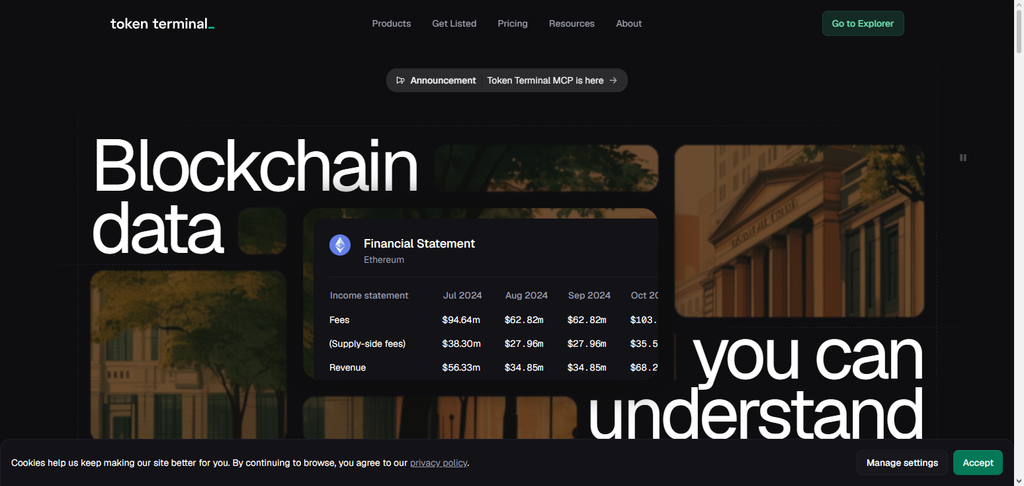
Token Terminal bolsters compliance by integrating Bloomberg and partnering with MarketVector, to enhance the institutional toolset. Token Terminal’s biggest selling point is demonstrating how crypto protocols have income, balance sheets, and valuation metrics to further merge traditional finance with digital currency.
Hedge funds and analysts can perform professional evaluations of DeFi projects using financial metrics rather than judgement metrics.
Token Terminal Upsides & Downsides
Upsides
- Financial statement-style analytics for DeFi.
- Covers 3000 assets across 100 chains.
- Institutional Bloomberg integration.
- MarketVector partnership for compliance.
- TradFi valuation models meet digital assets.
Downsides:
- Custom pricing may be high.
- Mainly focused on DeFi protocols.
- Insufficient macro data.
- Requires financial expertise.
- Fewer users than aggregators.
| Unique Features |
|---|
| • Founded in 2020, financial‑style analytics for DeFi. |
| • Custom pricing tiers for institutions. |
| • Tracks 100+ chains, 1,200 apps, 3,000 assets. |
| • Presents income statements and balance sheets. |
| • Bloomberg integration for institutional workflows. |
| • MarketVector partnership for compliance. |
| • Bridges traditional finance with crypto protocols. |
| • Used by analysts for valuation metrics. |
6. CoinGecko
Established in 2014, CoinGecko is one of the oldest reputable crypto data aggregators. Its pricing, which ranges from no-cost access to enterprise API subscriptions, caters to both retail and institutional investors. CoinGecko’s unmatched coverage includes 18,000+ coins, 1,500+ exchanges, and 200+ blockchains. A major strength is compliance.
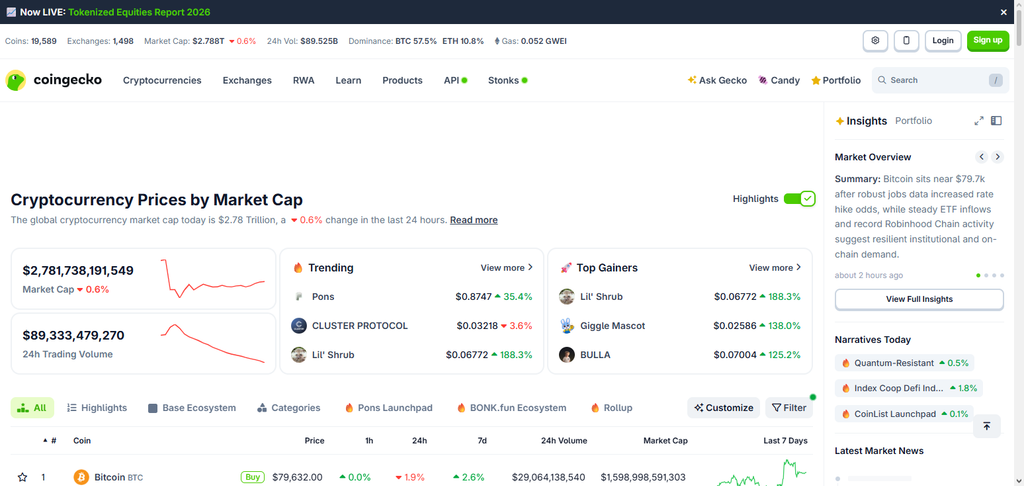
CoinGecko has SOC 2 Type II certification. This guarantees an enterprise level of reliability. CoinGecko independance differentiates it from competitors. CoinGecko retains neutrality from exchanges unlike its competitors. Institutions utilize CoinGecko’s certified API which offers reliable data for trading, risk management, and compliance.
CoinGecko Upsides & Downsides
Upsides :
- 18,000+ coins and 1,500 exchanges covered.
- SOC 2 Type II certified API.
- Free tier and enterprise tiers available.
- Independent and not affiliated with exchanges.
- Reliable global breadth of data.
Downsides:
- Requires financial knowledge and more depth in institutional dashboards.
- Less governance or fundamental research.
- API customization may require IT support.
- SOC 2 only for compliance.
- Focused more on breadth than depth and advanced analytics.
| Unique Features |
|---|
| • Founded in 2014, oldest independent aggregator. |
| • Free access plus enterprise API subscriptions. |
| • Covers 18,000+ coins, 1,500 exchanges, 200+ chains. |
| • SOC 2 Type II certified API. |
| • Neutral, unaffiliated with exchanges. |
| • Reliable enterprise‑grade data feeds. |
| • Used by trading desks and compliance teams. |
| • Global breadth unmatched in crypto data. |
7. Arkham Intelligence
Established in 2020, Arkham Intelligence is a provider of blockchain attribution and forensic intelligence services. Pricing is flexible from free to about $150 charged monthly for premium access. Arkham Intelligence covers blockchain entity mapping and attribution of wallets and their unique Intel Exchange marketplace.
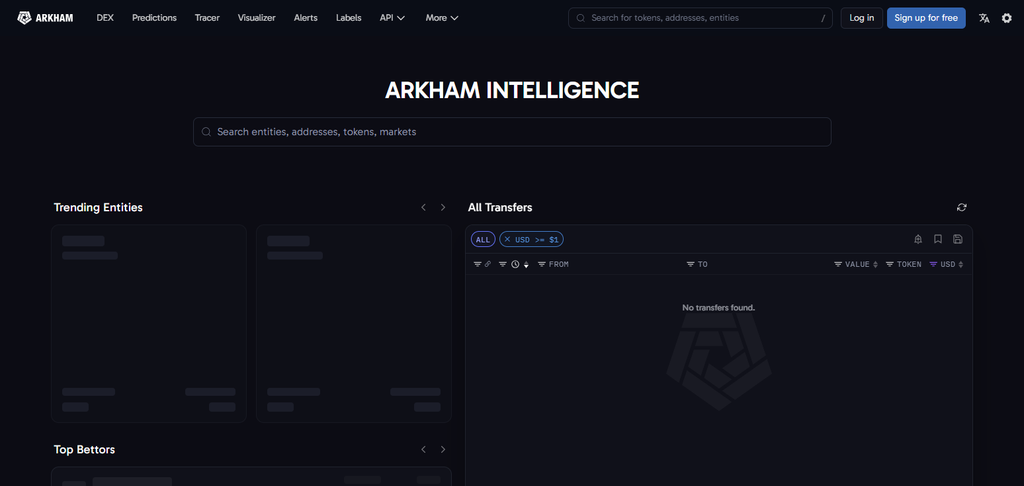
Compliance is an important element of the business with the use of AI to deanonymize transactions creating both ethical dilemmas and the potential for more institutional transparency. Arkham Intelligence’s competitive advantage is its ability to use AI to relate blockchain transactions to underlying individuals thereby enabling institutions to conduct forensic investigations.
Funds and regulators get access to a powerful tool that enables them to track funds transfers with a high degree of certainty and enhance surveillance for compliance.
Arkham Intelligence Upsides & Downsides
Upsides :
- AI-based entity attribution and de-anonymization.
- Intel Exchange for data access.
- Multi-chain wallet attribution.
- Used for forensic data investigations.
- Used for counterparty surveillance for institutions.
Downsides:
- Controversial de-anonymization methodology.
- Evolving compliance framework.
- Limited macro coverage or sentiment.
- Premium product (150 USD per month).
- Privacy concerns limit adoption.
| Unique Features |
|---|
| • Founded in 2020, entity attribution specialist. |
| • Pricing from free tier to $150/month premium. |
| • Multi‑chain wallet attribution and deanonymization. |
| • Intel Exchange marketplace for data. |
| • AI‑powered forensic blockchain intelligence. |
| • Controversial but valuable for transparency. |
| • Used for compliance and illicit flow tracking. |
| • Institutional monitoring of counterparties. |
8. IntoTheBlock
Launched in 2018, IntoTheBlock empowers its clients with AI‑powered dashboards that integrate on‑chain and institutional data. It offers enterprise clients pricing based on the advanced nature of its analytics. The platform has over 500 digital assets and provides over 260 AI-based indicators, from on‑chain liquidity to predictive signals.

The acquisition of Sentora introduced the platform to the compliance challenges and opportunities existing in the institutional DeFi space. IntoTheBlock’s edge in the market is the simplicity of its dashboards, which helped institutions adopt complex analytics.
The company provides institutions, including banks and hedge funds, with actionable insights relating to market sentiment and liquidity and risk with AI and blockchain analytics.
IntoTheBlock Upsides & Downsides
Upsides
- Predictive dashboards powered by AI.
- 260+ institutional indicators.
- 500+ assets covered.
- Focused on institutional adoption.
- Synergies from Sentora merging have increased compliance.
Downsides:
- Custom pricing with high potential cost.
- Limited governance data coverage.
- More focused on signals than fundamentals.
- Smaller coverage with less institutions.
- Needs AI expertise.
| Unique Features |
|---|
| • Founded in 2018, AI‑powered analytics provider. |
| • Custom pricing tiers for institutions. |
| • Covers 500+ assets with 260+ indicators. |
| • Predictive dashboards simplifying analytics. |
| • Merger with Sentora strengthened compliance. |
| • Accessible design for institutional adoption. |
| • Liquidity and sentiment monitoring. |
| • Risk analysis powered by AI signals. |
9. Delphi Digital
Delphi Digital was founded in 2018 to provide macro and crypto-specific research for institutions. They offer different tiers of pricing for their Pro and Pro+ plans for funds and companies respectively. Delphi Digital publishes more than 700 reports per year.
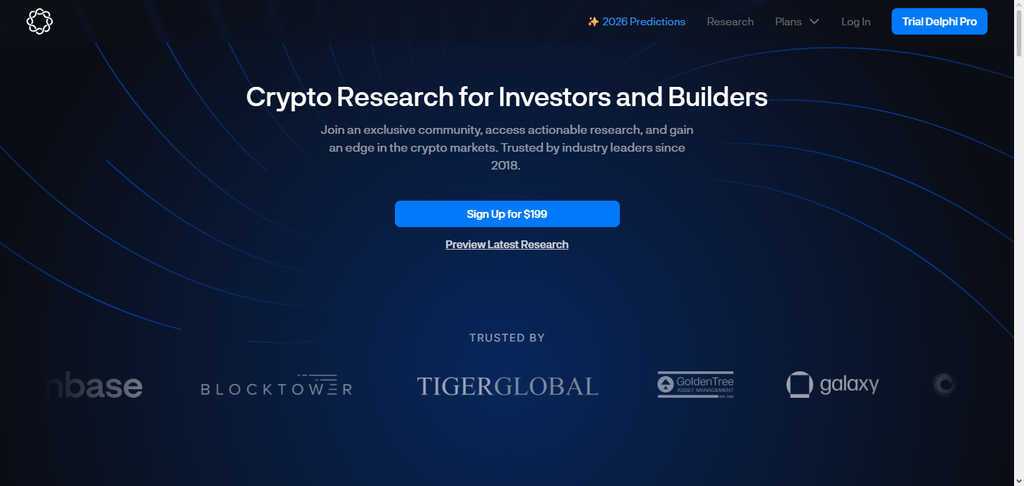
This includes research on ETFs, governance, and macro research. Delphi Digital reinforces its compliance with its advisory arm, Delphi Ventures, which is an SEC registered advisor. Their unique edge is their integration of research, venture capital, and labs.
This unique combination gives investors access to cutting edge insights and research. For institutions, Delphi Digital publishes detailed research reports that provide deep research on digital assets, thus making them an essential resource for institutions making strategic asset allocations.
Delphi Digital Upsides & Downsides
Upsides :
- 700+ reports released annually.
- Covers ETFs, governance, macro trends.
- SEC-registered advisory arm.
- Research, venture, and labs integrated.
- Theses drafted for allocation directed towards long-term approaches.
Downsides:
- More premium subscription costs.
- Leans more toward the research side of dashboards.
- Few real-time analytics.
- Reports may be published with too much niche focus.
- Slower to publish reports than aggregators.
| Unique Features |
|---|
| • Founded in 2018, premium research firm. |
| • Pro and Pro+ subscription tiers. |
| • Produces 700+ reports annually. |
| • Covers ETFs, governance, macro trends. |
| • SEC‑registered advisory via Delphi Ventures. |
| • Blend of research, venture, and labs. |
| • Long‑form theses guiding allocations. |
| • Institutional credibility with compliance backing. |
10. Santiment
Santiment began formal operations in 2016 as a behavioral and sentiment analytics firm for digital assets. Free tiered access and subscription plans starting at $49 per month are available. The platform analyzes over 2,500 assets and provides 1,100 metrics and 75 million labeled addresses. Santiment integrates social media sentiment and on-chain data to fill gaps in traditional analytics.
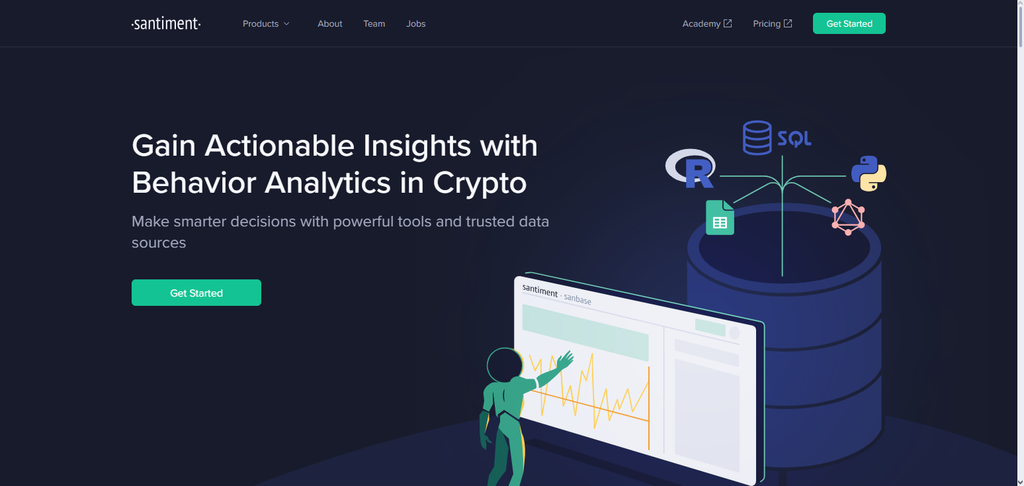
Compliance for the SAN Token governance structure ensures transparency and community control. Santiment claims to offer a first of its kind, market psychology and blockchain analytics integration, to explain the reasoning and rationale of market participants. Santiment’s institutional clientele gains access to sentiment data and predicts market movements from beyond on-chain metrics.
Santiment Upsides & Downsides
Upsides :
- Analytics for behavioral data and social sentiment combined with on-chain data.
- 2,500+ assets, 1,100 metrics collected.
- 75M+ labeled addresses.
- SAN token governance offers assurance.
- Psychological aspects of the market are analyzed.
Downsides:
- High pricing with a premium subscription starting at $49+/month.
- Less compliance certification as compared to competitors.
- Less coverage of macro economics.
- More focused on sentiment than fundamentals.
- Smaller client base among institutions.
| Unique Features |
|---|
| • Founded in 2016, behavioral analytics pioneer. |
| • Pricing from free tier to $49+/month premium. |
| • Covers 2,500+ assets, 1,100 metrics. |
| • 75M+ labeled addresses for sentiment tracking. |
| • SAN token governance model for transparency. |
| • Combines social sentiment with on‑chain flows. |
| • Unique focus on market psychology. |
| • Helps institutions anticipate sentiment shifts. |
Conclusion
By 2026, institutional investors will have more digital asset research platforms to select from. Each of these platforms will have its unique advantage across on-chain analysis, wallet analytics, fundamental research, financial data, and sentiment analysis. Some of these platforms will be Glassnode with their SOC-certified on-chain dashboards.
Others will be Nansen with the best wallet labeling and Messari with their governance driven reports. Some of these new platforms will have AI-based workflows like Lambda Finance, and some of the older platforms will focus more on enterprise-level reliability like CoinGecko.
One thing will remain the same: there won’t be a single platform that will address all the needs, so the best results will come from the completion of specialized services. This will lead to increased confidence in satisfying compliance obligations and greater confidence in creating digital asset strategies for the future.
FAQ
What is a digital asset research platform?
A digital asset research platform provides institutional investors with analytics, reports, and compliance‑ready data on cryptocurrencies, DeFi protocols, and blockchain activity.
Which platform is best for on‑chain analytics?
Glassnode is considered the gold standard, offering 3,500+ metrics and SOC 2 compliance for institutional use.
Which platform offers the widest market coverage?
CoinGecko covers 18,000+ coins, 1,500 exchanges, and 200+ blockchains, with SOC 2 Type II certification for enterprise reliability.
Which platform is strongest in wallet intelligence?
Nansen leads with 500M+ labeled wallets across 25+ chains, enabling real‑time institutional capital flow tracking.
Do these platforms provide compliance certifications?
Yes. Platforms like CoinGecko and Glassnode are SOC 2 certified, while Delphi Digital operates under SEC‑registered advisory compliance.