


This article highlights the Best Decentralized OTC Desks for Slippage-Free Swaps. Advanced DeFi users and institutions operating in the crypto space will find these desks helpful to facilitate smoother transactions.
These desks address DeFi’s issues with slippage and augment access to liquidity across blockchain networks and automated decentralized venues.
What Are Decentralized OTC Desks?
Decentralized OTC desks are blockchain trading systems that let users carry out big crypto trades directly without a centralized system or traditional order books.
Opting for a decentralized OTC means forgoing public trading systems to rely on alternative techniques for executions, such as smart order routing, batch auctions, or peer-to-peer RFQs.
The major focus of decentralized OTC desks is the needs of the substantial investors and traders: cutting slippage and doing the least amount of market impact while offering price assurance.
With decentralized systems, liquidity is drawn from different pooled decentralized OTC desks and integrated market makers, giving participants trading systems that are cost-effective and easy to use while taking the least amount of custodial trading risks.
Why Slippage-Free Swaps Matter
Preserves Trader Value: Trades are always executed at the expected price removing the risk of losing expected value due to volatility when large orders are fulfilled.
Required for Large Order Fulfillment: The large liquidity executions of institutional clients/whales result in a significant financial impact across the order fulfillments (slippage).
Price Forecasting Enhancements: Trading models with fixed or extremely small outcomes of slippage are price certain, thereby creating more certain and easier to execute trade models.
Reduces Larger Order/Slippage Market Impact: Large orders executed with slippage also reduce the larger impact on order fulfillment and increases larger order price certainty.
Increased Efficiency: Traders are more likely to be able to execute orders closer to the ideal price (optimal order fulfillment) without hidden costs of slippage.
Facilitates Greater Institutional Trading: Slippage models are preferred by hedge funds/DAOs for improved risk control and predictable trade fulfillment.
Comparative Analysis
To compare decentralized OTC desks, we examine their methods of handling liquidity, execution speed, slippage minimization, and cross-chain capabilities. Aggregators such as Matcha, ParaSwap, and OpenOcean commit resources toward sourcing liquidity across many DEXs. CowSwap and similar protocols target MEV and batch auction efficiency.
Other models, like RFQ-based systems and AirSwap, are also targeted at slippage. Constructing design features around intent is another approach within decentralized systems, like the 1inch Fusion model, where resolver competition results in optimized pricing.
Decentralized systems employing cross-chain capabilities, such as Symbiosis OTC, also construct their features around intent. Each system requires a control liquidity depth versus execution certainty trade-off.
Key Point & Best Decentralized OTC Desks for Slippage-Free Swaps
- CowSwap – Batch auctions system that enables MEV-protected, gas-efficient token swaps at fair market clearing prices.
- Matcha – Aggregator-powered OTC-style trading interface offering best price routing across multiple DEX liquidity sources.
- ParaSwap – Advanced liquidity aggregator optimizing token swaps with split routing and reduced slippage across DeFi markets.
- 1inch Fusion – Intent-based swap model combining resolvers and MEV protection for gasless, slippage-optimized trades.
- OpenOcean – Cross-chain liquidity aggregator providing unified access to DEXs and CEXs for best execution pricing.
- KyberSwap Elastic – Concentrated liquidity AMM enabling efficient swaps with dynamic fee and capital-efficient liquidity pools.
- Hashflow – RFQ-based DEX protocol offering quote-driven, zero-slippage swaps with guaranteed pricing from market makers.
- AirSwap – Peer-to-peer OTC trading protocol enabling direct wallet-to-wallet token swaps without order books.
- Symbiosis OTC – Cross-chain liquidity and swap protocol focusing on seamless bridging and OTC-style execution across networks.
- Balancer OTC – Vault-based liquidity system supporting private OTC trades with customizable pools and automated price balancing.
10 Best Decentralized OTC Desks for Slippage-Free Swaps
1. CowSwap
CowSwap is a decentralized exchange that uses batch auctions and MEV protection to completely remove slippage in a trade. Orders are aggregated to form “Coincidence of Wants” (CoW) where traders can exchange tokens with a clearing price that is most optimal and least subject to front-running.
On top of that, gas is saved because multiple orders are settled at one time, as opposed to several individual orders that need to be settled. This protocol is the most useful for institutional trade where large volumes of a token need to be traded and the price shouldn’t fluctuate so much.
CowSwap is known as one of the Best Decentralized OTC Desks for Slippage-Free Swaps because of the execution quality, liquidity, and insignificant effect on the market.
CowSwap Features, Advantages & Disadvantages
Features
| Feature | Details |
|---|---|
| Batch Auctions | Groups orders for optimal settlement price |
| MEV Protection | Prevents front-running and sandwich attacks |
| Coincidence of Wants | Direct order matching between users |
| Gas Efficiency | Reduces gas costs via batch execution |
Advantages
| Advantage | Details |
|---|---|
| Zero Slippage Execution | Trades settle at fair clearing price |
| Strong MEV Resistance | Protects institutional trades |
| Better Price Discovery | Aggregated order flow improves pricing |
Disadvantages
| Disadvantage | Details |
|---|---|
| Limited Liquidity Depth | Compared to large aggregators |
| Slower Execution Time | Batch settlement delays |
| Complex Mechanism | Less beginner-friendly |
2. Matcha
Matcha is a decentralized trading interface built atop the 0x protocol that enables users to trade with the most optimal prices by aggregating the liquidity of a multitude of decentralized exchanges. Matcha automates trade routing to minimize slippage.
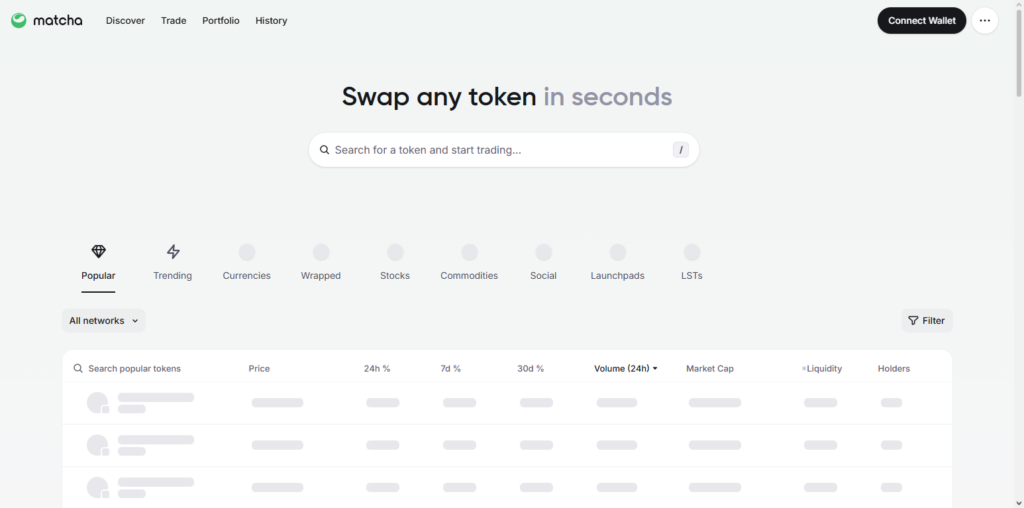
This interface offers great price efficiency along with advanced order types and transparent, commission-free pricing. Retail and institutional traders alike utilize Matcha in their token exchanges.
Matcha is a notable product in the Best Decentralized OTC Desks for Slippage-Free Swaps based on its usability and liquidity aggregation in the volatile DeFi marketplaces.
Matcha Features, Advantages & Disadvantages
Features
| Feature | Details |
|---|---|
| 0x Aggregation | Pulls liquidity from multiple DEXs |
| Smart Routing | Finds best execution path |
| Clean UI | Beginner-friendly interface |
| Price Comparison | Shows best available rates |
Advantages
| Advantage | Details |
|---|---|
| Easy to Use | Simple interface for all users |
| Good Price Execution | Aggregated liquidity reduces slippage |
| Transparent Pricing | No hidden execution fees |
Disadvantages
| Disadvantage | Details |
|---|---|
| Depends on DEX Liquidity | Performance varies with markets |
| No Native OTC Engine | Pure aggregation only |
| Limited Advanced Trading Tools | Not institutional-grade |
3. ParaSwap
ParaSwap is an innovative DeFi aggregator providing token swaps with optimal liquidity by dispersing orders. This technique maximally employs execution efficiencies while minimizing slippage.

By harnessing multiple DEXs, lending protocols, and liquidity pools, ParaSwap ensures its users achieve the most optimal pricing. ParaSwap also provides advanced APIs useful for institutional trading and DeFi integrations.
For large-volume trades, the smart routing engine of ParaSwap makes the best of its offering by reducing price impact. It is also featured in the Best Decentralized OTC Desks for Slippage-Free Swaps as a valid competitor thanks to its efficient execution of trades and optimal liquidity in an unpredictable market.
ParaSwap Features, Advantages & Disadvantages
Features
| Feature | Details |
|---|---|
| Smart Order Routing | Splits trades across pools |
| Multi-DEX Integration | Access to wide liquidity |
| API Support | Institutional integrations |
| Gas Optimization | Reduces transaction cost |
Advantages
| Advantage | Details |
|---|---|
| High Liquidity Access | Deep market routing |
| Efficient Execution | Low slippage swaps |
| Developer Friendly | Strong API ecosystem |
Disadvantages
| Disadvantage | Details |
|---|---|
| Complex Fee Structure | Hard for beginners |
| Market Dependency | Performance varies by liquidity |
| No Fixed Price Guarantee | Slippage still possible |
4. 1inch Fusion
1inch Fusion introduces an innovative swap model within the 1inch ecosystem. This model is hailed for its superior price optimization, secure transactions, and slippage reduction, along with the elimination of gas fees via intent-based trading.
Instead of the direct execution of an on-chain transaction, resolvers are incentivized to submit offers for the best price to fill users’ orders. Thanks to its enticing features, 1inch Fusion has landed a position in the Best Decentralized OTC Desks for Slippage-Free Swaps because of its gasless transactions and secure DEX trading.
1inch Fusion Features, Advantages & Disadvantages
Features
| Feature | Details |
|---|---|
| Intent-Based Trading | Users sign swap intent |
| Resolver Competition | Market makers fill orders |
| Gasless Swaps | No user gas fees |
| MEV Protection | Secure execution layer |
Advantages
| Advantage | Details |
|---|---|
| Zero Gas Experience | Highly efficient UX |
| Strong Price Optimization | Competitive execution |
| Advanced MEV Protection | Institutional-grade safety |
Disadvantages
| Disadvantage | Details |
|---|---|
| Complex Backend Model | Hard to understand mechanics |
| Limited Direct Control | Relies on resolvers |
| Variable Execution Time | Depends on competition |
5. OpenOcean
OpenOcean is a cross-chain DeFi aggregator. It bolsters both decentralized and centralized liquidity sources best trading prices. It employs advanced algorithms that break transactions across channels to reduce slippage. OpenOcean is multi-chain.
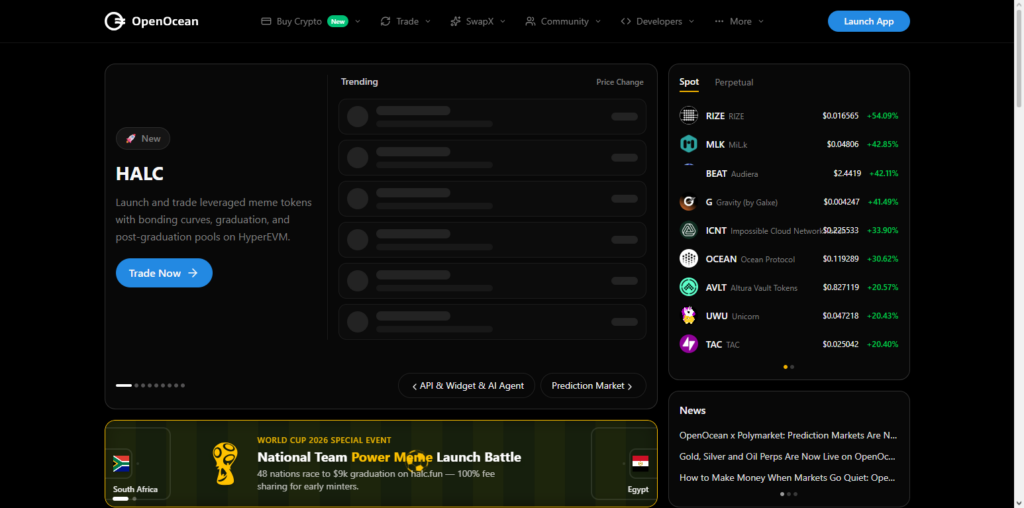
It offers liquidity across ecosystems. Additionally, it has trading tools and APIs for developers. Among the components of the Best Decentralized OTC Desks for Slippage-Free Swaps, OpenOcean is regarded for its hybrid liquidity, supportive cross-chain technology, and ability to offer aggressive pricing in the fragmented market.
OpenOcean Features, Advantages & Disadvantages
Features
| Feature | Details |
|---|---|
| Cross-Chain Aggregation | Supports multiple chains |
| CEX + DEX Integration | Hybrid liquidity sources |
| Smart Routing | Optimized trade execution |
| API Access | Developer tools |
Advantages
| Advantage | Details |
|---|---|
| Very Broad Liquidity | Combines CEX + DEX |
| Cross-Chain Swaps | Strong interoperability |
| Competitive Pricing | Best-route execution |
Disadvantages
| Disadvantage | Details |
|---|---|
| Centralized Elements | CEX integration risk |
| Complex Routing Logic | Less transparent |
| Network Dependency | Performance varies |
6. KyberSwap Elastic
KyberSwap Elastic is a concentrated liquidity AMM. It aims to improve capital efficiency and reduce the friction in a token swap. For allocating liquidity within a price range, a market can be deeper, though, and that results in narrow price differences, and a more favorable price to execute.
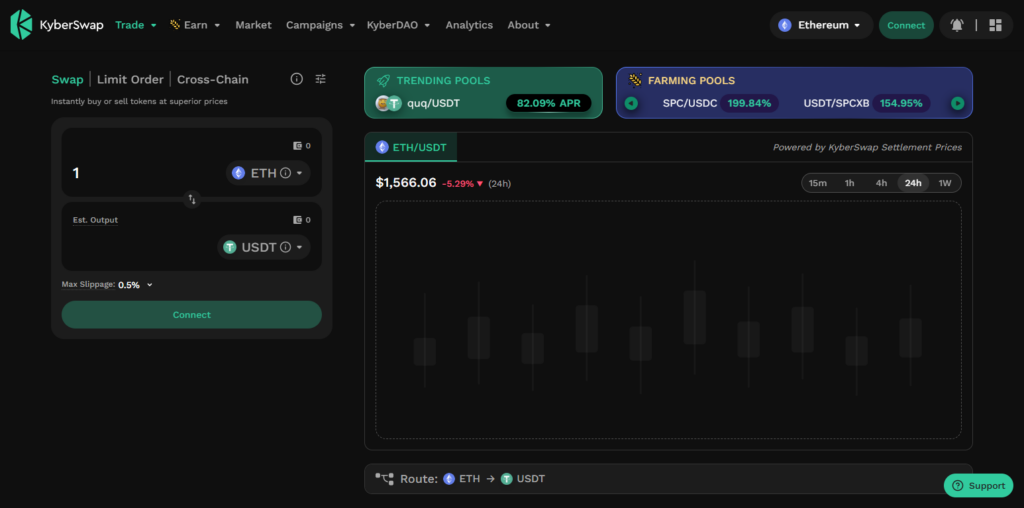
There is also a flexible fee system that adjusts to the changes in the market. KyberSwap Elastic is included in the Best Decentralized OTC Desks for Slippage-Free Swaps for its unique, efficient liquidity system, reduced price impact, and improved yields for liquidity providers.
KyberSwap Elastic Features, Advantages & Disadvantages
Features
| Feature | Details |
|---|---|
| Concentrated Liquidity | Liquidity in price ranges |
| Dynamic Fees | Adjusts to volatility |
| Capital Efficiency | Better LP returns |
| AMM Model | Automated trading pools |
Advantages
| Advantage | Details |
|---|---|
| Low Slippage Trades | Tight liquidity ranges |
| Higher LP Yield | Efficient capital use |
| Flexible Pools | Custom liquidity setup |
Disadvantages
| Disadvantage | Details |
|---|---|
| Complex LP Strategy | Hard for beginners |
| Impermanent Loss Risk | Still exists |
| Requires Active Management | For optimal returns |
7. Hashflow
Hashflow is a decentralized RFQ (Request For A Quote) protocol that allows users to trade without slippage. To achieve this, Hashflow combines off-chain price quoting with on-chain settlement. Market makers offering quotes results in set prices with no regard for market conditions.
This offers protection from MEV (Miner Extractable Value) and execution uncertainty. Hashflow enables cross-chain swaps without the usual bridging.
Due to its predictable pricing, Hashflow is used widely for institutional trading. Hashflow is featured in the Best Decentralized OTC Desks for Slippage-Free Swaps for its guaranteed pricing, zero slippage, and liquidity provider integration.
Hashflow Features, Advantages & Disadvantages
Features
| Feature | Details |
|---|---|
| RFQ Model | Market makers quote prices |
| Zero Slippage | Fixed execution price |
| Cross-Chain Swaps | Multi-chain support |
| On-Chain Settlement | Secure execution |
Advantages
| Advantage | Details |
|---|---|
| Guaranteed Pricing | No price impact |
| Institutional Friendly | Predictable execution |
| Strong Liquidity Providers | Reliable fills |
Disadvantages
| Disadvantage | Details |
|---|---|
| Market Maker Dependence | Liquidity-driven |
| Limited Token Coverage | Compared to aggregators |
| Less Decentralized Feel | RFQ reliance |
8. AirSwap
AirSwap is a decentralized OTC trading protocol with a peer-to-peer structure that enables trades of tokens directly from wallets with no intermediaries or need for order books.
AirSwap uses an RFQ model in which the parties to trade negotiate prices in an off-chain setting and execute the trade in on-chain. AirSwap eliminates slippage and decreases market exposure during trade execution.
AirSwap is used frequently for private trading of large amounts of tokens due to its efficiency. AirSwap is also featured in the Best Decentralized OTC Desks for Slippage-Free Swaps for its focus on privacy, direct trading, and decentralized OTC trading.
AirSwap Features, Advantages & Disadvantages
Features
| Feature | Details |
|---|---|
| P2P Trading | Wallet-to-wallet swaps |
| RFQ System | Off-chain price negotiation |
| No Order Books | Direct matching |
| OTC Focus | Large private trades |
Advantages
| Advantage | Details |
|---|---|
| High Privacy | No public order flow |
| Zero Slippage | Pre-agreed pricing |
| OTC Efficiency | Ideal for large trades |
Disadvantages
| Disadvantage | Details |
|---|---|
| Low Liquidity | Depends on counterparties |
| Manual Matching | Less automation |
| Slower Execution | Negotiation required |
9. Symbiosis OTC
Symbiosis OTC is a decenteralized cross-chain liquidity protocol allowing customizable token trades across blockchains with cross-chain minimal slippage. Combining both a bridge and an exchange all in one, it eliminates the complexity and lags of multiple transactions.

Symbiosis also combines cross-chain liquidity from multiple blockchains, saving users time and money, and empowering them to execute all of their trades in one place.
This protocol is a perfect addition to any multi-chain DeFi platform that enables the optimal trade of capital. In terms of all the cross-chain liquidity protocols, Symbiosis OTC is the best for achieving cross-chain capability and ease of transaction with robust liquidity.
Symbiosis OTC Features, Advantages & Disadvantages
Features
| Feature | Details |
|---|---|
| Cross-Chain Swaps | Multi-chain liquidity |
| Bridge + Swap Combo | Single transaction flow |
| Aggregated Liquidity | Multiple sources |
| Simplified UX | One-click swaps |
Advantages
| Advantage | Details |
|---|---|
| Easy Cross-Chain Trading | Seamless execution |
| Reduced Complexity | No manual bridging |
| Faster Settlement | Unified process |
Disadvantages
| Disadvantage | Details |
|---|---|
| Bridge Risk Exposure | Cross-chain dependency |
| Limited Depth in Some Chains | Liquidity varies |
| Still Evolving Protocol | Early-stage maturity |
10. Balancer OTC
Utilizing the Balancer liquidity, Balancer OTC provides private token swaps, as well as large-volume trades.
The flexible pool architecture of Balancer provides users the ability to carry out OTC trades with minimal slippage and a mitigated price impact.
Automated rebalancing assists trade execution in a timely manner. Balancer OTC is flexible enough to carry out highly detailed trades that are easily impacted due to a lack of liquidity.
Among the other decentralized OTC desks, Balancer OTC is the most favorable because it has a programmable liquidity system that can be executed with a high degree of flexibility. Flexible liquidity and slippage make Balancer OTC a premier DeFi desk.
Balancer OTC Features, Advantages & Disadvantages
Features
| Feature | Details |
|---|---|
| Custom Pools | Programmable liquidity |
| Multi-Asset Support | Flexible asset baskets |
| Automated Rebalancing | Maintains pool ratios |
| Vault Architecture | Efficient liquidity handling |
Advantages
| Advantage | Details |
|---|---|
| Highly Flexible OTC | Custom trade structures |
| Efficient Large Trades | Reduced slippage |
| Strong DeFi Integration | Deep ecosystem usage |
Disadvantages
| Disadvantage | Details |
|---|---|
| Complex Setup | Advanced configuration needed |
| Smart Contract Risk | Vault-based exposure |
| Not Beginner Friendly | Requires DeFi knowledge |
Future of Decentralized OTC Trading
Decentralized OTC trading will likely incorporate liquidity integrations, sophisticated execution models, and more accessible trading methodologies as institutional adoption trends grow within the crypto space. With OTC systems will shift to intent-based design.
In systems like these, users will communicate the objective of their trade, and automated market makers will vye to be the optimal execution provider with the least amount of slippage.
Expect cross chain systems to enable the transfer of assets across multiple networks without relying on the legacy systems of crypto-bridges. Improved protection from MEV (or miner’s extractable value) will create a trading environment that is more fair and efficient.
Alongside these developments, AI-based pricing strategies, and real-time liquidity systems will provide optimal trade execution.
Decentralized OTC trading will accomplish a highly automated state with a capital efficient design. The OTC trading networks will provide an adequate system to meet the demands and requirements of institutions and the global OTC trading networks.
Conclusion
Thanks to decentralized OTC desks, large-scale and institutional crypto traders can sidestep the challenges offered by existing crypto infrastructures, such as slippage, front running, and liquidity fragmentation. Now, decentralized OTC desks have emerged as the preferred infrastructure layer for these crypto traders. Platforms such as CowSwap, Matcha, ParaSwap, 1inch Fusion, work with advanced mechanisms (for example, batch auctions, RFQ pricing, intent-based execution, and cross-chain liquidity aggregation) in order to guarantee superior trade outcomes. More than one of these OTC desks can work in conjunction with one another to offer significant features, such as MEV protection, zero slippage guarantees, and multi-chain liquidity. Solving the same problems for advanced DeFi users as well as institutional users, the Best Decentralized OTC Desks for Slippage Free Swaps improve the speed and efficiency of the market by offering greater transparency and reducing risk.
FAQ
What are decentralized OTC desks?
Decentralized OTC desks are blockchain-based trading platforms that enable large crypto swaps directly between users or liquidity sources without relying on centralized exchanges. They use smart contracts, RFQ systems, or liquidity aggregators to provide efficient execution, reduced slippage, and improved transparency for institutional and high-volume trades.
How do OTC desks help reduce slippage?
They reduce slippage by using mechanisms like batch auctions, order splitting, intent-based execution, and RFQ pricing. Instead of executing trades on a single liquidity pool, they route or match orders across multiple sources, ensuring better price stability even for large transactions.
Which protocols are considered the best decentralized OTC desks?
Popular platforms include CowSwap, Matcha, ParaSwap, 1inch Fusion, OpenOcean, KyberSwap Elastic, Hashflow, AirSwap, Symbiosis OTC, and Balancer OTC, each offering different models for efficient and slippage-free swaps.
Are decentralized OTC desks safe to use?
Yes, most reputable OTC desks are non-custodial and use audited smart contracts. However, users should still verify protocol security, liquidity depth, and smart contract audits before executing large trades.
Who uses decentralized OTC desks?
They are commonly used by institutional investors, whales, DAO treasuries, market makers, and advanced DeFi traders who need to execute large token swaps with minimal price impact.
