


In this article, I will highlight the Best API‑First Crypto Companies that offer API services to utilize blockchain infrastructure and digital assets. The companies providing such services include exchanges (Coinbase Cloud, Binance), custodians (Fireblocks), and infrastructure providers (BitGo).
What is API-First Crypto Companie?
An API‑First Crypto Company refers to an entity that develops products and services around APIs as its primary distribution channel. It focuses on building developer-friendly interfaces that enable fintechs, exchanges, custodians, institutional investors, and other entities to access crypto trading, custody, payments, and compliance functions more efficiently.
An API-first company typically provides a set of standardized endpoints that allow developers to build applications programming interfaces for multiple blockchain platforms, including Bitcoin, Ethereum, Solana, Polygon, and Avalanche.
It usually offers API endpoints that support the creation of crypto wallets, NFTs, transactions, monitoring, stablecoin transfers, and other blockchain-based features. An API-first crypto company can offer free endpoints to developers and charge large institutional investors for enterprise-level solutions.
How To Choose API-First Crypto Companies to Watch
Founding Year and Reputation : Check the company’s founding year and overall credibility. The more established and reputable the company is, the more reliable its API service tends to be. Examples of well-established companies are Coinbase Cloud (founded in 2012) and Kraken (founded in 2011).
Headquarters : Consider the company’s headquarters, as it indicates the jurisdiction under which the business operates. It is essential to ensure that the API provider operates within a trustworthy legal framework.
Supported Blockchains : Determine how many blockchains the API supports. For instance, Alchemy and Moralis offer developer-friendly blockchain APIs that support over 30 blockchains each, while Fireblocks and BitGo are focused on custodied blockchains and support over 150 chains.
Supported Assets : Find out what assets the API covers. For example, while Binance API covers over 450 cryptocurrencies, Circle covers only stablecoins (USDC and EURC).
Supported Data : Inquire about the data available via the API. Some APIs provide transaction data, wallet balances, NFT data, compliance analytics, and liquidity data. For instance, Chainalysis offers compliance analytics, while Alchemy enhances NFT data.
Pricing : Clarify the pricing policy and see whether the company offers a free tier, enterprise-level contracts, or transparent developer pricing. Alchemy and Moralis, for instance, have a free tier, while Fireblocks and Chainalysis have enterprise-level plans.
Security and Compliance : Find out whether the API provider offers qualified custodian services and advanced security features like Multi-Party Computation (MPC). Notable custody service providers include Fireblocks and BitGo, while Chainalysis is renowned for its compliance and analytics solutions.
Key Points
| Company | Strengths | Best For |
|---|---|---|
| Coinbase Cloud | Custody-grade APIs, fiat on/off ramps | Enterprises in regulated markets |
| Binance API | Spot, margin, futures APIs | Global developers needing liquidity |
| Kraken API | Regulated trading + staking APIs | Institutions needing compliance |
| Fireblocks API | MPC-secured custody + settlement APIs | Banks & asset managers |
| BitGo API | Custody + liquidity APIs | Institutional custody providers |
| Alchemy API | Web3 developer APIs, NFT + DeFi support | dApp builders |
| Moralis API | Cross-chain wallet + token APIs | Startups needing fast integration |
| Crypto APIs | Unified blockchain + wallet endpoints | Enterprises needing standardized APIs |
| Chainalysis API | AML/KYC compliance APIs | Regulated exchanges & fintechs |
| Circle API | USDC payments + stablecoin APIs | Fintechs integrating stablecoin rails |
1. Coinbase Cloud
Founded in 2012 and based in San Francisco, United States, Coinbase Cloud is the development branch of the company Coinbase that provides API services for payments, wallets, trading, and stablecoins. The cloud service covers most significant blockchains such as Ethereum, Bitcoin, Solana, Base, and others.
Over 50 assets are available in Coinbase Cloud, and the data coverage includes custodial balances, transactions, staking, and prices. The company has a strong emphasis on security and compliance, and its security infrastructure is built on Coinbase’s compliant technology.
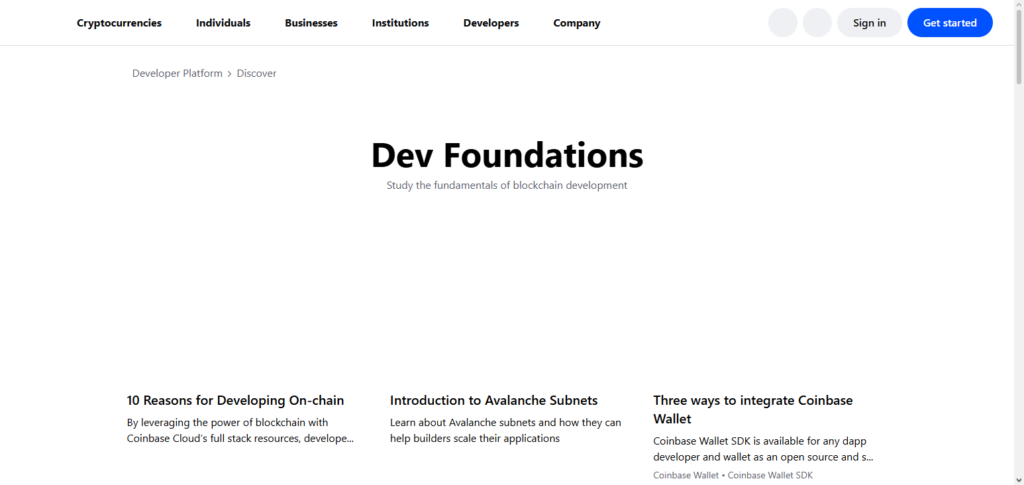
Apart from that, Coinbase Cloud offers a flexible pricing scheme, which accounts for a significant advantage. It operates on a freemium multi-tenant Software-as-a-Service (SaaS) model, so it structures its offers according to the API transaction volume.
Moreover, organizations can negotiate enterprise-wide agreements for augmented performance. Overall, the service is integrated by fintechs, banks, and crypto-native companies that want to incorporate crypto into their operations.
Features
- Developer infrastructure and APIs to build crypto apps.
- Blockchain access to query and interact with the networks.
- Wallet and transaction infrastructure to develop crypto apps.
- Easy to use APIs to connect to the Coinbase ecosystem.
- Can be used to build crypto wallets, trading applications, Web3, and more.
Pros
- Easy access to a major regulated crypto ecosystem.
- Developer-friendly infrastructure and documentation.
- Great for businesses already using Coinbase services.
- Can help reduce the complexity of developing crypto infrastructure.
- Can be useful for teams that want to rely on an established provider.
Cons
- Not always easy to use advanced features.
- Availability can be limited based on location.
- Can lead to increased reliance on Coinbase.
- Cost depends on the chosen product and API usage.
- Not always the best option for multi-chain applications.
2. Binance API
The crypto exchange Binance was founded in 2017 by Changpeng Zhao. The company’s headquarters is in Dubai (VARA-regulated). Binance API offers access to over 450 tokens and provides data about 1600 trading pairs, including a deep liquidity pool and analytics.
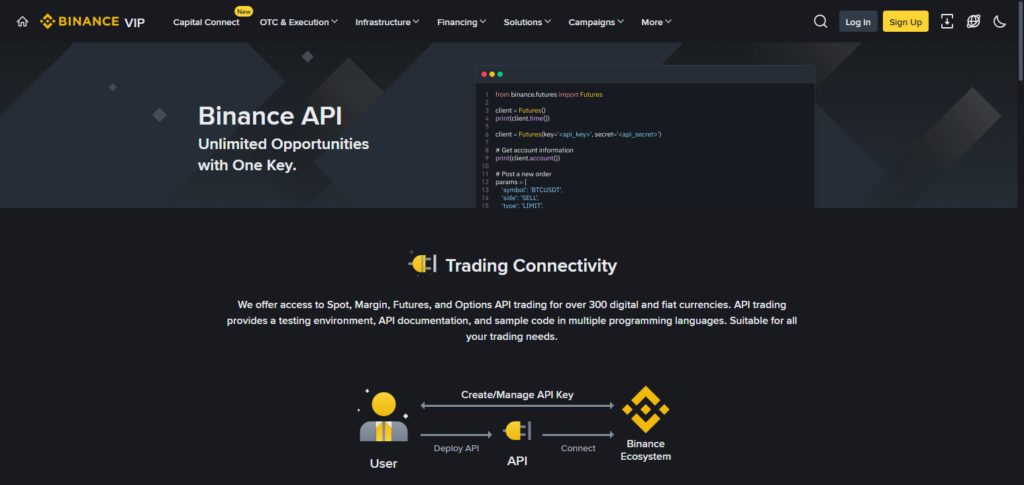
Among others, there is support for blockchain networks BNB Chain, Ethereum, Solana, etc. Information available on the Binance API includes market data, candlestick data, liquidity data, token holder data, and developer data.
The Binance APIs are free to use for basic trading and market data, but institutional data may require enterprise-level access. The Binance API pricing model is mostly transaction-based, where a 0.1% fee applies to spot trades and 0.02% to futures trades.
Features
- REST APIs for programmatic trading and account operations.
- WebSocket APIs for real-time market and user data.
- FIX API support for specific institutional trading needs.
- Market-data and trading APIs for Binance products.
- The official documentation provides API references, SDKs, and developer tools.
Pros
- Wide range of trading and market data features.
- Real-time data access via WebSocket APIs.
- Can be used to develop algorithmic trading applications.
- Comprehensive documentation and developer resources.
- Can be helpful for applications that need to access Binance directly.
Cons
- Limited to Binance-specific products and features.
- Some APIs may be unavailable in certain jurisdictions.
- Developers need to work with Binance-specific logic.
- Trading APIs require managing permissions and security.
- Not a multi-chain blockchain infrastructure solution.
3. Kraken API
Kraken Features: About the Company, Supported Cryptos, Staking, Trading & Security
Kraken was founded in 2011 by Jesse Powell and is based in San Francisco/Wyoming, USA.
The exchange has an API for 500+ cryptocurrencies and fiat pairs across 190+ countries and regions. Kraken supports Bitcoin, Ethereum, Solana, and other blockchain networks.
Kraken APIs can be used for spot, margin, futures, staking, and account data.
Their pricing model applies a maker-taker fee schedule, with a 0.25% maker fee, 0.40% taker fee, and instant buy API fee of 1%. Fees decrease for higher-volume traders to 0% maker and 0.05% taker.
The exchange has a strong security infrastructure with 95% of assets in cold storage and is SOC 2 certified. Additionally, Kraken provides institutional-grade custody and reporting solutions and transparency aroundProof of Reserves.
Features
- Spot REST API and WebSocket API for trading and account operations.
- Futures REST and WebSocket API for trading and account operations.
- FIX API access for institutional trading needs.
- APIs for automated trading and real-time market data.
Pros
- Choice of REST, WebSocket, and FIX protocols.
- Can be used to build automated trading applications.
- Institutional trading options are available via FIX.
- Real-time market data access.
- Kraken highlights its 24/7 trading infrastructure and more than 99% uptime.
Cons
- Mostly focused on the Kraken trading platform.
- Not ideal for developers that need blockchain infrastructure.
- Trading features require working with Kraken-specific logic.
- APIs can be complicated to use for institutional trading.
- Products may be unavailable in certain jurisdictions.
4. Fireblocks API
A digital asset infrastructure provider for institutional clients, Fireblocks was founded in 2018 in New York, United States. The company’s API covers more than 150 blockchain networks and thousands of digital assets to ensure custody, payments, tokenization, and treasury management solutions.
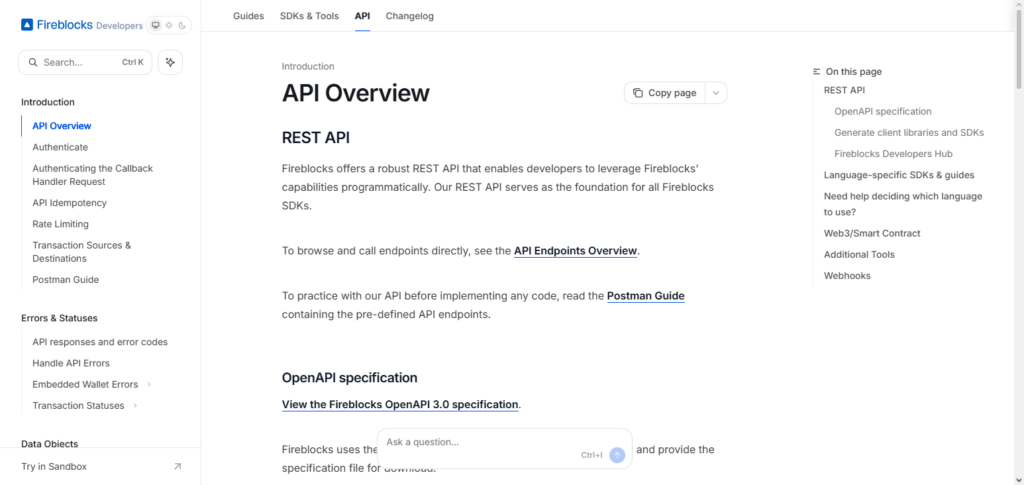
Fireblocks has pioneered the use of Multi‑Party Computation or MPC in the field to guarantee protection with no single point of failure. The company’s data covers wallet addresses, payments, DeFi, and compliance.
Fireblocks offers enterprise-level pricing, and its onboarding process is complex and requires signing agreements, which makes the service inaccessible to small companies and developers. Moreover, over 80 banks and 2400+ organizations worldwide trust Fireblocks to secure more than a trillion dollars in transactions.
Features
- REST API with access to most Fireblocks features.
- Vault account management APIs.
- Transaction and digital-asset infrastructure APIs.
- SDKs and developer tools to interact with the platform.
- Sandbox, API reference, and Postman tools for development.
Pros
- Institutional-grade transaction and wallet infrastructure.
- Comprehensive custody and wallet management APIs.
- Secure API authentication via signed requests.
- Can be used to develop crypto exchanges and custodial applications.
- Developers can use available SDKs to build applications faster.
Cons
- May be too powerful for small-scale applications.
- Institutional infrastructure may be more complex to use.
- Pricing is more relevant to businesses and exchanges.
- Developers need to understand Fireblocks’ security model.
- May provide more infrastructure than needed for a crypto data application.
5. BitGo API
The company was founded in 2013 by Mike Belshe and Ben Davenport. The headquarters is located in Sioux Falls, South Dakota, USA. BitGo is an innovator in the field of multi‑signature custody and offers solutions for 800+ assets from Bitcoin to Ethereum, Solana, Polygon, and others.
The BitGo API offers custody, wallet infrastructure, prime brokerage, lending, staking, and WBTC minting services. The data available through an API includes balances, transactions, reserves, and reports.
The tariff policy is institutional, and specific rates are determined through authorized service agreements with BitGo. The company is authorized by the NYDFS and chartered by the OCC as a custodian and provides institutional custody for over $100B in assets while facilitating 20% of Bitcoin transactions.
Features
- APIs related to digital-asset custody and wallet infrastructure.
- OpenAPI 3.0 specification to explore supported API endpoints.
- API Explorer to try out the API in a sandbox environment.
- Programmatic access to wallets and transactions.
- Institutional digital-asset infrastructure APIs.
Pros
- Digital-asset custody and wallet APIs suitable for institutions.
- OpenAPI specification for easier API exploration and use.
- API sandbox for testing purposes.
- Can be used for institutional wallet infrastructure needs.
- Good choice for developers that need to build a professional-grade crypto application.
Cons
- May be too complex for simple use cases.
- Can be challenging to work with in a non-custodial environment.
- Not a general-purpose blockchain or crypto data API.
- May require institutional-level onboarding to use.
- Developers that only need market data may find the API too complicated.
6. Alchemy API
Alchemy was founded in 2017 by Nikil Viswanathan and Joe Lau. The company is based in San Francisco, US and develops developer APIs for more than 100 blockchain platforms including Ethereum, Solana, Polygon, Arbitrum, and Optimism.
Their APIs offer RPC nodes, advanced data APIs such as NFT metadata, balances, and rollup infrastructure and provide transactional data, price data, NFTs, and DeFi positions.
The pricing is based on Compute Units (CUs) with a free plan available for up to 30 million CUs per month and a pay-as-you-go rate of $0.4 per each additional million CUs. Enterprise-level plans are also available upon request. The company’s clients include OpenSea, Zerion, and Polymarkets which are processed more than a trillion queries per year.
Features
- Blockchain APIs for reading and writing on-chain data.
- Structured Data APIs to access balances, transfers, NFTs, prices, and more.
- Wallet APIs for smart wallets and account abstraction.
- WebSockets, Trace, Debug, and Webhooks APIs.
- Alchemy supports more than 100 blockchains, according to its documentation.
Pros
- Wide range of blockchain features and infrastructure.
- Developer-friendly documentation and tools.
- Can be useful for Web3 startups and enterprise developers.
- Smart wallet and account abstraction APIs.
- Can be helpful to build production-ready blockchain applications.
Cons
- Learning curve associated with using the API.
- Cost and usage-related considerations for larger projects.
- Blockchain-specific API features may vary.
- More advanced features require increased API usage.
- Developers that only need basic features may find the API too powerful.
7. Moralis API
Moralis is a blockchain data provider company that was founded in 2020 by Ivan Liljeqvist and Filip Martinsson. The company is based in Stockholm, Sweden. Moralis’s API currently provides access to more than 30 blockchains, including Ethereum, Solana, BNB chain,
Polygon, Avalanche, and Bitcoin. Moralis offers blockchain data about wallet addresses, including token balances, NFT metadata, DeFi positions, and price. Information on wallet addresses is available in both real-time and historical form. Moralis provides enterprise-level indexing solutions on demand for its customers.
Moralis’s pricing plans begin with a free tier and go up to $49–$499 per month for developers, while enterprises receive custom contracts. Moralis focuses on providing decoded, enriched data and ensuring SOC 2 compliance with post-quantum security, which has made it a preferred choice for wallets, DeFi applications and platforms, and AI-driven Web3 agents.
Features
- Unified APIs that provide access to blockchain and Web3 data.
- Wallet, token standard, NFT, DeFi, and transaction data APIs.
- Streams API to access real-time on-chain data.
- RPC Nodes and Data APIs for blockchain interactions.
- The Data API covers more than 30 blockchains, according to the documentation.
Pros
- Easy-to-use unified API for blockchain and Web3 data.
- Can be used to develop applications for multiple chains.
- Wallet data APIs provide insight into user activity.
- Real-time Streams API for important on-chain events.
- Good choice for Web3 developers that need to work with wallets and make calculations.
Cons
- Choice of chains is smaller than with some competitors.
- Developers that need lower-level node infrastructure should consider other options.
- May be too abstract for applications with advanced data needs.
- Expenses should be reviewed for high API usage.
8. Crypto APIs
The crypto API provider Crypto APIs was founded in 2018 and has its headquarters in Sofia, Bulgaria. It offers blockchain unified APIs that cover more than 12 protocols such as Bitcoin, Ethereum, Solana, Polygon, and Testnets.
Its main services include the node-as-a-service offering, transaction simulators, wallets, NFT APIs, and compliance APIs for crypto data on balances, transactions, liquidity, and AML screening. The company uses a subscription-based pricing strategy for its blockchain API service.
Pricing is determined by an organization’s API usage volume and SLAs at the enterprise level. Financial technology companies use crypto APIs to provide services without building their own crypto infrastructure, with over 50 endpoints and SDKs to support rapid integration.
Features
- Crypto-related APIs, including trading and exchange data.
- Historical and real-time market data.
- Portfolio and transaction-related infrastructure.
- Can be useful to build applications that use crypto data.
Pros
- Crypto data APIs that can be used to build applications.
- Can help reduce the number of exchanges to work with.
- Good choice for fintech and crypto portfolio applications.
- Can be used to aggregate crypto-related data and services.
- General-purpose crypto API infrastructure for developers.
Cons
- Specific features and capabilities depend on the product.
- Developers may need to rely on a third party to receive data.
- Exchange coverage should be reviewed for specific use cases.
- Increased expenses may be associated with heavy usage.
- Developers that need to work with blockchain nodes directly should look elsewhere.
9. Chainalysis API
Chainalysis, created in 2014 by Michael Gronager, Jan Moller, and Jonathan Levin, is a New York-based company that provides blockchain analysis and compliance solutions. The company’s analytics products cover more than 100 blockchains.
The API offers KYT, Reactor (investigation), Address Screening, and Business Intelligence solutions. It has the broadest transaction graph database that connects on-chain activity to its real-world counterparty.
The company reveals pricing details upon request because their products are intended for enterprises (exchanges, banks, and government agencies).
Over 1500 companies, including the FBI, IRS, and exchanges, use its solutions. It also provides analytical data for 100+ blockchains. Analysis.com states that Chainalysis holds about 40% of the blockchain analytics market.
Features
- Blockchain-related APIs focused on risk and compliance.
- Transaction screening and address intelligence APIs.
- Tools to assist with Know-Your-Customer (KYC) procedures.
- Designed to help businesses and organizations that work with blockchain data.
Pros
- Risk assessment and screening tools for blockchain transactions.
- Can be useful for businesses that work with crypto transactions.
- Address intelligence APIs highlight suspicious activity.
- Can be helpful for regulatory compliance processes.
- Good choice for financial institutions and crypto businesses.
Cons
- Not ideal for developers that only need fundamental blockchain features.
- May be excessive to use for a basic crypto wallet application.
- Advanced compliance features may be challenging to implement.
- Cost structure may not be optimal for smaller businesses.
- Larger organizations should review if the solution matches their needs.
10. Circle API
Founded in 2013 by Jeremy Allaire, Circle is a U.S.-based company that has its headquarters in New York City. The company is best known for creating the USDC and EURC stablecoins. The firm’s APIs are used to operate on over 30 blockchains, including Ethereum, Solana, Avalanche, and Base. They offer API services for payments, wallet creation, transfers of tokens using CCTP cross-chain protocol, and minting and redemption of stablecoins.
The data provided consist of information on balances, liquid reserves, and compliance attestation. The firm’s services are mostly paid for by enterprise customers through API keys.
In addition, the company earns profits from the interest of the reserves and has gone public in 2025 (CRCL). As of now, it has created a platform that enables the Internet financial system, with more than $75 billion worth of USDC coins in circulation.
Features
- REST APIs focused on wallet infrastructure and blockchain financial services.
- Wallet creation and management infrastructure.
- Smart-contract and transaction APIs.
- USDC stablecoin transfer APIs via CCTP.
- Additional APIs relate to payments and institutional stablecoin operations.
Pros
- Good choice for stablecoin-based applications and services.
- Can be used to build crypto wallets and financial apps.
- Native USDC transfers between blockchains via CCTP.
- Idempotency support helps reduce duplicate API requests.
- Useful for fintech, Web3, and payments applications.
Cons
- Mostly focused on Circle’s stablecoin and financial infrastructure.
- Developers that need to work with a variety of crypto assets may need to choose another solution.
- Some features require additional setup and API keys.
- Availability of features and APIs depends on the jurisdiction.
Conclusion
In conclusion, API-first crypto companies provide foundational infrastructure for Web3 development. Coinbase Cloud, Binance API, Kraken API, Fireblocks API, BitGo API, Alchemy API, Moralis API, Crypto APIs, Chainalysis API, and Circle API offer custody, compliance, analytics, payments, or blockchain solutions for developers.
These crypto API providers differ in their target users, assets, blockchains supported, and billing plans. However, they all allow building reliable and compliant crypto applications with fiat on-ramps, off-ramps, custodianship, analytics, and payment processing.
Moreover, most of them provide free tiers and enterprise-level support, making crypto infrastructure accessible to fintechs, crypto exchanges, traditional financial institutions, and crypto-native protocols.
FAQ
What is an API‑first crypto company?
An API‑first crypto company builds its services around developer‑friendly APIs, enabling businesses to integrate trading, custody, payments, and blockchain data directly into their platforms without building infrastructure from scratch.
Which companies are leading in crypto APIs?
Top players include Coinbase Cloud, Binance API, Kraken API, Fireblocks API, BitGo API, Alchemy API, Moralis API, Crypto APIs, Chainalysis API, and Circle API. Each specializes in areas like trading, custody, compliance, or developer tooling.
Which API is best for compliance and analytics?
Chainalysis API leads in compliance, offering KYT, address screening, and investigation tools. Fireblocks and BitGo also emphasize regulated custody and reporting.
Which API is best for developers building apps?
Alchemy API and Moralis API are developer‑centric, offering enriched blockchain data, NFT metadata, and SDKs for rapid app deployment.