


This article will discuss the Best On-Chain Reputation Platforms for Web3, including reputation models, data sources, verification techniques, blockchain support, privacy approaches, developer access, portability, and composability. In this guide, we compare platforms based on practical Web3 use cases such as identity, Sybil resistance, DAO governance, DeFi, credentials, community trust, and decentralized applications to help readers understand the key differences between them.
How to Choose an On-Chain Reputation Platform
Identify the Primary Use Case: First decide if you need reputation for Sybil resistance, DAO governance, DeFi risk assessment, Web3 hiring, credentials, identity verification, airdrops, or community access. Different platforms are built on different trust signals.
Review the Reputation Model: Check to see if the platform offers a numeric score, attestations, credentials, wallet analysis, social reputation, proof of humanity, or a mix of signals. A score-based system and an attestation infrastructure should not be assessed by the same criteria.
Data Sources Assessment: See what information is contributing to reputation like transaction history, wallet age, DeFi activity, governance participation, NFTs, social accounts, GitHub contributions, credentials or verified identity information. More data isn’t always better. Relevance and verifiability matter.
Check how the Verification is done: Describe the platform’s method of proving that reputation information is authentic. Look for wallet signatures, cryptographic attestations, identity credentials, zero-knowledge proofs, behavioral analysis, or other documented verification methods.
Compare privacy controls. Verify that sensitive information is kept private, selective disclosure is available, and zero-knowledge or other privacy-preserving techniques are supported. This is particularly critical when reputation is predicated on identity or compliance information.
Blockchain and Network Support: Verify which blockchains and ecosystems the platform supports. For a single ecosystem, a dedicated platform may suffice, but when users are interacting across multiple networks, multichain compatibility may matter.
Portability Considerations: Can users take their reputation / credentials / attestations with them to other apps? Portable reputation could reduce platform lock-in and enable verified information to be reused across different services on the Web3.
Evaluate Composability: Verify whether the reputation data is available or can be integrated via APIs, SDKs, intelligent contracts, attestations or other developer tools by third-party applications. The same trust information can be used for multiple applications via composable reputation.
Developer Access Review: Projects that want to build their own application. Check for API availability, SDKs, documentation, smart-contract interfaces, data access, integration requirements, and supported programming environments. The ease of working with it can greatly affect the amount of time it takes for implementation.
Check the Reputation Transparency: Look for clear information about how the scores or credentials are generated. Instead, users and applications should be able to understand what signals contribute to a reputation result rather than relying on an unexplained black-box score.”
Sybil Resistance Testing: See how the platform differentiates between real users and multiple wallets owned by the same entity if it is going to be used for airdrops, grants, voting, or community rewards. The general quality of reputation is a different question than Sybil resistance.
Reputation Freshness Consideration: Check if reputation is updated continuously, periodically or after some attestations or events only. Recent activity might be important for applications where user behavior can change over time.
Evaluate Costs and Scalability: Compare transaction costs, API fees, verification costs, and infrastructure requirements. On-chain systems storing large amounts of reputation data may have different cost and scalability characteristics than hybrid or off-chain systems.
Check for Revocation and Updates: Consider if credentials and attestations can expire, be revoked, corrected or updated because reputation data may become stale or inaccurate. This is particularly important for identity, compliance and professional credentials.
Evaluate Ecosystem Integrations: Review current integrations with wallets, DAOs, DeFi protocols, identity providers, social platforms, governance and other Web3 apps. Existing integrations can help you evaluate whether the reputation layer can fit in your intended ecosystem.
Compare Trust Assumptions Finally, determine who or what the platform makes users and applications trust. Some systems rely heavily on blockchain activity, while others use credential issuers, community attestations, algorithms, or external data providers. Knowing these assumptions will help you assess the reputation system based on your particular needs.
Benefits of On-Chain Reputation
Trust, but Verify: Instead of relying on self-reported information, blockchain-based reputation records can serve as verifiable evidence of user activity, contributions, credentials or attestations.
Portable Reputation: Users could carry reputation signals, credentials or attestations with them between compatible Web3 applications, helping to avoid the need to build credibility from scratch on every platform.
More Transparency: Reputation data and the underlying blockchain activity can be independently verified depending on implementation, making the process more transparent than closed centralized scoring systems.
Sybil Resistance: Apps may use reputation systems that consider wallet activity, identity credentials, attestations, and proof-of-humanity signals to distinguish real participants from fake or bot accounts.
Better DAO Governance: DAOs may utilize contribution history, attestations, participation records or reputation signals to build more context-aware governance and community participation systems.
Improving DeFi Risk Assessment: Wallet behavior and prior on-chain activity can provide additional signals to evaluate users in lending, credit, rewards or other financial applications.
Reusable Credentials: Verified credentials and attestations can be reused across supported applications, allowing users to prove specific claims without repeating the same verification process multiple times.
Privacy-Preserving Proof: To verify some claims, some reputation systems apply selective disclosure or zero-knowledge technologies that do not necessarily reveal all underlying personal information.
Community Trust Signals: Reviews, vouches, contributions, attestations and social activity can help Web3 communities create more context around unknown wallets or participants.
Automated Access Decisions: Reputation-related signals can be used to automate eligibility for grants, rewards, governance participation, memberships or other blockchain-based services through intelligent contracts and applications.
Less Platform Lock-in: Open standards for reputation and attestation can make reputation information an interoperable layer, instead of something that is entirely owned by a single centralized application.
Contribution Recognition: Developers, DAO members, creators and community contributors can build a persistent record of participation that could be useful for grants, opportunities, governance or ecosystem recognition.
How We Selected These Platforms
| Selection Criteria | What We Evaluated |
|---|---|
| Reputation Model | Checked whether each platform uses wallet scores, community reputation, attestations, credentials, social activity, proof-of-humanity, or other verifiable reputation signals. |
| Data Sources | Examined the types of information used, including on-chain transactions, DeFi activity, governance, social accounts, credentials, attestations, and wallet history. |
| Verification Method | Considered how reputation claims are verified through wallets, cryptographic attestations, identity credentials, behavioral analysis, or privacy-preserving proofs. |
| Blockchain Support | Reviewed supported blockchains, networks, and Web3 ecosystems to determine where each reputation or identity system can be used. |
| Privacy | Evaluated privacy mechanisms such as selective disclosure, zero-knowledge proofs, hashed signals, off-chain processing, and user-controlled credentials. |
| Portability | Checked whether reputation scores, credentials, attestations, or identity information can be reused across compatible Web3 applications. |
| Composability | Examined APIs, SDKs, smart contracts, attestation standards, and other methods that allow third-party applications to integrate reputation data. |
| Developer Access | Reviewed available APIs, SDKs, documentation, integrations, and developer infrastructure for building reputation-enabled applications. |
| Sybil Resistance | Considered mechanisms that help identify duplicate, automated, or potentially fraudulent accounts, particularly for governance, grants, and airdrops. |
| Use Cases | Compared practical applications such as DAO governance, DeFi, airdrops, grants, identity, Web3 hiring, community access, and credential verification. |
| Transparency | Checked whether the platform documents its scoring methodology, data sources, verification process, and reputation-generation mechanisms. |
| Current Relevance | Considered the platform’s documented product capabilities and ecosystem relevance for Web3 reputation use cases in 2026. |
| Platform Differentiation | Included platforms representing different approaches, including reputation scoring, identity verification, attestations, social reputation, proof of humanity, and decentralized knowledge systems. |
Key Points
| Platform | Key Strength | Best For |
|---|---|---|
| Human Passport (formerly Gitcoin Passport) | Aggregates identity and trust signals to generate Sybil-resistant reputation scores. | DAO governance, airdrops, community verification |
| Ethos Network | Uses reviews, vouching, and staking mechanisms to create on-chain credibility scores. | Web3 social trust and scam prevention |
| Karma3Labs | Builds decentralized reputation infrastructure using EigenTrust-based reputation models. | Marketplaces, social protocols, DAO ecosystems |
| Lens Protocol Reputation Layer | Leverages social graph activity and wallet interactions to establish verifiable user reputation. | Decentralized social networks |
| Galxe Passport | Combines credential data and blockchain activity into portable Web3 identity profiles. | Community growth and rewards programs |
| Ethereum Attestation Service (EAS) | Enables trusted attestations that can serve as reusable reputation credentials across applications. | Verifiable credentials and trust systems |
| Intuition | Creates reputation through verifiable knowledge graphs and social attestations. | Trust-based discovery and identity verification |
| Civic Pass | Connects identity verification with on-chain reputation and compliance requirements. | Regulated Web3 applications |
| Nomis Protocol | Generates wallet reputation scores based on historical blockchain behavior. | Lending, DeFi risk assessment, airdrops |
| Arcx Score | Evaluates wallet activity across DeFi protocols to create portable credit and reputation metrics. | DeFi credit scoring and user evaluation |
1. Human Passport (formerly Gitcoin Passport)
Human Passport is a Sybil-resistant proof-of-humanity reputation system. The Reputation Model combines KYC, biometrics, web3 activity, web2 activity, and social trust into Passport Stamps and Passport Models that analyze EVM wallet behavior to classify addresses.
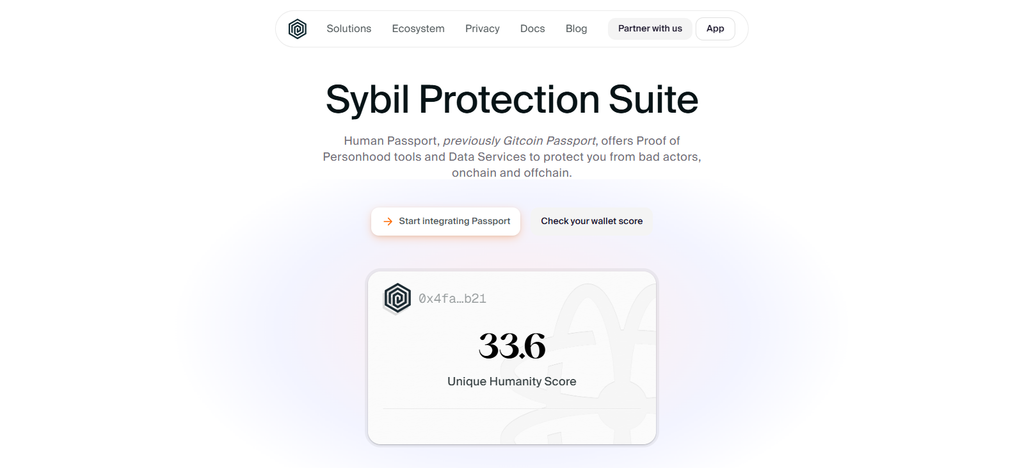
It supports Ethereum, multiple EVM networks with selected verification attestations via Optimism, Base and Stellar. Hashed signals and zero-knowledge individual verifications highlight privacy.
For developers: APIs, Passport Embed, Models API and smart contract. Reputation can be reused across integrated applications, and is useful for airdrops, grants, governance, and community protection.
| Feature | Details |
|---|---|
| Primary Focus | Proof of personhood, Sybil resistance, wallet classification and reputation evidence |
| Reputation Model | Uses Stamps, Passport Models and Individual Verifications to establish evidence that an address belongs to a real person or behaves like a human |
| Data Sources | On-chain activity, connected accounts, biometrics, Gitcoin activity, Discord, ENS, Binance credentials and other supported credentials |
| Blockchain Support | Primarily EVM-based wallet and blockchain activity, with verification credentials also available across supported ecosystems |
| Verification Method | Stamps, wallet/activity analysis, account credentials and individual ZK verification |
| Privacy Approach | Privacy-by-design; Human Passport says it does not store names, emails, IP addresses or personal identifiers and reduces verification information to hashed signals |
| Developer Access | APIs, Passport Embed, Models/Data Services and developer integrations |
| Portability & Composability | Passport credentials and scores can be consumed by integrated applications for access, rewards and Sybil protection |
| Key Use Cases | Airdrops, quadratic funding, DAO governance, grants, gaming, community protection and human verification |
| Distinctive Feature | Separates Stamps, Models and Individual Verifications, allowing applications to answer different identity and Sybil-resistance questions |
2. Ethos Network
Ethos Network is not just based on wallet activity, but on a community-driven credibility model. Reputation is calculated from on-chain history, reviews, vouches, reviewer trust, attestations, and account signals.

Ethos stores onchain protocol interactions like reviews, vouches, slashes, invitations, voting, and discussions, and its computed credibility score can integrate other observations. Verification is done via Ethereum wallets, social accounts, reviews, vouches and Ethos attestations.
Thus privacy is distinct from zero-knowledge identity systems because protocol interactions are public and readable. Making Ethos data composable across Web3 experiences. This enables developers to integrate Ethos data into their applications.
| Feature | Details |
|---|---|
| Primary Focus | On-chain credibility and community-driven reputation |
| Reputation Model | Credibility Score generated from reviews, vouches, slashes, invitations, wallet quality and connected-account signals |
| Data Sources | Ethereum wallet quality, wallet age, social profiles, reviews, vouches, invitations and attestations |
| Blockchain Support | Ethereum-based protocol mechanisms and supported blockchain infrastructure |
| Verification Method | On-chain reviews, vouches, slashing mechanisms and attestations connecting external accounts |
| Privacy Approach | Designed to preserve pseudonymity, although reputation interactions and reviews can be publicly visible |
| Developer Access | APIs and integrations intended for websites, applications and browser-based experiences |
| Portability & Composability | Designed as an independent reputation layer that applications can reference instead of maintaining separate reputation systems |
| Key Use Cases | Trust discovery, community reputation, scam-risk signals, social credibility and Web3 interactions |
| Distinctive Feature | Combines social reviews with economically backed vouches and slashing, rather than relying only on wallet activity |
3. Karma3 Labs
Karma3Labs is building decentralized reputation infrastructure for open Web3 apps, notably for governance, social networks, marketplaces and community coordination. Its model employs users’ online actions and contributions as reputation signals instead of a traditional identity profile.

The platform is built on on-chain reputation that applications can use to understand trust, participation and community relationships. Its approach is about moving reputation away from centralized gatekeepers and opaque algorithms.
Developer-facing infrastructure is meant to allow applications and marketplaces to ingest reputation signals. Composability is the key attribute, enabling reputation data to power governance, social discovery, community access, and decentralized marketplace interactions.
| Feature | Details |
|---|---|
| Primary Focus | Decentralized trust and reputation infrastructure for the open Web |
| Reputation Model | Reputation is designed around users’ actions, contributions and relationships rather than a single centralized identity database |
| Data Sources | Online actions, community participation, social relationships and application-level activity |
| Blockchain Support | Built around on-chain reputation infrastructure and Web3 application integration |
| Verification Method | Blockchain-recorded activity and decentralized reputation signals |
| Privacy Approach | Designed to reduce dependence on centralized gatekeepers and opaque reputation algorithms |
| Developer Access | Reputation infrastructure intended for decentralized applications, social networks, marketplaces and governance systems |
| Portability & Composability | A core concept; reputation can function as a shared layer that different applications can reference |
| Key Use Cases | DAO governance, social networks, decentralized marketplaces, community access and trust discovery |
| Distinctive Feature | Focuses on creating a general-purpose reputation layer for the open Web, rather than a reputation profile limited to one application |
4. Lens Protocol Reputation Layer
Lens Protocol is more accurately described as a decentralized social and identity infrastructure layer, rather than as a provider of a standalone numerical reputation score. In the Lens ecosystem, we can see reputation coming from social activity, profiles, follows, publications, interactions, and community participation. Its blockchain-based architecture allows social relationships and content to be portable – not locked within a centralized platform.
Lens infrastructure is available for developers to build applications and compose social data into various experiences. Privacy is not a one-size-fits-all privacy mechanism; it is application and data dependent. Thus Lens is more relevant when reputation is social graph, contribution history and community credibility rather than a fixed reputation score.
| Feature | Details |
|---|---|
| Primary Focus | Decentralized social identity, social graphs and portable Web3 social activity |
| Reputation Model | Social reputation can be derived from profiles, publications, relationships, interactions and community participation rather than one universal score |
| Data Sources | Social profiles, follows, posts/publications, interactions and ecosystem activity |
| Blockchain Support | Lens ecosystem and its blockchain-based social infrastructure |
| Verification Method | Wallet-linked decentralized profiles and blockchain-recorded social activity |
| Privacy Approach | Depends on the specific Lens application and information being published; it is not primarily a zero-knowledge reputation-score system |
| Developer Access | Social infrastructure and developer tools for building applications around Lens profiles and social graphs |
| Portability & Composability | A major design principle; profiles and social relationships can support multiple applications rather than being locked to one interface |
| Key Use Cases | Decentralized social networks, creator reputation, community discovery and portable social identity |
| Distinctive Feature | Reputation is better understood as portable social activity and graph-based credibility than as a conventional numerical reputation score |
5. Galxe Pass
Galxe Passport is an identity and verification layer that enables users to safely manage identity information across Web3 applications. Its model is not a universal reputation score, but rather reusable identity and compliance credentials. Data may include identification info and verification credentials used on Galxe experiences.
Passport V3 is being promoted as a regulatory-ready identity layer that connects decentralized privacy and regulatory needs. Verified identity information can be reused across supported applications so users don’t have to go through separate verification processes more than once.
Developers are able to integrate Galxe Identity Protocol and Passport infrastructure into their Web3 products. Its key use cases are user verification, compliant Web3 growth, access control and identity based experiences.
| Feature | Details |
|---|---|
| Primary Focus | Reusable Web3 identity and user verification |
| Reputation Model | Primarily identity and credential based rather than a universal reputation score |
| Data Sources | Verified identity information and supported credentials collected through Passport |
| Blockchain Support | Designed for Web3 applications and decentralized identity environments |
| Verification Method | Identity verification and reusable credentials that applications can use for access and compliance |
| Privacy Approach | Designed to let users verify required information without repeatedly exposing the same identity information to every application |
| Developer Access | Galxe Identity Protocol and related developer infrastructure |
| Portability & Composability | Verified identity can be reused across supported Galxe and Web3 experiences |
| Key Use Cases | Identity verification, compliant access, Web3 campaigns, community access and user onboarding |
| Distinctive Feature | Focuses on reusable identity verification, making it more identity-oriented than a conventional wallet reputation score |
6. The Ethereum Attestation Service (EAS)
Ethereum Attestation Service (EAS) is an open attestation infrastructure, not a platform with a predefined reputation score. Its model allows users, applications, organizations and protocols to make verifiable claims about people, wallets, assets or activities.

Attestations are stored onchain or offchain depending on the implementation. EAS provides a general-purpose attestation primitive that developers may use to build reputation, credentials, governance, voting, provenance, and social-graph systems on top of.
Verification is against signed attestations and their corresponding schemas. Its open infrastructure makes these claims highly composable, so that other applications can read and interpret reputation-related attestations according to their own rules.
| Feature | Details |
|---|---|
| Primary Focus | General-purpose on-chain and off-chain attestations |
| Reputation Model | No fixed universal reputation score; applications create their own reputation systems from attestations |
| Data Sources | Claims about users, wallets, organizations, assets, activities and credentials |
| Blockchain Support | Ethereum ecosystem and supported EVM environments |
| Verification Method | Cryptographically signed attestations based on defined schemas |
| Privacy Approach | Supports both on-chain and off-chain attestation models, allowing applications to choose how information is handled |
| Developer Access | Smart contracts, schemas, SDK/developer tooling and APIs |
| Portability & Composability | Very high potential because third-party applications can read and build on standardized attestations |
| Key Use Cases | Reputation, credentials, governance, identity, provenance, voting, social graphs and compliance |
| Distinctive Feature | Provides the underlying attestation primitive, allowing other applications to create their own reputation logic instead of imposing one universal score |
7. Intuition
Intuition refers to reputation as a decentralized knowledge graph and structured attestations, rather than a single universal score. Its reputation model uses Atoms, Triples and Signals to represent entities, relationships and community-backed claims.

Attestations are structured as subject-predicate-object relationships and can have attribution and economic signals. Intuition has its own Layer 3 network that settles to Base, and the protocol is built for information to flow between applications, chains, and AI agents.
Developers are able to query and build on the knowledge graph using APIs, GraphQL infrastructure and protocol primitives. It’s portability and composability makes it useful for decentralized identity, trust, reputation and machine readable Web3 information.
| Feature | Details |
|---|---|
| Primary Focus | Decentralized knowledge, reputation and attestation infrastructure |
| Reputation Model | Uses structured claims and community signals rather than depending on a single fixed reputation number |
| Data Sources | Atoms, Triples, Signals, attestations, relationships and community-generated information |
| Blockchain Support | Intuition ecosystem, with its architecture designed for interoperability across applications and blockchain environments |
| Verification Method | Cryptographic attestations and economically backed signals |
| Privacy Approach | Reputation and knowledge records can be structured independently from traditional centralized identity databases |
| Developer Access | APIs, GraphQL and protocol-level infrastructure for querying and building applications |
| Portability & Composability | Designed for reusable information across applications, Web3 ecosystems and AI agents |
| Key Use Cases | Decentralized identity, reputation, trust discovery, knowledge graphs and machine-readable Web3 information |
| Distinctive Feature | Represents reputation as structured relationships and signals in a decentralized knowledge graph, rather than only as a numerical score |
8. Civic Pass
Civic Pass was designed for reusable identity and human-verification credentials, not a universal reputation score. Its verification model can define specific attributes or eligibility criteria without forcing applications to start the whole verification process from scratch.

Civic also has a broader infrastructure providing developer authentication and verification tools. There are SDKs and backend verification libraries available for applications to integrate. Scoped authorization, encrypted token handling, and controlled access to data are highlighted for privacy and security.
Most relevant for Web3 reputation is therefore identity-backed trust: applications can use verified user information as an eligibility or access signal. It’s better suited for identity, access control, compliance and human-verification workflows than general reputation scoring.
| Feature | Details |
|---|---|
| Primary Focus | Identity verification, access control and proof-based user eligibility |
| Reputation Model | Credential and verification based rather than a universal reputation score |
| Data Sources | Identity and eligibility information collected through supported Civic verification methods |
| Blockchain Support | Designed for Web3 applications and blockchain-based access systems |
| Verification Method | Civic verification credentials and application-level authentication |
| Privacy Approach | Designed to minimize unnecessary exposure of identity information while allowing applications to verify required conditions |
| Developer Access | Developer SDKs, APIs and verification infrastructure |
| Portability & Composability | Verification credentials can support reusable access and identity workflows across integrated applications |
| Key Use Cases | Human verification, access control, compliance, identity checks and Web3 onboarding |
| Distinctive Feature | Uses verified identity attributes as trust signals, making it more appropriate for identity-backed access than traditional reputation scoring |
9. Nomis Protocol
Nomis Protocol is an on-chain reputation system that assigns Reputation Scores to wallets based on their blockchain activity, instead of requiring KYC or social-media verification. Its scoring model considers more than 30 parameters like wallet balance, transaction volume and wallet age and various score products for various applications.
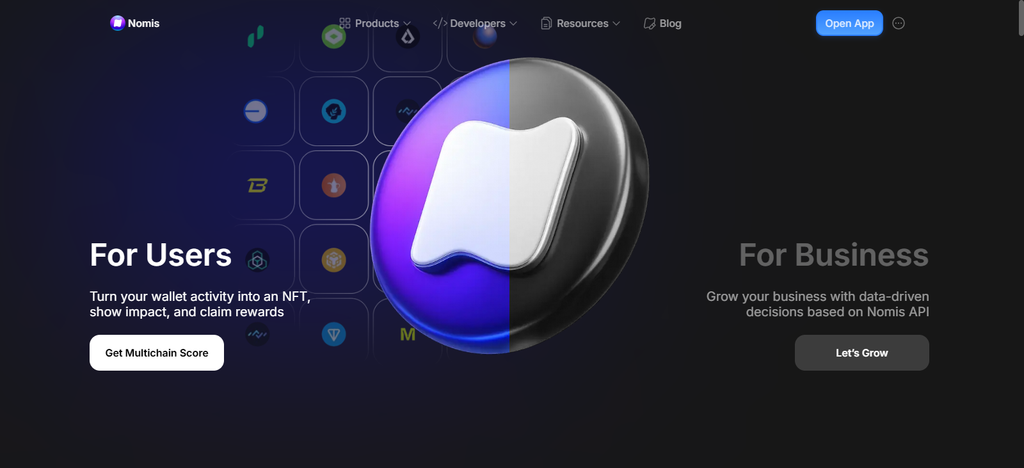
Its first product, the Multichain Score, was based on activity on Ethereum, Polygon and BNB Chain and later product scoring was extended to cross-chain DeFi activity. Users can check a score and mint it to prove reputation on the protocol layer. Developers are able to leverage Nomis scoring infrastructure to personalize experiences, eligibility, rates, rewards, and anti-Sybil mechanisms.
| Feature | Details |
|---|---|
| Primary Focus | On-chain wallet reputation and scoring |
| Reputation Model | Numerical wallet Reputation Scores generated from blockchain behavior and activity |
| Data Sources | Wallet age, balances, transaction activity, transaction volume, DeFi behavior and other on-chain parameters |
| Blockchain Support | Multichain wallet analysis, with scoring products covering supported blockchain ecosystems |
| Verification Method | Wallet-address analysis and on-chain activity evaluation |
| Privacy Approach | Primarily wallet-based, allowing reputation assessment without requiring traditional personal identity information |
| Developer Access | Reputation scoring infrastructure and integrations for Web3 applications |
| Portability & Composability | Scores can function as reputation signals for applications such as DeFi, rewards and eligibility systems |
| Key Use Cases | Wallet scoring, airdrops, rewards, DeFi personalization, user segmentation and Sybil/risk analysis |
| Distinctive Feature | Concentrates on quantifying blockchain behavior into wallet reputation scores, rather than relying primarily on social credentials |
10. ARCx Score
ARCx Score is an early reputation and credit scoring system for wallets in Web3 that creates a number from blockchain activity to score wallet behavior. The model was built on chain financial history, not traditional identity documents so wallet activity is the primary reputation signal.
Its concept linked blockchain behavior to creditworthiness and DeFi access, rather than social credentials. Verification was thus based on the wallet and privacy came from the fact that blockchain addresses could be evaluated without the need for conventional personal identity.
The historical significance is its attempt to make on-chain financial behavior portable as a reputational signal. However, the present availability and developer infrastructure of ARCx need to be verified separately before presenting ARCx as a platform actively maintained in 2026.
| Feature | Details |
|---|---|
| Primary Focus | Historical on-chain credit and wallet reputation scoring |
| Reputation Model | Wallet-based scoring designed to derive financial reputation from blockchain behavior |
| Data Sources | Historical DeFi and wallet activity, transaction behavior and on-chain financial signals |
| Blockchain Support | Primarily associated with Ethereum/DeFi infrastructure |
| Verification Method | Wallet-address and blockchain transaction history |
| Privacy Approach | Wallet-based assessment rather than conventional identity verification |
| Developer Access | Historically focused on integrating on-chain reputation and credit information into DeFi applications |
| Portability & Composability | Designed around using wallet-derived reputation as a reusable DeFi signal |
| Key Use Cases | DeFi credit assessment, lending-related decisions and wallet reputation |
| Distinctive Feature | Its model connected on-chain financial behavior with credit-style reputation, rather than focusing primarily on social identity or proof of humanity |
| 2026 Status Note | Treat ARCx as a historical/on-chain reputation model unless its current product availability and documentation are independently confirmed before publication |
Conclusion
On-chain reputation platforms will be key to Web3 identity, trust, governance and user verification by 2026. The platforms covered in this article use different approaches such as wallet activity, attestations, social contributions, proof of humanity, credentials and decentralized identity signals. Some are about sybil resistance, some about developer reputation, community trust or reusable credentials.
They differ in data sources, verification, privacy, blockchain support, developer access and portability, making each suitable for different applications. Understanding these factors can help Web3 projects select the reputation infrastructure that best matches their identity, trust, compliance, and ecosystem needs.
FAQ
What are on-chain reputation platforms?
On-chain reputation platforms use blockchain activity, attestations, credentials, social signals, or identity data to create verifiable reputation records for Web3 users, wallets, or contributors.
How does on-chain reputation work?
These platforms collect selected blockchain or verified identity signals and transform them into scores, attestations, credentials, profiles, or other reputation records that decentralized applications can use.
What data can be used for Web3 reputation?
Common signals include transaction history, wallet age, DeFi activity, DAO participation, NFT ownership, governance actions, attestations, social activity, GitHub contributions, and proof-of-humanity credentials.
Is on-chain reputation the same as a crypto identity?
No. Identity establishes information about a user, while reputation represents behavior, contributions, credibility, or verified claims associated with that identity or wallet.
Can on-chain reputation be used across different Web3 applications?
Yes, depending on the platform. Attestations, credentials, APIs, and composable reputation infrastructure can allow applications to reuse reputation information instead of creating separate systems.