


In this article, I will talk about Best Chain Abstraction Platforms for Web3 Developers, their main features, supported blockchain networks, abstraction models, developer integrations, pricing, security architecture, gas abstraction, universal accounts, and intent-based infrastructure. In this guide, developers will learn how to compare leading platforms and select the right chain abstraction solution for building scalable, user-friendly multichain applications across different blockchain ecosystems.
What Is Chain Abstraction?
Chain abstraction is a Web3 infrastructure solution that simplifies the interaction with multiple blockchain networks by hiding the technical differences between them from users and developers. Users can seamlessly access multichain applications in a more unified experience, rather than having to manually switch networks, manage separate wallets or bridge assets or hold native gas tokens on every chain.
Depending on the platform, chain abstraction can be achieved via universal accounts, unified balances, intents, solvers, cross-chain messaging, liquidity routing and gas abstraction. It also provides developers with the infrastructure to build multichain applications that can communicate with multiple blockchains by providing a simplified layer of integration, making multichain applications easier to use, build and scale.
How We Selected the Best Chain Abstraction Platforms
| Selection Criteria | What We Evaluated |
|---|---|
| Abstraction Model | Whether the platform uses universal accounts, unified balances, intents, solvers, cross-chain messaging, orchestration, or a hybrid approach. |
| Supported Chains | Number and variety of supported networks, including EVM and non-EVM ecosystems. |
| Developer Integration | Availability and quality of SDKs, APIs, smart contracts, documentation, and developer tools. |
| Universal Accounts | Whether users can access multiple chains through a unified account or account abstraction layer. |
| Unified Liquidity | Ability to access, route, or utilize liquidity across multiple blockchain networks. |
| Intent Infrastructure | Support for user intents, automated execution, solver networks, and outcome-based transactions. |
| Gas Abstraction | Ability to simplify or sponsor gas payments and reduce dependence on native tokens across chains. |
| Cross-Chain Execution | Support for cross-chain transfers, messaging, swaps, and contract calls. |
| Security Model | Smart-contract security, validators, MPC, relayers, solvers, verification mechanisms, and underlying trust assumptions. |
| Pricing & Fees | Developer costs, transaction fees, gas costs, API pricing, and other platform-related charges. |
| Production Readiness | Mainnet availability, ecosystem adoption, documentation quality, reliability, and suitability for production applications. |
| Developer Use Cases | Suitability for DeFi, wallets, payments, gaming, trading, AI agents, and other multichain applications. |
Key Points
| Platform | Key Strength |
|---|---|
| Particle Network | Comprehensive chain abstraction platform featuring Universal Accounts, Universal Liquidity, and cross-chain user balances. |
| NEAR Chain Signatures | Enables a single NEAR account to control accounts and sign transactions across multiple blockchains through Chain Signatures. |
| Socket Protocol | Chain abstraction infrastructure for seamless cross-chain asset movement, execution, and interoperability. |
| Across Protocol | Intent-based interoperability protocol that abstracts bridging and liquidity routing across chains. |
| OneBalance | Unified balance layer allowing users and applications to interact across multiple chains through a single account experience. |
| LayerZero | Omnichain interoperability protocol enabling applications to communicate and operate across multiple blockchains. |
| Chainlink CCIP | Cross-Chain Interoperability Protocol providing secure messaging and token transfers between blockchain networks. |
| Hyperlane | Permissionless interoperability framework that allows developers to connect applications across chains. |
| Wormhole | Cross-chain messaging and interoperability protocol supporting a wide range of blockchain ecosystems. |
| Agoric | Multi-chain orchestration platform focused on chain abstraction, smart contract automation, and cross-chain execution. |
1. Particle Network
Particle Network is a Universal Accounts-based chain-abstraction infrastructure platform that gives users the ability to access multiple blockchains with one unified account and balance experience. Its model is not based on traditional bridging, but integrates account abstraction, Universal Liquidity and chain abstraction.
Developers are able to build using Particle’s SDKs, APIs and smart account infrastructure. It supports a broad multichain environment, particularly the EVM ecosystems, and its Universal Accounts are designed to reduce the need to switch networks and the complexity of gas management.
The pricing depends on the services and infrastructure used. It uses smart-contract and account-abstraction infrastructure as its security model . Gas abstraction can ease native token requirements .
Key Strengths of Particle Network
- Universal Accounts: Provides a seamless account experience across multiple blockchains.
- Unified balances: Users can use assets cross-chains without having to manually manage separate balances.
- Chain Abstraction: Abstracts network switching and blockchain-specific complexity from users.
- Developer Infrastructure: SDKs, APIs and account-abstraction tooling to build multichain applications.
Gas Abstraction: Simplifies gas management, so users don’t need to own native tokens on each network.
| Feature | Details |
|---|---|
| Universal Accounts | Provides a unified account experience across multiple supported chains. |
| Universal Liquidity | Helps applications access and use liquidity across different networks. |
| Chain Abstraction | Hides network switching and multichain transaction complexity. |
| Account Abstraction | Supports programmable smart-account infrastructure for Web3 applications. |
| Gas Abstraction | Helps simplify gas management across supported blockchain networks. |
| Developer SDKs | Provides SDKs and APIs for integrating account and chain-abstraction functionality. |
| Multichain Support | Designed to connect applications with a broad range of blockchain ecosystems. |
2. NEAR Chain Signatures
NEAR Chain Signatures would offer a chain-abstraction way to sign transactions for external blockchain networks with decentralized MPC infrastructure by NEAR-controlled accounts. Unlike a traditional universal wallet, this model enables signatures to be generated for external-chain transactions without requiring users to manage separate private keys across different networks.
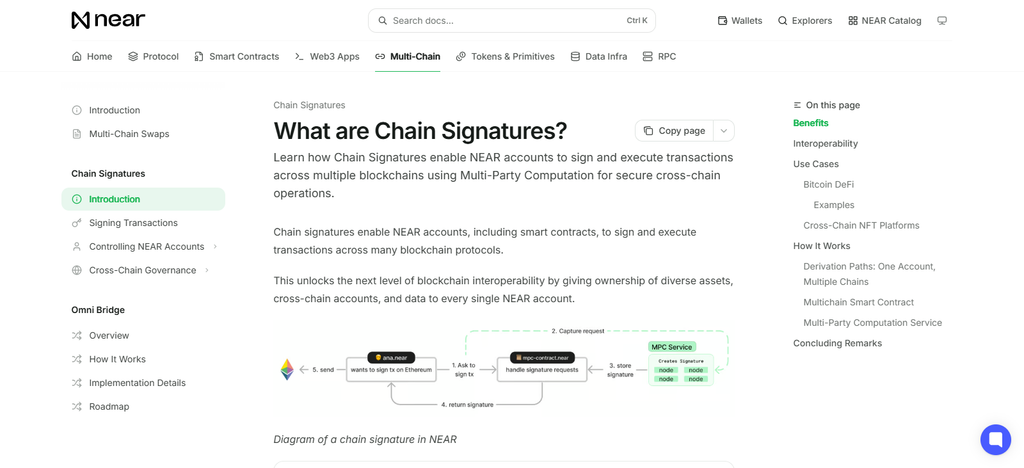
Developers integrate with Chain Signatures tooling and libraries, like chainsig.js. It supports EVM networks and chains like Bitcoin, and NEAR Intents extend the broader abstraction layer to assets on Ethereum, Arbitrum, Base, Solana and other networks. Pricing is based on consumption and execution on the network. Distributed signing with security based on MPC.
Key Strengths of NEAR Chain Signatures
- Signing (MPC): Decentralized signing of transactions for supported external blockchains.
- Multichain Access: Links NEAR-based apps with other blockchain ecosystems.
- Non-Custodial Architecture: It is designed to avoid having a centralized party hold the external-chain keys of users.
- Chain Abstraction: Applications can interact with different chains without the need for separate private-key management.
- Developer Friendly Integration: Offers tooling and libraries to build apps around chain signatures.
| Feature | Details |
|---|---|
| Chain Signatures | Enables NEAR accounts to generate signatures for transactions on external chains. |
| MPC Technology | Uses multi-party computation for distributed key management and signing. |
| Chain Abstraction | Reduces the need for users to manage separate accounts and keys across networks. |
| External-Chain Transactions | Supports transaction signing for supported EVM and non-EVM ecosystems. |
| NEAR Intents | Can work with NEAR’s intent infrastructure for cross-chain asset operations. |
| Developer Libraries | Provides Chain Signatures libraries and developer tooling. |
| Key Management | Uses distributed signing rather than placing complete private-key control with one party. |
3. Socket protocol
Socket Protocol enables cross-chain interoperability and transaction orchestration, giving developers the infrastructure to transfer assets and execute actions across different blockchain networks. Instead of a one size fits all universal-account product, its abstraction model is based on routing and composable cross-chain execution.
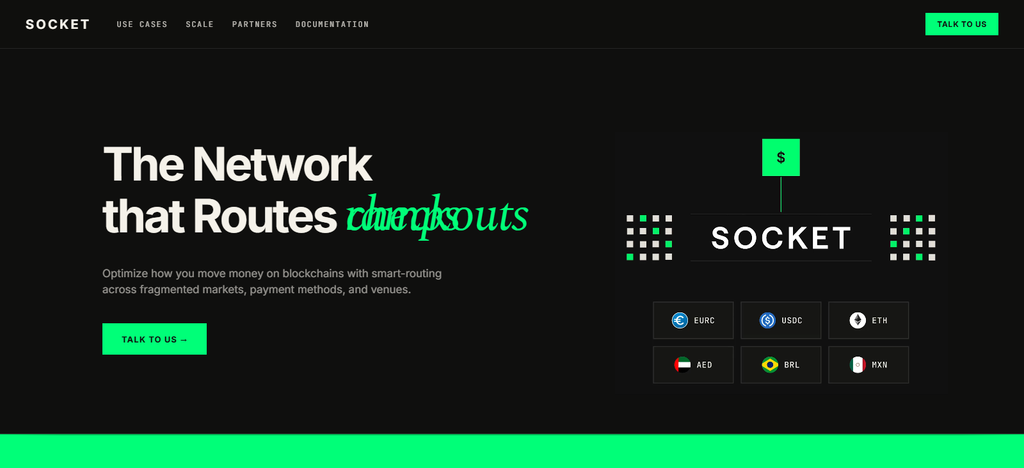
A developer integration layer with socket APIs, SDKs and transaction-routing infrastructure to enable applications to discover routes and execute multichain operations. It works with major EVM ecosystems, and Layer-2 networks too.
Pricing generally is based on transaction and routing infrastructure rather than one global subscription. Security relies on the bridges, liquidity providers and execution routes you choose. Socket is best understood as a developer-centric cross-chain orchestration infrastructure.
Key Strengths of Socket Protocol
- Cross-chain routing – finds routes for asset transfers and execution of transactions on supported networks.
- Composable Infrastructure: Offers building blocks for developers to construct multichain applications.
Transaction Orchestration: Orchestrates complex cross-chain operations over a single, unified infrastructure layer.
Extensive Network Connectivity: Connects apps to multiple blockchain networks and liquidity pools.
Developer APIs and SDKs: Offers integration infrastructure for applications requiring cross-chain capabilities.
| Feature | Details |
|---|---|
| Cross-Chain Routing | Finds suitable routes for moving assets between supported networks. |
| Transaction Orchestration | Coordinates multiple steps involved in cross-chain transactions. |
| Socket API | Provides APIs for integrating cross-chain functionality into applications. |
| Socket SDK | Developer tooling simplifies integration of cross-chain infrastructure. |
| Liquidity Routing | Connects applications with available cross-chain liquidity routes. |
| Bridge Aggregation | Can aggregate different bridging options to improve route selection. |
| Modular Infrastructure | Allows developers to build customized multichain transaction experiences. |
4. Across Protocol
Across Protocol employs an intent-based interoperability model, where users define their desired cross-chain outcomes, and relayers compete to achieve them. It supports the major networks such as Ethereum, Arbitrum, Base, Optimism,
Polygon, Solana and other supported chains with its current infrastructure listing 24 mainnet chains. Developers are able to plug in via the Swap API, Gasless API, deposit addresses and intelligent contracts. Across also supports ERC-7683 cross-chain intents and embedded destination-chain actions.
Gasless execution can eliminate the requirement of users to hold destination-chain gas. Prices vary based on the route, gas and transaction terms. Security is based on optimistic verification, competition of relayers, settlement and protocol contracts.
Key Strengths of Across Protocol
- Relayer Competition: Relayers compete to service cross-chain requests, helping to optimize execution.
- Intent-Based Execution: Allows users to specify the cross-chain state they desire rather than having to execute each transaction manually.
- Fast Cross-Chain Transfer: Built to transfer assets between supported networks at a fast pace.
- ERC-7683 Support: Provides infrastructure for the emerging standard for cross-chain intents.
- Gasless Capabilities: Its infrastructure allows users to not have to hold native gas tokens on destination chains.
| Feature | Details |
|---|---|
| Intent-Based Transfers | Users specify desired cross-chain outcomes instead of managing every transaction step. |
| Relayer Network | Relayers compete to fulfill user intents and provide destination-chain execution. |
| Cross-Chain Swaps | Supports asset movement and swap-related cross-chain workflows. |
| ERC-7683 | Supports the ERC-7683 framework for standardized cross-chain intents. |
| Gasless Transactions | Provides infrastructure that can reduce users’ need to hold destination-chain gas tokens. |
| Across API | Developers can integrate cross-chain transfer and execution functionality. |
| Fast Settlement | Uses its cross-chain architecture to provide efficient asset transfer and settlement. |
5. OneBalance
OneBalance is based on a single balance and chain-abstraction model that enables applications to expose assets and execution on multiple networks through a single interface. Fundamentally is the Unified Balance, which removes the need for users to bridge their funds manually before interacting with another chain.

Developers are able to access OneBalance via APIs and SDK-oriented infrastructure for cross-chain transfers and contract calls. Designed for EVM and other blockchain ecosystems, including Solana integrations.
Prices are usage-related and may differ depending on execution and routing needs. Security is a function of the underlying execution and settlement infrastructure. Its most relevant use case is multi-chain applications requiring unified liquidity and cross-chain actions.
Key Strengths of OneBalance
- Unified Balance: Consolidates liquidity from multiple chains into a single, simplified balance experience.
- Cross-Chain Execution: Allows apps to execute operations across multiple blockchain networks.
- Developer APIs: Infrastructure for plugging chain abstraction into applications.
- Multichain UX: Minimizes users’ need to bridge manually or change networks.
- Cross-Chain Contract Calls: allows applications to call contracts on supported chains via an abstraction layer
| Feature | Details |
|---|---|
| Unified Balance | Presents assets across supported networks through a unified balance abstraction. |
| Chain Abstraction | Hides much of the complexity associated with interacting with multiple chains. |
| Cross-Chain Contract Calls | Enables applications to initiate contract interactions across supported networks. |
| Unified Liquidity | Helps applications work with liquidity distributed across multiple chains. |
| Developer APIs | Provides APIs for integrating cross-chain functionality into applications. |
| Multichain Execution | Coordinates transactions and actions across different blockchain environments. |
| User Experience Layer | Reduces manual bridging and network-switching requirements for users. |
6. LayerZero
LayerZero is a modular interoperability protocol that allows applications to send arbitrary messages and value between supported blockchains. Its abstraction model is based on configurable messaging, not a native universal account.
Developers develop with OApps, Endpoint contracts, SDKs and APIs. LayerZero V2 uses Decentralized Verifier Networks (DVNs) for message verification and Executors for destination execution, enabling applications to set their security requirements.
Supported environments include EVM and non-EVM ecosystems such as Solana and Aptos. Fees for verification, execution and protocol related costs, vary by route. Executor options can deal with gas, but LayerZero is primarily an interoperability infrastructure, not a complete universal-account system.
Key Strengths of LayerZero
- Cross-Chain Contracts: Application logic that extends across multiple blockchains.
- Omnichain Messaging: Allows applications to communicate across different blockchain networks.
- Security you control: Developers decide what verification infrastructure to use for their applications and how to configure it.
- Extensive Ecosystem Compatibility: Connects the EVM and numerous non-EVM blockchain ecosystems.
- Developer Infrastructure: SDKs, endpoints and application-specific infrastructure to build multichain applications.
| Feature | Details |
|---|---|
| Omnichain Messaging | Enables applications to send messages between supported blockchain networks. |
| LayerZero V2 | Provides a modular architecture for cross-chain application development. |
| Decentralized Verifier Networks | Uses configurable DVNs to verify cross-chain messages. |
| Executors | Handles destination-chain transaction execution after message verification. |
| OApps | Provides an application model for building omnichain applications. |
| Cross-Chain Contract Calls | Allows smart contracts to communicate and trigger actions on other networks. |
| Configurable Security | Developers can select verification configurations appropriate for their application. |
7. Chainlink CCIP
Chainlink CCIP is the secure cross-chain messaging and token-transfer infrastructure for developers building multichain applications. Its abstraction model is for programmable cross-chain communication, not universal accounts or consumer-facing intent execution.
Developers are able to build using CCIP APIs, SDKs, intelligent contracts, and programmable token-transfer functionality. Its current mainnet directory features dozens of networks including Ethereum, Solana, BNB Chain, Base, Arbitrum, Avalanche and more. Prices are subject to change and may include execution, verification, token-pool and protocol fees.
CCIP leverages decentralized verification and defense-in-depth security via Chainlink infrastructure. It can abstract some of the complexity of destination execution, but it is not fundamentally a universal account platform.
Key Strengths of Chainlink CCIP
- Security-First Infrastructure: Leverages Chainlink’s decentralized oracle infrastructure to validate cross-chain messages.
- Cross-Chain Messaging: Allows applications to pass data and commands between compatible networks.
- Token Transfers: Enables standardized token transfer functionality across chains.
- Programmable Transfers – Token transfers plus cross-chain application instructions.
- Enterprise-Grade Infrastructure: Infrastructure for financial applications and organizations with needs for controlled cross-chain communication.
| Feature | Details |
|---|---|
| Cross-Chain Messaging | Transfers arbitrary data and instructions between supported blockchains. |
| Token Transfers | Provides infrastructure for transferring tokens across supported networks. |
| Programmable Token Transfers | Combines token transfers with instructions for destination-chain execution. |
| Decentralized Verification | Uses Chainlink’s decentralized oracle infrastructure to validate cross-chain messages. |
| Rate Limits | Provides controls designed to limit abnormal or excessive token movement. |
| Risk Management | Includes multiple security mechanisms for monitoring and controlling cross-chain activity. |
| Developer APIs and Contracts | Offers smart contracts and integration infrastructure for multichain applications. |
8. Hyperlane
Hyperlane is a permissionless, modular interoperability protocol that enables cross-chain messaging, token transfers, and interchain account functionality. Its abstraction model allows developers to develop applications that interact across supported networks without having to build separate messaging infrastructure for each chain.
Developers have access to Hyperlane’s Mailbox contracts, SDKs, Warp Routes, and Interchain Accounts. It supports EVM and other blockchain environments in its architecture and permissionless deployment is a major differentiator for new-chain integration.
Pricing depends on message delivery, and gas and infrastructure configuration. Security is modular via configurable Interchain Security Modules and validators. Hyperlane is more general interoperability infrastructure than a traditional universal-account wallet, but it can also be used to enable cross-chain contract calls and accounts.
Key Strengths of Hyperlane
- Permissionless Interoperability: Developers are able to link supported chains without requiring a central approval process.
- Interchain Security Modules: Security is configurable by developers through Interchain Security Modules.
- Interchain Accounts allows applications and accounts to act across different networks.
Warp Routes: The infrastructure to build cross-chain token-transfer systems. - Custom Developer Stack: Contracts, SDKs and Interoperability components for custom multichain applications.
| Feature | Details |
|---|---|
| Permissionless Interoperability | Allows developers to connect supported chains without centralized permission. |
| Cross-Chain Messaging | Enables data and instructions to move between connected networks. |
| Interchain Accounts | Allows accounts on one chain to control actions on another supported chain. |
| Interchain Security Modules | Provides configurable security mechanisms for message verification. |
| Warp Routes | Enables cross-chain token-transfer infrastructure. |
| Hyperlane SDK | Provides developer tools for integrating interoperability functionality. |
| Modular Architecture | Allows developers to customize security and cross-chain application components. |
9. Wormhole.
Wormhole is a multichain interoperability platform that provides messaging, token transfers and cross-chain applications and settlement infrastructure. Its abstraction model is built on confirmed cross chain messaging, not a native universal-account system.
Developers are able to build using Wormhole Core Contracts, SDKs, Connect, Native Token Transfers and messaging infrastructure. Supported ecosystem includes Ethereum, Solana, Sui, Aptos, Base, Arbitrum, Avalanche, BNB Chain and many other networks.
The fees are based on the selected product and the relevant transaction costs. Executors are not trusted to determine whether messages are valid . Security is based on the Wormhole Guardian network which signs Verifiable Action Approvals . Its infrastructure can support gas abstraction and intent based settlement applications.
Key Strengths of Wormhole
- Multichain Messaging: Allows applications to send messages across numerous blockchain ecosystems.
- Cross-Chain Token Transfers: Infrastructure to transfer supported assets across networks.
- Ecosystem Coverage: Connects major EVM and non-EVM ecosystems including Solana.
Guardian Network: Leverages a decentralized Guardian network to validate cross-chain messages. - Developer Tooling: SDKs and products to build cross-chain applications and integrations.
| Feature | Details |
|---|---|
| Cross-Chain Messaging | Enables applications to communicate across multiple blockchain ecosystems. |
| Wormhole Guardians | Guardian infrastructure observes and verifies cross-chain messages. |
| Native Token Transfers | Provides infrastructure for moving supported tokens between networks. |
| Wormhole Connect | Simplifies wallet and cross-chain integration for applications. |
| Cross-Chain Applications | Supports applications requiring communication and asset movement across chains. |
| EVM and Non-EVM Support | Connects ecosystems such as Ethereum, Solana, Sui, and other supported networks. |
| Developer SDKs | Provides tooling for building applications around Wormhole messaging and transfers. |
10. agorist
Agoric is a Layer-1 on Cosmos designed for cross-chain smart-contract orchestration with JavaScript. Its abstraction model is built on Orchestration which enables a smart contract to operate remote accounts, transfer assets, call contracts and orchestrate asynchronous operations among connected chains.
Developers: Agoric Orchestration SDK, JavaScript intelligent contracts, ChainHub and Orchestrator interfaces. It is built-in with Cosmos/IBC and can be connected to other external ecosystems via supported interoperability mechanisms.
IST is used for network fees and BLD is used for staking and governance in Agoric. Security relies on CometBFT consensus, IBC, and security assumptions of connected-chains. Its biggest differentiator is programmable multichain orchestration, not a consumer universal-account model.
Key Strengths of agorist
- **JavaScript Smart Contracts: ** Allows developers to write intelligent contracts using javascript based development tools.
Multichain Orchestration: Coordinates actions across multiple blockchain networks from programmable contracts. - Asynchronous Execution: Suited for cross-chain tasks that can finish at different times.
Cosmos Integration: Utilizes the Cosmos ecosystem and IBC as key elements of its interoperability stack. - Programmable Cross-Chain Applications: Allows developers to create applications that coordinate assets, accounts, and actions across connected chains.
| Feature | Details |
|---|---|
| Agoric Orchestration | Coordinates multichain actions through programmable smart contracts. |
| JavaScript Smart Contracts | Enables developers to write smart-contract logic using JavaScript-based tooling. |
| Interchain Accounts | Allows applications to control or coordinate accounts across connected chains. |
| IBC Integration | Uses Inter-Blockchain Communication as a core component of its Cosmos connectivity. |
| ChainHub | Provides infrastructure for discovering and interacting with connected chains. |
| Asynchronous Execution | Designed to manage cross-chain operations that may complete at different times. |
| Multichain DeFi | Enables developers to build applications that coordinate assets and actions across multiple chains. |
Conclusion
Chain abstraction is emerging as a critical infrastructure layer for building simpler and more interconnected Web3 applications. Particle Network, NEAR Chain Signatures, Socket Protocol, Across Protocol, OneBalance, LayerZero, Chainlink CCIP, Hyperlane, Wormhole, and Agoric have a different approach to the problem, through universal accounts, unified balances, intents, solvers, cross-chain messaging and programmable orchestration.
Developers looking to choose a platform should consider supported chains, integration methods, security architecture, gas abstraction, pricing, and execution models. Ultimately, the right solution depends on whether the application needs multichain accounts, cross-chain liquidity, automated intent execution, messaging or full cross-chain application orchestration.
FAQ
What is chain abstraction in Web3?
Chain abstraction is an infrastructure approach that hides blockchain-specific complexity from users and developers. It can simplify chain switching, gas management, liquidity movement, wallet interactions, and cross-chain transactions through unified accounts, intents, routing, and execution systems.
Why is chain abstraction important for Web3 developers?
Chain abstraction can reduce the complexity of building multichain applications. Instead of creating separate transaction flows for every network, developers can use abstraction infrastructure to provide a more unified experience across supported blockchains.
What is the difference between chain abstraction and account abstraction?
Account abstraction mainly makes blockchain accounts programmable and improves transaction management. Chain abstraction focuses on hiding differences between multiple blockchains, including network selection, liquidity, gas, and cross-chain execution. The two technologies can work together.
Which chain abstraction platform is best for developers?
There is no single best platform for every project. Particle Network and OneBalance are useful for unified account and balance experiences, Across focuses strongly on intent-based cross-chain execution, while LayerZero, Chainlink CCIP, Hyperlane, and Wormhole provide broader interoperability infrastructure.
Does chain abstraction eliminate the need for bridges?
Not necessarily. Chain abstraction can hide bridging complexity from users, but many abstraction systems still rely on bridges, liquidity networks, messaging protocols, solvers, or other cross-chain infrastructure behind the scenes.