


In this article, I will compare the Best Paymaster Platforms for Gasless Web3 Transactions based on their features, ERC-4337 support, gas sponsorship options, token-based payments, supported networks, developer tools, pricing, and security controls.
These platforms enable Web3 developers to reduce transaction friction, simplify user onboarding and offer more seamless blockchain experiences without needing users to hold native tokens for gas fees.
What Are Paymaster Platforms for Gasless Web3 Transactions?
Paymaster platforms are Web3 infrastructure services that let applications pay blockchain gas fees on behalf of users, or let users pay gas with supported tokens instead of native assets. They typically work in conjunction with account abstraction and ERC-4337, where a Paymaster verifies the eligible UserOperations and pays or sponsors their gas fees.
This eliminates the need for users to hold ETH, MATIC or any other native token before interacting with a dApp. Developers may also define sponsorship rules, spending caps, allow lists, transaction conditions and usage quotas to help reduce gas costs and provide a smoother, more familiar transaction experience.
Why Choose Paymaster Platforms for Gasless Web3 Transactions
Ease of User Onboarding: Users can access Web3 apps without needing to purchase or transfer native tokens on blockchains to pay for transactions.
Transactions Without Gas: Paymasters enable developers to sponsor the gas costs of eligible users, providing a better experience for wallets, DeFi apps, games and consumer dApps.
Support for ERC-20 Gas Payments: Some platforms enable users to pay transaction fees using tokens like USDC instead of ETH or some other native gas token.
Increase Conversion: The elimination of the upfront requirement of a gas-token removes friction in onboarding and may make blockchain applications more user-friendly for the mainstream.
Control Sponsorship Costs: Developers are able to control their gas budget by setting spending limits, transaction rules, allowlists, quotas and eligibility conditions.
Support Account Abstraction: Paymasters enable smart-account infrastructure, allowing for programmable transactions, batching, sponsored operations, and other more flexible wallet experiences.
Multi-Chain Access Expansion: Multiple Paymaster providers support several EVM chains, enabling developers to build uniform gas-payment experiences across chains.
Less Complicated Transactions: Users do not have to figure out which native token is required for gas, making blockchain interactions feel more like traditional Web2 applications.
Prevent Gas Abuse: Policy controls, validation, simulation, rate limits, and transaction restrictions can help prevent unauthorized or excessive sponsored transactions.
Enhance Web3 Product Design: Gas abstraction provides developers more control over the transaction experience, allowing them to build apps where the blockchain infrastructure is largely invisible to the user.
Key Points
| Paymaster Platform | Key Strength |
|---|---|
| Pimlico Paymaster | One of the most widely used ERC-4337 paymaster services, offering Verifying and ERC-20 paymasters, sponsored transactions, and support across 100+ chains. |
| Alchemy Gas Manager | Managed gas sponsorship platform integrated with smart wallets, bundlers, and Account Kit infrastructure. |
| Biconomy Paymaster | ERC-4337-compliant paymaster supporting flexible gas payment models and gasless user experiences. |
| ZeroDev Paymaster | Integrated account abstraction and paymaster stack optimized for Kernel smart accounts and gas sponsorship. |
| Coinbase Developer Platform Paymaster | Paymaster infrastructure bundled with Coinbase’s account abstraction and smart wallet ecosystem. |
| Stackup Paymaster | ERC-4337 infrastructure platform providing paymaster, bundler, and gas sponsorship services. |
| Candide Paymaster | Feature-rich paymaster infrastructure supporting no-code sponsorship policies and ERC-20 gas payments. |
| Etherspot Arka | Open-source paymaster service supporting sponsored and gasless transactions for smart accounts. |
| Openfort Paymaster | Production-grade paymaster with policy engines, stablecoin gas payments, and ERC-20 sponsorship models. |
| Circle USDC Paymaster | Paymaster infrastructure designed to enable gas payments directly in USDC for improved user onboarding. |
1. Pimlico Paymaster
Pimlico is an ERC-4337 Paymaster infrastructure provider with Verifying and ERC-20 Paymaster models. Founded in 2022.
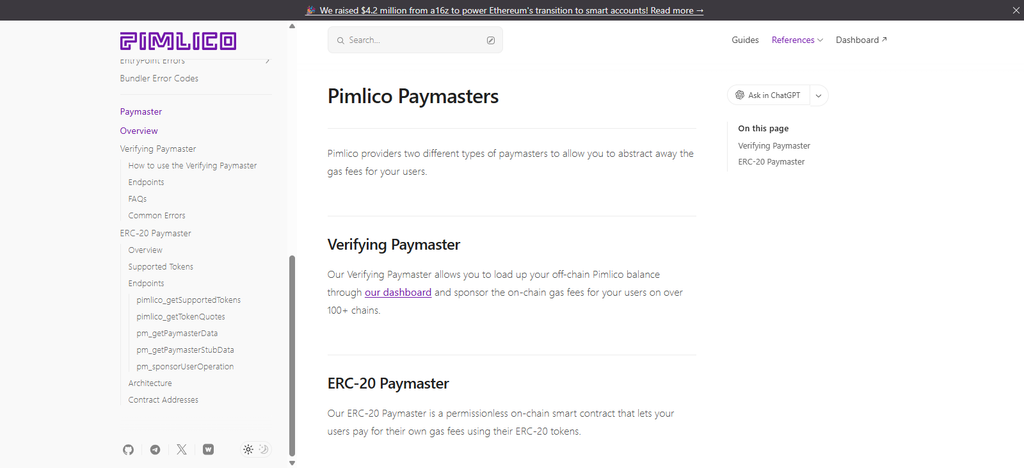
It provides gas sponsorship for users or gas payment with supported ERC-20 tokens including stablecoins. Pimlico supports 100+ chains including Ethereum, Base, Arbitrum, Optimism, Polygon and BNB Chain and works with smart accounts such as Safe, Kernel, MetaMask Smart Accounts and Coinbase Wallet.
Its sponsorship policies can set user budgets, transaction budgets and campaign budgets. Pimlico also runs its own Alto bundler and production pricing is pay-as-you-go with a published 10% surcharge on mainnet.
| Feature | Details |
|---|---|
| Paymaster Model | Verifying Paymaster for sponsored gas and ERC-20 Paymaster for token-based gas payments. |
| ERC-4337 Support | ERC-4337-compliant infrastructure with UserOperation-based gas sponsorship. |
| Gas Sponsorship | Developers can sponsor gas so users can transact without holding the native network token. |
| ERC-20 Gas Payments | Supports gas payments through ERC-20 tokens, including stablecoins and other supported tokens. |
| Supported Networks | Supports 100+ chains, including Ethereum, Base, Arbitrum, Optimism, Polygon and BNB Chain. |
| Sponsorship Policies | Developers can define budgets, transaction limits and user-specific sponsorship conditions. |
| Smart Account Compatibility | Integrates with Safe, Kernel, MetaMask Smart Accounts, Coinbase Wallet, Biconomy Nexus and other smart accounts. |
| Bundler Support | Pimlico provides its own bundling infrastructure through Alto. |
| Developer Tools | SDK/API infrastructure and Permissionless.js simplify Paymaster and smart-account integration. |
| Pricing | Usage-based infrastructure pricing; sponsorship costs depend on gas usage and selected services. |
| Security Controls | Policy-based authorization and UserOperation validation help control sponsored transactions. |
| Key Advantage | Strong combination of gas sponsorship, ERC-20 gas payments, bundling and broad multi-chain coverage. |
2. Alchemy Gas Manager
Alchemy Gas Manager is Alchemy’s ERC-4337 compliant Paymaster for sponsored transactions and programmable gas policies. Alchemy was founded in 2017 and Gas Manager supports major networks including Ethereum, Arbitrum, OP Mainnet, Polygon and Base.
Developers are able to sponsor user transactions or enable ERC-20 gas payments (including custom tokens where applicable). Gas policies provide controls to sponsorship limits and monitoring.
Alerts can be set to notify teams at various spending thresholds. Alchemy has its own ERC-4337 bundler too, creating an integrated sponsorship and UserOperation infrastructure. Current PAYG Gas Manager fee is 8% of gas fees covered and enterprise pricing is custom.
| Feature | Details |
|---|---|
| Paymaster Model | Gas Sponsorship, Onchain Paymaster and ERC-20 gas-payment policies. |
| ERC-4337 Support | Supports ERC-4337 and also provides Gas Manager functionality compatible with ERC-7702 flows. |
| Gas Sponsorship | Developers can cover users’ gas costs through configurable Gas Manager policies. |
| ERC-20 Gas Payments | Users can pay gas with supported ERC-20 tokens instead of the network’s native token. |
| Supported Networks | Supports gas sponsorship across multiple EVM networks, with chain availability depending on the selected policy and plan. |
| Sponsorship Policies | Supports spending caps, transaction limits, allowlists, blocklists, expiry periods and webhook-based approval. |
| Smart Account Compatibility | Designed to work with smart accounts and Alchemy Account Kit infrastructure. |
| Bundler Support | Integrated with Alchemy’s bundler infrastructure for UserOperation submission. |
| Developer Tools | Dashboard, Gas Manager API, SDKs and Wallet APIs provide multiple integration options. |
| Pricing | Testnet sponsorship is available broadly; mainnet sponsorship depends on PAYG or Enterprise access and usage limits. |
| Security Controls | Allowlisting, blocklisting, spending limits, policy expiration and transaction-level validation help reduce sponsorship abuse. |
| Key Advantage | Particularly strong for developers wanting detailed sponsorship rules and an integrated account-abstraction infrastructure stack. |
3. Biconomy Paymaster
Biconomy, founded in 2019, provides an ERC-4337 Paymaster that supports gas sponsorship and token-based gas payments. Its Paymaster is designed to remove native token requirements, while providing developers with control through configurable sponsorship policies. Developers are able to create rules based on conditions like owning a specific NFT, or limiting sponsorship to a fixed number of transactions.
Biconomy supports major EVM ecosystems and has integrated its Paymaster into its smart-account and bundler infrastructure. The platform also supports modular smart accounts and the newer account-abstraction architecture. There is not one Paymaster fee that is the same for all, pricing is based on the infrastructure and usage chosen by the developer. Developers should check their current plan before deploying.
| Feature | Details |
|---|---|
| Paymaster Model | Supports sponsored gas and token-based gas-payment approaches within Biconomy’s account-abstraction stack. |
| ERC-4337 Support | Built around ERC-4337 account abstraction and UserOperations. |
| Gas Sponsorship | Developers can sponsor transaction fees to remove native-token requirements from user transactions. |
| ERC-20 Gas Payments | Supports token-based gas-payment experiences where configured for the relevant network and application. |
| Supported Networks | Designed for multi-chain EVM applications with support varying by Biconomy product and network availability. |
| Sponsorship Policies | Developers can configure conditions around which users and transactions qualify for sponsored gas. |
| Smart Account Compatibility | Integrates with Biconomy’s Nexus smart-account architecture and broader account-abstraction tooling. |
| Bundler Support | Biconomy provides bundler infrastructure alongside its Paymaster and smart-account services. |
| Developer Tools | SDKs, APIs and account-abstraction infrastructure simplify implementation of sponsored transactions. |
| Pricing | Usage and infrastructure costs depend on the selected Biconomy services and deployment requirements. |
| Security Controls | Policy-based sponsorship and UserOperation validation help developers restrict eligible transactions. |
| Key Advantage | Useful for teams seeking a broader account-abstraction stack combining smart accounts, bundling and Paymaster functionality. |
4. ZeroDev Paymaster
ZeroDev Founded in 2022, ZeroDev is known for Kernel-based programmable smart-account infrastructure. Its Paymaster is compatible with ERC-4337 gas sponsorship and can be configured through ZeroDev’s infrastructure layer.
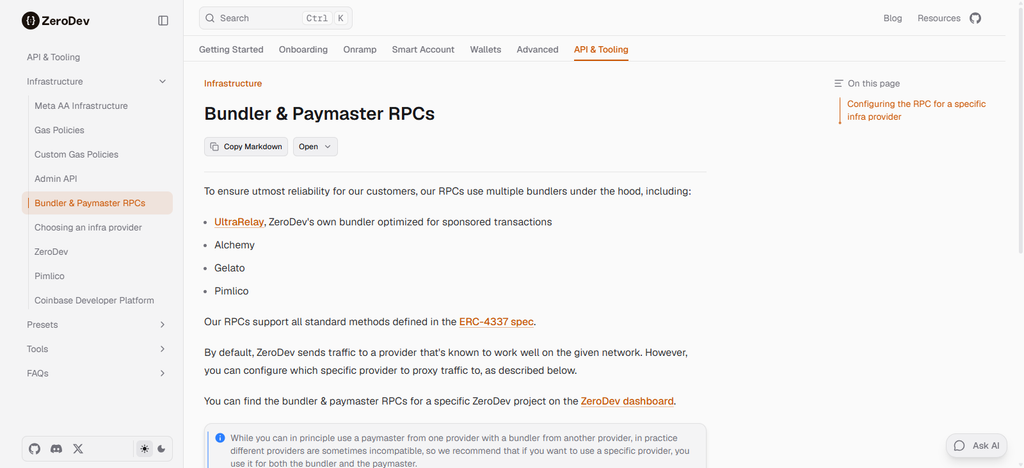
Developers are able to utilize sponsorship policies and custom Paymaster logic, while ZeroDev’s RPC infrastructure can route bundler and Paymaster traffic through UltraRelay, Alchemy, Gelato or Pimlico.
ZeroDev also supports ERC-20 gas payments including USDC on Ethereum, Polygon, Base, Optimism and Arbitrum, with a documented 5% premium on the exchange rate for that service. Pricing is built into the design of ZeroDev infrastructure as a whole, with usage credits and rate limits.
| Feature | Details |
|---|---|
| Paymaster Model | Supports sponsored transactions and ERC-20 gas payments through its Kernel smart-account infrastructure. |
| ERC-4337 Support | Built around ERC-4337-compatible Kernel smart accounts. |
| Gas Sponsorship | Applications can sponsor user transactions so users do not need native gas tokens. |
| ERC-20 Gas Payments | USDC is supported by default, while custom ERC-20 tokens can be configured through a custom Paymaster. |
| Supported Networks | Supports major EVM networks, with exact token and Paymaster availability depending on network configuration. |
| Sponsorship Policies | Developers can control which transactions qualify for sponsorship through Paymaster configuration and application logic. |
| Smart Account Compatibility | Deeply integrated with ZeroDev Kernel, its modular smart-account architecture. |
| Bundler Support | ZeroDev can work with bundling infrastructure including its integrated routing and supported third-party providers. |
| Developer Tools | Kernel SDK, Paymaster integrations and account-abstraction APIs support developer implementations. |
| Pricing | Pricing depends on ZeroDev infrastructure usage and selected services; ERC-20 gas payments include a documented exchange-rate premium. |
| Security Controls | ERC-20 approvals, Paymaster validation and configurable Paymaster logic help control token-based gas payments. |
| Key Advantage | Strong choice for developers building programmable Kernel-based smart accounts with ERC-20 gas-payment support. |
5. Coinbase Developer Platform Paymaster
Coinbase Developer Platform Paymaster offers ERC-4337-compatible gas sponsorship and bundling, with an emphasis on the Base ecosystem. The company, founded in 2012, launched this Paymaster product as part of the infrastructure of its Developer Platform.
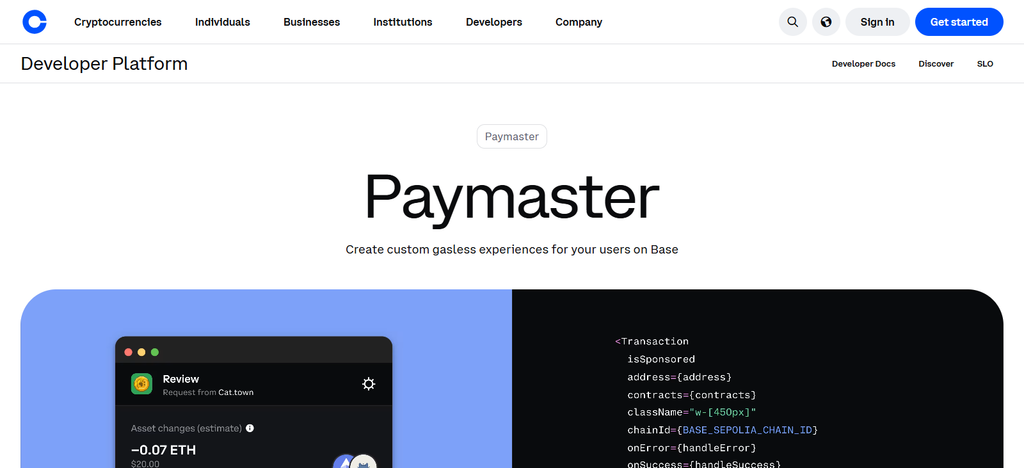
Developers are able to sponsor UserOperations so users don’t have to hold ETH for the corresponding transactions. It supports transaction batching to reduce friction. The current Paymaster offering is giving away free initial gas credits, with Coinbase advertising up to $15,000 in Base gas credits for eligible builders.
The bundler and Paymaster collaborate for smart-account transactions. Base Mainnet and Base Sepolia are the core documented environments.
| Feature | Details |
|---|---|
| Paymaster Model | Sponsored Paymaster designed to cover gas for eligible smart-account UserOperations. |
| ERC-4337 Support | Provides ERC-4337-compatible Paymaster and Bundler infrastructure. |
| Gas Sponsorship | Developers can sponsor users’ gas fees, removing the requirement for users to hold ETH for eligible transactions. |
| ERC-20 Gas Payments | The core CDP Paymaster is primarily positioned around gas sponsorship rather than general-purpose ERC-20 gas payments. |
| Supported Networks | The Paymaster and Bundler product is focused on the Base ecosystem. |
| Sponsorship Policies | Sponsorship is controlled through the application’s Paymaster configuration and available credits. |
| Smart Account Compatibility | Designed for smart-account UserOperations on Base. |
| Bundler Support | Coinbase provides a Bundler alongside the Paymaster for submitting UserOperations to Base. |
| Developer Tools | Coinbase Developer Platform provides APIs, SDKs and Base infrastructure for implementation. |
| Pricing | Coinbase currently promotes free access with initial gas credits, including up to $15,000 in additional Base gas credits for eligible builders. |
| Security Controls | Uses standardized ERC-4337 infrastructure and Coinbase-managed Paymaster/Bundler services. |
| Key Advantage | Particularly attractive for developers building gasless applications specifically on Base. |
6. Stackup Paymaster
Stackup is a provider of account abstraction infrastructure working on ERC-4337 bundling and Paymaster services Its Paymaster model is more geared toward letting developers sponsor gas for smart-account UserOperations, rather than making users hold native tokens.
Stackup’s infrastructure is designed for EVM-compatible applications and can be combined with ERC-4337 smart accounts and bundler infrastructure. The Paymaster manages the gas payment aspect of the UserOperation lifecycle.
Developers are empowered to create sponsorship rules in relation to their application logic. Pricing and exact network coverage of Stackup can vary by infrastructure configuration, so a fixed universal fee should not be stated without a current commercial quote.
| Feature | Details |
|---|---|
| Paymaster Model | ERC-4337 Paymaster infrastructure primarily designed for transaction sponsorship. |
| ERC-4337 Support | Strong focus on ERC-4337 account abstraction and UserOperation infrastructure. |
| Gas Sponsorship | Allows applications to cover gas costs for eligible smart-account transactions. |
| ERC-20 Gas Payments | ERC-20 payment capability depends on the selected Paymaster implementation and integration architecture. |
| Supported Networks | Focused on EVM-compatible networks where Stackup’s ERC-4337 infrastructure is available. |
| Sponsorship Policies | Applications can implement eligibility and sponsorship logic around their UserOperations. |
| Smart Account Compatibility | Designed to work with ERC-4337-compatible smart accounts. |
| Bundler Support | Stackup is notable for providing bundling infrastructure alongside Paymaster capabilities. |
| Developer Tools | APIs and ERC-4337 developer infrastructure help teams build account-abstraction applications. |
| Pricing | Pricing depends on infrastructure usage and the Stackup service configuration rather than one universal Paymaster fee. |
| Security Controls | UserOperation validation and Paymaster authorization help restrict sponsored activity. |
| Key Advantage | Useful for developers looking for an infrastructure-focused ERC-4337 stack rather than only a standalone Paymaster. |
7. Candide Paymaster
Candide, which started building account-abstraction infrastructure in 2022, offers an open, permissionless Paymaster compatible with ERC-4337 smart accounts. It supports sponsored transactions, and allows users to pay gas using supported tokens instead of the native asset on a blockchain.
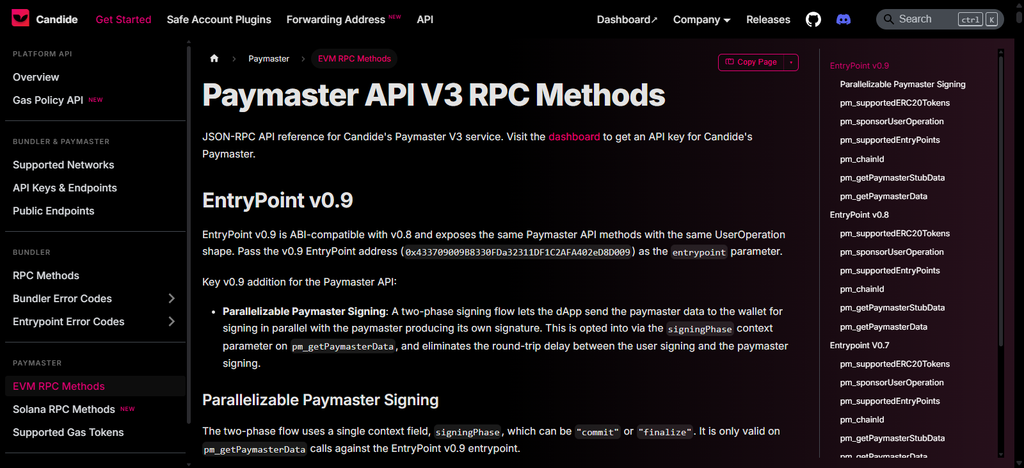
Networks such as Ethereum, Optimism, Arbitrum, Base, Polygon, BNB Chain, Celo, Gnosis, Plasma, World Chain and Solana are currently listed by Candide and have different gas payment mechanisms between EVM and Solana.
Its Paymaster can be used with its bundler and AbstractionKit, but also supports other ERC-4337 smart accounts. Pricing Starts free for Starter, then Launch at $399/month and Grow at $899/month.
| Feature | Details |
|---|---|
| Paymaster Model | Verifying Paymaster for sponsorship and ERC-20 Paymaster for token-based gas payments. |
| ERC-4337 Support | Full focus on ERC-4337 account abstraction and UserOperation infrastructure. |
| Gas Sponsorship | Developers can sponsor eligible user transactions without requiring users to hold native gas tokens. |
| ERC-20 Gas Payments | Supports gas payments using stablecoins and other supported ERC-20 tokens. |
| Supported Networks | Supports networks including Ethereum, Optimism, Arbitrum, Base, Polygon, BNB Chain, Celo and Gnosis, with availability depending on service. |
| Sponsorship Policies | Flexible gas policies allow developers to control which transactions receive sponsorship. |
| Smart Account Compatibility | Works with ERC-4337 smart accounts and Candide’s account-abstraction tooling. |
| Bundler Support | Candide provides bundler infrastructure alongside its Paymaster services. |
| Developer Tools | Includes SDKs, Paymaster tooling and UserOperation simulation capabilities. |
| Pricing | Offers developer plans with pricing varying by service level and usage. |
| Security Controls | Policy-based validation and UserOperation simulation help developers test and restrict sponsored transactions. |
| Key Advantage | Combines no-code sponsorship setup, ERC-20 gas payments and developer-oriented ERC-4337 tooling. |
8. Etherspot Arka
Etherspot’s Arka Paymaster is an open-source Paymaster service built on top of ERC-4337 account abstraction. Etherspot has been developing account-abstraction infrastructure since 2019, while Arka focuses on sponsored and gasless transactions for dApps.
Its Paymaster model enables apps to subsidize gas costs for users and drives forward the broader concept of paying gas with ERC-20 tokens. Arka can be integrated with Etherspot’s account abstraction infrastructure and bundling services as part of smart-account workflows.
Its open source nature is especially helpful to developers who want more ownership of the Paymaster stack. Public pricing is not available as a single universal fixed fee, so commercial costs should be confirmed based on the requirements of the deployment.
| Feature | Details |
|---|---|
| Paymaster Model | Paymaster-as-a-Service supporting verifying and quota-oriented sponsorship approaches. |
| ERC-4337 Support | Built for ERC-4337 account-abstraction applications and smart-account transactions. |
| Gas Sponsorship | Developers can cover gas costs for users through Arka’s Paymaster infrastructure. |
| ERC-20 Gas Payments | Supports token-oriented gas-payment experiences within its account-abstraction stack. |
| Supported Networks | Designed for EVM and rollup environments, with network availability depending on the Arka deployment. |
| Sponsorship Policies | Quotas and eligibility logic can be used to manage how much gas an application sponsors. |
| Smart Account Compatibility | Integrates with Etherspot’s smart-wallet and account-abstraction infrastructure. |
| Bundler Support | Works alongside Etherspot’s bundling infrastructure for UserOperation processing. |
| Developer Tools | SDKs and APIs support Paymaster integration and account-abstraction workflows. |
| Pricing | Commercial pricing depends on infrastructure usage and deployment requirements. |
| Security Controls | Sponsorship quotas and Paymaster validation help limit excessive gas expenditure. |
| Key Advantage | Useful for teams that want Paymaster services integrated into a broader smart-wallet and account-abstraction stack. |
9. Openfort Paymaster
Launched in 2022, Openfort offers its own ERC-4337 Paymaster and bundler infrastructure for consumer apps, gaming and embedded-wallet experiences.
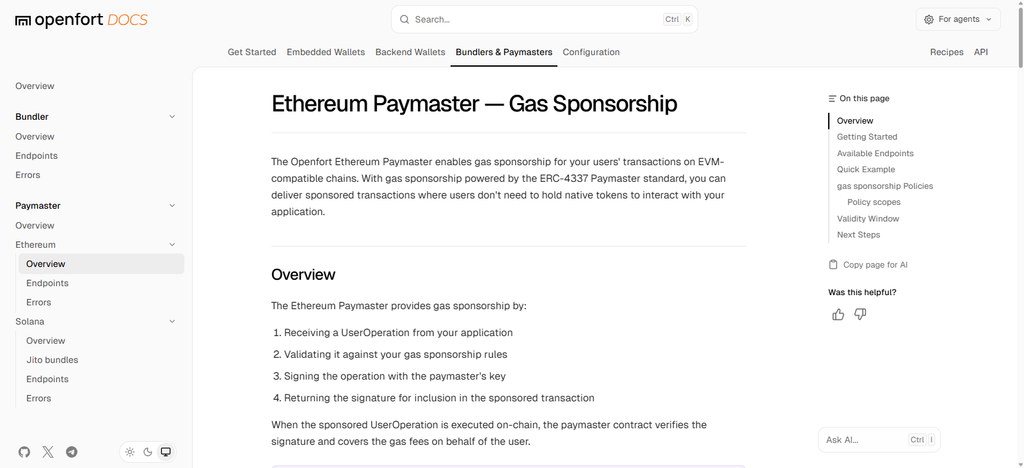
Its Paymaster supports Verifying Mode where the app pays gas, and ERC-20 Mode where users pay gas in tokens like USDC, USDT or DAI. Openfort supports EntryPoint versions v0.6, v0.8 and v0.9 and its infrastructure also supports EIP-7702 delegated accounts.
Sponsorship policies can limit transactions by contract, function, value, chain, recipient and spending limits. Openfort also offers balance monitoring and alerts for sponsorship infrastructure. The pricing is based on its larger infrastructure offering, not a single publicly announced Paymaster fee.
| Feature | Details |
|---|---|
| Paymaster Model | Verifying Mode for fully sponsored gas and ERC-20 Mode for token-based gas payments. |
| ERC-4337 Support | Supports ERC-4337 Paymaster architecture, including modern EntryPoint implementations. |
| Gas Sponsorship | Verifying Mode lets applications pay the complete gas cost for eligible users. |
| ERC-20 Gas Payments | Users can pay gas using supported ERC-20 tokens such as USDC, USDT and DAI. |
| Supported Networks | Supports multiple EVM networks through its account-abstraction infrastructure. |
| Sponsorship Policies | Policy engine can control sponsorship using contract, function, time, gas-budget and other conditions. |
| Smart Account Compatibility | Designed for Openfort smart accounts and embedded-wallet experiences. |
| Bundler Support | Openfort provides Paymaster and bundling infrastructure for its account-abstraction stack. |
| Developer Tools | APIs, SDKs, embedded wallets and Paymaster tooling target gaming and consumer applications. |
| Pricing | Pricing is tied to Openfort’s infrastructure plans and usage rather than a single Paymaster fee. |
| Security Controls | Policy validation, gas budgets and Paymaster signing restrict unauthorized sponsorship. |
| Key Advantage | Particularly suited to games, consumer apps and embedded-wallet products requiring both sponsored and ERC-20 gas flows. |
10. Circle USDC Paymaster
Circle Paymaster was launched in 2025 and is designed specifically around USDC gas payments rather than general-purpose gas sponsorship. Instead of paying transaction fees in native tokens like ETH, users can pay in USDC.
The underlying process of payment of gas is handled by the Paymaster. It’s permissionless, so developers are able to embed it into their own apps without a Circle account, and it supports ERC-4337 smart contract accounts and EIP-7702-enabled EOAs.
The live networks that have been documented are Arbitrum, Avalanche, Base, Ethereum, OP Mainnet, Polygon PoS and Unichain. Circle describes the product as focusing on stablecoins with automated native-token liquidity management.
| Feature | Details |
|---|---|
| Paymaster Model | USDC-focused Paymaster that lets users pay blockchain gas fees directly with USDC. |
| ERC-4337 Support | Supports ERC-4337 smart contract accounts and also EIP-7702-enabled EOAs. |
| Gas Sponsorship | The Paymaster fronts the native gas cost while collecting the corresponding gas payment in USDC. |
| ERC-20 Gas Payments | USDC only is currently supported; Circle plans to expand stablecoin support. |
| Supported Networks | Live on Arbitrum, Avalanche, Base, Ethereum, OP Mainnet, Polygon PoS and Unichain. |
| Sponsorship Policies | Primarily designed around user-paid USDC gas rather than a general-purpose developer sponsorship policy engine. |
| Smart Account Compatibility | Supports ERC-4337 smart contract accounts and EIP-7702 EOA flows. |
| Bundler Support | Works within account-abstraction transaction flows where UserOperations are submitted through compatible bundling infrastructure. |
| Developer Tools | Permissionless integration means developers do not need a Circle account to use the Paymaster. |
| Pricing | Circle states there is zero developer cost, while end users are charged 10% of the gas cost under its published fee model. |
| Security Controls | Circle states that its Paymaster smart contracts undergo third-party security audits. |
| Key Advantage | Best differentiated by its direct focus on letting users pay blockchain gas in USDC across multiple major networks. |
Comparison Table: 10 Best Paymaster Platforms
| Paymaster Platform | Paymaster Model | ERC-4337 | Gas Sponsorship | ERC-20 Gas Payment | Smart Account | Bundler | Main Strength |
|---|---|---|---|---|---|---|---|
| Pimlico Paymaster | Verifying + ERC-20 | Yes | Yes | Yes | Account-agnostic / ERC-7579 | Alto | Multi-chain infrastructure and flexible account compatibility |
| Alchemy Gas Manager | Sponsored + ERC-20 | Yes | Yes | Yes | Alchemy Modular Account / Light Account | Rundler | Advanced sponsorship policies and integrated developer stack |
| Biconomy Paymaster | Sponsored + Token Paymaster | Yes | Yes | Yes | Nexus / Smart Account | Biconomy Bundler | Modular account abstraction and cross-chain UX |
| ZeroDev Paymaster | Gas Policies + ERC-20 | Yes | Yes | Yes | Kernel | Ultra Relay | Programmable smart accounts and session-key support |
| Coinbase Developer Platform Paymaster | Sponsored Paymaster | Yes | Yes | Limited / product-dependent | Coinbase Smart Wallet | Coinbase Bundler | Simple gasless onboarding, especially for Base |
| Stackup Paymaster | Sponsored Paymaster | Yes | Yes | Depends on implementation | Provider-agnostic | Stackup Bundler | Neutral ERC-4337 infrastructure |
| Candide Paymaster | Sponsorship + ERC-20 | Yes | Yes | Yes | Safe / ERC-7579 | Voltaire | Safe-focused account abstraction and flexible policies |
| Etherspot Arka | Paymaster-as-a-Service | Yes | Yes | Supported | Modular accounts / ERC-7579 | Skandha / partner infrastructure | Modular account abstraction and cross-chain workflows |
| Openfort Paymaster | Verifying + ERC-20 | Yes | Yes | Yes | Openfort Smart Accounts | Openfort infrastructure | Gaming and consumer-focused gas abstraction |
| Circle USDC Paymaster | USDC Paymaster | Yes | User-funded USDC gas | USDC | ERC-4337 + EIP-7702 | Compatible bundler infrastructure | Pay blockchain gas directly with USDC |
Quick Comparison by Use Case
| Use Case | Recommended Platform | Why |
|---|---|---|
| Best Overall | Pimlico | Strong combination of Paymaster, bundler and account-agnostic infrastructure |
| Best for Sponsorship Policies | Alchemy | Detailed spending limits, allowlists and transaction policies |
| Best for Modular Accounts | Biconomy | Nexus and ERC-7579-oriented infrastructure |
| Best for Session Keys | ZeroDev | Kernel provides strong programmable account capabilities |
| Best for Base Apps | Coinbase CDP | Integrated Paymaster and Bundler with Base-focused onboarding |
| Best Neutral Infrastructure | Stackup | Provider-agnostic ERC-4337 infrastructure |
| Best for Safe Ecosystem | Candide | Safe-focused account abstraction and Paymaster tooling |
| Best for Cross-Chain Apps | Etherspot Arka | Modular infrastructure and transaction orchestration |
| Best for Web3 Gaming | Openfort | Embedded wallets and gas abstraction designed for consumer/gaming apps |
| Best for USDC Gas | Circle USDC Paymaster | Lets users pay gas directly with USDC |
Conclusion
Paymaster platforms are simplifying Web3 transactions by eliminating the need for users to possess native tokens for each transaction. The above-mentioned platforms vary in terms of gas sponsorship, ERC-20 gas payments, smart-account compatibility, network coverage and transaction policies.
Pimlico, Alchemy, Biconomy, ZeroDev, Coinbase Developer Platform, Stackup, Candide, Etherspot Arka, Openfort, Circle all serve different developer needs.
The developers should consider the supported networks, sponsorship controls, bundler infrastructure, security features, pricing, and integration requirements when choosing a Paymaster for their Web3 application to find the best fit for their needs and support for ERC-4337.
FAQ
What is a Paymaster in Web3?
A Paymaster is a smart-contract-based service that can pay blockchain transaction fees on behalf of users. It enables applications to offer gasless transactions or allow users to pay fees with supported ERC-20 tokens instead of native gas tokens.
How do Paymasters enable gasless transactions?
A user creates a UserOperation through a smart account, and the Paymaster agrees to sponsor the required gas. The bundler submits the transaction, while the Paymaster covers the eligible gas cost according to its sponsorship rules.
Are Paymaster transactions completely free?
Not necessarily. A transaction may appear gasless to the user because the application or Paymaster covers the fee. The developer still pays the underlying blockchain gas, and some Paymaster providers may charge infrastructure or service fees.
Do Paymasters require ERC-4337?
Most modern Web3 Paymasters are built around ERC-4337 account abstraction, which standardizes UserOperations, EntryPoint interactions, bundlers, and Paymaster functionality. Some newer implementations can also work with EIP-7702-based account-abstraction flows.