


In this article, I’ll discuss the Best AI-Based Crypto Wallets for Automated Transactions in 2026. I am going to explain how these wallets use AI to enable crypto management, on-chain transactions, token swap automation and help with DeFi activities. I will also compare their key features, supported blockchains, security, AI capabilities, transaction costs and limitations.
What Are AI-Powered Crypto Wallets?
AI-driven crypto wallets are digital wallets that utilize artificial intelligence and automated agents to make cryptocurrency management and blockchain transactions easier.
They assist users in carrying out such tasks as token swaps, crypto transfers, portfolio monitoring, recurring purchases and DeFi operations with the help of smart instructions and predefined permissions.
Unlike traditional wallets, some AI wallets can evaluate transaction conditions, communicate with intelligent contracts, and automatically execute on-chain activities upon user approval.
They may also have spending limits, transaction monitoring and security controls to safeguard users’ assets. These wallets leverage blockchain technology, smart contract technology, and AI automation for more efficient, flexible and accessible crypto management.
AI Wallets vs Traditional Crypto Wallets
| Comparison Point | AI-Powered Crypto Wallets | Traditional Crypto Wallets |
|---|---|---|
| Main Purpose | Automate crypto management and blockchain activities. | Store, send and receive cryptocurrencies. |
| Transaction Execution | Can execute approved transactions automatically. | Usually requires manual user confirmation. |
| AI Integration | Supports AI agents and intelligent automation. | Generally does not include native AI agents. |
| Token Swapping | Can automate swaps using predefined conditions. | Users typically initiate swaps manually. |
| Portfolio Management | Can support automated monitoring and portfolio analysis. | Primarily provides balance and transaction tracking. |
| DeFi Integration | Can automate supported DeFi activities through agent integrations. | Provides manual access to DeFi applications. |
| Recurring Transactions | Some wallets support scheduled purchases and recurring payments. | Usually requires manual or external scheduling tools. |
| Security Controls | May include spending limits, agent permissions and transaction monitoring. | Primarily relies on private keys, passwords and transaction approvals. |
| User Control | Allows configurable automation and approval requirements. | Users generally control each transaction directly. |
| Supported Networks | Depends on AI wallet and agent integrations. | Depends on the wallet’s supported blockchains. |
| Transaction Costs | Includes network gas, automation and applicable service fees. | Mainly includes network gas and applicable service fees. |
| Best For | Users seeking automated trading, transfers and DeFi management. | Users who prefer direct control over crypto transactions. |
How AI-Powered Crypto Wallets Work
User instructions: The user can give instructions to the AI Agent such as swapping tokens, transferring cryptocurrency or managing a portfolio.
AI Request Parsing: The AI agent parses the user instructions to determine the required blockchain operations.
Market and wallet data analysis: The system checks wallet balance, token price, network conditions and available transaction opportunities.
Transaction Planning: AI agents determine which tokens and networks to use, the transaction amount and execution strategy based on predefined rules.
Permission Check: The wallet checks spending limits, approved addresses, agent permissions and transaction restrictions before executing the transaction. 6. Smart Contract Interaction: Compatible wallets interact with blockchain intelligent contracts to perform swaps, transfers, staking or DeFi operations.
Transaction Monitoring. The wallet monitors the status of transactions, logs the activity on the blockchain and notifies you of successful or failed operations.
Key Points
| AI-Powered Crypto Wallet | Key Point |
|---|---|
| Coinbase Agentic Wallet | Enables AI agents to fund, send, trade, earn, and execute automated crypto transactions with programmable spending controls. |
| MetaMask | Supports programmable transaction automation through preauthorized actions, transaction batching, and account-abstraction features. |
| MoonPay Agents Wallet | Allows AI-driven trading, dollar-cost averaging (DCA), swaps, cross-chain execution, and automated portfolio monitoring. |
| Cobo Agentic Wallet | Built for autonomous blockchain operations, enabling AI-controlled asset management, DeFi interactions, and automated transactions. |
| Crypto.com Wallet | Offers AI-assisted transaction management and automated Web3 asset operations. |
| Safe (Safe Smart Account) | Uses programmable smart-account permissions that allow automated transaction execution under predefined rules. |
| Argent | Smart-contract wallet with automated security controls, transaction automation, and DeFi integration. |
| Zerion Wallet | Provides automated portfolio tracking, DeFi management, and intelligent transaction monitoring. |
| Rabby Wallet | Enhances automated transaction approvals with advanced risk detection and multi-chain support. |
| Trust Wallet | Supports automated Web3 interactions, staking operations, and AI-assisted asset management through integrated dApps. |
1. Coinbase Agentic Wallet
The Coinbase Agentic Wallet is an AI-focused crypto wallet infrastructure that allows autonomous agents to perform on-chain activities and manage digital currencies. Coinbase, founded in 2012, has introduced this wallet in 2026, supporting Base and agent-centric blockchain operations.
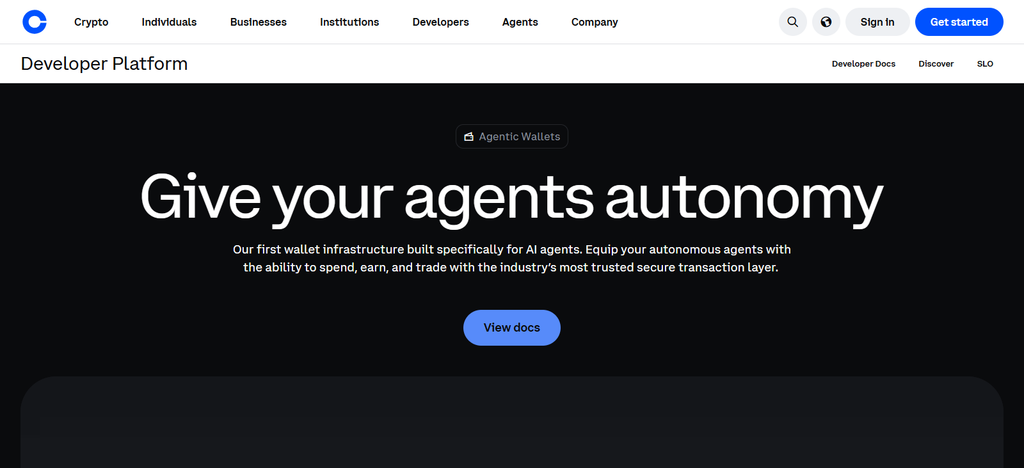
It has AI capabilities for automated authentication, funding, sending, trading and earning with its built-in agent skills. The x402 payment protocol enables agents to perform token transfers, DeFi activities and machine-to-machine payments.
Security features include programmable spend limits, transaction caps and secure private key infrastructure. Trading on Base is gasless and additional costs vary based on network and service usage.
Coinbase Agentic Wallet Key features, Pros & Cons
Features
| Key features | Details |
|---|---|
| AI Agent Integration | Enables AI agents to perform blockchain operations. |
| Automated Transactions | Supports sending, trading, earning and payments. |
| x402 Payments | Supports machine-to-machine payments. |
| Security Controls | Provides programmable spending limits and transaction restrictions. |
| Developer Tools | Offers agent-focused skills and integrations. |
Pros
| Pros |
|---|
| Supports automated crypto operations through AI agents. |
| Provides programmable spending limits. |
| Supports x402-based automated payments. |
| Keeps private keys isolated from agent code. |
| Useful for developers building autonomous financial applications. |
Cons
| Cons |
|---|
| Agentic features may require technical setup. |
| Supported operations depend on available integrations. |
| Spending restrictions can limit transaction flexibility. |
| Not every blockchain operation is supported. |
| Advanced functionality may be less suitable for beginners. |
2. MetaMask
MetaMask is a self-custody crypto wallet developed by Consensys, launched in 2016. Its 2026 Agent Wallet provides AI-powered transaction execution on EVM-compatible chains, Solana and Hyperliquid.

Its artificial intelligence is able to monitor opportunities for agents and execute swaps, perpetual trades, prediction-market trades and liquidity operations. Automated execution is performed using user defined daily limits of spending, approved protocols and risk settings.
The security features include transaction simulation, threat scanning and MEV protection with additional approval for certain transactions. Users retain ownership of their recovery phrase. Transaction costs include blockchain gas and applicable trading or protocol charges, with gasless execution available for eligible operations.
MetaMask Key features, Pros & Cons
Features
| Key features | Details |
|---|---|
| AI Agent Wallet | Provides a dedicated wallet for AI agents. |
| Multi-Chain Support | Supports Ethereum and multiple EVM networks. |
| Transaction Simulation | Checks expected transaction outcomes before execution. |
| Spending Limits | Allows users to define agent spending restrictions. |
| Security Protection | Includes threat scanning and MEV protection. |
Pros
| Pros |
|---|
| Offers dedicated AI-agent transaction functionality. |
| Supports multiple blockchain ecosystems. |
| Provides customizable spending limits. |
| Includes transaction simulation and security checks. |
| Supports controlled autonomous DeFi operations. |
Cons
| Cons |
|---|
| Advanced agent features can require configuration. |
| Some transactions require additional human approval. |
| Network gas fees can increase during congestion. |
| Agent permissions need careful management. |
| Newer agent features may have limited availability or early-access restrictions. |
3. MoonPay Agent’s Wallet
MoonPay Agents is an AI-driven non-custodial wallet infrastructure that was launched in February 2026 by MoonPay, a company founded in 2019. It supports Ethereum, Solana, Base, Polygon, Arbitrum, Optimism, BNB Chain, Avalanche, TRON and Bitcoin.
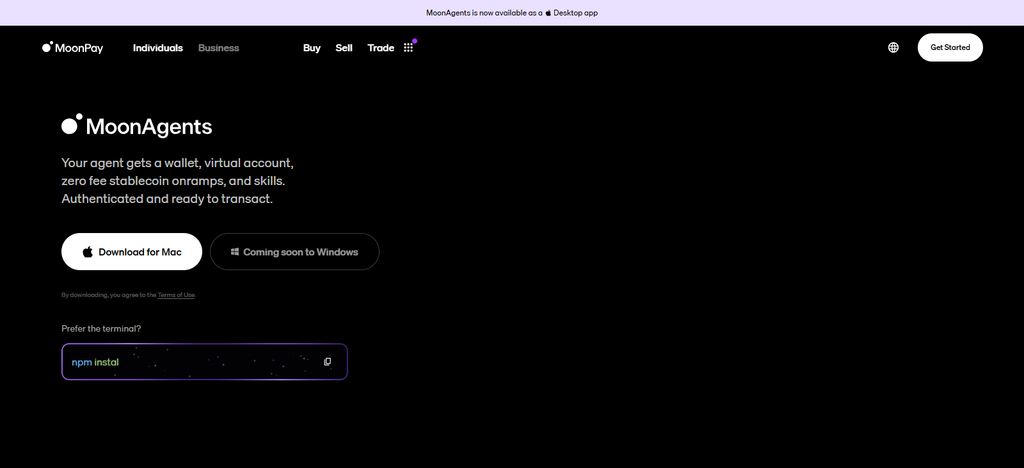
It’s packed with AI features like conversational commands, automated trading workflows and access to 54 crypto-specific tools across 17 skills. Agents can buy, sell, swap, and transfer tokens, support scheduled activities, and monitor portfolios. Private keys are encrypted using local operating-system keychain encryption.
Transaction costs depend on blockchain gas fees, the execution of trades, payment methods and any service charges that apply.What could be the reason for this?
MoonPay Agents Wallet Key features, Pros & Cons
Features
| Key features | Details |
|---|---|
| AI Agent Tools | Provides crypto-specific tools for AI agents. |
| Conversational Commands | Supports natural-language transaction instructions. |
| Automated Trading | Supports buying, selling and swapping activities. |
| Multi-Chain Operations | Connects agents with multiple blockchain networks. |
| Portfolio Monitoring | Supports wallet monitoring and automated workflows. |
Pros
| Pros |
|---|
| Supports integrations with popular AI platforms. |
| Offers multiple crypto automation tools. |
| Supports several blockchain ecosystems. |
| Enables automated swaps and transfers. |
| Provides locally protected wallet key storage. |
Cons
| Cons |
|---|
| Advanced workflows may require technical knowledge. |
| Transaction costs vary across supported networks. |
| AI execution depends on configured tools and permissions. |
| Third-party integrations can introduce additional risks. |
| Some automation features may require additional configuration. |
4. Cobo Agentic Wallet.
The Cobo Agentic Wallet is an AI-enabled crypto wallet for secure and autonomous blockchain activities. Founded in 2017, Cobo’s agentic wallet supports more than 80 blockchain networks, including Ethereum, Base, Arbitrum, Optimism, Polygon and Solana.
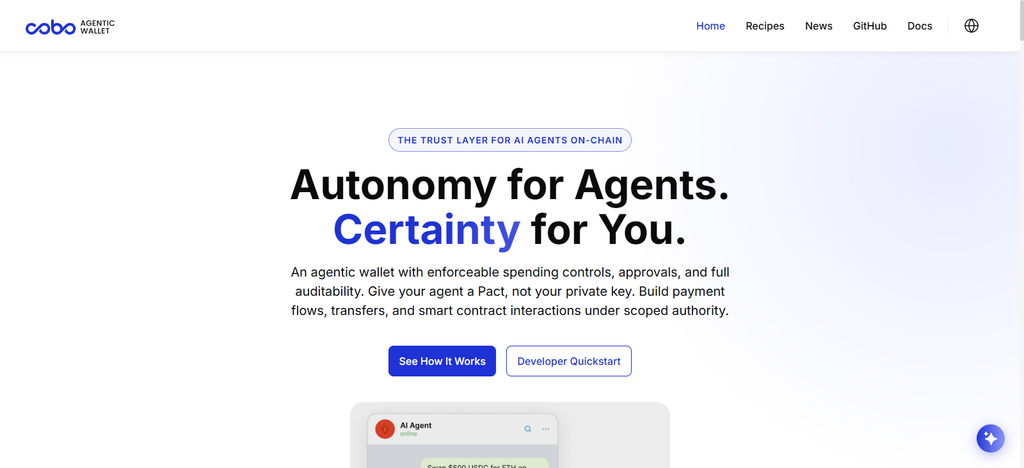
Its AI features include programmable agent permissions, modular skills and human-agent authorization through its Pact system. Automated transactions include token transfers, payments, decentralized trading, and smart contract interactions.
Its MPC-based security architecture prevents an AI agent from accessing private keys, on its own, without consent. Users can set spending budgets, approved contracts and execution conditions. The wallet is free in early access and we plan to charge for use later on.
Cobo Agentic Wallet Key features, Pros & Cons
Features
| Key features | Details |
|---|---|
| MPC Security | Uses multi-party computation for key protection. |
| Pact Authorization | Defines agent permissions and execution boundaries. |
| Multi-Chain Support | Supports more than 80 blockchain networks. |
| AI Agent Integration | Connects AI agents with blockchain operations. |
| Transaction Controls | Provides approval workflows and spending restrictions. |
Pros
| Pros |
|---|
| Offers MPC-based security architecture. |
| Supports extensive blockchain connectivity. |
| Provides customizable agent permissions. |
| Includes human approval mechanisms. |
| Suitable for enterprise crypto automation. |
Cons
| Cons |
|---|
| May be complex for individual beginners. |
| Enterprise-oriented features can require technical integration. |
| Advanced workflows may involve additional infrastructure costs. |
| Agent execution depends on predefined authorization policies. |
| Availability of specific features may vary by deployment. |
5. Crypto.com Wallet
Crypto.com Wallet (also known as Crypto.com Onchain) is a self-custody cryptocurrency wallet launched as a part of the Crypto.com ecosystem. Founded in 2016, the company has a wallet that supports multiple blockchain ecosystems including Ethereum, Cronos and other compatible networks.
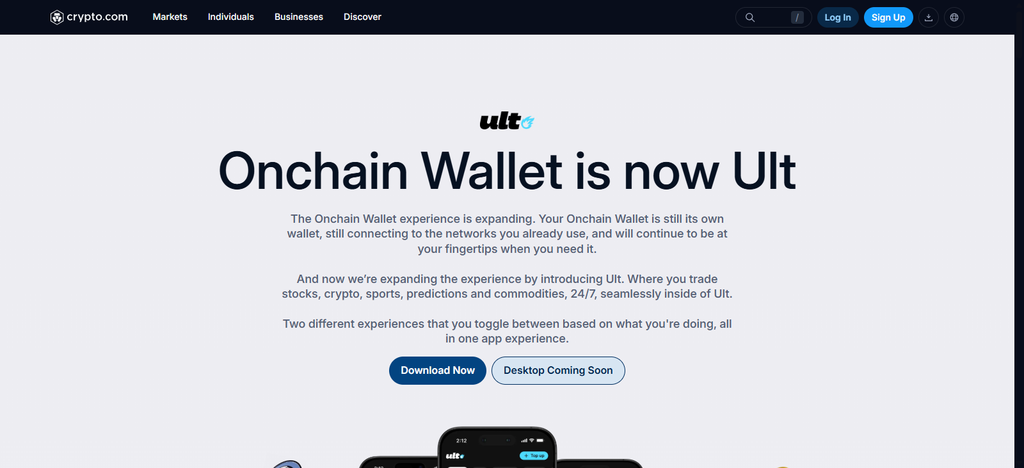
It has normal wallet functionality of transferring cryptocurrency, swapping tokens, staking and accessing decentralized apps. However, the Onchain Wallet does not natively support autonomous AI-agent execution, so it is important to differentiate between external automation integrations and native AI capabilities.
Users own their private keys and can access all supported DeFi services. The main transaction costs are blockchain network gas, swap fees and third-party protocol fees that apply.
Crypto.com Wallet Key features, Pros & Cons
Features
| Key features | Details |
|---|---|
| Self-Custody | Allows users to manage their private keys. |
| Token Swaps | Supports cryptocurrency exchange functionality. |
| DeFi Access | Connects users with decentralized applications. |
| Staking | Provides access to supported staking services. |
| Asset Management | Supports cryptocurrency transfers and portfolio management. |
Pros
| Pros |
|---|
| Provides self-custody wallet functionality. |
| Offers access to supported DeFi applications. |
| Supports token swaps and staking. |
| Provides a familiar wallet interface. |
| Useful for managing multiple digital assets. |
Cons
| Cons |
|---|
| Native autonomous AI-agent functionality is not established for the standard wallet. |
| Supported features vary by blockchain. |
| Swap services may involve additional charges. |
| DeFi interactions require understanding of smart contract risks. |
| External automation may require separate integrations. |
6. Safe (Safe Smart Account)
Safe Smart Account is a programmable smart contract wallet, originally built as Gnosis Safe in 2017. It supports Ethereum and numerous EVM-compatible blockchain networks and enables users to manage digital property with customizable account permissions.
Its AI features are mostly via external agent integrations, not a native autonomous AI assistant. Token transfers, multisignature payments, treasury operations, batch transactions and smart contract interactions via compatible applications can all be automated.
Security features such as multi-authorized signers, transaction policies and controlled execution permissions. Safe does not have a universal transaction fee, users only pay network gas and any applicable 3rd party automation or service fees.
Safe (Safe Smart Account) Key features, Pros & Cons
Features
| Key features | Details |
|---|---|
| Smart Accounts | Uses programmable smart contract wallets. |
| Multisignature Security | Requires multiple authorized approvals when configured. |
| AI Integrations | Supports external agent-based automation integrations. |
| Transaction Management | Supports batch transactions and controlled execution. |
| Treasury Management | Helps organizations manage digital assets. |
Pros
| Pros |
|---|
| Provides strong multisignature controls. |
| Supports programmable wallet permissions. |
| Suitable for organizational treasury management. |
| Enables controlled smart contract execution. |
| Can integrate with external automation tools. |
Cons
| Cons |
|---|
| Not a native AI assistant wallet. |
| Initial setup can be complicated. |
| Multisignature approvals may slow transactions. |
| Smart contract operations can involve additional gas costs. |
| External automation requires compatible integrations. |
7. Argent
Argent is a smart contract-based cryptocurrency wallet launched in 2017 that aims to simplify digital asset management and enhance account security. Its wallet ecosystem supports Ethereum-based environments (particularly Starknet and Layer 2 networks supported depending on the product version).
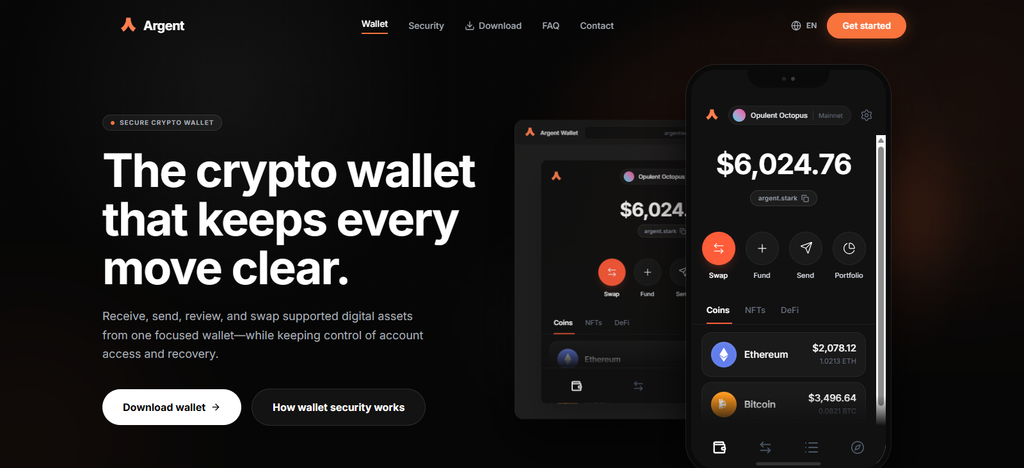
Argent provides smart-account features like social recovery, transaction controls, token transfers and decentralized application integrations. Its AI features aren’t defined as a native autonomous agent function, although compatible external apps can, in theory, automate certain wallet actions.
Users enjoy account recovery mechanisms and smart contract based security. Transaction costs include network gas, smart account execution fees, and applicable third-party service fees, depending on the blockchain chosen.
Argent Key features, Pros & Cons
Features
| Key features | Details |
|---|---|
| Smart Wallet | Uses smart contract-based wallet architecture. |
| Social Recovery | Supports account recovery through trusted guardians. |
| DeFi Integration | Provides access to supported decentralized applications. |
| Transaction Controls | Offers smart-account security features. |
| Layer 2 Support | Provides access to supported Ethereum Layer 2 ecosystems. |
Pros
| Pros |
|---|
| Offers social recovery functionality. |
| Simplifies supported smart-wallet operations. |
| Provides access to Ethereum ecosystem applications. |
| Supports smart contract-based security controls. |
| Useful for users exploring Layer 2 networks. |
Cons
| Cons |
|---|
| Native autonomous AI-agent execution is not established. |
| Blockchain support varies by Argent product. |
| Some operations depend on smart contract infrastructure. |
| External automation requires additional integrations. |
| Network fees still apply to on-chain transactions. |
8 Zerion Wallet
Founded in 2017, Zerion Wallet is a self-custody cryptocurrency wallet that combines multi-chain asset management with AI-agent infrastructure. It supports 66 mainnets including Ethereum, Solana, Base, BNB Chain, Arbitrum, Polygon and Avalanche. Its AI capabilities include Zerion CLI, which links compatible AI agents to wallet information, portfolio analysis and on-chain transactions.
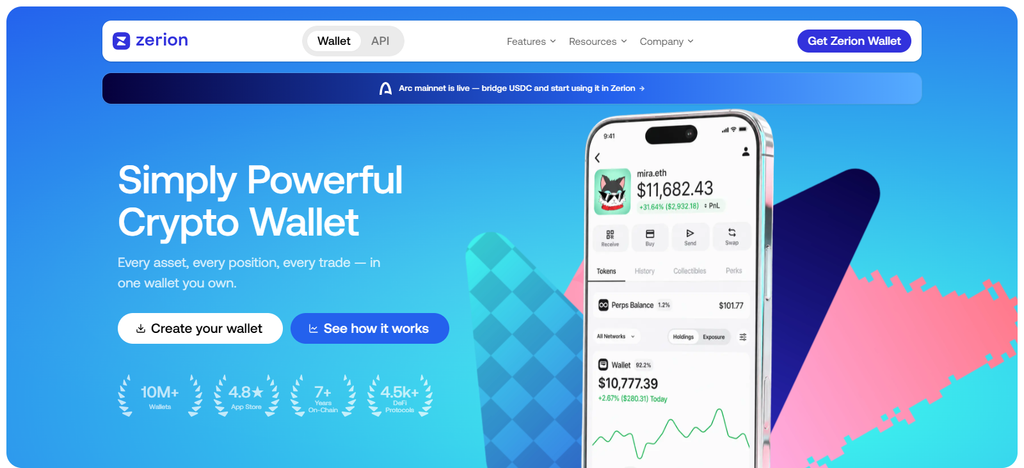
Automated activities can be token swaps, cross-chain bridging, portfolio rebalancing, wallet management through supported agent workflows. Users can also track their DeFi positions and transaction histories on different networks. Zerion has transaction costs based on blockchain gas, swap execution and bridge providers. Optional premium services may have additional fees.
Zerion Wallet Key features, Pros & Cons
Features
| Key features | Details |
|---|---|
| Multi-Chain Wallet | Supports multiple blockchain networks. |
| Portfolio Tracking | Displays digital assets and DeFi positions. |
| AI Integrations | Supports external agent workflows through compatible tools. |
| Token Swaps | Provides supported cryptocurrency swap functionality. |
| Cross-Chain Bridging | Allows asset transfers between compatible networks. |
Pros
| Pros |
|---|
| Provides detailed portfolio tracking. |
| Supports multiple blockchain ecosystems. |
| Offers convenient DeFi portfolio management. |
| Supports swaps and cross-chain bridging. |
| Developer tools can support AI-based workflows. |
Cons
| Cons |
|---|
| Not every wallet operation is AI-automated. |
| External agent integrations require configuration. |
| Cross-chain transactions may involve additional costs. |
| Supported features vary between networks. |
| DeFi portfolio data may require interpretation. |
9. Rabby-Wallet
Rabby Wallet is a non-custodial crypto wallet developed by the team of DeBank and launched in 2021. It supports more than 100 EVM compatible blockchain networks including Ethereum, Arbitrum, Optimism, Base, Polygon, Avalanche and BNB Chain.
Its main features are transaction simulation, automatic network detection, token approval management and security alerts. Rabby doesn’t have a verified native autonomous AI agent, but developers are able to use external integrations for supported blockchain operations.
Automated wallet activity normally includes swaps, DeFi interactions, and smart contract transactions via connected apps. Users pay for blockchain gas fees and any applicable swap or protocol fees, which vary based on the network and complexity of the transaction.
Rabby Wallet Key features, Pros & Cons
Features
| Key features | Details |
|---|---|
| EVM Compatibility | Supports more than 100 EVM-compatible networks. |
| Transaction Simulation | Previews potential transaction outcomes. |
| Risk Alerts | Identifies potentially dangerous wallet interactions. |
| Automatic Network Detection | Detects supported networks when connecting to applications. |
| DeFi Integration | Supports decentralized application interactions. |
Pros
| Pros |
|---|
| Provides useful transaction simulation. |
| Supports a wide range of EVM networks. |
| Helps identify risky transaction approvals. |
| Simplifies network switching. |
| Useful for active DeFi users. |
Cons
| Cons |
|---|
| No verified native autonomous AI-agent functionality. |
| Primarily focused on EVM-compatible ecosystems. |
| External automation requires separate tools. |
| Complex DeFi transactions can still involve risks. |
| Network gas fees remain applicable. |
10. Trust Wallet
Trust Wallet is a self-custody cryptocurrency wallet that was founded in 2017 and launched Trust Wallet Agent Kit in March 2026. Its agent infrastructure supports more than 25 blockchain networks including Ethereum, Solana, Bitcoin, Base, Polygon, BNB Chain, Cosmos, TON and Avalanche.
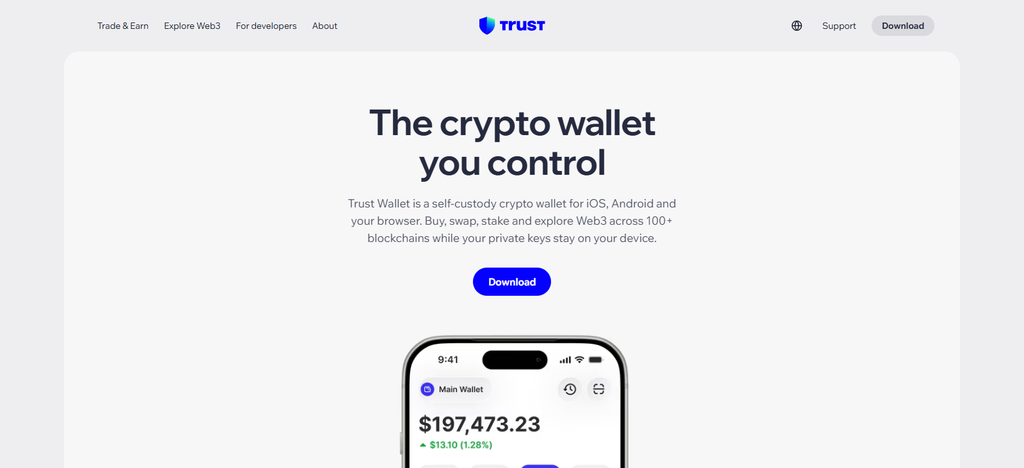
Its AI features let compatible agents access wallet features, market information, transaction tools and automated trading workflows. Supported activities include cross-chain swaps, token transfers, recurring buys, dollar-cost averaging and limit orders.
Users can either choose autonomous agent-wallet execution or WalletConnect approval workflows. Users still have control of their private keys. Transaction fees include network gas, swap execution fees and applicable third party service fees.
Trust Wallet Key features, Pros & Cons
Features
| Key features | Details |
|---|---|
| Trust Wallet Agent Kit | Provides AI-agent integration capabilities. |
| Multi-Chain Support | Connects agents with more than 25 blockchain networks. |
| Automated Transactions | Supports swaps, transfers and recurring purchases. |
| WalletConnect Integration | Enables user-controlled transaction approval workflows. |
| Self-Custody | Supports user-controlled wallet access and permissions. |
Pros
| Pros |
|---|
| Supports AI-agent transaction workflows. |
| Offers broad blockchain compatibility. |
| Enables recurring crypto purchase automation. |
| Provides self-custody options. |
| Supports cross-chain transaction workflows. |
Cons
| Cons |
|---|
| Advanced agent features may require developer configuration. |
| Automation capabilities depend on supported networks and tools. |
| Cross-chain operations can involve additional fees. |
| AI agents require carefully configured permissions. |
| Some transactions may still require manual approval. |
Conclusion
2026 – Transform how users manage digital currencies and automate on-chain transactions with AI-powered crypto wallets. Some of the platforms like Coinbase Agentic Wallet, MetaMask Agent Wallet, MoonPay Agents and Cobo Agentic Wallet provide advanced AI-agent functionality for transfers, trading, payments and DeFi activities.
Meanwhile Safe, Argent, Zerion, Rabby and Trust Wallet offer smart-account features, multi-chain access or compatible automation tools. When choosing a wallet, users should consider supported blockchains, AI features, transaction costs, security controls, and spending permissions. The best option is one that strikes a balance between automation, flexibility and user control without compromising asset security.
FAQ
What Are AI-Powered Crypto Wallets?
AI-powered crypto wallets use artificial intelligence or compatible AI agents to help users manage digital assets, monitor blockchain activities, execute approved transactions and automate supported DeFi operations.
Which Crypto Wallets Support AI Agent Transactions in 2026?
Coinbase Agentic Wallet, MetaMask Agent Wallet, MoonPay Agents and Cobo Agentic Wallet are examples of agent-focused solutions. Trust Wallet also provides AI agent functionality through its Agent Kit.
Can AI Crypto Wallets Automatically Execute Transactions?
Yes. Supported wallets can execute transactions such as token swaps, transfers, recurring purchases and DeFi operations. However, execution depends on agent permissions, wallet configuration and user approval requirements.
Are AI-Powered Crypto Wallets Safe to Use?
They can offer security features such as MPC protection, transaction simulation, spending limits and permission controls. However, users should review agent permissions, smart contract risks and transaction approvals before enabling automation.