


In this article I will discuss about the Best Blockchain Key Management Platforms that help businesses to secure, manage and control blockchain keys. We’ll review the leading platforms on security architecture, supported blockchain networks, deployment options, access control, pricing, integrations and key management features to help you find the right solution for your digital asset operations.
What Is Blockchain Key Management?
Blockchain key management is the management of cryptographic keys used to control access to assets and accounts on a blockchain, including their secure generation, storage, use , rotation, backup and recovery.
These platforms help organizations mitigate the risk of private-key theft, loss or unauthorized transactions with technologies such as MPC, TSS, HSMs, encryption, and multisignature controls.
They can also offer role-based permissions, transaction approval policies, audit trails, recovery mechanisms and automated workflows, making key management more secure and manageable for exchanges, financial institutions, Web3 companies and enterprise blockchain applications.
The Importance of Blockchain Key Management in 2026
Improves Transaction Security: Policy engines can have transaction limits, allow-lists, approval requirements, and other controls before assets are moved.
Multi-Chain Support: With businesses increasingly operating across multiple blockchain networks, centralized key and wallet management becomes more practical.
Enhances Access Governance: Role-based permissions allow organizations to control who can create wallets, conduct transactions, approve transfers and manage security settings.
Allows for Faster Recovery: Backup and recovery mechanisms can help organizations recover wallet operations after device failures, lost credentials, or other operational incidents.
**Helps Manage Insider Risk: ** Multi-person approvals and distributed signing can help reduce the risk of one employee having full control over transactions.
Auditability Improvements: Detailed activity and transaction logs provide operational accountability and enable organizations to monitor key usage and investigate unusual activity.
Facilitates Enterprise Integration: APIs and SDKs enable the integration of key management infrastructure with exchanges, treasury systems, payment applications, DeFi platforms and internal business systems.
Key Points
| Platform | Best For |
|---|---|
| Fireblocks | Enterprise treasury & custody |
| HashiCorp Vault | Enterprise cryptographic key lifecycle management |
| Dfns | Wallet-as-a-Service & embedded wallets |
| BitGo | Institutional custody |
| Cobo | Exchanges & Web3 businesses |
| Fordefi | DeFi institutions |
| Copper | Trading firms & funds |
| Utila | Payments & stablecoins |
| Safeheron | Enterprise self-custody |
| Cregis | Wallet infrastructure providers |
1. Fireblocks
Fireblocks employs MPC-based key management where distributed key shares are combined with secure hardware environments to mitigate single points of compromise. Its Supported Ecosystem includes 150+ blockchains and thousands of digital resources, supporting institutional multi-chain operations.
Deployment supports flexible wallet configurations and cloud environments for hot, warm and cold storage. It has a Security Focus that includes MPC, transaction governance, policy controls and security monitoring. Pricing The Essentials plan starts at $999/month, and custom enterprise plans start at $36,000/year. This is a great fit for banks, exchanges, fintechs, and large Web3 companies.
Best For Flameblocks
- Custody for institutional digital files
- Financial institutions and banks.
- Platforms & exchanges for crypto trading
- Multi-chain treasury management*
- Businesses requiring complex transaction policies
| Key Strength |
|---|
| MPC-based institutional security |
| Extensive multi-chain infrastructure |
| Advanced transaction policy controls |
| Strong treasury and custody workflows |
| Wide range of ecosystem integrations |
2. HashiCorp Vault
When compared to crypto-native custody platforms, HashiCorp Vault’s Key Management Approach is broader, including centralized secrets, encryption keys, certificates, and machine credentials.
It has a ** Supported Ecosystem ** , not primarily focused on blockchain but with hybrid, multi-cloud, kubernetes, enterprise applications and external KMS providers. Deployment options include self-managed, cloud-based via HCP Vault and on-premises for Enterprise.
It has Security Focus with HSM integration, FIPS 140-2 compliance, RBAC, audit logs, key rotation, and disaster recovery. Pricing is based on cloud usage or custom Enterprise licensing and is especially relevant for organizations that already run complex infrastructures.
Best For HashiCorp Vault
- Enterprise key management for cryptography
- Hybrid and cloud infrastructure
Application secrets management - organizations devOps workflows
- Centralized access management for businesses
| Key Strength |
|---|
| Centralized secrets and key management |
| Strong identity and access controls |
| HSM and cloud KMS integration |
| Detailed audit and monitoring capabilities |
| Flexible cloud and self-managed deployment |
3. Dfns
We provide MPC-based Key Management for programmable digital-asset wallets with support for MPC, HSM and offline key-management models. Supported Ecosystem 100+ blockchain networks such as Ethereum, Bitcoin, Solana, Polygon, Base, Tron, Stellar, and other major EVM networks. Deployment is flexible with SaaS, hybrid or full on-premises configurations.
Its ** Security Focus ** is distributed key shares , governance policies , quorum-based signing , and customizable infrastructure . Pricing: Starter $800 per year, Basic $8,000, Pro $35,000, Enterprise custom. “It benefits banks, fintechs, developers and institutions.
Best For Dfns
- Banking & Fintech apps
- Programmable wallets for digital resources
- building Web3 products
- Wallet infrastructure across multiple chains
- Companies looking for API-first key management
| Key Strength |
|---|
| API-first digital asset wallet infrastructure |
| MPC-powered key protection |
| Programmable wallet management |
| Flexible deployment architecture |
| Developer-friendly integrations and SDKs |
4. BitGo
BitGo combines MPC/TSS and multisignature Key Management to give institutions a variety of ways to secure digital information. The MPC architecture uses a 2-of-3 model where the important shares are spread among the user, the backup, and BitGo, while multisig wallets use different complete keys.
Its Supported Ecosystem offers a vast number of digital resources, with BitGo claiming to support over 1,700 assets.
Deployment includes custodian and self-custody wallet infrastructure. It has a Security Focus that includes transaction policies, whitelisting, user roles, and recovery controls. The pricing is usually customized for institutional requirements.
Best For BitGo
- Crypto exchanges and financial services
- Custody of digital resources from institutions
- Multi-sig and MPC wallets
Treasury and asset management. - Enterprises needing enterprise-grade security
| Key Strength |
|---|
| MPC and multisignature wallet options |
| Institutional custody infrastructure |
| Granular wallet and transaction policies |
| Broad digital asset support |
| Strong governance and recovery controls |
5. Cobo
Cobo combines MPC wallet infrastructure, smart-contract wallets and custody solutions for institutional clients and Web3 developers. The Key Management Approach uses MPC-based protection and institutional wallet controls to manage digital resources and apply governance policies for businesses.
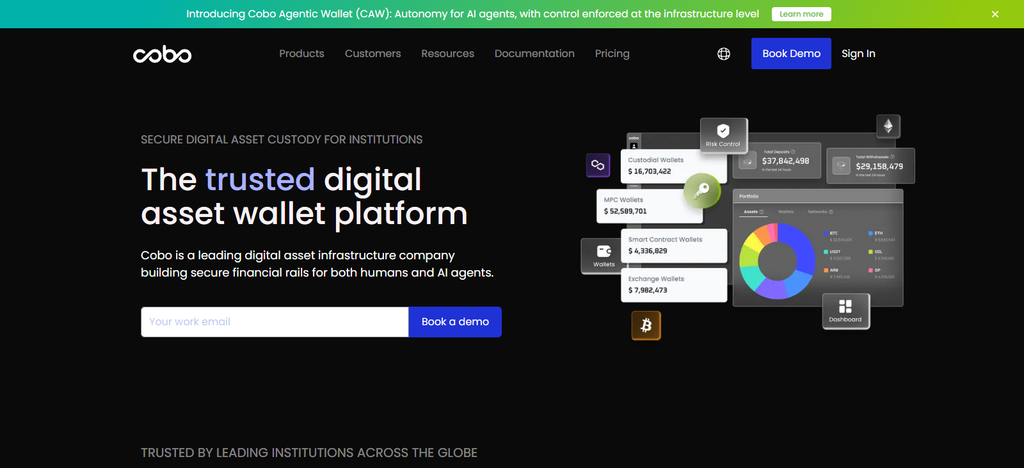
Supported Ecosystem is multi-chain, built for institutional and developer workflows. Deployment includes wallet infrastructure, APIs, SDKs and operational dashboards to build programmable asset-management systems.
It focuses Security on MPC, transaction policies, governance and controlled wallet operations. Pricing Pricing is plan-based and usage-based. Wallet, transfer-volume, API and user limits depend on plan.
Best For Cobo
- Infrastructure for institutional wallets
- Digital asset custody business
Web3 developers and apps - Asset management across chains
- Businesses needing wallet APIs and governance controls
| Key Strength |
|---|
| Institutional-grade MPC wallet infrastructure |
| Multi-chain digital asset management |
| Programmable wallet APIs |
| Customizable transaction governance |
| Strong Web3 infrastructure capabilities |
6. Fordefi
Fordefi provides MPC-based wallet security for institutional customers who want to interact directly with DeFi applications and different blockchain ecosystems. It has a Supported Ecosystem of around 70 native blockchains, covering EVM networks, Solana and SVM chains, Cosmos, Bitcoin-based networks, Sui, Aptos, TON, Starknet, and Stacks. It also lets organizations add compatible EVM chains via custom RPC endpoints.
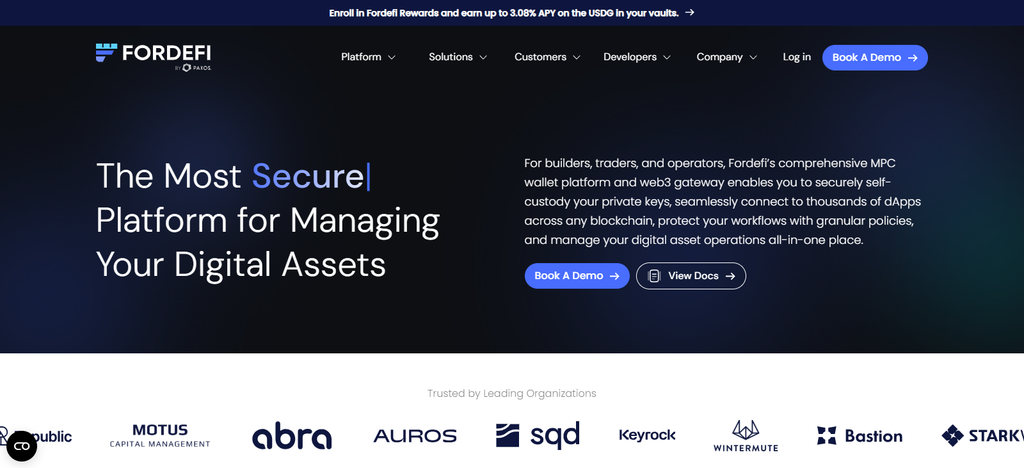
The deployment is about institutional wallet infrastructure and programmable transaction flows. Its Security Focus marries MPC signing with transaction controls and policy-based operations. Pricing is often tailored to institutional needs, making Fordefi a great fit for funds, Web3 companies and active on-chain teams.
Best For Fordefi
- Crypto trading teams & funds
- Web3 companies handling on-chain assets
Multi-chain transaction handling - Businesses seeking secure programmable wallets
| Key Strength |
|---|
| MPC-based institutional wallet security |
| Strong DeFi connectivity |
| Broad multi-chain transaction support |
| Granular transaction approval controls |
| Secure on-chain asset management |
7. Copper
Copper uses custody and key management infrastructure based on MPC to secure institutional electronic assets and combine custody with trading and settlement workflows. Its Supported Ecosystem is targeted at the institutional digital-asset markets, custody, exchanges, prime services and collateral management.
Deployment is about institutional custody infrastructure and API connectivity. This includes its ClearLoop network which connects custodians, venues and market participants. “Its Security Focus includes MPC custody, zero-trust principles, governance controls, security certifications, and insurance coverage.”
Pricing is primarily geared to institutional requirements rather than offered as a simple public subscription. Copper is suitable for institutions requiring custody, trading connectivity, collateral mobility and post trade infrastructure.
Best For Copper.
- Asset managers and crypto fund managers
- Institutional Digital Asset Custody
- Trading and settlement activities
- Management of Collateral
- Businesses combining custody with trading venues
| Key Strength |
|---|
| Institutional digital asset custody |
| MPC-based security architecture |
| Trading and settlement connectivity |
| ClearLoop settlement infrastructure |
| Strong institutional market focus |
8. Utila
Utila offers MPC-based Key Management focused on institutional wallet infrastructure, treasury operations, stablecoin payments, and digital-asset workflows. It has a Supported Ecosystem of 60+ blockchains, with wider ecosystem connectivity across exchanges, DeFi, yield, staking, and stablecoin liquidity venues.
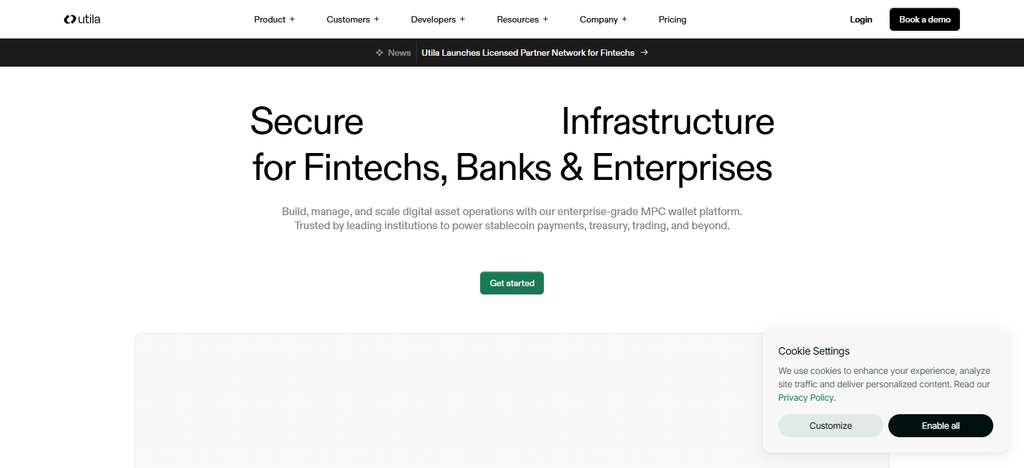
Deployment is flexible because its API co-signer can be run on a virtual machine or cloud environment. Its Security Focus includes MPC protection, approval workflows, role-based permissions, address whitelisting and policy controls.
Pricing Starts from $799/month for the Starter plan, which includes up to 1,000 wallets and $3 million in quarterly outbound volume; enterprise plans are custom.
Best For Utila
- Stablecoin payment operations
- Treasury management, institutional
*Digital Asset Businesses - Multi-chain wallet operation
#API-based wallet infrastructure for enterprises
| Key Strength |
|---|
| MPC-based institutional wallet infrastructure |
| Stablecoin payment and treasury workflows |
| API-driven wallet architecture |
| Flexible transaction approval policies |
| Integrations across exchanges and DeFi |
9. Safeheron
Instead of storing a complete private key in one place Safeheron distributes signing authority to multiple parties by using MPC-TSS Key Management. Its Supported Ecosystem spans major EVM, Bitcoin, TRON, Filecoin, Solana, Sui, Aptos, Ripple, Stellar and other networks with different cryptographic schemes.
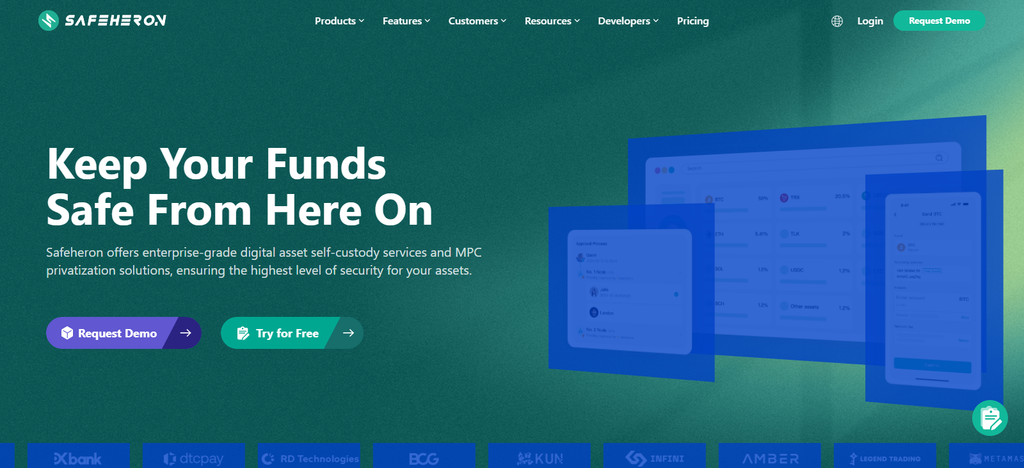
The deployment focuses on MPC self-custody infrastructure, APIs, SDKs and enterprise configurations. Its Security Focus is configurable with signing thresholds, policy controls, API co-signing,gas services, and distributed key protection. Starter pricing starts at $5,750 per year, with Enterprise and privatized MPC-TSS deployments available via custom pricing.
Best For Safeheron
- Custody by institutions
- Wallet infrastructure MPC-TSS
*Crypto exchanges and fintech companies - Multi-chain digital asset management system
- Customizable signing policies for businesses
| Key Strength |
|---|
| MPC-TSS self-custody technology |
| Distributed signing architecture |
| Customizable security and approval policies |
| Multi-chain wallet infrastructure |
| Enterprise APIs and governance features |
10. Cregis
Cregis offers MPC, TSS, HSM, and TEE based Key Management through its Trust Vault security architecture. Its Supported Ecosystem includes 40+ blockchain networks and 85+ tokens including Bitcoin, Ethereum, Solana, Tron, BNB Smart Chain, Polygon, Arbitrum, Avalanche, Aptos, Sui, TON and many more.
Deployment API-based WaaS infrastructure for fast integration and enterprise options. Security Focus comprises distributed key shards, HSM protection, TEE technology, risk policies, AML tools and governance controls. Pricing ranges from a free plan to paid Advanced and Business plans, and Enterprise pricing is customized.
Best For Cregis
- Businesses that accept payments in digital forms
- Wallet management by institution
- Asset operations across multiple chains
- Web3 & Blockchain Applications
- Companies looking for MPC, HSM and TEE based security
| Key Strength |
|---|
| Multi-layer cryptographic security |
| MPC, TSS, HSM, and TEE technologies |
| Multi-chain wallet infrastructure |
| Transaction risk and policy controls |
| Enterprise-focused digital asset management |
Conclusion
Selecting the best blockchain key management platform depends on your organization’s security needs, supported networks, deployment choices, budget, and operational requirements. Fireblocks, Dfns, BitGo, Cobo, Fordefi, Copper, Utila, Safeheron, and Cregis provide different approaches to MPC, TSS, HSMs, governance, and institutional wallet management HashiCorp Vault provides broader enterprise key and secrets management.
Before selecting a platform, businesses should consider key protection, recovery, control of access, transaction policies, integrations, scalability, compliance and pricing to find the solution that best suits their 2026 blockchain operations.
FAQ
What is a blockchain key management platform?
A blockchain key management platform helps businesses securely generate, store, control, use, recover, and manage the cryptographic keys required to access and move digital assets. These platforms may use technologies such as MPC, TSS, HSMs, encryption, and multisignature controls.
Why is blockchain key management important?
Blockchain transactions are generally irreversible, so losing or exposing a private key can create significant security and financial risks. Key management platforms add controls such as distributed signing, user permissions, transaction policies, approvals, backups, and recovery processes.
What is MPC key management?
MPC, or Multi-Party Computation, allows multiple parties or systems to participate in signing a transaction without requiring a complete private key to exist in one location. This can reduce single points of failure and limit the impact of individual compromises.
Which blockchain key management platform is best?
There is no single platform that is best for every organization. Fireblocks, Dfns, BitGo, Cobo, Fordefi, Copper, Utila, Safeheron, and Cregis target different institutional and business requirements, while HashiCorp Vault is designed more broadly for enterprise secrets and cryptographic key management.